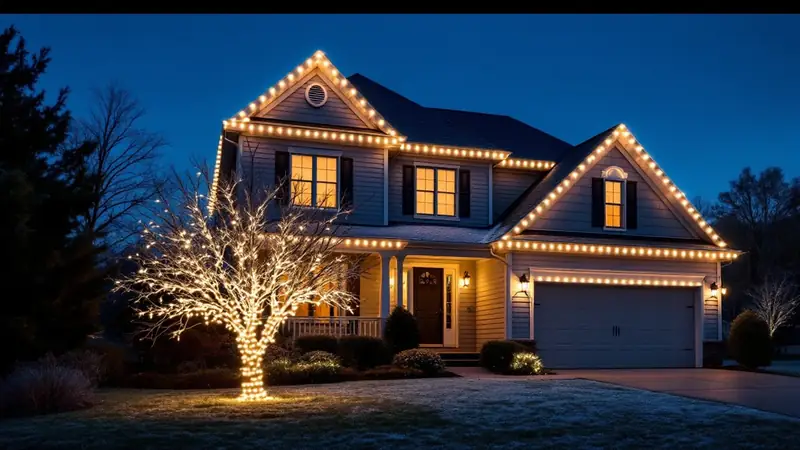
Short answer: Professional Christmas light installation costs about $5 to $10 per foot of roofline when the installer supplies, installs, services and removes the lights, based on 2026 price lists installers publish. A 150-foot roofline runs $750 to $1,500. Hanging lights you already own costs $1.50 to $2.50 a foot, and most companies set a $500 to $1,000 minimum.
$5–$10 per foot, first season, installer’s lights with takedown and storage (estimate from published 2026 price lists; see method)
$1.50–$2.50 per foot to hang lights you already own (Blue Agave Cleaning, year-2 labor rate)
14,900 ER visits for holiday decorating injuries in one season, nearly half from falls (CPSC, Nov. 2022–Jan. 2023)
0.8 W vs. 7 W per bulb, commercial C9 LED vs. incandescent C9 (manufacturer listings)
Most Christmas light cost pages give a national average with nothing behind it, and they disagree with each other by a factor of three. This page starts from documents you can open: the per-foot rates, minimums and add-on prices that installers publish on their own websites, retail price lists for commercial-grade bulbs and wire, manufacturers’ wattage ratings, EIA electricity prices (July 2026), and federal safety rules from OSHA and the CPSC. Where we turn those inputs into a range, the arithmetic is in the method box near the end.
Three numbers decide your bill: how many feet of roofline you light, which pricing model the installer uses (rent their lights, buy lights, or hang yours), and how many trees and shrubs you add. The calculator below multiplies them out. For other seasonal and outdoor project prices, see our cost guides and the landscaping cost breakdown.
Christmas light installation cost per foot: what installers publish
Roofline lighting is priced by the linear foot of edge you want lit: gutters, eaves, gable rakes and ridges. Trees and shrubs are priced by the strand or by the plant, and wreaths and garland by the piece. We found 17 installers that put real numbers on their websites in 2026. The ten below publish a per-foot rate for a full-service first season, meaning the company supplies commercial-grade lights, installs them, fixes outages during the season, takes them down and stores them.
| Installer | Market | Published rate per foot | Minimum |
|---|---|---|---|
| Shimmer & Shine Lights | Des Moines and Cedar Rapids areas, IA | $5.00 (booked by Nov. 14; rises Nov. 15 and Dec. 1) | $500 |
| Green Pro Services | Kankakee and Will counties, IL | $5–$7 string lights; $7–$9 C7/C9; $9–$10 icicle | $699 |
| Holiday Light Professionals (My Light Pros) | Denver, CO | $5.00–$9.00 | Not stated |
| Blue Agave Cleaning | Utah County, UT | $5.50–$6.50 year 1 (you keep the lights) | Not stated |
| Red Hat Lighting | Clark County, WA | $6.00 first season; $4.50 returning | Not stated |
| Christmas Lights & Decor | Knoxville and Sevier County, TN | $7.00, $8.50 or $10.00 by package | $650 |
| Castle Christmas Lights | Daytona Beach to Winter Park, FL | About $7 roofline; about $10 ridgelines | $1,000 |
| Xpress Lawn Solutions | Metro East (St. Louis area), IL | From $7.50; same price next season | Not stated |
| Bright Brothers of East Tampa | Tampa, FL | Around $7.50 | Not stated |
| Holiday Lights PHX | Chandler, Gilbert, Mesa, Tempe, AZ | $7–$11 first season | Homes from about $850 |
The lowest published rate is $5 a foot and the highest is $11, and nine of the ten fall inside $5 to $10. The middle of the market is narrower: the median low end is $6.50 and the median high end is about $8.25. Where a company publishes tiers, the spread inside one company is almost as wide as the spread between companies. Christmas Lights & Decor charges $7, $8.50 or $10 a foot for the same roofline depending on the package, with the higher tiers adding unlimited service calls, a design mockup and priority next-day service, and Green Pro charges $5 to $7 for string lights but $9 to $10 for icicles.
Minimums matter more than the per-foot rate on small houses. With a $650 to $1,000 minimum, a 70-foot ranch-house front pays the minimum, not 70 times the rate. Companies that publish whole-house prices instead of per-foot rates land in the same place: Sparkled Lighting in Utah starts seasonal service at $500 with most homes at $800 to $1,200, Holy City Hydro Shine near Charleston has an $800 minimum and an average above $1,200, and Christmas Lights Experts DFW sets a $750 project minimum.
Uses the per-foot and add-on ranges in this guide, compiled from installers' published 2026 prices. Most companies set a $500 to $1,000 minimum, which this estimate does not apply. Local prices vary; see How we built these numbers.
The calculator multiplies your roofline footage by the per-foot range for the model you pick, applies a factor if most of the run is on ridgelines (Castle Christmas Lights prices ridges at about $10 a foot against $7 for the gutter line, a 40 percent premium), and adds the trees, shrubs and services you tick. It does not apply minimums, so if your result is under about $650, expect the quote to come back at the company’s floor.
How much to install 100, 150, 200 or 300 feet of Christmas lights
Most single-story fronts need 100 to 150 feet; a two-story house lit on the front and sides often needs 200 to 300. Measure the edges you want lit, not the house’s square footage. The table runs the published per-foot ranges against common footages for each way of buying.
| Roofline lit | Rental package, first season ($5–$10/ft) | Buy through installer, year 1 ($5.50–$6.50/ft) | Install-only on your lights ($1.50–$2.50/ft) | DIY materials, commercial C9 LED ($1.44–$1.87/ft + $35 timer) |
|---|---|---|---|---|
| 100 ft | $500–$1,000 | $550–$650 | $150–$250 | $179–$222 |
| 150 ft | $750–$1,500 | $825–$975 | $225–$375 | $251–$316 |
| 200 ft | $1,000–$2,000 | $1,100–$1,300 | $300–$500 | $323–$409 |
| 300 ft | $1,500–$3,000 | $1,650–$1,950 | $450–$750 | $467–$596 |
So 200 feet of roofline costs about $1,000 to $2,000 for a full-service season on rented lights, about $300 to $500 a year to have someone hang lights you already own, and $323 to $409 in commercial-grade materials if you do it yourself and already have a ladder that reaches.
Rent, buy, or bring your own: three ways installers price the same roofline
The single biggest reason two quotes for the same house differ is that they are quoting different things. Installers run one of three models, and the per-foot rate only means something once you know which one you are looking at. Kirk Brown, who runs an outdoor-living company and a holiday-lighting company, laid out the first two in Turf Magazine: sell the lights in year one with a markup and charge labor only after that, or keep ownership and charge one all-inclusive fee every year.
| Rental (lease) package | Buy through the installer | Install-only, your lights | |
|---|---|---|---|
| Who owns the lights | Installer | You, after year 1 | You |
| Year-1 price per foot | $5–$10 | $5.50–$6.50 (one published list) | $1.50–$2.50 (labor) |
| Later years | Same or lower: Red Hat drops from $6.00 to $4.50; Xpress bills the same price | $1.50–$2.50 labor | $1.50–$2.50 labor |
| Takedown | Included | Included on Blue Agave’s plan | Often extra; $250–$600 as a standalone job in Dallas |
| Storage | Included, labeled by address | Installer stores at Blue Agave | You, or about $150–$300 a year |
| Dead bulbs mid-season | Installer replaces | Varies by contract | Your problem on most contracts |
| Best for | One to three seasons, or anyone without storage | Same house, same design for four or more years | Owners of good commercial lights |
Rental is the default for most full-service companies. Xpress Lawn Solutions states that it keeps ownership of the equipment and that the rate covers design, install, in-season service, removal, storage and bulb or clip replacement, with the next season billed at the same price. Red Hat Lighting drops returning homes from $6.00 to $4.50 a foot because the strands are already cut and labeled for the address.
Buying costs a little more in year one and much less afterward. Blue Agave Cleaning publishes $5.50 to $6.50 a foot for product and labor in year one, then $1.50 to $2.50 a foot for labor only, and gives the example of a 150-foot roofline at about $900, then about $300 a year. The owner of The Light Pros gave a similar split: about $800 to buy for the first year, then $300 to $400 for installation, against about $600 every year on a lease.
Bringing your own lights is the cheapest per foot and the hardest to book. Some full-service companies decline customer-owned strands; Holiday Lights PHX says it installs only lights it supplies and explains why on its site. If your lights are retail-grade, a mid-season outage can mean a second ladder trip, which an install-only contract may bill as a service call.
- Lease at a flat $7/ft
- Lease, $6.00 then $4.50/ft (returning discount)
- Buy through installer, $6.00 then $2.00/ft
- Permanent track lights, $27.50/ft once
- DIY commercial C9 LED materials
Source: Red Hat Lighting, Blue Agave Cleaning, Bluehopper/Trimlight/PermaGlow/Sparkled published rates and Christmas Lights Etc prices; our arithmetic Permanent ignores repairs and controller; DIY ignores replacement bulbs, ladder and your time. See method.
Show the numbers
| Lease at a flat $7/ft | Lease, $6.00 then $4.50/ft (returning discount) | Buy through installer, $6.00 then $2.00/ft | Permanent track lights, $27.50/ft once | DIY commercial C9 LED materials | |
|---|---|---|---|---|---|
| Yr 1 | 1,050 | 900 | 900 | 4,125 | 283 |
| Yr 2 | 2,100 | 1,575 | 1,200 | 4,125 | 283 |
| Yr 3 | 3,150 | 2,250 | 1,500 | 4,125 | 283 |
| Yr 4 | 4,200 | 2,925 | 1,800 | 4,125 | 283 |
| Yr 5 | 5,250 | 3,600 | 2,100 | 4,125 | 283 |
| Yr 6 | 6,300 | 4,275 | 2,400 | 4,125 | 283 |
| Yr 7 | 7,350 | 4,950 | 2,700 | 4,125 | 283 |
| Yr 8 | 8,400 | 5,625 | 3,000 | 4,125 | 283 |
Over eight seasons on a 150-foot roofline, a flat $7-a-foot lease costs $8,400, the Red Hat-style lease with a returning discount costs $5,625, and buying through the installer costs $3,000. A permanent track system at the midpoint of published rates ($27.50 a foot, so $4,125 up front) overtakes the flat lease in year 4 but does not catch up with the buy-through-the-installer plan until about year 12. That makes the purchase model the cheapest professional option for anyone who keeps the same design on the same house, and permanent lighting a better deal mainly for people who would otherwise lease every year or who want the lights for other holidays too.
Permanent Christmas lights: the one-time alternative
Permanent systems mount LED pixels in a color-matched track or clips under the eave and run from an app all year. Published installed prices run $18 to $35 per linear foot: Trimlight, a manufacturer, puts most installs at $18 to $35, Bluehopper quotes $20 to $35 with most homes at $3,000 to $7,000, Sparkled Lighting lists $25 to $30 or more for channel systems and $17 to $21 for clip-on systems, and PermaGlow starts runs at $28 to $32 a foot plus a controller from $350. That is three to five times the first-season cost of rented C9 bulbs, and the system is a fixed part of the house, which matters for HOA approval (see below).
Trees, bushes, wreaths and garland: what the extras cost
Roofline is usually the cheapest part of a display per foot of light. Trees are slow work: a crew wraps the trunk and each major limb by hand, often from a ladder, so prices climb with height and branch density. Installers price them per tree by size or per strand of mini lights.
| Add-on | Published prices |
|---|---|
| Small ornamental tree, under 10 ft | $95 (minis, Christmas Lights & Decor); $150 (Green Pro); average $280 for 4–10 strands (DFW Experts) |
| Medium shade tree | $250–$350 (Green Pro); average $600 for 10–20 strands (DFW Experts) |
| Large tree, 20 ft and up | $450 (Green Pro); average $1,000 for 20–30 strands, $1,600 for 30+ (DFW Experts) |
| Palm trunk | $125–$350 per palm by trunk height (Holiday Lights PHX); priced inside the display at Castle, about 2 mini strands for a small trunk |
| Mini lights, per strand installed | $35–$50 (Christmas Lights DC) |
| Shrub or bush | $35 (Christmas Lights & Decor); $50–$150 (Green Pro) |
| Porch column wrap | $45 per column (Christmas Lights & Decor) |
| Lit wreath, about 24–30 in | $85 (Christmas Lights & Decor); $150–$400 (Green Pro); $35–$85 labor to hang your own (DFW Experts) |
| Lit garland | $16 per ft (Christmas Lights & Decor); $25 per ft (DFW Experts) |
| Pathway stake lights | $9 per stake (Christmas Lights & Decor) |
The wide spread on trees is real, not noise. One company’s $95 “small tree” is a light trunk-and-canopy pass on an ornamental; another’s $1,000 “large tree” is 20 to 30 strands wrapped branch by branch. Ask how many strands a quote includes and whether the wrap goes to the branch tips. At $35 to $50 a strand, strand count is the clearest way to compare two tree prices. At the very top end, the owner of The Light Pros described a 90-foot tree wrapped in three colors for about $35,000.
Whole-house displays with trees, wreaths and garland are where totals climb into the thousands. Twinkle Nights in north Florida lists all-inclusive displays from $1,495, a medium example at $2,995 and up, and a high-end example at $5,995 and up. Christmas Brothers in the Los Angeles area starts at $3,300 for a small roofline design, with trees from $350 each.
Takedown and storage: included, or a second bill?
On a rental package, takedown and storage are part of the price: every rental-model company in our table says so. The second bill shows up in two cases: when you hired a handyman for install only, or when you own the lights and want them back. Christmas Lights Experts DFW publishes standalone takedown at $250 to $600 (roofline-only on a 2,000 to 3,000 square foot home at $250 to $400) and storage of customer-owned lights at about $150 to $300 a year.
Takedown usually starts in early January and depends on weather. Xpress Lawn Solutions schedules removals from January “weather-permitting” and says work may be delayed by ice or extreme frost, which in a snowy winter can push your lights past an HOA deadline. If your association sets a removal date, put it in the contract.
What the lights cost if you hang them yourself
Commercial-grade C9 lights are sold as empty socket wire plus separate bulbs, so you can cut runs to the exact length of each roof edge. Using retail prices from one large online seller, materials for a C9 LED roofline at 12-inch spacing come to about $1.44 to $1.87 a foot.
| Item | Listed price (Oct. 2026) | Per foot of roofline | Source |
|---|---|---|---|
| C9 socket wire, SPT-1, 12-in spacing | $234.99 or $409.99 per 1,000-ft spool | $0.23–$0.41 | Christmas Light Contractors USA; Christmas Lights Etc |
| C9 LED bulbs, commercial SMD, 0.8 W | $26.65–$32.99 per 25 | $1.07–$1.32 | Christmas Lights Etc |
| All-in-one gutter and shingle clips | $13.99 per 100 | $0.14 | Christmas Lights Etc |
| Total, C9 LED roofline | $1.44–$1.87 | Our arithmetic | |
| Compare: C9 incandescent, 7 W bulbs on a 100-ft stringer | $54.99 stringer + $9.00 per 25 bulbs | about $1.05 with clips | Christmas Lights Etc |
| Outdoor timer, 15 A | $34.99 each | per outlet | Christmas Lights Etc |
The LED premium is smaller than it looks: about 40 to 80 cents a foot over incandescent C9s, and the LED bulbs draw 0.8 watts against 7 watts and are rated for far longer life (the incandescent listing gives 3,000 hours). Mini-light strands for trees cost $14.84 to $19.99 per 70-light, 24-foot strand at the same retailer.
Against a full-service price of $5 to $10 a foot, the materials are a small share of what you pay an installer. The rest is ladder time, custom cutting, service calls, takedown, storage, insurance and margin; Brown’s Turf Magazine piece tells new installers to aim for 60 to 70 percent gross margin. DIY saves most of that, and costs you the climbing.
When DIY makes sense, and when it doesn’t
- Reasonable to DIY: a single-story gutter line you can reach from a 6- to 8-foot stepladder or a short extension ladder on level ground, with an outdoor GFCI outlet nearby.
- Hire it out: second-story eaves, ridgelines, steep or tile roofs, and anything that needs you on the roof. CPSC counts about 14,900 ER visits for holiday decorating injuries in one season, nearly half from falls.
- Middle option: buy commercial-grade lights yourself and pay a company’s install-only rate, if you can find one that will hang customer-owned lights.
Power, circuits, GFCI and the electric bill
Tripped breakers are a wattage problem, and the switch from incandescent to LED changed the math. The formula on the seller’s own spool listing is the one to use: bulbs times watts per bulb equals total watts, and total watts divided by 120 volts equals amps.
| Light | Rated draw | Per-run limit | Fits on one 15-amp circuit at 1,440 W |
|---|---|---|---|
| C9 LED, commercial SMD | 0.8 W per bulb | 1 bulb per ft | about 1,800 bulbs (1,800 ft) |
| C9 incandescent | 7 W per bulb | 1 bulb per ft | about 205 bulbs (205 ft) |
| 5 mm LED mini, 70 lights, 24 ft | 4.8 W per strand (216 W across 45 strands) | Max 45 strands end to end | about 300 strands, in several runs |
On incandescent C9s, a 200-foot roofline (1,400 watts) uses nearly a whole 15-amp circuit by itself, before anything else on that circuit, such as a garage freezer, turns on. The same roofline in LED draws 160 watts, which leaves the circuit nearly free for everything else.
Running costs follow the same ratio. At 6 hours a night for 40 nights, 200 feet of C9 LEDs uses about 38 kWh, or about $7 at the July 2026 U.S. average residential price of 18.31 cents per kWh from EIA’s Electric Power Monthly. The incandescent version uses 336 kWh, about $62. In Hawaii (48.00 cents) that becomes $18 against $161; in Louisiana (12.72 cents), $5 against $43. These use the listed wattage; measured draw can differ.
GFCI outlets, covers and listed lights
- Plug into a GFCI-protected outlet. The CPSC’s GFCI fact sheet notes that the National Electrical Code has required ground-fault protection on outdoor receptacles at homes since 1973, and says to test each GFCI monthly. Older houses may have outdoor outlets that predate the rule; a portable GFCI adapter is the stopgap.
- Use an in-use (bubble) cover. OSHA’s electrical standard for workplaces, 29 CFR 1910.305(j)(2)(vi), names holiday lights as an example of equipment left plugged in unattended in a wet location, which needs an enclosure that stays weatherproof with the plug inserted. The same idea applies at home.
- Buy lights with the three safety features. The CPSC treats seasonal lights that lack minimum wire size, strain relief or overcurrent protection (fuses) as a substantial product hazard. The CPSC’s holiday safety sheet says to use lights labeled by an independent testing laboratory, fasten outdoor lights securely, and use no more than three standard sets per extension cord.
- Don’t chain incandescents. CPSC’s 2025 holiday guidance repeats the rule: never string together more than three sets of incandescent lights.
If you need a new outdoor outlet or a dedicated circuit, that is electrical work, not light hanging, and many jurisdictions require a permit and a licensed electrician for it. Electricians earned a median $30.38 an hour in May 2025, per the BLS Occupational Outlook Handbook. Commercial and HOA displays may run into another rule: OSHA’s workplace standard limits temporary wiring for “Christmas decorative lighting” to 90 days (29 CFR 1910.305(a)(2)(i)(B)).
Ladder safety: the part of the price you can’t see
Height is a big part of why two-story homes cost more, and it is where homeowners get hurt. CPSC estimates about 160 holiday decorating injuries a day during the season, nearly half of them falls. For crews, OSHA’s ladder rule for construction work, 29 CFR 1926.1053, sets two habits worth copying at home:
- 3 feet above the edge. An extension ladder used to reach a roof must extend at least 3 feet above the landing, or be secured at the top with a grab rail (1926.1053(b)(1)).
- The 4-to-1 angle. The foot of the ladder sits about one-quarter of its working length out from the wall: 4 feet out for a 16-foot reach (1926.1053(b)(5)(i)).
- Other habits: keep three points of contact, never step on the top rungs, set the feet on firm, level ground (not frozen turf over a sprinkler line), and keep ladders away from the service drop where power enters the house.
When you hire, ask for the company’s certificate of general liability insurance and confirm it covers holiday lighting. Brown warns in Turf Magazine that standard landscaping or handyman policies often exclude ladder and roof work on lights. Our guide to checking a contractor’s license covers how to verify a state registration if your state requires one for exterior work.
This page is general information, not electrical, legal or safety advice. Electrical codes are adopted and amended locally; confirm outlet, circuit and permit requirements with your building department or a licensed electrician before adding power for a display.
HOA rules and display dates
Plug-in holiday lights rarely need a permit, but HOAs often set the calendar. Two examples from published community rules:
- SilverLakes community standards (Pembroke Pines and Miramar, Florida, adopted March 16, 2026): Christmas, Hanukkah and Kwanzaa lights may go up from November 1 and must come down by January 15, with no prior approval required.
- Cambridge Crossings HOA guidelines (Southport, North Carolina, amended January 15, 2024): Christmas decorations must be removed by January 15, and holiday lights are the one exception to the rule that exterior bulbs be clear or white.
Permanent track lighting is different: it is a fixed exterior change, so expect your association to treat it as an architectural modification that may need approval before installation. Read your own CC&Rs for three things before booking: earliest install date, removal deadline, and whether colored or flashing lights are restricted outside the season. Give the installer the removal date in writing.
Where you live changes the quote
The published rates cluster by region less than by company type, but four local factors show up again and again on installers’ pages:
- Roof type. Holiday Lights PHX says most East Valley homes have concrete or clay tile, which cracks under weight in the wrong spot and slows crews; its Arizona rates run up to $11 a foot.
- Palms. In Florida and Arizona, palm trunks replace deciduous-tree wraps: $125 to $350 a palm in the East Valley, or bundled into a $1,000 minimum in Central Florida.
- Snow and ice. Northern installers book installs early and schedule takedown around weather. Shimmer & Shine in Iowa raises its rate on November 15 and again on December 1; Xpress in Illinois warns that ice can delay service and takedown.
- Electricity price. The same LED roofline costs about two and a half times as much to run in California (33.61 cents per kWh) as in Utah (13.12 cents), per EIA July 2026 data, though in dollars that is still about $13 against $5 for 200 feet.
The booking window is short everywhere. Brown’s Turf Magazine piece says professional installs typically begin in mid-October, with November the busiest month. Early-booking discounts are common: Castle Christmas Lights offers 15 percent off for 2026 early bookers (not on jobs already at the minimum), and Shimmer & Shine’s $5 rate holds only for bookings by November 14.
Why landscaping companies hang Christmas lights
For lawn and landscape firms, holiday lighting fills the hole in the calendar. Employment at U.S. landscaping services companies (NAICS 561730) peaked at 1,014,200 in July 2025 and bottomed at 756,000 in January 2025, a swing of 258,200 jobs, or about 25 percent, per BLS Current Employment Statistics (not seasonally adjusted). Christmas lights put trained crews, trucks and ladders back to work from October through January.
Source: BLS Current Employment Statistics, series CEU6056173001, not seasonally adjusted July peak 1,014,200 vs. January low 756,000: 258,200 fewer jobs (25 percent).
Show the numbers
| Employees, landscaping services (NAICS 561730), thousands | |
|---|---|
| Jan | 756 |
| Feb | 781.40 |
| Mar | 812.10 |
| Apr | 930.40 |
| May | 984.80 |
| Jun | 1,013.30 |
| Jul | 1,014.20 |
| Aug | 1,002.30 |
| Sep | 980.10 |
| Oct | 965.40 |
| Nov | 933.10 |
| Dec | 848.20 |
Several of the companies in our price table are lawn or exterior-service firms: Xpress Lawn Solutions sells landscape, permanent and Christmas lighting; Twinkle Nights operates as a d/b/a of Sun Power Lawn Care LLC; and Green Pro Services is an exterior cleaning company. Brown wrote that adding holiday lighting “more than doubled our winter revenue.” The Census Bureau does not track holiday lighting as its own product line for the industry; the closest winter service it does track, snow removal, was offered by 14.4 percent of landscaping establishments in 2022, per the 2022 Economic Census product-line tables.
Operators pricing their first season can borrow the structure the published lists share: a per-foot rate for roofline, per-strand pricing for trees and shrubs, per-item prices for wreaths and garland, and a job minimum that covers the drive and setup. Our guide to bidding landscaping jobs covers overhead and margin math, and the business section has more on running a seasonal crew. Budget for commercial-grade inventory, labeled storage, and an insurance endorsement that covers roof work.
Red flags in a Christmas light quote
- One round number, no footage. A useful quote lists roofline feet, each tree, and each wreath or garland run on its own line.
- No statement of who owns the lights. Rental, purchase and install-only quotes are not comparable until you know.
- Takedown “available” rather than included. A standalone takedown in Dallas runs $250 to $600.
- No service-call promise. Full-service companies fix outages during the season at no charge; Castle says it usually responds within 72 hours.
- Retail strings on a commercial price. Ask for the bulb type (C9 or C7 LED, SMD) and wire (SPT-1 or SPT-2).
- No certificate of insurance. Ladder and roof work is the risk you are paying to hand off.
- Pressure to add an outlet without an electrician. New receptacles and circuits are electrical work, not decorating.
How we built these numbers
Installer rates. In October 2026 we compiled prices that 17 seasonal installers publish on their own websites (we did not request quotes or hire anyone). Ten publish a first-season per-foot rate for full service. Their low ends are $5.00, $5.00, $5.00, $5.50, $6.00, $7.00, $7.00, $7.00, $7.50 and $7.50 (median $6.50); their high ends are $5.00, $6.00, $6.50, $7.50, $7.50, $9.00, $10.00, $10.00, $10.00 and $11.00 (median $8.25). Where a company publishes a single figure, we used it as both ends. Nine of ten ranges sit inside $5 to $10, which we use as the headline range.
Footage table and calculator. Footage × the per-foot range for each model: rental $5–$10, premium rental $8.50–$11 (the top tiers at Christmas Lights & Decor, Green Pro and Holiday Lights PHX), buy-through-installer $5.50–$6.50 and install-only $1.50–$2.50 (both Blue Agave Cleaning, the one company we found publishing both). The ridgeline factor of 1.4 is Castle Christmas Lights’ $10 ridge rate over its $7 gutter-line rate. Add-on ranges are the low and high published figures in the add-ons table. Minimums and sales tax are not applied.
DIY materials. One bulb and one clip per foot at 12-inch spacing. Wire $0.23–$0.41/ft (1,000-ft spools at $234.99 and $409.99), LED bulbs $1.07–$1.32 (25-packs at $26.65 quantity price and $32.99), clips $0.14 ($13.99 per 100). Total $1.44–$1.87/ft, plus a $34.99 timer. Excludes plugs, cords, ladder and your time.
Eight-year comparison (chart 2). 150 ft. Flat lease: $7/ft every year. Lease with returning discount: $6.00 then $4.50 (Red Hat). Buy through installer: $6.00 then $2.00 (Blue Agave midpoints). Permanent: $27.50/ft once (midpoint of the $20–$35 published range), ignoring repairs and the controller. DIY: $283 in year 1 (midpoint materials plus timer), ignoring replacements and labor.
Electricity (chart 3). 200 ft at one bulb per foot. LED 0.8 W × 200 = 160 W; incandescent 7 W × 200 = 1,400 W. 6 hours × 40 nights = 240 hours, giving 38.4 kWh and 336 kWh. Multiplied by EIA’s July 2026 residential prices by state (Table 5.6.A). Winter prices differ from July prices; the comparison between bulb types holds either way.
Christmas light pricing questions
How much do people charge to put up Christmas lights?
Full-service installers that publish prices charge about $5 to $10 per foot of roofline in 2026, with their lights, takedown and storage included, and set minimums of roughly $500 to $1,000. Hanging lights you already own runs about $1.50 to $2.50 a foot. Trees add $95 to $1,000 or more each depending on size and strand count.
How much to install 200 ft of Christmas lights?
About $1,000 to $2,000 for a first season on an installer’s rented lights, at the published $5 to $10 per foot. If you own commercial-grade lights, labor-only installation is about $300 to $500. Doing it yourself, commercial C9 LED materials for 200 feet cost about $323 to $409 including a timer.
How much do people get paid to put up Christmas lights?
BLS does not publish a separate category for holiday lighting installers. Many crews come from landscaping firms, and landscaping and groundskeeping workers earned a median $18.82 an hour in May 2025 (BLS OEWS), while first-line landscaping supervisors earned a median $28.09. Electricians, who handle new outlets and circuits, earned a median $30.38. (BLS OEWS 37-3011; 37-1012; electricians). Our landscaper salary guide breaks crew pay down by state.
How do you charge for Christmas light installation?
Published price lists follow the same structure: a per-foot rate for roofline, per-strand or per-tree pricing for trees and shrubs, per-item prices for wreaths and garland, and a job minimum. Companies either rent the lights each season or sell them in year one and charge labor afterward. One trade-press guide for installers sets a 60 to 70 percent gross margin target.
How much does it cost to have Christmas lights taken down?
On a rental package, nothing extra: takedown and storage are included. As a standalone job, one Dallas company publishes $250 to $600, or $250 to $400 for a roofline-only home of 2,000 to 3,000 square feet, plus about $150 to $300 a year if it stores lights you own.
How much will 100 feet of lights cover?
On a roofline, 100 feet of C9 lights at 12-inch spacing covers 100 feet of gutter or eave with 100 bulbs. For trees and shrubs, 100 feet is about four 24-foot mini-light strands, which is the low end of one Dallas installer’s count of 4 to 10 strands for a small tree.
How much does it cost to have your house professionally decorated for Christmas?
Roofline-only seasons usually start at a $500 to $1,000 minimum. Full displays with trees, wreaths and garland are priced higher: one Florida company lists displays from $1,495, a medium example from $2,995 and a high-end example from $5,995, and a Los Angeles company starts at $3,300.
Sources
- Shimmer and Shine LLC, Christmas light installation cost guide (2026 rates), 2026 season, checked Oct. 2026. Accessed October 2026.
- Green Pro Services of Kankakee LLC, Christmas light installation estimator and pricing, checked Oct. 2026. Accessed October 2026.
- Holiday Light Professionals (My Light Pros), Christmas Light Installation Cost Guide, Denver 2026, 2026 season, checked Oct. 2026. Accessed October 2026.
- Blue Agave Cleaning, Christmas Light Installation in Utah County: service pricing breakdown, checked Oct. 2026. Accessed October 2026.
- Red Hat Lighting, Christmas light installation, Camas, WA, checked Oct. 2026. Accessed October 2026.
- Christmas Lights & Decor, Christmas lights, Sevierville, TN: packages and add-ons, 2026 season, checked Oct. 2026. Accessed October 2026.
- Castle Christmas Lights, Christmas lights on palm trees in Florida (pricing guide), 2026 season, checked Oct. 2026. Accessed October 2026.
- Xpress Lawn Solutions LLC, Landscape, permanent and Christmas lighting, checked Oct. 2026. Accessed October 2026.
- Bright Brothers of East Tampa, Christmas light installation, Tampa, checked Oct. 2026. Accessed October 2026.
- Holiday Lights PHX, East Valley Christmas light installation cost, 2026 season, checked Oct. 2026. Accessed October 2026.
- Christmas Lights Experts DFW, Christmas light installation cost, Dallas-Fort Worth, checked Oct. 2026. Accessed October 2026.
- Christmas Lights Experts DFW, Christmas light takedown service, checked Oct. 2026. Accessed October 2026.
- Christmas Lights DC, How much does tree wrapping cost?, checked Oct. 2026. Accessed October 2026.
- Sparkled Lighting, Permanent and seasonal Christmas light prices in Utah, checked Oct. 2026. Accessed October 2026.
- Holy City Hydro Shine, Christmas light installation, Summerville, SC, checked Oct. 2026. Accessed October 2026.
- Twinkle Nights (Sun Power Lawn Care LLC), Christmas and holiday lights pricing, checked Oct. 2026. Accessed October 2026.
- Christmas Brothers, Christmas light installation cost, Los Angeles area, checked Oct. 2026. Accessed October 2026.
- The Light Pros, How much does a turnkey Christmas light installation cost?, Sept. 28, 2025. Accessed October 2026.
- Trimlight, How much do permanent Christmas lights cost? 2026 pricing breakdown, 2026, checked Oct. 2026. Accessed October 2026.
- Bluehopper, How much do permanent Christmas lights cost?, checked Oct. 2026. Accessed October 2026.
- PermaGlow Systems, Permanent holiday lights cost, checked Oct. 2026. Accessed October 2026.
- Christmas Lights Etc, C9 Warm White Smooth OptiCore LED bulbs (0.8 W), box of 25, listed price Oct. 2026. Accessed October 2026.
- Christmas Lights Etc, C9 clear 7-watt incandescent bulbs, 25 pack; 100-ft C9 stringer, listed price Oct. 2026. Accessed October 2026.
- Christmas Lights Etc, 1,000-ft C9 commercial light spool, SPT-1, 12-in spacing; 15 A outdoor timer, listed price Oct. 2026. Accessed October 2026.
- Christmas Lights Etc, OMNI all-in-one Christmas light clip, 100 pack, listed price Oct. 2026. Accessed October 2026.
- Christmas Lights Etc, 5 mm LED wide-angle warm white light set, 70 lights, green wire, listed price Oct. 2026. Accessed October 2026.
- Christmas Light Contractors USA, SPT-1 1,000-ft C9 socket cord, 12-in spacing, listed price Oct. 2026. Accessed October 2026.
- U.S. Energy Information Administration, Electric Power Monthly, Table 5.6.A: average price of electricity by state, July 2026 data, released Sept. 24, 2026. Accessed October 2026.
- U.S. Consumer Product Safety Commission, Happy Holidays Start with Safety (release 25-049), 2025; injury data Nov. 2022–Jan. 2023. Accessed October 2026.
- U.S. Consumer Product Safety Commission, GFCI fact sheet, undated fact sheet. Accessed October 2026.
- U.S. Consumer Product Safety Commission, Holiday decoration safety tips (CPSC-611), undated publication. Accessed October 2026.
- U.S. Consumer Product Safety Commission, FAQ: seasonal and decorative lighting products, current as of Oct. 2026. Accessed October 2026.
- Occupational Safety and Health Administration, 29 CFR 1910.305, Wiring methods, components, and equipment for general use, current as of Oct. 2026. Accessed October 2026.
- Occupational Safety and Health Administration, 29 CFR 1926.1053, Ladders, current as of Oct. 2026. Accessed October 2026.
- National Fire Protection Association, NFPA 70, National Electrical Code, current edition. Accessed October 2026.
- SilverLakes, Community Standards & Modification Guidelines, adopted March 16, 2026. Accessed October 2026.
- Cambridge Crossings Homeowner Association, Architectural standards, implementation guidelines and rules, amended Jan. 15, 2024. Accessed October 2026.
- U.S. Bureau of Labor Statistics, Current Employment Statistics, landscaping services employees, not seasonally adjusted (CEU6056173001), 2025 monthly data. Accessed October 2026.
- U.S. Bureau of Labor Statistics, OEWS: Landscaping and Groundskeeping Workers (37-3011), May 2025. Accessed October 2026.
- U.S. Bureau of Labor Statistics, OEWS: First-Line Supervisors of Landscaping, Lawn Service, and Groundskeeping Workers (37-1012), May 2025. Accessed October 2026.
- U.S. Bureau of Labor Statistics, Occupational Outlook Handbook: Electricians, May 2025 pay data. Accessed October 2026.
- U.S. Census Bureau, 2022 Economic Census, products and services by industry (NAICS 561730), 2022. Accessed October 2026.
- Turf Magazine (Kirk Brown), The Bright Stuff: How To Build A Sparkling Side Business This Winter, 2025. Accessed October 2026.