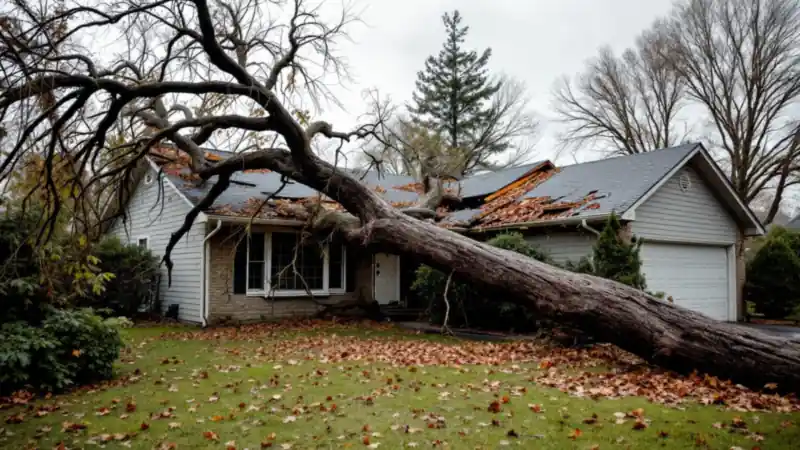
Short answer: Removing one storm-downed tree with a 21 to 30 inch trunk after hours costs an estimated $1,870–$3,850, call-out fee included. If it is on the house and needs a crane, plan on about $3,810–$7,550. If it touches a power line, stay 10 feet back and call the utility first. Many policies pay $500 per tree, $1,000 per loss, for removal.
$1,870–$3,850 one 21–30 in tree, after hours, call-out included (estimate; see method)
1.33x median off-hours vs. daytime emergency crew rate across 7 bids (Village of Grayslake, IL, 2025/26)
$500 / $1,000 common policy cap for removing a fallen tree: per tree / per loss (SC Dept. of Insurance, 2026)
10 ft minimum distance from any downed or overhead line (OSHA)
A tree on the roof at 11 p.m. is two problems at once: a safety problem that has to be handled in a fixed order, and a pricing problem where you have little time to shop. The pages ranking for this search are mostly single tree companies asking you to call. The top three publish no prices at all, and the cost pages further down give per-tree ranges and insurance caps without saying where they came from.
This guide is built from public records instead. Local governments and utilities buy emergency tree work through sealed bids, and those bid sheets are public. We compiled 2025 and 2026 tabulations from a Chicago-area village, a North Carolina utility, the North Carolina Department of Transportation and a Mississippi county, and added the FEMA 2025 Schedule of Equipment Rates, BLS wage data for tree trimmers (OEWS, May 2025), state insurance regulators’ consumer guidance and federal scam warnings. Every price below is an estimate built from those inputs, with the arithmetic in the method box. For other project prices, see our cost guides and the overall landscaping cost breakdown.
The first hour after a tree comes down: do these in order
The order matters more than speed. Insurance documentation and contractor calls can wait 20 minutes; a live wire cannot.
- Get people out of the affected rooms and away from the tree. Call 911 for injuries, fire, a gas smell or a line arcing on the ground.
- Treat every wire as live. OSHA’s storm-cleanup guidance says to stay at least 10 feet from overhead lines, to assume lines are energized until proven otherwise, and that clearing trees from electrical lines is work for qualified line-clearance tree trimmers only (OSHA Hurricane eMatrix, tree trimming). The same guidance warns against touching lines indirectly, through tools or branches.
- Call the electric utility if anything is touching a line, including the service wire to your house. The utility makes the line safe; an ordinary tree crew should not work inside that zone until it does, since OSHA reserves line clearing for qualified line-clearance trimmers.
- Photograph and video everything before anything moves: the tree, the base or break point, the roof, the fence, any vehicle, and wide shots of the yard. The South Carolina Department of Insurance and the Iowa Insurance Division both put this step ahead of any cleanup (SC Attorney General and SC Dept. of Insurance, Jan. 23, 2026; Iowa Insurance Division, Aug. 1, 2025).
- Prevent further damage you can safely reach. Iowa’s regulator tells homeowners to cover holes and broken windows with tarps or boards; Oklahoma’s says to keep receipts for emergency repair supplies (Oklahoma Insurance Department).
- Call your insurer or agent to open a claim and ask what they will pay for tree removal before you sign a large contract.
- Call a tree service and get the scope, price and payment terms in writing, even if it is a text message with a photo of a signed estimate.
Do not start cutting a tree that is resting on the house or bent under another tree. CDC notes that trees and branches bent or caught during high wind (“spring poles”) can release with enough force to kill, and that even a branch 2 inches thick can be dangerous under tension. It also says bystanders should be at least 2 tree lengths (at least 150 feet) from anyone felling a tree and 30 feet from anyone cutting limbs (CDC, Chain Saw Safety). About 36,000 people a year are treated in emergency departments for chain saw injuries, according to the same page.
Who do I call if a tree is down in my yard?
| Situation | First call | Then |
|---|---|---|
| Anyone hurt, fire, gas smell, wire arcing | 911 | Utility, then insurer |
| Tree or limb touching any power line, including the line to your house | Electric utility (outage or emergency line) | Tree service after the line is made safe |
| Tree on the house, garage or a car, no wires involved | Insurer or agent (to open the claim) | Tree service; roofer or contractor for temporary cover |
| Tree across your only driveway or a wheelchair ramp | Tree service | Insurer: some policies pay when a tree blocks access |
| Tree down in the open yard, nothing damaged | No emergency call needed | Get 2 to 3 regular-hours quotes |
| Tree from the street strip or a park onto your property | City public works or forestry line | Your insurer if it damaged a structure |
| Neighbor’s tree on your house | Your own insurer | Tell the neighbor; your insurer handles any recovery |
When the tree pulled the power line off the house
This step surprises many owners, in the words of the utility that explains it. Orlando Utilities Commission says that it maintains the service cable from the pole to the weatherhead (the cap on the pipe where the wires enter your house) but not the weatherhead itself, so a damaged weatherhead is the owner’s repair, best done by a licensed electrician, before the utility will reconnect. It adds that the electrician cannot start until the fallen tree is removed and nearby roof or siding damage is fixed (OUC, A Homeowner’s Guide to Damaged Weatherheads, 2022). Policies differ by utility, but the sequence usually runs: utility makes the line safe, tree crew removes the tree, roofer or electrician repairs your equipment, utility reconnects. Book the electrician at the same time as the tree crew, not after.
What is considered emergency tree removal?
Contracts give the clearest definition because someone has to pay the premium. Lauderdale County, Mississippi, defines an emergency call as “immediate service or after the hours of 5:00 p.m., weekends, and severe weather instances” in its 2026 tree-services bid (Lauderdale County Bid No. 4021 packet). Fayetteville Public Works Commission in North Carolina prices “after hours/emergency hours” as 7 p.m. to 7 a.m. (Fayetteville PWC bid tabulation, Feb. 3, 2026).
In practice, a situation justifies paying emergency rates when waiting makes things worse or keeps people at risk:
- A tree or large limb on an occupied structure, especially with an open roof and rain in the forecast.
- A tree blocking the only way in or out, or blocking a ramp someone needs.
- Broken limbs hanging over a door, driveway or play area.
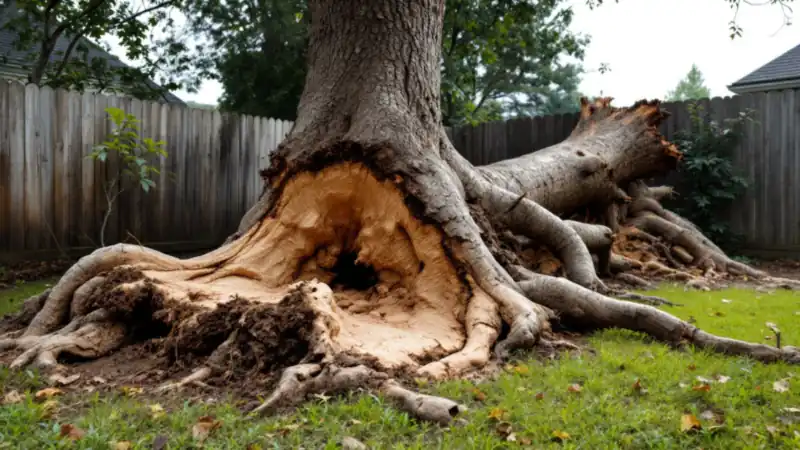
- A tree that started leaning during the storm, with the root plate lifting, toward the house or a road.
- Anything tangled in lines, after the utility has made it safe.
A tree lying flat across the back lawn is a cleanup job, not an emergency. Waiting a few days for business-hours pricing and two or three quotes is the easiest saving available, and our estimates below suggest it is worth hundreds to a few thousand dollars.
Emergency tree removal cost by trunk size
Public tree contracts price removals by trunk diameter rather than height, because diameter tracks the weight of wood that has to be cut, rigged and hauled. Public contracts use diameter at breast height (DBH), measured about 4.5 feet off the ground. The table below shows what bidders offered public agencies in 2025 and 2026 to remove one tree, by diameter class.
| Trunk diameter | Bids | Full range | Median | Middle half (used as our base) | Classes combined |
|---|---|---|---|---|---|
| Under 12 in | 11 | $74–$400 | $144 | $95–$235 | Grayslake 6–12.9 in; NCDOT 0–10 in |
| 12–20 in | 11 | $250–$900 | $400 | $320–$500 | Grayslake 13–20.9 in; NCDOT 11–20 in |
| 21–30 in | 11 | $595–$2,500 | $700 | $645–$850 | Grayslake 21–30.9 in; NCDOT 21–30 in |
| 31–40 in | 11 | $698–$4,000 | $1,350 | $1,000–$1,615 | Grayslake 31 in and over; NCDOT 31–40 in |
| Over 40 in | 8 | $1,150–$3,000 | $1,825 | $1,610–$2,125 | NCDOT 41–50 in and over 50 in |
These are scheduled, volume prices: the crew mobilizes once and works a list of trees for a public client. A one-off emergency job at a house adds three things: an after-hours or storm premium, extra care when the tree is on a structure or near lines, and a call-out or mobilization charge. The next table applies all three.
| Trunk diameter | Business hours, open access | After hours or weekend | Storm surge, crews on overtime | After hours, on house or near lines |
|---|---|---|---|---|
| Under 12 in | $1,100–$2,940 | $1,130–$3,020 | $1,140–$3,050 | $1,170–$3,110 |
| 12–20 in | $1,320–$3,200 | $1,430–$3,380 | $1,480–$3,450 | $1,560–$3,580 |
| 21–30 in | $1,640–$3,550 | $1,870–$3,850 | $1,970–$3,980 | $2,130–$4,190 |
| 31–40 in | $2,000–$4,320 | $2,350–$4,880 | $2,500–$5,120 | $2,760–$5,530 |
| Over 40 in | $2,610–$4,820 | $3,170–$5,570 | $3,420–$5,890 | $3,830–$6,430 |
Read across a row and the call-out charge does most of the work on small trees: a tree under 12 inches costs little to cut, but someone still has to roll a crew at night. On big trees the multipliers take over. If your quote shows no separate call-out fee, subtract it and compare the per-tree part.
Per-tree ranges and multipliers match the tables in this guide and come from 2025–26 public bid tabulations. Turn off the call-out fee if your quote has none. Local prices vary; see How we built these numbers.
Why emergency work costs more: after-hours, storm and crane premiums
After-hours premiums in real bids
The Grayslake tabulation is unusual because it asked all seven bidders for an emergency hourly rate in daytime and off-hours. Off-hours rates ran $195 to $690 an hour against $130 to $520 in daytime. Bidder by bidder, the off-hours premium ranged from 5 percent to 81 percent, with a median of 33 percent (Village of Grayslake, 2025/26).
Fayetteville PWC’s February 2026 storm-support bid shows a smaller gap: $450 an hour for a crew with equipment from 7 a.m. to 7 p.m. and $500 from 7 p.m. to 7 a.m., an 11 percent premium. The same bid separates a “standard removal” with no hazards ($350 per tree or hour) from a “high hazard removal” near homes, buildings or power lines ($450), a 29 percent difference. It also lists a $2,500 emergency call-out to cover initial mobilization and $1,000 per event for mobilization within the service area (Fayetteville PWC, PWC2526046). Lauderdale County’s 2026 award carries a $2,700 flat emergency call service charge on top of hourly rates (Lauderdale County, Bid No. 4021 tabulation).
A note on what is and is not law: federal rules require time and a half only for hours over 40 in a workweek, and do not require premium pay for nights, weekends or holidays as such (U.S. Department of Labor, Overtime Pay). After-hours surcharges are a pricing decision, which means they are negotiable, and they should be written into the estimate.
Storm surge pricing
After a widespread storm, every crew in the region has a backlog, works long weeks and pays overtime. We model that with a 1.5 multiplier, which matches time and a half and sits near the upper quarter of the Grayslake off-hours premiums (1.55x). Prices well above that during a declared emergency can cross into price gouging in some states (see the scams section).
Cranes and big equipment
A crane lets a crew lift a heavy trunk off a roof in sections instead of lowering or dropping pieces onto it. Lauderdale County’s 2026 award bills a crane at $420 an hour, separate from the crew. FEMA’s 2025 equipment schedule, which reimburses public agencies for owning and running equipment without an operator, puts a 35-ton all-terrain crane at $226.10 an hour; the difference is the operator, transport, insurance and margin.
| Line item | Rate | What it covers | Source |
|---|---|---|---|
| Tree trimmer and pruner, median wage | $24.50/hr | Pay only, before taxes, insurance, overhead | BLS OEWS, May 2025, SOC 37-3013 |
| Same, 75th percentile | $30.72/hr | Experienced climbers | BLS OEWS, May 2025 |
| Median wage at time and a half | $36.75/hr | Hours over 40 in a week | Arithmetic; DOL |
| Aerial lift, truck-mounted, 55 ft | $62.86/hr | Equipment ownership and operating cost, no operator | FEMA 2025 equipment rates |
| Brush chipper (Vermeer BC1500) | $54.11/hr | Equipment only | FEMA 2025 |
| Stump grinder (Vermeer SC852) | $55.28/hr | Equipment only | FEMA 2025 |
| All-terrain crane, 35 ton | $226.10/hr | Equipment only | FEMA 2025 |
| All-terrain crane, 60 ton | $285.76/hr | Equipment only | FEMA 2025 |
| Crane, billed to a county | $420/hr | Crane with operator, crew billed separately | Lauderdale County, 2026 |
| Crew with equipment, standard hours | $450/hr | Tree and debris removal crew | Fayetteville PWC, 2026 |
| Crew with equipment, 7 p.m. to 7 a.m. | $500/hr | Same crew after hours | Fayetteville PWC, 2026 |
The gap between the cost lines and the billed rates is not all profit. Tree work is counted inside the landscaping services industry (NAICS 561730), where payroll alone was 32.3 percent of revenue in 2022 (Census Bureau, 2022 Economic Census, EC2256BASIC); the rest has to cover insurance, fuel, trucks, disposal fees, overhead and profit.
Four emergency jobs, priced line by line
| Job | How we priced it | Estimate |
|---|---|---|
| 16 in maple across the driveway, weekday afternoon | 1 tree, 12–20 in, business hours, open access + call-out | $1,320–$3,200 |
| 24 in oak on the roof, Saturday night, crane needed | 1 tree, 21–30 in, x1.35 after hours, x1.3 on structure + call-out + crane (4–8 hrs at $420) + 1–4 haul loads | $3,960–$8,150 |
| Two 34 in pines down in the yard after a hurricane | 2 trees, 31–40 in, x1.5 storm surge + call-out + haul-off | $4,150–$8,140 |
| 10 in tree on the fence, Sunday morning | 1 tree, under 12 in, x1.35 after hours, x1.3 on structure + call-out | $1,170–$3,110 |
The roof job is the one to watch. More than two thirds of its cost is the crane, call-out and haul-off rather than the cutting, so ask whether the crane is truly needed (often yes for a heavy trunk on a roof) and how many hours are billed, including travel and setup.
Regional differences: wages and contract rates
Labor is the biggest input that varies by state. Tree trimmers earn a median of $24.50 an hour nationally, but state medians run from $18.94 in Nebraska and $19.17 in Texas to $36.27 in Oregon and $37.24 in Minnesota (BLS OEWS, May 2025). A crew in a high-wage state will bill more for the same tree, so treat our estimates as mid-market and adjust up in the Northeast, upper Midwest and West Coast and down across much of the South.
| Public buyer (state) | Crew or removal rate | Emergency or after-hours terms | Crane |
|---|---|---|---|
| Village of Grayslake (IL) | $130–$520/hr emergency crew, daytime | $195–$690/hr off-hours | Not bid |
| Fayetteville PWC (NC) | $450/hr crew with equipment | $500/hr after 7 p.m.; $2,500 call-out | Not bid separately |
| Lauderdale County (MS) | $480/hr tree removal | $2,700 flat call charge; $120/hr per crew member, 3-person minimum | $420/hr |
| NCDOT Division 6 (NC) | $74–$300/hr bucket-truck crew | Emergency mobilization $0.01–$500/day | Not bid |
For how landscaping labor costs compare across states more broadly, see our state-by-state industry data and landscaper pay figures.
Does homeowners insurance cover tree removal?
Usually yes when a covered storm drops a tree on a covered structure, and usually no when the tree just lands in the yard. The South Carolina Department of Insurance spelled out the limits in January 2026: most policies carry maximum coverage of “up to $1000 in reasonable expenses for removal of a fallen tree, with a limit of $500 per tree,” and if a tree does not touch or damage a covered structure, the policy may only pay if the tree becomes an obstacle (SC Dept. of Insurance via SC Attorney General, Jan. 23, 2026). Your policy’s numbers may differ; the declarations page and the “additional coverages” section are where to look.
| What happened | Typical treatment | Source |
|---|---|---|
| Storm drops your tree on the house, garage or fence | Structure repairs covered after the deductible; removal of the tree is also covered, within the policy’s limits | Oklahoma Insurance Dept.; Iowa Insurance Division |
| Tree falls in the yard and hits nothing | Removal may not be covered | Iowa Insurance Division |
| Tree blocks the driveway but hits nothing | May be paid as an obstacle, up to the tree-removal limit | SC Dept. of Insurance |
| Neighbor’s tree falls on your house | File on your own policy and pay your deductible; your insurer may recover from the neighbor’s insurer if the neighbor was negligent, and you may get the deductible back | Iowa Insurance Division; Oklahoma Insurance Dept. |
| Your tree falls on the neighbor’s property | They file with their insurer; you could be liable if neglect contributed | Iowa Insurance Division |
| Tree was dead, rotten or poorly maintained | Claim may be denied as negligence or maintenance | SC Dept. of Insurance; Iowa Insurance Division |
| Tree falls on your car | Not homeowners insurance; comprehensive auto coverage pays | Iowa Insurance Division |
| Home unlivable after the tree hit it | Policy may pay temporary living expenses | Iowa Insurance Division |
How much does insurance pay for tree removal?
Take the 24 inch oak on the roof above, estimated at $3,960–$8,150. Repairs to the roof, and generally the work to get the tree off the house, go through the structure claim, minus your deductible. Hauling the trunk and limbs off the property is where the cap described by South Carolina’s regulator bites: at $500 per tree and $1,000 per loss, two trees down in one storm could recover at most $1,000 for yard cleanup however much the crew charges. Ask the adjuster to split the tree invoice into “off the structure” and “removal from premises” lines so each part is handled under the right coverage.
How to get tree removal covered by insurance
- Photograph before cleanup, including the break or root plate. South Carolina’s regulators also suggest date-stamped photos of trees before storm season, plus saved arborist reports and invoices, to show the tree was not neglected (SC Dept. of Insurance).
- Report the claim promptly and ask, in writing, what the policy pays for tree removal from the structure and from the premises.
- Get an itemized invoice that says what the tree hit, how it was removed (rigging, crane) and what was hauled away.
- Do not sign your insurance benefits over to the tree company. The South Carolina Attorney General lists avoiding an assignment of benefits as a core protection, and the FTC says never to sign your insurance check over to a contractor (FTC, How To Avoid Scams After Weather Emergencies).
Who should pay for tree removal?
The owner of the property where the tree lands normally files the claim, even when the tree grew next door; Oklahoma’s insurance commissioner puts it as the owner “on whose property the tree limb fell” contacting their insurer (Oklahoma Insurance Department). A neighbor who ignored a known hazard can end up paying through subrogation. A tree that hits nothing is the landowner’s cost.
FEMA and disaster assistance: what it does and does not pay
FEMA is a backstop, not a tree service. Its fact sheets state that debris removal from private property is the owner’s responsibility and is usually ineligible for its Public Assistance program, except where debris is so widespread that it threatens public health and safety and FEMA designates specific areas with state and local governments (FEMA, Private Property Debris Removal After a Tornado, Apr. 28, 2023). In many declared disasters, local governments instead collect storm debris that owners stack at the curb by a set date, so ask before paying to haul brush.
For individuals, FEMA’s housing help turns on whether the home is safe, sanitary and functional; one of the factors it lists is safe access to and from the home (FEMA, How FEMA Determines if a Home is Habitable). FEMA does not charge application fees, and anyone asking for money to help you qualify is running a scam. The FTC also points to Small Business Administration disaster loans of up to $200,000 for homeowners repairing a primary residence (FTC).
Storm chasers and price gouging: the warning signs regulators list
The FTC’s list of scam signs after a disaster reads like a description of a bad tree crew: claims they do not need a license, a discount only if you sign right now, asking you to sign over your insurance check, full payment up front, cash or app or wire payment only, a blank contract, and offers to help you qualify for FEMA for a fee (FTC, 2026). South Carolina’s January 2026 advisory adds tree-specific points: be wary of out-of-state doorknockers following storms, refuse “free inspections” that lead to pressure, and ask for certificates of insurance for both general liability and workers’ compensation, then call the insurer to confirm the policy is active (SC Attorney General, 2026).
One trap is specific to emergencies. The FTC’s Cooling-Off Rule normally gives you three business days to cancel a sale made at your home, but the rule does not cover purchases “needed to meet an emergency” (FTC, Cooling-Off Rule). A contract signed in the driveway at midnight may not be cancellable, so read it before signing and keep the scope narrow: make the house safe tonight, price the rest tomorrow.
Price gouging laws apply in many states once an emergency is declared. In Florida, charging an unconscionable price for services needed because of the emergency is unlawful; prima facie evidence includes a gross disparity from the average price in the 30 days before the declaration, unless the increase reflects added costs. The ban runs up to 60 days under the initial declaration and can be extended, and offering services during the emergency without a local business tax receipt is a second-degree misdemeanor (Fla. Stat. 501.160). Other states have their own versions; your attorney general’s consumer office takes complaints.
- Pay a reasonable deposit, never the full price before the work is done.
- Pay by card or check; the FTC warns against cash, wire, gift card, payment app or cryptocurrency.
- Get a written contract with the company’s name, address, phone, license number where required, scope, price and completion date, and no blank spaces.
- Do not choose the lowest bid automatically; ask why prices differ.
Checking a tree company’s license and insurance during a storm
Most states do not license tree removal separately, but several do, and some require insurance as a condition of the license. Our license lookup guide explains how to search state databases, and the state-by-state requirements table covers the landscaping side.
| State | Tree-work credential | Agency |
|---|---|---|
| California | C-49 Tree and Palm contractor license | Contractors State License Board |
| Connecticut | Arborist license | CT Gen. Stat. ch. 451; DEEP |
| Louisiana | Arborist and utility arborist licenses | LDAF Horticulture Commission |
| Maryland | Licensed Tree Expert (trees over 20 ft) | Md. Natural Resources §5-415; DNR |
| Minnesota | Tree care company registration | Minn. Stat. 18G.07; Dept. of Agriculture |
| Mississippi | Tree surgery license, with liability insurance of at least $100,000 | MS Dept. of Agriculture and Commerce |
| New Jersey | Licensed Tree Expert or Licensed Tree Care Operator, plus business registration | NJ Board of Tree Experts |
| Alabama, Hawaii, Rhode Island | Tree surgery license (AL), C-27b tree trimming contractor (HI), arborist license (RI) | State agriculture, contractor and environment agencies |
In any state, two checks take five minutes and catch most fly-by-night crews: call the insurer named on the certificate of insurance to confirm both liability and workers’ compensation are active, and if the company claims ISA certification, look the arborist up in the ISA certified arborist directory. Workers’ compensation matters because an uninsured worker hurt on your roof is a claim nobody wants to sort out.
DIY or hire: where the line is
Homeowners can reasonably clear small limbs that are lying flat, are not under tension, and are nowhere near a line, using a saw they already know how to use. Everything else belongs to a crew with rigging and insurance: anything on a roof, anything bent or pinned under another trunk, anything hanging, and anything within 10 feet of a wire. CDC’s guidance on spring poles and its 150-foot felling clearance give a sense of why. A torn-off limb that falls the wrong way can turn a $1,500 removal into a much larger roof claim and an injury.
How to reduce the cost of emergency tree removal
- Split the job. Pay emergency rates only to get the tree off the house or out of the driveway; schedule the yard cleanup and stump at regular rates.
- Ask for the after-hours rate in writing. In the Grayslake bids the off-hours premium ranged from 5 to 81 percent depending on the company, so the second call can be much cheaper than the first.
- Check curbside debris pickup. After declared disasters many local governments collect storm debris placed at the curb, which can replace a paid haul-off.
- Keep the wood. Some crews will cut logs to length and leave them; ask what that saves.
- Skip the stump for now. Most 2026 public bids priced stump grinding at $50 to $720 per stump, and it is rarely urgent.
- Get two or three quotes for anything that is not urgent. The FTC recommends estimates from more than one contractor and an explanation for big price differences.
How we built these numbers
Per-tree base. We pooled per-tree removal bids from two public tabulations: Village of Grayslake, Illinois, Tree Maintenance 2025/26 (7 bidders, 4 diameter classes) and NCDOT Division 6 contract D6D2.SBE.017, March 4, 2026 (4 bidders, 6 diameter classes). We grouped them into 5 bands and took the 25th to 75th percentile of each band, rounded: under 12 in $95–$235; 12–20 in $320–$500; 21–30 in $645–$850; 31–40 in $1,000–$1,615; over 40 in $1,610–$2,125 (NCDOT only). These are bid prices for scheduled public work, not awarded or residential prices.
Urgency multipliers. After hours or weekend: x1.35, the median off-hours to daytime ratio across the 7 Grayslake emergency-rate bids (ratios ranged 1.05 to 1.81; median 1.33). Storm surge: x1.5, equal to time-and-a-half overtime and close to the 75th percentile Grayslake ratio (1.55). On a structure or near lines: x1.3, from Fayetteville PWC’s 2026 bid ($450 high-hazard vs. $350 standard removal).
Adders. Call-out or mobilization: $1,000–$2,700, from Fayetteville PWC ($1,000 per-event mobilization; $2,500 emergency call-out) and Lauderdale County ($2,700 flat emergency call charge). The low end also equals 2 hours at the Grayslake median off-hours crew rate ($500). Crane: $1,680–$3,360, which is 4 to 8 billed hours at Lauderdale County’s $420 an hour; the hours are our assumption. Haul-off: $150–$600, 1 to 4 loads at Fayetteville PWC’s $150 per load. Stump grinding: $100–$720 per stump, spanning the Fayetteville PWC and Lauderdale County bids.
Formula. Estimate = trees x per-tree base (low and high) x urgency multiplier x situation multiplier + adders. Example: one 21–30 in tree after hours in the open yard = $645 x 1.35 + $1,000 = $1,871 (low) to $850 x 1.35 + $2,700 = $3,848 (high), shown rounded as $1,870–$3,850.
Limits. Public contracts often bundle many trees and use crews already mobilized, so residential quotes can run higher than our base; the call-out adder is how we account for a single-job trip. Prices vary with region (see the wage chart), access, species, wood weight and how the tree failed. We did not use prices from directories or quote-aggregator sites. Wage data: BLS OEWS May 2025. Equipment costs: FEMA 2025 Schedule of Equipment Rates.
This page is general information, not legal, insurance or safety advice. Stay clear of downed lines and follow your utility’s and emergency officials’ instructions. Policy terms vary; confirm coverage with your insurer before you sign.
What homeowners ask after a storm
How much does an emergency tree removal cost?
For one storm-downed tree, our estimates run from about $1,100–$2,940 for a small tree in business hours to $3,830–$6,430 for a tree over 40 inches on a structure after hours, call-out included. A crane adds roughly $1,680 to $3,360.
How big of a tree to charge $1000 for removal?
In 2025 and 2026 public bids, scheduled removal of a tree with a 31 to 40 inch trunk had a median of $1,350, and the 21 to 30 inch class had a median of $700. So $1,000 buys roughly a 25 to 35 inch trunk at contract rates. A one-off emergency visit costs more once call-out and after-hours charges are added.
How do you get rid of trees quickly?
Call a crew that offers after-hours service and authorize only the urgent part: getting the tree off the house or out of the driveway. Ask whether your city is running curbside storm-debris pickup, which can clear cut wood faster and cheaper than paid haul-off.
How much does insurance pay for tree removal?
South Carolina’s Department of Insurance says most policies pay up to $1,000 per loss for removing fallen trees, with a $500 per-tree limit, mainly when the tree hit a covered structure or blocks access. Structure repairs are paid separately, after your deductible.
Who pays when a neighbor’s tree falls on my house?
You file with your own insurer and pay your deductible. If the neighbor was negligent, for example by ignoring a dead tree, your insurer can try to recover the cost from the neighbor’s insurer, and you may get your deductible back.
Sources
- Village of Grayslake, Illinois, Tree Maintenance (2025/26) Bid Tabulation, 2025/26 contract. Accessed October 2026.
- North Carolina Department of Transportation, Contract D6D2.SBE.017 bid tabulation, tree removal, stump grinding and overhang clearing, Mar. 4, 2026. Accessed October 2026.
- Fayetteville Public Works Commission, PWC2526046 Storm Support: Tree and Stump Removal Services, bid tabulation, Feb. 3, 2026. Accessed October 2026.
- Lauderdale County, Mississippi, Board of Supervisors, Bid No. 4021 Professional Tree Cutting Services, published tabulation, Jan. 2026. Accessed October 2026.
- Lauderdale County, Mississippi, Board of Supervisors, Bid No. 4021 bid packet (emergency call definition), Dec. 2025. Accessed October 2026.
- Federal Emergency Management Agency, 2025 Schedule of Equipment Rates, 2025. Accessed October 2026.
- U.S. Bureau of Labor Statistics, Occupational Employment and Wage Statistics, Tree Trimmers and Pruners (37-3013), national and state, May 2025. Accessed October 2026.
- U.S. Census Bureau, 2022 Economic Census, EC2256BASIC, NAICS 561730, 2022. Accessed October 2026.
- U.S. Department of Labor, Wage and Hour Division, Overtime Pay, current. Accessed October 2026.
- South Carolina Attorney General, with SC Department of Insurance and SC Department of Consumer Affairs, Tips for dealing with downed trees and limbs, Jan. 23, 2026. Accessed October 2026.
- Iowa Insurance Division, Consumer Connection: Tree Damage and Insurance, Aug. 1, 2025. Accessed October 2026.
- Oklahoma Insurance Department, Fallen Trees and Homeowners Insurance: What’s Covered?, undated consumer column. Accessed October 2026.
- Occupational Safety and Health Administration, Hurricane eMatrix: Tree Trimming, current. Accessed October 2026.
- Centers for Disease Control and Prevention, Chain Saw Safety, current. Accessed October 2026.
- Orlando Utilities Commission, A Homeowner’s Guide to Damaged Weatherheads, Oct. 1, 2022. Accessed October 2026.
- Federal Emergency Management Agency, Private Property Debris Removal After a Tornado, Apr. 28, 2023. Accessed October 2026.
- Federal Emergency Management Agency, How FEMA Determines if a Home is Habitable, Nov. 23, 2020. Accessed October 2026.
- Federal Trade Commission, How To Avoid Scams After Weather Emergencies and Natural Disasters, current. Accessed October 2026.
- Federal Trade Commission, Buyer’s Remorse: The FTC’s Cooling-Off Rule May Help, current. Accessed October 2026.
- Florida Legislature, Florida Statutes 501.160, unconscionable prices during a declared state of emergency, 2026 statutes. Accessed October 2026.
- International Society of Arboriculture, Certified arborist credential directory, current. Accessed October 2026.
- California Contractors State License Board, Licensing classifications, current. Accessed October 2026.
- Connecticut General Assembly, General Statutes chapter 451 (arborists), current. Accessed October 2026.
- Louisiana Department of Agriculture and Forestry, Nurseries and landscaping (Horticulture Commission licenses), current. Accessed October 2026.
- Maryland General Assembly, Natural Resources Article §5-415 (tree experts), current. Accessed October 2026.
- Minnesota Revisor of Statutes, Minn. Stat. 18G.07 (tree care registration), current. Accessed October 2026.
- Mississippi Department of Agriculture and Commerce, Regulation of professional services (tree surgery), current. Accessed October 2026.
- New Jersey Board of Tree Experts, Licensing, current. Accessed October 2026.