Short answer: Core aeration costs $85 to $200 for a 5,000 sq ft lawn (median $118) and $85 to $325 for 10,000 sq ft, per 14 price lists posted by 13 lawn companies (October 2026). Beyond the minimum, most charge about $15 per extra 1,000 sq ft. Aeration with overseeding runs $145 to $600, mostly $225 to $435.
$118 median price to core-aerate 5,000 sq ft (14 published price lists, Oct. 2026)
$15 typical charge per extra 1,000 sq ft above the minimum (range $5–$25)
$75–$125 to rent a walk-behind core aerator for a day (8 rental stores’ posted rates)
20–40 holes per sq ft: Purdue’s target, versus about 4.5 from one typical pass (Purdue; Penn State)
Most aeration price pages quote a single national range, such as “$107 to $202” or “7 to 27 cents per square foot,” and none show where the number came from. The per-square-foot figures are the bigger problem: on a typical suburban lawn, the companies that publish their prices charge between 1.7 and 4 cents per square foot. Quoting 7 to 27 cents overstates the real bill for anything bigger than a postage-stamp yard, because almost every company prices aeration as a minimum charge plus a small add-on per 1,000 sq ft.
So we went to the source. This page is built from the 14 price lists that 13 lawn companies in eight states post on their own websites, the posted rates of eight equipment rental stores, retail seed prices, and the land-grant university extension services that set the agronomy: Purdue, Penn State, Kansas State, Nebraska, Iowa State, Clemson, Georgia and Oregon State. Every price below links to the page it came from. If you are deciding between reseeding and starting over, our sod vs. seed comparison covers that choice; this page is about keeping an existing lawn breathing.
What lawn companies charge for core aeration (published prices)
These are the prices each company lists publicly for core aeration alone, with no seed. We calculated each company’s price for a 5,000 sq ft and a 10,000 sq ft lawn from its own formula. Most use one of two structures: a flat price up to a set size, or a base price plus a fixed amount per extra 1,000 sq ft.
Swipe the table sideways to see every column.
| Company (area) | Service | Posted price structure | 5,000 sq ft | 10,000 sq ft |
|---|---|---|---|---|
| Lawn Care Plus (Erie, Colo.) | Single pass | $70 under 5,000 sq ft; $85 for 5,000–6,000; tiers to $125 at 9,000 | $85 | Quote |
| Lawn Care Plus (Erie, Colo.) | Double (cross-hatch) pass | $95 under 5,000 sq ft; tiers to $185 over 10,000 | $110 | $170 |
| Outdoor Legacy (Centennial, Colo.) | Double pass | $85 up to 4,500 sq ft + $15 per 1,000 | $100 | $175 |
| Lawn Cowboys (Littleton, Colo.) | Single pass, 6–9 holes per sq ft | $80 spring, $99 fall, up to 5,000 sq ft (card price) | $99 (fall) | Quote |
| Yard Boss (Lincoln and Omaha, Neb.) | Core aeration | $90 up to 5,000 sq ft + $6 per 1,000 | $90 | $120 |
| Doehling Landscape (Shakopee, Minn.) | Fall core aeration | $130 up to 15,000 sq ft, plus tax | $130 | $130 |
| Stellar Property Maintenance (DuPage Co., Ill.) | Core aeration | $99 up to 5,000 sq ft | $99 | Quote |
| SCE Lawn Care (Webster, N.Y.) | Core aeration | $85 up to 12,000 sq ft + $5 per 1,000, plus tax | $85 | $85 |
| Lawn Panther (Raleigh suburbs, N.C.) | Core aeration | $129 up to 4,000 sq ft + 2 cents per sq ft | $149 | $249 |
| Denmark Lawn (Fort Worth, Texas) | Core aeration | $155 up to 5,000 sq ft; $285 for 5,000–10,000; tiers to $1,185 | $155 | $285 |
| Evergreen Lawn Aeration (Seattle) | Core aeration | $80 up to 2,000 sq ft + $15 per 1,000 | $125 | $200 |
| Harbor Design (Seattle) | Core aeration | $120 up to 2,000 sq ft + $15 per 1,000; custom over 10,000 | $165 | $240 |
| Toro Bravo Lawn (Tacoma, Wash.) | Core aeration | $120 up to 2,000 sq ft + $15 per 1,000, sales tax included | $165 | $240 |
| Earth First Lawn Care (Bellingham, Wash.) | Core aeration | $150 up to 3,000 sq ft + $25 per 1,000 | $200 | $325 |
Three things stand out. First, the middle of the market is narrow: half of these companies charge between $99 and $154 for a 5,000 sq ft lawn. Second, the add-on rate for extra area is small and consistent. Of the eight companies that post one, the median is $15 per 1,000 sq ft and the range is $5 to $25. Third, the highest prices sit in western Washington, which is also the state with the highest median wage for landscaping workers in this sample, $22.57 an hour (BLS OEWS, May 2025).
Lawn aeration cost by lawn size
Lawn size drives the bill, but not in a straight line. Below about 4,000 sq ft, nearly everyone charges a minimum, so a 2,000 sq ft yard pays almost what a 4,000 sq ft yard pays. Above 5,000 sq ft, the per-1,000 add-on takes over and the effective rate per square foot keeps falling. Use the grass area only. Two of the companies above, Denmark Lawn and Lawn Cowboys, say plainly that they measure turf, not the whole lot.
| Lawn (grass) area | Lowest posted | Middle half of companies | Median | Highest posted | Median per 1,000 sq ft | Companies |
|---|---|---|---|---|---|---|
| 2,000 sq ft | $70 | $86–$127 | $99 | $155 | $49.50 | 14 |
| 3,000 sq ft | $70 | $91–$134 | $99 | $155 | $33.00 | 14 |
| 4,000 sq ft | $70 | $91–$145 | $105 | $175 | $26.13 | 14 |
| 5,000 sq ft (about 1/8 acre) | $85 | $99–$154 | $118 | $200 | $23.50 | 14 |
| 7,500 sq ft | $85 | $129–$210 | $155 | $285 | $20.67 | 12 |
| 10,000 sq ft (about 1/4 acre) | $85 | $150–$244 | $200 | $325 | $20.00 | 11 |
| 15,000 sq ft | $100 | $159–$340 | $263 | $450 | $17.50 | 10 |
| 21,780 sq ft (1/2 acre) | $135 | $314–$508 | $400 | $625 | $18.37 | 8 |
| 43,560 sq ft (1 acre) | $245 | $595–$964 | $730 | $1,175 | $16.76 | 8 |
Two of the People Also Ask questions for this topic are literal sizes. A 2,000 sq ft lawn costs $70 to $155 to aerate at posted prices, with a median of $99, because you are paying the minimum. A 4,000 sq ft lawn costs $70 to $175, median $105.
Model fitted to 14 posted lawn company price lists (Oct. 2026); it matches the middle half of the market for 5,000 to 15,000 sq ft lawns. Lawns under 4,000 sq ft usually pay a flat minimum of $70 to $155. See How we built these numbers.
The calculator uses a simple model that reproduces the middle half of the published prices for 5,000 to 15,000 sq ft lawns: a $50 base visit charge plus 1.0 to 2.0 cents per sq ft for core aeration, or 3.5 to 7.0 cents per sq ft for aeration with overseeding. The table below lists every input so you can check it.
| Calculator input | Value | Where it comes from |
|---|---|---|
| Base visit charge | $50 | Fitted to the 25th to 75th percentile of posted prices at 5,000 and 10,000 sq ft |
| Core aeration only | $10–$20 per 1,000 sq ft | Same fit; inside the posted add-on rates of $5 to $25 |
| Core aeration + overseeding | $35–$70 per 1,000 sq ft | Fitted to posted aeration-and-seed packages, mostly $225 to $435 at 5,000 sq ft and $370 to $760 at 10,000 sq ft |
| Compacted soil, double pass | ×1.3 | Lawn Care Plus charges 25 to 36 percent more for a double pass than a single pass on lawns up to 7,000 sq ft |
| Severe compaction, three passes | ×1.6 | Our extrapolation: one more pass at the same 30 percent step |
| Dethatching (about 5,000 sq ft) | $199–$540 | Stellar’s $199 up to 5,000 sq ft; Harbor Design’s formula gives $540 at 5,000 sq ft |
| Starter fertilizer | $75–$99 | Harbor Design $75 up to 2,000 sq ft; Stellar $99 up to 5,000 sq ft |
- 25th percentile
- Median
- 75th percentile
Source: Green Industry Report analysis of company price pages, checked Oct. 13, 2026 Lawn size in sq ft of grass. Companies quoting a size on request are excluded from that point.
Show the numbers
| 25th percentile | Median | 75th percentile | |
|---|---|---|---|
| 2,000 | $86 | $99 | $127 |
| 3,000 | $91 | $99 | $134 |
| 4,000 | $91 | $105 | $145 |
| 5,000 | $99 | $118 | $154 |
| 7,500 | $129 | $155 | $210 |
| 10,000 | $150 | $200 | $244 |
| 15,000 | $159 | $263 | $340 |
Core aeration cost per square foot and per 1,000 sq ft
Per-square-foot pricing is mostly a way to talk about aeration, not a way it is sold. At posted prices, a 5,000 sq ft lawn works out to 1.7 to 4.0 cents per sq ft, and a 15,000 sq ft lawn to 0.7 to 3.0 cents. The useful number is the marginal one: once you are past the minimum, each extra 1,000 sq ft costs $5 to $25, usually $15. If a quote for a mid-size lawn works out to more than 5 cents per sq ft for aeration alone, it is above every published price in our sample.
How much it costs to aerate a lawn per acre
Eight of the 14 price lists include a formula that reaches an acre. Applied to 43,560 sq ft, those formulas give $245 to $1,175, with a median of $730, or about $17 per 1,000 sq ft. Treat that as an upper reference: Evergreen Lawn Aeration and others say large lawns are priced by estimate, and big open areas go faster. A 40-inch stand-on aerator is rated to cover up to 80,000 sq ft per hour (Longenecker’s rental listing), roughly four times what a walk-behind does, so per-acre quotes on open ground can come in well under the formula price.
Regional differences in aeration prices
Our sample is too small to rank states, and each state below rests on one to four companies. Still, the spread is real, and it lines up only loosely with what landscaping workers earn locally.
| State (companies) | 5,000 sq ft, posted | 10,000 sq ft, posted | Median wage, landscaping workers |
|---|---|---|---|
| Washington (4) | $125–$200 | $200–$325 | $22.57/hr |
| Colorado, Front Range (4) | $85–$110 | $170–$175 | $22.00/hr |
| Minnesota (1) | $130 | $130 | $22.41/hr |
| New York (1) | $85 | $85 | $21.56/hr |
| Illinois (1) | $99 | Quote | $21.05/hr |
| Nebraska (1) | $90 | $120 | $18.82/hr |
| North Carolina (1) | $149 | $249 | $18.22/hr |
| Texas (1) | $155 | $285 | $17.66/hr |
Washington’s high prices match its high wages. Colorado’s do not: four Front Range companies charge $85 to $110 for 5,000 sq ft despite wages above $22 an hour, which suggests that local competition and how a company is built (a dedicated aeration route versus a full-service crew) matter as much as labor rates. The two southern companies, in North Carolina and Texas, are among the most expensive in the sample even though their states pay the least. For a state-by-state look at what landscaping labor costs, see our landscaping industry by state data.
Single pass, double pass, spike or liquid: what you are paying for
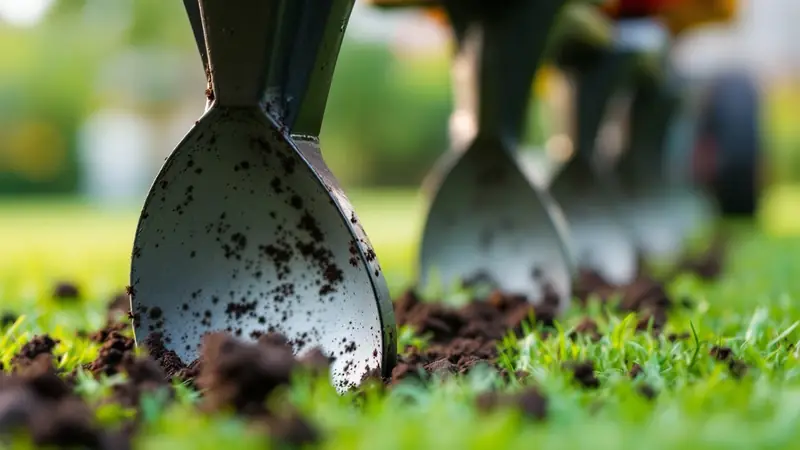
The single biggest difference between a $70 aeration and a $185 one is how many holes end up in the ground. Purdue Extension (AY-8) says aeration is most beneficial at 20 to 40 holes per sq ft, 2 to 3 inches deep, and warns that most rental machines, and often lawn care operators’ services, do not punch enough holes in one pass. Penn State Extension adds that most lawn aerators come with 1/2 to 3/4 inch tines on a 4 by 8 inch spacing, which opens only 1.38 percent of the surface per pass with 3/4 inch tines, and suggests targeting about 10 percent.
| Passes (4 x 8 inch tine pattern) | Holes per sq ft | Surface opened, 1/2 inch tines | Surface opened, 3/4 inch tines |
|---|---|---|---|
| 1 | 4.5 | 0.6% | 1.4% |
| 2 (cross-hatch) | 9 | 1.2% | 2.8% |
| 3 | 13.5 | 1.8% | 4.1% |
| 4 | 18 | 2.5% | 5.5% |
| 3 x 3 inch spacing (K-State guideline) | 16 | 2.2% | 4.9% |
The practical reading: a single pass is a light treatment. Kansas State recommends holes about 3 inches apart and says three or more passes may be needed to get there; its Johnson County office says aerating in at least two directions gives the greatest benefit. For compacted or clay soil, a double pass is the minimum worth paying for, and it costs only about 30 percent more. Lawn Care Plus charges $95 for a double pass versus $70 for a single on a lawn under 5,000 sq ft. Some companies, such as Outdoor Legacy, sell only the double pass. One company that does state its single-pass density, Lawn Cowboys, lists 6 to 9 holes per sq ft. Ask every bidder the same two questions: how many passes, and how many holes per square foot.
Core versus spike aeration
Spike or solid-tine aeration pokes holes without removing soil, and the extension services are close to unanimous about it on clay and silt. Nebraska Extension says spiking pushes soil particles apart “but increase[s] compaction between the spike holes” and is not effective in clay or silt soils, including spiked “aeration shoes.” Iowa State tells homeowners to avoid spike devices, and Clemson Extension says spiking may cause more compaction later. Penn State Extension says solid-tine equipment “should not be mistaken for core aerating equipment.” The one exception: Nebraska’s turf program notes solid tines are nearly as effective as hollow tines on sports fields and golf turf, where soils are often sand-based. A spike service is not a cheaper version of core aeration on a typical clay lawn; it is a different, weaker treatment.
Is liquid aeration worth it?
Liquid aeration is a spray, usually humates, surfactants or microbial products, sold as a substitute for pulling cores. It is cheaper: Lawn Care Plus lists it at $40 for a lawn under 5,000 sq ft, against $70 for single-pass core aeration. The evidence does not support it as a replacement. Colorado State University Extension writes that there is no “chemical” substitute for physical remediation of compaction and that at best these products act as a wetting agent. Nebraska Extension reached the same conclusion. A three-year field study at the University of Georgia on bermudagrass over clay loam found that only repeated hollow-tine cultivation reduced penetration resistance and produced a long-term increase in water infiltration; the liquid products raised soil moisture retention and rooting somewhat, but the authors concluded liquid aeration “does not substitute” for hollow-tine cultivation (Henry et al., Agronomy Journal, 2025).
Our read: if the soil is compacted, pay for cores. A liquid product may be a reasonable add-on for water penetration on a lawn that is not compacted, but it is not aeration in the sense the extension services use the word.
Aeration and overseeding cost
Aeration and overseeding are sold together because the holes give seed a place to land, and on cool-season lawns that is the bulk of the fall business. Here is what the companies that publish combined prices charge.
Swipe the table sideways to see every column.
| Company (area) | What the package includes | Posted price | 5,000 sq ft |
|---|---|---|---|
| Stellar (DuPage Co., Ill.) | Aeration $99 + tall fescue seed $49 (bluegrass $79); starter fertilizer $99 extra | Up to 5,000 sq ft | $148 ($178 bluegrass) |
| Lawn Cowboys (Littleton, Colo.) | Triple Play: aeration, fertilizer, 1 lb seed per 1,000 sq ft | $145 up to 5,000 sq ft | $145 |
| Lawn Cowboys (Littleton, Colo.) | Power Seeding: double-pass aeration, starter fertilizer, 3 lb seed per 1,000 | From $200; most lawns $225–$275 | $225–$275 |
| Lawn Cowboys (Littleton, Colo.) | Lawn Renewal: aeration, starter fertilizer, 5–8 lb seed per 1,000 with a split seeder | From $315; most lawns $335–$435 | $335–$435 |
| Earth First (Bellingham, Wash.) | Aeration plus overseeding, regular rates | $150 + $25/1,000 over 3,000; seeding $50 + $30/1,000 | $400 |
| Earth First (Bellingham, Wash.) | Same services at the spring and fall special | $100 + $20/1,000 over 5,000; seeding $75 up to 5,000 | $175 |
| Lawn Panther (Raleigh suburbs, N.C.) | Aeration and overseeding | From $269 | From $269 |
| Yard Boss (Lincoln and Omaha, Neb.) | Double-pass aeration, 5 lb tall fescue per 1,000 | $297 up to 5,000 sq ft + $34 per 1,000 | $297 |
| Lawn Care Plus (Erie, Colo.) | Double-pass aeration, seed, organic soil conditioner | $285 under 5,000 sq ft; $515 at 9,000–10,000 | $330 |
| SCE Lawn Care (Webster, N.Y.) | Aeration $85 + overseeding add-on $285 | $370 up to 12,000 sq ft | $370 |
| Evergreen (Seattle) | “Lawn Revival”: aeration, overseeding, starter fertilizer | $200 up to 2,000 sq ft + $70 per 1,000 | $410 |
| Lawn Theory (Northern Virginia) | Aeration and overseeding | Starts at $250 | From $250 |
| Lawngevity (Blount and Knox counties, Tenn.) | Aeration, overseed, starter fertilizer | Most lots $300–$600 | $300–$600 |
| Green Lawn Fertilizing (Mid-Atlantic) | Aeration and seeding | Starts at $470 | From $470 |
The spread, $145 to more than $470 for roughly the same lawn, is mostly about seed rate and how the seed goes down, not about the aeration. Lawn Cowboys’ own menu shows it: the same company sells 1 lb, 3 lb and 5 to 8 lb of seed per 1,000 sq ft at three price points. Always ask how many pounds per 1,000 sq ft, which variety, and whether a slit seeder is used.
What the seed itself costs
Seed is usually the smaller part of an overseeding bill. Kansas State’s Johnson County Extension recommends overseeding at half the new-lawn rate: 3 to 4 lb of tall fescue per 1,000 sq ft and about 2 lb of Kentucky bluegrass. NC State Extension calls for 6 lb of turf-type tall fescue per 1,000 sq ft when overseeding thin areas.
| Seed | Overseeding rate (lb per 1,000 sq ft) | Price per lb (50 lb to 10 lb bag) | Seed per 1,000 sq ft | Seed for 5,000 sq ft |
|---|---|---|---|---|
| Turf-type tall fescue | 3 to 6 | $3.10–$5.70 | $9–$34 | $47–$171 |
| Kentucky bluegrass | About 2 | $3.40–$5.90 | $7–$12 | $34–$59 |
Compare that with the overseeding add-on in the package prices above. At 5,000 sq ft, Yard Boss charges $207 more for aeration with seed than for aeration alone, and Evergreen $285 more. At 4 lb per 1,000 sq ft and $3.10 a pound, the tall fescue for that lawn costs about $62 at retail. The rest of the add-on pays for any extra pass, spreading, starter fertilizer, and the company’s margin and guarantee. That is not a rip-off, but it does mean a homeowner who rents an aerator and spreads seed can save more on overseeding than on aeration alone.
Agronomy that changes the price
Two extension findings cut against the standard one-pass “aerate and seed” package. Penn State Extension describes overseeding after aeration as following six to eight passes with a core aerator. Kansas State says core aeration is “not as highly recommended for overseeding” as other seedbed methods because it gives a less uniform stand and takes longer to fill bare areas. If your lawn is thin rather than compacted, a slit-seeding service, which drops seed into grooves, may get better results than an aeration package. Our sod vs. seed guide prices the larger repairs, and if the lawn is mostly gone, sod installation costs are the next comparison.
Warm-season lawns are a different case. Bermudagrass and zoysiagrass fill in by spreading, so southern companies tend to pair aeration with topdressing rather than seed: Lawn Panther sells aeration, topdressing and seeding from $569, and Denmark Lawn quotes compost or sand topdressing separately on site.
DIY: what it costs to rent a core aerator
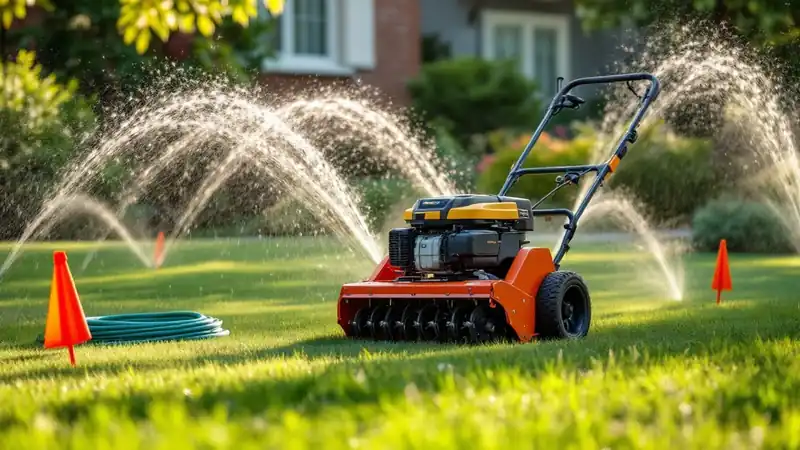
A walk-behind core aerator rents for $75 to $125 a day at the eight stores below, or $55 to $85 for a four-hour block. All eight post their rates online.
| Rental store (location) | 4 hours or half day | Day | Week |
|---|---|---|---|
| Burns Tool Rentals (Mishawaka, Ind.) | $60 | $75 | $225 |
| McAuliffe’s Rental (Marysville, Ohio) | $55 | $80 | $120 (weekend) |
| Taylor Rental (Concord, N.H.) | $76.50 | $102 | $408 |
| Wally’s Rentals (Concord, Calif.) | $75 | $105 | $375 |
| Airport Rental (Wilmington, Del.) | $80 | $110 | $450 |
| Moore Rental Service (Arlington, Texas) | $65 | $110 | $420 |
| Rental Stops (Grand Prairie, Texas) | $84.50 | $119 | $355.50 |
| Taylor Rental (Hillsdale and Ridgewood, N.J.) | $85 | $125 | $500 |
The machine is heavy. Taylor Rental lists its 19-inch model at 288 lb (Taylor Rental Concord), so you need a pickup or a trailer and a second person to load it. A typical walk-behind is rated at about 20,000 sq ft per hour (Taylor Rental, N.J.), but that is machine speed, not job time. Moore Rental Service tells customers a quarter-acre yard usually takes two to three hours including setup (Moore Rental Service), and Purdue warns that rental machines often need more than one pass to reach a useful hole count (Purdue AY-8). Oregon State adds that most rental aerators are not very heavy and will not penetrate well in hard soil (OSU Extension).
| Lawn size | DIY rental cost | Professional, posted median | What DIY saves |
|---|---|---|---|
| 3,000 sq ft | $55–$85 (4 hours) | $99 | $14–$44 |
| 5,000 sq ft | $55–$85 (4 hours) | $118 | $33–$63 |
| 10,000 sq ft | $75–$125 (day) | $200 | $75–$125 |
| 15,000 sq ft | $75–$125 (day) | $263 | $138–$188 |
Below about 5,000 sq ft, renting saves $14 to $63 before tax, damage waiver and fuel, and you take on a heavy machine and the risk of hitting a sprinkler head. Above 10,000 sq ft, renting starts to pay, especially if you split a day’s rental with a neighbor. The biggest DIY saving is on overseeding, where the seed costs a fraction of the add-on that companies charge.
Best time to aerate: cool-season vs. warm-season grass
Aerate when the grass is growing hard enough to fill the holes. That means the timing flips between the two grass groups, and it also shifts by latitude.
| Grass type | Best window | Extension source |
|---|---|---|
| Cool-season (Kentucky bluegrass, tall fescue, ryegrass, fine fescue), Midwest | September or April | Purdue AY-8; Iowa State |
| Cool-season, Great Plains | Early April to end of May; late August to end of October | Nebraska Extension (Lancaster Co.) |
| Cool-season, Kansas and Missouri | March, April or September | Kansas State MF2130 |
| Cool-season, Mid-Atlantic and Northeast | Early to mid-spring, or late summer to early fall | Penn State Extension |
| Tall fescue, Southeast transition zone | September or October; delay summer aeration until fall | University of Georgia; NC State |
| Kentucky bluegrass, western Oregon | Spring or fall | Oregon State Extension |
| Warm-season (bermudagrass, zoysiagrass, buffalograss), Plains | Late May through July or August | Kansas State; Nebraska Extension |
| Warm-season (bermudagrass, centipede, zoysia, St. Augustine), Southeast | Late spring to early summer; May through August in Georgia | Clemson Extension; UGA Extension, Fulton Co. |
Soil moisture matters as much as the calendar. Penn State says dry soil keeps tines from going deep enough and can break them, while wet soil can add compaction, because most ride-on aerators weigh well over 1,000 lb. Aim for soil moist enough to pull a full 2.5 to 4 inch core. Nebraska Extension suggests watering deeply two days ahead if it has been dry.
Two spring cautions. Penn State notes that spring aeration can bring weed seeds to the surface and open space for them, and spring is when crabgrass preventers go down. Nebraska’s turf program cites research showing that aerating after a preemergence herbicide does not reduce crabgrass control, but still advises aerating before the application where possible.
Timing also moves the price
Fall is peak season for cool-season aeration, and some posted prices show it. Lawn Cowboys charges $80 in spring and $99 in fall for the same service. Earth First Lawn Care runs a spring and fall special that halves its regular price for a 5,000 sq ft lawn, from $200 to $100, and Stellar offered 10 percent off fall aeration booked by Aug. 15. Booking early or taking a spring slot is the simplest way to pay less.
How often to aerate
Annual aeration is a common sales default, but the extension guidance depends on soil and traffic.
| Soil and use | How often | Source |
|---|---|---|
| Clay soil that drains poorly | 2 to 3 times a year | Nebraska turfgrass program |
| Clay soil with heavy foot or pet traffic | Twice a year | Kansas State; Iowa State |
| Well-drained soil, light traffic | Once a year | Kansas State; Iowa State |
| Silt loam | Every 2 to 3 years | Nebraska turfgrass program |
| Sandy soil | Rarely, maybe never | Nebraska turfgrass program |
| Georgia home lawns, general | At least every 3 to 4 years; once or twice a year where compacted | University of Georgia |
| Typical warm-season lawn | Not needed every year | UGA CAES Field Report |
Our position: if your lawn is on clay, gets real traffic, or was sodded over builder’s fill, aerate every year and consider two passes. If it is on loam, drains well and looks healthy, every two or three years is defensible, and the money saved can go to seed or a soil test. Kansas State lists warm-season grasses such as bermudagrass and zoysia as needing more aeration than bluegrass or fescue to keep thatch in check (MF2130), so thatch-prone southern lawns are the exception.
Signs your lawn needs aeration
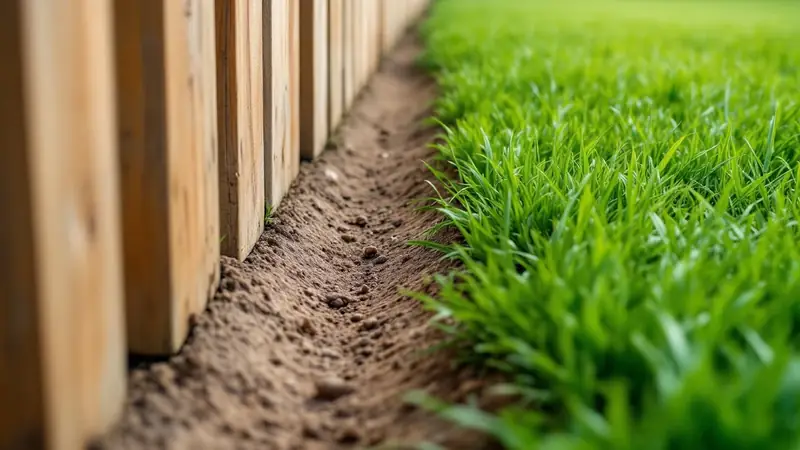
Nebraska Extension lists the places compaction shows up first: hard-packed soil at garden gates, along driveways and sidewalks, and along the inside of fences where dogs run. Compaction also slows water soaking in (Nebraska), and Kansas State says compacted lawns turn thin and yellow-green, hold up poorly to traffic and wilt sooner in heat. Kansas State’s table of how deep different activities compact soil explains why some lawns need more than a standard aeration can deliver:
| Cause of compaction | Depth affected | Can a 3-inch core reach it? |
|---|---|---|
| Children playing | Upper 1 inch | Yes |
| Dogs | Upper 1 inch | Yes |
| Sports activities | Upper 2 inches | Yes |
| Parking cars on the lawn | Upper 3 inches | Barely |
| Heavy construction equipment | Upper 6 inches | No; repeated aeration or renovation |
Two quick checks you can do yourself:
- The screwdriver test. Push a long screwdriver into moist soil with steady pressure. If it goes in easily, compaction is unlikely to be the problem. University of Illinois Extension calls this a “seat of the pants” test: soil moisture changes the result, so test when the soil is evenly moist and use the same force each time.
- The thatch wedge. Cut a small wedge of turf down to the soil with a knife. Kansas State says a thatch layer over 1/2 inch is a problem; Purdue recommends several dethatching passes at 0.5 inch or more, and Penn State sets the dethatching threshold at 1 inch.
Is it worth doing? The best evidence is about water and roots. In the Georgia field study, hollow-tine aeration produced the largest increase in rooting, and repeated aeration a long-term increase in water infiltration (Henry et al., 2025). Oregon State Extension reports that its research found lawns can use 20 to 30 percent less water after aeration. For an uncompacted lawn on sandy or loamy soil, the payoff is small.
Dethatching: when to add it, and what it costs
Dethatching (power raking) removes the spongy layer of stems and roots between the grass and the soil. It is more destructive than aeration and costs more: Stellar charges $199 up to 5,000 sq ft, Evergreen $180 up to 2,000 sq ft plus $70 per 1,000, Harbor Design $360 up to 2,000 sq ft plus $60 per 1,000, and Earth First starts at $200. For a 5,000 sq ft lawn that is $199 to $540. A lawn comber or dethatcher rents for $60 for four hours or $80 a day (Moore Rental Service).
Skip it on most fescue lawns. Purdue notes that tall fescue and perennial ryegrass rarely develop a thatch problem because of how they grow, and that annual core aeration, with better water and fertilizer management, also reduces thatch over several years. Dethatching earns its cost on Kentucky bluegrass and zoysia lawns with a measured thatch layer over 1/2 inch, done when the grass is actively growing: April or September for bluegrass, summer for zoysia.
What moves a quote, and red flags to watch for
- Turf area, not lot size. Measure the grass you want aerated. Lawn Cowboys, for one, measures lawns from satellite images and prices only the turf.
- Access. Walk-behind machines need room: Doehling Landscape lists a 52-inch minimum gate width, and Harbor Design requires a custom estimate for clearances under 45 inches, slopes, septic tanks or wet areas.
- Passes. A double pass costs about 30 percent more and roughly doubles the holes. Get the pass count in writing.
- Seed rate. For overseeding, ask for pounds per 1,000 sq ft and the variety. Posted packages range from 1 lb to 8 lb.
- Tax and payment terms. Toro Bravo includes Washington sales tax in its posted price; Doehling and SCE add tax; Lawn Cowboys charges $5 to $10 less for cash.
- Sprinklers and shallow lines. Evergreen and Harbor Design both ask customers to mark sprinkler heads and shallow utility lines and say they are not responsible for unmarked items. Flag them before the crew arrives.
Red flags in a quote:
- “Aeration” with no mention of cores or hollow tines. It may be spike or liquid aeration.
- Liquid aeration sold as a replacement for core aeration on compacted soil.
- Aerating a dormant warm-season lawn, or a cool-season lawn in summer heat.
- A price well above every posted price for your size: more than about $325 for core aeration alone on a 10,000 sq ft lawn.
- An annual contract pushed onto a healthy lawn on loam or sand that the extension services would aerate every two to three years.
A price far below the minimums in our table is not necessarily a red flag; some route-based aeration companies run very lean. But ask whether the business carries liability insurance and, where it applies fertilizer or herbicide, a state applicator license. Our guide on how to check a landscaper’s license links each state’s lookup.
For lawn care operators: what a 5,000 sq ft stop costs to run
If you sell aeration, the posted prices above are your market. Here is a rough cost floor for one single-pass stop on a 5,000 sq ft lawn, using public wage data and the same overhead assumption we use across our cost guides.
| Line item | Assumption | Cost |
|---|---|---|
| Machine time | 5,000 sq ft at half the 20,000 sq ft/hr rated speed (our field-efficiency assumption) | 0.5 hr |
| Setup | Flag sprinkler heads, unload and load (our assumption) | 0.25 hr |
| Drive to next stop | Our assumption for a dense route | 0.25 hr |
| Loaded labor | 1.0 hr × $18.82 median wage ÷ 0.70 (wages as share of compensation) | $26.89 |
| Equipment | Rental day rate of $75–$125 as a ceiling on owning cost, ÷ 8 stops a day | $9–$16 |
| Truck, fuel, insurance, overhead and profit | Equal to loaded labor (the ×2 multiplier we use across our cost guides) | $26.89 |
| Cost floor per stop | $63–$70 |
That floor sits right at the bottom of the posted market ($70 to $85 for a small lawn) and explains why almost nobody advertises below it. A second pass adds about half an hour, or roughly $27 at the same rates; Lawn Care Plus charges $25 more for its double pass, almost exactly that. The margin in this service comes from route density and from the overseeding add-on. For more on building prices from labor and overhead, see how to bid landscaping jobs and our landscaper salary data.
Price lists from even a few years ago run low. The consumer price index for gardening and lawn care services rose 63.5 percent from September 2019 to August 2026, against 30.5 percent for all items (BLS CPI, series CUUR0000SEHP02).
- Gardening and lawncare services
- All items
Source: BLS CPI-U, series CUUR0000SEHP02 and CUUR0000SA0, not seasonally adjusted BLS did not publish the lawn care index for September 2022. Aug. 2026 is the latest month available.
Show the numbers
| Gardening and lawncare services | All items | |
|---|---|---|
| Sep 2019 | 100 | 100 |
| Sep 2020 | 102.30 | 101.40 |
| Sep 2021 | 106.50 | 106.80 |
| Sep 2023 | 120.90 | 119.90 |
| Sep 2024 | 133.50 | 122.80 |
| Sep 2025 | 152 | 126.50 |
| Aug 2026 | 163.50 | 130.50 |
For the wider picture of what yard work costs, our landscaping cost guide covers other services, and the Costs section lists every price guide we publish.
Aeration cost questions, answered
How much does it cost to aerate a 4,000 sq ft lawn?
Across 14 posted price lists, $70 to $175, with a median of $105. Most lawns that size fall under a company’s minimum charge, so a 4,000 sq ft lawn costs about the same as a 2,000 sq ft one.
How much to aerate a 2,000 sq ft lawn?
$70 to $155 at posted prices, median $99. You are paying the minimum. If you can borrow a truck, a four-hour aerator rental costs $55 to $85, which saves little on a lawn this small.
What does TruGreen charge to aerate?
TruGreen prices aeration by address through its online quote, and we could not load its pricing pages to verify a published figure in October 2026, so we do not quote one. Compare its quote with the posted market: $85 to $200 for core aeration on 5,000 sq ft and $85 to $325 on 10,000 sq ft, before seed.
Is it expensive to aerate your lawn?
Not by lawn care standards. The median posted price for a 5,000 sq ft lawn is $118, about 2.4 cents per sq ft. Overseeding is what raises the bill: combined packages for the same lawn mostly run $225 to $435, and more where companies use heavy seed rates.
How much should I pay for aeration and overseeding?
For a 5,000 sq ft cool-season lawn, posted packages run $145 to about $600, most between $225 and $435; one Northern Virginia company starts at $250 and one Mid-Atlantic company at $470. Seed rate explains most of the gap, so ask how many pounds of seed per 1,000 sq ft are included.
Is it worth it to get your lawn aerated?
On compacted or clay soil, yes. University of Georgia field research found hollow-tine aeration produced the largest gain in rooting and a long-term increase in water infiltration, and Oregon State Extension reports 20 to 30 percent water savings. On healthy loam or sandy soil, every two to three years is enough.
What month is best to aerate and overseed?
For cool-season lawns, late August through September in most of the North and September to October in the transition zone, with April as a second choice. Warm-season lawns are aerated in late spring and early summer, roughly May through July, according to Kansas State and Clemson Extension.
How much does it cost to seed a 1,000 square foot lawn?
For overseeding, the seed itself costs about $9 to $34 for tall fescue at 3 to 6 lb, or $7 to $12 for Kentucky bluegrass at about 2 lb, at Hancock Seed’s October 2026 prices. Starting a new lawn takes roughly twice the seed.
How we built these numbers
Professional prices. We searched for U.S. lawn care companies that post core aeration prices on their own websites and kept the 14 price structures (13 companies; Lawn Care Plus posts single- and double-pass prices separately) that state a price by lawn size and were current in 2026. We left out cost-guide sites, lead-generation marketplaces, social media posts and two older price lists (one last updated in January 2023, one first posted in 2015). For each company we applied its own formula at each lawn size, rounding partial 1,000 sq ft blocks up. Where a company posts a range for a tier, we used the midpoint. A company that quotes a size on request is left out of that size’s statistics. The middle half is the 25th to 75th percentile (inclusive method). All price pages were checked Oct. 13, 2026. This is a sample of companies that publish prices, which skews toward smaller, route-based operators; national brands that quote by address are not in it.
Calculator. We fitted a base charge plus a per-1,000 rate to the 25th and 75th percentiles at 5,000 and 10,000 sq ft: ($99 to $154) and ($150 to $244). A $50 base with $10 to $20 per 1,000 sq ft gives $100 to $150 at 5,000 sq ft, $150 to $250 at 10,000 and $200 to $350 at 15,000, close to the published middle half at each size; it runs low for lawns under 4,000 sq ft, where flat minimums apply. The overseeding rate of $35 to $70 per 1,000 sq ft was fitted the same way to the posted packages ($225 to $400 at 5,000 sq ft, $400 to $750 at 10,000). The double-pass factor (1.3) comes from Lawn Care Plus’s single- and double-pass prices; the three-pass factor (1.6) is our extrapolation. The condition factor multiplies the whole service line, including seed, which overstates the seed share slightly.
Seed, rental and operator costs. Seed cost per 1,000 sq ft = overseeding rate × price per pound, with the low end at the low rate and the 50 lb bag price and the high end at the high rate and the 10 lb bag price. Rental rates are the stores’ posted rates before tax and damage waiver. The operator build-up uses the BLS national median wage, the BLS share of wages in total compensation, and three time assumptions that are ours, not measurements. CPI comparisons use not-seasonally-adjusted index values for September 2019 and August 2026, the latest month published.
This page is general information, not professional advice. Prices change; confirm current rates with the companies and rental stores linked here. Follow the label on any fertilizer or herbicide, and check your state’s rules before hiring someone to apply them.
Sources
- Lawn Care Plus Inc., Single Pass Lawn Aeration (price by lawn size), Checked Oct. 13, 2026. Accessed October 2026.
- Lawn Care Plus Inc., Double Pass Aeration (Cross-Hatch), Checked Oct. 13, 2026. Accessed October 2026.
- Lawn Care Plus Inc., Liquid Soil Aeration, Checked Oct. 13, 2026. Accessed October 2026.
- Lawn Care Plus Inc., Lawn Overseeding & Soil Treatment Package, Checked Oct. 13, 2026. Accessed October 2026.
- Lawn Cowboys, Service Pricing, Checked Oct. 13, 2026. Accessed October 2026.
- Outdoor Legacy, Sprinkler, Aeration & Landscaping Services (prices), Checked Oct. 13, 2026. Accessed October 2026.
- Stellar Property Maintenance, Fall aeration, overseeding and dethatching prices, Checked Oct. 13, 2026. Accessed October 2026.
- Doehling Landscape Services, Lawn Aeration Services in Shakopee, MN, Checked Oct. 13, 2026. Accessed October 2026.
- Yard Boss, Aeration & Overseeding (pricing), Page updated Oct. 5, 2026; checked Oct. 13, 2026. Accessed October 2026.
- Evergreen Lawn Aeration & Thatching, Services & Pricing, Page updated Sept. 28, 2026; checked Oct. 13, 2026. Accessed October 2026.
- Harbor Design, Lawn Care Program (pricing), Checked Oct. 13, 2026. Accessed October 2026.
- Toro Bravo Lawn, Lawn Aeration (price by lawn size), Checked Oct. 13, 2026. Accessed October 2026.
- Earth First Lawn Care, Bellingham Aeration and Overseeding (prices), Checked Oct. 13, 2026. Accessed October 2026.
- SCE Lawn Care, Core Aeration (prices), Checked Oct. 13, 2026. Accessed October 2026.
- Lawn Panther, Lawn Aeration Service in NC (prices), Page updated Oct. 1, 2026; checked Oct. 13, 2026. Accessed October 2026.
- Denmark Lawn, Core aeration and top dressing in Fort Worth (published pricing), Checked Oct. 13, 2026. Accessed October 2026.
- Lawngevity, Lawn Aeration & Overseeding in East TN, Checked Oct. 13, 2026. Accessed October 2026.
- Lawn Theory, Liquid Aeration vs Core Aeration in Northern Virginia (prices), Checked Oct. 13, 2026. Accessed October 2026.
- Green Lawn Fertilizing, How Much Does Aeration and Seeding Cost?, Updated Sept. 22, 2026; checked Oct. 13, 2026. Accessed October 2026.
- Burns Tool Rentals, Aerator, core (rental rates), Checked Oct. 13, 2026. Accessed October 2026.
- McAuliffe’s Rental, Lawn Aerator, 19 inch walk behind, Checked Oct. 13, 2026. Accessed October 2026.
- Taylor Rental Concord, Aerator rentals (rates and specifications), Checked Oct. 13, 2026. Accessed October 2026.
- Wally’s Rentals, Aerator, lawn (rental rates), Checked Oct. 13, 2026. Accessed October 2026.
- Airport Rental, Powered core aerator (rental rates), Checked Oct. 13, 2026. Accessed October 2026.
- Moore Rental Service, Lawn aerator (rental rates), Checked Oct. 13, 2026. Accessed October 2026.
- Moore Rental Service, Lawn Aerator Rental Arlington TX, Checked Oct. 13, 2026. Accessed October 2026.
- Rental Stops, Lawn aerator 18 inch (rental rates), Checked Oct. 13, 2026. Accessed October 2026.
- Taylor Rental (Hillsdale and Ridgewood, N.J.), Aerator, Bluebird (rental rates and rating), Checked Oct. 13, 2026. Accessed October 2026.
- Longenecker’s, Aerator, stand-on with spreader (rental rates and specifications), Checked Oct. 13, 2026. Accessed October 2026.
- Hancock Seed, Titan RX Turf Type Tall Fescue (product price page), Price checked Oct. 13, 2026. Accessed October 2026.
- Hancock Seed, Hancock’s Kentucky Bluegrass (product price page), Price checked Oct. 13, 2026. Accessed October 2026.
- Purdue Extension, AY-8: Mowing, Dethatching, Aerifying and Rolling Turf, Current web edition. Accessed October 2026.
- Penn State Extension, Tips to Improve Your Lawn Care Program This Fall, Current web article. Accessed October 2026.
- Penn State Extension, Lawn Management through the Seasons, Current web article. Accessed October 2026.
- Kansas State Research and Extension (J. Hoyle and R. Braun), MF2130, Aerating Your Lawn, February 2018. Accessed October 2026.
- K-State Research and Extension, Johnson County, September: Core Aerate the Lawn, Undated web article. Accessed October 2026.
- K-State Research and Extension, Johnson County, Lawn Seeding in the Fall, Undated web article. Accessed October 2026.
- Nebraska Extension in Lancaster County, Getting Your Lawn Ready for Summer: Aeration, Undated web article. Accessed October 2026.
- University of Nebraska-Lincoln Turfgrass Science, Updated information on lawn aerification, Undated web article. Accessed October 2026.
- Iowa State University Extension and Outreach, Core Aeration of Lawns, Undated web article. Accessed October 2026.
- Clemson University, Healthy lawns in South Carolina: Why aeration matters, Clemson News. Accessed October 2026.
- University of Georgia, Stay on Schedule to Maintain Healthy Turfgrass, July 21, 2020. Accessed October 2026.
- UGA Extension, Fulton County, May Lawn Care Update, May 2025. Accessed October 2026.
- University of Georgia CAES Field Report, Stimulate lawn growth early with aerification, Undated web article. Accessed October 2026.
- Oregon State University Extension Service, Best time to aerate?, Ask Extension. Accessed October 2026.
- Colorado State University Extension, PlantTalk Colorado, 1545: Liquid Lawn Aeration, Current web edition. Accessed October 2026.
- University of Illinois Extension, How often to aerate a lawn (Ask Extension), Archived Q&A. Accessed October 2026.
- NC State Extension, Tall Fescue Lawn Maintenance Calendar, Current web edition. Accessed October 2026.
- Henry, G.M., Wang, C.J., Begitschke, E.G., and Tucker, K.A., Agronomy Journal 117(3), Hybrid bermudagrass and soil response to liquid aeration compared with hollow-tine cultivation, Published 2025. Accessed October 2026.
- U.S. Bureau of Labor Statistics, Occupational Employment and Wage Statistics, landscaping and groundskeeping workers (37-3011), national and state, May 2025. Accessed October 2026.
- U.S. Bureau of Labor Statistics, Employer Costs for Employee Compensation, June 2026. Accessed October 2026.
- U.S. Bureau of Labor Statistics, CPI-U, Gardening and lawncare services (CUUR0000SEHP02), and all items (CUUR0000SA0), September 2019 to August 2026. Accessed October 2026.