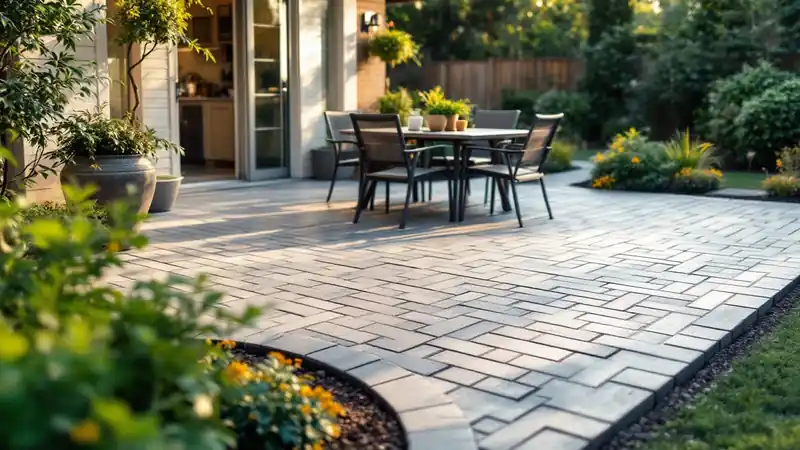
Short answer: A professionally installed concrete paver patio costs roughly $29 to $45 per square foot, by our estimate: about $4,300 to $6,300 for a 12×12 (144 sq ft) and $11,600 to $16,800 for a 20×20 (400 sq ft). Materials are only $6.50 to $11 per sq ft; labor, excavation, equipment and overhead make up the rest.
$29–$45 per sq ft installed, standard concrete pavers (estimate; see method)
$10,500 average landscape-professional price for an 18×16 paver patio (NALP members, NAR 2023 report)
95% of that cost Realtors estimate a seller recovers at sale (NAR 2023)
+47.3% producer prices for concrete pavers, Aug 2019 to Aug 2026 (BLS PPI)
Most paver patio cost pages give one per-square-foot range and stop. This one builds the price from the bottom: the base depth the industry’s own technical standard calls for, published 2026 prices for each layer from supply yards in four regions, and the one primary survey of what landscape contractors actually charge for a paver patio. Every figure links to where it came from, and the arithmetic is in the method note near the end.
Paver patio cost by size: 10×10, 12×12, 200, 400 and 1,000 sq ft
These are the sizes people search for. The installed columns combine our sourced material costs with a labor-and-overhead component anchored to the National Association of Landscape Professionals member survey in NAR’s 2023 Remodeling Impact Report: Outdoor Features, which priced an 18×16 concrete paver patio at $10,500. The ranges assume a 4-inch compacted base over reasonably drained soil, the minimum the paver industry’s construction standard sets for patios.
| Patio size | Area | Materials only | Installed: standard concrete pavers | Installed: premium concrete or natural stone |
|---|---|---|---|---|
| 10×10 | 100 sq ft | $700–$1,100 | $3,000–$4,500 | $3,300–$5,000 |
| 12×12 | 144 sq ft | $1,000–$1,500 | $4,300–$6,300 | $4,700–$7,100 |
| 10×20 | 200 sq ft | $1,400–$2,100 | $5,900–$8,600 | $6,400–$9,700 |
| 16×16 | 256 sq ft | $1,700–$2,700 | $7,500–$10,900 | $8,200–$12,300 |
| 18×16 | 288 sq ft | $1,900–$3,000 | $8,400–$12,200 | $9,200–$13,800 |
| 20×20 | 400 sq ft | $2,700–$4,100 | $11,600–$16,800 | $12,700–$19,100 |
| 25×40 | 1,000 sq ft | $6,500–$10,100 | $28,600–$41,500 | $31,300–$47,000 |
Two things stand out. First, the per-square-foot price barely falls with size: a 1,000 sq ft patio still lands around $29 to $41 per sq ft, because almost every hour of work (digging, hauling, compacting, laying, cutting) scales with area. Second, swapping standard pavers for premium concrete ones adds less than people expect, about $200 to $400 on a 12×12, because the pavers themselves are a minority of the bill.
Small patios are where our model is weakest. Contractors carry fixed costs per job (travel, equipment trailering, a minimum day) that a per-square-foot build can’t see, so a 10×10 quoted above $4,500 isn’t necessarily padded. For the bigger picture of yard budgets, see our landscaping cost breakdown.
What the industry standard says goes under the pavers
The technical body for segmental paving is the Interlocking Concrete Pavement Institute (ICPI), which now operates within the Concrete Masonry and Hardscapes Association (CMHA). Its construction bulletin, Tech Note PAV-TEC-002-22, Construction of Interlocking Concrete Pavements (formerly ICPI Tech Spec 2), sets the cross-section that drives most of your cost:
- Pavers: units 2 3/8 in. (60 mm) thick for pedestrian areas, patios and driveways.
- Aggregate base: “Sidewalks, patios and pedestrian areas should have a minimum base thickness (after compaction) of 4 in. (100 mm) over well-drained soils.” Colder climates and continually wet or weak soils need thicker bases. Base goes down in 4 to 6 in. lifts, each compacted with a plate compactor.
- Subgrade: compacted to at least 98 percent of standard Proctor density (ASTM D698).
- Bedding sand: ASTM C33 concrete sand screeded to a nominal 1 in. (25 mm). The bulletin says stone dust and screenings should not be used.
- Slope: at least 1.5 percent so water runs off.
The companion bulletin on edge restraints (PAV-TEC-003-22) adds two cost items quotes often skip. The base should extend past the edge restraint by at least its own thickness, so a 4-inch base runs 4 inches wider than the patio on every side. And flat plastic or metal landscape edging “is not an acceptable restraint”; the restraint must be made for pavers and spiked into the base. A house wall can serve as the restraint on that side.
Total depth for a standard patio is about 7.4 inches (2.4 in. paver, 1 in. sand, 4 in. base). On a 12×12 with the base extension, that is roughly 3.7 cubic yards of soil to dig out and haul away; a 6-inch base raises it to about 4.9 cubic yards.
Paver patio cost per square foot, layer by layer
Here is what each layer costs at published 2026 prices, converted to dollars per square foot of finished patio. The pallet coverages, bag coverages and weights come from the sellers’ and manufacturers’ own pages.
| Layer | Published price (October 2026) | Cost per sq ft of patio |
|---|---|---|
| 60 mm concrete pavers (Holland/rectangle) | $529–$539 per 120 sq ft pallet (Cummin, Atlanta); $3.97 per triple Holland paver at 1.57 per sq ft (Mutual Materials, WA) | $4.63–$6.85 incl. 5–10% cutting waste |
| Premium concrete pavers | $855.57 per 120 sq ft (Belgard Dimensions 12) to $841.07 per 112.5 sq ft (Origins 18) (Cummin) | $7.13–$7.48 before waste |
| Natural stone | $7.00 per sq ft gray sandstone; $11.25 per sq ft 1.5 in. Pennsylvania bluestone (Cummin) | $7.00–$11.25 before waste |
| Aggregate base, 4 in. compacted | $38.50 per ton #304 limestone (Bzak, Cincinnati area); $59 per cubic yard crusher run (Cummin); $99.99 per cubic yard crushed limestone (Houston) | $1.04–$2.00 (6 in. base: $1.56–$3.00), plus the extension past the edges |
| Bedding sand, 1 in. | $34 per ton coarse sand (Bzak); $64.99 per cubic yard torpedo/concrete sand (Houston) | $0.13–$0.20 |
| Polymeric joint sand | $41 and $42 per 50 lb bag; 65–85 sq ft per bag on 2 3/8 in. pavers with narrow joints (Alliance Gator spec) | $0.48–$0.65 |
| Edge restraint | $12 per 7 ft 8 in. Paver Rail Flex; $0.60 per 10 in. spike (Cummin) | $2.17 per linear ft, or $0.54–$0.72 per sq ft on a 12×12 |
| Geotextile (optional, for wet, clay or freeze-thaw soils) | $79 per 12.5 x 27 ft woven roll (Cummin) | about $0.23 |
| Delivery | $75–$100 per load by ZIP code (Bzak) | $150–$300 per job (2 to 3 loads) |
| Labor, excavation, disposal, equipment, overhead, profit | Residual of the NALP survey price after materials | $21.90–$31.10 |
Add it up and a standard concrete paver patio needs about $6.50 to $11 per sq ft of material. The single biggest swing inside that is the base aggregate, and it is mostly geography and trucking. The U.S. Geological Survey puts the average 2025 value of crushed stone at $18.50 per metric ton at the quarry; the cheapest yard price we found was more than double that before delivery, and the Houston price per yard was higher again.
4-inch or 6-inch base: what the extra depth costs
CMHA’s 4-inch figure is a minimum for well-drained soil. On clay, wet sites or in cold-winter states, the bulletin says bases need to be thicker, and many installers quote 6 inches or more. Going from 4 to 6 inches adds about $0.50 to $1.00 per sq ft of aggregate at our prices, plus 2 more inches of excavation and one more compacted lift. On a 12×12, that is roughly $85 to $160 in stone. It is the cheapest insurance in the job; settling and heaving are almost always base failures, not paver failures.
Why labor is 60 to 74 percent of the price
The only primary, contractor-side price we could find for a paver patio comes from NALP members surveyed for NAR’s 2023 Remodeling Impact Report: Outdoor Features: a backyard 18×16 concrete paver patio, dry set over compacted gravel and sand, with paving material at $7 to $10 per sq ft, averaged $10,500. That is $36.46 per sq ft.
Price that same patio’s materials at the 2026 figures above and they come to $2,760 to $4,180. The remaining $6,300 to $7,700 (60 to 74 percent) covers digging, hauling spoil, compacting, screeding, laying, cutting, equipment, insurance, overhead and profit. A paver manufacturer’s materials are the smaller share of any quote.
The tonnage explains why. A 12×12 patio needs about 3,700 lb of pavers (Cummin lists a 120 sq ft pallet at roughly 3,120 lb), about 8,700 lb of base and about 1,100 lb of bedding sand: close to 6.7 tons, before any soil comes out. CMHA’s mechanical installation bulletin (PAV-TEC-011) notes that “with manual installation, most crew members move between 7 and 10 tons of material per day.” Machines only pay off at scale (CMHA says they are used on projects as small as 10,000 sq ft), so residential patios are laid by hand.
Labor has also become more expensive. Average hourly earnings in the landscaping services industry rose from $20.15 in 2019 to $27.63 in 2025, a 37.1 percent increase, and reached $28.78 in August 2026 (preliminary), according to BLS Current Employment Statistics. If you want to see what crews themselves are paid, our landscaper salary data breaks it down by state.
Paver and gravel prices have outrun inflation since 2019
If a quote looks high next to a price you remember from a few years ago, the producer price data backs it up. From August 2019 to August 2026, BLS’s producer price index for concrete pavers rose 47.3 percent and the index for construction sand, gravel and crushed stone rose 60.7 percent. Consumer prices overall rose 30.6 percent over the same months.
| Price index | Aug 2019 | Aug 2026 | Change |
|---|---|---|---|
| Concrete pavers, PPI (WPU133141) | 227.8 | 335.6 | +47.3% |
| Construction sand, gravel and crushed stone, PPI (WPU1321) | 349.8 | 562.2 | +60.7% |
| Ready-mix concrete, PPI (WPU1333) | 282.3 | 395.2 | +40.0% |
| All items, CPI-U (CUUR0000SA0) | 256.6 | 335.0 | +30.6% |
Since August 2023 alone, concrete paver producer prices are up 10.8 percent and aggregates 21.7 percent, which is one reason we treat the 2023 NALP price as a floor rather than a midpoint.
How much location changes the price
Two inputs move by region: aggregate (trucking distance from a quarry) and labor. The base-stone prices above already span almost 2 to 1, from about $1.04 per sq ft in the Cincinnati area to $2.00 in Houston for a 4-inch base. Paver list prices ran about 35 percent higher at the Seattle-area manufacturer than at the Atlanta yard.
For labor, the cleanest public benchmark is the median wage for landscaping and groundskeeping workers in each metro from BLS Occupational Employment and Wage Statistics, May 2025. The national median is $18.82 an hour.
| Metro area | Median hourly wage, landscaping workers | Versus U.S. median |
|---|---|---|
| Boston-Cambridge-Newton, MA-NH | $23.57 | +25% |
| Seattle-Tacoma-Bellevue, WA | $23.31 | +24% |
| San Francisco-Oakland-Fremont, CA | $23.10 | +23% |
| Minneapolis-St. Paul-Bloomington, MN-WI | $22.67 | +20% |
| Denver-Aurora-Centennial, CO | $22.25 | +18% |
| New York-Newark-Jersey City, NY-NJ | $21.89 | +16% |
| Chicago-Naperville-Elgin, IL-IN | $21.77 | +16% |
| Los Angeles-Long Beach-Anaheim, CA | $21.46 | +14% |
| Phoenix-Mesa-Chandler, AZ | $18.82 | 0% |
| Cincinnati, OH-KY-IN | $18.56 | -1% |
| Atlanta-Sandy Springs-Roswell, GA | $18.51 | -2% |
| Miami-Fort Lauderdale-West Palm Beach, FL | $17.99 | -4% |
| Houston-Pasadena-The Woodlands, TX | $17.44 | -7% |
Wages are not the whole installation component (equipment, insurance and overhead are in there too), so treat these as a direction, not a multiplier. As a rough upper bound, if the $21.90 to $31.10 installation component moved one for one with wages, Boston or Seattle would sit about $5 to $8 per sq ft above our national range and Houston about $2 below it. Before signing, check the installer’s credentials with our guide to verifying a landscaper’s license; rules vary, as our state-by-state licensing table shows.
DIY paver patio cost: what you save and what you take on
Doing it yourself removes the $21.90 to $31.10 per sq ft installation component but not the work. A DIY 12×12 runs about $1,150 to $1,850 in materials and delivery at the prices above, plus tool rental: CMHA’s bulletin calls for compacting base lifts with a plate compactor (it cites 7,000 lbf reversible compactors for 4 to 6 in. lifts, and thinner lifts for 5,000 lbf machines), and most patios need a masonry saw for cuts. In NAR’s 2023 survey, 40 percent of consumers across all the outdoor projects did the entire job themselves.
The trade-off is in the base. Undercompacted subgrade, stone dust used as bedding, or landscape edging used as a restraint are the specific shortcuts the CMHA bulletins warn against, and each one shows up later as settling, rutting or spreading joints. If you are pricing a raised patio, the walls are a separate line item; see our retaining wall cost guide.
Do you need a permit for a paver patio?
Usually not a building permit, but often a zoning or stormwater sign-off. Patios at grade are commonly exempt from building permits, while hard-surface limits and setbacks are handled by zoning. Real examples from local and state rules:
- Prince William County, Virginia: lists “concrete (patio) slabs on grade that are not designed to support a future building addition” under work that does not need a building permit, with a note that zoning and/or watershed approval will be required (county Building Development Division).
- Minnesota (statewide building code): exempts “sidewalks and driveways that are not part of an accessible route” and low decks (no more than 30 inches above grade and not attached to a structure with frost footings) from building permits; patios are not named separately (Minn. R. 1300.0120, subp. 4).
- Shorewood, Minnesota: most residential lots are capped at 33 percent impervious coverage (25 percent within 1,000 ft of a lake), permeable pavers count as impervious, and projects adding 1,000 sq ft or more of impervious surface at once must submit a stormwater management plan (city handout).
- Stafford Township, New Jersey: pavers and patios need a zoning permit ($25 fee) with a survey showing the new surface, and patios must sit at least 3 ft from any property line (township instructions).
- Lake Stevens, Washington: lots developed before April 1, 2020 may cover at most 40 percent of the lot with impervious surface, and patios are listed as impervious (city fact sheet).
The pattern: building officials rarely care about an at-grade patio; planning and stormwater staff often do. A permeable paver system does not automatically get around a coverage cap, as Shorewood’s rule shows.
This page is general information, not legal advice. Permit and zoning rules change and vary by parcel; confirm with your city or county building and zoning offices before you build or sign a contract.
How we built these numbers
We have no job data of our own. We compiled published prices from four sellers’ websites on October 7, 2026 and quantities from CMHA’s construction bulletins, then anchored installation to the NALP survey in NAR’s 2023 report.
Materials per sq ft: pavers $4.41 (Cummin, $529/120 sq ft) to $6.23 (Mutual Materials, $3.97 x 1.57 per sq ft) with 5 to 10 percent waste; base at 4 in. compacted, using Cummin’s statement that a cubic yard of crusher run (about 2,700 lb) covers about 100 sq ft at 2 in., i.e., 50 sq ft and 54 lb per sq ft at 4 in.: low $38.50/ton x 54 lb = $1.04 (Bzak), high $99.99 / 50 = $2.00 (Houston); base area is (length + 8 in.) x (width + 8 in.) per CMHA’s base-extension rule; sand at 1 in. (1 cubic yard per 324 sq ft): $34/ton x 1.2 tons/yd / 324 = $0.13 to $64.99 / 324 = $0.20; polymeric sand $41/85 = $0.48 to $42/65 = $0.65; edge restraint $12/7.67 ft + one $0.60 spike per foot (our assumption; CMHA defers to the maker’s spacing) = $2.17 per linear ft, on three sides (house wall as the fourth) at the low end and four at the high end; delivery $150 to $300.
Installation component: NALP’s $10,500 for 288 sq ft minus that patio’s materials at the low and high inputs (with the survey’s $7 to $10 paving material) leaves $6,319 to $7,737, or $21.94 to $26.87 per sq ft. We kept $21.90 as the low end and escalated the high end by the change in BLS landscaping average hourly earnings from 2022 ($24.90) to August 2026 ($28.78), giving $31.10. Installed estimate = materials + delivery + area x $21.90 to $31.10.
Limits: one survey anchors the labor side; it reflects contractor estimates for a typical-quality patio on an average lot, not bids for your site. Access, slope, demolition of an old slab, soil export distance, steps, curves and borders all push real quotes up. Seller prices are list prices on one date and exclude sales tax.
Paver patio questions, answered
How much does a 200 square foot paver patio cost?
About $5,900 to $8,600 installed with standard concrete pavers by our estimate, or $6,400 to $9,700 with premium concrete or natural stone. Materials alone run about $1,400 to $2,100 plus delivery.
How much to install 1000 sq ft of pavers?
Roughly $28,600 to $41,500 for a 1,000 sq ft patio in standard concrete pavers, and $31,300 to $47,000 in premium or natural stone. Per square foot it is only slightly cheaper than a small patio because nearly all the labor scales with area. Projects this size can also trigger stormwater review; Shorewood, Minnesota requires a stormwater plan at 1,000 sq ft of new impervious surface.
Is a paver patio cheaper than concrete?
We could not find a primary, published installed price for a poured concrete patio, so we don’t put a number on the gap. What the data does show: ready-mix concrete producer prices rose 40.0 percent from August 2019 to August 2026, less than concrete pavers (47.3 percent). A paver patio’s cost is dominated by the base and hand labor described above, which a poured slab replaces with forming and finishing.
Do paver patios add value to a house?
In NAR’s 2023 Outdoor Features report, Realtors estimated a new paver patio adds $10,000 in value against a $10,500 cost, a 95 percent cost recovery. Homeowners who built one gave it a “Joy Score” of 9.9 out of 10. Those are estimates, not sale-price data.
How much does a 20×20 paver patio cost?
A 20×20 is 400 sq ft: about $11,600 to $16,800 with standard concrete pavers and $12,700 to $19,100 with premium pavers or natural stone, by our estimate. Doing it yourself, materials and delivery come to about $2,800 to $4,400 before tool rental.
More pricing guides live on our costs hub.
Sources
- Concrete Masonry & Hardscapes Association (ICPI), PAV-TEC-002-22: Construction of Interlocking Concrete Pavements, Revised 2022. Accessed October 2026.
- Concrete Masonry & Hardscapes Association (ICPI), PAV-TEC-003-22: Edge Restraints for Interlocking Concrete Pavements, Revised 2022. Accessed October 2026.
- Concrete Masonry & Hardscapes Association (ICPI), PAV-TEC-011: Mechanical Installation of Interlocking Concrete Pavements, Revised 2021. Accessed October 2026.
- National Association of REALTORS and National Association of Landscape Professionals, 2023 Remodeling Impact Report: Outdoor Features, March 2023. Accessed October 2026.
- Cummin Landscape Supply (Atlanta, GA), Holland Stone 60mm paver, pallet price and weight, Price checked Oct 7, 2026. Accessed October 2026.
- Cummin Landscape Supply (Atlanta, GA), Pavers and retaining wall price list (Belgard, natural stone), Prices checked Oct 7, 2026. Accessed October 2026.
- Cummin Landscape Supply (Atlanta, GA), Gravel and sand products (crusher run, sand), Prices checked Oct 7, 2026. Accessed October 2026.
- Cummin Landscape Supply (Atlanta, GA), Hardscape accessories (Paver Rail, spikes, geotextile), Prices checked Oct 7, 2026. Accessed October 2026.
- Cummin Landscape Supply (Atlanta, GA), Pavermate polymeric sand, 50 lb, Price checked Oct 7, 2026. Accessed October 2026.
- Mutual Materials (Washington), Holland Series Concrete Pavers, Price checked Oct 7, 2026. Accessed October 2026.
- Mutual Materials (Washington), PolySweep Polymeric Joint Sand, Price checked Oct 7, 2026. Accessed October 2026.
- Bzak Landscaping (Ohio), 304 Limestone, Price checked Oct 7, 2026. Accessed October 2026.
- Bzak Landscaping (Ohio), Coarse Sand, Price checked Oct 7, 2026. Accessed October 2026.
- Bzak Landscaping (Ohio), Delivery Charges, Checked Oct 7, 2026. Accessed October 2026.
- Texas Garden Materials (Houston, TX), Crushed Limestone 1.5 in. minus, price per cubic yard, Price checked Oct 7, 2026. Accessed October 2026.
- Texas Garden Materials (Houston, TX), Torpedo Sand, price per cubic yard, Price checked Oct 7, 2026. Accessed October 2026.
- Alliance Designer Products, Gator Maxx G2 polymeric sand: coverage, Checked Oct 7, 2026. Accessed October 2026.
- U.S. Geological Survey, Mineral Commodity Summaries 2026: Stone (Crushed), 2025 estimates. Accessed October 2026.
- U.S. Bureau of Labor Statistics, Producer Price Index, nonmetallic mineral products (WPU133141, WPU1321, WPU1333), Aug 2019 to Aug 2026 (Aug 2026 preliminary). Accessed October 2026.
- U.S. Bureau of Labor Statistics, Consumer Price Index, all items, U.S. city average (CUUR0000SA0), Aug 2019 to Aug 2026. Accessed October 2026.
- U.S. Bureau of Labor Statistics, Current Employment Statistics, landscaping services average hourly earnings (CEU6056173003, CES6056173003), 2019 to Aug 2026 (Aug 2026 preliminary). Accessed October 2026.
- U.S. Bureau of Labor Statistics, Occupational Employment and Wage Statistics, SOC 37-3011, metropolitan areas, May 2025. Accessed October 2026.
- Prince William County, Virginia, Do I Need a Permit?, Checked Oct 7, 2026. Accessed October 2026.
- Minnesota Office of the Revisor of Statutes, Minn. R. 1300.0120, Permits (subp. 4, work exempt from permit), Checked Oct 7, 2026. Accessed October 2026.
- City of Shorewood, Minnesota, Impervious Surface Frequently Asked Questions, Checked Oct 7, 2026. Accessed October 2026.
- Stafford Township, New Jersey, Zoning Permit Instructions for Impervious Surfaces, Checked Oct 7, 2026. Accessed October 2026.
- City of Lake Stevens, Washington, Permeable Hard Surface Fact Sheet, Checked Oct 7, 2026. Accessed October 2026.