Short answer: How much mulch do I need? Square feet × depth in inches ÷ 324 = cubic yards. At 3 inches, one cubic yard covers 108 sq ft and one 2 cu ft bag covers 8 sq ft, so a 200 sq ft bed needs about 1.85 yards or 25 bags. A yard equals 13.5 two-cubic-foot bags.
324 sq ft covered by one cubic yard at 1 inch deep; 108 sq ft at 3 inches (Clemson HGIC)
13.5 bags of 2 cu ft mulch in a cubic yard; 18 bags of 1.5 cu ft (arithmetic)
2–3 in. for fine wood and bark mulch in beds, up to 4 in. for coarse nuggets and chips (Clemson, ISA)
12 in. initial fill under play equipment, to hold 9 inches after compression (CPSC)
How much mulch do I need? The arithmetic takes one line, and most online mulch calculators stop there. They leave out three things that change the order: the right depth for the mulch you are buying, how much of last year’s layer is still on the bed, and the gap between a bag’s printed volume and a bulk yard. This guide gives the formula and a ready-made coverage chart, then the depths published by university extension services, the International Society of Arboriculture and the Consumer Product Safety Commission. It also covers tree rings, pine straw bales, pallet counts and the point where bulk beats bags. The calculator turns your area and depth into cubic yards, cubic feet and bag counts for 1.5, 2 and 3 cu ft bags, then into a budget using supplier prices checked in October 2026. Prices for other yard projects are on our cost guides hub.
Mulch coverage chart: yards and bags for 14 bed sizes
Find your bed size, read across to your depth. Each cell gives cubic yards for a bulk order and the number of 2 cu ft bags, rounded up. A 10 × 10 ft bed (100 sq ft) at 3 inches takes 0.93 yards or 13 bags, which is where the rule of thumb “one yard covers about 100 square feet at 3 inches” comes from. The exact figure is 108 sq ft.
Swipe the table sideways to see every column.
| Bed area | 2 in. deep | 3 in. deep | 4 in. deep |
|---|---|---|---|
| 50 sq ft | 0.31 yd · 5 bags | 0.46 yd · 7 bags | 0.62 yd · 9 bags |
| 100 sq ft | 0.62 yd · 9 bags | 0.93 yd · 13 bags | 1.23 yd · 17 bags |
| 150 sq ft | 0.93 yd · 13 bags | 1.39 yd · 19 bags | 1.85 yd · 25 bags |
| 200 sq ft | 1.23 yd · 17 bags | 1.85 yd · 25 bags | 2.47 yd · 34 bags |
| 250 sq ft | 1.54 yd · 21 bags | 2.31 yd · 32 bags | 3.09 yd · 42 bags |
| 300 sq ft | 1.85 yd · 25 bags | 2.78 yd · 38 bags | 3.70 yd · 50 bags |
| 400 sq ft | 2.47 yd · 34 bags | 3.70 yd · 50 bags | 4.94 yd · 67 bags |
| 500 sq ft | 3.09 yd · 42 bags | 4.63 yd · 63 bags | 6.17 yd · 84 bags |
| 750 sq ft | 4.63 yd · 63 bags | 6.94 yd · 94 bags | 9.26 yd · 125 bags |
| 1,000 sq ft | 6.17 yd · 84 bags | 9.26 yd · 125 bags | 12.35 yd · 167 bags |
| 1,500 sq ft | 9.26 yd · 125 bags | 13.89 yd · 188 bags | 18.52 yd · 250 bags |
| 2,000 sq ft | 12.35 yd · 167 bags | 18.52 yd · 250 bags | 24.69 yd · 334 bags |
| 3,000 sq ft | 18.52 yd · 250 bags | 27.78 yd · 375 bags | 37.04 yd · 500 bags |
| 5,000 sq ft | 30.86 yd · 417 bags | 46.30 yd · 625 bags | 61.73 yd · 834 bags |
Mulch calculator: area and depth to yards, bags and a budget
Enter your bed area in square feet and pick the depth. The yards and bag counts update as you type; pick the mulch and how you will buy it for the cost line. The calculator multiplies area × depth by a price per square foot per inch, which is the supplier price per cubic yard divided by 324 (or the bag price divided by the square feet one bag covers at 1 inch). To see the quantity behind the dollar figure, use the chart above or the formula below: cubic yards = sq ft × inches ÷ 324, and 2 cu ft bags = sq ft × inches ÷ 24.
- Cubic yards
- 1.85
- Cubic feet
- 50.0
- 2 cu ft bags
- 25
- 1.5 cu ft bags
- 34
- 3 cu ft bags
- 17
Quantity: cubic yards = sq ft × inches ÷ 324; 2 cu ft bags = sq ft × inches ÷ 24. Prices are the middle half of supplier price lists checked Oct. 18, 2026, before tax; some yards have 3 to 5 yard delivery minimums. See How we built these numbers.
Two settings matter more than the mulch type. Pick 1 inch if you are refreshing a bed that still has a layer on it (see topping up an old bed), and leave the delivery fee on only for bulk orders. The bulk prices are the middle half of posted yard prices, so a supplier near you can sit outside the range in either direction.
How much mulch do I need? The formula
Cubic yards of mulch = square feet × depth in inches ÷ 324. The 324 is the number of square feet one cubic yard covers at 1 inch deep: a cubic yard is 27 cubic feet (3 ft × 3 ft × 3 ft), and 27 × 12 inches = 324. For bags, divide the cubic feet you need by the bag size printed on the bag.
The mulch formula, with a worked example
Area: length (ft) × width (ft) = square feet.
Cubic feet: square feet × depth (in) ÷ 12.
Cubic yards: cubic feet ÷ 27, or square feet × depth (in) ÷ 324.
Bags: cubic feet ÷ bag size (cu ft), rounded up.
Example: a bed 25 ft long and 8 ft wide, mulched 3 inches deep. 25 × 8 = 200 sq ft. 200 × 3 ÷ 12 = 50 cubic feet. 50 ÷ 27 = 1.85 cubic yards, so order 2 yards in bulk. In bags: 50 ÷ 2 = 25 bags of 2 cu ft, or 50 ÷ 1.5 = 33.3, rounded up to 34 bags of 1.5 cu ft.
How much mulch per square foot?
One square foot at 3 inches takes 0.25 cubic feet of mulch, or one-eighth of a 2 cu ft bag. At 2 inches it takes 0.17 cubic feet (one-twelfth of a bag) and at 4 inches 0.33 cubic feet (one-sixth of a bag). Clemson University’s Home and Garden Information Center puts the same rule in one sentence: “One cubic yard will cover a 324-square-foot area with an inch of mulch” (Clemson HGIC 1604).
Iowa State University Extension works the same method through a 265 sq ft perennial bed refreshed with 1.5 inches of mulch: 33.1 cubic feet, or 17 bags of 2 cu ft, or 1.23 cubic yards (the page rounds it to 1.22) (Iowa State Extension). The most common slip in forum threads is skipping a conversion: multiplying feet by inches without dividing by 12, or reporting cubic feet as yards.
Before mulching a new grass bed, set the plant spacing: ‘Karl Foerster’ feather reed grass goes in 24 to 36 inches apart, and our Karl Foerster grass planting guide works out plants per row and per 100 sq ft.
How many cubic feet in a yard of mulch?
There are 27 cubic feet in a cubic yard of mulch: a cube 3 feet on each side. Bulk mulch is sold by that cubic yard; bags are labeled in cubic feet. Both are loose volume, so a yard of bulk and 13.5 two-cubic-foot bags should hold the same amount of mulch before it settles.
Measuring beds that are not rectangles
| Bed shape | Area formula (feet) | Example | Area | Mulch at 3 in. |
|---|---|---|---|---|
| Rectangle or square | length × width | 20 ft × 6 ft border | 120 sq ft | 1.11 yd or 15 bags (2 cu ft) |
| Circle | 3.14 × radius × radius (radius = half the diameter) | 10 ft island bed | 78.5 sq ft | 0.73 yd or 10 bags |
| Ring around a tree | 3.14 × (outer radius² minus inner radius²) | 8 ft ring, 1 ft bare circle left at the trunk | 49.5 sq ft | 0.46 yd or 7 bags |
| Triangle (corner bed) | base × height ÷ 2 | 12 ft × 12 ft corner | 72 sq ft | 0.67 yd or 9 bags |
| Kidney or free-form | Split into rectangles, circles and triangles and add them; or take the longest length × average width | 18 ft long, widths 4, 7 and 5 ft | 18 × 5.33 = 96 sq ft | 0.89 yd or 12 bags |
| Strip along a fence or foundation | length × depth of the strip | 60 ft × 3 ft | 180 sq ft | 1.67 yd or 23 bags |
- 2 in. deep
- 3 in. deep
- 4 in. deep
Source: Our arithmetic: sq ft × depth (in) ÷ 324 x axis: bed area in sq ft; values in cubic yards
Show the numbers
| 2 in. deep | 3 in. deep | 4 in. deep | |
|---|---|---|---|
| 100 | 0.62 | 0.93 | 1.23 |
| 200 | 1.23 | 1.85 | 2.47 |
| 300 | 1.85 | 2.78 | 3.70 |
| 400 | 2.47 | 3.70 | 4.94 |
| 500 | 3.09 | 4.63 | 6.17 |
| 750 | 4.63 | 6.94 | 9.26 |
| 1,000 | 6.17 | 9.26 | 12.35 |
| 1,500 | 9.26 | 13.89 | 18.52 |
| 2,000 | 12.35 | 18.52 | 24.69 |
How deep should mulch be? Depth by type and use
For most landscape beds, 2 to 3 inches of fine wood or bark mulch, or 3 to 4 inches of coarse nuggets or chips. Extension services agree on that band and disagree at the edges: Maryland says bark mulch 1 to 3 inches, Morton Arboretum says 3 to 4 inches under trees, and Iowa State says 2 to 4 inches for shredded hardwood. Depth is the biggest lever in your order, since 4 inches takes twice the mulch of 2.
If the bed has drip tubing, lay the line on the soil or weed fabric first and mulch over it, as our drip irrigation system guide explains.
The reason for the ceiling is oxygen. Clemson’s fact sheet says excessive fine-textured mulch “can suffocate plant roots, resulting in yellowing of the leaves and poor growth,” and Iowa State lists “waterlogging, reduced soil oxygen levels, shallow rooting, and overly warm soils in winter” as the costs of a layer that is too deep (Clemson HGIC; Iowa State Extension). Texture sets where in the band you land: fine material packs tight and stays at the low end, coarse material lets air through and can go deeper.
Swipe the table sideways to see every column.
| Mulch or situation | Where | Published depth | 1 cu yd covers | One 2 cu ft bag covers | Source |
|---|---|---|---|---|---|
| Fine-textured wood and bark mulch (most shredded mulches) | Beds, shrubs | 2–3 in. | 108–162 sq ft | 8–12 sq ft | Clemson HGIC |
| Coarse mulch such as pine bark nuggets | Beds, shrubs | up to 4 in. | 81–108 sq ft | 6–8 sq ft | Clemson HGIC |
| Coarse arborist wood chips | Trees, well-drained sites | 3–4 in. | 81–108 sq ft | 6–8 sq ft | ISA |
| Fine or composted mulches | Trees, well-drained sites | 2–3 in. | 108–162 sq ft | 8–12 sq ft | ISA |
| Hardwood chipped or shredded mulch | Garden beds | 2–4 in. | 81–162 sq ft | 6–12 sq ft | Iowa State |
| Finely textured or double-shredded mulch | Around trees | 1–2 in. | 162–324 sq ft | 12–24 sq ft | Penn State |
| Bark mulch or wood chips (Maryland guidance) | Trees and shrubs | 1–3 in. | 108–324 sq ft | 8–24 sq ft | Univ. of Maryland |
| Medium-to-coarse mulch under trees and shrubs | Trees, shrubs | 3–4 in. | 81–108 sq ft | 6–8 sq ft | Morton Arboretum |
| Any mulch, Florida-Friendly landscapes | Florida beds | 2–3 in. | 108–162 sq ft | 8–12 sq ft | UF/IFAS |
| Pine straw (pine needles) | Beds, shrubs, slopes | 2–3 in. | 108–162 sq ft | 8–12 sq ft | Clemson HGIC |
| Grass clippings or shredded leaves | Beds, vegetables | 2 in. maximum | 162 sq ft | 12 sq ft | Clemson HGIC |
| Any organic mulch on wet soil | Poorly drained sites | 2 in. maximum | 162 sq ft | 12 sq ft | ISA |
| Mulch over shallow-rooted plants such as boxwood | Shallow-rooted shrubs | 1 in. maximum | 324 sq ft | 24 sq ft | Univ. of Maryland |
| Wood chips, public playground | Fall zone under equipment | 9 in. compressed; 12 in. initial fill | 27–36 sq ft | 2–2.7 sq ft | CPSC Pub. 325 |
| Wood mulch (non-CCA), public playground | Fall zone under equipment | 9 in. compressed; 12 in. initial fill | 27–36 sq ft | 2–2.7 sq ft | CPSC Pub. 325 |
| Shredded/recycled rubber, public playground | Fall zone under equipment | 6 in. | 54 sq ft | 4 sq ft | CPSC Pub. 325 |
| Wood mulch, chips, EWF or rubber, home playground up to 8 ft | Backyard play sets | 9 in. minimum; 12 in. initial fill | 27–36 sq ft | 2–2.7 sq ft | CPSC Pub. 324 |
Three practical rules fall out of the table. Measure what you will actually buy: a bag of “premium shredded” is fine-textured and belongs at 2 to 3 inches, while pine bark nuggets can go to 4. Go thinner on wet ground; the ISA says more than 2 inches of organic mulch on wet soils “can reduce soil drying” and stress roots (ISA, Proper Mulching Techniques). And treat 3 inches as a ceiling for the total layer, old and new, in Maryland’s guidance: “Organic mulches should not exceed three inches in depth” (University of Maryland Extension).
How many bags of mulch in a yard?
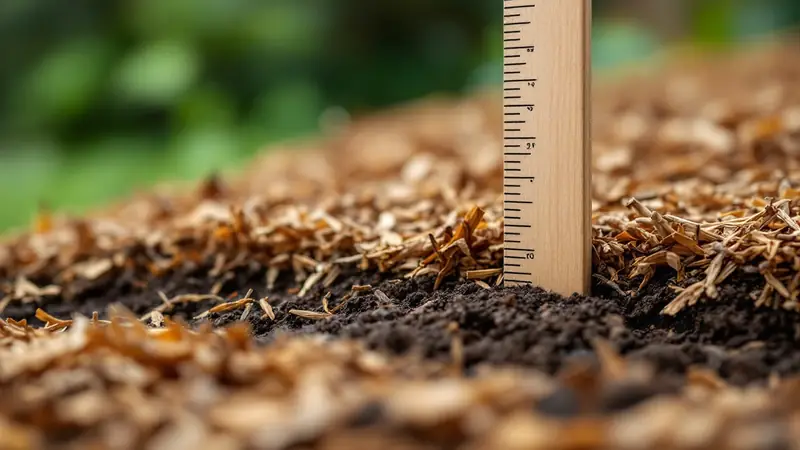
There are 13.5 bags of 2 cu ft mulch in one cubic yard, because a cubic yard holds 27 cubic feet. The other common sizes work the same way: 18 bags of 1.5 cu ft, 9 bags of 3 cu ft and 27 bags of 1 cu ft make a yard. Round up when you buy; half a bag is not for sale.
| Bag size | Bags per cubic yard | Covers at 2 in. | Covers at 3 in. | Covers at 4 in. |
|---|---|---|---|---|
| 1 cu ft | 27 | 6 sq ft | 4 sq ft | 3 sq ft |
| 1.5 cu ft | 18 | 9 sq ft | 6 sq ft | 4.5 sq ft |
| 2 cu ft | 13.5 | 12 sq ft | 8 sq ft | 6 sq ft |
| 3 cu ft | 9 | 18 sq ft | 12 sq ft | 9 sq ft |
| 1 cubic yard (bulk) | 1 | 162 sq ft | 108 sq ft | 81 sq ft |
How much will 20 bags of mulch cover? 25? 70?
Twenty 2 cu ft bags (40 cubic feet) cover 160 sq ft at 3 inches or 240 sq ft at 2 inches. Twenty-five bags (50 cubic feet) cover 200 sq ft at 3 inches. Seventy bags hold 140 cubic feet, which is 5.19 cubic yards: the point where bulk delivery is almost always cheaper.
| Number of 2 cu ft bags | Cubic feet | Cubic yards | Covers at 2 in. | Covers at 3 in. | Covers at 4 in. |
|---|---|---|---|---|---|
| 10 | 20 | 0.74 | 120 sq ft | 80 sq ft | 60 sq ft |
| 20 | 40 | 1.48 | 240 sq ft | 160 sq ft | 120 sq ft |
| 25 | 50 | 1.85 | 300 sq ft | 200 sq ft | 150 sq ft |
| 30 | 60 | 2.22 | 360 sq ft | 240 sq ft | 180 sq ft |
| 40 | 80 | 2.96 | 480 sq ft | 320 sq ft | 240 sq ft |
| 50 | 100 | 3.70 | 600 sq ft | 400 sq ft | 300 sq ft |
| 70 | 140 | 5.19 | 840 sq ft | 560 sq ft | 420 sq ft |
| 100 | 200 | 7.41 | 1,200 sq ft | 800 sq ft | 600 sq ft |
How many bags of mulch on a pallet?
A pallet of 2 cu ft mulch bags holds 60 to 70 bags on the listings we checked, which is 4.4 to 5.2 cubic yards. That is enough for roughly 480 to 560 sq ft at 3 inches. Pallet counts vary by maker and bag weight, so read the listing before you plan around one.
| Listing | Bag size | Bags per pallet | Volume per pallet | Covers at 3 in. |
|---|---|---|---|---|
| Master Landscape Supply, black mulch pallet (Ga.) | 2 cu ft | 70 | 140 cu ft (5.19 yd) | 560 sq ft |
| Cowart premium hardwood (distributor listing) | 2 cu ft | 70 | 140 cu ft (5.19 yd) | 560 sq ft |
| Jolly Gardener hardwood (distributor listing) | 2 cu ft | 65 | 130 cu ft (4.81 yd) | 520 sq ft |
| Whittlessey hardwood (distributor listing) | 2 cu ft | 60 | 120 cu ft (4.44 yd) | 480 sq ft |
| Miracle-Gro Organic pallet (Walmart.com) | 1.5 cu ft | 80 | 120 cu ft (4.44 yd) | 480 sq ft |
| PineStraw.com longleaf pine straw | Bales (9 lb each) | 48 | n/a | 3,000 sq ft at 2 in. (seller’s figure) |
Bag size is the trap. A 1.5 cu ft bag holds 25 percent less than a 2 cu ft bag and can sit on the same shelf at a similar price, so compare the price per cubic foot, not per bag. Pallet weight, and what a pickup can haul, is a separate question we leave to a guide on mulch weight.
Mulch around trees: ring sizes, the 3-3-3 rule and volcanoes
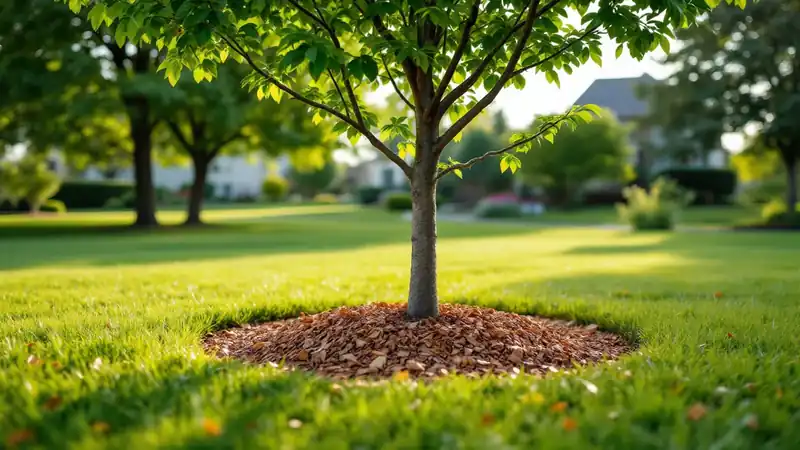
A tree ring takes less mulch than most people buy for it, because the ring is shallow and the useful part is wide. The ISA’s guidance is to apply mulch “near, but not touching, the trunk and extend to the drip line, if practical,” adding that “a 3 foot (1 meter) radius ring is the minimum for most trees,” which is a 6-foot circle (ISA). Clemson suggests a 3 to 4 foot circle for newly planted trees and, for established trees in lawns, “about 2 feet in diameter for each inch of trunk diameter” (Clemson HGIC).
The 3-3-3 rule for mulch, and why 3 feet is a floor
The 3-3-3 rule is a memory aid for tree rings: a ring at least 3 feet across, mulch 3 inches deep, and mulch kept 3 inches from the trunk. North Dakota State University Extension states it that way: a ring “at least 3 feet in diameter around the tree,” mulch “3 inches deep,” and mulch kept 3 inches from the trunk (NDSU Extension). Treat the 3 feet as a floor. The ISA minimum is a 3-foot radius, twice as wide, and the trunk gap grows with the tree: Penn State says pull mulch 3 to 5 inches from young trees and 8 to 10 inches from mature ones (Penn State Extension).
| Ring diameter | Typical use | Mulched area | At 2 in.: cu yd / 2 cu ft bags | At 3 in.: cu yd / 2 cu ft bags |
|---|---|---|---|---|
| 3 ft | 3-3-3 rule minimum (NDSU) | 6.3 sq ft | 0.04 yd / 1 bag | 0.06 yd / 1 bag |
| 4 ft | Newly planted tree, upper end (Clemson) | 11.8 sq ft | 0.07 yd / 1 bag | 0.11 yd / 2 bags |
| 5 ft | Older tree, upper end of Morton’s 4 to 5 ft | 18.8 sq ft | 0.12 yd / 2 bags | 0.17 yd / 3 bags |
| 6 ft | ISA minimum (3 ft radius) | 27.5 sq ft | 0.17 yd / 3 bags | 0.25 yd / 4 bags |
| 8 ft | Young shade tree toward the drip line | 49.5 sq ft | 0.31 yd / 5 bags | 0.46 yd / 7 bags |
| 10 ft | 5-inch trunk at Clemson’s 2 ft per inch | 77.8 sq ft | 0.48 yd / 7 bags | 0.72 yd / 10 bags |
| 12 ft | 6-inch trunk at Clemson’s 2 ft per inch | 112.3 sq ft | 0.69 yd / 10 bags | 1.04 yd / 15 bags |
| 16 ft | 8-inch trunk at Clemson’s 2 ft per inch | 200.3 sq ft | 1.24 yd / 17 bags | 1.85 yd / 26 bags |
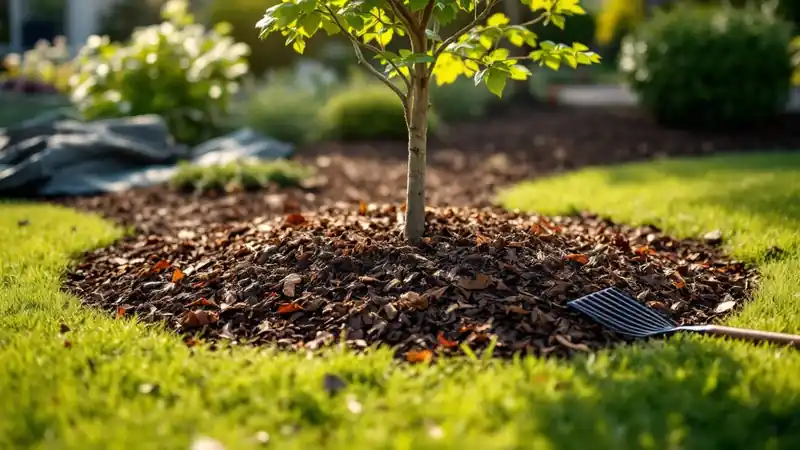
Volcano mulching, the cone of mulch piled against the trunk, is the one way to use too much mulch on a small area. Morton Arboretum says it “causes moisture to build up, creating ideal conditions for insect pests, diseases, and decay,” and Penn State’s shorthand is “Mulch out, not up!” (Morton Arboretum; Penn State Extension). If you are buying mulch for trees that already have a mound, the right order may be zero: pull the old mulch back into a wider, flatter ring first and see what is left. Grindings from a stump you have had removed can supply a ring for free; our stump grinding cost guide covers what crews leave behind.
Clump grasses have the same weak spot: Texas A&M AgriLife tells growers to keep soil and mulch off the crown of Gulf muhly, as our pink muhly grass planting steps explain.
Pine needle mulch: how many bales of pine straw you need
Pine straw is sold by the bale or roll, not by volume, so the yard formula does not apply directly. The most specific public figure comes from LSU AgCenter: “A 25-pound, 3-cubic-foot bale will cover 50 square feet 3 inches deep,” which works out to about half a pound per square foot (LSU AgCenter). Sellers’ figures run from 40 to 45 sq ft per bale (Pine Straw King) to 62.5 sq ft per bale at 2 inches implied by a 48-bale pallet rated for 3,000 sq ft (PineStraw.com), and about 80 sq ft per roll at 3 inches (Pine Straw Direct). Bale size and needle length differ, so ask for the seller’s coverage number.
| Area | Bales at 50 sq ft each (LSU, 3 in.) | Bales at 40–45 sq ft (Pine Straw King) | Bales at 62.5 sq ft (PineStraw.com, 2 in.) | Rolls at 80 sq ft (Pine Straw Direct, 3 in.) |
|---|---|---|---|---|
| 100 sq ft | 2 | 3 | 2 | 2 |
| 250 sq ft | 5 | 6–7 | 4 | 4 |
| 500 sq ft | 10 | 12–13 | 8 | 7 |
| 1,000 sq ft | 20 | 23–25 | 16 | 13 |
| 2,000 sq ft | 40 | 45–50 | 32 | 25 |
Depth for pine needles is 2 to 3 inches in both Clemson’s and Maryland’s guidance, and LSU recommends an initial 3-inch layer for shrubs and trees (Clemson HGIC; University of Maryland Extension). Pine straw also thins faster than bark. In a University of Florida study it lost half its depth in a year and was “almost completely gone” after two (UF/IFAS FR052). LSU’s top-up is about 1 inch once or twice a year, when “one bale of pine straw should go three times as far” as it did on the first application.
Are pine needles good mulch, and do they make soil acidic?
Pine needles make good mulch: Clemson notes they “tend to interlock and stay in place better than most mulches, especially on a slope.” They do not meaningfully acidify soil. University of New Hampshire Extension calls that a common myth and says “even a 2 to 3 inch layer of pine mulch will not change the soil pH enough to measure” (UNH Extension). The real drawback is fire. In a U.S. Forest Service flammability test pine straw had the fastest flame spread of the mulches tested, and a University of Florida extension office advises keeping pine straw “at least 30 feet from your house and other structures” in wildfire-prone areas (USDA Forest Service, Mulch Flammability; UF/IFAS Suwannee County).
Topping up an old bed vs. mulching a new one
A new bed needs the full depth. An existing bed needs only the difference between what is left and your target, and that is usually about 1 inch. Ordering a full 3 inches over an old layer is how beds end up 5 or 6 inches deep, the buildup Maryland Extension warns about: organic mulches “should only be replaced as needed to maintain their original depth” (University of Maryland Extension).
Top-up formula
Inches to add = target depth minus the depth still on the bed (push a trowel or ruler straight down in three or four spots and average).
Cubic yards = square feet × inches to add ÷ 324.
Example: a 1,000 sq ft set of beds with about 2 inches left and a 3-inch target. 1,000 × 1 ÷ 324 = 3.1 cubic yards, against 9.3 yards to mulch the same beds new at 3 inches. That is the difference between one small delivery and a full-size load.
How fast the old layer disappears depends on the material. A University of Florida trial laid six mulches 9 cm (3.5 inches) deep and measured them for two years: pine bark and cypress still had 6 cm, melaleuca almost 7, eucalyptus and utility-pruning chips about 5, and pine straw an average of 1 cm (UF/IFAS, Landscape Mulches: How quickly do they settle?). For bark and chip mulches that is a loss of about a third of the layer in two years, a bit over half an inch a year from a 3.5-inch start. Clemson puts the replenishment interval for “pine needles and bark mulches” at “around 2 to 4 years” (Clemson HGIC), while Morton Arboretum says hardwood chips “may last a full year” and finely ground compost may not last a season (Morton Arboretum). The sources differ, which is why measuring beats a calendar.
For how eastern redcedar decayed against cypress and pine bark in a 2-year Oklahoma State trial, see our guide to cedar mulch and how it compares.
Color is the usual reason people over-order. The ISA notes that buildup happens “if reapplication outpaces decomposition or if new material is added simply to refresh color.” If a bed looks faded but still measures 2 to 3 inches, raking it to turn up the darker layer underneath costs nothing. Shredded leaves are another free top-up for beds; our leaf removal cost guide covers what crews charge to haul them away instead.
Playground mulch: why the depth is 12 inches, not 3
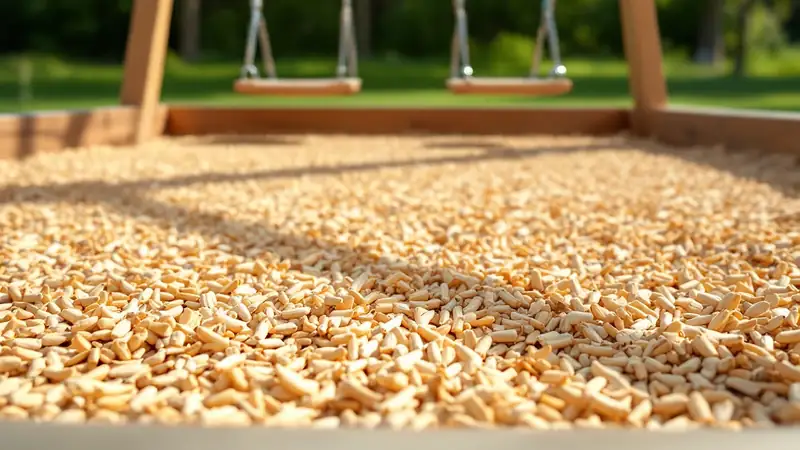
Under a swing set or climber, mulch is a fall surface, not a garden top-dressing, and the numbers jump. The U.S. Consumer Product Safety Commission’s Public Playground Safety Handbook says never to use less than 9 inches of loose-fill material (6 inches for shredded rubber), and its Table 2 rates 9 inches of compressed wood chips as protecting to a 10-foot fall height and 9 inches of non-CCA wood mulch to 7 feet. Because loose fill “will compress at least 25% over time,” the handbook’s own example is an initial fill of 12 inches to hold 9.
CPSC’s July 2025 edition lists rubber mulch at 8 inches installed and 6 inches kept for a 10-foot fall, and our rubber mulch pros and cons page compares it with wood.
That changes the order size. The handbook also says the use zone around most equipment extends at least 6 feet in every direction (swings need more, front and back). A backyard play set with an 8 × 10 ft footprint therefore needs a mulched area of about 20 × 22 ft, or 440 sq ft. At 12 inches that is 440 × 12 ÷ 324 = 16.3 cubic yards, the equivalent of 220 bags of 2 cu ft. Nobody should buy that in bags.
| Loose-fill material | Minimum compressed depth | Protects to a fall height of | Initial fill to allow for 25% compression | Cubic yards per 100 sq ft at initial fill |
|---|---|---|---|---|
| Wood chips | 9 in. | 10 ft | 12 in. | 3.70 |
| Wood mulch (non-CCA) | 9 in. | 7 ft | 12 in. | 3.70 |
| Shredded/recycled rubber | 6 in. | 10 ft | 6 in. (rubber does not compress the same way, per CPSC) | 1.85 |
| Pea gravel (for comparison) | 9 in. | 5 ft | 12 in. | 3.70 |
| Sand (for comparison) | 9 in. | 4 ft | 12 in. | 3.70 |
Is it cheaper to buy mulch by the yard or by the bag?
Bulk is cheaper per cubic yard almost everywhere, but the delivery fee decides small jobs. On posted 2026 prices, dyed bulk mulch costs about $32 to $42 a yard at the supply yard, while 2 cu ft bags of basic hardwood at $3.49 to $3.99 work out to $47 to $54 a yard. With a $75 delivery fee and $3.99 bags, bulk starts to win at about 5 yards; cheaper delivery lowers that point and sale-priced bags raise it.
Price gets its own guide; here is the short version used by the calculator. How much is a yard of mulch? Across 12 supply yards’ posted prices, undyed shredded hardwood runs $24 to $40 a cubic yard (middle half, median $31); dyed black, brown or red mulch $32 to $42 across 14 yards (median $39); and cedar, cypress, hemlock or pine bark $46 to $60 across 19 listings (median $50), before delivery and tax. How much is a bag of mulch? Basic 2 cu ft hardwood bags were $3.49 on sale and $3.99 regular at Ohio Mulch, and $3.49 a bag in a 70-bag pallet at Master Landscape Supply; premium bagged bark ran $7.99 to $14.90 for 2 cu ft (Mahoney’s; Mulch Center).
| How you buy it | Posted price | Per cubic yard | Per sq ft at 3 in. | Basis |
|---|---|---|---|---|
| Bulk, undyed shredded hardwood | $24–$40 a yard | $24–$40 | $0.22–$0.37 | Middle half of 12 supply yards (median $31) |
| Bulk, dyed black, brown or red | $32–$42 a yard | $32–$42 | $0.30–$0.39 | Middle half of 14 supply yards (median $39) |
| Bulk, cedar, cypress, hemlock or pine bark | $46–$60 a yard | $46–$60 | $0.43–$0.56 | Middle half of 19 listings (median $50) |
| Bulk, playground wood chips | $36–$50 a yard | $36–$50 | $0.33–$0.46 | Full range of 5 supply yards |
| 2 cu ft bags, basic hardwood | $3.49–$3.99 a bag | $47–$54 | $0.44–$0.50 | Ohio Mulch; Master Landscape Supply pallet |
| 1.5 cu ft bags | $3.47–$4.98 a bag | $62–$90 | $0.58–$0.83 | Walmart.com (Hyponex single bag; Miracle-Gro Organic pallet) |
| 2 cu ft bags, premium bark | $7.99–$14.90 a bag | $108–$201 | $1.00–$1.86 | Mahoney’s; Mulch Center |
| Bulk delivery fee, one load | $40–$250 | n/a | n/a | T.W. Nickerson town fees; Portland Rock $40–$170 by distance |
Bags vs. bulk break-even
Break-even yards = delivery fee ÷ (bagged price per yard minus bulk price per yard).
Example: dyed bulk at the $39 median against $3.99 bags ($53.87 a yard) is a $14.87 gap per yard. With a $75 delivery fee, 75 ÷ 14.87 = 5.0 yards. Under 5 yards, bags cost less; over it, bulk does. Against sale bags at $3.49 ($47.12 a yard) the gap is $8.12 and the break-even moves to 9.2 yards. Against 1.5 cu ft bags at $4.98 ($89.64 a yard) it falls to 1.5 yards.
Minimums can override the math. Remington Mulch in Northern Virginia has “a 5 yard minimum on ALL BULK Deliveries,” and Got Mulch on Long Island requires each material as a separate order (Remington Mulch; Got Mulch). Others, such as T.W. Nickerson on Cape Cod, deliver any quantity for a flat town fee (T.W. Nickerson). The hidden cost of bags is labor and trash: 125 bags for a 1,000 sq ft bed at 3 inches is 125 bags to lift, slit and throw away. A crew’s time to spread either is the bigger number on a hired job; see what landscaping workers are paid and how contractors price jobs like this.
Can I just lay mulch over dirt, grass or weeds?
Over bare, weeded soil, yes: that is the normal way to mulch, and Clemson’s only prep step is “it is best to weed the area” first (Clemson HGIC). Over lawn or a weedy patch, put down a smothering layer first. Oregon State University Extension describes sheet mulching as cardboard, newspaper or heavy paper laid on the soil “to smother existing weeds,” then covered with bark or wood chips; the cardboard “breaks down after several months” (Oregon State Extension, EM 9559). Iowa State suggests 1 to 2 layers of cardboard or 2 to 3 of newspaper and warns that too many layers block water and air (Iowa State Extension).
Sheet mulching does not change the quantity math, since the cardboard has no real thickness, but it does argue for the upper end of the depth range so the paper stays covered. Landscape fabric is a different story. University of New Hampshire Extension notes that “any mulch or soil on top of the landscape fabric can support weed growth,” and Maryland Extension says to cut fabric away near tree roots because it can lead to girdling roots (UNH Extension; University of Maryland Extension).
Six ordering mistakes that waste mulch
- Mixing feet and inches. 200 sq ft × 3 inches gives 600, which is neither cubic feet nor yards. Divide by 12 for 50 cubic feet, or by 324 for 1.85 cubic yards.
- Ordering a new-bed depth for a refresh. Measure first. Most refreshes need about an inch, a third of a new bed’s mulch.
- Counting bags, not cubic feet. Eighty 1.5 cu ft bags hold the same 120 cubic feet as sixty 2 cu ft bags.
- Mulching the whole yard at bed depth. Paths and play areas have their own numbers; playgrounds need 9 to 12 inches, not 3.
- Piling it against trunks and siding. Clemson says keep mulch 2 to 3 inches from woody stems and 6 to 12 inches from building walls (Clemson HGIC). That clearance also trims the order slightly.
- Splitting colors across one delivery. Some yards will not mix materials on one truck, so two colors can mean two delivery fees (Got Mulch; T.W. Nickerson).
Mulch is usually the smallest line in a landscape budget. For the bigger pieces (plants, hardscape, labor), see how much landscaping costs.
Mulch quantity questions, answered
How much will 25 bags of mulch cover?
Twenty-five 2 cu ft bags (50 cubic feet, 1.85 cubic yards) cover 200 sq ft at 3 inches, 300 sq ft at 2 inches or 150 sq ft at 4 inches. Twenty-five 1.5 cu ft bags cover three-quarters of that: 150 sq ft at 3 inches.
How much area will 20 bags of mulch cover?
Twenty 2 cu ft bags hold 40 cubic feet, enough for 160 sq ft at 3 inches or 240 sq ft at 2 inches. With 1.5 cu ft bags it is 120 sq ft at 3 inches.
How many 2 cu ft bags of mulch equal 1 yard?
13.5 bags. A cubic yard is 27 cubic feet, and 27 ÷ 2 = 13.5, so buy 14 to be safe. For other sizes: 18 bags of 1.5 cu ft, 9 bags of 3 cu ft and 27 bags of 1 cu ft each make a yard.
How many yards is 70 bags of mulch?
Seventy 2 cu ft bags are 140 cubic feet, or 5.19 cubic yards: about one pallet, covering 560 sq ft at 3 inches. Seventy 1.5 cu ft bags are 105 cubic feet, or 3.89 yards.
How much mulch do I need for a 10 x 10 area?
A 10 × 10 ft area is 100 sq ft. At 3 inches it needs 25 cubic feet: 0.93 cubic yards or 13 bags of 2 cu ft. At 2 inches it needs 0.62 yards (9 bags); at 4 inches, 1.23 yards (17 bags).
What is the 3-3-3 rule for mulch?
It is a rule of thumb for trees: a mulch ring at least 3 feet across, 3 inches deep, kept 3 inches from the trunk, as NDSU Extension puts it. Arborist guidance is wider: the ISA calls a 3-foot radius (6-foot circle) the minimum for most trees.
Is it cheaper to buy mulch by the yard or by the bag?
By the yard, once the job is big enough to absorb the delivery fee. Dyed bulk mulch posted at $32 to $42 a yard in October 2026, against $47 to $54 a yard for basic 2 cu ft bags. With a $75 delivery fee the break-even is around 5 yards against $3.99 bags.
Can I just lay mulch over dirt?
Yes, over bare soil that has been weeded. Over grass or heavy weeds, lay cardboard or several sheets of newspaper first so they smother what is underneath, then mulch on top.
How long do pine needles last as mulch?
About a year before they need topping up. In a University of Florida trial pine straw lost half its depth in the first year, and a UF/IFAS county office says it needs reapplying “every six months to once a year for aesthetics.” Clemson gives a longer 2 to 4 years for pine needles and bark.
How we built these numbers
We have no job data of our own. Quantities are arithmetic: 1 cubic yard = 27 cubic feet = 324 square feet at 1 inch, the same conversion Clemson HGIC and Iowa State Extension publish. Bag coverage uses the nominal volume printed on the bag. Tree-ring areas subtract a 1-ft bare circle at the trunk. No waste or settling allowance is built into the tables or the calculator.
Depths are quoted from the extension, arboriculture and CPSC sources linked in the depth table, all re-opened on October 18, 2026. Where sources disagree (bark mulch at 1 to 3 inches in Maryland, 3 to 4 inches at Morton Arboretum) we show each rather than averaging them.
Prices. We recorded posted per-cubic-yard prices on supply-yard pages in N.Y., N.J., Mass., Va., N.C., Ga., Fla., Ohio, Mich., Ind., Ill., Texas, Colo. and Ore., checked October 18, 2026, one figure per yard per category (black where a yard sells several dyed colors). Undyed hardwood, 12 yards: $20, $20, $22, $25, $25.50, $30, $32.50, $35, $40, $41, $50, $69.99 (middle half $24.25 to $40.25, rounded to $24 to $40). Dyed, 14 yards: $27 to $55 (middle half $31.88 to $42). Cedar, cypress, hemlock and pine bark, 19 product listings: $32 to $91 (middle half $45.50 to $60). Playground chips, 5 yards: $36 to $50. We left out a wholesale-only price list, pages that do not state the unit, and prices that appear to include delivery. Piedmont Landscape Materials is counted at its in-store retail price. Bagged prices are converted at 13.5 bags (2 cu ft) or 18 bags (1.5 cu ft) per yard. Calculator rates are each range divided by 324 (bulk) or the bag price divided by 24 or 18 (bags), per square foot per inch of depth.
Retail pages at Home Depot, Lowe’s, Ace and Tractor Supply blocked automated access, so big-box shelf prices are not in the ranges. Walmart.com and the Pool360 distributor listings were read in a browser on October 18, 2026. Prices change with season and location; spring sales can put bags well below these figures. Our full approach is on the methodology page.
This page is general information. Playground surfacing depths are the CPSC’s published minimums, not a safety inspection; follow the equipment and surfacing manufacturers’ instructions and, for public or commercial play areas, a certified playground safety inspector.
Sources
- Clemson Cooperative Extension, Home & Garden Information Center, Mulch (HGIC 1604), revised June 20, 2016. Accessed October 2026.
- Iowa State University Extension and Outreach, How to Determine the Amount of Mulch Needed for a Garden Bed, last reviewed July 2026. Accessed October 2026.
- Iowa State University Extension and Outreach, Using Mulch in the Garden, last reviewed February 2026. Accessed October 2026.
- International Society of Arboriculture, Proper Mulching Techniques (Trees Are Good brochure), 2021. Accessed October 2026.
- Penn State Extension, Mulching Landscape Trees, updated April 12, 2018. Accessed October 2026.
- University of Maryland Extension, Mulching Trees and Shrubs, updated December 6, 2023. Accessed October 2026.
- University of Maryland Extension, Excess Mulch Problems, updated March 14, 2023. Accessed October 2026.
- The Morton Arboretum, How to Mulch Trees and Shrubs, undated web page. Accessed October 2026.
- UF/IFAS Florida-Friendly Landscaping Program, Principle 4 Guidance, undated web page. Accessed October 2026.
- NDSU Extension, Dakota Gardener: Your lawn mower scares trees, July 5, 2022. Accessed October 2026.
- U.S. Consumer Product Safety Commission, Public Playground Safety Handbook (Pub. 325), 2010 edition with Dec. 29, 2015 notice. Accessed October 2026.
- U.S. Consumer Product Safety Commission, Outdoor Home Playground Safety Handbook (Pub. 324), Publication 324. Accessed October 2026.
- UF/IFAS Extension (Duryea and Minogue), Landscape Mulches: How quickly do they settle? (FOR 69/FR052), study published 1999; page 2024. Accessed October 2026.
- LSU AgCenter, Pine straw makes excellent mulch, March 30, 2009. Accessed October 2026.
- University of New Hampshire Extension, Do pine trees and pine needles make soil more acidic?, October 16, 2019. Accessed October 2026.
- University of New Hampshire Extension, Should I use landscape fabric to keep weeds out of my perennial garden?, May 4, 2019. Accessed October 2026.
- UF/IFAS Extension Lake County, What is the best mulch to use in the Florida landscape?, October 27, 2022. Accessed October 2026.
- UF/IFAS Extension Suwannee County, Is Your Home and Landscape Susceptible to Wildfires?, February 1, 2022. Accessed October 2026.
- USDA Forest Service (Zipperer, Long, Hinton, Maranghides, Mell), Mulch Flammability, 2007. Accessed October 2026.
- Oregon State University Extension, Sheet mulching and lasagna composting with cardboard (EM 9559), revised July 2025. Accessed October 2026.
- Remington Mulch (Va.), Bulk mulch prices and delivery minimum, price page checked Oct. 18, 2026. Accessed October 2026.
- Got Mulch (N.Y.), Bulk mulch, price page checked Oct. 18, 2026. Accessed October 2026.
- Eastern Landscape & Mason Supply (N.Y.), Mulch, price page checked Oct. 18, 2026. Accessed October 2026.
- Kirk Allen Landscape Supply (N.J.), Mulches, price page checked Oct. 18, 2026. Accessed October 2026.
- T.W. Nickerson (Mass.), Cape Cod bark mulch, price page checked Oct. 18, 2026. Accessed October 2026.
- T.W. Nickerson (Mass.), Delivery charges, checked Oct. 18, 2026. Accessed October 2026.
- Canton Topsoil (Mich.), Price list, price page checked Oct. 18, 2026. Accessed October 2026.
- McCarty Mulch & Stone (Ind.), Landscaping mulch, price page checked Oct. 18, 2026. Accessed October 2026.
- Midwest Compost (Ill.), Mulch, price page checked Oct. 18, 2026. Accessed October 2026.
- Cheaper Than Dirt Landscape Supply (Texas), Pricing, price page checked Oct. 18, 2026. Accessed October 2026.
- Gaston Mulch (Fla.), Mulch, price page checked Oct. 18, 2026. Accessed October 2026.
- Mulch and Stuff (Fla.), Premium black mulch, price page checked Oct. 18, 2026. Accessed October 2026.
- Master Landscape Supply (Ga.), Black mulch, per yard and 8-yard truck, price page checked Oct. 18, 2026. Accessed October 2026.
- Master Landscape Supply (Ga.), Black mulch by the pallet (70 bags), price page checked Oct. 18, 2026. Accessed October 2026.
- Piedmont Landscape Materials (N.C.), Premium black hardwood, price page checked Oct. 18, 2026. Accessed October 2026.
- Ohio Mulch, Bulk pine bark mulch, price page checked Oct. 18, 2026. Accessed October 2026.
- Ohio Mulch, Premium shredded hardwood, 2 cf, price page checked Oct. 18, 2026. Accessed October 2026.
- Direct Landscape Supply (Colo.), Mulch and bark, price page checked Oct. 18, 2026. Accessed October 2026.
- Portland Rock & Landscape Supply (Ore.), 2026 retail price list, 2026. Accessed October 2026.
- Portland Rock & Landscape Supply (Ore.), Delivery rates, 2025 rate sheet, checked Oct. 18, 2026. Accessed October 2026.
- Mahoney’s Garden Centers (Mass.), Bagged mulches, price page checked Oct. 18, 2026. Accessed October 2026.
- Mulch Center (Ill.), Bagged products, price page checked Oct. 18, 2026. Accessed October 2026.
- Walmart.com, Hyponex by Scotts Brown Mulch, 1.5 cu ft, checked Oct. 18, 2026. Accessed October 2026.
- Walmart.com, Miracle-Gro Organic All Natural Mulch, pallet of 80 bags, checked Oct. 18, 2026. Accessed October 2026.
- Pool360 (distributor), Jolly Gardener 2 cu ft hardwood mulch, checked Oct. 18, 2026. Accessed October 2026.
- Pool360 (distributor), Cowart 2 cu ft premium hardwood mulch, checked Oct. 18, 2026. Accessed October 2026.
- Pool360 (distributor), Whittlessey hardwood mulch, 2 cu ft, checked Oct. 18, 2026. Accessed October 2026.
- PineStraw.com, One pallet of long-needle pine straw, checked Oct. 18, 2026. Accessed October 2026.
- PineStraw.com, One commercial pallet, checked Oct. 18, 2026. Accessed October 2026.
- Pine Straw King (Ga.), Long needle pine straw, Marietta, checked Oct. 18, 2026. Accessed October 2026.
- Pine Straw Direct, Pine straw rolls, checked Oct. 18, 2026. Accessed October 2026.