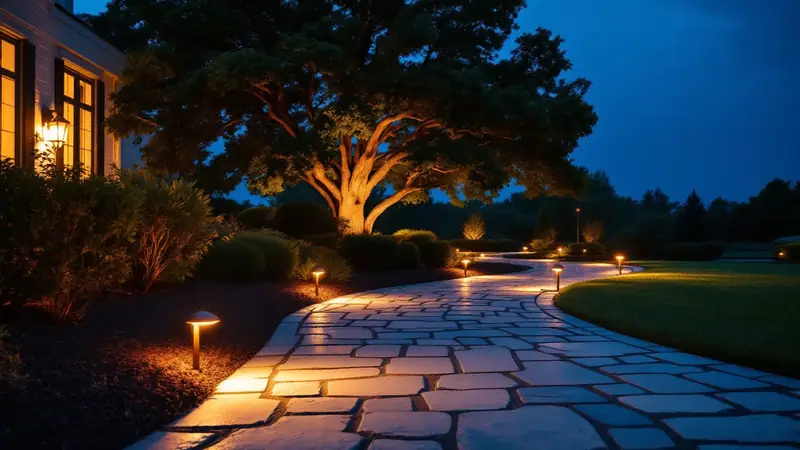
Short answer: Low-voltage LED landscape lighting costs an estimated $165 to $520 per fixture installed for a typical mix of path, spot, well and step lights, plus $470 to $820 for a 300-watt transformer with a photocell. A 20-fixture system comes to about $3,800 to $11,200, and running it costs roughly $20 to $75 a year.
$165–$520 per fixture installed, typical mix of path, spot, well and step lights (estimate; see method)
$3,800–$11,200 for a 20-fixture system with transformer (estimate)
$29 a year to run 20 LED fixtures 5 hours a night at the U.S. average residential rate (EIA, Jan.–July 2026)
6 inches minimum cover for buried landscape lighting cable at 30 volts or less (NEC Table 300.5)
Most landscape lighting price pages give one national range and a list of fixture prices with no source. The ranges they publish are usually right in the middle and wrong at both ends, because the two things that move a quote most are rarely shown: which tier of fixture is going in the ground, and how many crew-hours the site will eat.
This page builds the price from the parts. Fixture, lamp, transformer and cable prices come from manufacturers’ and suppliers’ published price pages, checked in October 2026. Labor uses BLS wage data for electricians and landscaping workers (OEWS, May 2025). Overhead and profit come from how electrical contractors’ revenue splits in the 2022 Economic Census. Running costs use the EIA’s residential electricity price by state. The arithmetic is in the method box near the end, and the same numbers drive the calculator. For other project prices, see our cost guides and the overall landscaping cost breakdown.
Landscape lighting cost per fixture, by type
Installers price landscape lighting by the fixture, and the fixture price already includes the lamp, its share of cable and connectors, the digging, the connections and the night-time aiming. The three installed columns below are three hardware tiers on the same labor model: a value line of lamp-ready fixtures, solid cast-brass fixtures sold direct by a manufacturer, and pro-channel fixtures priced at the list price retailers show. The transformer is separate and comes in the next section.
| Fixture type | What it lights | DIY parts per fixture | Installed, value line | Installed, solid brass | Installed, pro-grade at list | Crew-hours assumed |
|---|---|---|---|---|---|---|
| Path light | Walks, bed edges, steps down a slope | $73–$110 | $155 | $225 | $500 | 0.50–0.75 |
| Spotlight / uplight | Trees, walls, columns, signs | $74–$98 | $155 | $205 | $465 | 0.50–0.75 |
| In-ground well light | Tree trunks and walls from below grade, lawn areas | $109–$116 | $255 | $295 | $725 | 1.00–1.50 |
| Deck or step light | Stair risers, deck posts, wall caps | $83–$111 | $195 | $275 | $650 | 0.75–1.50 |
| Typical mix (50% path, 35% spot, 10% well, 5% step) | A front yard and walk | About $80–$105 | $165 | $225 | $520 | About 0.6–0.9 |
Low end uses value-line fixtures, high end pro-grade fixtures at list price, both with LED lamps. Excludes permits, new circuits and design fees. Local prices vary; see How we built these numbers.
The spread inside each row is mostly hardware, not labor. A value-line path light and its lamp cost $55.98 at VOLT’s published prices (a $39.99 Essentials fixture plus a $15.99 G4 LED lamp). A Kichler integrated-LED dome path light lists at $259.99. Same hole, same cable, same 30 minutes of a two-person crew, and the installed price roughly triples.
Well lights and step lights cost more for a different reason: time. A well light needs a hole dug 10 to 12 inches deep in heavy soil and a sleeve of 4-inch PVC so the fixture sits level and stays put, according to VOLT’s well-light installation guide. A step light goes into a wall, riser or deck board, so the crew is coring masonry or cutting wood, not just pushing a stake into mulch. Our model doubles the crew-hours for those two types at the high end.
Integrated LED or lamp-ready?
Lamp-ready fixtures take a replaceable bi-pin (G4) or MR16 LED lamp, which the buyer chooses by wattage, beam spread and color temperature. VOLT sells its standard LED MR16 lamp for $13.99 and rates it for 50,000 hours to L70 (the point where output falls to 70 percent). Integrated fixtures have the LED built in. They save the lamp purchase, but when the LED board fails the repair can mean replacing the whole fixture. For a homeowner, lamp-ready is the safer bet on a system meant to last 15 years or more; integrated makes sense where the fixture is small or hard to reach, such as a step light set into a wall.
What a whole system costs, from 10 to 60 fixtures
A quote is fixtures times a per-fixture price, plus the transformer. The table uses the typical mix above and one 300-watt transformer with a photocell up to 40 fixtures. The LED load column assumes an average of 4 watts per fixture, which sits between VOLT’s 3-watt G4 path lamp and 5-watt MR16 spot lamp.
| Fixtures | LED load (4 W avg.) | Smallest transformer at 80% loading | Installed estimate, value line | Installed estimate, pro-grade at list | Two-person crew time (est.) |
|---|---|---|---|---|---|
| 10 | 40 W | 50 W (100 W common) | $2,100 | $6,000 | About 1 day |
| 15 | 60 W | 75 W | $2,900 | $8,600 | About 1 day |
| 20 | 80 W | 100 W | $3,800 | $11,200 | 1.5 to 2.5 days |
| 30 | 120 W | 150 W | $5,400 | $16,400 | 2 to 3.5 days |
| 40 | 160 W | 200 W | $7,100 | $21,600 | 3 to 4.5 days |
| 60 | 240 W | 300 W at the limit; 600 W in practice | $10,400 | $32,300 | 4.5 to 7 days |
Two things in that table surprise people. First, a 300-watt transformer has room for about 60 LED fixtures on load alone; with 20-watt halogen lamps the same transformer carried 12. Second, the price per fixture barely falls as systems grow, because the crew time scales with the fixture count. The transformer is the only real fixed cost, and on a 20-light job it is 12 percent of the value-line total and 7 percent of the pro-grade one.
- Value line
- Pro-grade at list
Source: Green Industry Report estimates; typical fixture mix plus one 300 W transformer with photocell (600 W at 60 fixtures) Estimates, see method. Excludes permits, new circuits and design fees.
Show the numbers
| Value line | Pro-grade at list | |
|---|---|---|
| 10 | 2,100 | 6,000 |
| 15 | 2,900 | 8,600 |
| 20 | 3,800 | 11,200 |
| 30 | 5,400 | 16,400 |
| 40 | 7,100 | 21,600 |
| 60 | 10,400 | 32,300 |
How many fixtures does a yard need?
For walks, VOLT’s path-light selection guide gives a simple formula: add the fixture’s beam spread to the path length, divide by the beam spread and round up. A 50-foot path with a 16-foot spread needs (50 + 16) / 16 = 4.1, so 5 fixtures, more if you stagger them on both sides. For trees and walls the count is design, not arithmetic: one spotlight for a small tree, two or three for a broad canopy or a wide wall. As a worked example, a 50-foot walk lit from both sides (8 to 10 fixtures), two trees at two spotlights each and four lights washing the front of the house add up to 16 to 18 fixtures, which is why the 20-fixture row is a useful one to compare quotes against.
Line by line: where the money goes on a 20-light job
Here is the same 20-fixture system broken into the lines a detailed quote should show: 10 path lights, 7 spotlights, 2 well lights and 1 step light, on one 300-watt transformer.
| Line item | Value line | Share | Pro-grade at list | Share |
|---|---|---|---|---|
| Fixtures and LED lamps | $1,209 | 32% | $5,289 | 47% |
| 12/2 direct-burial cable | $234 (400 ft) | 6% | $350 (600 ft) | 3% |
| Waterproof connectors | $110 | 3% | $160 | 1% |
| Transformer and photocell | $253 | 7% | $449 | 4% |
| Crew labor with benefits | $748 (12.25 crew-hours) | 20% | $1,242 (18.75 crew-hours) | 11% |
| Overhead, equipment, insurance and profit | $1,260 | 33% | $3,696 | 33% |
| Total | $3,813 | 100% | $11,187 | 100% |
The overhead line is not padding. Electrical contractors spent 30.9 percent of revenue on materials, 27.7 percent on payroll and 8.4 percent on benefits in 2022, according to the 2022 Economic Census. The remaining third covers trucks, trenchers, insurance, office staff, callbacks and profit. A quote far under the value-line column can be missing one of those, such as the return visit to re-aim fixtures after the plants fill in.

Transformer sizing: the 80 percent rule and what each size costs
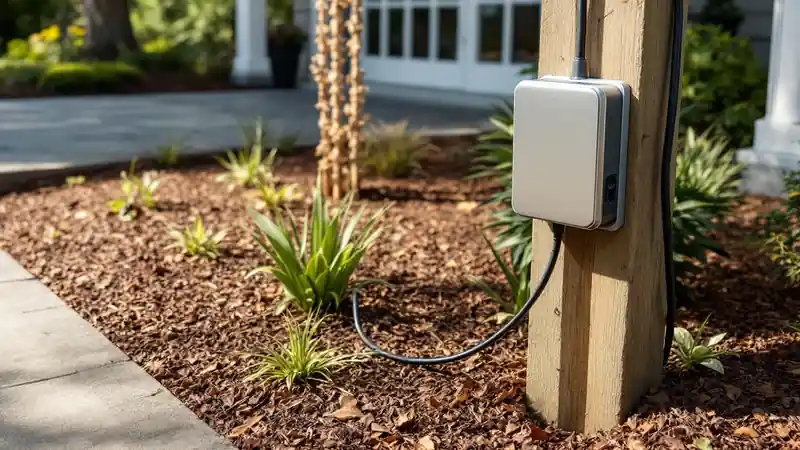
The transformer steps 120-volt house power down to 12 to 15 volts. VOLT’s transformer installation guide says the National Electrical Code limits a circuit to 80 percent of its maximum load, so a 300-watt common tap has a working capacity of 240 watts. It then subtracts another 10 percent for losses in the wire and calls about 70 percent of the nameplate the optimal working load. Put the other way round: multiply your fixture wattage by about 1.25 (or 1.4 for the conservative version) and buy the next transformer size up. The same guide says the transformer must plug into a GFCI-protected circuit and sit at least 12 inches above the ground.
One refinement: LED drivers draw slightly more volt-amps (VA) than their wattage. VOLT’s lamp guide notes that VA, not watts, is the figure for sizing wire and transformers. Use the VA on the spec sheet when a manufacturer lists it.
| Transformer | Published price | Working load at 80% | 4-watt LED fixtures it can carry | Installed with photocell (est.) |
|---|---|---|---|---|
| VOLT Essentials 100 W | $99.99 | 80 W | 20 | Not modeled |
| VOLT 300 W multi-tap (12–15 V) | $229.99 | 240 W | 60 | $470 |
| VOLT 600 W multi-tap | $274.99 | 480 W | 120 | $535 |
| Kichler Pro Series 300 W (15PR300SS) | $376.56 list | 240 W | 60 | $820 |
| Kichler Pro Series 600 W | $581.51 list | 480 W | 120 | $1,125 |
| Kichler Pro Series 900 W (15PR900SS) | $1,037.53 list | 720 W | 180 | $1,805 |
Load is rarely what forces a bigger or second transformer on an LED job. Distance is. Voltage drops along the cable, so far fixtures get less than 12 volts and dim. Multi-tap transformers solve this by letting the installer connect a long run to a higher tap; VOLT’s guide gives the example of a 100-foot run on the 15-volt tap to deliver 12 volts at the far fixtures. On a large property, a second transformer at the far end can cost less than hundreds of feet of heavy cable back to the house.
Cable: what each gauge costs per foot
| Direct-burial cable | Price, 250 ft | Per foot | Typical use |
|---|---|---|---|
| 16/2 | $94.99 | $0.38 | Short leads, small kits |
| 14/2 | $112.99 | $0.45 | Short runs, few fixtures |
| 12/2 | $145.99 | $0.58 | Most residential home runs |
| 10/2 | $235.99 | $0.94 | Long or heavily loaded runs |
| 8/2 | $469.99 | $1.88 | Very long runs to a far hub |
Cable is cheap relative to everything else, at 3 to 6 percent of a typical job. Moving from 12-gauge to 10-gauge on 400 feet adds about $145. That is a poor place for a contractor to save money and a reasonable place to ask questions if the quote does not say which gauge is going in.
Labor cost to install landscape lighting, state by state
Landscape lighting sits between two trades. Landscape companies install a lot of it; electricians handle the 120-volt side and much of the high-end work. Nationally, electricians earn a median $30.38 an hour and landscaping and groundskeeping workers $18.82, according to BLS OEWS (May 2025). With benefits at 30.2 percent of payroll (the 2022 ratio for electrical contractors), a two-person crew costs a contractor about $61 to $66 an hour before overhead.
The table applies each state’s median wages to the typical-mix fixture (about 0.71 crew-hours per fixture) and grosses that up for overhead. It also shows what 20 LED fixtures cost to run in that state, using the EIA’s average residential electricity price for January through July 2026. Wages are the bigger swing: the labor portion of a fixture runs from $56 in Arkansas to $97 in Oregon.
Swipe the table sideways to see every column.
| State | Electricians, median hourly | Landscaping workers, median hourly | Labor portion per fixture (est.) | Residential electricity, cents/kWh | Yearly cost to run 20 LED fixtures, 5 h a night | Same, dusk to dawn |
|---|---|---|---|---|---|---|
| United States | $30.38 | $18.82 | $68 | 18.19 | $29 | $70 |
| Alabama | $26.78 | $17.13 | $61 | 16.54 | $27 | $64 |
| Alaska | $43.00 | $22.93 | $91 | 27.09 | $44 | $104 |
| Arizona | $29.36 | $18.71 | $67 | 15.44 | $25 | $60 |
| Arkansas | $23.59 | $17.20 | $56 | 13.61 | $22 | $52 |
| California | $36.62 | $21.90 | $81 | 33.25 | $53 | $128 |
| Colorado | $29.92 | $22.00 | $72 | 16.72 | $27 | $64 |
| Connecticut | $37.28 | $21.99 | $82 | 27.97 | $45 | $108 |
| Delaware | $30.63 | $17.96 | $67 | 17.86 | $29 | $69 |
| District of Columbia | $37.97 | $23.46 | $85 | 24.66 | $40 | $95 |
| Florida | $27.52 | $17.84 | $63 | 15.30 | $25 | $59 |
| Georgia | $28.04 | $18.25 | $64 | 15.40 | $25 | $59 |
| Hawaii | $46.38 | $22.08 | $95 | 46.28 | $74 | $178 |
| Idaho | $30.29 | $20.00 | $70 | 12.96 | $21 | $50 |
| Illinois | $47.87 | $21.05 | $95 | 19.22 | $31 | $74 |
| Indiana | $32.93 | $18.30 | $71 | 17.04 | $27 | $66 |
| Iowa | $29.26 | $18.71 | $66 | 14.20 | $23 | $55 |
| Kansas | $31.66 | $18.91 | $70 | 15.21 | $24 | $59 |
| Kentucky | $28.71 | $17.63 | $64 | 14.27 | $23 | $55 |
| Louisiana | $29.59 | $16.76 | $64 | 13.35 | $21 | $51 |
| Maine | $36.24 | $22.10 | $81 | 29.99 | $48 | $116 |
| Maryland | $35.33 | $18.93 | $75 | 21.30 | $34 | $82 |
| Massachusetts | $38.18 | $23.40 | $85 | 30.14 | $48 | $116 |
| Michigan | $36.67 | $18.33 | $76 | 21.53 | $35 | $83 |
| Minnesota | $37.58 | $22.41 | $83 | 16.25 | $26 | $63 |
| Mississippi | $29.26 | $15.21 | $62 | 15.19 | $24 | $59 |
| Missouri | $31.45 | $18.52 | $69 | 13.96 | $22 | $54 |
| Montana | $36.90 | $21.80 | $81 | 13.95 | $22 | $54 |
| Nebraska | $29.24 | $18.82 | $67 | 12.90 | $21 | $50 |
| Nevada | $35.37 | $18.66 | $75 | 13.53 | $22 | $52 |
| New Hampshire | $30.21 | $21.58 | $72 | 26.79 | $43 | $103 |
| New Jersey | $37.14 | $19.88 | $79 | 23.98 | $39 | $92 |
| New Mexico | $28.07 | $18.06 | $64 | 15.08 | $24 | $58 |
| New York | $37.86 | $21.56 | $82 | 29.38 | $47 | $113 |
| North Carolina | $27.31 | $18.22 | $63 | 14.94 | $24 | $58 |
| North Dakota | $31.59 | $19.61 | $71 | 12.36 | $20 | $48 |
| Ohio | $31.11 | $18.38 | $69 | 18.70 | $30 | $72 |
| Oklahoma | $29.33 | $17.20 | $64 | 13.58 | $22 | $52 |
| Oregon | $48.71 | $21.65 | $97 | 15.40 | $25 | $59 |
| Pennsylvania | $32.50 | $18.99 | $71 | 21.04 | $34 | $81 |
| Rhode Island | $35.62 | $21.51 | $79 | 29.22 | $47 | $113 |
| South Carolina | $28.24 | $17.65 | $64 | 15.93 | $26 | $61 |
| South Dakota | $29.51 | $17.01 | $64 | 14.50 | $23 | $56 |
| Tennessee | $29.37 | $17.80 | $65 | 13.87 | $22 | $53 |
| Texas | $28.16 | $17.66 | $63 | 16.06 | $26 | $62 |
| Utah | $29.81 | $19.59 | $68 | 13.16 | $21 | $51 |
| Vermont | $30.49 | $22.23 | $73 | 23.95 | $38 | $92 |
| Virginia | $30.24 | $18.46 | $67 | 16.83 | $27 | $65 |
| Washington | $45.78 | $22.57 | $95 | 14.40 | $23 | $56 |
| West Virginia | $31.16 | $15.50 | $65 | 15.47 | $25 | $60 |
| Wisconsin | $36.80 | $19.82 | $78 | 19.00 | $31 | $73 |
| Wyoming | $36.59 | $18.42 | $76 | 13.95 | $22 | $54 |
Labor is only about 11 to 20 percent of a whole job in our model, so even the $41 spread between Arkansas and Oregon moves a 20-fixture quote by about $800. Hardware tier still matters more than geography. Where the state column bites is on retrofit work: boring under a concrete walk or coring a stone wall can double the hours on a fixture, and those hours are billed at local rates. Our landscaper pay data has the wage detail by metro area.
Do you need an electrician or a permit for landscape lighting?
Usually not for the low-voltage side, usually yes for anything that touches 120 volts, and the rules vary by state and city. The national model is the National Electrical Code (NFPA 70), which states and cities adopt with their own amendments. The parts that shape a landscape lighting job:
- Article 411 covers lighting systems operating at 30 volts or less. The system must be listed as a whole or assembled from listed parts, and the code keeps these systems at least 10 feet horizontally from the edge of a pool, spa or fountain unless Article 680 permits otherwise.
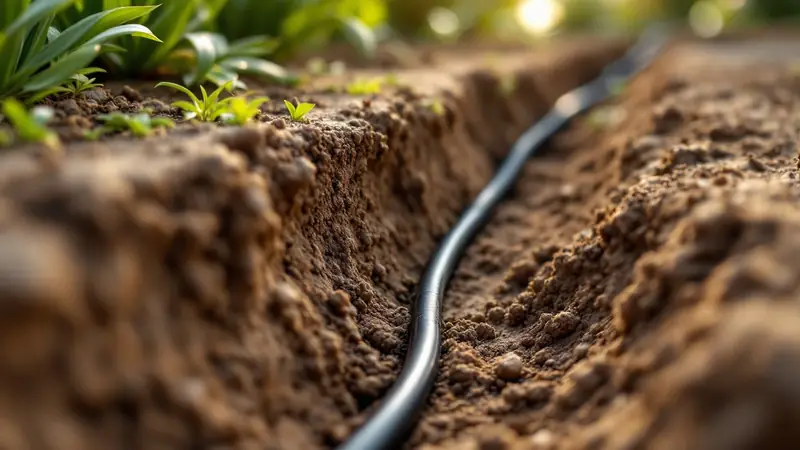
- Table 300.5 sets a minimum cover of 6 inches for “circuits for control of irrigation and landscape lighting limited to not more than 30 volts” installed in UF or other identified cable. A 120-volt circuit needs 6 to 24 inches depending on the wiring method, including 12 inches for a GFCI-protected residential circuit of 20 amps or less, and low-voltage cable under a home’s driveway needs 18 inches.
- Outdoor receptacles must be GFCI-protected (Section 210.8), and 15- and 20-amp receptacles in wet locations need a cover that stays weatherproof with a plug inserted, the “in-use” cover (Section 406.9).
Who may do the work is state law, and three examples show the range:
- Washington exempts underground low-voltage landscape lighting from electrical licensing and permits, but only if the power comes from a listed Class 2 power supply, the 120-volt equipment feeding it is installed by a licensed electrician, and nothing is installed within the scope of NEC Article 680 (pools and fountains), under WAC 296-46B-925(8). The NEC caps a Class 2 power source at 100 volt-amperes (NFPA 70, Chapter 9, Table 11(A)), and a 300-watt multi-tap transformer is well over that, so read the transformer’s label before assuming the exemption applies.
- California: the Contractors State License Board says a C-27 landscaping contractor may obtain permits and contract for electrical work such as yard lighting “provided the work is part of or incidental to an overall landscaping project” (CSLB Building Official Information Guide). A lighting-only job is a different question; see our California landscaper license lookups and the guide to checking a license.
- Los Angeles County exempts from electrical permits low-energy circuits powered from a source rated at no more than 30 volts and 1,000 volt-amperes, but adds that “a permit shall be obtained for the power supplies required by the above systems” (LA County Public Works, Work Exempt from Permits). In practice that means the new outlet or hardwired transformer connection, not the cable in the beds.
Our state-by-state licensing table covers the landscaping side. For a quote, the practical rule is simple: if there is no GFCI outlet within reach of the transformer location, budget for an electrician.
What an electrician adds for a new outdoor outlet
We estimate $195 to $410 for a new GFCI receptacle with an in-use cover where a circuit is already nearby, before any permit fee. That is 2 to 4 electrician hours at the national median to 75th-percentile wage ($30.38 to $40.36, BLS OEWS May 2025), plus a 20-amp weather-resistant GFCI receptacle at $32.53 and an in-use cover at $18.24 to $31.89 (Leviton’s store, checked Oct. 13, 2026), grossed up for overhead. A new circuit from the panel or a long trench is a separate, larger job.
This page is general information, not legal or electrical advice. Electrical codes, permit rules and licensing requirements are adopted and amended locally; confirm with your building department and state licensing agency before you hire or start work, and have any 120-volt work done by a licensed electrician where your state requires one.
How much landscape lighting adds to an electric bill
Very little, once the lamps are LED. The arithmetic is fixtures x watts x hours x price per kWh. Twenty fixtures averaging 4 watts, plus 10 percent for wire and transformer losses, draw 88 watts. At 5 hours a night (dusk to about 11 p.m.) that is 161 kWh a year, or $29 at the U.S. average residential price of 18.19 cents per kWh for January through July 2026 (EIA Table 5.6.B). Run the same system dusk to dawn, about 12 hours a night averaged over the year, and it is 385 kWh, or $70.
Halogen is where the old horror stories come from. VOLT markets its 2-watt LED G4 lamp as a replacement for a 15-watt halogen lamp, and the incandescent wedge lamp Kichler sells for older fixtures is rated 24.4 watts. At 20 watts a lamp, the same 20 fixtures on 5 hours a night use 803 kWh, or about $146 a year at the national price. If an older system is still running halogen, swapping lamps pays back in a season or two in high-price states.
Timers, photocells and smart controllers
Every system needs something to switch it. The cheapest controls are add-ons to the transformer, and the smart options cost more in lamps than in the controller itself.
| Control | Published price | What it does |
|---|---|---|
| Mechanical timer (VOLT) | $24.99 | Fixed on/off times; drifts with the seasons and power cuts |
| Photocell (VOLT) | $22.99 | On at dusk; pair with a timer for an off time |
| Astronomic digital timer (VOLT) | $45.99 | Tracks sunset by date; holds an off time |
| Plug-in photocell (Kichler 15565BK) | $72.36 list | Dusk-to-dawn sensor for Kichler transformers |
| Smart control timer, Wi-Fi and Bluetooth (Kichler 16085BK) | $101.27 list | App scheduling for the transformer as a whole |
| VOLT SMART Gateway | $69.99 | Bridges app control to smart lamps; up to 127 devices |
| Smart color MR16 lamp vs. standard (VOLT) | $59.99 vs. $13.99 | Per-fixture dimming, zones and color; adds $46 a fixture |
Installed, a transformer-level smart controller runs an estimated $125 to $200. Lamp-level smart control is a different budget: at $46 more per lamp, putting smart lamps in 20 fixtures adds about $920 in parts alone. For most homes, an astronomic timer at under $50 does the job: on at sunset all year, off at a set hour. Smart lamps earn their cost where you want separate scenes (a dim late-night setting for the walk, the trees off after midnight) or where a dark-sky curfew applies to some fixtures but not others.
Dark-sky ordinances that change the design and the price
A growing number of cities regulate residential outdoor lighting, and the rules land hardest on uplights, the fixtures that make landscape lighting look like landscape lighting. Four examples, from strict to light:
- Flagstaff, Arizona. Zoning Code Division 10-50.70 classes landscape lighting as decorative Class 3 lighting and says that architectural and landscape lighting “directed upward onto a structure, tree, or other landscape feature is not allowed.” Downward-aimed landscape lighting counts against a per-lot lumen budget: 5,000 lumens in Lighting Zone 2 and 1,500 in Zone 1 for single-family homes, with fixtures not mounted to a building capped at 1,500 lumens in Zone 2 and not allowed in Zone 1. Solar lights of 5 watts or less used in residential landscaping are exempt.
- Tucson and unincorporated Pima County, Arizona. The 2012 Outdoor Lighting Code caps residential lighting at 55,000 lumens per acre in the brightest zone and 12,000 in the darkest, with unshielded light limited to 11,000 lumens per acre down to zero. Flood and spot lamps must be aimed no higher than 45 degrees to the horizontal, “half-way between straight down and straight to the side,” when the source is visible from any adjacent residential property, and fixtures within 25 feet of a neighbor’s lot line must be full cutoff. Pima County and Tucson have a proposed update out for public comment.
- Arizona statewide. A.R.S. 49-1102 requires all outdoor light fixtures to be fully or partially shielded, except incandescent fixtures of 150 watts or less and other sources of 70 watts or less. Low-voltage LED landscape fixtures fall under the exemption on wattage, which is why the city codes above matter more.
- Lexington-Fayette, Kentucky. The outdoor lighting text amendment adopted July 9, 2024, as summarized by the Urban County Government’s planning page, requires outdoor lights to be fully shielded and 3,000 Kelvin or below. Check the ordinance text for residential exemptions before you buy fixtures.
What this does to a quote: fully shielded path lights with a hat or louver, which the value and brass tiers above already include; spotlights with glare shields, louvers or long cowls, often a step up in price; warm lamps (2,700 K is the default on most of the lamps priced here); and a lumen budget that can cut the fixture count. In Flagstaff’s Zone 2, 1,500 lumens for fixtures not mounted to a building buys about five 300-lumen path lights and no uplights at all. Ask any installer working in a dark-sky jurisdiction to show the lumen total on the quote.
Maintenance costs and how long the system lasts
LED lamps outlast most of what surrounds them. VOLT rates its MR16 lamp at 50,000 hours to L70 and its 2-watt G4 lamp at 40,000 hours. At 5 hours a night that is 27 and 22 years; dusk to dawn, about 11 and 9 years. The fixtures, many of which carry lifetime warranties at VOLT, and the transformer usually outlive the first lamp change.
The recurring cost is the landscape, not the lights. Shrubs grow over path lights, mulch buries well lights, mowers and string trimmers knock spotlights off aim, and frost heave tilts stakes. We estimate a yearly tune-up of a 20-fixture system at $90 to $200: 1 to 2 crew-hours to re-aim, raise sunk fixtures, trim around lenses, check connections and reset the timer, at the crew rates above with overhead. Many owners do this themselves in an evening with a flashlight and pruners.
DIY or hire: what the parts list costs
Low-voltage systems are one of the few electrical-adjacent projects many homeowners can do themselves where local rules allow, because nothing past the plug runs at line voltage. The DIY column in the first table is the honest comparison: about $80 to $105 in parts per fixture for value-line or brass hardware, so roughly $1,600 to $2,100 for 20 fixtures plus $250 to $300 for a 300-watt transformer and photocell. VOLT also sells boxed kits, from a $230.99 Basics kit to $999.99 for six spotlights and four path lights.
What you give up by doing it yourself: the night-time aiming (the step that separates good lighting from lit-up yards), voltage readings at the far fixtures, and a warranty on the labor. What you keep: roughly half of the installed price on value-line or brass hardware. The jobs most worth hiring out are the ones with the most labor per fixture, such as well lights in lawn, step lights cored into masonry, and runs that cross a driveway, where cable needs 18 to 24 inches of cover or a raceway under the code tables above. If you are building a patio or wall anyway, run sleeves and cable before the hardscape goes in; see our paver patio and retaining wall cost guides.
Red flags in a landscape lighting quote
- No transformer size or load. The quote should name the transformer wattage and the total fixture load, and the load should be at or under 80 percent of capacity.
- No lamp spec. Lumens or wattage, beam spread and color temperature for each fixture type. “LED” alone tells you nothing.
- Halogen lamps in 2026. At five times the power for the same light, they cost more to run and force a bigger transformer.
- No cable gauge or burial depth. 12/2 and 6 inches of cover are the minimum to expect on most home runs.
- Transformer on a non-GFCI outlet or an outlet without an in-use cover.
- A “lighting package” price with no fixture count. Divide the total by the fixtures; anything over about $520 per fixture for a standard mix deserves an explanation.
- No night visit. Final aiming has to happen after dark, and the quote should say when.
- Uplights aimed at a neighbor’s windows or across a lot line in a city with a lighting code.
How we built these numbers
We do not have our own job data. Each estimate is materials plus labor, grossed up for overhead and profit, built from the published inputs below. Ranges are estimates, not quotes. Our general approach is on the methodology page.
Fixtures and lamps (checked Oct. 13, 2026). Value line, VOLT: Essentials Conehead path light $39.99 + G4 LED lamp $15.99; Fat Boy spotlight $39.99 + adjustable-beam MR16 $16.99; MR16 Salty Dog well light $77.99 + MR16 $13.99; cast brass deck light $49.99 + G4 $15.99. Brass tier, VOLT: Max Spread path light $72.99 + $15.99; Top Dog spotlight $59.99 + $16.99; Salty Dog well light $77.99 + $16.99; integrated thin step light $89.99. Pro-grade tier, Kichler list prices shown by Sprinkler Supply Store: 15810BKT27R integrated path light $259.99; 15494AZT accent light $219.99 + $16.99 lamp; 15194AZ well light $343.93 + $16.99 lamp; 15073AZT step light $292.82 + $15.99 lamp. Typical mix: 50 percent path, 35 percent spot, 10 percent well, 5 percent step.
Cable and connectors. 12/2 direct-burial cable at $145.99 per 250 ft ($0.584 per ft); 20 ft per fixture in the value and brass cases, 30 ft at the pro-grade end, covering each fixture’s share of the home run. Connectors $5.50 to $8.00 per fixture, from VOLT’s $10.99 two-pack direct-burial connectors and $3.99 DryConn connectors.
Labor. Low case: a landscaping supervisor and worker at national medians of $28.09 and $18.82 an hour; high case: an electrician and electrician’s helper at $30.38 and $20.51 (BLS OEWS, May 2025). Benefits add 30.2 percent of payroll (electrical contractors’ fringe benefits divided by payroll, 2022 Economic Census), giving $61.06 and $66.24 per crew-hour. Crew-hours per fixture are our planning assumption, not a measured rate: 0.50 to 0.75 for path and spot lights; 1.0 to 1.5 for well lights; 0.75 to 1.5 for deck and step lights. They include layout, trenching to 6 inches, connections, and a share of the night aiming visit. Transformers take 1 to 1.5 crew-hours; a smart controller 0.25 to 0.5. The state table uses each state’s electrician and landscaping-worker medians at 0.7125 crew-hours per typical-mix fixture.
Overhead and profit. Materials plus labor divided by 0.6696: electrical contractors (NAICS 238210) spent 30.9 percent of revenue on materials, 27.7 percent on payroll and 8.4 percent on benefits in 2022 (Census Bureau, EC2223BASIC). We apply the ratio to retail and list prices, which slightly overstates the high end, since contractors buy below list.
Calculator modifiers. Labor is about 20 to 30 percent of the per-fixture price once overhead is applied. The 0.95 factor for new landscapes reflects roughly 20 percent fewer crew-hours with open soil and no plants to protect; the 1.25 factor for retrofits reflects roughly double the crew-hours for boring under walks, coring masonry or long runs. The 600-watt adder is the difference between the installed 600-watt and 300-watt estimates.
Operating cost. 4 watts average per LED fixture, plus 10 percent for wire and transformer losses (VOLT’s guide uses a 10 percent allowance for wire losses), at 5 hours a night or 12 hours averaged over a year, priced at EIA’s January to July 2026 residential average by state. The halogen comparison uses 20 watts per lamp. Excluded throughout: permit fees, design fees, sales tax, trenching under driveways, new circuits from the panel, and removal of an old system.
Landscape lighting questions, answered with numbers
What is the average cost to install landscape lighting?
For a typical 10- to 20-fixture low-voltage LED system, an estimated $2,100 to $11,200 installed, transformer included. The low end uses value-line fixtures; the high end uses pro-channel fixtures at list price. Per fixture, the typical mix of path, spot, well and step lights works out to about $165 to $520.
How much is low-voltage landscape lighting per fixture?
Installed, an estimated $155 to $500 for a path light, $155 to $465 for a spotlight, $255 to $725 for an in-ground well light and $195 to $650 for a deck or step light. Parts alone run about $73 to $116 per fixture for value-line or brass hardware with an LED lamp and cable.
How much does landscape lighting add to an electric bill?
About $29 a year for 20 LED fixtures running 5 hours a night at the U.S. average residential rate of 18.19 cents per kWh (EIA, January to July 2026), or $70 dusk to dawn. By state, the 5-hour figure ranges from about $20 in North Dakota to $74 in Hawaii. The same system with halogen lamps costs about $146 a year.
Do you need an electrician to install landscape lighting?
For the low-voltage cable and fixtures, often not; for a new outdoor outlet, a hardwired transformer or any 120-volt fixtures, yes in most places. Washington, for example, exempts underground landscape lighting from electrical licensing only when it is fed by a listed Class 2 power supply, and Los Angeles County requires a permit for the power supply even though the low-voltage circuits are exempt.
How long do low-voltage LED landscape lights last?
VOLT rates its LED MR16 lamp at 50,000 hours and its 2-watt G4 lamp at 40,000 hours. That is 22 to 27 years at 5 hours a night, or about 9 to 11 years dusk to dawn. Fixtures and transformers typically outlast the lamps; plants, mowers and frost are what knock systems out of adjustment.
How much does an electrician charge to install outdoor lights?
Electricians earned a median $30.38 an hour in May 2025 (BLS OEWS), from $23.59 in Arkansas to $48.71 in Oregon; billed rates are higher once benefits, overhead and profit are added. We estimate $195 to $410 for a new GFCI outdoor outlet with an in-use cover near an existing circuit, before permit fees.
Sources
- U.S. Bureau of Labor Statistics, Occupational Employment and Wage Statistics, May 2025: state and national estimates for electricians (47-2111), helpers (47-3013), landscaping workers (37-3011) and supervisors (37-1012), May 2025 estimates, released May 15, 2026. Accessed October 2026.
- U.S. Census Bureau, 2022 Economic Census, Construction, EC2223BASIC (NAICS 238210 Electrical contractors), 2022 data, posted Nov. 2024. Accessed October 2026.
- U.S. Energy Information Administration, Electric Power Monthly, Table 5.6.B: Average price of electricity to ultimate customers by state, year to date, Jan.–July 2026, released Sept. 24, 2026. Accessed October 2026.
- VOLT Lighting, Path lights (published prices), Checked Oct. 13, 2026. Accessed October 2026.
- VOLT Lighting, Spotlights (published prices), Checked Oct. 13, 2026. Accessed October 2026.
- VOLT Lighting, Well lights (published prices), Checked Oct. 13, 2026. Accessed October 2026.
- VOLT Lighting, Deck lights (published prices), Checked Oct. 13, 2026. Accessed October 2026.
- VOLT Lighting, MR16 and G4 LED lamps (published prices; LED MR16 rated 50,000 hours L70), Checked Oct. 13, 2026. Accessed October 2026.
- VOLT Lighting, 2W LED Directional G4 Bi-Pin bulb (15 W halogen replacement, 40,000 hours), Checked Oct. 13, 2026. Accessed October 2026.
- VOLT Lighting, Direct burial cable (published prices), Checked Oct. 13, 2026. Accessed October 2026.
- VOLT Lighting, Low voltage transformers (published prices), Checked Oct. 13, 2026. Accessed October 2026.
- VOLT Lighting, 300 W multi-tap transformer, timer and photocell options, Checked Oct. 13, 2026. Accessed October 2026.
- VOLT Lighting, 600 W multi-tap transformer, Checked Oct. 13, 2026. Accessed October 2026.
- VOLT Lighting, SMART Gateway and 5W smart RGBCW MR16 lamp, Checked Oct. 13, 2026. Accessed October 2026.
- VOLT Lighting, How to install a low voltage transformer (80 percent loading, GFCI, voltage taps), Accessed Oct. 2026. Accessed October 2026.
- VOLT Lighting, How to select path and area lights (spacing formula), Accessed Oct. 2026. Accessed October 2026.
- VOLT Lighting, How to install well lights, Accessed Oct. 2026. Accessed October 2026.
- VOLT Lighting, Landscape lighting kits (published prices), Checked Oct. 13, 2026. Accessed October 2026.
- Sprinkler Supply Store, Kichler 15810BKT27R LED path light (list and sale price), Checked Oct. 13, 2026. Accessed October 2026.
- Sprinkler Supply Store, Kichler 15494AZT long cowl accent light, Checked Oct. 13, 2026. Accessed October 2026.
- Sprinkler Supply Store, Kichler 15194AZ PAR36 in-ground well light, Checked Oct. 13, 2026. Accessed October 2026.
- Sprinkler Supply Store, Kichler 15073AZT louvered step light, Checked Oct. 13, 2026. Accessed October 2026.
- Sprinkler Supply Store, Kichler Pro Series 300 W, 600 W and 900 W transformers, Checked Oct. 13, 2026. Accessed October 2026.
- Sprinkler Supply Store, Kichler 15565BK photocell and 16085BK smart control timer, Checked Oct. 13, 2026. Accessed October 2026.
- Sprinkler Supply Store, Kichler 15598CLR 24.4 W S8 wedge lamp, Checked Oct. 13, 2026. Accessed October 2026.
- Leviton, 20 Amp Slim GFCI weather-resistant outlet (GFWR2-W) and while-in-use covers, Checked Oct. 13, 2026. Accessed October 2026.
- National Fire Protection Association, NFPA 70, National Electrical Code (Article 411; Table 300.5; Sections 210.8 and 406.9), 2023 edition. Accessed October 2026.
- Washington State Legislature, WAC 296-46B-925, Electrical/telecommunications contractor's license (exemptions, subsection 8), Effective April 1, 2024. Accessed October 2026.
- Contractors State License Board (California), Building Official Information Guide (C-27 scope), Accessed Oct. 2026. Accessed October 2026.
- Los Angeles County Public Works, Work Exempt from Permits (Title 27 electrical exemptions), Accessed Oct. 2026. Accessed October 2026.
- City of Flagstaff, Ariz., Zoning Code Division 10-50.70, Outdoor Lighting Standards, Amended Nov. 15, 2022. Accessed October 2026.
- City of Tucson / Pima County, Ariz., 2012 Outdoor Lighting Code, 2012 code; update proposed 2025. Accessed October 2026.
- Pima County, Ariz., Outdoor Lighting Codes in Pima County, Accessed Oct. 2026. Accessed October 2026.
- Arizona State Legislature, A.R.S. 49-1102, Shielding of outdoor light fixtures; exemptions, Accessed Oct. 2026. Accessed October 2026.
- Lexington-Fayette Urban County Government, Outdoor Lighting Standards (zoning ordinance text amendment), Adopted July 9, 2024. Accessed October 2026.