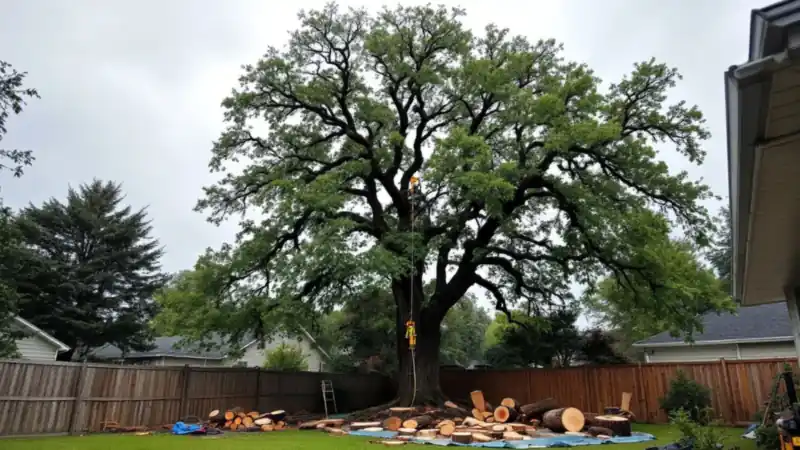
Short answer: Removing one tree costs an estimated $570 to $1,285 for a typical 30- to 60-foot tree, $225 to $570 under 30 feet, $1,025 to $1,995 at 60 to 80 feet and $1,590 to $3,425 above 80 feet, before a crane. Stump grinding adds about $95 to $550 a stump; hauling the logs away adds $205 to $775.
$570–$1,285 per tree, 30 to 60 ft, open drop zone, brush chipped and removed (estimate; see method)
$695–$1,170 what three contractors bid a Missouri city to remove one 19- to 24-inch tree in April 2026 (City of Overland bid results)
99 tree trimmers and pruners killed on the job in the U.S. in 2024 (BLS Census of Fatal Occupational Injuries)
10 ft closest an unqualified worker may bring a saw or pole to a power line up to 50 kV (29 CFR 1910.333)
Most tree removal price pages give four height bands and a range for each, with no way to check where the numbers came from. The pages ranking at the top of this search do exactly that: one is a California tree service quoting its own bands, one is a software company’s calculator, and one is a marketplace citing its own job data and an estimating database it does not publish.
This page builds every range from published inputs you can open: BLS wage data for tree trimmers and pruners (OEWS, May 2025), Census Bureau figures on how landscaping firms’ revenue splits into payroll and everything else (2022 Economic Census), FEMA’s 2025 equipment rate schedule, dated crane bids, landfill fee schedules, and, most usefully, public bid tabulations in which tree companies priced removals tree by tree for cities and a state DOT. The arithmetic is in the method box near the end. For how tree work fits with other project prices, see our cost guides and the full landscaping cost breakdown.
Tree removal cost by height
Height is how homeowners describe a tree, and it is how most quotes are framed. The table assumes a healthy tree with a clear area to drop limbs and sections, a three-person crew with a chipper, brush chipped and taken away, and the trunk left on site in rounds. Everything else on this page is priced as a change from that baseline.
| Tree height | Typical trunk (our assumption) | Crew-hours | Estimated cost per tree |
|---|---|---|---|
| Small: under 30 ft | under 12 in | 1 to 2 | $225–$570 |
| Medium: 30 to 60 ft | 12 to 24 in | 2.5 to 4.5 | $570–$1,285 |
| Large: 60 to 80 ft | 24 to 36 in | 4.5 to 7 | $1,025–$1,995 |
| Very large: over 80 ft | over 36 in | 7 to 12 | $1,590–$3,425 |
The low end of each range is a crew paid the national median tree trimmer wage working at the fast end of the hour range; the high end is a crew paid the 75th-percentile wage working at the slow end. A 30-foot ornamental pear in an open front yard sits near the bottom of its band. A 55-foot maple leaning toward a garage sits near the top of the medium band before any access charge is added.
Per-tree prices are the height-band estimates in this guide; brush chipping and cleanup are included, the trunk is left in rounds. Stump grinding and log haul-away are priced per tree. Local prices vary; see How we built these numbers.
How much does it cost to cut down a 40 ft tree?
An estimated $570 to $1,285 with a clear drop zone, which is the medium band. Our model pairs a 40-foot tree with a trunk of roughly 12 to 18 inches at chest height (an assumption; species vary). For a trunk that size, the three contractors bidding Overland, Mo., in April 2026 asked $500 to $780 for a 13- to 18-inch tree with no utility line nearby (City of Overland bid results, April 2026). If the tree has to be roped down in pieces over a roof, apply the access factors further down: roughly $740 to $1,670 at a 1.3 factor.
How much is it to remove a 50 ft or 100 ft tree?
A 50-foot tree falls in the same medium band, usually in its upper half: roughly $925 (the band midpoint) to $1,285 for a healthy tree with room to work. A 100-foot tree is a different job. Our very-large band ($1,590 to $3,425) assumes climbers and rigging only; many 100-foot removals near houses use a crane, which adds an estimated $780 to $3,360 for four to eight hours of crane time (see the crane section). Public bids for the biggest trunks show the same scale: $3,120 to $4,025 for a 55- to 60-inch tree in Overland’s 2026 bids.
How big of a tree costs $1,000 to remove?
At public-bid prices, $1,000 buys roughly a 19- to 30-inch trunk. In Overland’s 2026 bids, the 19- to 24-inch class ran $695 to $1,170 and the 25- to 30-inch class $1,200 to $1,560. In our height model, $1,000 is the upper half of the 30- to 60-foot band or the bottom of the 60- to 80-foot band.
What cities actually pay per tree: public bid prices by trunk diameter
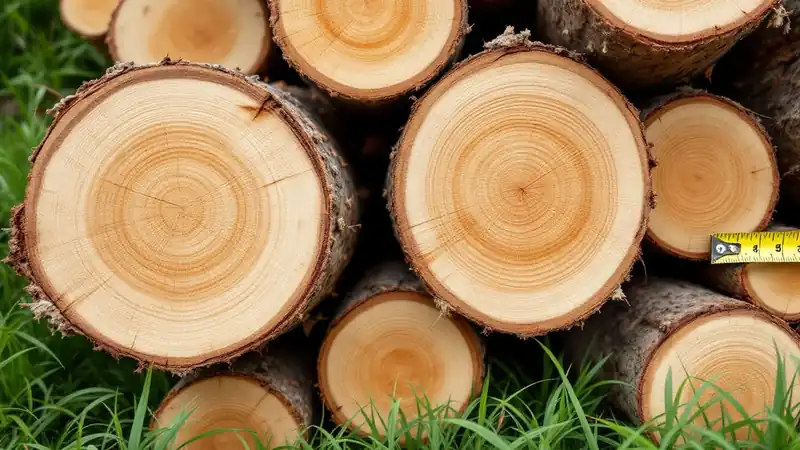
Tree companies price by trunk diameter more often than by height, because diameter is easy to measure and tracks the weight of wood that has to come down. Cities make them do it in writing. A diameter-class bid sheet lists a price per tree for each size class, every bidder fills it in, and the tabulation becomes a public record. Measure your own tree’s diameter at breast height (DBH), 4.5 feet above the ground: wrap a tape around the trunk and divide the circumference by 3.14.
| Trunk diameter (DBH) | Lowest bid | Highest bid | Near a utility line (low–high) |
|---|---|---|---|
| 0–6 in | $60 | $195 | $60–$292.50 |
| 7–12 in | $275 | $487.50 | $275–$585 |
| 13–18 in | $500 | $780 | $581.25–$1,625 |
| 19–24 in | $695 | $1,170 | $755–$1,365 |
| 25–30 in | $1,200 | $1,560 | $1,300–$1,755 |
| 31–36 in | $1,560 | $1,700 | $1,755–$1,800 |
| 37–42 in | $1,560 | $2,370 | $1,852.50–$2,468.75 |
| 43–48 in | $2,340 | $2,730 | $2,535–$2,843.75 |
| 49–54 in | $2,730 | $3,347.50 | $2,925–$3,476.25 |
| 55–60 in | $3,120 | $4,025 | $3,120–$4,168.75 |
A second tabulation, from a village in Lake County, Ill., shows how wide quotes spread for identical work. Seven companies bid the same 30 removals for 2025–26:
| Trunk class | Lowest of 7 bids | Median bid | Highest of 7 bids |
|---|---|---|---|
| Under 5.9 in | $40 | $60 | $160 |
| 6–12.9 in | $74 | $144 | $400 |
| 13–20.9 in | $250 | $400 | $900 |
| 21–30.9 in | $690 | $800 | $2,500 |
| 31 in and over | $1,200 | $1,430 | $4,000 |
The highest bidder for a 31-inch-plus tree asked 3.3 times the lowest. That is the single best argument for getting three quotes on a large removal. The same spread shows up on a state highway contract: four bidders on a North Carolina DOT roadside job in Robeson County priced a 21- to 30-inch tree at $600 to $800 and a tree over 50 inches at $1,800 to $2,650 (NCDOT bid tabulation, contract D6D1.SBE.007, April 2025). A Michigan city’s 2026 street-tree contract, 37 mature trees along local and major streets, drew eight bids from $46,280 to $136,715, or about $1,250 to $3,700 a tree (City of Owosso, 2026 Fall Tree Removal bid tabulation).
Two cautions before you hold a contractor to these numbers. Public contracts bundle dozens of trees on open streets, so a one-tree backyard job carries more travel and setup per tree. And bid sheets can be unbalanced: one NCDOT bidder entered $1 for every stump-grinding class, recovering the money on other lines. Treat these as a floor for open-access work, not a quote.
Why tree removal costs so much: the line items behind a quote
A tree removal quote is mostly crew time. There are almost no materials, so the price is labor plus the trucks and machines the crew brings, plus the insurance and overhead that come with some of the most dangerous work in the country.
| Cost input | Published figure | Source |
|---|---|---|
| Tree trimmer and pruner wage, U.S. median | $24.50 an hour ($30.72 at the 75th percentile) | BLS OEWS, May 2025 |
| Payroll as a share of landscaping-firm revenue | 32.3 percent | Census, 2022 Economic Census, NAICS 561730 |
| Three-person crew, billed (our calculation) | $227 to $285 per crew-hour | wages ÷ 0.323 |
| Brush chipper, 12- to 19-inch capacity, equipment only | $29.70 to $54.11 an hour | FEMA Schedule of Equipment Rates, 2025 |
| Truck-mounted aerial lift, 55 to 80 ft | $62.86 to $65.87 an hour | FEMA, 2025 |
| Stump grinder, 23- to 26-inch wheel | $55.28 to $56.33 an hour | FEMA, 2025 |
| Knuckleboom log loader (grapple) | $150.01 an hour | FEMA, 2025 |
| 40-ton boom truck crane with operator | $195 to $225 an hour, 4-hour minimum | Tennessee Tech RFQ, Nov. 2025 |
| Crane, county tree contract | $420 an hour | Lauderdale County, Miss., Bid 4021, 2026 |
The crew rate in our model lines up with what contractors bid when cities ask for hourly prices. Bidders on the North Carolina DOT job priced a bucket truck with a chainsaw crew at $75 to $300 an hour, and the only bidder on Lauderdale County’s 2026 contract priced removal at $480 an hour with a three-person minimum crew. Seven bidders for Grayslake priced daytime emergency crews at $130 to $520 an hour.
Danger is part of the price. The Bureau of Labor Statistics counted 99 deaths among tree trimmers and pruners in 2024: 39 from falls and 39 from being struck by or caught in something, usually wood (BLS CFOI, Table A-5, 2024). Grounds maintenance workers as a group died at 20.9 per 100,000 full-time workers, against 3.3 for all U.S. workers (BLS CFOI hours-based rates, 2024). That risk shows up in workers’ compensation and liability premiums, which sit inside the overhead every quote has to cover.
Prices have also climbed faster than inflation. The consumer price index for gardening and lawn care services, the closest BLS series to tree work, rose 52 percent from September 2019 to September 2025, from 210.9 to 320.6 (BLS CPI series CUUR0000SEHP02). All items rose 26.5 percent over the same months (BLS CPI-U, CUUR0000SA0).
Access, houses and power lines: what raises the price
The same tree can cost twice as much depending on what is underneath it. A tree with open lawn around it can be felled in a few big pieces. A tree over a roof has to be climbed, limbed and lowered piece by piece on ropes, which multiplies the crew-hours. We price that as a multiplier on the base estimate.
| Situation | Factor we apply | Why |
|---|---|---|
| Open drop zone, truck and chipper can reach the tree | 1.0 | Baseline |
| Backyard with gate-only access; brush carried out by hand | 1.2 | Extra labor-hours dragging brush to the chipper |
| Near a house, fence, pool or garage; lowered in sections | 1.3 | Rigging and roping each piece |
| Over a roof or within reach of power lines | 1.6 | Slowest rigging; line-clearance rules may require a qualified crew or the utility first |
| Dead, decayed or storm-damaged tree | 1.25 | Climbing restrictions, more rigging, sometimes a lift or crane |
Trees near power lines: who handles what
Federal rules keep anyone who is not a qualified electrical worker, and any conductive object they hold, at least 10 feet from an energized overhead line of 50 kV or less, with more distance for higher voltages (29 CFR 1910.333(c)(3)). A ladder, pole saw or falling limb counts. That is why tree crews without line-clearance training will not cut limbs touching the wires, and why a tree tangled in lines often starts with a call to the utility.
Utilities split the job by which wire is involved. The high-voltage lines on poles along the street are the utility’s to keep clear, usually at no charge to you; the service drop, the single line from the pole to your house, is generally yours. PG&E tells customers that property owners are responsible for keeping service drops clear and offers a free temporary disconnect so a contractor can work safely (PG&E vegetation management). Dominion Energy in Virginia will not cut trees on or near a service line but will disconnect the line at no cost (Dominion Energy). FPL trims around its own lines without charging the owner (FPL tree FAQ).
Two catches. When a utility does cut a tree near its lines, the wood is usually left for the owner: PG&E leaves larger wood on site because it belongs to the property owner, and FPL and Georgia Power both say storm debris is the owner’s or local government’s to remove (Georgia Power FAQ). And the utility’s work is clearance, not removal of the whole tree, so you may still need a contractor for the rest. Call the utility before you book the job; a free disconnect can move a tree from the 1.6 factor to the 1.3 factor in our calculator.
When a crane is worth it
A crane lifts whole sections out over the house, so the crew spends fewer hours rigging. On a large tree with no drop zone, that trade often cuts total cost. Crane time is bought in blocks: the lowest bidder for Tennessee Tech’s November 2025 crane contract charged $195 an hour for a 40-ton boom truck with a 4-hour minimum ($780), and $265 an hour for a 60-ton unit with a 6-hour minimum (Tennessee Tech University bid tabulation, Crane/Boom Truck, Nov. 18, 2025). Lauderdale County, Miss., pays $420 an hour for a crane on its tree contract. We use $780 to $3,360 per job for crane time, four to eight hours, as an add-on.
Does the species change the price? Wood weight and hardness
Species matters in two ways: how hard the wood is on saws and chippers, and how much it weighs, which decides how big each rigged piece can be and how much the load costs to haul. The U.S. Forest Products Laboratory publishes both. A green (freshly cut) oak weighs about 61 pounds per cubic foot; a 10-foot section of an 18-inch trunk is roughly 1,080 pounds.
Swipe the table sideways to see every column.
| Species | Specific gravity, green | Side hardness, green (lbf) | Green weight (lb per cu ft) |
|---|---|---|---|
| Eastern cottonwood | 0.37 | 340 | 59 |
| Eastern white pine | 0.34 | 290 | not listed |
| Silver maple | 0.44 | 590 | 49 |
| Loblolly pine | 0.47 | 450 | 50 |
| Sweetgum | 0.46 | 600 | 60 |
| American sycamore | 0.46 | 610 | 64 |
| Black walnut | 0.51 | 900 | 58 |
| Sugar maple | 0.56 | 970 | 59 |
| Northern red oak | 0.56 | 1,000 | 61 |
| White oak | 0.60 | 1,060 | 64 |
| Pecan | 0.60 | 1,310 | not listed |
| Honeylocust | 0.60 | 1,390 | not listed |
| Shagbark hickory | 0.64 | 1,460 | not listed |
Two points stand out. Cottonwood is soft (340 lbf) but heavy when green (59 pounds per cubic foot) because it holds so much water. Hickory and honeylocust are four times harder than cottonwood, which slows cutting and dulls chipper knives. In practice, crews price dense hardwoods such as oak, hickory and pecan above pines and soft maples of the same height, and large cottonwoods and sycamores above what their softness suggests. We do not apply a separate species factor in the calculator; the spread inside each height band covers most of it.
Whole-tree weight climbs much faster than diameter. Using the Forest Service’s national biomass equation for the oak, hickory and hard maple group and the moisture content above, a 12-inch tree weighs roughly 1.1 tons green above ground, an 18-inch tree about 2.8 tons and a 24-inch tree about 5.7 tons (Jenkins and others, Forest Science, 2003; Wood Handbook). Doubling the trunk diameter roughly quintuples the wood. These are estimates for a typical tree, and open-grown yard trees with big crowns can run heavier.
Stump grinding: leave it or grind it
Almost no removal quote includes the stump unless it says so. Grinding takes the stump and surface roots 6 to 12 inches below grade and leaves a pile of chips; full extraction, digging the root ball out, costs more and only makes sense where something will be built.
| Stump diameter | Grayslake, Ill. 2025/26 (7 bids, low–high) | Overland, Mo. 2026 (3 bids, low–high) |
|---|---|---|
| Under 6 in | $25–$150 | $30–$65 |
| 6–12.9 in / 7–12 in | $45–$250 | $65–$85.50 |
| 13–20.9 in / 13–24 in | $95–$425 | $65–$193.50 |
| 21–30.9 in / 25–30 in | $160–$550 | $97.50–$247.50 |
| 31 in and over / 31–36 in | $195–$600 | $97.50–$301.50 |
For a one-off residential stump we use $95 to $550 per stump, the range of public bids for 13- to 30-inch stumps. A single small stump often costs more than its class price because the contractor has a trip minimum; Lauderdale County’s contractor charges $360 for any stump up to 24 inches. Grinding several stumps on one visit is where the per-stump price falls. After grinding, the hole needs topsoil and seed or sod; see our sod installation cost guide for patch pricing.
Haul-away or leave the wood?
Brush is easy: it goes through the chipper and leaves in the chip truck. Trunk wood is the expensive part to remove, because it is heavy and landfills and yard-waste sites charge by the ton. Leaving the trunk cut into rounds for firewood or for you to deal with is the simplest way to cut a quote.
| Facility | Wood or stump rate | Effective |
|---|---|---|
| Broome County, N.Y., landfill | $55 per ton, tree trunks and stumps | county fee page, current |
| Madison County, N.Y. | $65 per ton, stumps and oversized tree waste; $35 brush | 2025 solid waste fee schedule |
| Seattle transfer stations | $132 per ton, clean yard or wood waste | Seattle Public Utilities rates, April 1, 2026 |
We price log haul-away for one 30- to 60-foot tree at $205 to $775: one to two hours of a two-person crew with a truck and loader, plus 1 to 3 tons of wood at $55 to $132 a ton. Larger trees scale with weight; a 24-inch oak can put more than 5 tons on the truck.
Tree removal cost by state
Crew wages are the biggest regional variable. We reran the medium-band estimate (a 30- to 60-foot tree, 2.5 to 4.5 crew-hours) with each state’s tree trimmer wages: the low end uses the state median wage, the high end the state 75th percentile. Equipment, insurance and overhead are scaled the same way, which is a simplification; rural states with lower wages also tend to have lower overhead.
Swipe the table sideways to see every column.
| State | Median tree trimmer wage | Crew-hour cost (median) | 30–60 ft tree, estimated |
|---|---|---|---|
| Alabama | $19.95 | $185 | $465–$980 |
| Arizona | $24.36 | $226 | $565–$1,105 |
| Arkansas | $21.95 | $204 | $510–$960 |
| California | $30.07 | $279 | $700–$1,575 |
| Colorado | $24.71 | $229 | $575–$1,195 |
| Connecticut | $23.52 | $218 | $545–$1,325 |
| Delaware | $23.72 | $220 | $550–$1,185 |
| Florida | $22.15 | $206 | $515–$980 |
| Georgia | $22.55 | $209 | $525–$1,055 |
| Hawaii | $27.40 | $254 | $635–$1,330 |
| Idaho | $21.08 | $196 | $490–$1,025 |
| Illinois | $30.99 | $288 | $720–$1,520 |
| Indiana | $22.14 | $206 | $515–$1,045 |
| Iowa | $20.62 | $191 | $480–$1,110 |
| Kansas | $23.27 | $216 | $540–$1,165 |
| Kentucky | $21.35 | $198 | $495–$925 |
| Louisiana | $22.77 | $211 | $530–$1,170 |
| Maine | $22.32 | $207 | $520–$1,135 |
| Maryland | $22.70 | $211 | $525–$1,025 |
| Massachusetts | $30.07 | $279 | $700–$1,595 |
| Michigan | $27.67 | $257 | $640–$1,215 |
| Minnesota | $37.24 | $346 | $865–$1,555 |
| Mississippi | $19.98 | $186 | $465–$965 |
| Missouri | $29.40 | $273 | $680–$1,325 |
| Montana | $28.65 | $266 | $665–$1,250 |
| Nebraska | $18.94 | $176 | $440–$875 |
| Nevada | $24.62 | $229 | $570–$1,035 |
| New Hampshire | $28.68 | $266 | $665–$1,200 |
| New Jersey | $34.59 | $321 | $805–$1,615 |
| New Mexico | $22.76 | $211 | $530–$1,190 |
| New York | $30.00 | $279 | $695–$1,590 |
| North Carolina | $23.31 | $216 | $540–$1,225 |
| North Dakota | $21.55 | $200 | $500–$930 |
| Ohio | $23.87 | $222 | $555–$1,100 |
| Oklahoma | $22.57 | $210 | $525–$1,020 |
| Oregon | $36.27 | $337 | $840–$1,685 |
| Pennsylvania | $27.98 | $260 | $650–$1,290 |
| Rhode Island | $29.35 | $273 | $680–$1,225 |
| South Carolina | $20.99 | $195 | $485–$1,010 |
| South Dakota | $24.25 | $225 | $565–$1,225 |
| Tennessee | $22.76 | $211 | $530–$990 |
| Texas | $19.17 | $178 | $445–$920 |
| Utah | $27.35 | $254 | $635–$1,330 |
| Vermont | $29.89 | $278 | $695–$1,415 |
| Virginia | $23.34 | $217 | $540–$1,085 |
| Washington | $30.70 | $285 | $715–$1,600 |
| West Virginia | $23.62 | $219 | $550–$1,140 |
| Wisconsin | $27.85 | $259 | $645–$1,255 |
| Wyoming | $22.22 | $206 | $515–$1,285 |
Minnesota, Oregon and New Jersey sit at the top of the table, with median tree trimmer pay above $34 an hour; Texas, Nebraska and Alabama sit at the bottom, under $20. The same 50-foot tree carries a crew cost roughly 1.9 times higher in Minnesota than in Nebraska. For landscaping pay by state more broadly, see our landscaper salary data.
Do you need a permit to remove a tree? Rules and fees in 13 big cities
In much of the country, no permit is needed to take down a tree in your own yard. In cities with tree ordinances, the permit is often the least of it: the replacement payment for a large tree can cost more than the removal. Sizes below are trunk diameter at 4.5 feet unless the code measures circumference. We read each city’s code and current fee schedule; rules change, so confirm with the city before booking.
Swipe the table sideways to see every column.
| City | Private-yard trees that need a permit | Fees and replacement payments | Dead or hazardous trees |
|---|---|---|---|
| Washington, D.C. | “Special” trees 40 to 100 inches around (about 13 to 32 inches across), effective May 21, 2026; trees over 100 inches around only if hazardous or an exempt species | Tree Fund payment of at least $55 per inch of circumference (D.C. Code §8-651.04) | Permit still issued, with no Tree Fund payment if shown to be hazardous |
| Seattle | Trees 6 inches and up. Without a development project, most residential lots may remove two 6- to 12-inch trees per three years; 12 inches and up only if hazardous or (12 to 24 inches) damaging a foundation or utilities | Hazard review from $275.50 (half the $551 hourly rate); payment in lieu of replacement $2,833 per 12- to 24-inch tree (Director’s Rule 8-2023) | No land-use fee for dead trees and no replacement (Tip 242B, 2025), but approval still needed |
| Portland, Ore. | Private trees 12 inches and up; 20 inches and up need a Type B permit with inch-for-inch replacement | Application free for up to 3 trees, $25 a tree for 4 or more; $472 per inch in lieu of replanting (fee schedule eff. July 10, 2026) | Permit still needed, with tree-for-tree replacement; emergencies can file within 7 days |
| Austin | Protected trees 19 inches and up; heritage species (all oaks, pecan, cedar elm and others) 24 inches and up need a variance | $252.89 tree review without a building permit; mitigation fund $200 per inch (fee schedule eff. Oct. 1, 2026) | Damaged imminent-hazard tree may be removed without a permit within 7 days; schedule notes fees waived for dead, diseased or hazard trees |
| Atlanta | Non-pine trees 6 inches and up; pines 12 inches and up (ordinance adopted June 2025, amended Feb. 2026) | Recompense $140 per caliper inch owed in 2026, indexed to inflation from 2027 | Permit still required; no replacement or recompense |
| Charlotte | Outside development, only heritage trees: N.C. native species 30 inches and up | $500 per heritage tree, or replacement planting options (city checklist, 2024) | No permit or mitigation for dead, diseased or failing heritage trees, with documentation |
| Oakland | Coast live oaks 4 inches and up; other trees 9 inches and up except eucalyptus and Monterey pine | $579.06 permit for 1 to 10 trees (non-development); $619 per tree in-lieu fee (FY2026-27 fee schedule) | Not confirmed for private dead trees; check with the city |
| San Jose | Trunks 38 inches around (about 12 inches across) at 54 inches above ground | Set in the city planning fee schedule | Permit required even for dead trees |
| Los Angeles | Only protected natives: oaks (not scrub oak), Southern California black walnut, western sycamore, California bay, 4 inches and up | $805.99 application plus $2,892.48 inspection for 1 to 2 trees (LAMC 46.04) | No exemption; decline or danger of falling are grounds to approve |
| Houston | Private yard trees not regulated; street and sidewalk-zone trees 20 inches and up (or listed street-tree species) need 20 days’ notice | Inch-for-inch replacement or a per-inch fee; fines up to $500 per tree | Storm or accident damage is a defense |
| Miami-Dade County (unincorporated) | Trees 3 inches or 12 feet and up, but existing single-family yards are exempt unless a specimen tree (18 inches and up) or in a natural forest community | Set by county administrative order | Dead trees exempt outside natural forest communities; cities may be stricter |
| Denver | No general permit for private yard trees; permit required for right-of-way trees | Set by Forester rule | No value compensation for dead or unhealthy right-of-way trees |
| Chicago | Private trees not covered; parkway trees become city property once planted | $20 permit to remove a parkway tree (MCC 10-32-090) | City forestry crews handle dead parkway trees |
The pattern: West Coast cities and Atlanta regulate ordinary yard trees and charge by the inch; Houston, Denver and Chicago leave private yard trees alone and regulate only trees along the street; Charlotte and Los Angeles protect only certain trees. A 20-inch oak removed with no replanting could carry a recompense of about $2,800 in Atlanta (20 inches at $140, if all 20 inches are owed) and $9,440 in Portland’s in-lieu fee (20 inches at $472) on top of the contractor’s bill. Ask the contractor whether they pull the permit; many do, and the permit cost belongs on the quote.
Street trees: often the city’s job, not yours
If the tree stands between the sidewalk and the curb, it may not be yours to remove or pay for. Chicago’s code makes parkway trees city property once planted, and its forestry bureau handles dead ones. Atlanta’s parks department maintains and removes right-of-way trees. Portland and Seattle are exceptions: there, the adjacent owner generally maintains street trees and pays for removal. Call the city forester before paying anyone to cut a street tree.
Who pays when a neighbor’s tree falls?
In most states the answer turns on one question: did the tree owner know, or should they have known, that the tree was dead, decayed or dangerous? If a healthy tree comes down in a storm, it is treated as an act of nature, and each owner’s own insurance handles damage to their own property. Connecticut’s insurance department puts it plainly: a tree owner is legally liable only if the owner’s negligence caused the tree to fall (Connecticut Insurance Department, storm claims FAQ). South Carolina’s regulator gives the same answer and adds that your insurer may recover from the neighbor if negligence was involved (S.C. Department of Insurance FAQ).
Extension law guides describe the negligence test the same way. University of Georgia Extension: the owner is liable only with preexisting knowledge that the tree was diseased, decayed or otherwise dangerous (UGA Extension Circular 1099, 2022). NC State Extension points to a duty to remove reasonably foreseeable dangers, such as a tree that is dead or visibly dying (NC State Extension, 2022). Practical upshot: if a neighbor’s tree looks dead or is leaning over your house, tell them in writing and keep a copy. That notice is what later separates an act of nature from negligence.
| Situation | Who usually pays | Source |
|---|---|---|
| Healthy tree falls in a storm onto your house | Your homeowners policy (you pay the deductible) | Conn. Insurance Dept. |
| Dead or visibly decayed tree the owner knew about falls on your house | The tree owner (or their insurer), often through subrogation by your insurer | NC State Extension; Insurance Information Institute |
| Tree falls but hits nothing insured | Usually you; debris removal is generally not covered | Insurance Information Institute |
| Neighbor’s branches hang over your yard | You may trim to the property line at your own expense | UF/IFAS EDIS FE962, 2022 |
What homeowners insurance pays for tree removal
The standard homeowners form written by ISO, which many insurers use or adapt, pays up to $1,000 per loss to remove fallen trees, and no more than $500 for any one tree. It applies when a tree is felled by wind, hail or the weight of ice, snow or sleet (or a neighbor’s tree by a covered peril) and it damages a covered structure or blocks a driveway or wheelchair ramp (ISO HO 00 03 sample form, 2000 edition, via III). That is less than the cost of most large removals in the tables above. Connecticut’s regulator describes coverage of up to $500 for removal in the same circumstances; check your own policy’s wording, because insurers adapt the form.
Trimming a neighbor’s tree and the cost of cutting the wrong one
You can generally cut back branches and roots that cross onto your property, up to the line and at your own cost, but not in a way that kills the tree (UF/IFAS EDIS; Ohio State University Agricultural and Resource Law Program, 2023). Cutting down a tree that is not yours is expensive: Washington’s timber trespass statute awards treble damages (RCW 64.12.030), and California (Civil Code §3346), New York (RPAPL §861), Oregon (ORS 105.810) and Michigan (MCL 600.2919) have multiple-damages rules of their own. Before removing a tree near a boundary, confirm whose side of the line the trunk stands on.
Can seniors get free tree removal?
There is no national free tree removal program. The closest federal option is USDA’s Section 504 home repair program for rural homeowners: grants are limited to owners 62 or older with very low income (7 CFR 3550.103), and grant money may only pay for repairs that remove identified health and safety hazards (7 CFR 3550.102). USDA lists the maximum grant as $10,000 and the maximum loan as $40,000 at 1 percent (USDA Rural Development, Section 504). Neither the rule nor the program page names trees, so a hazardous tree threatening the house is the case to ask about, not routine removal.
Two other routes cost nothing. If the tree is a street or parkway tree, the city usually owns it and removes it (see the permit table above). And if the problem is limbs in the primary power lines, the utility clears those at its own cost.
What is the cheapest time of year for tree removal?
Late fall through winter, outside storm season, in most of the country. No public data set tracks seasonal tree prices, so this is reasoning from the bid sheets rather than a measured discount: the Overland bidders priced emergency removals 37 percent above scheduled ones (pooled across sizes), and one bidder doubled every emergency price. Booking a non-urgent removal in a slow month, and grouping several trees into one visit, avoids both the storm premium and a second trip charge. Deciduous trees also weigh less and are easier to see through once the leaves drop.
Reading a tree removal quote: what should be in writing
- Which trees, by location and trunk size, and whether each is felled whole or dismantled in sections.
- Whether stump grinding is included, how deep, and whether the chips are removed or left in the hole.
- What happens to the trunk wood and brush: chipped and hauled, or left in rounds.
- Who obtains the city permit, if one is required, and who pays any replacement fee.
- Proof of liability insurance and workers’ compensation coverage. A worker hurt on your property without coverage can become your problem.
- Whether a crane, lift or utility disconnect is needed, and who schedules it.
Some states license tree work separately from landscaping. Maryland, for example, bars anyone from working as a tree expert without a state license, and its definition covers removing trees taller than 20 feet (Md. Code, Natural Resources § 5-415, § 5-417). Check our license requirements by state and how to check a license before you pay a deposit. A quote far below the public bid prices above usually means something has been left out: the stump, the haul-away, or the insurance.
Is it cheaper to cut a tree down yourself?
For a small tree that can fall in any direction without hitting anything, yes: the cost is a saw, safety gear and your time. Above roughly 20 to 30 feet, or anywhere near a structure or a line, the numbers turn the other way. The trade’s fatality count above is for trained crews with proper equipment, and a damaged roof costs more than the removal. Splitting the work is a fair compromise: have a crew drop the tree and leave the wood, then cut and haul the rounds yourself.
How we built these numbers
We do not have our own job data. Each estimate is crew time multiplied by a billed crew rate, built from the published inputs below, then checked against public bid prices. Ranges are estimates, not quotes. Our general approach is on the methodology page.
Crew rate. Three workers at the national tree trimmer and pruner wage: $24.50 median and $30.72 at the 75th percentile (BLS OEWS, May 2025, SOC 37-3013). Wages are divided by 0.3231, landscaping services firms’ 2022 payroll as a share of revenue ($37.29 billion of $115.41 billion, Census EC2256BASIC, NAICS 561730). The gross-up covers trucks, chipper, saws, insurance, overhead and profit. Result: $227.48 to $285.24 per crew-hour.
Crew-hours by height. Our planning assumptions: 1 to 2 hours under 30 feet, 2.5 to 4.5 hours at 30 to 60 feet, 4.5 to 7 hours at 60 to 80 feet, and 7 to 12 hours above 80 feet. Low estimate = low hours × low rate; high = high hours × high rate. Check: dividing the Overland, Mo., 2026 bids by the model’s crew rate implies 1.8 to 3.4 crew-hours for a 13- to 18-inch tree, 2.4 to 5.1 hours at 19 to 24 inches, and 5.5 to 7.5 hours at 31 to 36 inches, which brackets our medium and large bands. Pairing height bands with trunk diameters is our assumption; the relationship varies by species and growing conditions.
Add-ons. Crane: 4 to 8 hours at $195 to $420 an hour (Tennessee Tech and Lauderdale County bids), $780 to $3,360. Stump grinding: $95 to $550, the range of Grayslake and Overland bids for 13- to 30-inch stumps. Log haul-away: 1 to 2 hours of a two-person crew at the same gross-up plus 1 to 3 tons at $55 to $132 a ton, $205 to $775. Access factors are our assumptions; the Overland utility-line and emergency premiums are the only published reference we found.
State estimates. The medium band recalculated with each state’s median and 75th-percentile wage, keeping the national gross-up. Wood weight. Green weight = 62.4 lb per cubic foot × green specific gravity × (1 + mean green moisture content), from Wood Handbook Tables 5-3b and 4-1. Whole-tree weights use the Jenkins (2003) hard maple, oak, hickory and beech equation, biomass (kg) = exp(−2.0127 + 2.4342 × ln DBH in cm), converted to green weight with a 74.5 percent moisture content.
Not included: permits and replacement fees, emergency or after-hours premiums, utility disconnect charges, sales tax where it applies, and repairs to lawns or hardscape.
This page is general information, not legal, insurance or safety advice. Tree ordinances, liability rules and utility policies change and vary by city and state; confirm with your city forester or permit office, your insurer and your utility before work starts. Never work within 10 feet of a power line.
Tree removal questions people ask
What is the average cost to cut down a tree?
For the most common yard tree, 30 to 60 feet tall, our estimate is $570 to $1,285 with clear access, brush hauled away and the trunk left in rounds. Public bids in Missouri and Illinois put a 13- to 24-inch tree at roughly $250 to $1,170 on open city streets, while backyard jobs near houses run higher.
How much does it cost to take down a large tree?
A 60- to 80-foot tree is an estimated $1,025 to $1,995; over 80 feet, $1,590 to $3,425 before crane time. If it must come down over a roof, multiply by about 1.3 to 1.6, and add $780 to $3,360 if a crane is used. A 55- to 60-inch trunk drew bids of $3,120 to $4,025 in Overland, Mo., in 2026.
How much does it cost to remove a 10 ft tree?
A 10-foot tree is usually a short job: our small-tree band starts at about $225 for a crew visit, and public bids for trunks under 6 inches ran $40 to $195 a tree. Many contractors have a trip minimum, so adding it to a larger job is cheaper than booking it alone.
How can I reduce the cost of tree removal?
Get three quotes (one Illinois village’s bids varied more than threefold for the same tree), keep the wood instead of paying for haul-away, have several trees and stumps done in one visit, book outside storm season, and clear fences, cars and furniture from the work area so the crew needs less rigging.
Does homeowners insurance pay for tree removal?
Only in specific cases. The standard ISO homeowners form pays up to $500 per tree and $1,000 per loss to remove a tree felled by wind, hail or ice that hits a covered structure or blocks a driveway. A dead tree you remove as a precaution, or a tree that falls on open lawn, is usually yours to pay for.
Do I need a permit to remove a tree on my property?
It depends on the city. Many places require nothing for a yard tree, but Atlanta regulates most trees 6 inches and up, Portland 12 inches and up, Austin 19 inches and up, and Washington, D.C., trees about 13 inches across and up. Replacement fees can exceed the removal price: $140 per inch in Atlanta and $472 per inch in lieu of replanting in Portland.
Sources
- U.S. Bureau of Labor Statistics, Occupational Employment and Wage Statistics, May 2025, state and national files (SOC 37-3013 Tree Trimmers and Pruners), May 2025 estimates, released May 15, 2026. Accessed October 2026.
- U.S. Bureau of Labor Statistics, OEWS tables (May 2025), May 2025. Accessed October 2026.
- U.S. Census Bureau, 2022 Economic Census, EC2256BASIC, NAICS 561730 Landscaping Services, 2022, posted Dec. 2024. Accessed October 2026.
- City of Overland, Mo., Bid Results, On-Call Supportive Urban Forest Tree Care Services, April 21, 2026. Accessed October 2026.
- Village of Grayslake, Ill., Tree Maintenance (2025/26) Bid Tabulation, 2025. Accessed October 2026.
- North Carolina Department of Transportation, Bid tabulation, contract D6D1.SBE.007, Tree Removal, Stump Grinding and Overhang Clearing, Robeson County, April 3, 2025. Accessed October 2026.
- City of Owosso, Mich., 2026 Fall Tree Removal bid tabulation (unofficial results), Aug. 25, 2026. Accessed October 2026.
- Lauderdale County, Miss., Board of Supervisors, Bid No. 4021, Professional Tree Cutting Services, annual term bid opening results, 2026 annual term. Accessed October 2026.
- Tennessee Tech University, Bid tabulation, Crane/Boom Truck, requisition 207854095, Nov. 18, 2025. Accessed October 2026.
- FEMA, 2025 Schedule of Equipment Rates, disasters declared on or after July 1, 2025. Accessed October 2026.
- FEMA, Schedule of Equipment Rates (program page), 2025. Accessed October 2026.
- USDA Forest Service, Forest Products Laboratory, Wood Handbook: Wood as an Engineering Material, FPL-GTR-282, Tables 4-1 and 5-3b, 2021. Accessed October 2026.
- Jenkins, J.C., Chojnacky, D.C., Heath, L.S., Birdsey, R.A. (USDA Forest Service), National-scale biomass estimators for United States tree species, Forest Science 49(1), 2003. Accessed October 2026.
- Broome County, N.Y., Division of Solid Waste Management, Landfill tipping fees, current schedule. Accessed October 2026.
- Madison County, N.Y., 2025 Solid Waste Fee Schedule, 2025. Accessed October 2026.
- Seattle Public Utilities, Transfer station rates, rates as of April 1, 2026. Accessed October 2026.
- U.S. Bureau of Labor Statistics, Census of Fatal Occupational Injuries, Table A-5, fatal occupational injuries by occupation and event, 2024, 2024. Accessed October 2026.
- U.S. Bureau of Labor Statistics, Census of Fatal Occupational Injuries, hours-based fatality rates, 2024, 2024. Accessed October 2026.
- U.S. Bureau of Labor Statistics, CPI-U series CUUR0000SEHP02, Gardening and lawncare services, Sept. 2019 to Sept. 2025. Accessed October 2026.
- U.S. Bureau of Labor Statistics, CPI-U series CUUR0000SA0, All items, Sept. 2019 to Sept. 2025. Accessed October 2026.
- Electronic Code of Federal Regulations, 29 CFR 1910.333, Selection and use of work practices (overhead line clearances), current. Accessed October 2026.
- Maryland General Assembly, Natural Resources Article §5-415, definitions (tree expert), current. Accessed October 2026.
- Maryland General Assembly, Natural Resources Article §5-417, license required, current. Accessed October 2026.
- Council of the District of Columbia, D.C. Code §8-651.02, definitions (Special Tree), as amended by D.C. Law 26-113, effective May 21, 2026. Accessed October 2026.
- Council of the District of Columbia, D.C. Code §8-651.02 and §8-651.04 (Urban Forest Preservation, as amended by D.C. Law 26-113), effective May 21, 2026. Accessed October 2026.
- City of Seattle, Seattle Municipal Code 25.11.050 (tree protection), Ord. 127099, 2024. Accessed October 2026.
- Seattle Department of Construction and Inspections, Director’s Rule 8-2023, payment in lieu of tree replacement, effective July 31, 2023. Accessed October 2026.
- Seattle Department of Construction and Inspections, Tip 242B, tree removal on developed lots, updated Oct. 1, 2025. Accessed October 2026.
- City of Portland, Ore., Portland City Code Chapter 11.40, tree permits, effective Jan. 3, 2025. Accessed October 2026.
- City of Portland, Ore., Tree permitting fee schedule, effective July 10, 2026. Accessed October 2026.
- City of Austin, Trees on residential property, accessed Oct. 2026. Accessed October 2026.
- City of Austin Development Services, Tree review and inspection fees, effective Oct. 1, 2026. Accessed October 2026.
- City of Atlanta, Code of Ordinances §158-69, recompense, Ord. 2025-19, amended Ord. 2026-03. Accessed October 2026.
- City of Charlotte, Tree Ordinance (City Code Chapter 21) as adopted, effective June 1, 2023. Accessed October 2026.
- City of Charlotte, Non-development heritage tree checklist, April 2024. Accessed October 2026.
- City of Oakland, Oakland Municipal Code Chapter 12.36, protected trees, current. Accessed October 2026.
- City of Oakland, FY 2026-27 adopted Master Fee Schedule, effective July 1, 2026. Accessed October 2026.
- City of San Jose, San Jose Municipal Code Chapter 13.32, tree removal controls, current. Accessed October 2026.
- City of Los Angeles, Los Angeles Municipal Code §46.00 to 46.06, protected trees and shrubs, Ord. 186,873 (2021) and 187,205 (2021). Accessed October 2026.
- City of Houston, Code of Ordinances Chapter 33, Article VI, trees and shrubs, current. Accessed October 2026.
- Miami-Dade County, Code §24-49, tree removal permits, current. Accessed October 2026.
- City and County of Denver, Revised Municipal Code §57-20, permits, current. Accessed October 2026.
- City of Chicago, Municipal Code Chapter 10-32, trees, plants and shrubs, current. Accessed October 2026.
- Pacific Gas and Electric Co., Vegetation management, accessed Oct. 2026. Accessed October 2026.
- Dominion Energy, Tree trimming and power lines (Virginia), accessed Oct. 2026. Accessed October 2026.
- Florida Power & Light, Trees FAQ, accessed Oct. 2026. Accessed October 2026.
- Georgia Power, Land and tree management FAQs, accessed Oct. 2026. Accessed October 2026.
- Connecticut Insurance Department, Homeowners storm claims FAQs, undated. Accessed October 2026.
- South Carolina Department of Insurance, FAQ 185, neighbor’s tree, undated. Accessed October 2026.
- University of Georgia Extension, Circular 1099, Tree Ownership and Responsibility, July 21, 2022. Accessed October 2026.
- NC State Extension, Tree Fall Liability: Who Is Responsible for Property Damage?, April 26, 2022. Accessed October 2026.
- Insurance Information Institute, If a tree falls on your house, are you covered?, accessed Oct. 2026. Accessed October 2026.
- Insurance Services Office (via Insurance Information Institute), Homeowners 3 Special Form, HO 00 03 10 00 (sample), 2000 edition. Accessed October 2026.
- University of Florida IFAS Extension, EDIS FE962, neighbor tree law, Oct. 3, 2022. Accessed October 2026.
- Ohio State University, Agricultural and Resource Law Program, Trees near rural property boundaries: what are the laws?, Feb. 17, 2023. Accessed October 2026.
- Washington State Legislature, RCW 64.12.030, Injury to or removing trees, etc.: damages, current. Accessed October 2026.
- Electronic Code of Federal Regulations, 7 CFR 3550.102, Section 504 grant and loan purposes, current. Accessed October 2026.
- Electronic Code of Federal Regulations, 7 CFR 3550.103, Section 504 eligibility (age 62 for grants), current. Accessed October 2026.
- USDA Rural Development, Single Family Housing Repair Loans and Grants, accessed Oct. 2026. Accessed October 2026.