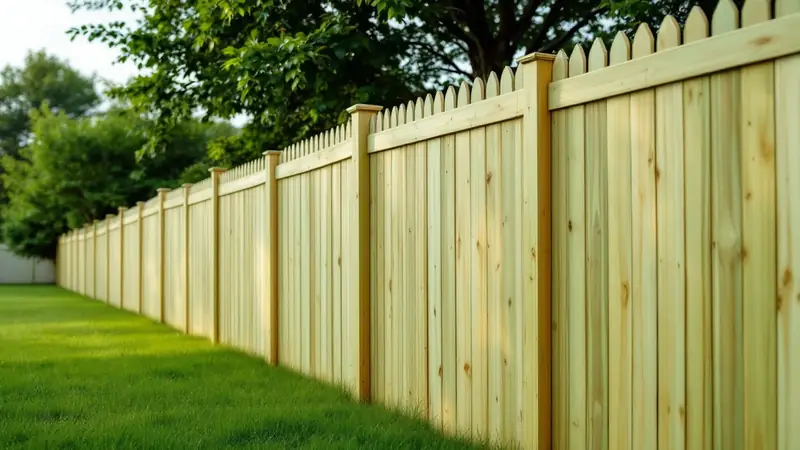
Short answer: A 6-foot treated-pine privacy fence costs an estimated $27 to $39 per linear foot installed, about $4,050–$5,850 for 150 feet before gates and tear-out. Chain link runs $25 to $40 a foot, aluminum $41 to $66 and vinyl $44 to $63. The model building code exempts fences up to 7 feet from permits; local zoning often sets lower limits.
$27–$39 per linear foot, 6-ft pressure-treated privacy fence installed (estimate; see method)
$4,050–$5,850 for 150 feet of that fence, before gates and removal (estimate)
7 ft height up to which the model residential code exempts a fence from a building permit (IRC R105.2)
48 in minimum pool barrier height, with self-closing, self-latching gates (ISPSC 305)
The two big-box retailers that rank for this search do not publish an installed price per foot. One lists material prices per panel and per picket and says its average fencing job in 2025 came to $6,300 (The Home Depot fence installation cost guide); the other says prices vary by location and contractor and offers a consultation (Lowe’s fence installation page). Neither tells you what a foot of finished fence should cost, or why.
This page builds that number. Each per-foot figure comes from dated, published prices for pickets, posts, rails, panels and post-setting concrete; from BLS wage estimates for fence erectors (OEWS, May 2025); and from the 2022 Economic Census record of how specialty trade contractors split revenue between materials, payroll and everything else. The arithmetic is in the method box near the end, and public bid prices from two state transportation departments serve as a check. For other project prices, see our cost guides and the overall landscaping cost breakdown.
Fence cost per linear foot, by material
Material choice moves the price more than anything else on a fence quote, including where you live. The table prices the most common residential builds on level, open ground with normal soil. “DIY materials” is what the parts cost at the published prices we found, including post-setting concrete and a waste allowance. “Installed” adds crew labor and the overhead and profit a contractor has to cover.
| Fence type and height | DIY materials per ft | Installed per ft | 150 ft installed | Build assumed |
|---|---|---|---|---|
| Split rail, 3-rail, about 4 ft | $6.17–$9.69 | $13–$21 | $1,950–$3,150 | Posts usually tamped, not concreted |
| Wood picket, 4 ft, pressure-treated pine | $10.07–$12.55 | $21–$29 | $3,150–$4,350 | Spaced pickets, 2 rails |
| Chain link, 4 ft | $13.30–$19.97 | $25–$40 | $3,750–$6,000 | Galvanized or black-coated, line posts about every 8 to 10 ft |
| Wood privacy, 6 ft, pressure-treated pine | $12.62–$17.66 | $27–$39 | $4,050–$5,850 | Dog-ear pickets, 3 rails, posts every 8 ft |
| Wood privacy, 6 ft, cedar pickets | $13.85–$29.78 | $29–$60 | $4,350–$9,000 | Cedar pickets on treated posts and rails |
| Steel ornamental (“wrought iron” look), 4 ft | $17.67–$31.67 | $34–$61 | $5,100–$9,150 | Powder-coated steel panels, 8 ft wide |
| Aluminum, 4 ft, residential grade | $21.54–$34.62 | $41–$66 | $6,150–$9,900 | Panels 6 ft wide |
| Vinyl (PVC) privacy, 6 ft | $23.27–$32.53 | $44–$63 | $6,600–$9,450 | Tongue-and-groove panels, 8 ft wide |
| Composite privacy, 6 ft | $51.17–$90.29 | $94–$165 | $14,100–$24,750 | Wood-plastic composite, 6 ft sections |
Uses the per-foot ranges in this guide. Removal is about $3 to $7 per foot; the 15 percent factor approximates that for a mid-priced fence. Excludes permits and sales tax. Local prices vary; see How we built these numbers.
Three things stand out. First, the cheap end of the market is narrower than most guides suggest: once you add posts set in concrete, a 4-foot chain link fence is not far below a 6-foot wood privacy fence, because both pay for the same post holes, concrete and crew time. Second, cedar privacy has the widest spread in the table, because picket prices run from $2.99 for economy cedar at a Buffalo, N.Y., yard (Lenco) to $8.49 at an Omaha fence supplier (Omaha Fence Co.). Third, labor is a smaller share of a fence than many homeowners assume: in our build-ups it is roughly 8 to 24 percent of the pre-markup cost, and the rest is materials. That is why a vinyl or composite fence costs more almost everywhere, whatever local wages are.
How much 100, 150, 200 and 500 feet of fence cost
Most quotes are for a backyard run of 100 to 200 feet. A square 1-acre lot has about 835 feet of perimeter (the square root of 43,560 square feet is 208.7 feet a side), and a 20-by-20-foot dog run is 80 feet. These totals use the per-foot ranges above and leave out gates and tear-out, which are priced in the next sections.
| Fence length | Split rail | Chain link, 4 ft | Wood privacy, 6 ft (treated pine) | Vinyl privacy, 6 ft | Aluminum, 4 ft |
|---|---|---|---|---|---|
| 80 ft (20 x 20 run) | $1,040–$1,680 | $2,000–$3,200 | $2,160–$3,120 | $3,520–$5,040 | $3,280–$5,280 |
| 100 ft | $1,300–$2,100 | $2,500–$4,000 | $2,700–$3,900 | $4,400–$6,300 | $4,100–$6,600 |
| 150 ft | $1,950–$3,150 | $3,750–$6,000 | $4,050–$5,850 | $6,600–$9,450 | $6,150–$9,900 |
| 200 ft | $2,600–$4,200 | $5,000–$8,000 | $5,400–$7,800 | $8,800–$12,600 | $8,200–$13,200 |
| 500 ft | $6,500–$10,500 | $12,500–$20,000 | $13,500–$19,500 | $22,000–$31,500 | $20,500–$33,000 |
| 835 ft (1-acre square) | $10,855–$17,535 | $20,875–$33,400 | $22,545–$32,565 | $36,740–$52,605 | $34,235–$55,110 |
| 1,000 ft | $13,000–$21,000 | $25,000–$40,000 | $27,000–$39,000 | $44,000–$63,000 | $41,000–$66,000 |
For rural acreage the economics change. Iowa State University Extension prices a 1,320-foot woven-wire livestock fence at $2.34 a foot and a barbed-wire fence at $1.99 a foot, including labor and equipment at a $20-an-hour custom rate, at 2024 retail prices (Iowa State Ag Decision Maker File B1-75, revised December 2024). That is a farm fence, not a residential one, but it is the realistic option for fencing several acres for animals.
Where the money goes on a 150-foot privacy fence
Using the midpoints of our 6-foot treated-pine estimate, a 150-foot fence comes to about $4,930. Materials are about $2,270 of that and crew pay with benefits about $650. The remaining $2,010 or so is what a contractor needs for everything else: trucks, augers, insurance, office staff, estimates that do not turn into jobs, and profit. That split follows the 2022 Economic Census: establishments in NAICS 238990, the “all other specialty trade contractors” industry that includes fence builders, spent 31.2 percent of revenue on materials, 22.7 percent on payroll and 5.4 percent on benefits, leaving about 40.7 percent for all other costs and profit.
Fence building is a big business inside that industry. In 2022, establishments in NAICS 238990 reported $10.95 billion of revenue from building new fences, $1.80 billion from altering existing ones and $1.06 billion from fence repair, and 7,231 establishments reported new-fence revenue (Census Bureau, 2022 Economic Census product lines, ECNNAPCSIND2022). New fencing alone was 13.2 percent of the industry’s revenue.

Material by material: what you get for the money
Wood privacy: treated pine vs cedar
A 6-foot board fence on 8-foot post spacing uses about 18 pickets per section with 5.5-inch boards butted together, three 2×4 rails and one post. Published prices for 1x6x6 treated dog-ear pickets ran $2.49 at Lenco in the Buffalo area and $3.59 at R.P. Lumber in Illinois and Indiana. Treated 2x4x8 rails were $5.52 at R.P. Lumber and $6.29 at Lenco; a 4x4x8 treated post was $12.99 (R.P. Lumber) and a 4x4x10, for deeper setting in cold climates, $17.95 (Lenco). That works out to $12.62 to $17.66 a foot in parts, or $4,050–$5,850 installed for 150 feet.
Swapping in cedar pickets raises materials to $13.85 to $29.78 a foot and the installed range to $29–$60. The low end is economy cedar; the high end is the $8.49 picket price from a fence company’s retail store (Omaha Fence Co.). Ask which species and grade the quote assumes; “cedar” covers a wide range of wood.
Vinyl (PVC) privacy
A complete 6×8-foot white privacy section with post and cap was $159.92 from a wholesaler that ships nationally (Vinyl Fence Wholesale, prices as of August 2026), about $20 a foot plus freight. A retail-priced 6×8 panel ran $139 to $169 by color, with 5×5 posts at $39 to $44 and caps from $4.90 (FenceCenter Dogwood series). With concrete, that is $23.27 to $32.53 a foot in materials and an estimated $44–$63 installed, or $6,600–$9,450 for 150 feet.
Vinyl versus wood comes down to paying more now to avoid staining later. On our numbers, vinyl privacy costs about $17 to $24 more per foot installed than treated pine, or roughly $2,550 to $3,600 more on a 150-foot run. Whether that pays back depends on how often you would otherwise stain or replace boards, which varies too much by climate to put a reliable number on.
Chain link
Chain link prices cluster tighter than people expect. A complete 4×50-foot kit (black-coated fabric, six posts, top rail and fittings) listed at $529, about $10.58 a foot (ALEKO, checked October 2026). A Maine fence yard lists 4-foot galvanized material at $14.50 a foot, with end or gate posts at $62 and corner posts at $75 (Mainline Fence). Our installed estimate is $25–$40 a foot.
Public bids bracket that range. Tennessee DOT’s 2025 awarded contracts averaged $10.00 a foot for 4-foot chain link plus $250 for each end or corner post assembly, on 2,702 feet of highway fence (TDOT Average Unit Prices, 2025). Missouri DOT’s 2025 statewide bids for 48-inch chain link averaged $69.42 a foot across 18 bids, with a low of $45 (MoDOT 2025 Unit Bid Prices). Highway work brings volume discounts on one end and prevailing wages, bonding and traffic control on the other; a backyard job sits between.
Aluminum and steel ornamental (“wrought iron”)
Aluminum panels 6 feet wide started at $80.35, with matching posts from $25.36; fancier styles ran to $131.84 a panel and $39 a post (Fence Workshop panels; posts). Installed, that is $41–$66 a foot. Powder-coated steel is usually what a quote means by “wrought iron” today. An 8-foot, 4-foot-tall steel panel listed at $87 from one seller (BuyOrnamentalFence) and $169.01 from another, with posts at $30.26 (America’s Fence Store); our installed estimate is $34–$61 a foot. Hand-forged custom iron is a different product, priced by the job; we did not find published prices to build a per-foot figure.
Composite
Composite is the most expensive common fence because nearly all of its cost is material. A 6-foot-wide composite section with one post listed at $275 on sale and $489 at regular price (NewEra composite fence kit), or $46 to $82 a foot before concrete. Home Depot’s cost guide lists composite panels at $381 to $462 and posts at $86 to $124 (Home Depot), which lands in the same zone. Installed, we estimate $94–$165 a foot.
Split rail
A 3-rail split rail fence, about 4 feet tall, is the cheapest wood fence to build. Treated 11-foot rails were $14.90 and 3-hole treated posts $16, on 10-foot-4-inch post spacing (The Split Rail Store, Pennsylvania); western red cedar 10-foot rails were $18.45 (A-Fence, Texas) and locust posts $40. That gives $6.17 to $9.69 a foot in materials and $13–$21 installed. Add welded wire mesh if the goal is keeping a dog in.
Wood picket, 4 feet
A 4-foot picket fence uses 1×4 treated pickets, $1.99 at a Louisiana yard (Stine) and $2.11 at another (OS Lumber), spaced about 16 to an 8-foot section on two rails. Installed, we estimate $21–$29 a foot. Picket fences are often the front-yard fence, which is where height limits are tightest (see the permits section below).
Gates: the line item that moves a small quote most
A walk gate costs as much as 13 to 40 feet of privacy fence, and it needs a heavier post and hardware. The figures below are the published price of a prefabricated gate with hardware, plus 2 to 4 labor-hours (4 to 6 for a double drive gate), grossed up the same way as the fence.
| Gate | Published price, gate with hardware | Estimated installed | Price source (checked October 2026) |
|---|---|---|---|
| Chain link walk gate, 3 ft wide | $256–$308 (4 to 6 ft tall) | $528–$754 | Mainline Fence |
| Aluminum walk gate, 4 x 4 ft | $254.47 | $525–$664 | America’s Fence Store, Kansas City |
| Steel ornamental walk gate, 4 ft wide | $295.55–$489.59 | $594–$1,060 | Amerifence; America’s Fence Store |
| Vinyl privacy walk gate, 4 ft wide, 6 ft tall | $385–$415 | $745–$935 | Wam Bam; Buy Direct Vinyl Fence |
| Steel double drive gate, 10 to 12 ft, 4 ft tall | $990–$1,468.03 | $1,861–$2,828 | America’s Fence Store |
Tearing out the old fence
Removing and hauling away an existing wood fence adds an estimated $3 to $7 per foot, or about $450 to $1,050 for 150 feet. The labor is mostly pulling posts with concrete still attached. The disposal is weight: a 6-foot treated-pine privacy fence is roughly 31 pounds per foot once you count about 18 pounds of wood (pine at a specific gravity of 0.51, from the USDA Forest Products Laboratory Wood Handbook) and about 12.5 pounds of concrete per foot (two 50-pound bags per post every 8 feet, per Quikrete’s data sheet). That is about 2.3 tons for 150 feet.
Landfill fees for that load vary by more than two to one. Indian River County, Fla., charges commercial haulers $52.74 a ton for clean construction and demolition debris in fiscal 2025-26 (Indian River County Solid Waste Disposal District rates); Baltimore’s city landfill went to $135 a ton, including a $7.50 disposal fee, in November 2025 (Baltimore Department of Public Works). Chain link and metal fences weigh less, and the metal can often go to a scrap recycler instead of a landfill.
What pushes a quote up: slope, rock, height and access
Because labor is a modest share of a fence’s cost, site problems raise the total less than people fear, unless they change the materials too. In our build-ups, labor is 8 to 24 percent of pre-markup cost depending on material. A slope that adds half again to crew time raises the total by roughly 4 to 12 percent; rock or roots that double crew time raise it by roughly 8 to 24 percent. The calculator uses 10 and 20 percent as round figures.
- Slope. Fences on a grade are either stepped (each panel level, with a gap underneath that grows downhill) or racked (panels follow the slope). Stepped sections need taller posts at each step.
- Post depth. Quikrete’s post-setting instructions call for a hole one-third of the post length plus 6 inches for a gravel base, and for structural posts at least 6 inches below the frost line (Quikrete, Setting Posts). Where frost runs deep, getting below it can mean a 10-foot post for a 6-foot fence, which is why our high case uses a 4x4x10.
- Height. We did not price 8-foot fences. They need longer posts and more lumber, and an 8-foot fence is over the 7-foot permit exemption in the model code, so add a permit and possibly a wind-load review.
- Access. Backyards reachable only through a house gate mean hand-carrying materials and no auger machine, which raises labor hours.
- Underground utilities. Every post hole is excavation, so call 811 first (see below). A post hole that lands on a buried line has to move, and damaging one can be dangerous and expensive.
Does where you live change the price?
Less than you would think. Fence erectors earned a national median of $23.07 an hour in May 2025, with the middle half between $19.43 and $28.18 (BLS OEWS, SOC 47-4031). State medians range from $17.78 in Georgia to $31.06 in Alaska, a 75 percent spread. But because labor is only about a fifth of the cost of a treated-pine privacy fence, that spread moves our 150-foot estimate by only about $450 at the low end and $750 at the high end, from $3,750 to $4,200 and $5,550 to $6,300.
Material prices vary by region too, through freight, local lumber supply and competition, and we have no national dataset that measures them by state. Treat the table as the labor effect only. Five states and the District of Columbia had no published fence erector wage: Hawaii, Idaho, Kentucky, Maryland and Vermont.
Swipe the table sideways to see every column.
| State | Fence erector median wage | Wage index (US = 100) | 6-ft treated-pine privacy, per ft | 150 ft |
|---|---|---|---|---|
| Alaska | $31.06 | 135 | $28–$42 | $4,200–$6,300 |
| Pennsylvania | $28.17 | 122 | $28–$41 | $4,200–$6,150 |
| Minnesota | $27.53 | 119 | $28–$41 | $4,200–$6,150 |
| New Jersey | $27.26 | 118 | $28–$41 | $4,200–$6,150 |
| California | $26.95 | 117 | $27–$41 | $4,050–$6,150 |
| Montana | $26.79 | 116 | $27–$41 | $4,050–$6,150 |
| Connecticut | $25.57 | 111 | $27–$40 | $4,050–$6,000 |
| Iowa | $25.25 | 109 | $27–$40 | $4,050–$6,000 |
| Washington | $24.93 | 108 | $27–$40 | $4,050–$6,000 |
| Louisiana | $24.89 | 108 | $27–$40 | $4,050–$6,000 |
| Wisconsin | $24.72 | 107 | $27–$40 | $4,050–$6,000 |
| New Hampshire | $24.45 | 106 | $27–$40 | $4,050–$6,000 |
| Illinois | $24.38 | 106 | $27–$40 | $4,050–$6,000 |
| Delaware | $24.34 | 106 | $27–$40 | $4,050–$6,000 |
| Nebraska | $24.10 | 104 | $27–$40 | $4,050–$6,000 |
| North Dakota | $23.71 | 103 | $27–$39 | $4,050–$5,850 |
| Utah | $23.42 | 102 | $27–$39 | $4,050–$5,850 |
| Massachusetts | $23.28 | 101 | $27–$39 | $4,050–$5,850 |
| Colorado | $23.26 | 101 | $27–$39 | $4,050–$5,850 |
| South Dakota | $23.26 | 101 | $27–$39 | $4,050–$5,850 |
| New York | $23.08 | 100 | $27–$39 | $4,050–$5,850 |
| Ohio | $23.02 | 100 | $27–$39 | $4,050–$5,850 |
| Indiana | $22.84 | 99 | $27–$39 | $4,050–$5,850 |
| Kansas | $22.66 | 98 | $26–$39 | $3,900–$5,850 |
| Nevada | $22.57 | 98 | $26–$39 | $3,900–$5,850 |
| Rhode Island | $22.33 | 97 | $26–$39 | $3,900–$5,850 |
| Arizona | $22.24 | 96 | $26–$39 | $3,900–$5,850 |
| Arkansas | $22.19 | 96 | $26–$39 | $3,900–$5,850 |
| Michigan | $22.02 | 95 | $26–$39 | $3,900–$5,850 |
| Florida | $21.90 | 95 | $26–$39 | $3,900–$5,850 |
| Tennessee | $21.79 | 94 | $26–$39 | $3,900–$5,850 |
| Maine | $21.78 | 94 | $26–$39 | $3,900–$5,850 |
| West Virginia | $21.65 | 94 | $26–$39 | $3,900–$5,850 |
| Oregon | $21.43 | 93 | $26–$38 | $3,900–$5,700 |
| New Mexico | $21.37 | 93 | $26–$38 | $3,900–$5,700 |
| Missouri | $20.81 | 90 | $26–$38 | $3,900–$5,700 |
| Virginia | $19.26 | 83 | $26–$38 | $3,900–$5,700 |
| Alabama | $19.15 | 83 | $26–$38 | $3,900–$5,700 |
| Wyoming | $19.11 | 83 | $26–$38 | $3,900–$5,700 |
| North Carolina | $18.80 | 81 | $26–$37 | $3,900–$5,550 |
| Mississippi | $18.61 | 81 | $26–$37 | $3,900–$5,550 |
| South Carolina | $18.25 | 79 | $25–$37 | $3,750–$5,550 |
| Oklahoma | $18.21 | 79 | $25–$37 | $3,750–$5,550 |
| Texas | $17.92 | 78 | $25–$37 | $3,750–$5,550 |
| Georgia | $17.78 | 77 | $25–$37 | $3,750–$5,550 |
One oddity in the data: Montana has 680 fence erector jobs, a concentration 8.4 times the national average by BLS’s location quotient, the highest of any state (BLS OEWS, May 2025). Ranch fencing is the likely reason, though the data does not say so.
Are fence materials getting more expensive?
Yes, and unevenly. Producer prices for steel mill products, the input for chain link, steel posts and ornamental panels, were 23.4 percent higher in August 2026 than a year earlier (BLS PPI WPU1017, preliminary). Softwood lumber was up 11.8 percent (BLS PPI WPU0811), plastic sheet and shapes, a proxy for vinyl, 12.5 percent (BLS PPI WPU0722), and ready-mix concrete 2.3 percent (BLS PPI WPU1333). Lumber is still well below its 2021 peak, when the annual average index was 85 percent above 2019.
- Softwood lumber
- Steel mill products
- Ready-mix concrete
- Plastic sheet and shapes (vinyl proxy)
Source: BLS Producer Price Index series WPU0811, WPU1017, WPU1333, WPU0722 Rebased by us to the 2019 annual average; August 2026 values are preliminary.
Show the numbers
| Softwood lumber | Steel mill products | Ready-mix concrete | Plastic sheet and shapes (vinyl proxy) | |
|---|---|---|---|---|
| 2019 | 100 | 100 | 100 | 100 |
| 2020 | 130 | 90 | 103 | 99 |
| 2021 | 185 | 172 | 106 | 113 |
| 2022 | 179 | 187 | 117 | 130 |
| 2023 | 123 | 157 | 130 | 125 |
| 2024 | 118 | 143 | 138 | 124 |
| 2025 | 123 | 146 | 139 | 126 |
| Aug 2026 | 137 | 187 | 142 | 143 |
These are wholesale producer prices, not what a lumber yard charges you, and the August 2026 figures are preliminary. They help explain why a quote from last spring may not hold today; ask how long a quote is valid.
Permits, height limits and setbacks
Two different rulebooks apply. The building code decides whether you need a permit; zoning decides how tall the fence can be and where it can go. The 2021 International Residential Code, the model code that states and cities adopt and amend, exempts “Fences not over 7 feet (2134 mm) high” from building permits (IRC R105.2, as published by Grant County, Wash.). Cities can amend that, and zoning height limits are often lower. Four large cities show the range:
| Jurisdiction | Building permit | Front yard height | Side and rear height | Source |
|---|---|---|---|---|
| Model code (IRC 2021) | Not required up to 7 ft | Set by local zoning | Set by local zoning | IRC R105.2 |
| Chicago | Not required up to 5 ft (measured on both sides) if zoning-compliant; over 6 ft needs a survey and site plan | Zoning | Zoning | Chicago DOB, permit not required; fence permit page |
| Los Angeles (R zones) | Check LADBS | 3.5 ft (8 ft with Zoning Administrator approval) | 8 ft on lots 40 ft or wider outside hillside areas | LAMC 12.22 C.20(f) |
| Phoenix | Check Planning and Development | 40 in in the required front setback | 6 ft | Phoenix Zoning, Residential Fences (Section 703.A) |
| Seattle | Not required up to 8 ft without masonry or concrete over 6 ft | 4 ft in front or street-side setback | 6 ft, plus 2 ft of arbors or trellises | Seattle SDCI, Fences |
How height is measured varies: Los Angeles measures from the natural ground level next to the fence (LAMC 12.22 C.20(f)), Seattle allows 8 feet on a sloping site if the average height between posts is 6 feet (Seattle SDCI), and Phoenix measures from the higher of the adjacent finished grades (Phoenix). If your fence sits on a retaining wall, the two are often measured together; our retaining wall cost guide covers the 4-foot wall rule.
Before any digging, contact 811. The service is free (811 Before You Dig), and state law sets the notice period. Florida, for example, requires notice at least 2 full business days before excavation (Fla. Stat. 556.105).
This page is general information, not legal advice. Zoning and permit rules change and vary by neighborhood; confirm with your city or county before you sign a contract or set a post.
Pool fences: the code that changes the price
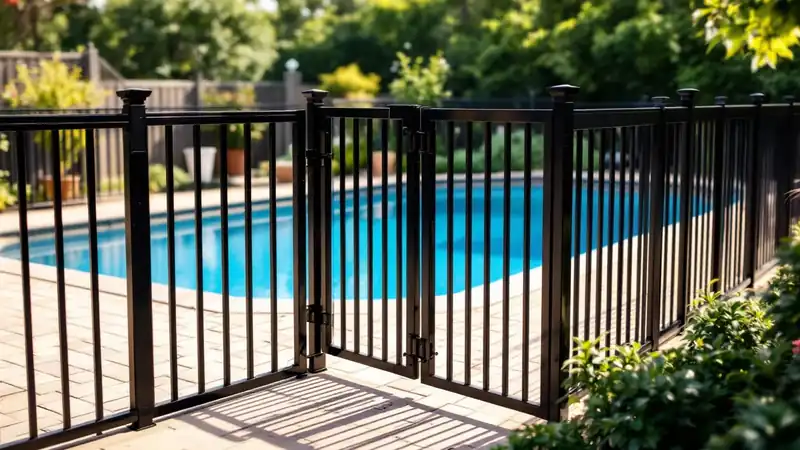
If the fence is the barrier for a pool or spa, it has to meet pool barrier rules, often based on the International Swimming Pool and Spa Code. The key requirements, from the 2018 ISPSC as adopted in Kent County, Del. (Kent County pool barrier requirements):
- Height of at least 48 inches, measured on the side away from the pool (305.2.1).
- No more than 2 inches between the bottom of the barrier and grass or gravel, or 4 inches over a solid surface such as concrete (305.2.1).
- Openings must not pass a 4-inch sphere (305.2.2).
- Chain link openings no larger than 1¾ inches (305.2.7). Standard 2¼-inch residential mesh does not qualify unless slats bring the openings down.
- Pedestrian gates open outward away from the pool and are self-closing and self-latching (305.3).
- If the latch release is less than 54 inches above grade, it goes on the pool side at least 3 inches below the top of the gate, with no openings over ½ inch within 18 inches of it (305.3.3).
- A 36-inch clear zone outside the barrier, free of anything a child could climb (305.2.9).
Those rules show up in the quote. Pool-rated aluminum panels are a separate product line (one retailer lists a 4½-by-6-foot pool panel at $119, FenceCenter), chain link needs smaller mesh or slats, and every pool gate needs self-closing hinges and a code-height latch. States also legislate barriers: Florida’s residential pool barrier statute requires a barrier “at least 4 feet high on the outside” (Fla. Stat. 515.29). The federal CPSC Safety Barrier Guidelines for Residential Pools set out the same core features as voluntary guidance.
Neighbors, property lines and HOAs
Some states make neighbors share the cost of a boundary fence. California’s Good Neighbor Fence Act presumes adjoining owners “share an equal benefit from any fence dividing their properties” and are “equally responsible for the reasonable costs of construction, maintenance, or necessary replacement,” unless they agree otherwise in writing. An owner planning to spend money on such a fence must give each neighbor 30 days’ written notice describing the problem, the solution, the estimated cost, the proposed split and the timeline (Cal. Civ. Code § 841). Other states handle shared fences differently or not at all; check yours before assuming a neighbor will pay half.
Practical points that save disputes:
- Know where the line is. A survey or the existing boundary pins beat a guess, and a fence that strays onto the neighbor’s land invites a dispute over moving it.
- Read your HOA covenants before you get quotes. Covenants can set height, material, color and which side faces out, and may require written approval before work starts. They can be stricter than the city’s rules.
- Put the finished side and the post side in writing with the contractor, and in the neighbor agreement if you are splitting the cost.
DIY or hire it out?
Doing it yourself saves the labor and overhead, which on our numbers is the larger part of the bill: 150 feet of 6-foot treated-pine fence is about $1,890 to $2,650 in parts against $4,050–$5,850 installed. You give up the auger, the crew and the warranty (both big-box retailers advertise a one-year labor or workmanship warranty, Home Depot; Lowe’s). Long, straight runs of split rail or picket fence on soft, level ground are reasonable DIY projects. Vinyl and aluminum need posts set precisely to panel width, and pool barriers have to pass inspection, so those are where hiring pays.
If you hire, check the license. California, for example, licenses fence builders under its C-13 Fencing classification (CSLB C-13 classification), and since January 1, 2025, a license is required for jobs over $1,000 in labor and materials, or for any job that needs a permit or employs workers (CSLB, AB 2622). Our state-by-state licensing guide and the steps in how to check a contractor’s license apply to fence builders too.
Red flags in a fence quote
- A single lump sum with no linear footage, height, material grade or post spacing. You cannot compare it with anything.
- No post-setting spec. The quote should say post size, length, hole depth and whether posts are set in concrete.
- Gates, removal, haul-away and permit fees “to be determined.” Those are exactly the items that move a small job by $1,000 or more.
- A large deposit. California’s licensing board cautions that a down payment should not exceed 10 percent of the contract price, and later payments should not run ahead of work done or materials delivered (CSLB AB 2622 release, linked above).
- No mention of 811 or who is responsible for locating utilities and private lines such as sprinkler pipes.
Contractors pricing their own work can use the same build-up: material takeoff, crew hours, then overhead and margin. Our guide to bidding landscaping jobs walks through that math.
How we built these numbers
We do not have our own job data. Each estimate is materials plus labor, grossed up for overhead and profit, from the published inputs below. Ranges are estimates, not quotes; our general approach is on the methodology page.
Materials (prices checked October 2026). Treated pine privacy: 18 pickets, 3 rails and 1 post per 8-ft section; pickets $2.49 (Lenco) to $3.59 (R.P. Lumber); rails $5.52 (R.P. Lumber) to $6.29 (Lenco); posts $12.99 for a 4x4x8 (R.P. Lumber) to $17.95 for a 4x4x10 (Lenco). Cedar pickets $2.99 to $8.49 (Omaha Fence Co.). 4-ft picket: 16 pickets at $1.99 to $2.11 and 2 rails per section. Concrete: 2 to 3 bags of fast-setting mix per post at $8.69 (R.P. Lumber) to $8.99 (Lenco); Quikrete says two 50-lb bags set a post in a 9-inch hole 30 inches deep (data sheet). Wood fences carry a 10 percent waste and fastener allowance, prefabricated systems 5 percent. Vinyl: $159.92 per complete section (Vinyl Fence Wholesale) to a $169 panel, $44 post and $7.90 cap (FenceCenter). Chain link: $529 per 50-ft kit with 6 posts (ALEKO) to $14.50 per foot plus $62 to $75 terminal posts, 4 per 150 ft (Mainline Fence). Aluminum: $80.35 panel and $25.36 post to $131.84 and $39 per 6-ft section (Fence Workshop). Steel: $87 panel (BuyOrnamentalFence) to $169.01, plus $30.26 post, brackets and cap (America’s Fence Store). Composite: $275 to $489 per 6-ft section with post (NewEra). Split rail: 3 rails and 1 post per 10.33 ft, $14.90 rails and $16 posts (The Split Rail Store) to $18.45 cedar rails (A-Fence) and $40 locust posts.
Labor. Fence erector wages from BLS OEWS May 2025: the median, $23.07, in the low case and the 75th percentile, $28.18, in the high case, plus benefits at 23.6 percent of payroll (NAICS 238990 benefits divided by payroll, 2022 Economic Census), for $28.51 and $34.83 per labor-hour. Productivity is our planning assumption, not a measured rate, in labor-hours per linear foot: split rail 0.05 to 0.08; chain link 0.06 to 0.10; 4-ft picket, aluminum and steel 0.09 to 0.13; vinyl 0.10 to 0.14; wood privacy 0.11 to 0.16; composite 0.16 to 0.22. Those imply a two-person crew building about 100 to 145 feet of wood privacy fence in a day.
Overhead and profit. Materials plus labor divided by 0.593: in 2022, NAICS 238990 establishments spent 31.2 percent of revenue on materials, 22.7 percent on payroll and 5.4 percent on benefits (Census Bureau, EC2223BASIC). Removal: 0.03 to 0.06 labor-hours per foot plus disposal at $52.74 to $135 per ton (Indian River County; Baltimore) for about 31 lb per foot. State estimates scale only the labor portion by each state’s median wage. Excluded throughout: permits, surveys, sales tax, delivery, gate operators, grading and unusual access. Public bids (TDOT, MoDOT) and Home Depot’s published $6,300 average job (Home Depot) were used as checks, not inputs.
Fence cost questions, with the numbers
What is the average cost to install a fence?
For the most common fence, a 6-foot pressure-treated wood privacy fence, we estimate $27 to $39 per linear foot installed, or $4,050–$5,850 for 150 feet before gates and removal. Home Depot reports its average fencing job in 2025 cost $6,300, which fits a 150-foot privacy fence with a gate and tear-out of an old fence.
How much does 200 ft of fencing cost?
An estimated $5,400–$7,800 for 6-foot treated-pine privacy, $5,000–$8,000 for 4-foot chain link, $8,800–$12,600 for vinyl privacy and $2,600–$4,200 for split rail, before gates and removal.
How much does it cost to have 100 feet of fence installed?
About $2,700–$3,900 for a 6-foot treated-pine privacy fence, $2,500–$4,000 for 4-foot chain link and $4,100–$6,600 for 4-foot aluminum. Short runs often price toward the high end per foot because setup and travel are spread over fewer feet.
How much does a 20×20 fence cost?
A freestanding 20-by-20-foot enclosure is 80 feet of fence: an estimated $2,000–$3,200 in 4-foot chain link or $2,160–$3,120 in 6-foot treated-pine privacy, plus a walk gate at roughly $525 to $1,060. If one side is the house wall, you need 60 feet.
How much would 500 ft of privacy fence cost?
An estimated $13,500–$19,500 for 6-foot treated pine, $14,500–$30,000 with cedar pickets and $22,000–$31,500 for vinyl. At 1,000 feet, double those figures; long straight runs usually come in toward the low end.
How much does it cost to pay someone to put a fence up?
On a treated-pine privacy fence, labor plus the contractor’s overhead and profit is roughly $14 to $22 per foot above the cost of materials, by our estimates.
Is a wood fence or vinyl fence cheaper?
Wood is cheaper to build. A 6-foot vinyl privacy fence is an estimated $44 to $63 per foot installed against $27 to $39 for treated pine, about $2,550 to $3,600 more for 150 feet. Vinyl is sold on lower upkeep, not a lower price.
Is it cheaper to install a fence yourself?
Yes, by roughly half or more on the cash cost. Parts for 150 feet of 6-foot treated-pine privacy fence run about $1,890 to $2,650 at the prices we found, against an estimated $4,050 to $5,850 installed. You take on tool rental, utility locates, the permit if one is needed, and the risk of posts that heave or lean.
Do I need a permit to build a fence?
Often not for a standard backyard fence. The model residential code exempts fences up to 7 feet, Seattle up to 8 feet and Chicago up to 5 feet, but zoning height limits still apply, and front-yard limits in the cities we checked run from 40 inches to 4 feet. A fence that doubles as a pool barrier also has to meet pool barrier rules, so ask your building department whether it is inspected.
Sources
- U.S. Bureau of Labor Statistics, Occupational Employment and Wage Statistics, SOC 47-4031 Fence Erectors (national and state), May 2025. Accessed October 2026.
- U.S. Census Bureau, 2022 Economic Census, Construction: Summary Statistics (EC2223BASIC), NAICS 238990, 2022. Accessed October 2026.
- U.S. Census Bureau, 2022 Economic Census, Product Lines by Industry (ECNNAPCSIND2022), fencing construction lines, 2022, posted April 2026. Accessed October 2026.
- U.S. Bureau of Labor Statistics, Producer Price Index WPU0811, Softwood lumber, 2019 to August 2026. Accessed October 2026.
- U.S. Bureau of Labor Statistics, Producer Price Index WPU1017, Steel mill products, 2019 to August 2026. Accessed October 2026.
- U.S. Bureau of Labor Statistics, Producer Price Index WPU1333, Ready-mix concrete, 2019 to August 2026. Accessed October 2026.
- U.S. Bureau of Labor Statistics, Producer Price Index WPU0722, Unsupported plastic film, sheet and other shapes, 2019 to August 2026. Accessed October 2026.
- Lenco Supplies, Buffalo, N.Y., Fence pickets, panels and posts, Prices checked October 2026. Accessed October 2026.
- Lenco Supplies, Pressure treated lumber, Prices checked October 2026. Accessed October 2026.
- Lenco Supplies, Quikrete Fast-Setting Concrete Mix, 50 lb, Price checked October 2026. Accessed October 2026.
- R.P. Lumber, 1x6x6 MCA pressure treated dog-ear fence picket, Price checked October 2026. Accessed October 2026.
- R.P. Lumber, 2x4x8 #1 MCA pressure treated lumber, Price checked October 2026. Accessed October 2026.
- R.P. Lumber, 4x4x8 Southern Pine No. 2 pressure treated, Price checked October 2026. Accessed October 2026.
- R.P. Lumber, Quikrete 1004-50 Fast-Setting Concrete Mix, Price checked October 2026. Accessed October 2026.
- Omaha Fence Co., Cedar wood fence picket 5/8 x 5-1/2 x 6 ft, Price checked October 2026. Accessed October 2026.
- Stine Home + Yard, 1x4x4 French Gothic treated fence picket, Price checked October 2026. Accessed October 2026.
- OS Lumber & Supply, 1×4 4-ft treated French Gothic fence board, Price checked October 2026. Accessed October 2026.
- Quikrete, Fast-Setting Concrete Mix (No. 1004) data sheet, Accessed October 2026. Accessed October 2026.
- Quikrete, Setting Posts project sheet, Accessed October 2026. Accessed October 2026.
- Vinyl Fence Wholesale, Privacy fence price list, Prices as of August 2026. Accessed October 2026.
- FenceCenter, Dogwood Home Series vinyl panels, posts and caps, Prices checked October 2026. Accessed October 2026.
- FenceCenter, Aluminum fence panels, including pool panels, Prices checked October 2026. Accessed October 2026.
- Wam Bam Fence, Vinyl gates, Prices checked October 2026. Accessed October 2026.
- Buy Direct Vinyl Fence, 6 ft x 4 ft solid privacy single gate kit, Price checked October 2026. Accessed October 2026.
- Mainline Fence, Maine, Residential chain link fences, galvanized material prices, Prices checked October 2026. Accessed October 2026.
- ALEKO, Chain link fence complete kit, 4 x 50 ft, Price checked October 2026. Accessed October 2026.
- Fence Workshop, Aluminum fence panels, Prices checked October 2026. Accessed October 2026.
- Fence Workshop, Aluminum fence posts, Prices checked October 2026. Accessed October 2026.
- America’s Fence Store, Kansas City (Amerifence), 4 ft x 4 ft ornamental aluminum gate, Price checked October 2026. Accessed October 2026.
- America’s Fence Store, Kansas City (Amerifence), 100 ft, 4 ft ornamental steel fence package, Prices checked October 2026. Accessed October 2026.
- BuyOrnamentalFence, 4 x 8 ft three-rail ornamental steel panel, Price checked October 2026. Accessed October 2026.
- America’s Fence Store, 4 ft steel flat top ornamental panels, posts and gates, Prices checked October 2026. Accessed October 2026.
- NewEra, Composite fence co-extrusion kit, 6 x 6 ft, Price checked October 2026. Accessed October 2026.
- The Split Rail Store, Products and pricing, Prices checked October 2026. Accessed October 2026.
- A-Fence, Split rail fence, Prices checked October 2026. Accessed October 2026.
- The Home Depot, Fence Installation Cost Guide, Accessed October 2026. Accessed October 2026.
- Lowe’s, Fence installation and professional installers, Accessed October 2026. Accessed October 2026.
- Baltimore City Department of Public Works, Board of Estimates approves first landfill tipping fee increase in 32 years, October 2025. Accessed October 2026.
- Indian River County, Fla., Solid Waste Disposal District, Rates and fees, FY 2025-2026, FY 2025-2026. Accessed October 2026.
- USDA Forest Service, Forest Products Laboratory, Wood Handbook: Wood as an Engineering Material (FPL-GTR-190), 2010. Accessed October 2026.
- International Code Council, via Grant County, Wash., 2021 International Residential Code, Section R105.2, 2021 edition. Accessed October 2026.
- Kent County, Del., Pool barrier requirements (2018 ISPSC as amended), Accessed October 2026. Accessed October 2026.
- U.S. Consumer Product Safety Commission, Safety Barrier Guidelines for Residential Pools (Pub. 362), Accessed October 2026. Accessed October 2026.
- Florida Legislature, Section 515.29, Residential swimming pool barrier requirements, 2026 Florida Statutes. Accessed October 2026.
- City of Los Angeles, Los Angeles Municipal Code Sec. 12.22 C.20(f), Fences and walls in the A and R zones, Accessed October 2026. Accessed October 2026.
- City of Phoenix Planning and Development, Residential Fences, Section 703.A summary, Revised September 2013. Accessed October 2026.
- City of Chicago Department of Buildings, Fences: building permit not required, Accessed October 2026. Accessed October 2026.
- City of Chicago Department of Buildings, Fence or trash enclosure permit instructions, Accessed October 2026. Accessed October 2026.
- Seattle Department of Construction and Inspections, Fences, Accessed October 2026. Accessed October 2026.
- California Legislature, Civil Code Section 841, Accessed October 2026. Accessed October 2026.
- Florida Legislature, Section 556.105, Procedures, 2026 Florida Statutes. Accessed October 2026.
- Common Ground Alliance, 811 Before You Dig, Accessed October 2026. Accessed October 2026.
- Contractors State License Board (California), C-13 Fencing classification, Accessed October 2026. Accessed October 2026.
- Contractors State License Board (California), Handyperson exemption to increase to $1,000 in 2025 (AB 2622), December 30, 2024. Accessed October 2026.
- Tennessee Department of Transportation, Average Unit Prices, January 1 to December 31, 2025, 2025. Accessed October 2026.
- Missouri Department of Transportation, 2025 Unit Bid Prices, 2025. Accessed October 2026.
- Iowa State University Extension and Outreach, Estimated Costs for Livestock Fencing, Ag Decision Maker File B1-75, Revised December 2024. Accessed October 2026.