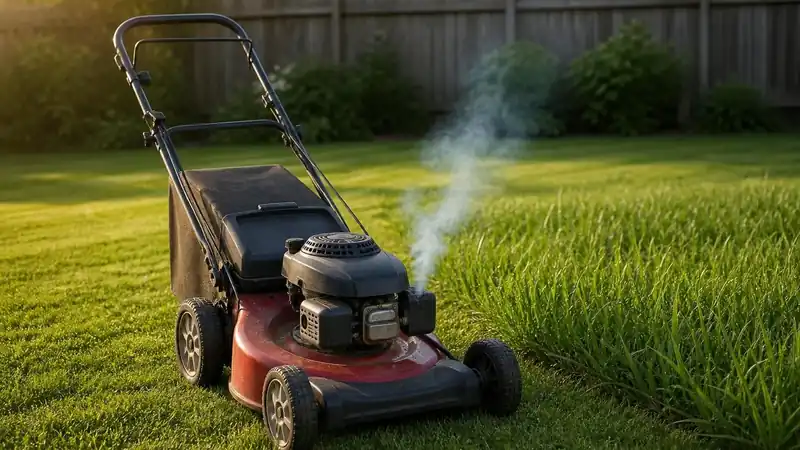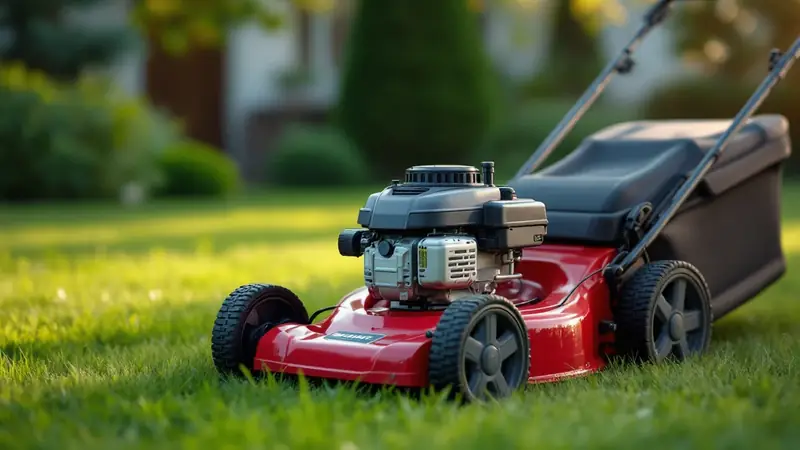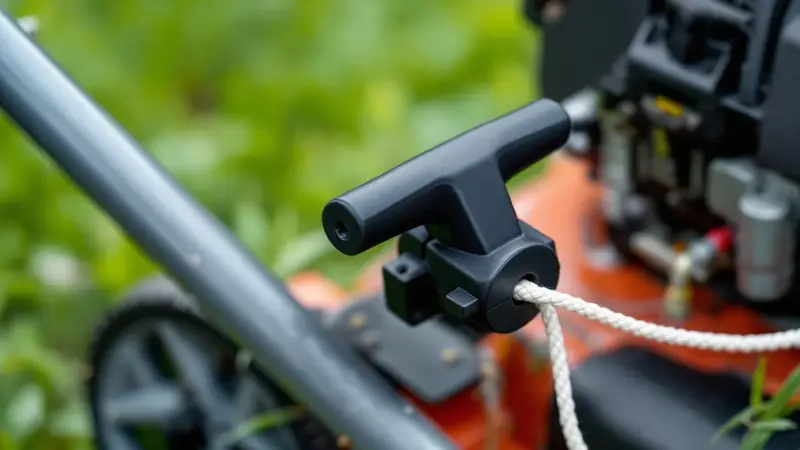
A lawn mower pull cord hard to pull usually means the flywheel brake is on: hold the blade-control bar against the handle. If it stays stiff, pull the plug wire and check for a jammed blade, then for oil in the cylinder after a tip.
When a lawn mower pull cord is hard to pull, Briggs & Stratton’s troubleshooting page names two causes first: the flywheel brake, which stays on until the bar is brought “all the way to the handle,” and a blade dragging in grass or clogged with clippings. Cub Cadet’s support article 451-1 (updated June 5, 2025) adds 5 more, from hydrolock to a sheared flywheel key, and tells you to disconnect and ground the spark plug wire before you look at any of them.
What none of the top-ranked pages does is sort those causes by what your hand feels. A rope that will not move from the first inch, one that goes 6 inches and stops, one that snaps back, and one that is heavy on every pull point to different parts, and the table below gives each feel its check, its fix and the maker page behind it. If the rope pulls freely but the engine will not fire, the problem is fuel or spark instead, covered in our guide to a lawn mower that will not start; the normal pull technique for each engine is in how to start a lawn mower by engine type.
Disconnect the spark plug wire before you touch the blade, tip the mower or pull the rope by hand to test it. A recoil starter holds a spring under tension: Kohler tells technicians to wear safety goggles when servicing one. This page is general information, not a repair warranty.
Lawn mower pull cord hard to pull: match the feel to the cause
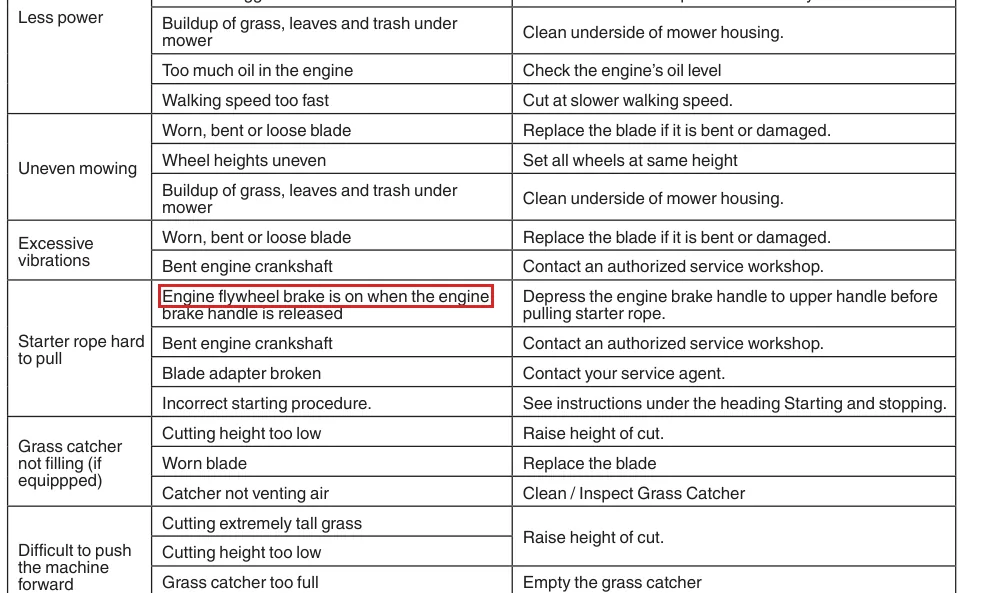
Run the rows top to bottom; the first 5 cost nothing and account for most of what the maker charts list. Husqvarna’s L221A chart for “starter rope hard to pull” lists 4 causes: the flywheel brake on because the brake handle is released, a bent engine crankshaft, a broken blade adapter and an incorrect starting procedure (operator’s manual p. 26).
| What the rope does | Likely cause | Check (plug wire off) | Fix | Part and price, Nov. 24, 2026 | Source |
|---|---|---|---|---|---|
| Barely moves from the first inch, as if braked | Flywheel brake on: the blade-control bar is not held fully against the handle | Pull the bar all the way to the handle and try again | Hold the bar down for every pull; the brake releases only at full travel | None | Briggs Top 5 Tips; Husqvarna L221A p. 26 |
| Still feels braked with the bar held to the handle | Brake cable broken, kinked or no longer moving the brake arm on the engine | Plug wire off: watch the brake lever at the engine move as you squeeze the bar | Replace the cable; Toro says its engine brake cable is not adjustable | Model-specific cable | Toro 492-9333 p. 9-11 |
| New mower: the rope will not pull straight out of the box | Handle shipped folded down into the blade | Look for the lower handle ends reaching under the deck | Remove the T-bolts, lift the handle 6 to 8 in, refit the bolts and wing nuts | None | Cub Cadet 451-1 |
| Moves a few inches, then stops dead; the blade will not turn by hand | Blade jammed by packed wet clippings, a stick, rock or root | Plug wire off, tip air filter or carburetor side up, look under the deck | Clear it with a stick, not your hands | None | Briggs Top 5 Tips; Cub Cadet 451-1; Honda HRN216 p. 9 |
| Locked solid right after a tip, storage on its side or an oil top-up | Hydrolock: oil in the cylinder stops the piston | Remove the spark plug; oil on the plug or in the hole confirms it | Rag over the hole, turn the engine slowly to push the oil out, then correct the oil level | None unless the plug is oil-fouled | Cub Cadet 451-1; Briggs 80098075 p. 8 |
| Pulls part way, then becomes very difficult | Loose or missing blade: the engine needs the blade’s weight to carry it through compression | Gloved hand: try to move the blade on its bolt | Torque the bolt to spec (Honda HRN216: 36 to 43 ft-lb); never run without the blade | None | Cub Cadet 451-1; Honda HRN216 p. 18 |
| Pulls part way, then jerks back hard | Sheared flywheel key, most common on Briggs & Stratton and Tecumseh engines | Flywheel off: look for a sheared or partly sheared key | Replace the key; Cub Cadet advises a shop because the flywheel must come off | Briggs 5002K, 3 keys: $4.62 | Cub Cadet 451-1; Briggs flywheel key FAQ |
| Stiff at one point each turn, with vibration after the blade hit something | Bent crankshaft or broken blade adapter | Plug wire off: turn the blade and watch whether the tip traces a wobble | Authorized service workshop | Dealer quote | Husqvarna L221A p. 26; Honda HRN216 p. 8 |
| Heavy on every pull and kicks back, though the deck is clear | Automatic compression release not working | A compression gauge misreads on these engines; Kohler uses a leakdown test | Camshaft or release repair at a dealer | Dealer quote | Kohler 14 690 01 pp. 13, 16, 42 |
| Heavy on every pull after high hours or a valve job | Valve clearance outside the engine’s cold spec | Feeler gauge between valve and rocker arm, engine cold, piston 1/4 in past top dead center | Set to the clearance in the valve table below | None | Briggs valve FAQ; Briggs 80098075 p. 10 |
| Stiff on cold mornings, normal once warm | SAE 30 oil below 40°F (4°C) | Check the grade you put in | Change to 10W-30, or synthetic 5W-30 for all temperatures | Oil change | Briggs oil FAQ |
| Rope stays out, rewinds slowly or catches inside the starter | Tangled rope or broken recoil spring | Unbolt the starter housing and look | Replace the starter as an assembly (Cub Cadet) or rewind a new rope (Kohler) | Briggs 497680 $45.74; Honda 28400-Z9L-014 $11.59 (list $18.95) | Cub Cadet 451-1; Kohler 14 690 01 p. 32 |
Check it in this order
The order runs from free and reversible to the jobs that need a flywheel puller or a dealer. Each yes ends the search; the flow below holds the same logic as the 12-row table above.
1Is the blade-control bar short of the handle while you pull?
YesHold it fully against the handle; the flywheel brake stays on until it is (Briggs Top 5 Tips; Husqvarna L221A p. 26).
NoGo to the next question
2Brand-new mower: do the lower handle ends reach down into the deck?
YesLift the handle 6 to 8 in and refit the T-bolts (Cub Cadet 451-1).
NoGo to the next question
3Was the mower tipped, stored on its side or topped up with oil just before?
YesHydrolock: remove the plug, rag over the hole, turn the engine slowly to expel the oil, then correct the level (Cub Cadet 451-1).
NoGo to the next question
4Plug wire off: is the blade jammed by clippings, a stick, a rock or a root?
YesClear the deck with a stick, not your hands (Briggs; Honda HRN216 p. 9).
NoGo to the next question
5Is the blade loose or missing, or the blade adapter broken?
YesTorque the bolt to spec (Honda HRN216: 36 to 43 ft-lb) or replace the adapter (Cub Cadet 451-1; Husqvarna p. 26).
NoGo to the next question
6Does the rope pull part way, then jerk back hard?
YesSheared flywheel key: replace it, flywheel off (Cub Cadet 451-1; Briggs 5002K, $4.62).
NoGo to the next question
7Did the blade hit something, and does the blade tip now wobble?
YesBent crankshaft or blade adapter: authorized service workshop (Husqvarna p. 26; Honda HRN216 p. 8).
NoGo to the next question
8Does the rope stay out, rewind slowly or catch inside the starter?
YesReplace the recoil starter assembly or the rope (Cub Cadet 451-1; Kohler 14 690 01 p. 32).
NoGo to the next question
9Is it below 40 degrees F with SAE 30 in the crankcase?
YesChange to 10W-30 or synthetic 5W-30 (Briggs oil FAQ).
NoHeavy on every pull with all of the above ruled out: check cold valve clearance against the engine's spec, then have a dealer check the compression release (Kohler 14 690 01 pp. 13, 42).
Source: Briggs & Stratton Top 5 Tips; Cub Cadet 451-1; Husqvarna L221A; Honda HRN216; Kohler 14 690 01
- Hold the blade-control bar fully against the handle and pull. Honda’s HRN216 manual says to keep holding it to “prevent premature wear to the flywheel brake system” (p. 8).
- Pull the spark plug wire, empty or shut off the fuel, and tip the mower with the spark plug side up (Briggs 80098075, p. 8) or, on a Honda HRN216, the carburetor side up (p. 9).
- With gloves on, try to turn the blade. If it will not move, clear the deck with a stick; if it turns but the rope was locked, go to the hydrolock steps below.
- Check the blade bolt and adapter. Honda’s HRN216 blade bolt torque is 36 to 43 ft-lb (p. 18); our table of lawn mower blade bolt directions shows which way it turns.
- Pull slowly with the plug wire still off and feel for a hard stop at one point (bent crankshaft) or a snap-back (flywheel key) before ordering parts.
Why the rope is meant to feel some resistance
Some stiffness is normal. Briggs & Stratton’s operator’s manual 80098075 says to pull “slowly until resistance is felt and then pull rapidly to avoid kickback” (p. 8), and Honda’s HRN216 manual gives the same two-stage pull (p. 8). The resistance is the compression stroke. A rope that is heavy for the whole stroke, every pull, is not.
Modern push-mower engines carry an automatic compression release so a person can pull them at all. Kohler’s XT service manual describes the parts: a decompression weight and arm on the camshaft hold the exhaust valve off its seat during the first part of the compression stroke at cranking speeds of 1,000 RPM or less, then retract above about 1,000 RPM (14 690 01, p. 42). Kohler states that without it, manual starting “would be virtually impossible.” Honda lists “automatic mechanical decompression” on its GCV170 engine page.
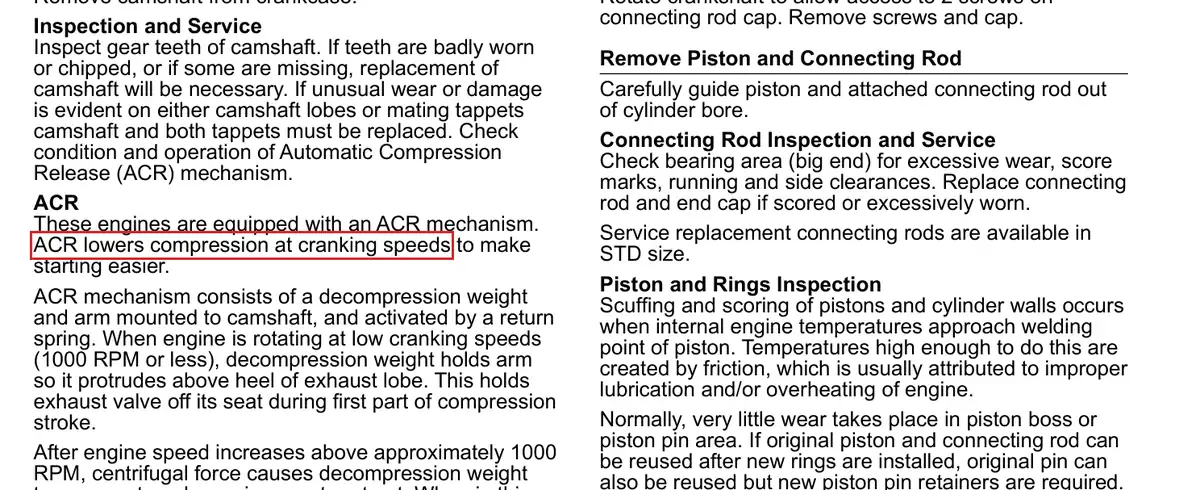
Kohler’s troubleshooting list puts “faulty ACR mechanism” and “flywheel key sheared” under hard starting (p. 13), and its compression test page says an accurate gauge reading is difficult on these engines, so its manual uses a cylinder leakdown test instead (p. 16). Because the release works by lifting the exhaust valve a small amount, an exhaust clearance far above spec can leave too little lift to vent compression. That last point is our reading of Kohler’s description, not a maker statement; the remedy is the same either way: set the cold clearance below.
| Engine | Found on | Intake, cold | Exhaust, cold | Maker note | Source |
|---|---|---|---|---|---|
| Kohler XT-6 to XT8 | Walk-behinds (XT series) | 0.003 to 0.005 in (0.0762 to 0.127 mm) | 0.003 to 0.005 in | Set at top dead center of the compression stroke until the gauge drags slightly | Kohler 14 690 01 p. 49 |
| Honda GCV170 | HRN216VKA | 0.10 ± 0.02 mm (0.0031 to 0.0047 in) | 0.10 ± 0.02 mm | Check and adjust every 100 hours or every year; dealer job unless you have the tools | Honda HRN216 pp. 11, 18 |
| Briggs & Stratton 80000, 90000, 093J00, 100000 (125 to 163 cc) | Push mowers | 0.004 to 0.008 in (0.10 to 0.20 mm) | 0.004 to 0.008 in | Briggs recommends an authorized dealer for engine service | Briggs 80098075 p. 10 |
| Honda GCV190 | HRX217 | 0.15 ± 0.04 mm (0.0043 to 0.0075 in) | 0.20 ± 0.04 mm (0.0063 to 0.0094 in) | Procedure in the Honda shop manual | Honda HRX217 p. 17 |
Briggs & Stratton’s valve procedure for its overhead-valve engines: release the brake spring, turn the flywheel until both valves close, then turn it clockwise past top dead center until the piston has moved down 1/4 in, and measure between valve and rocker arm with a feeler gauge (Briggs valve FAQ). Honda marks its valve check as a dealer item every 100 hours or every year unless you have the tools and the shop manual (HRN216 p. 11).
The flywheel brake and the 3-second rule
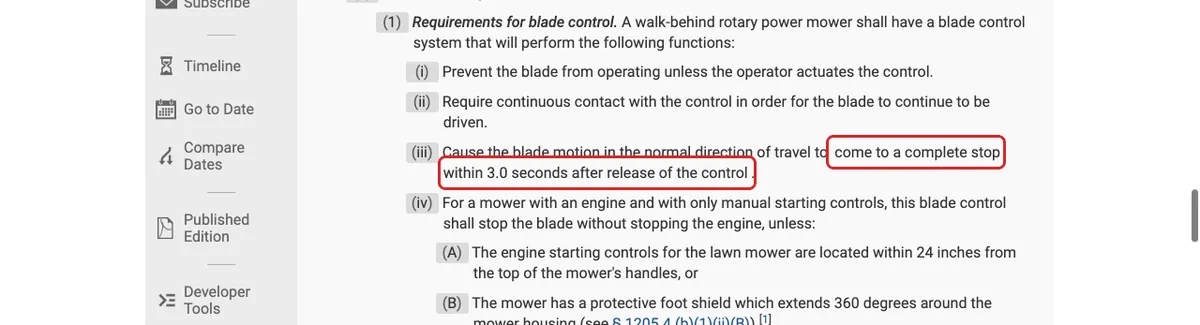
The brake exists because of federal law. Under 16 CFR 1205.5(a)(1), a walk-behind rotary mower’s blade control must stop the blade within 3.0 seconds of release, and most pull-start mowers meet it with a brake pad or band against the flywheel. That is why the rope locks when the bar is up: the brake is clamping the same flywheel the starter turns.
When the bar is held and the rope still drags, test the brake itself. Briggs & Stratton says a healthy brake stops the engine within 3 seconds; it replaces a band brake when the pad is under 0.030 in thick, and treats a holding torque under 45 inch-pounds at the starter clutch as a sign of wear or misadjustment (Briggs brake inspection FAQ). On Toro walk-behinds the engine brake cable “is not adjustable. If it fails to function it will need to be replaced” (Toro 492-9333, p. 9-11). Honda schedules a flywheel brake pad check every 100 hours or every year (HRN216 p. 11).
How to free a hydrolocked engine
Oil in the cylinder cannot be compressed, so the piston stops and the rope locks. Cub Cadet blames tipping the engine the wrong way during transport or service, or an overfilled crankcase (451-1). Briggs & Stratton’s manual says to tip only with the spark plug side up (its oil change page also allows air filter side up), because any other direction can let oil or gasoline reach the air filter or spark plug and make starting difficult (80098075, p. 8). Which side stays up on other brands is in our guide to why a lawn mower smokes after tipping.
- Set the mower level on a hard surface, fuel valve off if fitted, and disconnect the spark plug wire.
- Remove the spark plug and lay a shop rag over the hole, as Cub Cadet advises, to catch the oil spray (451-1).
- Turn the engine slowly with the rope until it spins freely and no more oil comes out.
- Clean or replace an oil-soaked plug, refit it to the maker’s torque (180 lb-in on Briggs 80000 to 100000 series engines, 80098075 p. 10) and reconnect the wire.
- Check the dipstick and drain any excess; our oil change guide covers each maker’s dipstick method. Expect white smoke for a few minutes on the first start while the leftover oil burns off.
Recoil starter: replace the assembly or just the rope?
If the rope stays out, rewinds slowly or catches partway, the fault is in the starter, not the engine. Cub Cadet’s advice is blunt: “DO NOT attempt to take the starter apart”; buy the recoil assembly and swap it, usually a few bolts (451-1). Kohler’s service manual shows the other route: a rope can be replaced without full disassembly by pulling it out about 12 in, tying a slip knot so the pulley cannot unwind, and swapping the rope at the handle (14 690 01, p. 32).
| Part | What it replaces | Price, Nov. 24, 2026 | Seller |
|---|---|---|---|
| Briggs & Stratton 497680 rewind starter | Whole starter: housing, pulley, spring, rope and grip (fits many 099700 to 12×600 series engines per the listing) | $45.74 | Briggs & Stratton online store |
| Briggs & Stratton 498144 pulley and spring assembly | Pulley with recoil spring, for the same engine families | $17.51 | Briggs & Stratton online store |
| Briggs & Stratton 280399S starter rope | Rope only | $5.28 | Briggs & Stratton online store |
| Honda 28400-Z9L-014 recoil starter (replaces 28400-Z9V-014) | Whole starter for GCV170 and GCV200, HRN216 and HRX217 | $11.59 sale, $18.95 list | Cutler’s, authorized Honda dealer |
| Briggs & Stratton 5002K flywheel key, pack of 3 | Sheared key behind the flywheel | $4.62 | Briggs & Stratton online store |
A whole Honda HRN216 starter lists for less than many shops charge to fit one: our survey of lawn mower repair costs found pull cord and recoil jobs at $20 to $68. On a Briggs engine the rope alone is $5.28, so a broken rope with a sound spring is the cheapest fix on this page, after the free ones above.
Cold weather and the wrong oil
If the rope is stiff only on cold mornings, look at the oil before the engine. Briggs & Stratton’s oil chart footnote reads: “Below 40°F (4°C) the use of SAE 30 will result in hard starting” (Briggs oil FAQ). For spring and fall mowing it lists 10W-30, or synthetic 5W-30 for all temperatures; our lawn mower oil type chart by engine maker lists the grades for Honda, Kohler and Toro too.
How we compiled this
On Nov. 24, 2026 we read the starting, brake, valve and troubleshooting sections of 7 maker documents (Briggs & Stratton operator’s manual 80098075, Kohler’s XT service manual 14 690 01, Honda’s HRN216VKA and HRX217 owner’s manuals, Husqvarna’s L221A manual and Toro’s walk power mower service manual 492-9333), 5 Briggs & Stratton support pages, Cub Cadet article 451-1, Honda’s GCV170 engine page and the federal mower standard at 16 CFR 1205.5. Prices are 5 maker or authorized-dealer part listings checked the same day. We read the top results for 4 phrasings of the query on Google. We did not test any mower; every figure is as the maker prints it, with the page cited.
Frequently asked questions
Why is my lawn mower so hard to pull start?
Most often the flywheel brake: the blade-control bar must be held all the way to the handle before you pull (Briggs & Stratton). Next are a blade jammed by clippings and oil in the cylinder after a wrong-side tip (Cub Cadet 451-1).
What causes a pull cord to lock up?
A rope that locks solid usually has something stopping the crankshaft: the flywheel brake, a jammed blade, or hydrolock. If it pulls part way and then jerks back hard, Cub Cadet names a sheared flywheel key as the most likely cause (451-1).
How do you make a pull start easier to pull?
Pull slowly until you feel resistance, then pull rapidly, as Briggs & Stratton’s manual instructs (80098075, p. 8). Keep the blade bolted on and clear, and use 10W-30 or synthetic 5W-30 below 40°F instead of SAE 30 (Briggs oil FAQ).
Why is my pull cord not recoiling?
A rope that stays out or rewinds slowly has a tangled rope or a broken recoil spring. Cub Cadet advises replacing the recoil starter as one assembly rather than opening it (451-1); a Honda HRN216 starter listed at $11.59 on Nov. 24, 2026 (Cutler’s).
Can a loose blade make the pull cord hard to pull?
Yes. Cub Cadet says a loose or missing blade lets the rope pull part way, then become very difficult, because most mower engines rely on the blade’s flyweight to carry them through compression (451-1). Never run the mower without its blade.
Sources
- Briggs & Stratton, Top 5 Mower Troubleshooting Tips, support page, current. Accessed November 2026.
- Cub Cadet, Starter Rope Difficult To Pull, article 451-1, last modified June 5, 2025. Accessed November 2026.
- Husqvarna, L221A operator’s manual, troubleshooting schedule, p. 26. Accessed November 2026.
- American Honda Motor Co., HRN216VKA owner’s manual, pp. 8, 9, 11, 18. Accessed November 2026.
- American Honda Motor Co., HRX217HYA and HRX217VKA owner’s manual, specifications, p. 17. Accessed November 2026.
- Briggs & Stratton, Operator’s manual 80098075 Rev. A, models 80000, 90000, 093J00, 100000, pp. 8, 10. Accessed November 2026.
- Kohler Co., XT-6 to XT8 engine service manual 14 690 01 Rev. G, pp. 13, 16, 32, 42, 49. Accessed November 2026.
- U.S. Consumer Product Safety Commission (eCFR), 16 CFR Part 1205, Safety Standard for Walk-Behind Power Lawn Mowers, § 1205.5, current eCFR. Accessed November 2026.
- Briggs & Stratton, How to Inspect Your Small Engine for Brake Replacement, support page, current. Accessed November 2026.
- Briggs & Stratton, How do I check if my engine’s flywheel key needs replacement?, support page, current. Accessed November 2026.
- Briggs & Stratton, Small Engine Valve Maintenance & Repair, support page, current. Accessed November 2026.
- Briggs & Stratton, What type and how much oil for my lawn mower?, support page, current. Accessed November 2026.
- Briggs & Stratton, How to Change Small Engine Oil, support page, current. Accessed November 2026.
- The Toro Company, Walk Power Mower Drive Systems Service Manual, Form 492-9333, p. 9-11. Accessed November 2026.
- American Honda Motor Co., GCV170 engine features and specifications, product page, current. Accessed November 2026.
- Briggs & Stratton, 497680 Rewind Starter, $45.74, Nov. 24, 2026. Accessed November 2026.
- Briggs & Stratton, 498144 Pulley & Spring Assembly, $17.51, Nov. 24, 2026. Accessed November 2026.
- Briggs & Stratton, 280399S Starter Rope, $5.28, Nov. 24, 2026. Accessed November 2026.
- Briggs & Stratton, 5002K Flywheel Key, $4.62, Nov. 24, 2026. Accessed November 2026.
- Cutler’s (authorized Honda dealer), Honda 28400-Z9L-014 Recoil Starter, $11.59 sale, $18.95 list, Nov. 24, 2026. Accessed November 2026.