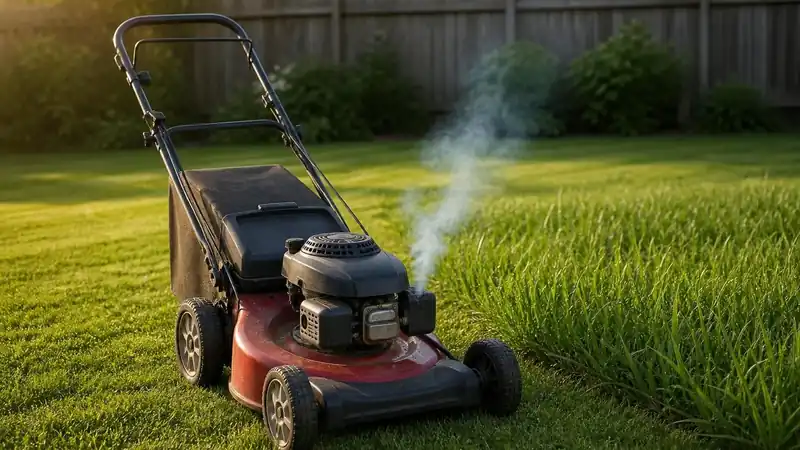
Lawn mower smoking points to what is burning: white or blue smoke is oil from an overfilled crankcase, a tip or a spill, and usually clears in minutes; black smoke is excess fuel, usually a clogged air filter.
Key takeaways
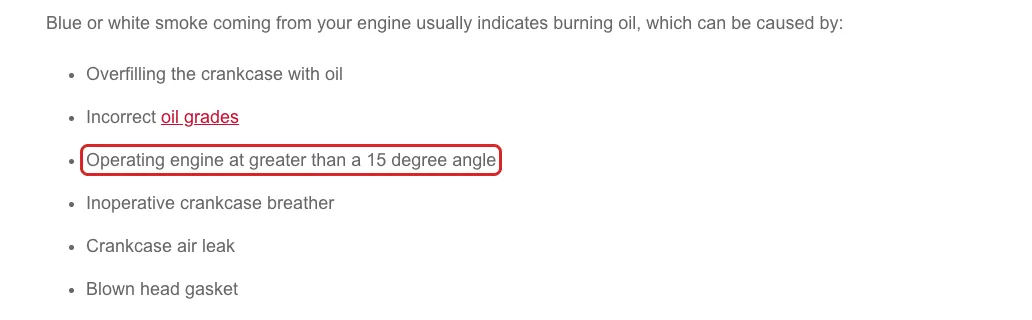
- Briggs & Stratton lists an overfilled crankcase, the wrong oil grade, running the engine at more than a 15 degree angle, a faulty crankcase breather, a blown head gasket and worn rings as causes of white or blue smoke, and says smoke from a tilted engine should clear after a few minutes on flat ground (Briggs smoke FAQ, Jan. 2026).
- Two makers print overfill as a smoke cause: Honda’s HRN216 manual calls white or blue smoke from the muffler “an indication of overfilling” (Honda HRN216 manual), and Kawasaki’s FR-series manual says excess oil “will cause a smoking condition” (Kawasaki FR manual). Honda, Kawasaki and Toro read the dipstick without screwing it in; Briggs & Stratton’s engine manual says to tighten it first.
- Black, sooty smoke is a rich mixture. Kohler’s service manual lists a clogged air cleaner, a choke left partly closed, dirt under the fuel inlet needle, plugged bowl vents and a leaky float (Kohler 14 690 01).
- Smoke that survives a correct oil level and a clean filter is internal. Kohler’s tests: crankcase vacuum should be at least 4 inches of water, and leakdown air escaping at the breather means worn rings or cylinder (Kohler 32 690 03).
- Three CPSC recalls from January 2025 to October 2026 tie mower smoke to fire: John Deere ZTrak mowers with Kawasaki engines (5 fires, 26 melting or smoking reports), RYOBI 40V mowers (97 overheating reports, 5 fires) and DR Power trimmer mowers (19 fires from grass and debris) (CPSC recall 27-016).
| Key number | Value | Source |
|---|---|---|
| Tilt angle that Briggs lists as a smoke cause | More than 15 degrees | Briggs smoke FAQ |
| Max operating angle at full oil | 15° Honda GCV170; 20° Kohler XT; 25° Kohler 7000 and Kawasaki FR | Maker manuals |
| Minimum crankcase vacuum, running engine | 4 in. of water (10.2 cm) | Kohler 14 690 01, p. 15 |
| Altitude where the stock carburetor runs rich | Above 2,000 ft (Honda); kit at 4,000 ft (Kohler) | Honda GCV170; Kohler XT |
| Air filter for Briggs 550e engines | $11.57 to $12.72 | Briggs store, Oct. 30, 2026 |
What does the color of lawn mower smoke mean?
Smoke color tells you what the engine is burning. White or blue smoke is oil, which Briggs & Stratton traces to an overfilled crankcase, the wrong oil grade, tilting past 15 degrees, a faulty breather, a blown head gasket or worn rings. Black, sooty smoke is unburned fuel from a rich mixture, and Kohler’s XT service manual puts a clogged air cleaner first on that list.
| Smoke you see | What is burning | Likely causes, most common first | First check | Source |
|---|---|---|---|---|
| White or blue puff at startup that fades within minutes | Oil in the cylinder or muffler | Recent tip or oil change; oil put in the cylinder for storage; factory oil in a new engine | Run it on level ground, then read the dipstick | Briggs FAQ; Honda GCV170, p. 11 |
| Steady white or blue smoke while mowing | Oil reaching the combustion chamber or hot exhaust | Overfilled crankcase; oil-soaked air filter; wrong oil grade; inoperative or crimped breather; blown head gasket; worn rings | Dipstick, then air filter | Briggs FAQ; Honda HRN216, p. 6 |
| Blue smoke plus rising oil use | Oil getting past rings or valve guides | Worn or broken rings; worn bore; worn valve guides | Spark plug wet with oil; leakdown test | Kohler 14 690 01, pp. 14, 42 |
| Black, sooty smoke with misfiring or loss of power | Excess fuel (rich mixture) | Clogged air cleaner; choke partly closed; dirt under fuel inlet needle; plugged bowl vent; leaky float; stale fuel; high altitude | Air filter, then choke | Kohler 14 690 01, p. 20; Briggs tips |
| Smoke or air puffing from the dipstick tube | Crankcase pressure | Clogged breather; piston blow-by; leaky valves | Crankcase vacuum test | Kohler 14 690 01, p. 15 |
| Smoke from the deck, belt area or motor housing, burning smell | Grass, a belt or wiring, not exhaust | Packed grass near hot parts; slipping belt; electric motor or connector overheating | Stop, pull the key or battery, let it cool | Toro 20349 manual; CPSC 25-127 |
Briggs & Stratton’s own list adds two causes most guides skip: a crankcase air leak and “an obstructed or crimped breather tube (located behind the air filter).” Both cost the crankcase its vacuum, and Kohler says crankcase pressure “can cause oil to be forced out at oil seals, gaskets, or other available spots,” so the smoke looks like an overfill. The screenshot below is the Briggs FAQ as captured on October 30, 2026.
Is white smoke from a lawn mower dangerous, and how long should it last?
White smoke on its own is rarely an emergency: Briggs & Stratton calls engine smoke “usually not serious” (Briggs Top 5 Tips, Jan. 2026) and says smoke from a tilted engine should clear after a few minutes on a flat surface. It turns into a stop-now problem when it keeps going at a correct oil level, when the engine struggles to keep running, or when smoke comes from anywhere other than the muffler.
No maker publishes a minute count for burn-off; Honda only says an engine oiled for storage “will smoke briefly at startup. This is normal” (Honda GCV170 manual, p. 11). Run any smoking engine outdoors: Cub Cadet’s XT1 manual calls the carbon monoxide in exhaust “odorless, and deadly” (Cub Cadet 769-10184D, p. 5).
| What you see | Keep running or stop | Why (source) |
|---|---|---|
| Brief smoke after storage, with oil put in the cylinder | Keep running; it is expected | Honda GCV170: “This is normal” (p. 11) |
| Smoke after a tip or oil change that fades within a few minutes on level ground | Keep running, outdoors | Briggs smoke FAQ |
| Still smoking after a few minutes on level ground with the oil at the full mark | Stop; check the air filter and breather | Briggs smoke FAQ cause list |
| Light smoke and the engine keeps dying or struggling | Stop; have a shop look at it | Briggs Top 5 Tips: “time for a serious look by a professional” |
| Black smoke after a new filter and an open choke | Stop mowing; carburetor service | Honda: have a dealer inspect “black exhaust smoke” (GCV170, p. 13); Kohler p. 20 |
| Smoke from a battery mower, the deck, a belt or wiring | Stop now; remove the key or battery | CPSC recalls 25-083, 25-127, 27-016 |
Why is my lawn mower smoking after tipping it or changing the oil?
Tipping a four-stroke mower the wrong way lets crankcase oil run into the cylinder, carburetor, air filter or muffler, and it burns off as white or blue smoke on the next start. Every maker names the side that must stay up: Briggs & Stratton says spark plug up or muffler side down, and Honda’s GCV170 manual says muffler side down and “Do not tilt with the carburetor side down.”
| Engine or mower | Tip it with | Max operating angle | Dipstick reading | Source |
|---|---|---|---|---|
| Briggs & Stratton walk-behind engines (80000 to 100000 series) | Spark plug side up (FAQ also allows muffler side down) | Up to 15° | Install and tighten, then read | Briggs 80024908 Rev. B, pp. 6, 8, 11; Briggs FAQ |
| Honda GCV170 engine | Muffler side down; never carburetor side down | 15° (26 percent slope) | Insert, do not screw in | Honda 00X37Z9V0002, pp. 8 to 10 |
| Honda HRN216 mower (GCV170) | Right side down, fuel cap side up | Avoid slopes over 20°; steep slopes “can starve the engine of oil” | Insert without screwing in | Honda 00X31VR8B103, pp. 6, 8, 12 |
| Toro 21in Recycler 20349 | Air filter up, dipstick down | No figure; mow across slopes | Insert, do not screw in; wait 3 minutes | Toro 20349 manual |
| Kohler XT6 to XT8 (walk-behind) | Air cleaner facing up | 20° at full oil | Threaded cap: rest it on the tube, do not thread | Kohler 14 690 01, pp. 5, 26 |
| Kohler 7000 KT610 to KT745 (riding) | Riding mowers are not tipped | 25° at full oil | Press the dipstick completely down | Kohler 32 690 03, pp. 15, 51 |
| Kawasaki FR651V, FR691V, FR730V (riding) | Riding mowers are not tipped | 25° in any direction | Insert without screwing in | Kawasaki FR manual, pp. 15, 19 |
A wrong-side tip needs no parts unless the air filter soaked up oil. Follow these steps in order; the blade-side version of the same tipping rules is in our guide to sharpening a mower blade.
- Set the mower on its wheels on level ground and wait. Toro’s Recycler manual waits 3 minutes for oil to settle before a dipstick reading; Honda’s HRN216 manual says “a couple of minutes.”
- Pull the air filter. Toro says to replace a filter that “is wet with oil or fuel” (Toro 20349 manual), and Kohler says a paper element “cannot be blown out with compressed air.” A Briggs 593260 cartridge for 550e-series engines lists at $11.57 (Briggs store, Oct. 30, 2026).
- Wipe oil off the muffler and engine only when cold. Honda says to let a running engine cool for at least half an hour before cleaning it (GCV170, p. 11).
- Read the dipstick the maker’s way (table above) and drain any excess before starting.
- Start outdoors on level ground. Honda says to move at least 10 feet from where you fueled before starting (HRN216, p. 7). Briggs says the smoke should clear in a few minutes; if it does not, check the breather and head gasket.
Will too much oil make a lawn mower smoke?
Yes. Honda’s HRN216 manual says excess oil “may get transferred to the air cleaner housing and air filter” and that white or blue smoke from the muffler “is an indication of overfilling,” and Kawasaki says oil above the FULL mark “will cause a smoking condition, and may cause the engine to overheat.” The trap is reading the dipstick wrong for the brand: Honda and Kawasaki rest it in the tube, Briggs tightens it, and Toro varies by model, so follow your manual.
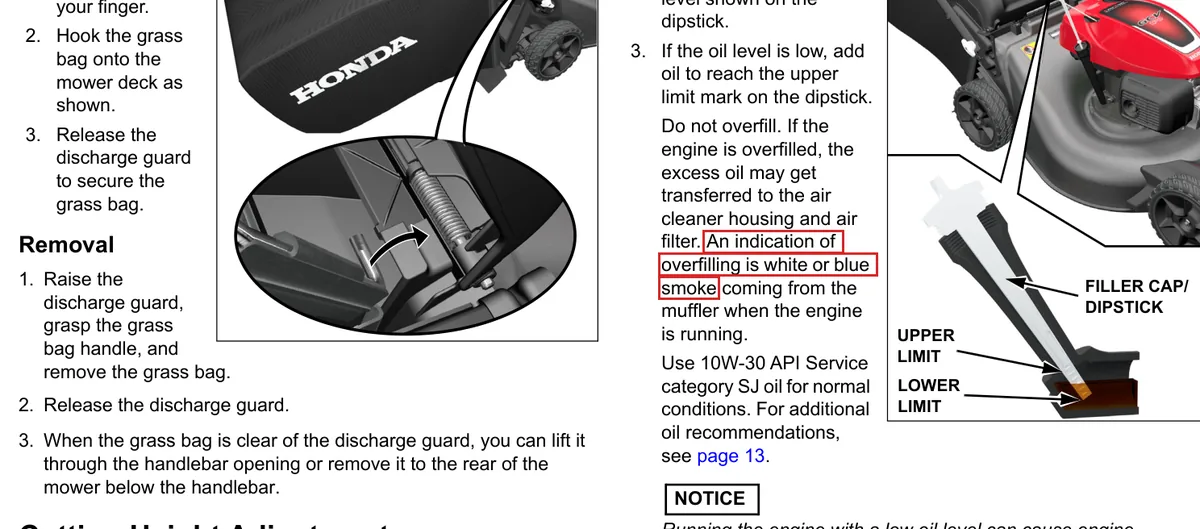
Overfills often start at the factory: Honda says some oil stays in the HRN216 engine after factory running and “the amount of oil left in the engine varies,” so its refill is 12.0 to 13.5 oz against a 13.5 oz capacity. Toro pours about 3/4 of the 18.6 fl oz capacity, waits 3 minutes and tops up. Capacities by engine are in our lawn mower oil guide.
A level that rose by itself is a different problem. Kohler’s inspection step says that if oil is above the operating range, “sniff for gasoline odor” (Kohler 14 690 01, p. 14): fuel leaking past a dirty inlet needle into the crankcase raises the level and thins the oil. Briggs & Stratton names a float stuck open by stale-fuel gum or by tipping (Briggs fuel-in-oil FAQ). Change that oil and fix the carburetor, or the overfill comes back.
To remove excess oil:
- With the engine cool and level, pump oil out through the dipstick tube with an extractor: Briggs 5430K (1.6 L) lists at $26.72 and 5431K (4 L) at $42.11 (Briggs store, Oct. 30, 2026).
- Or tip and drain the maker’s way: muffler side down through the filler neck on a Honda GCV170, air filter up on a Toro Recycler or Kohler XT. Drain a little more than you think and refill.
- Remove a few ounces at a time. Wait 2 to 3 minutes (Honda, Toro), then read the dipstick again by the maker’s method.
- Replace the air filter if oil reached it, then start outdoors and let the residue burn off.
What causes black smoke from a lawn mower?
Black smoke means the engine is running rich, with more fuel than the air can burn. Kohler’s XT service manual lists a clogged air cleaner, a choke partly closed while running, dirt under the fuel inlet needle, plugged bowl vents or air bleeds, and a leaky float. Briggs & Stratton adds bad fuel and an overfilled crankcase, and says to start with the air filter (Briggs Small Engine Problem Solving Tips, Apr. 2026).
If a clean air filter does not stop it, the inlet needle and float are next, and our guide to cleaning a lawn mower carburetor covers Kohler’s float test: submerge it and replace it if it leaks.
| Order | Check | What points to it | Fix | Source |
|---|---|---|---|---|
| 1 | Air filter | Dirt-packed or oil-soaked element; Briggs calls a clogged filter “a common cause for black smoke” | Clean a foam element, replace paper; $11.57 to $12.72 for Briggs 550e filters | Briggs carburetor FAQ; Briggs store |
| 2 | Choke | Plate not fully open once warm | Honda: move the choke to OFF “as soon as the engine fully warms up”; Kohler: check lever and linkage | Honda GCV170, p. 8; Kohler p. 20 |
| 3 | Oil level | Above the full mark | Drain to the correct level | Briggs tips |
| 4 | Fuel | Gas older than 30 days | Replace the gas; Kohler says not to use gasoline older than 30 days | Briggs tips; Kohler XT, p. 4 |
| 5 | Carburetor | Wet plug, fuel dripping from the air horn | Clean needle and seat; submerge the float to check for leaks; overhaul kits from $26.39, carburetor 799583 at $50.91 | Kohler p. 20; Briggs store |
| 6 | Altitude | Mowing above 2,000 ft (Honda) or 4,000 ft (Kohler) | Dealer fits a high-altitude jet or kit | Honda GCV170, p. 12; Kohler XT, p. 21 |
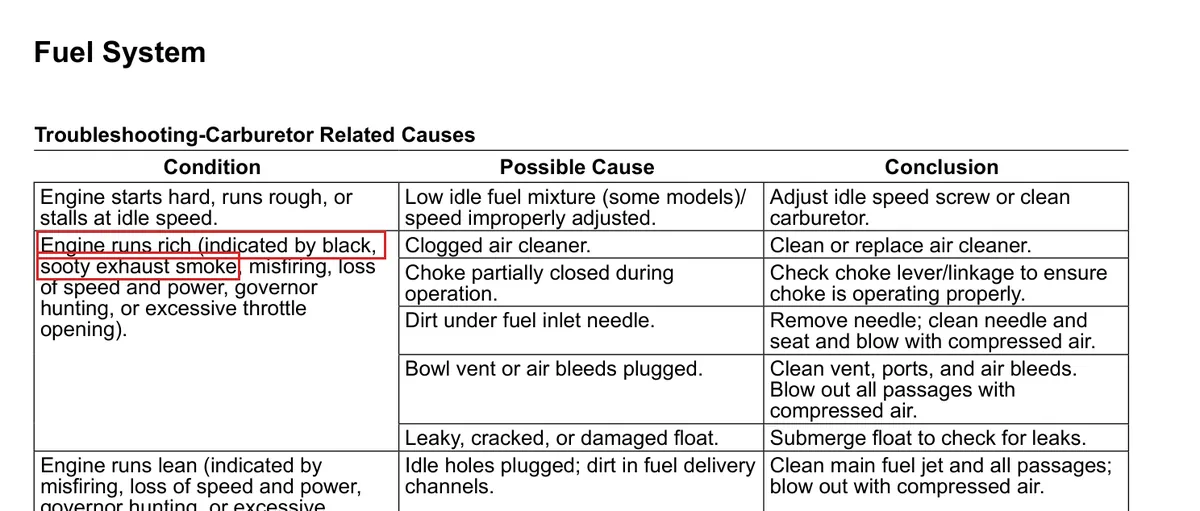
The spark plug confirms the diagnosis. Kohler says a wet plug comes from excess fuel (“a restricted air cleaner, a carburetor problem, or operating engine with too much choke”) or from oil, and that a normal plug carries “light tan or gray colored deposits” (Kohler 14 690 01, p. 27). Fuel-wet and sooty points back to this table; oil-wet points to the next section. The no-start side of a flooded carburetor is in our lawn mower won’t start checklist.
Is it a blown head gasket, worn rings or a bad breather?
If smoke survives a correct oil level, a clean air filter and a few minutes on level ground, oil is getting in through the engine itself. Kohler’s service manuals separate the suspects with two tests: a crankcase vacuum check, which should read at least 4 inches of water, for the breather, and a cylinder leakdown test, where air escaping at the breather means worn rings or cylinder.
| Test | Result | Points to | Source |
|---|---|---|---|
| Pull the spark plug | Wet with oil | Restricted air cleaner, breather problem, worn rings or valve guides | Kohler 14 690 01, p. 27 |
| Crankcase vacuum, engine at no-load high speed | Under 4 in. of water, or pressure | Clogged breather; leaking seals or gaskets; blow-by or leaky valves; restricted exhaust | Kohler 14 690 01, p. 15 |
| Breather tube behind the air filter | Crimped or blocked | Oil pushed into the intake | Briggs smoke FAQ |
| Leakdown, piston at top dead center | Air escaping at breather or dipstick tube | Rings or cylinder worn | Kohler 14 690 01, p. 16; Kohler 32 690 03, p. 28 |
| Leakdown | Air at exhaust or intake | Exhaust or intake valve not sealing | Kohler 14 690 01, p. 16 |
| Leakdown at 35 psi (walk-behind setting) | 50 to 70 percent leakage (yellow); 80 to 100 percent (red) | Some wear, plan an overhaul; heavy wear, recondition or replace the engine | Kohler 32 690 03, pp. 27 to 28 |
| Compression gauge | Single cylinder with automatic compression release | Kohler says an accurate reading is “difficult to obtain”; use leakdown instead | Kohler 14 690 01, p. 16 |
| Head-to-block seam | Oil weeping at the seam, weak power | Blown head gasket; Kohler: never reuse it, torque head screws to 246 in. lb in two stages | Kohler 14 690 01, p. 49 |
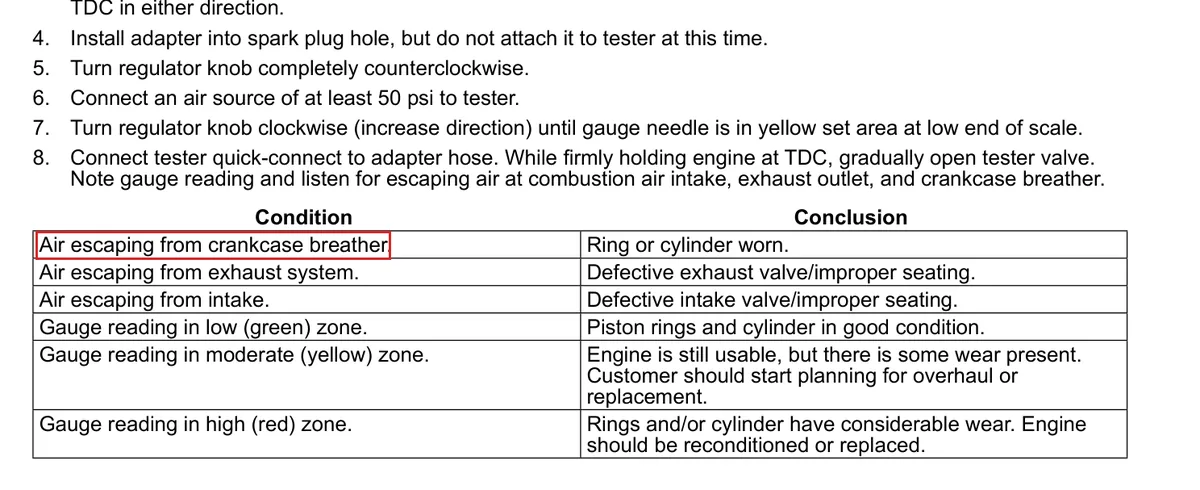
Kohler’s ring section reads “Ring failure is usually indicated by excessive oil consumption and blue exhaust smoke” (Kohler 14 690 01, p. 42), but the same manual says to “remove and check valves first” when power drops, because worn valve guides burn oil too. Parts are cheap: head gaskets list at $7.71 to $18.14 and ring sets at $23.53 to $57.66 on the Briggs store. The labor is not, since the head comes off for both; posted shop rates run $65 to $130 an hour in our lawn mower repair cost survey.
Can a smoking lawn mower start a fire?
Yes. The fires in three recent CPSC recalls came from heat meeting debris or a failed part, not from burning oil: grass and debris igniting in DR Power trimmer mowers (19 fires), a voltage regulator overheating John Deere ZTrak engines (5 fires, 26 melting or smoking reports) and a connector overheating in RYOBI 40-volt mowers (97 overheating reports, 5 fires).
| Recall (CPSC number, date) | Units (U.S.) | Hazard in CPSC’s words | Reports | Remedy |
|---|---|---|---|---|
| John Deere ZTrak Z720E, Z730M, Z740R, Z760R with Kawasaki engines (25-083, Jan. 2, 2025) | About 39,000 | “The voltage regulator in the mower’s engine can fail during use or while the product is being stored,” overheating the engine | 5 fires; 26 melting and/or smoking; no injuries | Free repair at a Deere dealer |
| RYOBI 40V Brushless 21in mowers (25-127, Feb. 6, 2025) | About 217,500 | A push-on connector inside the powerhead can overheat | 97 overheating reports, including 5 fires; 2 minor burns | Free replacement |
| DR Power Pilot and Premier trimmer mowers (27-016, Oct. 8, 2026) | About 42,860 | “Grass and debris can accumulate in the trimmer mowers and ignite” | 19 fires; 2 minor injuries | Free repair kit |
Toro says to “keep the machine free of dry grass and leaf debris” and to let the engine cool before storing it in any enclosure (Toro 20349 manual); Kawasaki and Honda keep a running engine at least 3.3 and 3 feet from buildings (Kawasaki FR manual). Briggs & Stratton’s engine manual warns that leaves and grass near the muffler “can catch fire” and prints California Public Resources Code section 4442: no running an engine on forest, brush or grass-covered land without a working spark arrester (Briggs 80024908, p. 5).
Why is my riding mower smoking from underneath?
Smoke from under a riding mower’s deck or footrest, with a burning-rubber smell, comes from outside the engine: a deck or drive belt slipping against a pulley, or grass packed against the muffler and engine. Toro’s TimeCutter manual (Form 3399-367) and Cub Cadet’s XT1 manual both say to keep the machine free of grass, leaves and debris build-up, and Toro lists plugged cooling fins as an overheating cause.
- Disengage the blades, remove the key and let it cool (Cub Cadet 769-10184D, p. 7).
- Look for packed clippings on the deck top, around the muffler and on the engine’s cooling screen. Kawasaki says to check the rotary screen before each use and clean the cooling fins and shrouds every 100 hours.
- Spin each idler pulley by hand; one that grinds or sticks lets the belt slip and heat. Toro’s TimeCutter troubleshooting sends worn or loose belts to a dealer.
- Check that the belt rides inside its keepers and follows the belt routing diagram in the operator’s manual.
Why is my electric or battery mower smoking?
A battery or corded mower has no oil to burn, so smoke means a motor, connector or battery is overheating. Stop, remove the battery or unplug the cord, and do not restart it. EGO’s LM2130SP manual says a solid orange indicator means the mower shut down from overheating and to cool the battery at least 15 minutes (EGO manual, p. 38)
| EGO LM2130SP indicator or rule | Meaning | What to do (EGO manual) |
|---|---|---|
| Solid orange | Mower stopped from overheating | Remove the battery, move mower and battery to shade, cool at least 15 minutes |
| Flashing orange | Mower overloaded | Remove the battery, clean grass from under the deck, slow your pace |
| Battery LED flashing, mower dark | Battery overheated | Release the bail, wait until the pack cools to about 152°F (67°C) |
| Storage rule | Hot motor near debris | Keep the motor cover free of grass and leaves; cool before storing in any enclosure |
How much does it cost to fix a smoking lawn mower?
Most smoke fixes cost under $30 in parts at the Briggs & Stratton online store, checked October 30, 2026: $11.57 to $12.72 for a 550e-series air filter, $26.72 for an oil extractor, $3.70 to $7.44 for a spark plug. Internal causes cost more in labor than parts: head gaskets list at $7.71 to $18.14 and ring sets at $23.53 to $57.66, but both need the cylinder head off.
| Fix | Part (Briggs & Stratton number) | Posted price, Oct. 30, 2026 | Who does it, per the manuals | Listing |
|---|---|---|---|---|
| Drain excess oil | Oil extractor 5430K (1.6 L) or 5431K (4 L) | $26.72 to $42.11 | Owner | 5430K |
| Wrong oil grade: change it | SAE 30, 100005 (18 oz) | $7.41 | Owner | 100005 |
| Oil-soaked or clogged air filter | 593260 or 5432K cartridge (550e series) | $11.57 to $12.72 | Owner | 593260 |
| Fouled spark plug | 591868 or 5435K | $3.70 to $7.44 | Owner | 591868 |
| Breather assembly or tube | 590395 assembly; tubes $7.76 to $23.30 | $7.76 to $23.30 | Owner or shop | 590395 |
| Carburetor (rich, flooding) | Overhaul kit 594958, or carburetor 799583 | $26.39 to $50.91 | Shop, per Honda and Kawasaki | 799583 |
| Blown head gasket | 692249, 799586 or 796584 (fit varies by engine) | $7.71 to $18.14 | Shop | 799586 |
| Worn rings | Standard ring sets, fit varies by engine | $23.53 to $57.66 | Shop, or replace engine | ring sets |
Diagnosis is where a shop pays off. Briggs lists its 19545 leakdown tester at $247.49 (Briggs store), and Kohler’s procedure needs at least 50 psi of shop air; an hour at the $92 median posted rate in our repair cost survey costs less.
What do common lawn mower smoke guides get wrong?
Most smoke articles repeat two unsourced numbers, a 15 degree slope limit and 5 to 15 minutes of burn-off, and forum threads add a compression test for rings. The maker documents are more precise: the angle limit is 15 degrees for Briggs and Honda engines but 20 to 25 degrees for Kohler and Kawasaki, Briggs only says “a few minutes,” and Kohler says a compression gauge misreads its single-cylinder engines.
| Common claim | What the primary source says | Source |
|---|---|---|
| Never mow slopes over 15 degrees | 15° for the Briggs FAQ and the Honda GCV170 engine; 20° for Honda’s HRN216 mower and Kohler XT; 25° for Kohler 7000 and Kawasaki FR; 15° on EGO’s battery mower | Maker manuals listed in Sources |
| Run it 10 to 15 minutes to burn off the oil | Briggs: smoke “should clear after a few minutes of running on a flat surface.” No maker gives a minute count | Briggs smoke FAQ |
| White smoke means water in the gas | Briggs: white or blue smoke “usually indicates burning oil.” Honda warns that hosing the engine can push water into the air cleaner and cylinder | Briggs FAQ; Honda HRN216, p. 15 |
| Do a compression test to check the rings | Kohler: on single-cylinder engines with automatic compression release an accurate reading is hard to get; use a leakdown test | Kohler 14 690 01, p. 16 |
| Gray smoke means the engine is finished | No maker manual reviewed uses gray. Kohler ties blue smoke plus high oil use to rings, and says to check valves first | Kohler 14 690 01, pp. 40, 42 |
| Screw the dipstick in (or never screw it in) to check the oil | It depends on the brand. Briggs: “Install and tighten the dipstick” before reading. Honda, Kawasaki: insert without screwing in. Toro: varies by model (20349 rests it; 21332 and 21352 screw it in). Kohler XT: rest a threaded cap on the tube; press and turn a 1/4-turn cap | Briggs 80024908, p. 6; Honda, Kawasaki, Toro, Kohler manuals |
Which fix should you try first?
Work from free checks to expensive ones: oil level and any recent tip first, then the air filter, then the choke and fuel, then the breather, and only then the head gasket or rings. The table pairs each symptom with the next step and its source, and the flowchart below it runs the same logic as yes or no questions.
| If your situation is | Do this | Why (source) |
|---|---|---|
| Smoke from a battery mower, the deck, a belt or wiring | Stop, remove key or battery, let it cool, clear debris, check recalls | Toro, EGO manuals; CPSC 25-127, 27-016 |
| White or blue smoke within minutes of tipping or an oil change | Set it level, check the filter, run outdoors a few minutes | Briggs smoke FAQ |
| Oil above the full mark (maker’s dipstick method) | Drain to the mark, replace an oily filter | Honda HRN216; Kawasaki FR manual |
| Oil level rose by itself and smells of gas | Change the oil, service the carburetor needle and float | Kohler 14 690 01, pp. 14, 20 |
| Black smoke | Air filter, then choke, then fresh gas, then carburetor | Briggs tips; Kohler p. 20 |
| White or blue smoke at a correct level with a clean filter | Check the breather tube, then crankcase vacuum (4 in. of water minimum) | Briggs FAQ; Kohler p. 15 |
| Blue smoke, oil use climbing, power down | Leakdown test; red zone means recondition or replace | Kohler 32 690 03, p. 28 |
| Repair quote for rings or head work tops the mower’s value | Price a replacement engine or mower before approving | Our repair cost survey |
1Is the smoke coming from the deck, a belt, wiring or a battery mower rather than the muffler?
YesStop, remove the key or battery, let it cool, clear grass and check the serial number against CPSC recalls 25-083, 25-127 and 27-016.
NoGo to the next question
2Did you tip the mower, change the oil or take it out of storage in the last day?
YesSet it level, replace an oil-soaked air filter, run it outdoors; Briggs says the smoke should clear in a few minutes.
NoGo to the next question
3Is the oil above the full mark when read the maker's way (Briggs: tightened; Honda, Kawasaki: resting in the tube; Toro: per your model's manual)?
YesDrain to the mark; if the oil smells of gasoline, service the carburetor needle and float (Kohler).
NoGo to the next question
4Is the smoke black and sooty?
YesClean or replace the air filter, open the choke, replace stale gas, then clean or rebuild the carburetor (Briggs; Kohler p. 20).
NoGo to the next question
5Is the breather tube behind the air filter crimped, or does air puff from the dipstick tube?
YesClear or replace the breather and have crankcase vacuum checked: at least 4 in. of water (Kohler p. 15).
NoInternal wear: have a leakdown test done. Air at the breather means rings or cylinder; a red-zone reading means recondition or replace the engine (Kohler 32 690 03).
Prevention is the list in reverse: read the dipstick the maker’s way, tip only with the named side up, replace the air filter on schedule (every 2 years or 150 hours on the HRN216) and clear grass off the engine after mowing. Our lawn care schedule sets the season, and deck clogging is covered in can you mow wet grass.
How we compiled this
We read 18 primary documents in October 2026: Briggs & Stratton, Honda, Kohler, Kawasaki, Toro, Cub Cadet and EGO owner’s and service manuals, five Briggs & Stratton support pages and three CPSC recall notices. Parts prices are list prices on the Briggs & Stratton online store, checked October 30, 2026; fit depends on the engine model and type. We ran no engines and timed no burn-offs; every threshold is the maker’s.
| Recap | Number | Source |
|---|---|---|
| White or blue smoke after a tip should clear in | A few minutes on flat ground | Briggs smoke FAQ |
| Honda refill after an oil change | 12.0 to 13.5 oz (capacity 13.5 oz) | Honda HRN216 |
| Crankcase vacuum minimum | 4 in. of water | Kohler 14 690 01 |
| Leakdown red zone (35 psi test) | 80 to 100 percent leakage | Kohler 32 690 03 |
| Most smoke fixes in parts | $3.70 to $42.11 | Briggs store, Oct. 30, 2026 |
| Recall fire reports, 2025 to 2026 | 5 + 5 + 19 | CPSC 25-083, 25-127, 27-016 |
Frequently asked questions
Is it safe to use a lawn mower if it’s smoking?
Briefly, if it is white or blue smoke right after a tip, an oil change or storage and it fades within a few minutes on level ground, which Briggs & Stratton says to expect. Stop if smoke continues at a correct oil level, if the engine struggles to keep running, or if smoke comes from the deck, a belt or a battery mower.
How long will a lawn mower smoke after tipping it over?
Briggs & Stratton says smoke from a tilted engine should clear after a few minutes of running on a flat surface. No maker publishes an exact time. If an oil-soaked air filter stays in place, the smoke can continue, so check the filter first; Toro says to replace one that is wet with oil or fuel.
Why is my lawn mower blowing white smoke while cutting?
Smoke that starts mid-mow often follows a slope. Briggs lists running past 15 degrees as a cause, and Honda says slopes over 20 degrees can starve the HRN216 engine of oil. If it smokes on flat ground too, check the oil level and the breather tube behind the air filter.
Why is my new lawn mower smoking?
A new engine can smoke from factory oil or from an overfill on the first fill. Honda says some oil stays in the engine after factory running and the amount varies, so read the dipstick the way the manual says before running it. Smoke that fades within a few minutes is oil burning off; steady smoke at a correct level is a warranty question.
Can too much oil damage a lawn mower engine?
It can. Kawasaki says oil above the FULL mark causes smoking and may make the engine overheat, and Kohler’s manuals tell owners never to run with oil above the dipstick’s operating range, listing a high oil level under both power loss and overheating. Drain to the mark before running it again.
What does blue smoke from a lawn mower mean?
Blue smoke is burning oil. After a tip or an overfill it clears once the excess burns off. If it keeps coming with rising oil use, Kohler’s service manual says ring failure “is usually indicated by excessive oil consumption and blue exhaust smoke,” and a leakdown test with air escaping at the breather confirms worn rings or cylinder.
Why is smoke coming out of my mower’s dipstick tube?
That is crankcase pressure. Kohler says a running engine should hold at least 4 inches of water of crankcase vacuum, and that pressure usually comes from a clogged or misassembled breather, with blow-by past worn rings or leaky valves as the other causes. Clean the breather first, then have the vacuum and leakdown tested.
Can a blown head gasket cause white smoke in a lawn mower?
Yes. Briggs & Stratton lists a blown head gasket among the causes of white or blue smoke, and Kohler lists “Blown head gasket/overheated” under excessive oil use. Look for oil at the head-to-block seam and weak power. Kohler says never to reuse a head gasket; Briggs gaskets list at $7.71 to $18.14.
Sources
- Briggs & Stratton, Why is White / Blue Smoke Coming from the Engine?, updated Jan. 15, 2026. Accessed October 2026.
- Briggs & Stratton, Small Engine Problem Solving Tips, updated Apr. 6, 2026. Accessed October 2026.
- Briggs & Stratton, Top 5 Mower Troubleshooting Tips, updated Jan. 13, 2026. Accessed October 2026.
- Briggs & Stratton, Operator’s manual, engine models 080000, 090000, 093J00, 100000, 80024908USCN Rev. B, 2018, pp. 5 to 11. Accessed October 2026.
- Briggs & Stratton, Why is fuel mixing with engine oil in the crankcase?, updated Jan. 13, 2026. Accessed October 2026.
- Briggs & Stratton, How to Clean a Small Engine Carburetor, updated Jan. 15, 2026. Accessed October 2026.
- American Honda Motor Co., GCV170 and GCV200 engine owner’s manual, 00X37Z9V0002, 2021 edition, pp. 7 to 13. Accessed October 2026.
- American Honda Motor Co., HRN216VKA lawn mower owner’s manual, 00X31VR8B103, 2022 edition, pp. 4 to 18. Accessed October 2026.
- Kohler Engines, XT-6 to XT8 service manual, 14 690 01 Rev. G, 2014, pp. 3 to 49. Accessed October 2026.
- Kohler Engines, 7000 Series KT610 to KT745 service manual, 32 690 03 Rev. M, 2022, pp. 15 to 80. Accessed October 2026.
- Kawasaki Motors, FR651V, FR691V, FR730V owner’s manual, 2016 revision, printed pp. 15 to 35. Accessed October 2026.
- The Toro Company, 21in Recycler lawn mower, model 20349, operator’s manual, 2018 web edition. Accessed October 2026.
- The Toro Company, TimeCutter SS 4250, SS 5000, MX 5000 operator’s manual, Form 3399-367 Rev B, pp. 6 and 51. Accessed October 2026.
- Cub Cadet (MTD), XT1 and XT2 Enduro Series tractor operator’s manual, 769-10184D, 2015, pp. 5 and 7. Accessed October 2026.
- EGO Power+, LM2130SP and LM2150SP 56-volt mower operator’s manual, pp. 10 and 38. Accessed October 2026.
- U.S. Consumer Product Safety Commission, Kawasaki Motors USA recalls John Deere ZTrak zero turn mowers with Kawasaki engines (25-083), Jan. 2, 2025. Accessed October 2026.
- U.S. Consumer Product Safety Commission, TTI Outdoor Power Equipment recalls RYOBI battery powered mowers (25-127), Feb. 6, 2025. Accessed October 2026.
- U.S. Consumer Product Safety Commission, DR Power Equipment recalls Pilot and Premier trimmer mowers (27-016), Oct. 8, 2026. Accessed October 2026.
- Briggs & Stratton online store, Parts listings: 593260, 5432K, 591868, 5435K, 590395, 594958, 799583, 692249, 799586, 796584, 5430K, 5431K, 100005, 19545 and ring sets, list prices checked Oct. 30, 2026. Accessed October 2026.