You can mow wet grass, but 9 of the 12 mower manuals we checked tell you not to, citing slips, clogs and skids. Purdue turf specialists accept a careful wet cut on flat, firm ground; skip slopes and corded mowers.
Key takeaways
- Riding mowers: the CPSC safety sheet, reproducing ANSI/OPEI B71.1-2003, says “Do not mow on wet grass. Tires may lose traction.” UGA Extension adds that riding mowers slide and roll over on slopes steeper than 27 percent (CPSC; UGA Extension, 2025).
- 9 of the 12 operator's manuals we read, from 9 brands, tell you not to mow wet grass; the other 3 warn that it costs footing or traction. The Toro 21442 manual says "Avoid mowing in wet conditions"; Cub Cadet and Scag riding manuals say "Do not mow on wet grass" and cap slopes at 15 degrees (Toro; Cub Cadet; Scag).
- Wet clippings jam mowers, and jams cause injuries: CPSC staff traced 3 percent of an estimated 18,500 ER-treated walk-behind mower injuries (2016 to 2018) to tasks such as reaching under a running mower to clear a clog (CPSC staff memo, 2019).
- Disease risk depends on the disease: brown patch needs 10 to 12 hours of continuous leaf wetness (NC State), and mowing off morning dew cut dollar spot in Minnesota trials (Ellram et al., 2007). Pythium and Ascochyta are the cases where extension services say not to mow wet turf.
- No extension source we found sets a wait in hours. Mow when the blades are dry and tires leave no muddy tracks (Purdue); a saturated soil keeps draining for about 48 hours (FAO).
Is it bad to mow wet grass?
Mowing wet grass is riskier for the person mowing than for the lawn. The documented harms are slips into the blade, tires that lose grip on slopes, wet clippings that plug the chute and stall the engine, and ruts on soft soil. Torn leaves and disease spread are real for a few named diseases, but Purdue Turfgrass Science still calls mowing wet turf in light rain acceptable.
| Risk | What happens | Number or threshold | Source |
|---|---|---|---|
| Slip into the blade (walk-behind) | Foot slides under the deck | 5% of an estimated 18,500 ER-treated walk-behind injuries, 2016 to 2018, fit the slip or sudden-movement pattern | CPSC staff memo, Dec. 2019 |
| Lost traction (riding mower) | Tires slide; the machine can tip on a slope | 35,000 ER-treated riding mower injuries a year (2012 to 2014); about 90 deaths a year (2008 to 2010) | CPSC riding mower fact sheet |
| Clogged chute or deck | Wet clippings plug the discharge and can jam the blade and stall the engine | 3% of the 18,500 injuries came from tasks such as reaching under a running mower to clear a clog | CPSC walk-behind fact sheet; CPSC memo |
| Ruts and compaction | Wheels tear and displace soft soil | “Minimize traffic when soil is wet or near field capacity” | UC ANR Publication 8080 |
| Clumped clippings | Mats of wet clippings shade the grass below | Clippings are harmless only if spread evenly and not thick enough to shade the grass | Purdue AY-8-W |
| Disease spread | Spores ride on wet equipment; fungi enter cut or frayed leaf tips | Brown patch needs 10 to 12 hours of continuous leaf wetness; Pythium can kill large areas in a day at 80°F to 90°F | NC State; Cornell |
| Electric shock (corded mowers) | Water reaches a mains-powered motor or cord | Manual: no use in damp or wet conditions; GFCI-protected outlet | Greenworks 25022 manual |
How many mower injuries involve slips and clogs?
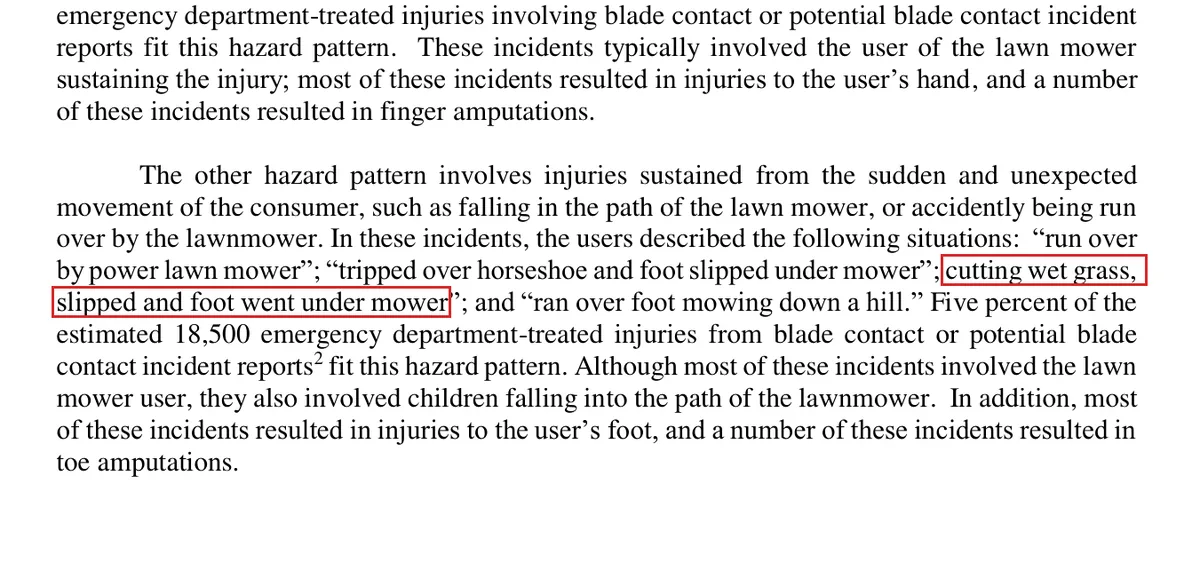
CPSC staff estimated 18,500 ER visits tied to walk-behind mowers from January 2016 to December 2018, based on 366 sampled cases. Twelve percent involved blade contact or potential blade contact. Five percent fit a slip or sudden-movement pattern, with case narratives that include "cutting wet grass, slipped and foot went under mower", and 3 percent came from tasks near the blade such as clearing a clog (CPSC staff memo, Dec. 20, 2019).
| CPSC hazard pattern (walk-behind mowers, 2016 to 2018) | Share of 18,500 | Injuries over 3 years | Per year (our division) |
|---|---|---|---|
| Slip, trip or sudden movement into the blade (includes “cutting wet grass, slipped”) | 5% | about 925 | about 310 |
| Task near the blade, such as reaching under to clear a clog | 3% | about 555 | about 185 |
| Blade contact, pattern not determined | 4% | about 740 | about 245 |
| All blade contact or potential blade contact | 12% | 2,200 (CPSC figure) | about 735 |
What do mower manuals say about mowing wet grass?
9 of the 12 operator's manuals we read, from 9 brands, tell you not to mow wet grass. Walk-behind manuals call it a slip hazard (Toro, Ryobi); riding and zero-turn manuals cite lost traction, steering and braking (Cub Cadet, Scag, Exmark). Honda, Toro's TimeCutter and Exmark warn without a ban; the corded Greenworks manual adds electric shock.
| Brand and model | Type | Manual (form no.) | What it says about wet grass | Page |
|---|---|---|---|---|
| Toro 22 in. Recycler 21442 | Gas walk-behind | Form 3445-588 Rev A | “Wet grass or leaves can cause serious injury if you slip and contact the blade. Avoid mowing in wet conditions.” | p. 13 |
| Toro 60V Flex-Force 22 in. Recycler 21466 | Battery walk-behind | Form 3441-853 Rev B | “Wet grass or leaves can cause serious injury if you slip and contact the blade. Avoid mowing in wet conditions or when it is raining.” | p. 4 |
| Honda HRX217 (HYA, HZA) | Gas walk-behind | 00X31-VH7-W600 | “Mowing on a slope when the grass is damp or wet could cause you to slip, fall, and lose control of the mower.” | p. 8 |
| Greenworks 25022, 20 in. 12A | Corded electric walk-behind | No form no. printed | “Do not use the lawn mower in damp or wet conditions or operate in the rain.” | p. 3 |
| Cub Cadet XT1 and XT2 Enduro tractors | Riding lawn tractor | Form 769-10975A | “Do not mow on wet grass. Reduced traction could cause sliding.” | p. 4 |
| EGO 56V 21 in. LM2130SP and LM2150SP | Battery walk-behind | No form no. printed | “Do not mow on wet grass. Unstable footing could cause slipping.” | p. 10 |
| Ryobi 40V HP 21 in. RY40HPLM01 | Battery walk-behind | 999000428 Rev 03 | “Do not operate the lawn mower in wet grass. Walk, never run.” | p. 2 |
| Husqvarna LC221A | Gas walk-behind | 1158719-27 | “Never operate machine in wet grass.” | p. 3 |
| Husqvarna TS 142 lawn tractor | Riding lawn tractor | 2570-001 | “Do not mow wet grass. It is slippery, and tires can lose their grip so that the product skids.” | p. 9 |
| Toro TimeCutter ZR4200T and ZS4200T | Residential zero-turn | Form 3479-377 Rev A | “Be aware that operating the machine on wet grass, across slopes, or downhill may cause the machine to lose traction.” | p. 18 |
| Exmark Lazer Z (LZE, LZS, LZX) | Commercial zero-turn | Part No. 4506-887 Rev B | “Be aware that operating the machine on wet grass, across slopes or downhill may cause the machine to lose traction.” | PDF 39 |
| Scag Cheetah II (SCZII) | Commercial zero-turn | Part No. 03577 | “Do not mow on wet grass. Wet grass reduces traction and steering control.” | p. 7 |
The manuals also explain what wet grass does to the machine. Toro's 21442 and 60V manuals say wet grass and leaves "tend to clump on the yard and can cause the machine to plug or the engine to stall" (Toro 21442, p. 15). Greenworks says wet clippings stick under the deck and stop the mower from mulching (Greenworks 25022, p. 22).
Even the commercial manual that bans wet mowing tells you how to do it. Scag's Cheetah II book says: "When mowing wet or tall grass, mow the grass twice", at low speed with the deck at its highest setting for the first pass (Scag 03577, p. 24). Its troubleshooting chart (p. 27) gives the fix "Cut grass after it has dried out". Toro's TimeCutter manual lists its lowest speed for "Heavy, wet grass mowing conditions" (Toro 3479-377, p. 22).
How long after rain should you wait to mow?
Wait until the grass blades are dry and the soil is firm enough that tires leave no muddy tracks. No university source we found puts that in hours. Purdue Turfgrass Science says light rain on firm ground is acceptable, while a soaked lawn needs longer: a saturated soil keeps draining for about 48 hours before it settles at field capacity (FAO glossary).
| Check | How to run it | If it fails | Source |
|---|---|---|---|
| Standing water or a soaked lawn | Look for puddles or water squeezing up around your shoes | Wait; mowing a water-soaked lawn adds compaction, disease spread and heavy clipping buildup | Mississippi State Extension, 2009 |
| Tire tracks | Drive or push a short test strip on flat ground | If a riding mower leaves muddy tracks, switch to a walk-behind there or wait; ruts can permanently damage turf | Purdue, Patton 2013 |
| Soil moisture | Time since a soaking rain | Soil near field capacity (about 48 hours after saturation) compacts most easily: minimize traffic | FAO; UC ANR 8080 |
| Wet blades | Mow a pass and look under the deck | Clippings that clump or cake mean a mulching mower will clog: switch to side discharge or wait for afternoon | Purdue |
| Lightning | Thunder or a storm warning | Do not operate the mower | Toro 21442 manual, p. 13 |
When does waiting do more harm than mowing wet?
Waiting does more harm once the grass passes 1.5 times your mowing height, because the next cut would remove more than one-third of the blade, the limit in Purdue Extension AY-8-W. Purdue's Zac Reicher wrote that mowing wet grass beats letting a lawn reach 8 inches (Purdue, 2006). The table works the one-third rule for common heights; our lawn care calendar lists the heights by grass.
| Your mowing height | Mow before grass reaches (height × 1.5) | Blade removed at that point | Rain still falling at that height? |
|---|---|---|---|
| 2 inches | 3 inches | 1 inch (one-third) | Mow wet with the steps below |
| 2.5 inches | 3.75 inches | 1.25 inches | Mow wet with the steps below |
| 3 inches | 4.5 inches | 1.5 inches | Mow wet with the steps below |
| 3.5 inches | 5.25 inches | 1.75 inches | Mow wet with the steps below |
| 4 inches | 6 inches | 2 inches | Mow wet; Toro says to walk slower at the highest setting over 6 inches |
Does mowing wet grass spread lawn disease?
Sometimes, and it depends on the disease. Extension services name Pythium blight (Cornell) and Ascochyta leaf blight (Michigan State) as cases where you should not mow wet turf. For dollar spot the opposite held in field trials: mowing off morning dew every day reduced the disease on creeping bentgrass (Ellram, Horgan and Hulke, Crop Science, 2007).
| Disease | Weather that drives it | What the source says about wet mowing | Source |
|---|---|---|---|
| Brown patch | Nights above 60°F; worst when lows top 70°F and highs top 90°F; leaves wet 10 to 12 hours straight | Shorten leaf wetness; on golf turf, daily dew removal by mowing or dragging a hose helps | NC State Extension; Penn State |
| Pythium blight | 80°F to 90°F, high soil moisture, little air movement; can kill large areas in a day | “Avoid mowing when the grass is wet.” | Cornell Plant Disease Diagnostic Clinic (rev. Oct. 2025) |
| Ascochyta leaf blight | Drought-stressed turf after wet or humid spells | Spores spread with rain, irrigation water or lawn equipment and enter cut leaf tips; do not mow when wet, use sharp blades | MSU Extension, June 2026 |
| Dollar spot | High humidity and long leaf-wetness periods | Remove dew early by poling, mowing or syringing | K-State EP131; Ellram et al. 2007 |
| Fall diseases on soaked lawns | Rainy early-fall weather | Do not mow a water-soaked lawn until drier conditions prevail | Mississippi State, 2009 |
The dollar spot study tested mowing at 4 a.m., 10 a.m. and 10 p.m. on creeping bentgrass cut to 16 mm (0.63 inch) in 2004 and 2005. Daily mowing at 4 a.m. gave the least disease, daily dew removal beat every other day, and dull reel blades worked as well as sharp ones. In lab tests, breaking leaf wetness after 6 hours shrank lesions most (Ellram et al. 2007). That is golf fairway turf, not a home lawn, so treat it as evidence that dew itself, not the mower, is what feeds this disease.
Watering sets the same clock. Evening irrigation keeps blades wet through the night, which is why NC State says to avoid watering in the late afternoon or evening; our guide to the best time to water grass gives the morning window. Tall fescue is highly susceptible to brown patch in hot, humid weather, as our tall fescue guide notes; the other grasses we profile are in Turf and Trees.
Can you mow wet grass with an electric or battery mower?
Not a corded one. The Greenworks 25022 manual says "Do not use the lawn mower in damp or wet conditions or operate in the rain" and calls for a GFCI-protected outlet (Greenworks). Battery mowers have no cord, but Toro's 60V Recycler manual says to avoid wet conditions and rain, and EGO's U.S. manual says "Do not mow on wet grass" (EGO).
| Mower power | Manual rule on wet grass and rain | Main hazard | Source |
|---|---|---|---|
| Corded electric (Greenworks 25022) | No use in damp or wet conditions or rain; GFCI outlet; outdoor-rated cord (SJTW-A and similar) | Electric shock, slips | Manual pp. 3 to 4 |
| Battery (Toro 60V 21466) | Avoid wet conditions or rain; battery label: “Do not expose to rain” | Slips; water on battery terminals | Form 3441-853, pp. 4 to 5 |
| Battery (EGO LM2130SP, U.S. manual) | “Do not mow on wet grass”; “Don’t use in rain”; do not wash the mower with a hose | Slips; water in the motor and electrical connections | EGO manual, pp. 7 and 10 |
| Battery (EGO, European site) | Occasional dew is fine; drizzle risks the tool and 56V battery; cut no lower than 35 mm | Water ingress; warranty excludes water or rain exposure | EGO Europe |
| Gas walk-behind (Toro 21442, Honda HRX217) | Avoid wet conditions; wet slopes cause slips | Slips, clogs and stalls | Toro p. 13; Honda p. 8 |
Is it safe to mow wet grass on a slope or with a riding mower?
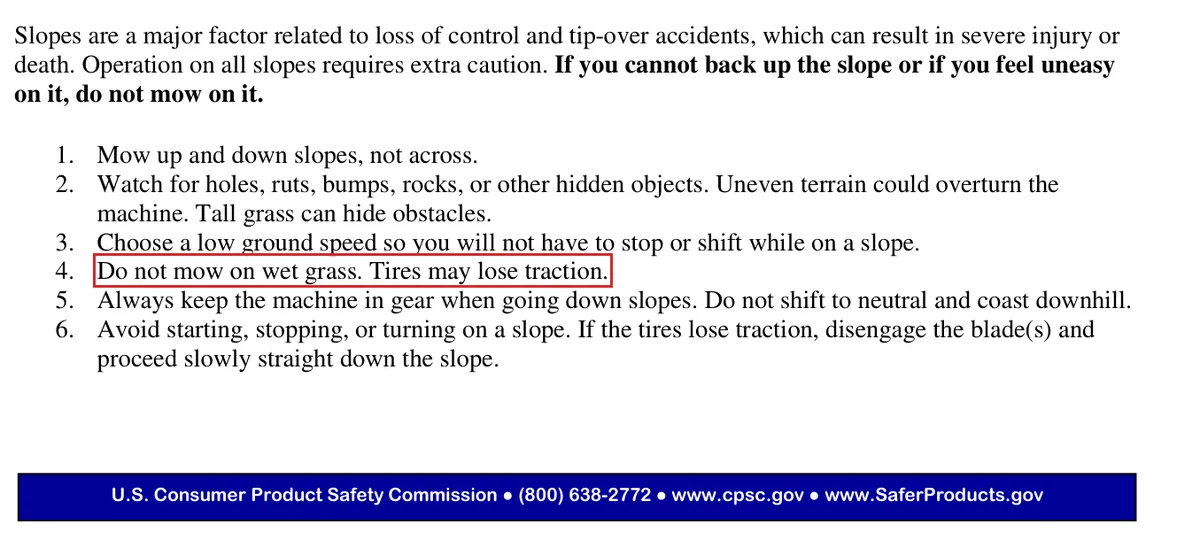
No. CPSC's riding mower sheet, reproducing ANSI/OPEI B71.1-2003, lists "Do not mow on wet grass. Tires may lose traction." under slope operation (CPSC). Walk-behind mowers go across a slope and riding mowers go up and down it (CPSC). UGA Extension says riding mowers slide and roll over on slopes steeper than 27 percent, about 15 degrees.
Measure a slope before you trust it. UGA Extension's method: hold a tape measure level from the top of the slope out 10 feet, stand a yardstick at that point and read the drop. A drop of 2.7 feet or more (27 percent) rules out a riding mower; a 3-foot drop is 30 percent. UGA puts push mowers at up to 20 degrees, mowed across the slope from the bottom up.
The dry-grass cap is not the same on every riding mower either: Husqvarna’s Z248F zero-turn manual stops at 10 degrees while its TS 120 lawn tractor allows 15, and John Deere sets 13 for both, as our zero turn vs lawn tractor guide shows model by model.
| Drop over a 10-ft level run | Slope (percent) | Angle (degrees) | Against the limits |
|---|---|---|---|
| 1 ft (12 in) | 10% | 5.7° | Under every manual limit when dry |
| 2 ft (24 in) | 20% | 11.3° | Under the limits when dry; still no riding mower on it wet |
| 2.7 ft (32 in) | 27% | 15.1° | About 15°: the cap in 9 of the 12 manuals; UGA riding mower cutoff (27 percent) |
| 3 ft (36 in) | 30% | 16.7° | UGA’s worked example: too steep to mow safely |
| 3.6 ft (43 in) | 36% | 19.8° | About 20°: Honda HRX217 cap and UGA push mower limit |
| 4 ft (48 in) | 40% | 21.8° | Over every limit in this table |
Every limit in the chart assumes dry grass. Cub Cadet's tractor manual puts its 15-degree cap at "a rise of approximately 2-1/2 feet every 10 feet" and its safety section says "Do not mow on wet grass. Reduced traction could cause sliding." (Cub Cadet, pp. 4 and 19). CPSC counts about 90 riding mower deaths a year (2008 to 2010), with tip-overs, run-overs and falls from the machine as the common fatal patterns (CPSC).
How do you mow wet grass if you have to?
Raise the deck, switch from mulching to side discharge, throw clippings onto the strip you already cut and plan a second pass. Those are the steps from Purdue's Zac Reicher and Aaron Patton. Skip slopes and soaked spots, use a gas or battery walk-behind rather than a corded mower, and shut the mower off completely before clearing a clog.
| Setting | Dry lawn | Wet lawn | Source |
|---|---|---|---|
| Deck height | Your normal height | Highest notch; EGO: no lower than 35 mm (1.4 in) on dewy grass | Purdue; EGO |
| Clippings | Mulch or side discharge | Side discharge onto the mowed strip; bag if clumps sit on top | Purdue |
| Passes | One | Two: high first, then final height (Scag: low speed) | Scag 03577, p. 24 |
| Turns | Normal | Wide, slow turns; no pivots on soft ground | Purdue |
| Machine | Any | Walk-behind where a rider leaves muddy tracks; no corded mower | Purdue; Greenworks |
- Sharpen the blade before the wet spell; Purdue lists it first. Our guide to sharpening a mower blade covers file angle and balance.
- Set the deck to its highest notch (Purdue); EGO says no lower than 35 mm (1.4 inches) on dewy grass (EGO).
- Remove the mulching plug and use side discharge; Purdue says mulching mowers clog more easily, and the Greenworks 25022 manual says wet grass sticks under the deck and prevents mulching (Greenworks manual).
- Aim the chute at the strip already mowed and avoid sharp turns, which tear wet turf (Purdue); Scag adds a low ground speed.
- Mow a second time the same day, which Reicher calls double-mowing, or bag the clumps if they still sit on top and use them as mulch or compost (Purdue).
- Use a walk-behind wherever a riding mower leaves muddy tracks; Purdue warns ruts can permanently damage turf. Fill them later with our guide to leveling a lawn; UC IPM says aerating relieves some compaction, timed per our guide to when to aerate your lawn.
- Clear clogs only with the engine off and the blade stopped. Toro's 21442 manual says to "wait for all moving parts to stop before servicing, fueling, or unclogging" (Toro, p. 2).
- Clean under the deck right after: Toro's washout method is to set the lowest height on pavement, run the engine and spray water in front of the right rear wheel, then run it dry for a few minutes to stop rust (Toro, p. 16).
If the mower stalls in wet clippings and will not restart, our guide to why a lawn mower will not start walks through the checks.
Which wet-grass advice is wrong?
Three rules repeat across the top results and overstate their sources: never mow wet grass, wait 24 hours after rain, and wet mowing always spreads disease. Purdue accepts mowing in light rain, no extension source we found fixes a 24-hour wait, and dew removal by mowing cut dollar spot in a 2-year study. Brand blogs also run looser than the same brands' manuals.
| Common claim | Where it appears | What the primary source says | Source |
|---|---|---|---|
| “Never mow a wet lawn” | Title of the No. 2 Google result, a Reddit r/lawncare thread (Oct. 2026) | “It is fine to mow wet turf or mow during light rain”, with a raised deck and a sharp blade; mowing wet beats letting grass reach 8 inches | Purdue, Patton 2013; Reicher 2006 |
| Wait at least 24 hours after rain | Husqvarna’s “Can you mow wet grass?” guide | No hour count; the test is dry blades and no muddy tire tracks. A soaked soil drains for about 48 hours | Purdue; FAO |
| Mowing wet grass spreads disease | LawnStarter, Husqvarna and most top 10 pages | True for Pythium and Ascochyta; for dollar spot, daily dew removal by mowing reduced disease | Cornell; MSU; Ellram 2007 |
| You can mow wet grass with a few precautions | Husqvarna’s “Can you mow wet grass?” guide | Husqvarna’s own LC221A manual: “Never operate machine in wet grass”; its TS 142 tractor manual: “Do not mow wet grass” | Husqvarna 1158719-27, p. 3; 2570-001, p. 9 |
| Battery mowers have no wet-grass issue | EGO Europe: “In theory, there’s no safety issue” | EGO’s own U.S. manual: “Do not mow on wet grass”; Toro’s 60V manual: avoid wet conditions or rain; EGO’s European warranty excludes water or rain exposure | EGO manual, p. 10; Toro 3441-853; EGO Europe |
| Mulch wet clippings back into the lawn | Common mower-blog advice | Use side discharge; mulching mowers clog more easily in wet grass | Purdue; Greenworks 25022 |
Should you mow wet grass today or wait?
Mow today only if every check passes: no standing water or muddy tire tracks, no slope under a riding mower, no cord, no lightning and no active Pythium or Ascochyta. If the grass is already 1.5 times your mowing height and rain keeps coming, a careful wet cut does less harm than waiting (Purdue). Otherwise wait for dry blades, often by afternoon (Purdue).
| If your situation is | Do this | Why (source) |
|---|---|---|
| Puddles, or tires leave muddy tracks | Wait; mow soggy spots later with a walk-behind | Wet soil ruts and compacts (UC ANR 8080; Purdue) |
| Riding or zero-turn mower and wet grass on any slope | Do not mow | “Do not mow on wet grass. Tires may lose traction” (CPSC, ANSI B71.1) |
| Dry slope over 27 percent (2.7-ft drop in 10 ft) | No riding mower; push mower across the slope | UGA Extension |
| Wet slope with a walk-behind | Skip it until dry | Slip risk named in the Honda HRX217 and Toro manuals |
| Corded electric mower, grass damp or raining | Do not mow | Greenworks 25022: shock risk; GFCI outlet required |
| Battery mower, dew or drizzle | Wait; the manuals say avoid wet conditions | Toro 60V manual; EGO warranty excludes water exposure |
| Hot, humid week and greasy or cottony patches | Wait for dry turf | Pythium and Ascochyta spread on wet equipment (Cornell; MSU) |
| Grass past 1.5 × mowing height, more rain forecast | Mow wet: high deck, side discharge, double cut | One-third rule (Purdue AY-8-W) |
| Dew only, flat firm lawn, gas walk-behind | Mow now with side discharge, or wait until afternoon | Purdue, 2013 |
1Is there standing water, or do tires leave muddy tracks?
YesWait. Wet soil ruts and compacts (UC ANR 8080; Purdue).
NoGo to the next question
2Is any wet area sloped, or are you on a riding or zero-turn mower on a slope?
YesDo not mow it wet: "Tires may lose traction" (CPSC, ANSI/OPEI B71.1-2003).
NoGo to the next question
3Is it a corded electric mower?
YesWait until grass and ground are dry (Greenworks 25022 manual: shock risk).
NoGo to the next question
4Is there thunder or lightning nearby?
YesStop (Toro 21442 manual).
NoGo to the next question
5Do you see greasy, water-soaked or cottony patches in hot, humid weather?
YesWait for dry turf; Pythium and Ascochyta spread on wet equipment (Cornell; MSU).
NoGo to the next question
6Is the grass past 1.5 times your mowing height, with more rain forecast?
YesMow now: highest deck setting, side discharge, second pass (Purdue).
NoMow with side discharge on firm, flat ground, or wait for dry blades for a cleaner cut, often by afternoon (Purdue).
Source: CPSC; Purdue Turfgrass Science; UC ANR; Cornell; MSU; manufacturer manuals
This page is general safety information, not a substitute for your mower's operator's manual. Where the two differ, follow the manual for your model.
How we compiled this
We read 12 operator's manuals from 9 brands (2016 to 2024 editions), 3 CPSC documents, 12 extension or university publications from 9 universities, 1 peer-reviewed field study, EGO's European help page and the FAO soil-moisture glossary, all accessed October 28 and 29, 2026. Manual quotes are copied from each PDF's text layer with page numbers. We did not test any mower; injury shares are CPSC staff estimates and the per-year figures are our division.
| Mower | Wet grass verdict | Key number | Source |
|---|---|---|---|
| Riding tractor or zero-turn | Do not mow wet grass | 15° (26.8%) dry-slope cap in Cub Cadet and Scag manuals | CPSC; Cub Cadet |
| Gas walk-behind | Avoid; acceptable on flat, firm ground with care | Honda: avoid slopes over 20° | Toro; Honda |
| Battery walk-behind | Avoid wet conditions and rain | EGO: cut no lower than 35 mm if dewy | Toro 60V; EGO |
| Corded electric | Do not mow damp or wet grass | GFCI outlet; 15° slope cap | Greenworks |
Frequently asked questions
Is it okay to mow the lawn when the grass is wet?
On flat, firm ground with a gas walk-behind, yes: Purdue Turfgrass Science calls mowing wet turf or in light rain acceptable, with a raised deck and side discharge. Not on slopes, with a corded mower, on soaked soil, or when Pythium or Ascochyta is active.
How long after rain should I wait to cut the grass?
Until the blades are dry and tires leave no muddy tracks. No extension source we found sets an hour count. A soaked lawn keeps draining for about 48 hours (FAO), and soil near that point compacts most easily (UC ANR 8080).
Why do landscapers mow wet grass?
Crews mow on fixed weekly routes, so a rain day pushes every later lawn back. Purdue calls a careful wet cut acceptable, and golf managers are told to mow early to strip dew (K-State EP131). Our lawn mowing cost data shows how crews price weekly visits.
Can you ruin a lawn mower by mowing wet grass?
Usually not, but wet clippings plug the deck and can stall the engine (Toro 21442 manual) or jam the blade (CPSC). Electric models face water: EGO's European warranty excludes water or rain exposure. Clean under the deck after every wet cut.
Can you mow wet grass with a zero turn?
The manuals say no. Scag's Cheetah II zero-turn manual says "Do not mow on wet grass. Wet grass reduces traction and steering control" and bans slopes over 15 degrees (Scag 03577). If you must, Scag says to mow twice at low speed, deck highest on the first pass.
Is it ok to mow wet grass in the morning?
Dew-wet grass clumps and makes footing slick. To keep dust out of the bag, Honda's HRX217 manual says it is best to mow in the morning when the ground is slightly damp and the grass is dry (Honda). Purdue suggests mowing in the afternoon when blades are dry (Purdue).
What is the 1/3 mowing rule?
Never remove more than one-third of the leaf blade in one mowing (Purdue AY-8-W). To hold a lawn at 3 inches, mow before it passes 4.5 inches. In a rainy spring, Purdue says an occasional larger cut does little long-term harm.
Sources
- U.S. Consumer Product Safety Commission, Riding Lawnmowers fact sheet (Publication 588; safe practices reproduced from ANSI/OPEI B71.1-2003), injury data 2012 to 2014. Accessed October 2026.
- U.S. Consumer Product Safety Commission, Power Lawn Mowers fact sheet (walk-behind), injury data 2012 to 2014. Accessed October 2026.
- U.S. Consumer Product Safety Commission staff, Petition to Amend Warning Label Requirements in 16 CFR Part 1205, with Tab A memo of Dec. 20, 2019, NEISS 2016 to 2018. Accessed October 2026.
- UGA Extension Forsyth County (Heather N. Kolich), Lawn mower safety on slopes and hills, Mar. 28, 2025. Accessed October 2026.
- Purdue Turfgrass Science (Aaron Patton), How to Mow Now That it has Stopped Raining, Apr. 22, 2013. Accessed October 2026.
- Purdue Turfgrass Science (Zac Reicher), Mowing Wet Grass, May 16, 2006. Accessed October 2026.
- Purdue Extension and University of Illinois, AY-8-W: Mowing, Dethatching, Aerifying and Rolling Turf, undated PDF. Accessed October 2026.
- NC State Extension, Brown Patch in Turf (TurfFiles), current page. Accessed October 2026.
- Penn State Turfgrass Disease Diagnostic Lab, Brown Patch pest profile, current page. Accessed October 2026.
- Cornell Plant Disease Diagnostic Clinic, Pythium Blight and Root Rot on Turfgrass, revised Oct. 2025. Accessed October 2026.
- Michigan State University Extension, Turf update: Ascochyta leaf blight damaging lawns, June 11, 2026. Accessed October 2026.
- Ellram, Horgan and Hulke, Crop Science 47(5):2129 to 2137, Mowing strategies and dew removal to minimize dollar spot on creeping bentgrass, Sept. 2007. Accessed October 2026.
- K-State Research and Extension (Megan Kennelly), EP131: Dollar Spot in Golf Course Turf, undated PDF. Accessed October 2026.
- UC Agriculture and Natural Resources (M. Ali Harivandi), Publication 8080: Turfgrass Traffic and Compaction: Problems and Solutions, Dec. 2002. Accessed October 2026.
- UC IPM, Healthy Lawns: Abiotic disorders, Compaction, current page. Accessed October 2026.
- Mississippi State University Extension, Soggy lawns and fall turf diseases (Turf Tips), Sept. 28, 2009. Accessed October 2026.
- FAO, Glossary of soil moisture terms: Field Capacity, current page. Accessed October 2026.
- EGO Power+ Europe, Can I cut wet grass with a battery lawn mower?, current page. Accessed October 2026.
- The Toro Company, 22in Recycler Lawn Mower 21442 Operator's Manual, Form 3445-588 Rev A, 2021. Accessed October 2026.
- The Toro Company, 60V Flex-Force 22in Recycler 21466 Operator's Manual, Form 3441-853 Rev B, 2021. Accessed October 2026.
- American Honda Motor Co., HRX217 Owner's Manual, 00X31-VH7-W600, 2020. Accessed October 2026.
- Greenworks, 25022 20in 12A Electric Lawn Mower Owner's Manual, 2019 to 2021. Accessed October 2026.
- Cub Cadet (MTD Products), XT1 and XT2 Enduro Series Tractor Operator's Manual, Form 769-10975A, 2016. Accessed October 2026.
- Scag Power Equipment, Cheetah II (SCZII) Operator's Manual, Part No. 03577, Aug. 2024 printing. Accessed October 2026.
- EGO Power+ (Chervon), LM2130SP / LM2150SP 21in. Lawn Mower Operator's Manual, 2021 PDF. Accessed October 2026.
- The Toro Company, TimeCutter ZR4200T / ZS4200T Operator's Manual, Form 3479-377 Rev A, 2026. Accessed October 2026.
- Exmark Mfg. Co., Lazer Z Operator's Manual, Part No. 4506-887 Rev B, 2024. Accessed October 2026.
- Ryobi (Techtronic Industries), RY40HPLM01 40V HP Brushless 21in. Self-Propelled Mower Operator's Manual, 999000428, Oct. 23, 2024 (Rev 03). Accessed October 2026.
- Husqvarna, LC221A Operator's Manual, 1158719-27, Nov. 29, 2016. Accessed October 2026.
- Husqvarna, TS 142 Operator's Manual, 2570-001, 2024. Accessed October 2026.