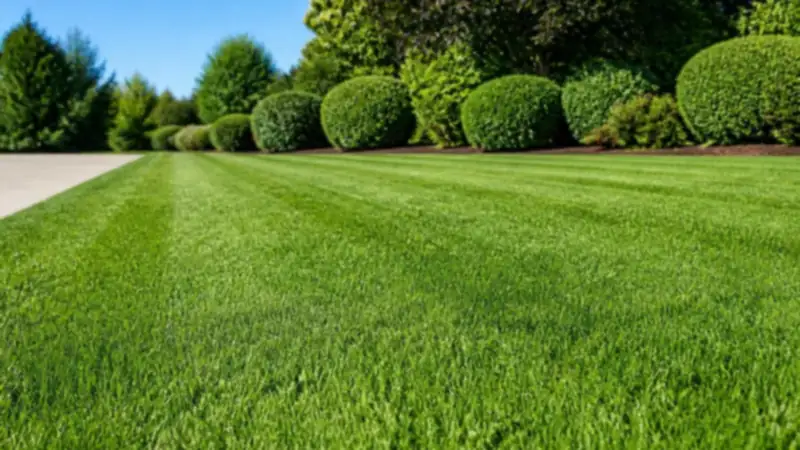
Tall fescue is a deep-rooted, bunch-type cool-season lawn grass: mow it at 2.5 to 3.5 inches, seed 5 to 6 lb per 1,000 sq ft when soil tops 60°F, and pick a turf-type cultivar over Kentucky 31.
Key takeaways
- In the latest completed national trial, the 2018 National Tall Fescue Test, Kentucky 31 averaged 4.2 for turf quality on a 1 to 9 scale, last of 132 entries, while Daybreak led at 6.4 (NTEP report 24-9).
- Tall fescue is a bunch-type grass that cannot fill bare spots on its own; NC State says bare areas must be reseeded and that patches over 4 inches across should be replanted (NC State Extension Gardener Handbook).
- NC State sets mowing at 2.5 to 3.5 inches in spring and 3.5 inches in summer (NC State AG-367), and its gardener handbook says never to cut tall fescue shorter than 2.5 inches (NC State).
- Seed in fall: NC State TurfFiles puts the optimum at 68°F to 77°F air and soil above 60°F, at 5 to 6 lb per 1,000 sq ft (NC State TurfFiles, 2025).
- The basic North Carolina program is 1 lb of nitrogen per 1,000 sq ft in mid-September, November and February, about 3 lb a year (NC State AG-367).
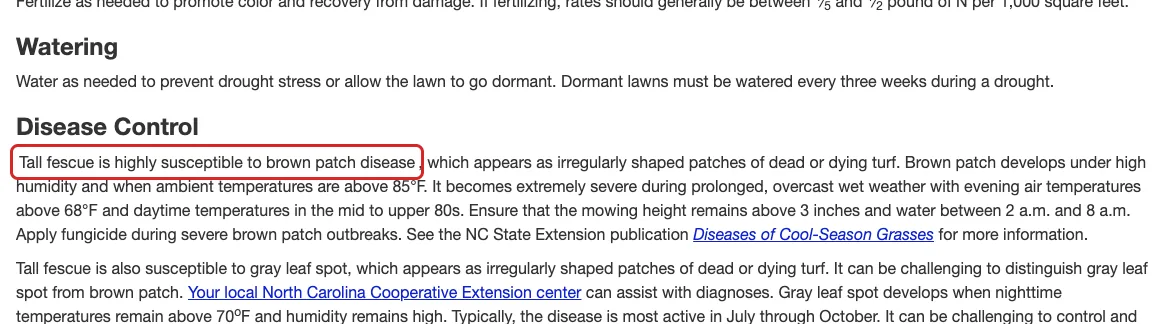
- Brown patch is the main disease: NC State says it develops above 85°F and turns severe when nights stay above 68°F (NC State AG-367).
| Key number | Value | Source |
|---|---|---|
| Accepted botanical name | Schedonorus arundinaceus (synonyms Festuca arundinacea, Lolium arundinaceum) | USDA PLANTS |
| Seeds per pound | 227,000 | USDA NRCS Plant Guide |
| Mowing height | 2.5 to 3.5 in (3.5 in in summer); never below 2.5 in | NC State AG-367 |
| Seeding rate, new lawn | 5 to 6 lb per 1,000 sq ft (NC State); 7 to 9 lb (Iowa State) | NC State TurfFiles; Iowa State |
| Seed when | Air 68°F to 77°F, soil above 60°F | NC State TurfFiles |
| Nitrogen, basic program | About 3 lb per 1,000 sq ft a year, mostly in fall | NC State AG-367 |
| Water | About 1 in a week, wetting soil 4 to 6 in deep | NC State AG-367 |
| Root depth on deep soils | 2 to 3 ft | Oregon State Beaver Turf |
| Sod, national farm price | 50.03¢ per sq ft (Q2 2026) | USDA AMS |
What is tall fescue grass?
Tall fescue is a perennial cool-season grass from Europe, listed by the USDA PLANTS Database as Schedonorus arundinaceus and introduced, not native, in the lower 48 states. Lawn bags still call it Festuca arundinacea. Unmowed, it grows 2 to 5 feet tall and flowers by late May in southern Illinois (Illinois Extension).
Its range is wide for a cool-season grass. The USDA NRCS Plant Guide maps it east of the Great Plains except southern and central Florida, plus the Pacific and Intermountain Northwest, on soils of pH 5.5 to 7.0. UC IPM calls it the most common lawn grass in California (UC IPM), and Iowa State rates it hardy through most Iowa winters in USDA zone 5 (Iowa State). Profiles of the other lawn grasses are in our Turf & Trees section.
Where a soil test reads below that range, the rates, timing and per-pass limits are in our lime for lawn guide.
| Name you will see | What it means | Source |
|---|---|---|
| Schedonorus arundinaceus | Accepted name in the USDA PLANTS Database (symbol SCAR7) | USDA PLANTS |
| Festuca arundinacea, Lolium arundinaceum | Older and alternative names still used by seed labels, UC IPM and the NRCS Plant Guide (symbol LOAR10) | USDA NRCS; UC IPM |
| Kentucky 31 (KY-31, K-31) | Forage cultivar found in Menifee County, Ky., in 1931 and released by the University of Kentucky in 1943; coarse and usually endophyte-infected | University of Kentucky; USDA NRCS |
| Turf-type tall fescue | Cultivars bred since the early 1980s (Rebel, Falcon, Olympic first) for finer leaves and more tillers | Oregon State |
| Dwarf and semi-dwarf tall fescue | Shorter, denser turf types; dwarfs root less deeply and are less drought tolerant | Oregon State |
| Rhizomatous tall fescue (RTF) | Barenbrug trademark for cultivars sold as forming short rhizomes | Barenbrug USA |
What does tall fescue grass look like?
Tall fescue looks like a coarse, upright, medium to dark green grass with leaves that are distinctly ridged on top, smooth and shiny underneath, and pointed at the tip. Oregon State says its leaves are wider than those of any other perennial cool-season grass, and Illinois Extension notes the stiff leaves stand out at close to 90 degrees from the stem (Oregon State; Illinois Extension).
| Feature | Tall fescue | Source |
|---|---|---|
| Leaf width | Flat blades 1/8 to 1/4 in wide (Kentucky bluegrass: under 1/8 in; fine fescue: 1/16 in or less) | K-State MF2031 |
| Leaf surface | Upper side strongly ridged; underside smooth and shiny with a keel near the base | Oregon State |
| Leaf tip | Pointed, often with a constriction about 0.5 in below the tip | Oregon State |
| New leaves (vernation) | Rolled in the bud | UC IPM |
| Auricles and ligule | Short, blunt, rounded auricles, sometimes absent on newer cultivars; short membranous ligule | Illinois Extension; Oregon State |
| Leaf edges | Rough, with fine hairs at the collar on vigorous shoots | Oregon State |
| Growth habit | Clumps (bunch type); faster vertical growth than other lawn grasses, especially in spring | Oregon State |
What is the difference between turf-type tall fescue and Kentucky 31?
Turf-type tall fescue is bred for lawns; Kentucky 31 was released for pasture. In the 2018 National Tall Fescue Test, Kentucky 31 finished last of 132 entries for turf quality (4.2 on a 1 to 9 scale), leaf texture, genetic color and summer density, while the trial’s entries averaged 5.96 for quality (NTEP). It still survived and greened up as well as the newest cultivars.
University of Kentucky agronomist E.N. Fergus found the grass in 1931 on the Suiter farm in Menifee County, Ky., and the university released it as Kentucky 31 in 1943 (University of Kentucky). As late as 1977 it made up about 97 percent of all tall fescue turf in the United States, per the history Oregon State compiled; the first turf types, Rebel, Falcon and Olympic, arrived in the early 1980s with almost twice as many tillers per plant (Oregon State Beaver Turf).
| NTEP rating (1 to 9 unless noted) | Kentucky 31 | Mean of all 132 entries | Daybreak (top quality) | LSD (0.05) | Source |
|---|---|---|---|---|---|
| Turf quality, mean of all sites, 2019 to 2023 | 4.2 | 6.0 | 6.4 | 0.2 | NTEP Table Appendix |
| Leaf texture (9 = very fine) | 4.3 | 6.1 | 6.6 | 0.3 | NTEP Table 34 |
| Genetic color (9 = dark green) | 4.1 | 6.4 | 6.3 | 0.3 | NTEP Table 32 |
| Summer density | 4.7 | 6.3 | 6.3 | 0.6 | NTEP Table 37 |
| Quality mowed at 1.5 in, Blacksburg, Va. | 3.0 | 6.0 | 6.2 | 0.6 | NTEP Table 31 |
| Gray leaf spot, New Jersey (9 = no disease) | 5.5 | 7.0 | 8.2 | 0.8 | NTEP Table 49 |
| Spring green-up | 6.1 | 5.8 | 5.9 | 0.5 | NTEP Table 33 |
| Drought wilting, West Lafayette, Ind. (9 = no wilting) | 6.0 | 6.2 | 6.0 | 1.4 | NTEP Table 43 |
| Living ground cover in summer, % | 88.9 | 88.6 | 89.7 | 6.6 | NTEP Table 40 |
The bottom three rows explain why Kentucky 31 persists on roadsides and farms. Its spring green-up score of 6.1 sat within 0.1 of the best entry, and its drought and summer cover scores were statistically level with the field. Purdue lists Kentucky 31 only for roadsides, parking areas and low-maintenance sites, at 8 to 10 lb of seed per 1,000 sq ft (Purdue AY-25-W).
Which tall fescue varieties scored best in national trials?
Daybreak scored the highest turf quality in the 2018 National Tall Fescue Test, 6.4 on a 1 to 9 scale averaged over 2019 to 2023, and finished in the top quarter at 73.9 percent of trial sites (NTEP). Fourteen more commercially available cultivars averaged 6.3. With a least significant difference of 0.2, those 15 are statistically tied.
Swipe the table sideways to see every column.
| Cultivar (breeder code) | NTEP sponsor | Quality, all sites | % of sites in top 25% | Quality, 9 transition-zone sites | Quality, 4 Northeast sites | Quality, Ga. and Miss. | Brown patch (9 = none) | Quality in shade, Ames, Iowa |
|---|---|---|---|---|---|---|---|---|
| Daybreak (AH2) | BrettYoung | 6.4 | 73.9 | 6.4 | 7.0 | 5.8 | 6.6 | 5.5 |
| Xanadu (JT 268) | Barenbrug USA | 6.3 | 69.6 | 6.2 | 6.6 | 5.7 | 6.3 | 6.3 |
| Capitan (DLFPS-321/3705) | DLF USA | 6.3 | 65.2 | 6.3 | 6.2 | 5.7 | 6.8 | 6.0 |
| Titanium G-LS (PPG-TF 255) | Mountain View Seeds | 6.3 | 65.2 | 6.3 | 6.5 | 5.7 | 6.6 | 5.7 |
| Expanse (PPG-TF 262) | Landmark Turf & Native Seed | 6.3 | 65.2 | 6.2 | 6.7 | 5.6 | 6.5 | 4.8 |
| Bonfire (JS DTT) | Barenbrug USA | 6.3 | 56.5 | 6.2 | 6.5 | 5.7 | 6.5 | 5.9 |
| Clash (AH1) | Landmark Turf & Native Seed | 6.3 | 56.5 | 6.0 | 6.8 | 5.8 | 6.3 | 5.0 |
| Serenade (PPG-TF 320) | Integra Turf, Inc. | 6.3 | 52.2 | 6.2 | 6.5 | 5.6 | 6.7 | 5.3 |
| Southside (PPG-TF 267) | Landmark Turf & Native Seed | 6.3 | 52.2 | 6.2 | 6.6 | 5.6 | 6.0 | 4.9 |
| Spyder 2LS (ZRC1) | Mountain View Seeds | 6.3 | 52.2 | 6.3 | 6.7 | 5.5 | 6.4 | 5.8 |
| Fierce (K18-RS6) | The Scotts Company | 6.3 | 47.8 | 6.2 | 6.7 | 5.5 | 6.4 | 5.2 |
| Providence (GO-RH20) | Grassland Oregon Seed | 6.3 | 47.8 | 6.3 | 6.6 | 5.6 | 6.6 | 6.1 |
| Rover (PPG-TF 306) | Landmark Turf & Native Seed | 6.3 | 47.8 | 6.2 | 6.4 | 5.5 | 6.3 | 6.2 |
| Firenza II (PPG-TF 244) | Integra Turf, Inc. | 6.3 | 43.5 | 6.1 | 6.6 | 5.9 | 6.3 | 6.0 |
| Titan GLX (TF445) | Smith Seed Services | 6.3 | 43.5 | 6.3 | 6.4 | 5.9 | 6.6 | 5.8 |
| Kentucky 31 | Standard | 4.2 | 0.0 | 4.4 | 2.6 | 4.1 | 5.9 | 5.4 |
| LSD (0.05) | 0.2 | 0.3 | 0.5 | 0.6 | 1.1 | 0.9 |
Regional columns matter more than the national average when you shop. In the two Southeast plots, Griffin, Ga., and Mississippi State, no entry beat 5.9, below the 6.0 NTEP calls generally acceptable, while the five North Central sites averaged 6.3 (NTEP Table 21; Table 22). Shade separated the leaders too: Xanadu rated 6.3 under trees at Ames, Iowa, and Expanse 4.8, a gap larger than the 0.9 LSD.
NTEP itself makes no variety recommendations, and NC State advises sowing a blend of two or three cultivars rather than one. A newer trial, the 2024 National Tall Fescue Test, has only first-year data (NTEP report 26-1, 2025), so the 2018 test remains the latest completed comparison as of October 2026. Check the cultivar names on the seed tag against the table; our grass seed cost guide covers what a bag of turf-type blend costs.
Does tall fescue spread?
Tall fescue spreads very little. It grows in clumps by tillering, and NC State says damaged or bare areas must be reseeded (NC State). In a Kansas State test, tall fescue daughter plants emerged no more than 1.5 cm (about 0.6 in) into a 1-ft bare circle, while Kentucky bluegrass reached about 8 cm (K-State, 2008).
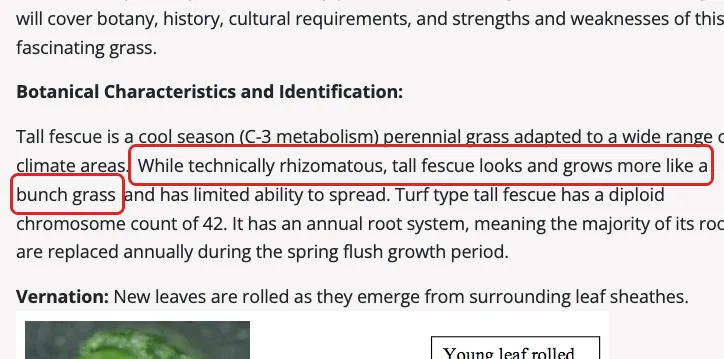
Rhizomatous tall fescue (RTF) is the exception the seed trade sells. Barenbrug says its patented RTF “produces true rhizomes that spread beneath the soil surface” and that new tillers emerge several inches from the mother plant (Barenbrug). Purdue’s position is narrower: some cultivars produce short rhizomes and may be marketed as RTF, but they are not a different species (Purdue TURF-63-W).
| Claim or study | Who ran it | What it found | Source |
|---|---|---|---|
| RTF “produces true rhizomes that spread beneath the soil surface” | Barenbrug (company page) | Claim; no measurement on the page | Barenbrug USA |
| Turf Saver RTF uses “up to 30% less water” | Barenbrug (company page) | Claim; the page does not name the independent test | Barenbrug USA |
| Spaced plants, mid-September 2001 | Barenbrug patent data | 88% of Bar Fa 08PB plants had rhizomes vs 51% of Kentucky 31; rhizomes 1 to 33 cm long | US 6,677,507 |
| Rhizomes per plant, Oregon plots | Barenbrug researchers | Labarinth 10.2 vs Kentucky 31 1.0 and Rebel II 0.9 (LSD 2.4) | Sports Turf Manager, 2012 |
| Fill of 1-ft bare circles and spread of 4-in plugs, 2006 to 2007 | Kansas State University (seed partly supplied by Barenbrug) | RTF blend left a 24.6 cm hole vs 26.1 cm for Kentucky 31 and 10.5 cm for bluegrass; “rhizomatous tall fescue cultivars and blends did not increase rate of coverage” | K-State, 2008 |
| Rhizome counts in the national spread study, Logan, Utah, 2014 to 2016 | NTEP | Kentucky 31 had 3.3 to 4.0 rhizomes per 2 plugs; with an LSD of 4.6 to 8.9 and a CV near 100%, most entries were not statistically different from it | NTEP report 18-13, Table 18 |
| Is RTF a separate species? | Purdue Extension | No: rhizome-forming cultivars are tall fescue | Purdue TURF-63-W |
The weight of the independent evidence is that rhizome counts differ between cultivars but lateral fill on a mowed lawn does not differ much. The K-State report cites Barenbrug research that plants need to be at least 20 months old before rhizome production is substantial, so any RTF effect would show only in a lawn’s second year. Plan to reseed bare spots over 4 in across either way (NC State).
What is the difference between tall fescue and fine fescue?
Tall fescue and fine fescue are different species. Tall fescue blades are 1/8 to 1/4 inch wide and strongly veined; fine fescue blades are 1/16 inch wide or less and bristle-like (K-State MF2031). Fine fescues tolerate more shade and need under 2 lb of nitrogen a year (Purdue TURF-65-W), but Colorado State rates their wear tolerance only moderate, and only the creeping red types spread.
| Grass | Botanical name | Growth habit | Shade tolerance | Traffic tolerance | Nitrogen, lb per 1,000 sq ft a year | Seed, lb per 1,000 sq ft | Share of Northern retail seed bags containing it | Source |
|---|---|---|---|---|---|---|---|---|
| Tall fescue (turf type) | Schedonorus arundinaceus | Bunch type | Good (NC State 4 of 6) | Very good (5 of 6) | 2 to 4 | 5 to 6 | Not reported | NC State; TurfFiles |
| Strong creeping red fescue | Festuca rubra ssp. rubra | Thick, long, numerous rhizomes | Good to excellent | Poor to fair | Under 2 | 4 to 6 | 64% | Purdue TURF-65-W; TURF-64-W |
| Slender creeping red fescue | F. rubra ssp. littoralis | Slender, short or few rhizomes | Good to excellent | Good | Under 2 | 4 to 6 | 2% | Purdue; TURF-64-W |
| Chewings fescue | F. rubra ssp. commutata | Bunch type | Excellent | Good | Under 2 | 3.5 to 6 | 27% | Purdue; TURF-64-W |
| Hard fescue | Festuca brevipila | Bunch type | Good | Fair to good | Under 1 | 3 to 6 | 7% | Purdue; TURF-64-W |
| Sheep fescue | Festuca ovina | Bunch type | Fair to good | Poor to fair | Under 1 | 3 to 6 | 0% | Purdue; TURF-64-W |
| Blue fescue | Festuca glauca | Clump-forming ornamental | Not rated | Not a lawn grass | Not rated | Not a lawn grass | Not reported | Purdue TURF-63-W |
Sources differ on fine fescue care numbers, so name the one you follow. Purdue says mow above 2 inches, preferably 2.5 to 4, and warns that more than 2 lb of nitrogen a year can lower fine fescue quality; Colorado State says mow 1 to 3 inches, seed 5 to 7 lb, and allows 3 to 4 lb of nitrogen on sandy or high-traffic sites (Purdue; Colorado State).
The two groups are often sown together. NC State suggests 1.5 lb of fine fescue per 1,000 sq ft when it is mixed with tall fescue or Kentucky bluegrass for shade, and says to mow such a tall fescue mix at 2.5 inches or higher (NC State). Blue fescue, the powder-blue clump sold for beds, is an ornamental, not a lawn grass.
Is tall fescue better than Kentucky bluegrass or bermudagrass?
Tall fescue is better than Kentucky bluegrass for heat, drought and wear, and better than bermudagrass for shade and winter color. NC State’s lawn-grass table rates tall fescue 5 of 6 for drought and wear against 4 for bluegrass, and 4 for shade against 1 for common bermudagrass (NC State Table 9-1). Bluegrass repairs itself; tall fescue does not.
| Criterion | Tall fescue | Kentucky bluegrass | Common bermudagrass | Source |
|---|---|---|---|---|
| Season | Cool-season; green most of the winter | Cool-season | Warm-season; dormant after the first heavy frost | NC State Table 9-1 |
| Shade tolerance (6 = excellent) | 4 (good) | 4 (good) | 1 (very poor) | NC State Table 9-1 |
| Heat tolerance | 4 | 3 | 5 | NC State Table 9-1 |
| Cold tolerance | 5 | 5 | 1 | NC State Table 9-1 |
| Drought tolerance | 5 | 4 | 6 | NC State Table 9-1 |
| Wear tolerance | 5 | 4 | 6 | NC State Table 9-1 |
| Cutting height | 2.5 to 3.5 in | 1.5 to 2.5 in | 0.75 to 2 in | NC State Table 9-1 |
| Nitrogen, lb per 1,000 sq ft a year | 2 to 4 (Piedmont) | 2 to 3 (mountains) | 4 to 4.5 (Piedmont) | NC State Table 9-1 |
| Spreads to fill bare spots | No (bunch type) | Yes (rhizomes) | Yes (stolons and rhizomes) | NC State Extension Gardener Handbook |
| Seeding rate, lb per 1,000 sq ft | 6 | 1 to 2 | Our seed cost guide lists rates | NC State Extension Gardener Handbook |
| Sod, national farm price, Q2 2026 | 50.03¢ per sq ft | 34.44¢ | 38.04¢ | USDA AMS |
The practical split is regional. NC State calls tall fescue best adapted to its mountain and piedmont regions, and the best grass there for a lawn that stays green year-round, but says it will not perform well in full sun on sandy coastal plain soil (NC State). Iowa State recommends turf-type tall fescue over bluegrass for non-irrigated lawns in central and southern Iowa (Iowa State).
Mixing the two cool-season grasses buys some repair ability. NC State says tall fescue adds drought and heat tolerance and Kentucky bluegrass adds finer texture and recuperative potential; Iowa State suggests 90 to 95 percent tall fescue with 5 to 10 percent bluegrass by seed weight. Our bermudagrass guide and zoysia grass guide cover the warm-season side, and installed sod prices are in our sod installation cost guide.
When and how do you plant tall fescue?
Plant tall fescue seed in late summer to early fall, when air runs 68°F to 77°F and soil stays above 60°F, at 5 to 6 lb per 1,000 sq ft (NC State TurfFiles). NC State warns that spring-seeded tall fescue is more exposed to drought, heat, disease and weeds; sod can go down any time the ground is not frozen (NC State).
| Region | Seeding window | Notes | Source |
|---|---|---|---|
| North Carolina mountains | Aug. 15 to Sept. 1 | Seeding later raises the chance of failure | NC State Extension Gardener Handbook |
| North Carolina piedmont | Sept. 1 to Sept. 15 (renovation Sept. 1 to Oct. 1) | Get seed down by mid-October at the latest | NC State; NC State TurfFiles |
| North Carolina coastal plain | Sept. 15 to Oct. 15 | Poor in full sun on sandy soil | NC State |
| Georgia Piedmont | September through October | Avoid December and any time after April | UGA Extension |
| Iowa | Mid-August to mid or late September; to early October in southern Iowa | Spring option: late April to early May; germination slows below 50°F soil | Iowa State |
How to seed a tall fescue lawn
Seeding tall fescue is a three-week job of seed-to-soil contact and steady moisture. The seven steps below combine NC State, UGA and Iowa State instructions; quantities are per 1,000 sq ft, and our overseeding guide covers seeding into an existing lawn.
- Test the soil and lime or fertilize to the report; the USDA NRCS lists pH 5.5 to 7.0 as tall fescue’s range (NRCS).
- Core-aerate a compacted lawn or till bare ground, then smooth it; NC State says aeration holes catch seed and hold moisture (TurfFiles).
- Spread 5 to 6 lb of a turf-type blend of two or three cultivars, half in each of two passes at right angles (UGA; NC State). More seed is not better: NC State says high rates make weak, thin stands.
- Rake the seed into the top 1/4 inch of soil or roll it, and apply a starter (high-phosphorus) fertilizer if you have no soil test.
- Keep the top 1 to 2 inches of soil moist with up to 1/4 inch of water a day for about three weeks, then water less often and deeper.
- Mow for the first time at 2 inches, then raise the deck to 2.5 to 3 inches as the stand matures.
- Hold all herbicides until the new grass is extensively tillered (NC State TurfFiles).
Where do tall fescue guides disagree with extension sources?
Seed-company care pages and land-grant publications give different numbers for planting and mowing tall fescue. The table quotes each as published in October 2026. The largest gap is spring seeding: one seed company lists spring as a seeding season once soil reaches 50°F to 65°F, while NC State does not recommend spring seeding at all.
| Topic | What the guide says | What the extension source says | Source |
|---|---|---|---|
| Soil temperature for seeding | Seed when soil reaches 50°F to 65°F (Pennington) | Optimum air 68°F to 77°F with soil above 60°F; Iowa State says germination is slow below 50°F | NC State TurfFiles; Iowa State |
| Spring seeding | Plant in early fall or in spring when soil reaches 50°F to 65°F (Pennington) | Spring-seeding tall fescue is not recommended; spring stands suffer drought, heat, disease and weeds | NC State; TurfFiles |
| Spring mowing height | Maintain 2 to 3 inches (Pennington) | 2.5 to 3.5 inches; never shorter than 2.5 inches | NC State AG-367; NC State |
The germination gap is mostly weather. The 5 to 10 days that Iowa State and UGA give assume warm, moist soil; NC State’s 10 to 21 days covers a fall that turns cool or dry. Plan on three weeks of watering either way. More germination detail is in our grass seed germination guide.
How do you mow, fertilize and water tall fescue?
Mow tall fescue at 2.5 to 3.5 inches (3.5 in summer), feed about 1 lb of nitrogen per 1,000 sq ft in September, November and February, and give it about 1 inch of water a week (NC State AG-367). NC State ties both habits, fall-weighted feeding and a cut above 3 inches, to less summer brown patch.
How short can you cut tall fescue?
Do not cut tall fescue below 2.5 inches; NC State says it performs best at 3.5 inches (NC State). NTEP’s low-mow plot shows why: mowed at 1.5 inches at Blacksburg, Va., the 132 entries averaged 6.0 for quality, but Kentucky 31 fell to 3.0 (NTEP Table 31). Remove no more than one-third of the blade per cut.
| Source | Recommended height | Season or condition |
|---|---|---|
| NC State AG-367 | 2.5 to 3.5 in; mow every 5 to 7 days in late spring | March to May |
| NC State AG-367 | 3.5 in, before it passes 5 in | June to August |
| NC State AG-367 | 2.5 to 3 in | September to November |
| NC State Gardener Handbook | Best at 3.5 in; never below 2.5 in; cut back to 3 in when it reaches 4.5 in | All year |
| UGA Extension | 2.5 to 3 in; 3 in in summer | Georgia |
| Iowa State | 3 in (rarely has weed problems at that height); every 5 to 6 days | Iowa |
| Oregon State | 2 to 3 in for improved cultivars | Pacific Northwest |
| K-State MF736 | Turf types 2 to 3 in; Kentucky 31 2.5 to 3.5 in | Kansas |
When should you fertilize tall fescue?
Fertilize tall fescue mainly in fall. NC State’s basic program is 1 lb of nitrogen per 1,000 sq ft in mid-September, again in November and again in February, with optional spring and summer feedings of only 1/5 to 1/2 lb (NC State AG-367). Heavy spring or summer nitrogen greatly increases brown patch, NC State says (NC State).
| Timing | NC State AG-367 (lb N per 1,000 sq ft) | Iowa State, higher-maintenance lawn | Iowa State, low-maintenance lawn |
|---|---|---|---|
| Spring (March to May) | Optional 0.2 to 0.5 | 0.5 to 0.75 | None |
| Summer (June to August) | Optional 0.2 to 0.5 | None | None |
| September | 1 | 0.75 to 1 | None |
| Late October to November | 1 (November) | 0.75 to 1 | 1 |
| February | 1 | None | None |
| Annual total | 3 (basic) to 4 | 2 to 2.75 | 1 |
To turn a nitrogen rate into pounds of product, NC State divides 100 by the first number on the bag for 1 lb of nitrogen per 1,000 sq ft. The worked rows below apply that formula to three common bags and a 5,000 sq ft lawn on the three-feeding basic program.
Our lawn fertilizer explainer shows what the other two numbers on the bag guarantee and how fast each nitrogen source releases.
| Bag analysis | Formula | Product per 1,000 sq ft per feeding | Per feeding, 5,000 sq ft | Per year (3 feedings), 5,000 sq ft |
|---|---|---|---|---|
| 16-4-8 | 100 ÷ 16 | 6.25 lb | 31.3 lb | 93.8 lb |
| 12-4-8 | 100 ÷ 12 | 8.3 lb | 41.7 lb | 125 lb |
| 10-10-10 | 100 ÷ 10 | 10 lb | 50 lb | 150 lb |
How much water does tall fescue need?
Tall fescue needs about 1 inch of water a week, applied so the soil wets 4 to 6 inches deep, and ideally between 2 a.m. and 8 a.m. to cut disease (NC State AG-367). A lawn allowed to go dormant in drought still needs watering every three weeks, and NC State says some stand loss is possible once a drought passes three weeks.
| Watering rule | Amount or interval | Source |
|---|---|---|
| Established lawn, spring and fall | About 1 in a week, wetting soil 4 to 6 in deep | NC State AG-367 |
| Sandy soil | About 1/2 in every third day | NC State AG-367 |
| Summer, Kansas | 1 to 1.5 in a week | K-State MF736 |
| Dormant lawn in drought | Water every 3 weeks | NC State AG-367 |
| Low-input lawn, Iowa | 3 to 5 waterings a summer may be enough | Iowa State |
| New seeding | Up to 1/4 in a day for about 3 weeks | UGA Extension |
Deep roots are why tall fescue can coast through dry spells. Oregon State reports roots 2 to 3 feet deep on deep soils, though dwarf types root less (Oregon State). In a Kansas State rainout-shelter study, tall fescue sod mowed at 3.5 inches did not go dormant through 83 days of drought in 2017 and 60 days in 2018, while Kentucky bluegrass went dormant in about 11 and 7 weeks (K-State, 2019). Timing advice by grass is in our lawn watering guide.
Thatch is rarely a tall fescue problem: NC State says removal is generally not necessary, and Oregon State calls it probably the lowest thatch producer of the common cool-season grasses. NC State AG-367 schedules core aeration for September through November, on clay soils and high-traffic lawns. Our aeration timing guide covers the calendar, and the dethatching cost guide explains when a power rake is worth paying for.
What are the downsides of tall fescue?
The downsides of tall fescue are that it does not spread to fill damage, it is highly susceptible to brown patch in hot, humid weather, it needs frequent mowing in spring, and it thins in full sun on sandy soil. Iowa State says common and improved stands need interseeding every 3 to 5 years to stay even (Iowa State).
| Problem | Trigger or threshold | What to do | Source |
|---|---|---|---|
| Brown patch | Above 85°F with high humidity; severe when nights stay above 68°F and days reach the mid to upper 80s | Mow above 3 in, water between 2 and 8 a.m., avoid spring and summer nitrogen; fungicide in severe outbreaks | NC State AG-367; NC State |
| Gray leaf spot | Nights above 70°F with high humidity; most active July to October | Mow at 3 in or taller, remove clippings; fungicides needed to suppress | NC State AG-367 |
| Bare or thin spots | Damage larger than 4 in across | Reseed; tall fescue cannot spread into the gap | NC State |
| Clumpy, uneven stand | Traffic plus too little water | Interseed every 3 to 5 years, ideally after core aeration | Iowa State |
| Summer decline on sand | Full sun on sandy coastal plain soil | Choose a warm-season grass for that area | NC State |
| White grubs | Adults fly and lay eggs in June | Preventive product in June; curative after larvae hatch, about 24 hours after a heavy rain | NC State AG-367 |
| Fast spring growth | Spring flush | Mow every 5 to 7 days | NC State; Iowa State |
Cultivar choice shifts the disease odds but does not remove them. In NTEP’s warm-temperature brown patch ratings, entries ranged from 4.6 to 6.8 on a 9-point scale with an LSD of 1.1; Capitan led at 6.8 (NTEP Table 46). Gray leaf spot separated entries more sharply: Kentucky 31 rated 5.5 in New Jersey against an entry mean of 7.0.
This page is general information. Fungicide and herbicide rules vary by state and product; read and follow the product label, which is the law for pesticide use.
Is tall fescue toxic to dogs?
No veterinary source we found lists tall fescue as toxic to dogs, and the ASPCA’s dog plant list names fescue neither as toxic nor as safe (ASPCA). The ASPCA adds that eating any plant can cause vomiting. The documented toxicity is fescue toxicosis in grazing livestock and pregnant mares, caused by an endophyte fungus inside many plants (University of Kentucky).
That fungus, Epichloë coenophialum, makes ergovaline, the alkaloid that harms mammals, and peramine, which repels insects (Virginia Tech SPES-114P). Virginia Tech counts tall fescue as the main forage on more than 35 million U.S. acres. Oregon State says the endophytes bred into turf-type tall fescue for pest resistance are usually toxic to livestock, and sets the ergovaline threshold at 0 ppb for mares in the last 60 to 90 days of pregnancy (Oregon State EM 9156). Do not feed lawn clippings to horses or cattle.
Is tall fescue the right grass for your lawn?
Tall fescue suits a sunny to partly shaded lawn in the transition zone, the Piedmont, the Midwest or California, where the owner wants year-round green and accepts reseeding thin spots every few years. It is a poor fit for full sun on sandy Southern soil or for a lawn that must heal itself from heavy wear (NC State; Iowa State).
| If your situation is | Do this | Why (source) |
|---|---|---|
| Sandy soil, full sun, coastal plain or Deep South | Plant bermudagrass or zoysiagrass instead | NC State says tall fescue will not perform well there (NC State) |
| Piedmont or transition zone, sun to medium shade | Seed a blend of 2 to 3 turf-type cultivars at 6 lb per 1,000 sq ft in early fall | NC State’s recommended rate and blend (NC State) |
| Roadside, ditch bank or field you will rarely mow | Kentucky 31 at 8 to 10 lb per 1,000 sq ft is acceptable | Purdue lists KY31 only for low-maintenance sites (Purdue AY-25-W) |
| Brown patch every summer | Mow above 3 in, stop spring and summer nitrogen, overseed with a cultivar rated 6.6 or higher for brown patch | NTEP Table 46 range 4.6 to 6.8; NC State AG-367 |
| Shade under trees | Choose a cultivar that held quality in NTEP shade plots (Xanadu 6.3, Rover 6.2) or add fine fescue | NTEP Table 29; NC State says fine fescue suits shade (NC State) |
| You want the lawn to repair itself | Seed 90 to 95% tall fescue with 5 to 10% Kentucky bluegrass | Bluegrass rhizomes fill gaps (Iowa State) |
| Bare spot larger than 4 in | Reseed the spot; plugging will not work | Tall fescue is bunch type (NC State) |
| You can only plant in spring | Lay sod, or seed in late April to early May and expect more weeds | Iowa State spring window; NC State sod any time ground is not frozen |
1Is the lawn in full sun on sandy soil in the coastal plain or Deep South?
YesPlant bermudagrass or zoysiagrass instead (NC State).
NoGo to the next question
2Is it a roadside or field you will rarely mow?
YesKentucky 31 at 8 to 10 lb per 1,000 sq ft is acceptable (Purdue AY-25-W).
NoGo to the next question
3Can you only plant in spring?
YesLay sod, or seed in late April to early May and expect more weeds (Iowa State).
NoGo to the next question
4Does the lawn need to repair itself from heavy wear?
YesSeed 90 to 95% tall fescue with 5 to 10% Kentucky bluegrass (Iowa State).
NoGo to the next question
5Does brown patch hit the area every summer?
YesUse a cultivar rated 6.6 or higher for brown patch in NTEP Table 46, mow above 3 in and feed in fall (NC State).
NoSeed a blend of 2 to 3 turf-type tall fescue cultivars at 6 lb per 1,000 sq ft in early fall, when soil is above 60°F (NC State).
Source: NC State Extension Gardener Handbook; NC State AG-367; Iowa State; Purdue AY-25-W; NTEP report 24-9
How we compiled this
We compiled this page in October 2026 from 35 primary documents: the NTEP 2018 National Tall Fescue Test final report and 17 of its data tables (all 132 entries), extension publications from NC State, Iowa State, Oregon State, UGA, Illinois, Purdue and UC IPM, the USDA PLANTS profile and NRCS Plant Guide, the USDA AMS and NC State sod price reports, the 2012 NTEP spread study, Kansas State spread and drought research, Purdue and Colorado State fine fescue publications, Virginia Tech, Kentucky and Oregon State endophyte publications, the ASPCA plant list, and Barenbrug’s own RTF pages and patent. We also checked one seed company’s care page for the comparison table. We did not grow, test or rate any grass ourselves; trial means across all entries and the fertilizer quantities are our arithmetic from the published figures.
Frequently asked questions
Is tall fescue a good lawn grass?
Yes, in the mountains, Piedmont, transition zone, Midwest and California. NC State calls it the best grass for a lawn that stays green year-round in the North Carolina mountains and piedmont (NC State), and UC IPM says it is the most common lawn grass in California.
Which is better, Kentucky bluegrass or tall fescue?
Tall fescue is better for heat, drought and wear; bluegrass is better at self-repair. In a Kansas State drought study, tall fescue sod did not go dormant through 83 days of drought in 2017, while Kentucky bluegrass went dormant in about 11 weeks (K-State, 2019). Bluegrass plugs spread to more than three times the area of tall fescue plugs in K-State’s 2007 spread test.
What is the best month to plant tall fescue?
September in most of its range. NC State’s windows are Aug. 15 to Sept. 1 in the mountains, Sept. 1 to 15 in the piedmont and Sept. 15 to Oct. 15 on the coastal plain; UGA says September through October in Georgia; Iowa State says mid-August to mid or late September.
Does fine fescue spread?
Only the two creeping red fescues spread; the other three common fine fescues stay in clumps. Purdue lists strong creeping red fescue with thick, long, numerous rhizomes and slender creeping red with short or few, while Chewings, hard and sheep fescue are bunch types (Purdue TURF-65-W).
How do I tell if I have bermuda or fescue?
Check in winter and look at the leaves. Bermudagrass is a warm-season grass that turns brown after the first heavy frost and spreads by stolons and rhizomes; tall fescue stays green most of the winter, grows in clumps and has wide leaves, 1/8 to 1/4 inch, with strong ridges on top (NC State; K-State MF2031).
Will fescue choke out other grass?
Turf-type tall fescue rarely takes over a lawn because it spreads mainly by upright tillers. Oregon State reports the reverse west of the Cascades, where bentgrass and annual bluegrass crowd tall fescue into clumps (Oregon State). Old forage tall fescue does persist in pastures and prairie plantings and can be hard to remove, per Illinois Extension.
Is rhizomatous tall fescue invasive?
Not as a lawn grass: in K-State’s test an RTF blend filled a 1-ft bare circle no faster than Kentucky 31. Tall fescue as a species is introduced in the United States, and the USDA NRCS Plant Guide says it may become weedy or invasive in some regions and habitats (USDA NRCS).
What is the best tall fescue grass seed?
A certified (blue-tag) blend of two or three turf-type cultivars that scored well in NTEP trials, such as Daybreak, Xanadu, Capitan or Titanium G-LS, all rated 6.3 to 6.4 for quality in the 2018 national test. Purdue advises avoiding seed that lists KY31 for a quality lawn (Purdue AY-25-W).
Sources
- National Turfgrass Evaluation Program (NTEP), 2018 National Tall Fescue Test, 2019 to 2023 Data, Final Report NTEP No. 24-9, Final report, 2019 to 2023 ratings. Accessed October 2026.
- NTEP, 2018 National Tall Fescue Test, Summary of Turfgrass Quality Ratings, 2019 to 2023, 2019 to 2023 ratings. Accessed October 2026.
- NTEP, 2018 National Tall Fescue Test final report (PDF), entries and sponsors, page 2, Entries list, 2024. Accessed October 2026.
- NTEP, 2024 National Tall Fescue Test, 2025 Data, Progress Report NTEP No. 26-1, First-year data, 2025. Accessed October 2026.
- NC State Extension, AG-367, Tall Fescue Lawn Maintenance Calendar, Published July 8, 2021. Accessed October 2026.
- NC State Extension, Extension Gardener Handbook, Chapter 9: Lawns (Table 9-1), Published Feb. 1, 2022. Accessed October 2026.
- NC State TurfFiles, Time for Fall Seeding of Tall Fescue, September 2025. Accessed October 2026.
- Iowa State University Extension, Yard and Garden, All About Tall Fescue: A Low-Maintenance Alternative to Kentucky Bluegrass, Current page. Accessed October 2026.
- Oregon State University, Beaver Turf, Tall Fescue, Current page. Accessed October 2026.
- UC Statewide IPM Program, UC Guide to Healthy Lawns: Tall fescue, 2019. Accessed October 2026.
- UGA Cooperative Extension, Oglethorpe County, Establishing Tall Fescue in your Lawn, Sept. 4, 2025. Accessed October 2026.
- University of Illinois Extension, Identifying Tall Fescue (Grasses at a Glance), May 30, 2023. Accessed October 2026.
- Purdue University and University of Illinois, AY-25-W, Purchasing Quality Grass Seed for Your Lawn, Undated publication. Accessed October 2026.
- USDA PLANTS Database, Schedonorus arundinaceus (Schreb.) Dumort., tall fescue, symbol SCAR7, Current profile. Accessed October 2026.
- USDA NRCS, Plant Guide: Tall Fescue, Lolium arundinaceum (LOAR10), Edited 2001 and 2006. Accessed October 2026.
- USDA Agricultural Marketing Service, National Quarterly Sod Report (April 1 to June 30, 2026), Q2 2026, released July 17, 2026. Accessed October 2026.
- NC State Extension, Sod Producers’ Report for North Carolina, 2026, Survey March 2026. Accessed October 2026.
- University of Kentucky Research and Education Center, The Rise and Improvement of Tall Fescue, June 16, 2025. Accessed October 2026.
- K-State Research and Extension, MF2031, Turfgrass Identification, Professional Series, July 2017. Accessed October 2026.
- K-State Research and Extension, MF736, Tall Fescue Lawns, April 2015. Accessed October 2026.
- Kansas State University, Kansas Agricultural Experiment Station, Lateral Spread of Tall Fescue Cultivars and Blends (Turfgrass Research 2008), 2008 report, plots seeded 2005. Accessed October 2026.
- Kansas State University, Kansas Agricultural Experiment Station, Minimal Water Requirements of Cool-Season Turfgrasses for Survival and Recovery After Prolonged Drought, July 2019. Accessed October 2026.
- NTEP, 2012 National Tall Fescue Test, 2013 to 2017 Data, Final Report NTEP No. 18-13 (Table 18, spread study at Logan, Utah), 2014 to 2016 counts. Accessed October 2026.
- Barenbrug USA, What is RTF? The Patented Rhizomatous Tall Fescue That Repairs Itself, Company page as of October 2026. Accessed October 2026.
- Barenbrug USA, Turf Saver RTF product page, Company page as of October 2026. Accessed October 2026.
- U.S. Patent and Trademark Office via Google Patents, US 6,677,507 B2, Tall fescue variety having rhizomes (Barenbrug USA), Granted Jan. 13, 2004; expired. Accessed October 2026.
- Sports Turf Manager (Wipff and Singh, Barenbrug USA), Rhizomatous Tall Fescue and Regenerating Perennial Ryegrass for Sports Fields?, Summer 2012. Accessed October 2026.
- Purdue Extension, TURF-63-W, Fine Fescues: Understanding the Differences, March 2022. Accessed October 2026.
- Purdue Extension, TURF-64-W, Establishment of Fine Fescues, March 2022. Accessed October 2026.
- Purdue Extension, TURF-65-W, Management of Fine Fescues, Rev. March 2022. Accessed October 2026.
- Colorado State University Extension, Fine Fescues for Lawns (Garden Notes), Reviewed July 2025. Accessed October 2026.
- Virginia Cooperative Extension, SPES-114P, Tall Fescue, Endophytes and Alkaloids, and Fescue Toxicosis, Oct. 16, 2024. Accessed October 2026.
- University of Kentucky Ag Equine Programs, Avoid Tall Fescue Toxicity this Spring, Current page. Accessed October 2026.
- Oregon State University Extension, EM 9156, Endophyte toxins in grass and other feed sources: Risks to livestock, Revised February 2026. Accessed October 2026.
- ASPCA Animal Poison Control Center, Toxic and Non-Toxic Plant List: Dogs, Current list. Accessed October 2026.
- Pennington Seed, All You Need to Know About Tall Fescue, Page as of October 2026. Accessed October 2026.