Short answer: Lawn dethatching costs $155 to $382 for a 5,000 sq ft lawn (median $175) and $164 to $748 for 10,000 sq ft, based on price lists posted by 12 U.S. lawn companies (October 2026). Renting a power rake costs $65 to $105 a day. Pay for dethatching only when the thatch layer is thicker than 1/2 inch.
$175 median posted price, 5,000 sq ft lawn (11 price lists, Oct. 2026)
$65–$105 per day to rent a walk-behind power rake (8 rental stores)
1/2 inch thatch depth at which extension services say to dethatch (UC IPM, Clemson)
About 2× what the same company charges for core aeration (8 companies posting both)
Lawn dethatching cost depends less on where you live than on how the company prices the job. Some lawn companies charge a flat fee that covers most suburban lawns; others charge by every 1,000 sq ft and include hand-raking and cleanup. For the same 5,000 sq ft lawn, the posted prices we compiled run from $55 to $550. This guide shows every price list, what each one includes, what it costs to rent a dethatcher and do it yourself, and the extension-service research on when dethatching is worth paying for at all.
What lawn companies charge to dethatch: 12 published price lists
We collected every dethatching or power-raking price we could find that a U.S. lawn company posts on its own website with a lawn size attached, then applied each company’s formula at standard lawn sizes. Cost-guide sites, lead-generation marketplaces and social media posts are left out. All 12 pages were checked in October 2026.
| Company (location) | Posted price | 5,000 sq ft | 10,000 sq ft | Cleanup |
|---|---|---|---|---|
| Steiner Aerating & Power Raking (West Jordan, Utah) | $55 up to 6,000 sq ft; $85 to 8,000; $110 to 10,000 | $55 | $110 | None: thatch is left on the lawn |
| Suburban Outdoor Services (Shakopee, Minn.) | $145 up to 10,000 sq ft; larger lawns quoted | $145 | $145 | Debris hauled away; tax extra |
| J Hansen Lawn Service (Lakewood, Colo.) | $100 up to 2,000 sq ft; $125 to 3,999; $150 to 5,000 | $150 | Quote | Hand-raked and bagged; bags stay with you |
| Steve’s Cutting Edge Lawn Care (Ontario, N.Y.) | $160 for the first 12,000 sq ft, then $9 per 1,000 | $160 | $160 | Mower vacuums the thatch; haul-away from $68; tax extra |
| Lawn Aerating & Thatching Tri-Cities (Kennewick, Wash.) | $169 up to 5,000 sq ft; $199 to 8,000; $229 to 11,000; $259 to 14,000; then $30 per 3,000 | $169 | $229 | Hauled away or put in your yard-waste bin |
| Doehling Landscape (Shakopee, Minn.) | From $175 up to 15,000 sq ft (dethatch only) | $175 | $175 | “Not a full-service clean-up”; tax extra |
| Stellar Property Maintenance (Chicago area, Ill.) | From $199 up to 5,000 sq ft; each further 5,000 sq ft 10% to 25% less | $199 | $378 | Not stated |
| Grass is Greener (Parker, Colo.) | From $75 per 1,000 sq ft, $75 minimum | $375 | $750 | Not stated |
| Evergreen Lawn Aeration & Thatching (Seattle) | $180 up to 2,000 sq ft, then $70 per 1,000 | $390 | $740 | Raked into your bin or bags (bags $1 each); no haul-away |
| Harbor Design (Seattle) | $360 up to 2,000 sq ft, then $60 per 1,000 | $540 | $840 | Not stated |
| Highlands Ranch Aeration (Highlands Ranch, Colo.) | $250 for 2,000 sq ft, then $100 per 1,000 (single pass, hand-raked) | $550 | $1,050 | Hand-raked off; $50 less without cleanup |
| LawnTuneUps.com (Seattle) | $180 up to 2,000 sq ft; larger lawns by estimate | Quote | Quote | Cleanup can change the price |
Two companies post a starting price only. Earth First Lawn Care in Bellingham, Wash., says dethatching “depends on thatch layer and lawn access for hauling off” and starts at $200. Lawn Pros in Colorado Springs advertises power raking for $120 without stating a lawn size. Neither is in the statistics below.
The sample leans toward Colorado, Washington, Minnesota and Utah. That is where companies post dethatching prices, and it matches the agronomy: power raking is mostly a Kentucky bluegrass service, and bluegrass dominates lawns in those states. In the Southeast, lawn companies rarely publish a dethatching price, and Florida’s extension service says the practice is “not always needed in home lawns” there (details below).
Lawn dethatching cost by lawn size
Measure the grass you want dethatched, not the lot. Then find your size below. The middle half is the range between the 25th and 75th percentile of the posted prices, which is where a fair quote usually lands.
| Lawn size | Price lists | Lowest | Middle half | Median | Highest |
|---|---|---|---|---|---|
| 2,000 sq ft | 12 | $55 | $149–$185 | $172 | $360 |
| 3,000 sq ft | 11 | $55 | $152–$238 | $175 | $420 |
| 5,000 sq ft | 11 | $55 | $155–$382 | $175 | $550 |
| 8,000 sq ft | 10 | $85 | $164–$600 | $253 | $850 |
| 10,000 sq ft | 10 | $110 | $164–$748 | $304 | $1,050 |
| 15,000 sq ft | 8 | $175 | $264–$1,129 | $819 | $1,550 |
| 20,000 sq ft | 7 | $232 | $513–$1,470 | $1,440 | $2,050 |
| 1/2 acre (21,780 sq ft) | 5 | $250 | $349–$1,650 | $760 | $2,250 |
| 1 acre (43,560 sq ft) | 5 | $448 | $559–$3,300 | $1,410 | $4,450 |
Pro rates fitted to 12 posted lawn company price lists (Oct. 2026); they match the middle half of the market at 5,000 and 10,000 sq ft. DIY covers rental and disposal stickers, not bags, fuel or your time. Pre-tax. See How we built these numbers.
- 25th percentile
- Median
- 75th percentile
Source: Green Industry Report calculation from 12 posted company price lists, checked Oct. 18, 2026 Sample shrinks above 10,000 sq ft as flat-rate companies switch to custom quotes.
Show the numbers
| 25th percentile | Median | 75th percentile | |
|---|---|---|---|
| 2,000 sq ft | $149 | $172 | $185 |
| 3,000 sq ft | $152 | $175 | $238 |
| 5,000 sq ft | $155 | $175 | $382 |
| 8,000 sq ft | $164 | $253 | $600 |
| 10,000 sq ft | $164 | $304 | $748 |
| 15,000 sq ft | $264 | $819 | $1,129 |
| 20,000 sq ft | $513 | $1,440 | $1,470 |
Dethatching cost per square foot and per 1,000 sq ft
Nearly every company quotes a base charge plus a rate for each extra 1,000 sq ft. The formula is:
Price = base charge + (lawn sq ft − sq ft in the base) ÷ 1,000, rounded up, × rate per 1,000 sq ft. Worked example at Evergreen’s posted rates for a 6,500 sq ft lawn: (6,500 − 2,000) ÷ 1,000 = 4.5, rounded up to 5; 5 × $70 = $350; $350 + $180 = $530.
The posted add-on rates fall into two groups. Flat-rate route operators add $9 to $36 per extra 1,000 sq ft (Steve’s Cutting Edge $9, Tri-Cities $30 per 3,000, Stellar about $30 to $36). Full-service companies add $60 to $100 (Harbor Design $60, Evergreen $70, Grass is Greener $75, Highlands Ranch Aeration $100). On a per-square-foot basis, the 5,000 sq ft median of $175 works out to $0.035 per sq ft, and the middle half to $0.03 to $0.08.
Cost to dethatch 1 acre
Five companies post prices that reach an acre: $448 (Steve’s Cutting Edge), $559 (Tri-Cities, which posts “approx. $559” itself), $1,410 (Stellar), $3,300 (Grass is Greener) and $4,450 (Highlands Ranch Aeration). At that size, get quotes from both pricing models. The cheapest posted acre price comes from a company that collects the thatch with a mower as it rakes.
Why quotes for the same lawn differ by 3 times
Local wages don’t explain the spread. The two Shakopee, Minn., companies post some of the lowest prices in the sample, yet Minnesota’s median wage for landscaping workers is $22.41 an hour, about the same as Washington’s $22.57 and Colorado’s $22.00, and well above the national $18.82 (BLS OEWS, May 2025). Three other things move the price.
- Pricing model. At 5,000 sq ft, the seven flat-rate companies charge $55 to $199. The four that price every 1,000 sq ft charge $375 to $550. Flat-rate operators usually sell dethatching in spring alongside cleanups on a dense route; Doehling’s dethatch-only price ($175) sits next to a $220 “full spring cleanup” on the same page.
- Cleanup. Hand-raking and removing the thatch can take longer than the machine work. Highlands Ranch Aeration posts three levels: power rake only ($200 for 2,000 sq ft), single pass with hand-raking ($250) and a double pass with hand-raking ($300). Steiner, the cheapest in the sample, leaves the thatch on the lawn and suggests you bag it with your mower.
- Equipment. Steve’s Cutting Edge power-rakes with a JRCO dethatching rake and collects the thatch with a mower right behind it, which is how it can charge $160 for up to 12,000 sq ft.
Prices from a few years ago run low. The consumer price index for gardening and lawn care services rose 63.5 percent from September 2019 to August 2026, against 30.5 percent for all items (BLS CPI, series CUUR0000SEHP02).
Lawn dethatching service: what’s included and what costs extra
A dethatching service quote should spell out five things. If it doesn’t, ask before you book.
| Line item | Posted examples | What to ask |
|---|---|---|
| Passes | Single, overlapped passes at Evergreen; a double pass costs $50 more at Highlands Ranch Aeration | How many passes, in which directions? |
| Raking up | Included at J Hansen, Evergreen and Highlands Ranch; not included at Steiner | Will the loose thatch be raked off the lawn? |
| Haul-away | From $68 extra at Steve’s Cutting Edge; included at Suburban Outdoor; your bin or bags at Evergreen | Who takes the debris away, and is there a fee? |
| Heavy thatch or moss | “There may be an extra charge for an over abundance of moss/thatch” (Evergreen) | Is the price fixed, or can it change on the day? |
| Sales tax | Added at Doehling, Suburban Outdoor and Steve’s Cutting Edge | Is tax in the price? (See the state rules below.) |
Access matters too. Doehling lists a 60-inch minimum gate width. Steve’s Cutting Edge asks customers to mark invisible dog fence wire and irrigation lines, because the tines scratch the soil surface. Mark sprinkler heads before any crew arrives.
Red flags in a dethatching quote:
- An annual dethatching plan for a tall fescue or perennial ryegrass lawn. Those grasses “rarely develop a thatch problem” (Purdue Extension AY-8).
- Nobody cut a plug to measure the thatch. A salesperson’s look at the lawn is not a measurement.
- Dethatching a cool-season lawn in summer heat, or any lawn under drought stress (Penn State Extension).
- A price above every posted price for your size: more than about $550 for 5,000 sq ft or $1,050 for 10,000 sq ft, with standard cleanup.
Our guide on how to check a landscaper’s license links each state’s lookup if you also want to confirm a company’s registration before you hire.
Lawn dethatcher rental: what a power rake costs to rent
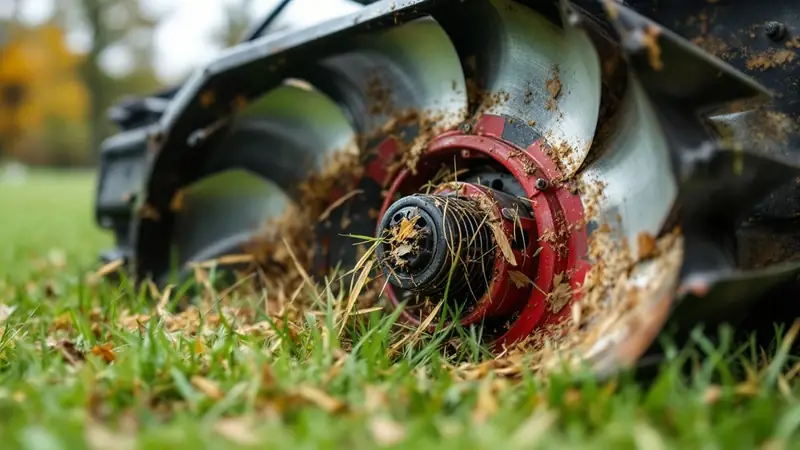
A walk-behind power rake (dethatcher) rents for $65 to $105 a day at the eight stores below, or $48 to $74 for four hours. All eight post their rates online.
| Rental store (location) | Machine | 4 hours | Day | Week |
|---|---|---|---|---|
| Curtis Rental Group (DeKalb, Ill.) | 18 in. walk-behind, gas | $48 | $70 | $280 |
| 903 Landscape Supply (Jim Thorpe, Pa.) | 18 in. gas power rake | n/a | $65 | $195 |
| A-1 Rental (Ann Arbor, Mich.) | Bluebird power rake | $63 | $100 | $252 |
| Taylor True Value Rental (Holland, Mich.) | Dethatcher / power rake | $65 | $100 | $400 |
| Taylor’s ACE (Marshfield, Mass.) | 5.5 hp power rake | $70 | $90 (8 hours) | n/a |
| AAA Equipment Center (Pequot Lakes, Minn.) | Walk-behind power rake | $70 | $105 | $420 |
| Noonan Equipment and Event Rental (Springfield, Ill.) | 20 in. power rake, 160 lb | $74 | $98 (24 hours) | n/a |
| Dahl’s Equipment Rentals (San Jose, Calif.) | 20 in. power rake, 160 lb | n/a | $105 | $325 |
Can you rent a lawn dethatcher? Yes: general rental stores and some hardware stores carry them, usually listed as a “power rake.” Plan the logistics before you book. A 20-inch machine weighs about 160 lb (Noonan, Dahl’s), so you need a pickup or trailer and a second person to load it. Dahl’s lists a rated output of 13,000 sq ft per hour, but that is machine speed with no raking. For a typical suburban lawn, a four-hour block covers the machine work; the raking and bagging take longer.
DIY vs. hiring a pro: the math
DIY cost = rental + bags or disposal fees. Worked example for 5,000 sq ft: a four-hour rental of $48 to $74, plus 13 to 26 yard-waste bags (see the disposal section) at $0.80 to $3.68 per sticker, comes to about $58 to $170 before your time and the bags themselves.
| Lawn size | Rental | Disposal (stickers) | DIY total | Pro, posted median |
|---|---|---|---|---|
| 3,000 sq ft | $48–$74 (4 hours) | $6–$57 | $54–$131 | $175 |
| 5,000 sq ft | $48–$74 (4 hours) | $10–$96 | $58–$170 | $175 |
| 10,000 sq ft | $65–$105 (day) | $21–$191 | $86–$296 | $304 |
| 20,000 sq ft | $65–$105 (day) | $42–$383 | $107–$488 | $1,440 |
For a small lawn, DIY saves little once you count the bags and an afternoon of raking; a flat-rate company at $145 to $175 is close to break-even. DIY pays off on large lawns where the local companies price per 1,000 sq ft: at 20,000 sq ft, the posted median is $1,440. The trade-off is risk. Penn State warns that removing more thatch than you intended “can severely thin the stand,” and suggests setting the blades high for the first pass (Penn State Extension).
Skip the cheap shortcuts. Purdue advises avoiding machines with flexible rake-type tines and dethatching attachments that bolt to a rotary mower blade, and prefers machines that cut with knives or blades (Purdue AY-8).
Cleanup and disposal: what the thatch costs to get rid of
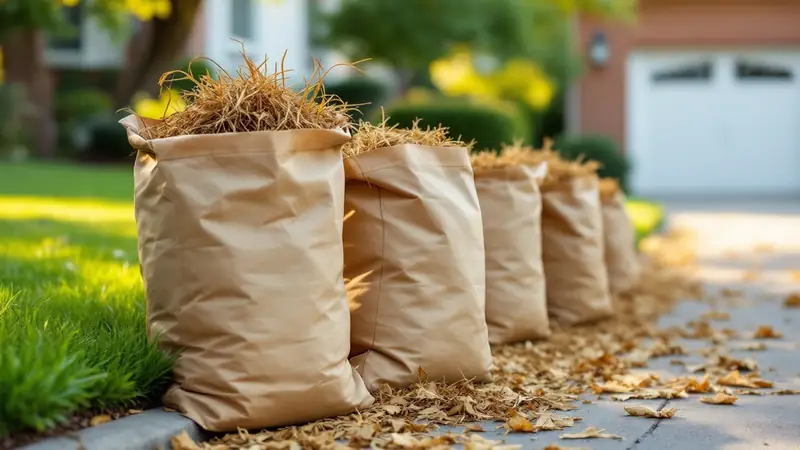
Dethatching produces a lot of debris. Purdue says several passes “will produce large quantities of refuse,” Kansas State calls it “an incredible amount of material,” and Florida’s extension service notes that thatch removed from an average lawn “may fill several pickup trucks” (Purdue; K-State; UF/IFAS Extension).
Debris volume (cu ft) = lawn sq ft × inches of material removed ÷ 12. Worked example: 5,000 sq ft × 1/8 inch ÷ 12 = 52 cu ft, or 1.9 cubic yards, or 13 thirty-gallon bags (4.0 cu ft each). At 1/4 inch it doubles to 104 cu ft, 3.9 cubic yards and 26 bags. These are planning numbers built on our assumption about depth; loose thatch fluffs up, so expect more bags, not fewer.
| Place | What you pay | Price |
|---|---|---|
| Midland, Mich. | Sticker per 30-gallon kraft bag (bag bought separately) | $0.80 |
| Grand Rapids, Mich. | City yard waste paper bag, collection included | $2.75 each, or 5 for $13.75 |
| Waukegan, Ill. | Sticker per bag | $3.04 |
| Mundelein, Ill. | Yard waste sticker (2026–27 rates) | $3.23 |
| Glen Ellyn, Ill. | Sticker per container | $3.52 |
| Westmont, Ill. | Yard waste sticker (2026) | $3.68 |
| Davenport, Iowa compost facility | Grass drop-off, residential | $0.50 per bag; $6.00 per cubic yard |
| Missouri Organic Recycling (Kansas City) | Drop-off, lawn and leaf bags or lawn debris by truck | $2.00 per bag; $7.00 per cubic yard |
Hauling it yourself is usually cheaper than stickers. At the Davenport and Kansas City drop-off rates, the 1.9 to 3.9 cubic yards from a 5,000 sq ft lawn cost $12 to $27, against $10 to $96 in stickers. Composting costs nothing; Oklahoma State suggests composting thatch rather than bagging it for the landfill, and Colorado State says to compost it before using it as mulch, so any live grass in it dies first (OSU Extension; CSU Extension). If you are also paying for fall leaf cleanup, our leaf removal cost guide covers the haul-away side of yard debris.
Does your lawn need dethatching? How to measure thatch
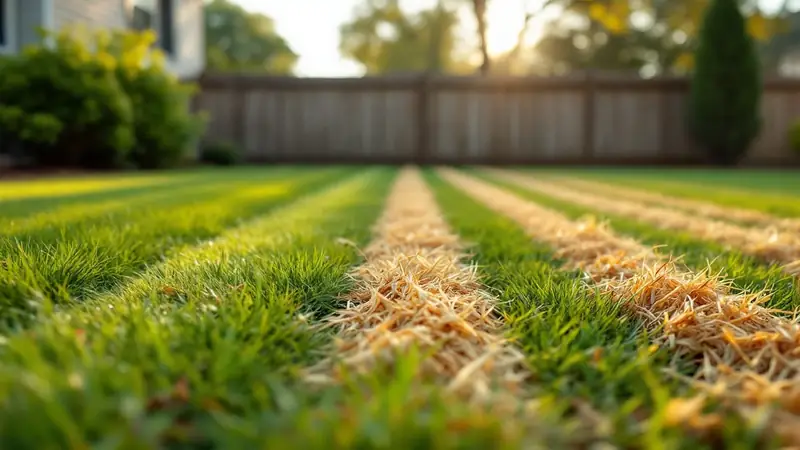
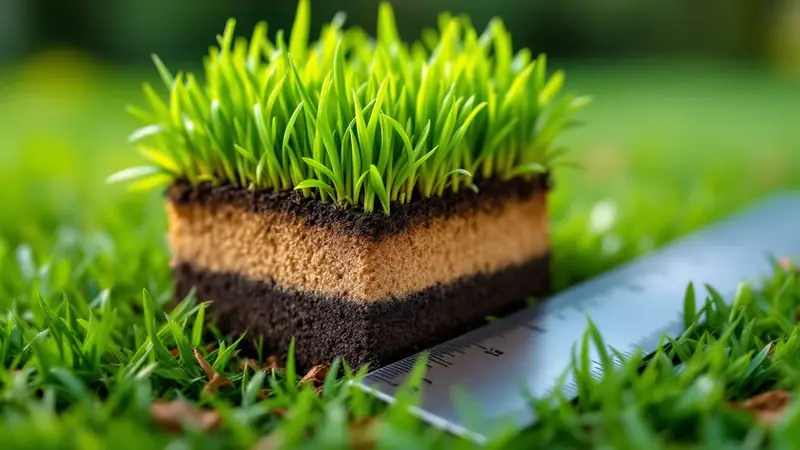
A lawn that needs dethatching feels spongy or bouncy underfoot, and a cut plug shows a brown, felt-like layer more than 1/2 inch thick between the green grass and the soil. To check, cut out a small square about 3 inches deep and measure that brown layer (UC IPM). Check several spots; thatch is rarely even.
If that square shows C-shaped white larvae instead of a felt-like layer, the spongy feel may be grubs; our grubs in lawn guide gives the per-species thresholds for treating.
Other signs: water runs off instead of soaking in (CSU), the mower scalps because the wheels sink into the thatch, and grass crowns sit above the soil (Penn State; LSU AgCenter). Oklahoma State adds that bluegrass lawns with heavy thatch can look healthy in spring and then die in large patches during summer heat and drought (OSU).
| Thatch depth | What extension services advise |
|---|---|
| Up to 1/2 inch | Healthy. A thin layer insulates roots and cushions traffic (Penn State, Utah State). Core-aerate instead of power raking (K-State). |
| More than 1/3 inch (cool-season) or 1/2 inch (warm-season) | Oklahoma’s stricter limits: fescue, bluegrass and ryegrass above 1/3 inch; bermudagrass, zoysiagrass and buffalograss above 1/2 inch (OSU). |
| More than 1/2 inch | Dethatch (UC IPM; Clemson HGIC). Several passes in different directions, and reseeding may be needed (Purdue). |
| 1 inch or more | “Turf problems will likely result” (Penn State). Florida’s threshold for removal (UF/IFAS). Purdue: most easily removed with a sod cutter, then the lawn is re-established. |
| 2 inches or more | Almost impossible to reduce without severely thinning the turf; plan to seed (Penn State). |
Past an inch, compare the dethatching quote with starting over. Purdue’s advice for thatch thicker than 1 inch is to strip it with a sod cutter and re-establish the lawn; our sod installation cost guide prices that route.
When to dethatch your lawn, by grass type and region
Dethatch when your grass is growing fast enough to recover: late summer to early fall for cool-season lawns (Kentucky bluegrass, fine fescue), and late spring to early summer, after green-up, for warm-season lawns (bermudagrass, zoysiagrass, St. Augustinegrass). The grass needs three to four weeks of active growth afterward to recover (LSU AgCenter). Many lawn companies call the job “thatching” (Tri-Cities and Evergreen both do), so when to thatch a lawn and when to dethatch it are the same question.
| Grass | Thatch tendency | Best window | Source |
|---|---|---|---|
| Kentucky bluegrass | High; may need it yearly | September (or April) in Indiana, never summer; late August to early fall elsewhere | Purdue, Penn State, K-State |
| Creeping red (fine) fescue, creeping bentgrass | High | Late summer to early fall | Penn State, UC IPM |
| Tall fescue, perennial ryegrass | Low; rarely a problem | Every few years at most, if a measurement says so | Purdue, UC IPM, Clemson |
| Bermudagrass (hybrid) | High | Spring after green-up to early summer (S.C.); February to March before green-up (Okla.) | Clemson, OSU |
| Zoysiagrass | High (slow to break down) | Summer, when actively growing | Purdue, Clemson |
| St. Augustinegrass | Puffy, spongy thatch is most common in St. Augustine and zoysia | Late spring or early summer; April to July north of Orlando | LSU, UF/IFAS |
| Centipedegrass, buffalograss | Rarely thick | Use moderation if you must | OSU |
When should you dethatch your lawn: spring or fall?
For cool-season lawns, fall wins. Penn State notes that weeds are less likely to move in after late-summer or fall dethatching than after spring dethatching, and the cooler weather reduces the chance of injury (Penn State). UC IPM allows mid-to-late spring or early fall but warns against dethatching while weeds are germinating (UC IPM). The one spring exception is a light pass to lift wet, matted grass; Colorado State says that can speed spring green-up (CSU). That light spring pass is what many Colorado and Minnesota companies sell alongside spring cleanups, as Doehling and Suburban Outdoor do.
How late is too late to dethatch a lawn?
Count back from when your grass stops growing. With three to four weeks needed for recovery (LSU), a cool-season lawn in the northern states is best done in September, the month Purdue and Kansas State name (Purdue; K-State). Oklahoma State extends the cool-season window through mid-October there (OSU). Warm-season lawns are done by midsummer; dethatching them in fall leaves open turf going into dormancy.
For how dethatching fits around fertilizer and preemergent dates, see the lawn care schedule for cool- and warm-season grass.
When not to dethatch your lawn
- When the turf is weak or under heat or drought stress (Penn State).
- When the soil is saturated (more turf damage) or bone-dry (blades can’t penetrate) (LSU).
- Right after a pre-emergent herbicide. Apply it after dethatching, or it binds to the thatch and works less well (UC IPM).
- On Kentucky bluegrass in summer (Purdue).
How often should you dethatch your lawn?
Only as often as a measurement says. Bermudagrass, bentgrass and Kentucky bluegrass can build thatch fast enough to need it yearly; tall fescue and perennial ryegrass may not need it for several years (UC IPM). Overwatering, heavy nitrogen and clay soils speed the buildup. Some companies recommend it every year: Tri-Cities lists thatching as “recommended once per year.” A yearly plan makes sense only if each year’s plug shows more than 1/2 inch.
Dethatching vs. core aeration: which one to pay for
For most lawns with thatch at or below 1/2 inch, core aeration is the better buy. Kansas State recommends core aeration rather than power raking at that depth (K-State). One aeration with 1/2-inch tines spaced about 2 inches apart removes about 10 percent of the thatch, and it relieves compaction, which is one cause of thatch buildup (CSU). The catch: Purdue notes that annual aeration may take several years to bring thick thatch below 1/2 inch (Purdue).
Our guide on when to aerate your lawn lists the month windows by grass type and region and the latest safe date for each.
Aeration is also cheaper. At the eight companies that post both prices, dethatching a 5,000 sq ft lawn costs a median of about twice as much as core aeration.
| Company | Core aeration, 5,000 sq ft | Dethatching, 5,000 sq ft | Ratio |
|---|---|---|---|
| Steiner (Utah) | $55 | $55 | 1.0× |
| Doehling (Minn.): aeration, dethatching | $130 | $175 | 1.3× |
| Steve’s Cutting Edge (N.Y.): aeration, dethatching | $85 | $160 | 1.9× |
| Tri-Cities (Wash.) | $89 | $169 | 1.9× |
| J Hansen (Colo.) | $75 | $150 | 2.0× |
| Stellar (Ill.) | $99 | $199 | 2.0× |
| Evergreen (Wash.) | $125 | $390 | 3.1× |
| Harbor Design (Wash.) | $165 | $540 | 3.3× |
If your lawn really does have more than 1/2 inch of thatch, the order matters: Oklahoma State says any other lawn work (topdressing, seeding, fertilizer) should come after dethatching or aeration, and can be done the same day (OSU). Our lawn aeration cost guide has posted aeration prices for every lawn size.
Is a power rake and a dethatcher the same thing?
Mostly, yes. Rental stores and lawn companies use “power rake” and “dethatcher” for the same walk-behind machine. The real distinction is with a vertical mower (verticutter): a vertical mower’s blades are fixed to the shaft, while a power rake’s blades are hinged so they give when they hit a rock (Utah State). Penn State adds that power rakes with wire tines suit smaller jobs, while vertical mowers have more power and durability for heavy thatch (Penn State). A dethatching blade or spring-tine attachment for a rotary mower is a different, weaker tool (Purdue).
How many times should you go over your lawn with a dethatcher?
Start with one pass with the blades set high, check how much thatch came up and how thin the grass looks, then decide on a second pass (Penn State). With 1/2 inch of thatch or more, plan on several passes in different directions (Purdue). With severe thatch, Oklahoma State suggests moderate treatments over two or three years rather than removing it all at once (OSU).
After dethatching: overseeding, fertilizer and recovery costs
Dethatching leaves the lawn looking ragged; Purdue warns it can look that way “for some time” and that reseeding may be necessary after removing 1/2 inch or more (Purdue). LSU says to fertilize, irrigate and mow to push recovery (LSU). Fall dethatching on a cool-season lawn lines up with the best seeding window, which is why companies bundle the two.
| Add-on | Posted price | Per 1,000 sq ft |
|---|---|---|
| Overseeding, tall fescue or Kentucky bluegrass | $49 or $79 up to 5,000 sq ft (Stellar) | $10–$16 |
| Overseeding with aeration | $285 up to 12,000 sq ft (Steve’s Cutting Edge) | About $24 |
| Overseeding | $50 base plus $30 per 1,000 sq ft (Earth First) | $30 plus the base |
| Starter fertilizer | $99 up to 5,000 sq ft (Stellar); $75 per application up to 2,000 sq ft (Harbor Design) | n/a |
| Package: thatching, aeration, overseeding and starter fertilizer | $380 up to 2,000 sq ft plus $140 per 1,000 (Evergreen) | $140 over the base |
Seed bought on its own costs less than the service; a separate guide in this series prices grass seed by the bag and by the square foot. If you use a pre-emergent herbicide, read its label for how long to wait before seeding.
We tabulated the reseeding wait printed on each common label in our crabgrass guide.
Sales tax on dethatching in some states
Some states tax lawn services, and several name dethatching or power raking specifically. Where they do, add the state and local rate to any pre-tax price in this guide.
| State | Rule | Source |
|---|---|---|
| Minnesota | Lawn services are taxable; the examples list dethatching and “raking, including power raking.” Not taxable when part of an initial landscaping project. | Minnesota Department of Revenue |
| Pennsylvania | Lawn care services are taxable and “include but are not limited to … dethatching.” | Pa. Department of Revenue, REV-717 |
| South Dakota | Lawn services, including “raking, including power raking,” are taxable at the 4.2% state rate plus municipal tax. | S.D. Department of Revenue |
| Iowa | Landscaping and lawn care services are subject to sales tax. | Iowa Department of Revenue |
Rules differ by state, and some exempt lawn services entirely. Check your own state’s revenue department, and ask whether a quote is before or after tax.
For lawn care operators: what to charge for dethatching
If you sell dethatching, the posted prices above are your market. Here is a rough cost floor for a two-pass job on a 5,000 sq ft lawn with raking and disposal, built from public data and assumptions we state.
| Line item | Assumption | Cost |
|---|---|---|
| Machine time | Two passes (10,000 sq ft) at half the 13,000 sq ft/hr rated speed (our field-efficiency assumption) | 1.5 hr |
| Raking, bagging, loading | Our assumption | 1.0–2.0 hr |
| Setup and drive | Our assumption | 0.5 hr |
| Loaded labor | 3.0–4.0 hr × $18.82 median wage ÷ 0.70 (wages as share of compensation) | $81–$108 |
| Equipment | $65–$105 rental day rate as a ceiling on owning cost, ÷ 3 jobs a day | $22–$35 |
| Disposal | 1.9–3.9 cu yd at $6–$7 per cu yd drop-off | $12–$27 |
| Truck, fuel, insurance, overhead and profit | Equal to loaded labor (the ×2 multiplier we use across our cost guides) | $81–$108 |
| Cost floor per job | $195–$277 |
That floor of $195 to $277 sits above all but the highest flat-rate price in the sample ($55 to $199) and below every per-1,000 sq ft price ($375 to $550). The flat-rate companies make the numbers work by cutting the slow part: Steiner leaves the thatch on the lawn, J Hansen leaves the bags, Tri-Cities can use the customer’s yard-waste bin, and Steve’s Cutting Edge collects the thatch with a mower and charges from $68 to haul it. If you rake and haul by hand, price like the per-1,000 sq ft companies, or sell dethatching only with a spring cleanup on the same visit. The guide to bidding landscaping jobs walks through building a price from labor and overhead, and our landscaper salary data has state and metro wages if yours differ from the national median.
For other yard services and how they add up over a season, see our landscaping cost guide and the full list of cost guides.
Dethatching questions, answered
How much do people charge to dethatch a lawn?
Lawn companies that post prices charge a median of $175 for a 5,000 sq ft lawn and $304 for 10,000 sq ft. Flat-rate route companies charge $145 to $199 for most suburban lawns; companies that price every 1,000 sq ft and rake up the debris charge $375 to $550 at 5,000 sq ft.
Is $400 a reasonable price to dethatch 1,000 sq ft?
No. The highest posted price for a lawn up to 2,000 sq ft is $360 (Harbor Design in Seattle), and the median is $172. For a patch that small, you are paying a minimum charge; a four-hour power rake rental at $48 to $74 is the cheaper route.
Is it worth it to dethatch your lawn?
Only if a cut plug shows more than 1/2 inch of thatch. Below that, core aeration costs about half as much at the same company and also reduces thatch. Florida’s extension service says homeowners are sometimes convinced to buy dethatching and “may spend unnecessary money on unneeded practices” (UF/IFAS Extension).
What lawns need dethatching?
Lawns of spreading grasses that build thatch: Kentucky bluegrass, creeping red fescue, creeping bentgrass, hybrid bermudagrass, zoysiagrass and St. Augustinegrass, especially when overwatered, heavily fertilized or growing on clay or acid soil. Tall fescue and perennial ryegrass lawns rarely need it.
Why tall fescue builds so little thatch, and the fall feeding and mowing program it needs instead, is in our tall fescue lawn guide.
Zoysia builds thatch fastest when overfed with nitrogen; the annual rates by state are in our zoysia grass lawn guide.
What month should I dethatch my lawn?
September for cool-season lawns such as Kentucky bluegrass in most northern states (late September to mid-October in Oklahoma). For warm-season lawns such as bermudagrass, zoysiagrass and St. Augustinegrass, late spring to early summer after full green-up; April to July in north Florida. Oklahoma State is the exception, advising February to March, before green-up.
Can you dethatch your lawn anytime?
No. Dethatch only when the grass is actively growing and has three to four weeks to recover, and never during heat, drought, dormancy or when the soil is waterlogged.
What are common dethatching mistakes?
Dethatching a tall fescue lawn that doesn’t need it; setting the blades too deep on the first pass; dethatching cool-season grass in spring just as crabgrass germinates; applying pre-emergent herbicide before dethatching instead of after; skipping overseeding after removing heavy thatch; and running over unmarked sprinkler heads or invisible fence wire.
Our guide on overseeding a lawn after dethatching covers the seed rates and watering that follow a power-raking pass.
How much does TruGreen dethatching cost?
We found no published TruGreen dethatching price. TruGreen’s own article on aeration versus dethatching describes aeration as the service TruGreen offers, so ask a local TruGreen office in writing whether it dethatches at all, and compare any quote with the posted prices in this guide.
How we built these numbers
Professional prices. We searched for U.S. lawn companies that post a dethatching or power-raking price with a lawn size on their own websites and kept the 12 that were current in October 2026. We left out cost-guide sites, lead-generation marketplaces, social media posts, two companies that post a starting price with no lawn size, and one Texas company whose site could not be loaded securely. For each company we applied its own formula at each lawn size, rounding partial 1,000 sq ft blocks up; Stellar’s larger-lawn discounts come from the calculator on its home page. Where a company quotes a size on request, it is left out of that size’s statistics. Highlands Ranch Aeration appears at its standard tier (single pass, hand-raked). The middle half is the 25th to 75th percentile (inclusive method). All pages were checked Oct. 18, 2026. The sample skews toward small, route-based operators in the bluegrass states; national brands that quote by address are not in it.
Calculator. We fitted a $100 base charge plus $10 to $65 per 1,000 sq ft to the 25th and 75th percentiles at 5,000 and 10,000 sq ft. It gives $150 to $425 at 5,000 sq ft and $200 to $750 at 10,000, within about $50 of the published middle half at both sizes. At 20,000 sq ft it gives $300 to $1,400 against a published middle half of $513 to $1,470, so the low end runs light for large lawns, where the cheapest flat-rate companies stop posting prices. The double-pass factor (1.1) comes from Highlands Ranch Aeration’s single- and double-pass prices. The DIY rate of $2 to $19 per 1,000 sq ft is disposal only: 1/8 to 1/4 inch of material (our assumption) in 30-gallon bags at $0.80 to $3.68 per sticker. The overseeding add-on ($10 to $30 per 1,000 sq ft) and the starter fertilizer and haul-away add-ons come from the posted prices in this guide.
Rental, disposal and operator costs. Rental rates are the stores’ posted rates before tax and damage waiver. Disposal fees are the published 2026 rates of the cities and facilities named. The operator build-up uses the BLS national median wage, the BLS share of wages in total compensation and the time and overhead assumptions labeled in the table. CPI comparisons use not-seasonally-adjusted index values for September 2019 and August 2026, the latest month published.
This page is general information, not professional, tax or legal advice. Prices and tax rules change; confirm current rates with the companies, rental stores and agencies linked here. Follow the label on any fertilizer or herbicide you apply after dethatching.
Sources
- Evergreen Lawn Aeration & Thatching, Services & Pricing, Checked Oct. 18, 2026. Accessed October 2026.
- Harbor Design, Lawn Care Program (pricing), Checked Oct. 18, 2026. Accessed October 2026.
- LawnTuneUps.com, Seattle Lawn Dethatching & Power Raking, Checked Oct. 18, 2026. Accessed October 2026.
- Lawn Aerating & Thatching Tri-Cities, Pricing, Checked Oct. 18, 2026. Accessed October 2026.
- Steiner Aerating & Power Raking, Pricing & Preparations, Checked Oct. 18, 2026. Accessed October 2026.
- Highlands Ranch Aeration, Power Raking and Lawn Repair, Checked Oct. 18, 2026. Accessed October 2026.
- J Hansen Lawn Service, Services, Checked Oct. 18, 2026. Accessed October 2026.
- Grass is Greener, Lawn Dethatching in Parker, CO, Checked Oct. 18, 2026. Accessed October 2026.
- Doehling Landscape, Spring & Fall Clean-ups / Dethatching, Checked Oct. 18, 2026. Accessed October 2026.
- Doehling Landscape, Lawn Aeration, Checked Oct. 18, 2026. Accessed October 2026.
- Suburban Outdoor Services, Dethatching Service, Checked Oct. 18, 2026. Accessed October 2026.
- Stellar Property Maintenance, Lawn Dethatching, Checked Oct. 18, 2026. Accessed October 2026.
- Stellar Property Maintenance, Home page price list and calculator, Checked Oct. 18, 2026. Accessed October 2026.
- Steve's Cutting Edge Lawn Care, Dethatching, Checked Oct. 18, 2026. Accessed October 2026.
- Steve's Cutting Edge Lawn Care, Core Aeration, Checked Oct. 18, 2026. Accessed October 2026.
- Earth First Lawn Care, Bellingham Aeration (price list), Checked Oct. 18, 2026. Accessed October 2026.
- Lawn Pros, Power Raking, Colorado Springs, Checked Oct. 18, 2026. Accessed October 2026.
- The Curtis Rental Group (rentmidwestequip.com), Lawn & Garden Equipment Rentals, Checked Oct. 18, 2026. Accessed October 2026.
- 903 Landscape Supply, Gas Power Rake & Lawn Dethatcher rental, Checked Oct. 18, 2026. Accessed October 2026.
- A-1 Rental, Lawn & Garden Equipment Rentals, Checked Oct. 18, 2026. Accessed October 2026.
- Taylor True Value Rental, Dethatcher – Power Rake, Checked Oct. 18, 2026. Accessed October 2026.
- Taylor's ACE, Lawn and Garden Rentals, Checked Oct. 18, 2026. Accessed October 2026.
- AAA Equipment Center, Power Rake (Lawn Dethatcher) Rental, Checked Oct. 18, 2026. Accessed October 2026.
- Noonan Equipment and Event Rental, Billy Goat 20" Power Rake, Dethatcher, Checked Oct. 18, 2026. Accessed October 2026.
- Dahl's Equipment Rentals, Lawn dethatcher power rake, Checked Oct. 18, 2026. Accessed October 2026.
- City of Midland, Mich., Weekly Yard Waste Collection, Checked Oct. 18, 2026. Accessed October 2026.
- City of Grand Rapids, Mich., Yard Waste Services, Checked Oct. 18, 2026. Accessed October 2026.
- City of Waukegan, Ill., Yard Waste Collection, Checked Oct. 18, 2026. Accessed October 2026.
- Village of Mundelein, Ill., Garbage & Recycling (2026-2027 rates), Checked Oct. 18, 2026. Accessed October 2026.
- Village of Glen Ellyn, Ill., Yard Waste, Checked Oct. 18, 2026. Accessed October 2026.
- Village of Westmont, Ill., Yard Waste & Trash/Bulk Stickers Update (2026), Checked Oct. 18, 2026. Accessed October 2026.
- City of Davenport, Iowa, Compost Facility, Checked Oct. 18, 2026. Accessed October 2026.
- Missouri Organic Recycling, Kansas City Yard Waste Drop Off, Checked Oct. 18, 2026. Accessed October 2026.
- UC Statewide IPM Program, UC Guide to Healthy Lawns: Dethatching, when to dethatch, 2017. Accessed October 2026.
- Purdue Extension, AY-8: Mowing, Dethatching, Aerifying and Rolling Turf, Current edition. Accessed October 2026.
- Penn State Extension, Managing Thatch in Lawns, Current edition. Accessed October 2026.
- Oklahoma State University Extension, Thatch Management in Lawns, Current edition. Accessed October 2026.
- Kansas State University, Power Raking or Core Aeration? That is the question!, August 2015. Accessed October 2026.
- Colorado State University Extension, Lawn Care Basics, Reviewed August 2025. Accessed October 2026.
- Utah State University Extension, Turfgrass Cultivation (Aerification), Current edition. Accessed October 2026.
- LSU AgCenter, Thatch Management, Current edition. Accessed October 2026.
- UF/IFAS Extension Nassau County, Q: I was told my yard needed to be de-thatched…, July 2017. Accessed October 2026.
- Clemson Cooperative Extension HGIC, Controlling Thatch in Lawns, Reviewed Aug. 2018. Accessed October 2026.
- Minnesota Department of Revenue, Landscape Maintenance Services, Updated Feb. 3, 2026. Accessed October 2026.
- Pennsylvania Department of Revenue, REV-717, Retailer's Information, Current edition. Accessed October 2026.
- South Dakota Department of Revenue, Landscaping and Lawn Care (tax facts), June 2024. Accessed October 2026.
- Iowa Department of Revenue, Landscaping, Lawn Care, Snow Removal & Tree Services, Current. Accessed October 2026.
- U.S. Bureau of Labor Statistics, Occupational Employment and Wage Statistics, 37-3011, May 2025. Accessed October 2026.
- U.S. Bureau of Labor Statistics, Employer Costs for Employee Compensation, June 2026. Accessed October 2026.
- U.S. Bureau of Labor Statistics, CPI-U, Gardening and lawncare services (CUUR0000SEHP02), Sept. 2019 to Aug. 2026. Accessed October 2026.
- TruGreen, Aeration vs. Dethatching, Accessed Oct. 2026. Accessed October 2026.