How to overseed a lawn: mow to 1 to 1.5 inches, open the soil with a slit seeder or core aerator, sow half the new-lawn seed rate in two directions, and keep the top inch moist until seedlings are mowed.
Key takeaways
- Cool-season lawns overseed best from Aug. 15 to Sept. 15 in northern Indiana and Illinois, and a one-week delay can add 2 to 4 weeks before the stand matures (Purdue AY-3).
- Overseed at about half the new-lawn rate: 3 to 4 lb of tall fescue or 1 to 1.5 lb of Kentucky bluegrass per 1,000 sq ft (Kansas State).
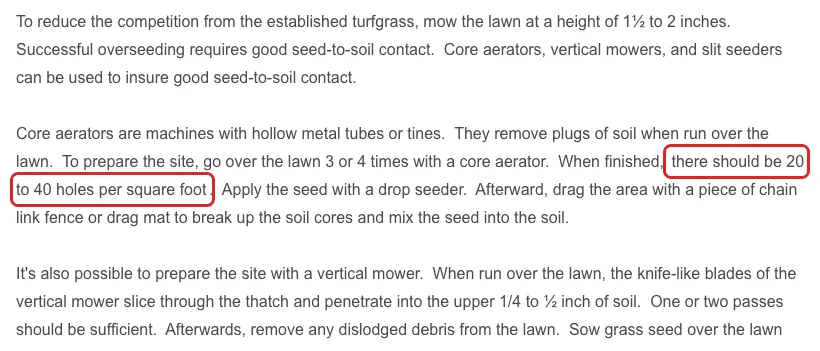
- Seed needs soil, not thatch: aim for 20 to 40 core holes per square foot, which takes 3 or 4 aerator passes (Iowa State), or use a slit seeder that cuts the seed in.
- Overseed only when at least half the lawn is still desirable grass and thatch is no deeper than 1/2 inch; below that, Penn State Extension says kill the old turf and reseed (Penn State).
- Water 2 to 4 times a day so the top 0.5 to 1 inch never dries, then cut back once seedlings reach 2 inches (Purdue AY-3).
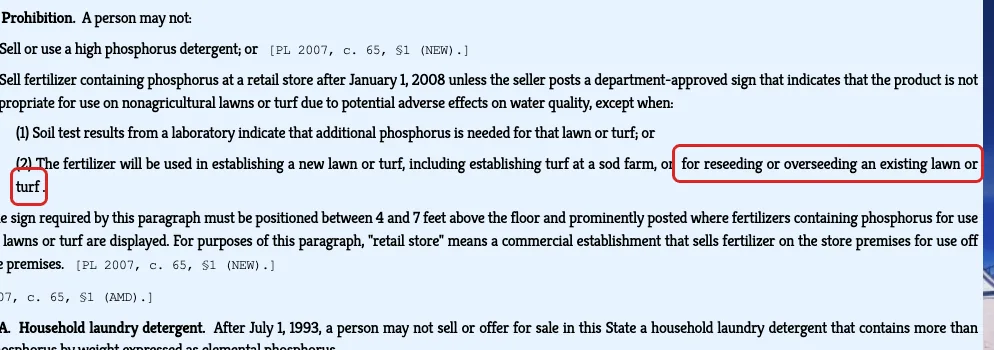
- Several states restrict phosphorus on lawns but allow it for seeding; Maine names overseeding outright (38 M.R.S. §419), while Minnesota’s exemption covers only first establishing turf, so a soil test is the safer route there (Minn. Stat. §18C.60).
1 to 1.5 in mowing height before you overseed (Purdue AY-20; Kansas State)
20 to 40 seed holes per sq ft from core aeration (Iowa State; Purdue AY-20)
3 to 4 lb tall fescue per 1,000 sq ft when overseeding (Kansas State)
$225 to $435 typical posted price to aerate and overseed 5,000 sq ft (10 companies’ posted packages, Oct. 2026)
Should you overseed, or does the lawn need renovating?
Overseed when the lawn is thin but at least half of it is still the grass you want, with thatch no deeper than 1/2 inch. That is Penn State Extension’s cutoff for its overseeding program (Penn State, Renovation of Lawns). If less than half is desirable grass, or quackgrass, bentgrass or nimblewill runs through it, spot seeding will not fix it: kill the old turf with glyphosate and reseed at the full rate.
Extension services draw that line in slightly different places, so check which one matches your region. Rutgers keeps the old lawn when more than 30 percent of it is desirable grass (Rutgers FS108), UConn wants a 60 percent stand before slice seeding (UConn), and Utah State says overseed if no more than 50 percent of the area is dead (Utah State).
| Extension service | Overseed (keep the lawn) when | Start over when | Source |
|---|---|---|---|
| Penn State Extension | 50% or more desirable grass, no perennial grass weeds, thatch 1/2 in or less | Under 50% desirable, or bentgrass, nimblewill or quackgrass present: glyphosate, then seed | Renovation of Lawns |
| Rutgers NJAES | More than 30% desirable lawn grasses | Under 30% desirable; strip the dead mat if thatch exceeds 1 in | FS108 |
| UConn | At least a 60% stand of acceptable turf (slice seeder) | Lawn “hopelessly beyond repair”: kill, till and reseed | Lawn Renovation and Repair |
| Utah State | No more than 50% of the area dead | All or most of the grass in an area dead | Renovate Your Lawn |
| Kansas State | Thatch 1/4 in or less (power rake first if 1/4 to 3/4 in) | Thatch 3/4 in or more: remove with a sod cutter and start over | Fall Turfgrass Tips |
Fix the cause first. Penn State lists shade, compaction, poor drainage, acid soil, thatch and a poorly adapted grass as the usual reasons a lawn thins, and new seed fails for the same reasons the old grass did. If the cost of starting over is the question, our sod vs seed comparison prices both routes per 1,000 sq ft.
Start from how much good grass is left and how thick the thatch is, then check grass type and recent herbicide use. Each row below gives the threshold, the action and the extension source behind it; the flowchart under the table runs the same logic as yes or no questions. Rows near a threshold, such as 30 to 50 percent desirable grass, are judgment calls.
| If your situation is | Do this | Why (source) |
|---|---|---|
| At least 50% desirable grass, thatch 1/4 in or less | Overseed at half the new-lawn rate | Penn State Program I; Kansas State rates |
| 30% to 50% desirable grass | Control weeds, aerate hard (8 to 10 passes) and seed toward the full new-lawn rate | Rutgers keeps lawns above 30%; Penn State starts over below 50% |
| Under 30% desirable, or quackgrass, bentgrass or nimblewill throughout | Kill with glyphosate, then seed at the full rate or lay sod | Rutgers FS108; Penn State Program II |
| Thatch 1/4 to 3/4 in | Power rake, then overseed | Kansas State |
| Thatch 3/4 in or more | Remove with a sod cutter and start over | Kansas State |
| Broadleaf herbicide in the last 2 to 6 weeks | Wait out the label interval before seeding | Rutgers, Missouri, Penn State, Utah State |
| Spring seeding with crabgrass pressure | Use only siduron or mesotrione at seeding | Purdue AY-20; UConn |
| You cannot water 2 to 4 times a day | Core aerate rather than slit seed, or dormant seed in winter | Kansas State; Purdue AY-20 |
| Bermudagrass lawn, want green in winter | Perennial ryegrass at 5 to 10 lb when 4 in soil nears 75°F | UGA; Clemson HGIC 1206 |
| Centipedegrass, St. Augustinegrass or zoysiagrass | Do not overseed with ryegrass | Clemson HGIC 1206; UGA |
1Is less than half the lawn desirable grass, or do quackgrass, bentgrass or nimblewill run through it?
YesRenovate: kill the old turf with glyphosate, then seed at the full new-lawn rate or lay sod.
NoGo to the next question
2Is the thatch layer 3/4 inch or thicker?
YesRemove it with a sod cutter and start over.
NoGo to the next question
3Is the thatch between 1/4 and 3/4 inch?
YesPower rake first, then overseed at half the new-lawn rate.
NoGo to the next question
4Is it centipedegrass, St. Augustinegrass or zoysiagrass and you want winter color?
YesDo not overseed it with ryegrass; Clemson and UGA say it harms these grasses.
NoGo to the next question
5Did you apply a broadleaf herbicide in the last 2 to 6 weeks?
YesWait out the label's reseeding interval, then overseed.
NoOverseed now: mow to 1 to 1.5 inches, open the soil, sow half the new-lawn rate in two directions and water 2 to 4 times a day.
Source: Penn State Extension, Rutgers FS108, Kansas State, Clemson HGIC 1206, UGA
When is the best time to overseed a lawn?
For cool-season grasses (tall fescue, Kentucky bluegrass, perennial ryegrass, fine fescues), late summer is best: Aug. 15 to Sept. 15 in northern Indiana and Illinois and Sept. 1 to 30 in the southern halves of both states (Purdue AY-3). Spring is second best and fights crabgrass. Warm-season bermudagrass and zoysiagrass are seeded from April to July in North Carolina (NC State Table 9-4).
Timing is a soil temperature question more than a calendar one. UConn says germination slows once soil cools below 50°F and sets its latest Connecticut seeding date before Oct. 4 (UConn); Purdue starts spring watering for germination once soil passes 55°F (Purdue AY-20). Seed sown into cold soil sits; seed sown in July heat dies of drought.
| Grass and region | Overseeding window | Trigger to check | Source |
|---|---|---|---|
| Cool-season, northern Indiana and Illinois | Aug. 15 to Sept. 15 | One week late can add 2 to 4 weeks to maturity | Purdue AY-3 |
| Cool-season, southern Indiana and Illinois | Sept. 1 to Sept. 30 | Same | Purdue AY-3 |
| Cool-season, Connecticut | Aug. 15 to mid-September; latest before Oct. 4 | Germination slows below 50°F soil | UConn |
| Tall fescue, North Carolina mountains | Aug. 15 to Sept. 1 | Seeding after the window raises failure risk | NC State |
| Tall fescue, North Carolina Piedmont and coastal plain | Sept. 1 to Oct. 1 | Same | NC State |
| Cool-season, spring or dormant seeding (Indiana) | Thanksgiving to March (dormant); early April | Water once soil exceeds 55°F | Purdue AY-20 |
| Bermudagrass, zoysiagrass (North Carolina) | April to July (March for some regions) | Warm-season seed germinates at 68 to 95°F air temperature (UT W160-B) | NC State Table 9-4 |
| Ryegrass into dormant bermudagrass (South Carolina) | About 30 days before first frost | Highs near 70°F, lows above 50°F | Clemson HGIC 1206 |
Our month-by-month lawn care schedule places overseeding next to fertilizing and pre-emergent dates for both grass groups.
What seed should you use, and how much?
Match the grass already in the lawn and sow about half the new-lawn rate. Kansas State puts tall fescue at 3 to 4 lb per 1,000 sq ft for overseeding against 6 to 8 lb for a bare-soil lawn, and Kentucky bluegrass at half of its 2 to 3 lb new-lawn rate (Kansas State).
To add clover while you overseed, the University of Maryland keeps microclover to 3 to 5 percent of the seed weight, as explained in our guide to clover lawn pros and cons.
| Grass | New-lawn rate (lb per 1,000 sq ft) | Overseeding rate (lb per 1,000 sq ft) | Source |
|---|---|---|---|
| Tall fescue, turf-type | 6 to 8 | 3 to 4 | Kansas State; Missouri IPM |
| Kentucky bluegrass | 2 to 3 | 1 to 1.5 | Kansas State |
| Perennial ryegrass | 4 to 5 | 2 to 2.5 (half rate, our arithmetic) | Penn State Table 1 |
| Fine fescues (chewings, red, sheep) | 3 to 5 | 1.5 to 2.5 (half rate, our arithmetic) | UT W160-B |
| Perennial ryegrass into dormant bermudagrass | 10 on bare soil | 5 (Clemson); 5 to 10 (UGA) | Clemson HGIC 1206; UGA |
Pure live seed matters at these low rates. The University of Missouri gives the same 3 to 4 lb tall fescue rate as pure live seed; its example: with germination near 85 percent, 3 to 4 lb of pure live seed means buying about 3.5 to 4.5 lb per 1,000 sq ft, or 28 to 36 lb for an 8,000 sq ft lawn (Missouri IPM). Rates are not unanimous: NC State tells North Carolina homeowners to overseed thin tall fescue at 6 lb per 1,000 sq ft (NC State), the low end of Kansas State’s new-lawn rate.
Use the low end of the range on a lawn that is merely thin and the high end where bare soil shows. Going past the top of the range does not help: Penn State warns that excessively dense stands from high seeding rates bring more disease and mower scalping (Penn State, Lawn Establishment). Species notes for each grass are in our guides to tall fescue and bermudagrass. Profiles of the other lawn grasses and their care calendars are collected in our turf and trees guides.
- Seed to buy (lb)
- 17.5
- Seed per pass, two passes at right angles (lb)
- 8.8
Seed = area × midpoint extension overseeding rate × price per lb (Kansas State, Penn State, UT, Clemson, UGA rates; Oct. 2026 seed prices from our grass seed cost page). Rentals: posted day rates checked Oct. 2026. Pre-tax; excludes fuel, damage waivers and water.
| Worked example: 5,000 sq ft tall fescue lawn | Input | Result |
|---|---|---|
| Lawn area | 5,000 sq ft = 5 units of 1,000 sq ft | 5 |
| Overseeding rate | 3 to 4 lb per 1,000 sq ft (Kansas State) | 15 to 20 lb of seed |
| Seed price | $2.00 a lb (50 lb bag) to $5.70 a lb (10 lb bag), Oct. 2026 | $30 to $114 |
| Two passes at right angles | Half the seed each way (Purdue AY-3) | 7.5 to 10 lb per pass |
| Water to germination | 1/8 to 1/4 in a day = 75 to 150 gal per 1,000 sq ft (UT W160-B) | 375 to 750 gal a day |
How do you overseed a lawn, step by step?
Overseeding is twelve short jobs done in order over about two months, and most failures trace back to step 6: seed that never touches soil. The sequence below follows Purdue’s procedure for seeding into an existing lawn (Purdue AY-20) with the rates and thresholds from the other extension services cited on this page. Each step lists its number, tool or wait time.
- Pick the date. Aim for the start of your window (Aug. 15 in northern Indiana and Illinois); soil should be above 50°F and below summer heat.
- Test the soil 3 to 4 weeks ahead. Penn State says to apply lime by the report, no more than 100 lb per 1,000 sq ft at one time (Penn State).
- Clear weeds early. A 2,4-D, MCPP and dicamba product needs about 4 weeks before seeding (Penn State); skip crabgrass preventers except siduron or mesotrione, which UConn lists as safe at seeding (UConn).
- Mow to 1 to 1.5 inches and bag the clippings (Purdue AY-20; Kansas State). Lower turf lets light reach the seedlings.
- Check thatch. At 1/4 inch or less, go ahead; between 1/4 and 3/4 inch, power rake first (Kansas State). Our dethatching cost guide covers rental and hired prices.
- Open the soil. Run a slit seeder in two directions, or core aerate until there are 20 to 40 holes per sq ft, about 3 to 4 passes (Iowa State), with holes no more than 3 inches apart (Rutgers).
- Spread starter fertilizer. Purdue uses 1.5 lb of P2O5 per 1,000 sq ft when soil test phosphorus is low; Penn State caps starter nitrogen at 0.5 to 1 lb, since more than 1.5 lb can burn seedlings (Penn State). Check your state’s phosphorus law first.
- Sow half the seed one way, half at right angles. Set a drop spreader low and make as many passes as it takes (Purdue AY-3).
- Work the seed in. Drag aeration cores with a section of chain-link fence or a drag mat (Iowa State), then roll lightly with an empty water roller (Purdue AY-3).
- Water 2 to 4 times a day so the top 0.5 to 1 inch stays moist; cut back once seedlings are 2 inches tall (Purdue AY-3).
- Keep mowing the old grass at 1.5 inches until the seedlings have been cut twice, then raise the deck 1/2 inch at a time over 3 weeks to 2.5 to 3.5 inches (Purdue AY-20).
- Feed the new grass. Apply 0.75 to 1 lb of nitrogen per 1,000 sq ft 4 to 6 weeks after germination and again at 8 to 10 weeks (Purdue AY-3).
Slit seeder, core aerator or rake: which tool should you use?
A slit seeder gives the best seed-to-soil contact because it drops seed into a groove it just cut; Kansas State prefers it of the three machine methods (Kansas State). Core aeration needs less watering, since the holes stay moist, and suits compacted soil. A hand rake works for patches.
| Method | What it does | Passes | Best when | Rental, posted (Oct. 2026) | Source |
|---|---|---|---|---|---|
| Slit seeder (power overseeder) | Vertical blades cut grooves 1/8 to 1/2 in deep (Billy Goat OS901SPH) and drop seed into them; the Classen TS-20 seeds a 20 in width | 2, at an angle to each other | Thin lawn, any soil; best seed contact (Kansas State) | $90 to $184 a day (5 stores) | Billy Goat; Classen |
| Core aerator, then spread seed | Pulls soil plugs; seed lands in the holes | 3 to 4 for 20 to 40 holes per sq ft; up to 8 to 10 (Penn State) | Compacted soil; when you cannot water several times a day | $75 to $141 a day (4 of the same stores) | Iowa State |
| Vertical mower or power rake, then seed | Blades cut 1/4 to 1/2 in into soil and lift thatch | 1 or 2, plus one after seeding to work seed in | Thatch 1/4 to 3/4 in | $62 to $119 a day (3 of the same stores) | Iowa State; Kansas State |
| Hand rake and spreader | Scratches the surface so seed touches soil | Rake, seed, rake in | Bare spots and small thin patches | No rental | UConn |
| Disk seeder (turf-type) | Cuts seed directly into the soil | 1 or 2 | Penn State’s first choice; dense dead cover after glyphosate | Rarely stocked by rental stores | Penn State |
The extension services do not agree on core aeration for overseeding. Iowa State builds its method around 3 or 4 aerator passes (Iowa State), while Kansas State’s Johnson County office says core aeration is “not as highly recommended for overseeding” because it leaves a less uniform stand (K-State Johnson County). Penn State uses 6 to 8 passes in its seasonal guide (Penn State) and 8 to 10 in its renovation program.
If you hire the aeration, our lawn aeration cost page lists posted prices for aeration alone and with seed from 13 companies in eight states.
Posted rental rates for a walk-behind slit seeder ran $90 to $184 a day at five stores checked on Oct. 19, 2026. At the four that also list a core aerator, the slit seeder costs $25 to $56 more per day. A Billy Goat OS901SPH cuts a 22 in swath with an 11-blade reel, is rated at 29,040 sq ft an hour and holds 30 lb of seed (Billy Goat), enough for about 7,500 to 10,000 sq ft of tall fescue at 3 to 4 lb per 1,000 sq ft.
| Rental store | Slit seeder (model) | Slit seeder: 4 hours / day / week | Core aerator: day | Power rake: day |
|---|---|---|---|---|
| Schulhoff Tool Rental, Cincinnati, Ohio | Billy Goat OS901-SPH | $93 / $124 / $434 | $84 (Ryan Lawnaire IV) | $62 |
| Art’s Rental Equipment, Sharonville, Ohio | Billy Goat OS901SPH | $98 (3 hours) / $140 / $490 | $84 | $70 |
| General Rent-All, Massillon, Ohio | Billy Goat OS901SPH | $75 / $100 / $415 | $75 | Not listed |
| 55 Rental, Hamel, Minn. | Billy Goat, self-propelled | $106 / $184 / $723 | $141 (28 in) | $119 |
| Ace Hardware of Litchfield, Litchfield, Conn. | Billy Goat, self-propelled | $55 (half day) / $90 / not listed | Not listed | Not listed |
Should you fertilize before or after overseeding?
Apply starter fertilizer just before or right after seeding, then feed again 4 to 6 weeks after germination. Purdue sets the starter dose at 1.5 lb of P2O5 per 1,000 sq ft where soil test phosphorus is low (0 to 13 ppm) and 1.0 lb where it is medium or high (Purdue AY-3, Table 1). Several states restrict phosphorus on lawns but exempt new seeding.
Each state’s phosphorus rule and its new-seeding exemption are listed in our lawn fertilizer guide.
The wording matters for overseeding. Maine and Massachusetts name overseeding or renovation; Maryland, New Jersey, Washington and Virginia cover repairing turf; Minnesota, Vermont, New York and Wisconsin speak of first establishing or newly established turf. In those four, such as Minnesota under Minn. Stat. §18C.60, overseeding an existing lawn may fall outside the seeding exemption, which is our reading of the text, not a ruling; a qualifying soil test is the cleaner route in every state below.
| State | Law (source) | What it allows when you seed | Other rule to watch |
|---|---|---|---|
| Maine | 38 M.R.S. §419(2)(B) | Retail sign rule waived when fertilizer is used “for reseeding or overseeding an existing lawn or turf”; also after a soil test | A sign rule for stores, not a use ban |
| Massachusetts | 330 CMR 31.05 | New lawn on bare ground “or as part of a Renovation” (330 CMR 31.02 counts overseeding), first growing season; soil test 3 years old or less | No application to frozen, snow-covered or saturated soil |
| Maryland | Agric. §8-803.5 | “reestablishing or repairing a turf area”; also first-time establishment and a soil test | No N or P before March 1 or after Nov. 15, or on frozen ground |
| New Jersey | N.J.S.A. 4:9-15.8a; P.L.2010, c.112 | “reestablishing or repairing a turf area”; also a soil test | Act also sets seasonal and waterside limits; see the act |
| Washington | RCW 15.54.500 | “establishing grass or repairing damaged grass, using either seeds or sod,” in that growing season; soil test | Exemptions do not lift the frozen-ground or impervious-surface bans |
| Virginia | Va. Code §3.2-3600, §3.2-3607 | Starter products sold as lawn fertilizer for new turf, “turf areas being repaired or renovated,” or a soil test within 3 years | A sales rule for maintenance fertilizer |
| Minnesota | Minn. Stat. §18C.60 | “first establishing turf via seed or sod procedures, and only during the first growing season”; soil test within 3 years | Rates may not exceed University of Minnesota recommendations |
| Vermont | 10 V.S.A. §1266b | Starter fertilizer when “first establishing grass in turf via seed or sod procedures,” first growing season; recent soil test | No fertilizer on turf before April 1 or after Oct. 15, or within 25 ft of water |
| New York | ECL §17-2103 | “newly established lawn … during the first growing season”; or a soil test showing need | No lawn fertilizer Dec. 1 to April 1 |
| Wisconsin | Wis. Stat. §94.643 | Establishing grass by seed or sod, during that growing season; soil test within 36 months | No fertilizer on frozen ground or impervious surfaces |
Where a soil test is the route, Purdue’s phosphorus table gives the dose: 1.5 lb of P2O5 per 1,000 sq ft at 0 to 13 ppm soil P, 1.0 lb above that for new seedings (Purdue AY-3). Vermont’s Oct. 15 cutoff is the earliest in the table and falls inside many fall overseeding windows, so a Vermont starter application belongs near the start of the window.
This page is general information, not legal advice. Fertilizer laws and local ordinances change; confirm with your state agriculture or environment agency before you buy a phosphorus starter fertilizer.
How often should you water after overseeding?
Water lightly 2 to 4 times a day until the seed germinates, keeping the top 0.5 to 1 inch of soil moist, then water less often and deeper once seedlings reach 2 inches (Purdue AY-3). UT Extension sizes the early daily total at 1/8 to 1/4 inch, about 75 to 150 gallons per 1,000 sq ft (UT W160-B).
| Stage after overseeding | How often | How much | Source |
|---|---|---|---|
| Seeding to germination | 2 to 4 times a day | Keep top 0.5 to 1 in moist; avoid saturating | Purdue AY-3 |
| First several weeks | Daily | 1/8 to 1/4 in (75 to 150 gal per 1,000 sq ft) | UT W160-B |
| Ryegrass overseeded into bermudagrass | 3 to 5 times a day | Seldom more than 1/2 in a day in total | UGA |
| Seedlings about 2 in tall | Less often | About 1/2 in every 2 to 3 days (300 gal per 1,000 sq ft) | UT W160-B |
| After 2 or 3 mowings | Deep and infrequent | Normal lawn irrigation | Purdue AY-3 |
Core aeration cuts the watering burden: Kansas State notes that seed in aeration holes stays moister than a surface seedbed and needs less irrigation (Kansas State). Without any watering, fall rain alone is a gamble; dormant seeding in winter is the low-water alternative Purdue describes. Germination days by grass are on our grass seed germination time page.
How do you overseed a bermudagrass lawn for winter color?
Sow perennial ryegrass into dormant bermudagrass at 5 to 10 lb per 1,000 sq ft when soil at 4 inches nears 75°F and nights fall into the 50s (UGA). Clemson uses 5 lb about 30 days before first frost (Clemson HGIC 1206). Do not overseed centipedegrass, St. Augustinegrass or zoysiagrass this way; Clemson says it severely harms them.
To thicken a thin St. Augustine lawn instead, plug or sprig it in late spring, using the spacing and rates in our St. Augustine grass guide.
| Step | Clemson HGIC 1206 (South Carolina) | UGA CAES (Georgia) |
|---|---|---|
| Seeding rate | 5 lb per 1,000 sq ft into an established lawn; 10 lb on bare soil | 5 to 10 lb in lawns; 8 to 12 lb for sports fields and golf |
| When | About 30 days before first frost: highs near 70°F, lows above 50°F; early October (Upstate), late October (Midlands, coast) | Soil approaching 75°F at 4 in, nights in the 50s, or 2 to 4 weeks before the first killing frost |
| Before seeding | Mow closely and catch clippings; verticut heavy thatch; wait 30 days after core aeration | Mow closely or scalp with light vertical mowing; blow or sweep off debris |
| Watering | Lightly 2 or 3 times a day until germination | 3 to 5 times a day, seldom over 1/2 in a day |
| Feeding | 1/2 lb N per 1,000 sq ft after the second mowing; none after mid-to-late January | Start about 3 weeks after seeding; 1 lb N per 1,000 sq ft per month |
| Spring | Mow the ryegrass to 1 in to weaken it | Heavier seeding makes the spring transition harder |
| Other services | Texas A&M: 5 to 10 lb, 5 to 8 weeks before first frost | University of Arizona: 12 to 15 lb in October; raise the mowing height 30 to 40% 14 days before, do not scalp to ground level |
Ryegrass competes with the bermudagrass as it greens up in spring, and heavier seeding makes that transition harder (UGA). Clemson stops fertilizing the ryegrass by mid-to-late January and mows it to 1 inch in spring to weaken it. Thickening bermudagrass with bermudagrass seed is a different job, done April to July (NC State).
Spring transition triggers from four extension services, and how annual, intermediate and perennial ryegrass differ in it, are compared in our perennial ryegrass guide.
Where do popular overseeding guides differ from extension advice?
The biggest gap is mowing height. A Kansas City garden retailer tells customers to mow fescue or bluegrass to 2.5 to 3 inches before overseeding (Grass Pad), while Purdue and Kansas State say 1 to 1.5 inches and Penn State about 3/4 inch for a renovation. Taller turf shades seedlings; scalping weakens the grass you are keeping.
| Question | What popular guides say | What extension publications say | Source |
|---|---|---|---|
| Mowing height before seeding | 2.5 to 3 in, 1 or 2 notches lower (Grass Pad, Aug. 2026) | 1 to 1.5 in (Purdue, Kansas State); 1.5 to 2 in (Iowa State); about 3/4 in for renovation (Penn State) | Purdue AY-20; Iowa State |
| Core aeration passes | One pass in most “aerate and seed” packages | 3 to 4 (Iowa State, Kansas State); 6 to 8 or 8 to 10 (Penn State) | Iowa State; Penn State |
| Tall fescue overseeding rate | “The worse the yard, the more seed” | 3 to 4 lb (Kansas State, Missouri); 6 lb (NC State) | Kansas State; NC State |
| First mow of seedlings | Wait until new grass matches the lawn | Start when the first blades reach about 2 in (Purdue); 3 in average, cut to 2 in (UT); 3.5 in (UConn) | Purdue AY-3; UT W160-B |
| Covering seed | 1/8 in of peat or a thin soil layer | 1/8 to 1/4 in of organic matter after seeding and rolling (UT); straw thin enough to see about 50% of the soil (Purdue) | UT W160-B; Purdue AY-3 |
Herbicide waits vary just as much. For a broadleaf mix of 2,4-D, MCPP and dicamba, Rutgers allows seeding after at least 2 weeks, Missouri after 3 to 4, Penn State after about 4, and Utah State plans on about 6 for a Trimec-type product (Utah State). Glyphosate leaves no soil residue, so Penn State seeds within a couple of days once the kill shows. The label interval is the legal one.
Label reseeding waits for 13 store-bought lawn weed killers, from 1 day for iron HEDTA to 6 months for atrazine, are compared in our lawn weed killer guide.
After seeding, hold broadleaf herbicides until the new grass has been mowed at least three times, and crabgrass preventers other than siduron until it has been mowed 4 to 8 times (Purdue AY-20). Our crabgrass guide lists pre-emergent active ingredients and their reseeding intervals.
What does it cost to overseed yourself vs hire a company?
Doing it yourself on a 5,000 sq ft tall fescue lawn costs about $140 to $299 in seed, starter fertilizer and a one-day core aerator rental, or $155 to $358 with a slit seeder instead. Lawn companies that post combined aeration and overseeding prices mostly charge $225 to $435 for the same lawn, according to the posted packages of 10 companies on our lawn aeration cost page.
| Line item, 5,000 sq ft tall fescue overseed | Quantity | DIY cost | Source |
|---|---|---|---|
| Tall fescue seed | 15 to 20 lb (3 to 4 lb per 1,000 sq ft) | $30 to $114 | Kansas State rate; prices on our grass seed cost page |
| Starter fertilizer | Label rate for 5,000 sq ft | $35 to $60 | Grass seed cost page (Oct. 2026 retail prices) |
| Core aerator rental | 1 day | $75 to $125 | 8 stores on our lawn aeration cost page |
| Total with core aerator | $140 to $299 | Sum of the rows above | |
| Slit seeder rental instead | 1 day | $90 to $184 | 5 stores, checked Oct. 19, 2026 (table above) |
| Total with slit seeder | $155 to $358 | Seed + fertilizer + slit seeder | |
| Water to germination | 375 to 750 gal a day for 2 to 3 weeks | Your utility rate | UT W160-B |
| Hired aeration and overseeding | 5,000 sq ft package | $225 to $435 (most posted packages) | 10 companies’ posted packages, Oct. 2026 |
The saving is real but narrower than it looks once you price the machine: on a 5,000 sq ft lawn, DIY saves roughly $74 to $111 at the middle of each range, and the company carries the risk of a failed stand. Above about 10,000 sq ft the rental is spread over more area and DIY pulls further ahead, since the package rate fitted on our lawn aeration cost page is $35 to $70 per 1,000 sq ft while overseeding seed costs $6 to $23 per 1,000 sq ft.
How we compiled this
We compiled the steps, rates and thresholds from 19 university extension publications (Purdue, Kansas State, Iowa State, Penn State, Rutgers, UConn, Utah State, Missouri, Tennessee, NC State, Clemson, Georgia, Texas A&M and Arizona) and read each in full in October 2026. Rental rates come from five rental stores’ own web pages, recorded only where the price appears in the page itself, and machine specifications from Billy Goat and Classen. We read the statute or regulation text for the 10 state phosphorus rules in the table on official legislature or agency sites, or a verbatim legal mirror where the official site blocked scripts. Seed, fertilizer and professional prices are carried over from our grass seed cost and lawn aeration cost compilations; we did not seed or test any lawn.
Frequently asked questions
Can you just throw grass seed down to overseed?
You can, but much of it will not establish. Seed lying on thatch dries out; UGA notes that seed germinating in thatch or above the soil surface is more likely to die. Purdue calls seed-to-soil contact critical, so at minimum rake the soil open, spread the seed, rake it in and roll it lightly.
What month should you overseed your lawn?
For cool-season lawns, late August through September: Aug. 15 to Sept. 15 in northern Indiana and Illinois, Sept. 1 to Oct. 1 on the North Carolina Piedmont. Warm-season bermudagrass and zoysiagrass are seeded April to July. Ryegrass for winter color goes into bermudagrass about 30 days before first frost, per Clemson.
Can you put too much seed down when overseeding?
Yes. Penn State says excessively dense stands from high seeding rates bring more disease and mower scalping. For overseeding, stay near half the new-lawn rate: 3 to 4 lb of tall fescue or 1 to 1.5 lb of Kentucky bluegrass per 1,000 sq ft, per Kansas State. Our grass seed cost page covers bag sizes.
Should I overseed my lawn before or after leveling it?
Level first, then seed, so the seed is not buried. Keep any topdressing thin: UT Extension uses 1/8 to 1/4 inch of organic matter over new seed, and Penn State says no more than 1/4 to 1/2 inch of compost or peat can be worked in with an aerator. Deeper fill smothers the grass you are keeping.
Depth limits per pass from ten extension services, and the lift-the-sod method for deeper dips, are in our guide to leveling a lawn.
Do I need to scarify or dethatch before overseeding?
Only if the thatch is thicker than about 1/4 inch. Kansas State wants 1/4 inch or less for overseeding, a power rake for 1/4 to 3/4 inch, and a sod cutter and fresh start at 3/4 inch or more. A slit seeder also cuts through light thatch as it seeds.
When can I mow after overseeding?
Keep mowing the existing grass at about 1.5 inches. Purdue starts cutting the seedlings once the first blades reach about 2 inches, mows at 1.5 inches until they have been cut twice, then raises the deck 1/2 inch at a time over 3 weeks to the normal 2.5 to 3.5 inches.
How often should you overseed a lawn?
Every 3 to 5 years for a cool-season lawn, together with aeration, according to the University of Missouri, which recommends regular fall overseeding to keep the stand dense. Lawns thinned by drought, grubs or disease may need it the following fall regardless.
Before reseeding a patch that peels up like carpet, dig a square foot and compare the count with the species thresholds in our guide to grubs in lawns.
Sources
- Purdue University and University of Illinois, AY-3-W, Establishing Turfgrass Areas From Seed, n.d. (current PDF). Accessed October 2026.
- Purdue University Cooperative Extension Service (Z. Reicher, C. Throssell), AY-20, Seeding a Turf Area in the Spring, July 1998. Accessed October 2026.
- Kansas State University, Fall Turfgrass Recommendations and Tips, August 2019. Accessed October 2026.
- K-State Research and Extension, Johnson County, Lawn Seeding in the Fall, n.d.. Accessed October 2026.
- Iowa State University Extension and Outreach (A. Steil), Overseeding a Lawn, last reviewed August 2024. Accessed October 2026.
- Penn State Extension (J. C. Harper II, P. Landschoot), Renovation of Lawns, n.d.. Accessed October 2026.
- Penn State Extension, Lawn Establishment, n.d.. Accessed October 2026.
- Penn State Extension, Lawn Management through the Seasons, n.d.. Accessed October 2026.
- Rutgers NJAES Cooperative Extension, FS108, Renovating Your Lawn, page dated 2026. Accessed October 2026.
- Utah State University Extension, Renovate Your Lawn After a Long, Hot Summer, October 2001. Accessed October 2026.
- UConn Home and Garden Education Center, Lawn Renovation and Repair, revised 2016. Accessed October 2026.
- University of Missouri IPM (L. Miller), Replenish Your Lawn With More Lawn, September 13, 2019. Accessed October 2026.
- University of Tennessee Extension, W160-B, Turfgrass Establishment: Seeding, n.d. (2023 upload). Accessed October 2026.
- NC State Extension, Extension Gardener Handbook, Chapter 9: Lawns (Table 9-4), n.d.. Accessed October 2026.
- NC State Extension, Tall Fescue Lawn Maintenance Calendar, n.d.. Accessed October 2026.
- Clemson Cooperative Extension, Home & Garden Information Center, HGIC 1206, Overseeding With Ryegrass, updated September 24, 2024. Accessed October 2026.
- University of Georgia CAES Field Report, Fall turfgrass interseeding and overseeding: not one in the same, September 19, 2013. Accessed October 2026.
- Grass Pad (Kansas City lawn and garden retailer), How to Overseed your Lawn in the Fall, August 1, 2026. Accessed October 2026.
- Billy Goat, OS901SPH Overseeder (product specifications), checked Oct. 2026. Accessed October 2026.
- Classen, TS-20 Turf Overseeder specification sheet, 2023. Accessed October 2026.
- Schulhoff Tool Rental, Overseeder, Billy Goat OS901-SPH (rental rates), checked Oct. 19, 2026. Accessed October 2026.
- Art’s Rental Equipment, Lawn Overseeder 9HP Gas, Self-Propelled (rental rates), checked Oct. 19, 2026. Accessed October 2026.
- General Rent-All, Overseeder, Billy Goat S/P (rental rates), checked Oct. 19, 2026. Accessed October 2026.
- 55 Rental, Overseeder, Billy Goat (rental rates), checked Oct. 19, 2026. Accessed October 2026.
- Ace Hardware of Litchfield, Billy Goat Self-Propelled Overseeder (rental rates), checked Oct. 19, 2026. Accessed October 2026.
- University of Arizona Cooperative Extension, AZ1683, Overseeding Winter Grasses into Bermudagrass Turf, October 2015. Accessed October 2026.
- Texas A&M AgriLife Extension, B-6239, Turfgrass Establishment for Texas, 2010. Accessed October 2026.
- Maine Legislature, 38 M.R.S. §419, Prohibition on the sale and use of phosphorus, current statute. Accessed October 2026.
- Massachusetts Department of Agricultural Resources (via Cornell LII), 330 CMR 31.05, Plant nutrient application requirements, effective June 5, 2015. Accessed October 2026.
- Maryland General Assembly, Agriculture Article §8-803.5, Fertilizer Use Act of 2011, current statute. Accessed October 2026.
- New Jersey Department of Agriculture, New Jersey fertilizer law (N.J.S.A. 4:9-15.8a and P.L.2010, c.112), current. Accessed October 2026.
- Washington State Legislature, RCW 15.54.500, Turf fertilizers containing phosphorus, 2011 c 73. Accessed October 2026.
- Code of Virginia, §3.2-3600, Definitions (lawn fertilizer), current statute. Accessed October 2026.
- Minnesota Office of the Revisor of Statutes, Minn. Stat. §18C.60, Phosphorus turf fertilizer use restrictions, 2025 statutes. Accessed October 2026.
- Vermont General Assembly, 10 V.S.A. §1266b, Fertilizer containing phosphorus or nitrogen, current statute. Accessed October 2026.
- New York State Senate, Environmental Conservation Law §17-2103, current statute. Accessed October 2026.
- Wisconsin Department of Agriculture, Trade and Consumer Protection, Turf Fertilizer Restrictions (Wis. Stat. §94.643), fact sheet. Accessed October 2026.