Lime for lawn soil helps only when a lab test reads below the grass’s target pH, 6.0 to 7.0 for most lawns. Divide the lab rate by the bag’s CCE; spread 50 lb per 1,000 sq ft per pass, maximum.
Key takeaways
- Test before you buy: Ohio State Extension says only a lab soil test gives the lime requirement, and Purdue says a pH of 6.0 to 7.5 needs no adjustment at all (Ohio State HYG-4026; Purdue AY-18).
- Targets differ by grass: 6.0 to 7.0 for Kentucky bluegrass, perennial ryegrass, bermudagrass and zoysiagrass, 5.5 to 6.5 for tall fescue, and 5.0 to 6.0 for centipedegrass (University of Kentucky AGR-214; UGA C1003).
- Lab rates assume pure calcium carbonate. Pounds of product = lab rate ÷ CCE: 75 lb at 80 percent CCE becomes 94 lb per 1,000 sq ft (Penn State Extension).
- Per-pass ceilings split the extension services: 50 lb per 1,000 sq ft at Virginia Tech, Maryland and Ohio State, 100 lb at Penn State, Purdue and Kentucky. Split the rest 1 to 6 months apart (Virginia Tech 452-718).
- Expect a slow change: up to 6 months to measure (Maryland Extension) and 6 to 18 months in UConn’s estimate; Kentucky and NC State say pelletized lime is not faster than ground limestone (UMD; UConn).
- Price per pound spans almost nine times: 40 lb pelletized bags ran $0.18 to $0.27 a lb (Vigoro, Soil Doctor) and fast-acting or specialty limes $0.83 to $1.57 a lb on Oct. 28, 2026, while label CCE ran only 86 to 93 percent (product table).
6.0 to 7.0 target soil pH for most lawn grasses (Ohio State; Univ. of Kentucky)
5.0 to 6.0 target pH for centipedegrass, so most centipede lawns need no lime (UGA C1003)
50 lb per 1,000 sq ft per pass on established turf; 100 lb at Penn State (Virginia Tech; Maryland; Penn State)
6 to 18 months for lime to move soil pH (UConn Extension, 2025)
What does lime do for a lawn?
Lime raises soil pH by neutralizing acidity, which makes nitrogen, phosphorus, potassium, sulfur, calcium, magnesium and molybdenum more available to grass roots. Ohio State Extension lists all seven as less available once pH falls below 6.0. Lime is not a fertilizer: Purdue notes it does not replace a fertilization program, and it supplies only calcium, plus magnesium if dolomitic (Ohio State HYG-4026).
Small pH numbers hide large changes: each whole unit is a tenfold change in acidity, so pH 5.5 is ten times more acid than 6.5. At pH 5.5 or below, Penn State warns of calcium, magnesium and phosphorus shortages and aluminum and manganese at levels that may injure turf (Penn State, Liming Turfgrass Areas).
Rain, irrigation and ammonium fertilizers acidify soil over time, so need varies by region. NC State says nearly all North Carolina soils are naturally acidic; Purdue says most Indiana soils under turf need no lime; Ohio State expects acid soil in eastern Ohio but not its calcite-rich west.
Three products sold beside lime do not do its job. Gypsum changes pH little if at all, per Ohio State, Penn State and Kentucky. Hydrated and burned lime raise pH but can burn turf, so Penn State rules them out for lawns. Lime does not kill moss either: Penn State links moss to acid soil but says lime does not control weeds.
How do you know if your lawn needs lime?
Send a soil sample to a lab and lime only when the reported pH sits below the target for your grass. Purdue says pH 6.0 to 7.5 needs no adjustment; Maryland Extension limes only below 5.5 and calls 6.0 to 6.8 optimum. The rate comes from the lab’s buffer pH or lime requirement test: NC State says a pH reading alone, from a kit or probe, cannot produce an accurate lime rate.
| Grass | Target soil pH | Lime when the test reads below | Source |
|---|---|---|---|
| Kentucky bluegrass | 6.0 to 7.0 (Penn State: grows best at 6.5 to 7.2) | 6.0 | UK AGR-214, Table 2; Penn State |
| Perennial ryegrass | 6.0 to 7.0 | 6.0 | UK AGR-214, Table 2 |
| Tall fescue | 5.5 to 6.5 (Maryland: 5.8 to 6.5) | 5.5 | UK AGR-214; UMD |
| Fine fescues (chewings, creeping red) | 5.5 to 6.5 (hard fescue 5.0 to 6.5) | 5.5 | UK AGR-214, Table 2 |
| Bermudagrass | 6.0 to 7.0 | 6.0 | UK AGR-214, Table 2 |
| Zoysiagrass | 6.0 to 7.0 | 6.0 | UK AGR-214; UMD |
| Centipedegrass | 5.0 to 6.0 (NCDA&CS: about 5.5) | 5.0; above 6.0 iron turns short | UGA C1003; NCDA&CS Note 9 |
| Other lawn grasses, North Carolina lab | Lab target 6.0 (centipede 5.5) | 6.0 | NC State AG-439-51, Table 1 |
Sample the way the lab expects. Purdue asks for 10 to 15 cores taken 3 inches deep with thatch and leaves removed, mixed into one sample; the University of Georgia lab wants lawn samples 4 inches deep. Purdue retests in 3 years and Maryland every 3 to 4 years. Lab prices, kits and how to read the report are on our soil test guide.
Symptoms are weak evidence. Yellowing and moss also follow shade, compaction or low nitrogen, and yellow centipedegrass usually means pH is too high: UGA says iron uptake drops above 6.0. See our centipede grass lawn guide; other grasses are profiled in our turf and trees guides.
How much lime does a lawn need per 1,000 sq ft?
Use the number on your soil report. Rates run from about 20 lb to 190 lb of calcitic lime per 1,000 sq ft by starting pH and texture: Kentucky puts a sand at pH 5.5 at 20 to 30 lb and a clay at pH 4.5 at 150 to 190 lb. Rutgers gives 65 lb for a sandy loam and 150 lb for a silt loam at pH 5.5 (Rutgers FS633).
| Starting pH | Sand or loamy sand | Loam | Clay loam or clay | Source |
|---|---|---|---|---|
| 4.5 | 30 to 50 lb | 80 to 130 lb | 150 to 190 lb | UK AGR-214, Table 1 |
| 5.5 | 20 to 30 lb | 45 to 75 lb | 90 to 100 lb | UK AGR-214, Table 1 |
| 5.5 (Rutgers example) | 65 lb (sandy loam) | 150 lb (silt loam) | Not given | Rutgers FS633 |
How do you turn the lab’s number into pounds of product?
Divide the lab’s rate by the calcium carbonate equivalent (CCE) printed on the bag. Lab rates assume pure calcium carbonate, which is 100 percent CCE. Penn State’s example: a report calling for 75 lb per 1,000 sq ft and a lime labeled 80 percent CCE gives 75 ÷ 0.80 = 94 lb of product. Ohio State gives the same formula and adds that an amount over its 50 lb ceiling should be split in two.
Fineness matters too. NC State’s effective neutralizing value (ENV) adjusts CCE for particle size, and Va. Code § 3.2-3706 makes Virginia labels print an ENV figured from the 20, 60 and 100 mesh fractions.
How do you convert a per-acre recommendation?
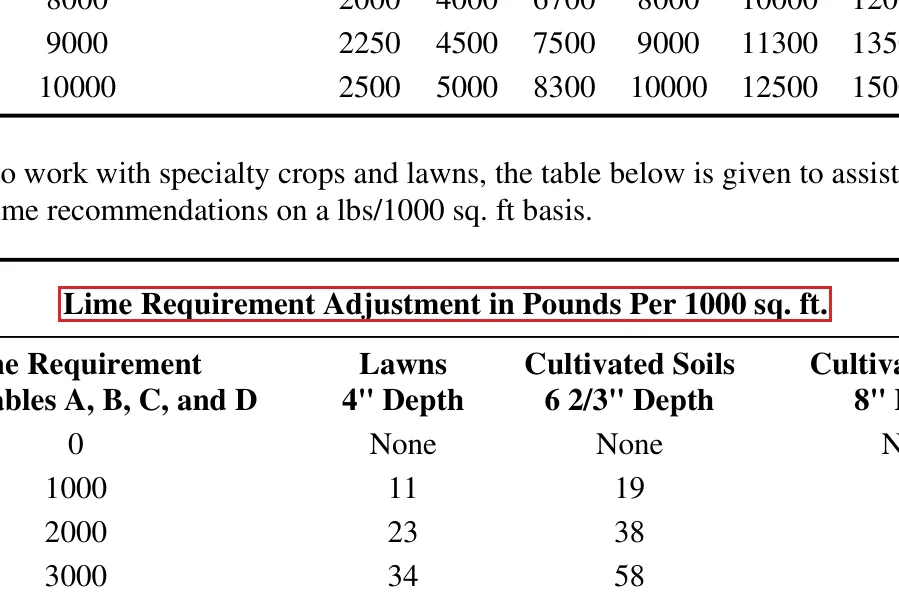
Divide pounds per acre by 43.5 to get pounds per 1,000 sq ft, NC State’s conversion; its own example turns 0.75 ton per acre into 34.5 lb. Watch the depth. The University of Georgia figures lime for the top 8 inches but samples lawns at 4, so its lawn column halves the rate: 1,000 lb per acre becomes 11 lb per 1,000 sq ft, not 23 (UGA Special Bulletin 62).
| Step | Georgia lab report (UGA) | Penn State lab report | Source |
|---|---|---|---|
| Soil test result | pH 5.5, lime buffer capacity 400, target pH 6.0 | Report calls for 75 lb limestone per 1,000 sq ft | UGA SB 62; Penn State |
| Lab rate as pure calcium carbonate | 2,500 lb per acre for the top 8 inches (Table C) | 75 lb per 1,000 sq ft | UGA SB 62 Table C; Penn State |
| Per 1,000 sq ft of lawn | 2,500 ÷ 43.56 ÷ 2 (4-inch lawn depth) = 28.7 lb | 75 lb | UGA lawn adjustment table |
| Divide by the bag’s CCE | Pennington Fast Acting Lime, 89%: 28.7 ÷ 0.89 = 32.2 lb | Lime at 80% CCE: 75 ÷ 0.80 = 94 lb | Labels; Penn State |
| Product for a 5,000 sq ft lawn | 32.2 × 5 = 161 lb, or 6 bags of 30 lb | 94 × 5 = 470 lb, or 12 bags of 40 lb | Arithmetic |
| Passes | 1 pass (under every ceiling) | 2 passes of 47 lb, 1 to 6 months apart; 1 pass under Penn State’s 100 lb ceiling | Virginia Tech; Penn State |
| Cost, Oct. 28, 2026 | 6 × $24.95 = $149.70 (Seed World) | 12 × $7.20 to $10.86 = $86 to $130, if a 40 lb pelletized bag carried 80% CCE | Product table |
The calculator below runs the same arithmetic: lab rate, bag CCE and price per pound in; pounds, bags and cost out.
- Pounds of product
- 278
- 40 lb bags
- 7
- 50 lb bags
- 6
Product lb = lawn area × lab rate ÷ CCE. Keep each pass at or under 50 lb of product per 1,000 sq ft (Virginia Tech, Maryland, Ohio State); Penn State, Purdue and Kentucky allow 100 lb. Prices are bag prices checked Oct. 28, 2026.
| Default calculator inputs | Value | Result |
|---|---|---|
| Lawn area | 5,000 sq ft | 5 units of 1,000 sq ft |
| Lab lime rate | 50 lb calcium carbonate per 1,000 sq ft | 250 lb calcium carbonate |
| Bag CCE | 90 percent | 250 ÷ 0.90 = 278 lb of product |
| Bags | 40 lb or 50 lb | 7 bags of 40 lb, or 6 of 50 lb |
| Price per lb | 40 lb pelletized lawn lime ($0.18 to $0.27 a lb: Vigoro, Soil Doctor) | $50.00 to $75.00 |
| Passes | 56 lb of product per 1,000 sq ft | 1 pass at Penn State’s ceiling; 2 passes of 28 lb at the 50 lb ceiling |
What is the most lime you can put on a lawn at once?
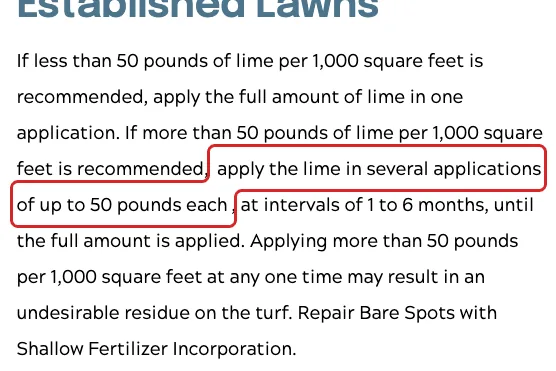
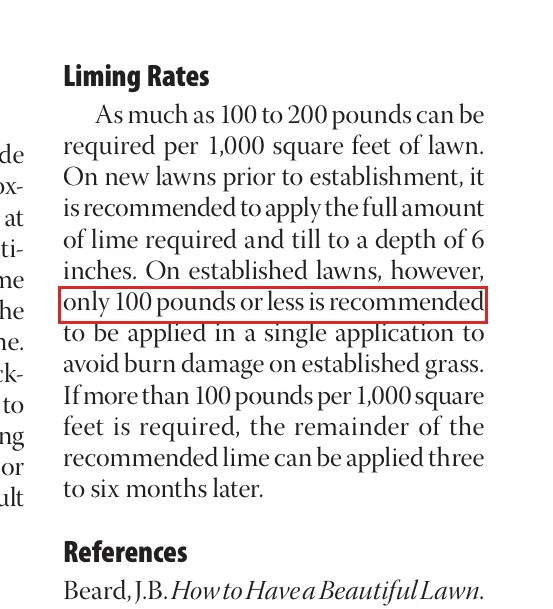
Fifty pounds per 1,000 sq ft per pass is the common ceiling: Virginia Tech, Maryland Extension and Ohio State use it, and Scotts repeats it. Penn State, Purdue and the University of Kentucky allow 100 lb on established, higher-cut turf. Both camps split anything above their cap into later passes, 1 to 6 months apart, and both allow the full amount on bare soil that is tilled in before planting.
| Source | Most per pass, established lawn | Interval for the rest | Reason given | Source link |
|---|---|---|---|---|
| Scotts (retail guide) | 50 lb | Not stated | Not stated | ScottsMiracle-Gro |
| Virginia Tech, Soil Test Note 18 | 50 lb | 1 to 6 months | More can leave a residue on the turf | VCE 452-718 |
| University of Maryland Extension | 50 lb | 6 months (85 lb = 50 + 35) | Not stated | UMD, 2026 |
| Ohio State, HYG-4026 | 50 lb of ground, dolomitic or pelletized product (hydrated 20, burned 10) | Split in half, two times a year | Not stated | Ohio State |
| UConn Home and Garden Education Center | 50 lb typical | Spring and fall, or 30-day intervals | Not stated | UConn, 2025 |
| Penn State Extension | 100 lb (golf greens 25 lb) | Spring and fall | Not stated | Penn State |
| Purdue, AY-18 | 100 lb on higher-cut turf | Not stated | Not stated | Purdue AY-18 |
| University of Kentucky, AGR-214 | 100 lb | 3 to 6 months | Avoid burn damage | UK AGR-214 |
Which ceiling should you follow? For pelletized or ground limestone, the 50 lb pass is the conservative reading and costs one extra spreader trip. No ceiling covers hydrated lime, which Ohio State caps at 20 lb.
Bare soil is different: Penn State allows the full requirement at once if it is worked 4 to 6 inches deep before seeding, and NC State’s Carolina Lawns says 6 to 8 inches. Seeding into an existing lawn is in our overseeding guide.
Which lime should you buy for a lawn?
Buy ground limestone, calcitic or dolomitic, in pelletized form if you will use a home spreader, and compare bags by CCE and price per neutralizing pound. Choose dolomitic only when the soil test shows low magnesium, per Penn State and NC State. Skip hydrated and burned lime on lawns, and do not count gypsum as lime.
| Material | CCE (approx.) | Speed (Ohio State) | Most per 1,000 sq ft per pass | Notes | Source |
|---|---|---|---|---|---|
| Ground limestone (calcitic) | 70 to 95% | Slow | 50 lb | Standard choice; dusty in a drop spreader | Ohio State Table 1 |
| Dolomitic limestone | 70 to 95%; can exceed 100% (NC State) | Slow | 50 lb | Adds magnesium; NC law requires 6% Mg as carbonate | Ohio State; NC State |
| Pelletized limestone | 70 to 95% | Fast (Ohio State); not faster (Kentucky, NC State) | 50 lb | Ground lime bound into pellets; spreads cleanly | Ohio State; UK AGR-214 |
| Hydrated lime | 140% | Fast | 20 lb | Caustic; burns turf; Penn State says never on lawns | Ohio State; Penn State |
| Burned lime (quicklime) | 180% | Fast | 10 lb | Caustic; hard to apply | Ohio State Table 1 |
| Gypsum (calcium sulfate) | Not a liming material | Little or no pH change | Not applicable | Adds calcium and sulfur only | Ohio State; UK AGR-214 |
Is pelletized or fast-acting lime faster?
Not reliably. Kentucky’s AGR-214 says pellets are bound with lignosulfonates that must break down before neutralizing starts, so they typically do not react faster than ag lime at equal rates. NC State says pellets touch fewer soil particles, so pH changes more slowly. UConn calls studies of products sold as fast-acting inconsistent. Ohio State’s table does rate pelletized as fast; pellets are mostly a cleaner way to spread the same stone.
What do the bag labels have to show?
State liming laws decide what you can compare. Virginia, Pennsylvania and North Carolina require CCE or its equivalent on the label, and Pennsylvania and Virginia also require the fineness breakdown, so a buyer can check both purity and particle size before paying a premium.
| State | Rule | What the label or product must meet | Source |
|---|---|---|---|
| Virginia | Va. Code § 3.2-3706; § 3.2-3700 | CCE, ENV by formula and minimum sieve fractions on every label; a standard liming ton is 90% CCE; dolomitic means 15% or more of the carbonate is magnesium carbonate | Code of Virginia, Title 3.2, Ch. 37 |
| Pennsylvania | 7 Pa. Code §§ 108.14, 108.15 | Total Ca and Mg percent and fineness class; Penn State reports minimums of 95% through 20 mesh, 60% through 60 mesh and 50% through 100 mesh for ground and pelletized stone (granular: 95, 40, 30) | Pa. Code ch. 108; Penn State |
| North Carolina | N.C. Agricultural Liming Materials and Landplaster Act | 90% through 20 mesh; 25% (calcitic) or 35% (dolomitic) through 100 mesh; no minimum CCE, but the label must state the amount equal to 90% CCE lime; pellets must slake to these sizes | NC State AG-439-51 |
Label CCE varies less than price. We compiled the guaranteed analysis of 10 retail lawn limes from maker labels and safety data sheets, with prices checked Oct. 28, 2026. Five print a CCE, 86 to 93 percent; four print none; Jonathan Green’s Mag-I-Cal Plus is mostly calcium sulfate.
| Product (maker page) | Type and form | CCE on label | Ca / Mg | Bag | Label coverage per bag | Price, Oct. 28, 2026 | Product equal to 50 lb CaCO3 | Cost per 1,000 sq ft at that rate |
|---|---|---|---|---|---|---|---|---|
| Solu-Cal PLUS Enhanced Calcitic Lime | Prilled calcitic | 91% | 36% / 0.5% | 50 lb | 12.5 lb per 1,000 sq ft for low pH (4,000 sq ft a bag); 5 to 6 lb to maintain | Not confirmed (listings for unclear bag sizes) | 55 lb | n/a |
| Espoma Organic Garden Lime | Pelletized dolomitic | 93% | 21% / 10% | 5 lb | 2.5 to 5 lb per 100 sq ft without a test (25 to 50 lb per 1,000 sq ft) | $7.48 (Walmart) | 54 lb | $80.43 |
| Pennington PennGreen Pelletized Dolomitic Limestone | Pelletized dolomitic | 90% | 24% / 5% | 40 lb | 15 to 25 lb per 1,000 sq ft, established lawns | Not found | 56 lb | n/a |
| Pennington Fast Acting Lime Plus AST | Prilled, from dolomitic limestone | 89% | 24% / 2.5% (2018 label) | 30 lb | 30 lb per 5,000 sq ft at pH 6.0 or above; 120 lb below 5.0 (6 to 24 lb per 1,000 sq ft) | $24.95 (Seed World) | 56 lb | $46.72 |
| Lilly Miller Super Sweet | Prilled calcitic | 86% | 34% / not listed | 25 lb | 2,000 sq ft a bag, once a year (12.5 lb per 1,000 sq ft) | $39.20 (Walmart marketplace) | 58 lb | $91.16 |
| Earth Science (Encap) Fast Acting Lime | Pelletized calcitic | Not published | Not published | 25 lb | 25 lb per 5,000 sq ft at pH 6.0; 75 lb below 5.5 (5 to 15 lb per 1,000 sq ft) | $20.99 (Oley Valley Feed, Google Shopping listing) | n/a | n/a |
| Hi-Yield Fast Acting Lime | Fast-acting granules | Not published | Not published | 25 lb | 25 lb per 5,000 sq ft at pH 6.0 or above; 100 lb below 5.0 | $29.99 (Rick’s Garden Center, Google Shopping listing) | n/a | n/a |
| Soil Doctor Pelletized Lawn Lime | Pelletized; SDS lists 52 to 87% CaCO3 and 12 to 40% MgCO3 | Not published | Not published | 40 lb | Not on a maker page we could reach | $10.86 (Walmart) | n/a | n/a |
| Vigoro Organic Pelletized Lawn Lime | Pelletized | Not published | Not verified | 40 lb | 1,000 sq ft a bag (listing title) | $7.20 (Home Depot, Google Shopping listing) | n/a | n/a |
| Jonathan Green Mag-I-Cal Plus (acidic and hard soil) | Calcium sulfate (gypsum) blend with some calcium carbonate | Not published | 28% Ca; 1.5% S | Not printed | 3.6 lb per 1,000 sq ft (2019 label); Iowa ECCE 1,682 lb per ton | Not found | n/a | n/a |
Compare label rates with your lab rate. Fast-acting bags print 5 to 25 lb per 1,000 sq ft; at 89 percent CCE, Pennington’s 6 lb pass neutralizes about 5.3 lb of calcium carbonate, a tenth of a 50 lb lab rate. Commodity 40 lb pellets at $0.18 to $0.27 a lb cost $9 to $14 for 50 lb, but print no CCE to check.
When should you apply lime to your lawn?
Lime can go on in any month the ground is not frozen and the grass is not wilted or frosted. Penn State and Maryland Extension call fall the most effective season because rain, snow and freeze and thaw work lime in; NC State’s Carolina Lawns guide prefers winter; Ohio State points to spring and fall rains.
Aerating first pays off: Ohio State says coring before liming helps it into the soil, citing a 2008 Agronomy Journal study, and Purdue says it speeds the pH change. Our aeration timing guide lists the best months by grass.
| Source | Best timing | Avoid | Source link |
|---|---|---|---|
| Penn State Extension | Any time; most effective in fall | Windy days for powdered lime | Penn State |
| NC State, Carolina Lawns | Any time; winter usually best (less traffic, freeze and thaw) | Not stated | NC State |
| Ohio State, HYG-4026 | Any time; spring or fall rains help | Wilted or frost-covered turf | Ohio State |
| University of Maryland Extension | Any time; autumn is ideal (winter freeze and thaw) | Snow- or frost-covered turf | UMD, 2026 |
| UConn, 2025 | Fall; repeat spring and fall if more is needed | Not stated | UConn |
| Scotts (retail guide) | Spring as soil warms, or fall | Dormant or stressed lawns, summer and winter | ScottsMiracle-Gro |
How do you apply lime to a lawn, step by step?
Liming a lawn takes one afternoon once the numbers are set: test, convert the lab rate to product, aerate compacted soil, spread in two directions, water it in and retest. Each step carries the figure an extension service gives for it.
- Test the soil. Send one mixed sample of 10 to 15 cores, 3 to 4 inches deep (Purdue AY-18; UGA).
- Read the lime line. Per-acre rates divide by 43.5 for pounds per 1,000 sq ft (NC State).
- Convert to product. Divide by the bag’s CCE as a decimal: 50 lb at 90 percent CCE is 56 lb of product per 1,000 sq ft.
- Plan the passes. Keep each pass at or under 50 lb per 1,000 sq ft (Virginia Tech, Maryland, Ohio State) and schedule the rest 1 to 6 months later.
- Core-aerate first if the soil is compacted. Ohio State says coring first helps lime work into the soil, and Purdue says it speeds the pH change.
- Spread in two directions. Set the spreader to half the rate and cover the lawn north to south, then east to west (Maryland Extension). Powdered lime bridges in drop spreaders; pellets flow (Penn State).
- Keep it off acid-loving plants such as azaleas, rhododendrons and blueberries (Penn State).
- Water it in. Irrigate after spreading to wash lime off the leaves, per Ohio State, unless rain is due.
- Retest before liming again, every 3 to 4 years (Maryland Extension).
How long does lime take to work, and how long does it last?
Lime is slow. Maryland Extension says one application can take up to 6 months to change pH measurably, UConn says 6 to 18 months, and Ohio State says several months. Once the target is reached it holds 2 to 3 years on sandy soils and 3 to 4 years on finer soils, according to Rutgers, which is why yearly liming without a test overshoots.
| Question | Answer | Source |
|---|---|---|
| Time to a measurable pH change | Up to 6 months | UMD, 2026 |
| Time to change pH (range) | 6 to 18 months, by weather and soil | UConn, 2025 |
| How deep surface lime moves | Little movement within 1 to 3 years; it neutralizes only where it lands | NC State AG-439-51 |
| Credit for recent lime | Lab subtracts a residual credit for lime applied in the past 12 months | NC State AG-439-51 |
| How long a correct dose lasts | 2 to 3 years on sandy soil; 3 to 4 years on finer soil | Rutgers FS633 |
| When to retest | Every 3 years (Purdue); every 3 to 4 years (Maryland); every 2 to 3 years (NC State) | Purdue AY-18; UMD; NC State |
Can you put too much lime on a lawn?
Yes. Ohio State says soil above pH 8.0 locks up nitrogen, phosphorus, iron, manganese, boron, copper and zinc and favors summer patch on Kentucky bluegrass. Rutgers says yearly liming can push pH high enough to cause iron, manganese and zinc shortages and worsen root diseases. Penn State notes iron chlorosis after over-liming. On centipedegrass, trouble starts above pH 6.0.
The fix is to stop liming and retest. If the lab prescribes sulfur, the University of Georgia handbook says to split any rate above 30 lb per 1,000 sq ft and retest after 2 to 3 months.
Should you lime your lawn this year?
Lime this year only if a lab test from the past 3 years shows pH below your grass’s range. Everything else, from symptoms to a neighbor’s routine to a bag’s coverage claim, is a reason to test, not to spread. The table and flowchart below hold the same thresholds, drawn from the extension publications cited above.
| If your situation is | Do this | Why (source) |
|---|---|---|
| No lab soil test in the past 3 years | Test before buying lime | Only a lab test gives a lime rate (Ohio State; Purdue) |
| pH 6.0 to 7.5 on a cool-season, bermudagrass or zoysiagrass lawn | Do not lime | Purdue calls adjustment unnecessary in that range (AY-18) |
| Centipedegrass at pH 5.0 or higher | Do not lime; treat yellowing with iron | Target 5.0 to 6.0 (UGA C1003) |
| pH below target; lab rate 50 lb or less per 1,000 sq ft (after CCE) | Apply it in one pass | Within every ceiling (Virginia Tech) |
| Lab rate 51 to 100 lb after CCE | Two passes 1 to 6 months apart (one pass is within Penn State, Purdue and Kentucky ceilings) | Virginia Tech; Penn State |
| Lab rate over 100 lb after CCE | Passes in spring and fall until applied; retest in between | Penn State; UK AGR-214 |
| Bare soil before seeding or sod | Apply the full rate and till it 4 to 6 inches deep | Penn State; Kentucky |
| Soil test shows low magnesium | Use dolomitic limestone | Penn State; NC State |
| pH above 7.5 | No lime; ask the lab about sulfur | UGA SB 62; Ohio State |
1Is your last lab soil test more than 3 years old, or did you only use a kit or probe?
YesGet a lab test first; a pH reading alone cannot set a lime rate.
NoGo to the next question
2Is the lawn centipedegrass with pH 5.0 or higher?
YesDo not lime. Treat yellowing with iron and keep pH at 5.0 to 6.0.
NoGo to the next question
3Is pH at or above your grass's target (6.0 for most lawns, 5.5 for tall fescue)?
YesDo not lime. Retest in 3 to 4 years.
NoGo to the next question
4Is the soil bare and about to be seeded or sodded?
YesApply the full rate and till it 4 to 6 inches deep.
NoGo to the next question
5After dividing by CCE, is the rate over 50 lb per 1,000 sq ft?
YesSplit it: 50 lb passes 1 to 6 months apart (100 lb passes under Penn State, Purdue or Kentucky rules).
NoApply the full rate in one pass, water it in and retest in 3 to 4 years.
Source: Purdue AY-18; Ohio State HYG-4026; UGA C1003; Penn State; Virginia Tech 452-718
How we compiled this
We compiled rates, ceilings, timing and pH targets from 14 extension publications and lab handbooks (Ohio State, Penn State, Purdue, Kentucky, NC State, NCDA&CS, Georgia, Virginia Tech, Maryland, UConn, Rutgers) and the Virginia and Pennsylvania liming rules, read in October 2026. Product data come from maker labels and safety data sheets; prices were checked Oct. 28, 2026. No lime or lawn was field-tested for this page; the worked examples are arithmetic.
| Conversion | Multiply or divide | Example |
|---|---|---|
| lb per acre to lb per 1,000 sq ft | Divide by 43.5 (NC State) or 43.56 | 1,500 lb per acre = 34.5 lb |
| Tons per acre to lb per 1,000 sq ft | Multiply by 2,000, then divide by 43.5 | 1 ton per acre = 46 lb |
| lb per 1,000 sq ft to lb per acre | Multiply by 44 (Ohio State) | 50 lb = 2,200 lb per acre |
| UGA 8-inch table to a 4-inch lawn | Divide lb per acre by about 87 | 2,000 lb per acre = 23 lb |
| Lab rate to product | Divide by CCE as a decimal | 50 lb at 0.90 = 56 lb |
| Product to 40 lb bags | Product lb per 1,000 sq ft × lawn area in 1,000s ÷ 40 | 56 lb × 5 ÷ 40 = 7 bags |
Frequently asked questions
How much does a 40 lb bag of lime cover?
At the 50 lb per 1,000 sq ft ceiling, a 40 lb bag covers 800 sq ft; at a 25 lb rate, 1,600 sq ft. Label coverage in our product table runs from 1,000 sq ft (Vigoro, 40 lb) to 10,000 sq ft (Solu-Cal, 50 lb, maintenance rate) per bag, so divide the bag weight by your own product rate instead.
Does lime kill grass?
Ground and pelletized limestone at soil test rates do not. Hydrated and burned lime can, so Penn State rules both out for turf, and Kentucky caps limestone passes at 100 lb per 1,000 sq ft to avoid burn. Over-liming harms grass slowly by pushing pH above 8.0 (Ohio State).
Will lime make my lawn green?
Only if acid soil was the limit. Lime frees nutrients Ohio State lists as scarce below pH 6.0, but carries no nitrogen and can take 6 months to show (Maryland Extension). On centipedegrass, liming above pH 6.0 can turn it yellow, per UGA.
Do you fertilize or lime first?
Neither has to wait for the other in the extension guides compiled here; feed on the calendar in our lawn fertilizer guide and lawn care schedule. Penn State warns that strongly acid soil limits fertilizer response, so liming makes each later feeding count.
Do you apply lime before or after rain?
Spread lime on dry grass ahead of a light rain, or water it in yourself. Ohio State says to irrigate after spreading to wash lime off the leaves and that rain helps move it into the root zone. Skip wilted turf and frost- or snow-covered turf, which Ohio State and Maryland Extension rule out.
How much lime do you need for 1 acre of lawn?
Multiply the per-1,000 sq ft rate by 43.56. A 50 lb rate is 2,178 lb, about 1.1 tons of product per acre, or 55 bags of 40 lb. At that scale, NC State and Kentucky both note that ground ag lime costs less than pellets.
Sources
- The Ohio State University Extension (E. Nangle, D. Gardner), HYG-4026, Lime and the Home Lawn, Sept. 1, 2021. Accessed October 2026.
- Penn State Extension, Liming Turfgrass Areas, updated Jan. 1, 2002 (current page). Accessed October 2026.
- Purdue University Cooperative Extension (Z. Reicher, C. Throssell), AY-18, Soil Testing for Lawns, n.d. (current PDF). Accessed October 2026.
- University of Kentucky Cooperative Extension (G. Munshaw, E. Ritchey), AGR-214, Liming Kentucky Lawns, July 2014. Accessed October 2026.
- NC State Extension and NCDA&CS, AG-439-51, Soil Acidity and Liming: Basic Information for Farmers and Gardeners, Dec. 12, 2018; reviewed Oct. 19, 2023. Accessed October 2026.
- NC State Extension, AG-69, Carolina Lawns, July 2, 2021. Accessed October 2026.
- NCDA&CS Agronomic Division, Soil Fertility Note 9, Problems with Centipedegrass, June 1997. Accessed October 2026.
- University of Georgia (D. Kissel, L. Sonon), Special Bulletin 62, Soil Test Handbook for Georgia, September 2008. Accessed October 2026.
- UGA Cooperative Extension (A. Martinez, C. Waltz), Circular 1003, Centipedegrass Decline, full review June 21, 2022. Accessed October 2026.
- Virginia Cooperative Extension, 452-718, Soil Test Note 18: Lawn Fertilization for Warm Season Grasses, March 2021; reviewed August 2026. Accessed October 2026.
- University of Maryland Extension (M. Talabac), Maintaining an Established Lawn, January 2026; updated Sept. 14, 2026. Accessed October 2026.
- UConn Home and Garden Education Center, Fall is a Great Time to Lime and Fertilize Lawns, Sept. 20, 2025. Accessed October 2026.
- Rutgers Cooperative Extension (J. Heckman, J. Murphy), FS633, Fertilizing the Home Lawn, January 2003. Accessed October 2026.
- Commonwealth of Virginia, Code of Virginia, Title 3.2, Chapter 37, Agriculture Liming Materials (§§ 3.2-3700, 3.2-3706), current code. Accessed October 2026.
- Commonwealth of Pennsylvania, 7 Pa. Code Chapter 108, Agricultural Liming Materials (§§ 108.14, 108.15), adopted March 4, 1994. Accessed October 2026.
- Schlossberg, Waltz, Landschoot and Park, Agronomy Journal 100(3): 855 to 861, Recent Mechanical Cultivation of Lawns Enhances Lime Application Efficacy, 2008. Accessed October 2026.
- ScottsMiracle-Gro, How and When to Add Lime to Your Soil, page as of October 2026. Accessed October 2026.
- Solu-Cal USA, Solu-Cal PLUS 50 lb bag label, 2024 label. Accessed October 2026.
- Espoma, Organic Garden Lime product page, page as of Oct. 28, 2026. Accessed October 2026.
- Pennington (Gro Tec), hosted by DoMyOwn, PennGreen Pelletized Dolomitic Limestone 40 lb label, current PDF. Accessed October 2026.
- Pennington, hosted by Home Depot, Fast Acting Lime Plus AST label, label v4, April 2018. Accessed October 2026.
- Lilly Miller (Pennington), Super Sweet lime front label, page as of Oct. 28, 2026. Accessed October 2026.
- Encap (Earth Science), Fast Acting Lime product page, page as of Oct. 28, 2026. Accessed October 2026.
- Hi-Yield (Fertilome), Fast Acting Lime info sheet, January 2020. Accessed October 2026.
- Oldcastle, The Soil Doctor, Pelletized lime safety data sheet, current PDF. Accessed October 2026.
- Jonathan Green, hosted by a distributor, Mag-I-Cal Plus specification sheet, 2019 label. Accessed October 2026.
- Walmart, Espoma Garden Lime 5 lb listing, price checked Oct. 28, 2026. Accessed October 2026.
- Walmart, Soil Doctor Pelletized Lawn Lime 40 lb listing, price checked Oct. 28, 2026. Accessed October 2026.
- Seed World, Fast Acting Lime Plus AST 30 lb listing, price checked Oct. 28, 2026. Accessed October 2026.
- Walmart marketplace (Supply the Home), Lilly Miller Soil Sweetener 25 lb listing, price checked Oct. 28, 2026. Accessed October 2026.
- Home Depot, Vigoro 40 lb Organic Pelletized Lawn Lime listing (price via Google Shopping), price checked Oct. 28, 2026. Accessed October 2026.