How to plant grass seed: till 4 to 6 inches deep, grade away from the house, add starter fertilizer, sow half the seed each way, rake it 1/4 inch under, roll, mulch it lightly and keep the top inch moist.
Key takeaways
- Seed cool-season grass from mid-August to mid-October in Maryland, and warm-season grass from mid-May into June; the soil temperature target for germination is 50 to 70°F at a 1-inch depth (University of Maryland Extension).
- Till 4 to 6 inches deep and, where a soil test shows organic matter under 3 percent, mix in 1 to 2 inches of compost: 3 to 6 cubic yards per 1,000 sq ft (UMD; Purdue AY-3).
- Grade the soil away from the house at 1 to 2 percent, a 1 1/4 to 2 1/2 inch drop every 10 feet (UMD); Purdue warns that slopes steeper than a 1-foot drop every 4 feet bring mowing and erosion problems (Purdue AY-28).
- Sow tall fescue at 6 to 8 lb and Kentucky bluegrass at 2 to 3 lb per 1,000 sq ft, half the seed in each of two directions at right angles (Penn State Extension).
- Cover seed with no more than about 1/2 inch of soil or 1/4 inch of compost or straw, because grass seed needs light to germinate (UMD); a leaf rake dragged lightly leaves most seed about 1/4 inch deep (Penn State).
- Water 2 to 4 times a day so the top 0.5 to 1 inch never dries, and keep broadleaf herbicides off until the seedlings have been mowed at least 3 times (Purdue AY-3).
4 to 6 in tilling depth for a new seedbed (Purdue AY-3; UMD)
1 to 2% grade away from buildings (UMD Extension)
6 to 8 lb tall fescue seed per 1,000 sq ft (Penn State; UMD)
80 to 100 lb straw per 1,000 sq ft on level ground (Penn State; UMD)
When is the best time to plant grass seed?
Plant cool-season grass (tall fescue, Kentucky bluegrass, perennial ryegrass, fine fescues) in late summer to early fall, and warm-season grass (bermudagrass, zoysiagrass, centipedegrass) in late spring to early summer. University of Maryland Extension puts the windows at mid-August to mid-October and mid-May into June, with germination fastest at 50 to 70°F soil temperature, measured about 1 inch deep (UMD, Starting a New Lawn).
Early in the window beats late. Purdue says that even inside its Aug. 15 to Sept. 15 window for northern Indiana and Illinois, waiting one week to seed may mean the stand takes 2 to 4 more weeks to mature (Purdue AY-3). Spring is the fallback: UMD calls March to early April seeding harder than fall, and says weed competition is the most common cause of failed spring seedings.
| Grass and region | Seeding window | What to check | Source |
|---|---|---|---|
| Cool-season, Maryland | Mid-Aug. to mid-Oct.; spring March to early April (harder) | Germination takes about 2 weeks; killing frosts possible in November | UMD Extension |
| Cool-season, northern Indiana and Illinois | Aug. 15 to Sept. 15 | One week late can add 2 to 4 weeks to maturity | Purdue AY-3 |
| Cool-season, southern Indiana and Illinois | Sept. 1 to Sept. 30 | Same | Purdue AY-3 |
| Cool-season, dormant seeding (Indiana, Illinois) | Thanksgiving to March | Seed waits for April or May soil warmth; works best in the northern half | Purdue AY-3 |
| Kentucky bluegrass or tall fescue, North Carolina mountains | Aug. 15 to Sept. 1 | Seeding after the date raises failure risk | NC State Table 9-4 |
| Bermudagrass, North Carolina Piedmont | April to July | Warm-season seed germinates at 68 to 95°F air temperature (UT W160-B) | NC State Table 9-4 |
| Centipedegrass, North Carolina Piedmont | March to July | Seeded centipedegrass may take 2 to 3 years to establish | NC State |
| Zoysiagrass (Zenith, Compadre), Arkansas | May 15 to July 1 | Seeding before May 15 can cut germination in cool soil | Arkansas MP476 |
| Warm-season, Maryland | Mid-May into June | Less than 10 hours of daylight (Nov. to Feb.) supports no grass growth | UMD Extension |
The two leading sources disagree on winter seeding. Purdue recommends dormant seeding from Thanksgiving to March because freeze and thaw cracks give seed a place to lodge (Purdue AY-3), while UMD says ungerminated fall-sown seed dies over winter, except Kentucky bluegrass. Dormant seeding is a cold-climate tactic; where winters swing warm, as in southern Indiana, Purdue itself warns that seed can sprout and then freeze. Our month-by-month lawn care schedule places seeding next to fertilizer and crabgrass preventer dates.
Should you seed, lay sod or patch?
Seed when you are inside the seeding window, can water 2 to 4 times a day for several weeks and can wait 4 to 6 weeks for the first mowing (UMD). Choose sod when you need a usable lawn in about a month, are outside the window, or are planting a grass sold only as sod, plugs or sprigs. Very steep ground and deep shade may need no lawn at all.
Sod roots in 2 to 3 weeks and can go down any time the ground is not frozen and daytime highs stay below 90°F, according to UMD. Seed costs far less: about $5 to $46 of seed covers 1,000 sq ft of most lawn grasses against $283 to $523 for the same area of sod at the farm, as compiled in our sod vs seed comparison.
| If your situation is | Do this | Why (source) |
|---|---|---|
| Slope steeper than a 1-foot drop every 4 feet (25%) | Terrace, build a wall or plant a ground cover instead of lawn | Purdue AY-28: mowing and erosion problems |
| Slope you can mow but that washes | Seed under an erosion blanket, hydroseed, or sod pegged on the high side | Penn State; UT W160-B; Purdue AY-28 |
| Fewer than 6 hours of direct sun | Use a shade mix (fine fescues at 4 to 5 lb per 1,000 sq ft) or switch to a ground cover | UMD; Penn State Table 1 |
| Water puddles for 24 hours or more | Fix drainage before seeding, or plant a rain garden | UMD |
| Soil test shows under 3% organic matter | Till in 1 to 2 in of compost (3 to 6 cu yd per 1,000 sq ft) | UMD |
| Lawn needed within about a month | Lay sod: roots in 2 to 3 weeks vs 4 to 6 weeks to a mowable seeded lawn | UMD |
| Past the seeding window, cool-season grass | Sod now, or dormant seed after the ground cools (northern states) | UMD; Purdue AY-3 |
| You want zoysiagrass | Plugs or sod; seed only Zenith or Compadre, May 15 to July 1, no deeper than 1/4 in | UMD; Arkansas MP476 |
| You want St. Augustinegrass | Sod or sprigs; NC State lists no seeding rate for it | NC State Table 9-4 |
| Bare spot under 4 inches across in bermudagrass, zoysiagrass or Kentucky bluegrass | Let it fill in; seed larger spots | NC State |
| Bare spot in tall fescue or perennial ryegrass, any size | Seed it: bunch-type grasses cannot spread | NC State |
| You cannot water 2 to 4 times a day | Postpone seeding during drought, mulch with straw, or lay sod | UMD; Purdue AY-3 |
1Is the slope steeper than a 1-foot drop every 4 feet?
YesSkip the lawn: terrace, build a wall or plant a ground cover (Purdue AY-28).
NoGo to the next question
2Does the area get fewer than 6 hours of direct sun?
YesSeed a fine fescue shade mix at 4 to 5 lb per 1,000 sq ft, or plant a ground cover (UMD; Penn State).
NoGo to the next question
3Does water stand for 24 hours or more after rain?
YesFix the drainage first, or plant a rain garden (UMD).
NoGo to the next question
4Do you want zoysiagrass or St. Augustinegrass?
YesUse plugs, sprigs or sod; zoysia seed only as Zenith or Compadre, May 15 to July 1 (UMD; Arkansas MP476; NC State).
NoGo to the next question
5Do you need a usable lawn within about a month, or are you outside the seeding window?
YesLay sod: it roots in 2 to 3 weeks and goes down whenever the ground is not frozen and highs stay under 90°F (UMD).
NoGo to the next question
6Will you be unable to water 2 to 4 times a day for several weeks?
YesPostpone seeding, dormant seed in the North, or lay sod (UMD; Purdue AY-3).
NoSeed it: till 4 to 6 inches, sow half the seed each way, rake it about 1/4 inch under, roll, straw lightly and water 2 to 4 times a day.
Source: UMD Extension; Purdue AY-3 and AY-28; Penn State Extension; Arkansas MP476; NC State Extension
Thickening a lawn that still has at least half its grass is overseeding, not new-lawn planting, and uses about half the seed per 1,000 sq ft; the aeration and seeding steps for that job are in our guide to overseeding a lawn.
How do you plant grass seed, step by step?
Planting grass seed on bare soil takes 12 steps: test, kill weeds, grade, add soil, till, settle, fertilize, sow, rake, roll, mulch and water. Most of the calendar goes to the soil test, a weed kill that can take up to 3 weeks and letting tilled soil settle. Every step below carries the number an extension service attaches to it (Purdue AY-3; Penn State).
- Test the soil 3 to 4 weeks ahead. Take 10 to 15 cores 3 to 4 inches deep and mix them into one sample (NC State). UMD says lime is needed only below pH 5.5, with 6.0 to 6.8 optimum and 5.8 to 6.5 suiting tall fescue. Our soil test guide covers labs and fees.
- Kill existing grass and weeds. Spray glyphosate, which has no soil residual but does not kill weed seeds (Penn State). Wait for full kill, a few days to 3 weeks, and at least 7 days before tilling so it reaches the roots (NC State). The label sets the seeding wait; the table below lists the intervals on seven current labels.
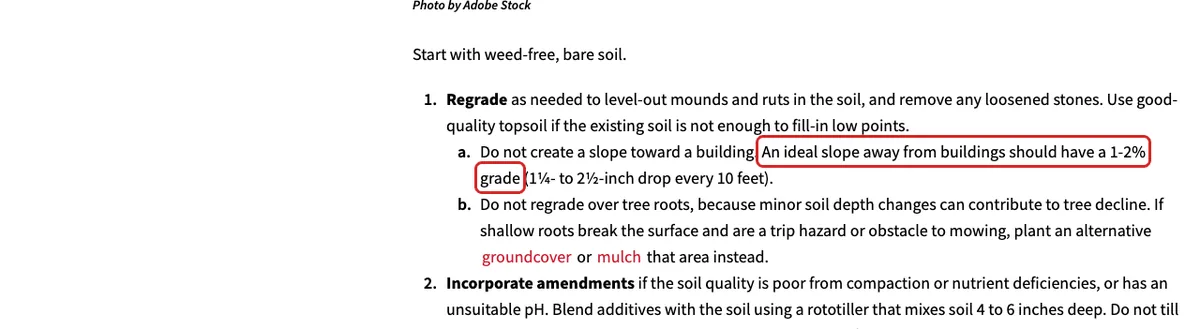
- Clear and rough grade. Rake out stones larger than 2 inches (Penn State) and slope the ground away from the house at 1 to 2 percent (UMD) for at least 15 feet (Purdue AY-28). Do not change grade over tree roots.
- Add topsoil only where it is thin. Penn State wants 4 to 6 inches of settled topsoil, with about 2 inches of it mixed into the top 2 to 3 inches of subsoil so water does not perch at the boundary. One cubic yard covers 81 sq ft at 4 inches; delivered prices are on our topsoil cost page.
- Amend and till 4 to 6 inches deep. Spread compost 1 to 2 inches deep when organic matter tests under 3 percent (UMD), plus any lime the report calls for, then till moist (not wet) soil in 1 or 2 passes (Penn State). Over-tilling to powder causes crusting.
- Let it settle, then fine grade. Water or rain settles the soil; a light roller works when it is dry. Walk it: there should be no visible footprints (NC State), and Purdue’s sod guide says footprints deeper than 0.5 inch need more watering or rolling (AY-28). Rake until clods are marble size or smaller.
Steps 1 to 6 are the ones most often skipped, and UMD lists their failures by name: compacted soil that will not absorb water, incomplete blending of compost that leaves uneven drainage, and mounds that the mower scalps later (UMD, causes of new lawn failure). A seed bed that passes the footprint test usually fixes all three.
- Spread starter fertilizer. Apply what the soil test calls for; Purdue uses 1.5 lb of phosphate (P2O5) per 1,000 sq ft on low-phosphorus soil (AY-3 Table 1), and Penn State caps nitrogen below 1.5 lb per 1,000 sq ft to avoid burn. Check the state rules in the phosphorus table below.
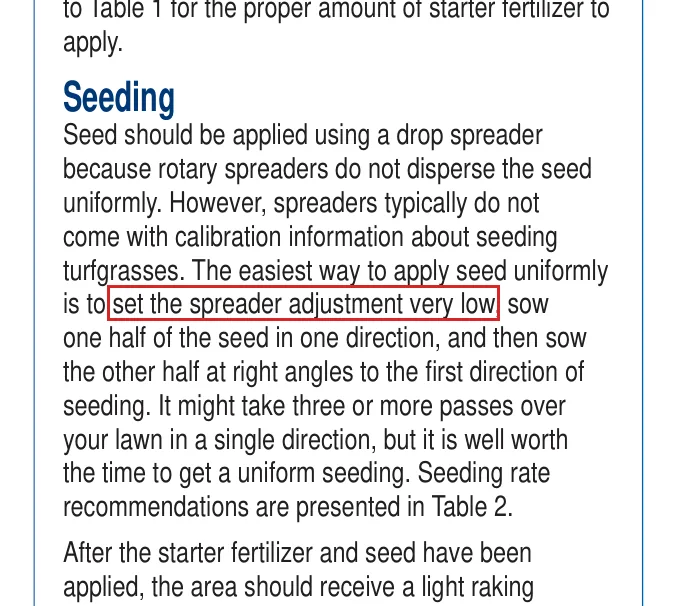
- Sow half the seed in each of two directions. Set the spreader low, walk north to south with half, then east to west with the rest (UMD). Purdue prefers a drop spreader because rotary spreaders spread seed less evenly (AY-3).
- Rake the seed in lightly. Drag a leaf rake in straight lines without pressure; most seed ends up about 1/4 inch deep and some stays visible (Penn State). Never bury it under more than about 1/2 inch of soil (UMD).
- Roll once. Use an empty water-fill lawn roller for seed-to-soil contact (Purdue AY-3), with the roller and soil surface dry so seed does not stick to the drum (Penn State).
- Mulch with straw, not hay. Spread 80 to 100 lb of clean straw per 1,000 sq ft on level ground (Penn State), thin enough that about half the soil shows (Purdue). On seeded zoysiagrass, skip heavy straw: it cut coverage in Arkansas trials (MP476).
- Water the same day, then 2 to 4 times daily. Apply about 1/4 inch per session for seed (UMD), keep the top 0.5 to 1 inch moist (Purdue) and avoid evening watering. Our grass seed germination guide gives sprouting days and the taper schedule.
How long should you wait after weed killer before planting grass seed?
The product label sets the wait, and it ranges from 3 days to a year. A glyphosate lawn product can allow seeding 3 days after spraying, broadleaf killers 1 to 4 weeks, and crabgrass preventers 3 to 12 months. Read the “reseeding” or “replant” line on your exact label before you buy seed; the label is the law (EPA-accepted Roundup label).
| Product (EPA Reg. No.) | Active ingredient | Wait before seeding, per the label | Label |
|---|---|---|---|
| Roundup Weed & Grass Killer Concentrate Plus (71995-29) | Glyphosate 18% + diquat | Lawn grasses may be planted 3 days after application | EPA label, April 2022 |
| Razor (228-366) | Glyphosate 41% | Delay tillage or renovation 7 days; no fixed seeding day count | EPA label, January 2015 |
| Speed Zone Broadleaf (2217-833) | 2,4-D, mecoprop-p, dicamba, carfentrazone | Reseed 1 week after application | EPA label, March 2025 |
| Trimec Classic Broadleaf (2217-543) | 2,4-D, MCPP-p, dicamba | Grass seed can be sown 3 to 4 weeks after application | EPA label, April 2014 |
| Tenacity (100-1267) | Mesotrione | May be applied before or after seeding, except fine fescue; blends under 20% fine fescue | EPA label, September 2022 |
| Dimension 2EW (62719-542) | Dithiopyr | Seeding within 3 months of one application (4 months after sequential ones over 2 pt/acre) may fail | EPA label, July 2021 |
| Barricade 4FL (100-1139) | Prodiamine | 4 to 12 months, by rate and region (4 months at 16 fl oz/acre) | EPA label, February 2024 |
If a crabgrass preventer went down this spring, a fall seeding may still fail: at Barricade 4FL’s 24 fl oz rate the northern wait is 6 months. The broadleaf rule from the extension side is similar to the labels: Missouri puts 2,4-D and dicamba at a 3 to 4 week reseeding restriction and spot-sprayed glyphosate at 3 to 5 days (University of Missouri IPM).
Pesticide use is regulated by the label. This page is general information, not a pesticide recommendation; read and follow the current label for the product you use and your state’s rules.
How much seed, fertilizer, compost and straw do you need?
Per 1,000 sq ft of new lawn, plan on 6 to 8 lb of tall fescue seed (or 2 to 3 lb of Kentucky bluegrass), about 6 lb of an 18-24-12 starter fertilizer, 3 to 6 cubic yards of compost if the soil needs it, and 80 to 100 lb of straw. Multiply by your lawn area in thousands of square feet (Penn State; UMD).
| Material | Amount per 1,000 sq ft | Notes | Source |
|---|---|---|---|
| Tall fescue seed | 6 to 8 lb | Purdue lists 6 to 9 lb, but its own per-acre figure (261 to 348 lb) works out to 6 to 8 | Penn State Table 1 |
| Kentucky bluegrass seed | 2 to 3 lb | Purdue and UT use 1.5 to 2 lb | UMD |
| Perennial ryegrass seed | 4 to 5 lb | UT: 4 to 6 lb | Penn State Table 1 |
| Fine fescue seed (shade) | 4 to 5 lb | UMD: 4 to 6 lb | Penn State Table 1 |
| Bermudagrass seed, hulled | 1 to 2 lb | Double for unhulled seed (UT) | NC State Table 9-4 |
| Centipedegrass seed | 0.25 to 0.5 lb | Slow: 2 to 3 years to full cover | NC State Table 9-4 |
| Starter fertilizer, 18-24-12 | 6.25 lb | Delivers 1.5 lb phosphate (P2O5), Purdue’s low-P rate | Purdue AY-3 Table 1 (our arithmetic) |
| Compost, 1 in deep | 3.09 cu yd | Only if organic matter is under 3% | UMD (1,000 sq ft x 1 in / 324) |
| Compost, 2 in deep | 6.17 cu yd | Deeper layers are hard to till evenly | Penn State |
| Straw | 80 to 100 lb (2 to 3 bales of 30 to 40 lb) | Purdue calls 1 bale a light cover; NC State 1 to 2 bales for cool-season grass | Penn State |
| Lime, no soil test | 75 lb ground limestone | NC State’s default when no test was done; skip for centipedegrass | NC State |
| Water per session | About 1/4 in (156 gallons) | 1 inch over 1,000 sq ft is 623 gallons | UMD (our arithmetic) |
Seed amounts double for coated or unhulled seed, and our grass seed cost guide prices each species per pound and per bag. More seed is not better: UT warns that seeding too heavily gives “a very dense stand of weak, poorly developed and disease-prone seedlings” (UT W160-B).
Starter fertilizer: how much nitrogen does each product deliver?
Divide the target nutrient by the percentage on the bag. To put down Purdue’s 1.5 lb of phosphate per 1,000 sq ft with an 18-24-12 product, spread 1.5 / 0.24 = 6.25 lb, which also delivers 6.25 x 0.18 = 1.13 lb of nitrogen. That sits above Penn State’s 0.5 to 1 lb starter range but under the 1.5 lb burn line (Penn State).
| Product and rate per 1,000 sq ft | Nitrogen (lb) | Phosphate, P2O5 (lb) | How it is used | Source |
|---|---|---|---|---|
| 18-24-12 at 6.25 lb | 1.13 | 1.50 | Surface, at seeding | Purdue AY-3 rate; our arithmetic |
| 16-22-8 at 6.8 lb | 1.09 | 1.50 | Surface, at seeding (Purdue’s example analysis) | Purdue AY-3 |
| 10-10-10 at 10 lb | 1.00 | 1.00 | Surface, at seeding (top of Penn State’s range) | Penn State |
| 20-10-10 at 5 lb | 1.00 | 0.50 | Surface, at seeding | Penn State |
| 5-10-10 at 40 lb | 2.00 | 4.00 | Tilled 6 to 8 in deep before planting, no soil test | NC State |
| 10-20-20 at 20 lb | 2.00 | 4.00 | Tilled 6 to 8 in deep before planting, no soil test | NC State |
| 18-4-6 at 16 lb | 2.88 | 0.64 | Tilled 6 to 8 in deep before planting, no soil test | NC State |
The table shows why the soil test comes first: NC State’s no-test examples put down 2 to 2.9 lb of nitrogen, worked deep into the soil, while a surface starter at seeding should stay near 1 lb. If your report shows high phosphorus (25 ppm or more in Purdue’s Table 1), Purdue still allows 1.0 lb of phosphate for new seed; in several states below, the law decides.
- Starter fertilizer, 18-24-12 (lb)
- 31
- Straw bales (90 lb per 1,000 sq ft, 35 lb bales)
- 13
- Compost for 1 in (cu yd)
- 15.4
- Water per 1/4 in session (gallons)
- 779
Seed = area x extension new-lawn rate x Oct. 18, 2026 seller prices (our grass seed cost page). Starter fertilizer: LESCO 18-24-12, $60.99 to $82.99 per 50 lb bag. Straw: $7.00 to $13.99 a bale. Compost: 3.09 cu yd per 1,000 sq ft at $38 to $53 a yard, before delivery. Rentals: posted day rates, Oct. 28, 2026. Pre-tax.
How much slope does a new lawn need?
A new lawn should fall away from the house at roughly 1 to 4 percent, depending on the extension service: UMD recommends 1 to 2 percent, NC State 2 to 3 percent and Penn State 1 to 4 percent. At 2 percent the ground drops about 2 1/2 inches every 10 feet; Purdue sets the upper limit for a mowable lawn at a 1-foot drop every 4 feet (Purdue AY-28).
Right against the foundation, building codes ask for more: IRC R401.3 requires the grade to fall at least 6 inches within the first 10 feet, about 5 percent, and our lawn leveling guide shows how to check it with a string line.
| Source | Recommended grade away from buildings | Drop per 10 ft | Other rule | Link |
|---|---|---|---|---|
| University of Maryland Extension | 1% to 2% | 1 1/4 to 2 1/2 in | Never slope toward a building; do not regrade over tree roots | Starting a New Lawn |
| Purdue AY-28 | About 2% (1 ft in 50 ft) | 2.4 in | Slope away at least 15 ft; steeper than 1 ft in 4 ft causes mowing and erosion problems | AY-28-W |
| NC State Extension | 2% to 3% | 2.4 to 3.6 in | Firm the soil until no footprints show | Gardener Handbook ch. 9 |
| Penn State Extension | 1% to 4% (1 to 4 ft per 100 ft) | 1.2 to 4.8 in | Shape the subsoil first, lowered for 4 to 6 in of topsoil | Lawn Establishment |
To check grade without a laser level, run a string between a stake at the foundation and one 10 feet out, level it with a line level, and measure down to the soil at the far stake. A 1 1/4 to 2 1/2 inch gap meets UMD’s range. Penn State recommends setting the grade on the subsoil before topsoil goes back, marked on stakes at fixed intervals (Penn State).
How deep should grass seed be planted?
Grass seed should sit at or just under the surface: most of it about 1/4 inch deep and none under more than about 1/2 inch of soil. A light drag with a leaf rake leaves most seed about 1/4 inch deep (Penn State); UMD caps cover at about 1/2 inch of soil or 1/4 inch of compost or straw, because grass seed needs light to germinate (UMD).
| Source | How to cover the seed | Maximum cover | Link |
|---|---|---|---|
| Penn State Extension | Drag a leaf rake in straight lines with no pressure, then roll | About 1/4 in of soil; some seed stays visible | Lawn Establishment |
| University of Maryland Extension | Raking in is optional; a light cover of topsoil or finished compost helps germination | About 1/2 in of soil, 1/4 in of compost or straw | Starting a New Lawn |
| UT Extension W160-B | Rake and roll, then topdress with organic matter as a mulch substitute | 1/8 to 1/4 in of organic matter | W160-B |
| University of Arkansas MP476 | Maximize seed-to-soil contact; zoysiagrass needs light | 1/4 in for zoysiagrass seed | MP476 |
| NC State Extension | Hand rake or drag a mat or a span of chain-link fence, then roll | Light cover (no depth given) | Gardener Handbook ch. 9 |
Can you just throw grass seed on bare dirt?
You can, but expect thin, patchy results on hard or crusted soil. UMD says raking seed in is not strictly necessary, yet Purdue calls seed-to-soil contact critical and pairs a light raking with rolling for that reason (Purdue AY-3). Seed lying on a hard surface dries out between waterings, washes off in heavy rain and feeds birds.
On hard dirt, loosen the soil first. For small bare spots, NC State says to loosen the top 4 to 6 inches with a rake, hoe or shovel, or the top 2 to 3 inches where hand tools cannot go deeper, and to smooth it until clods are smaller than marbles (NC State). For a whole yard, a rented rear-tine tiller ($60 to $100 a day in the rental table below) does the same job.
To keep birds off, UMD suggests a lightweight floating row cover or open-weave cheesecloth, tacked down with landscape staples and removed once grass pushes against it; a thin layer of straw also hides seed (UMD). Avoid covers with plastic mesh, which UMD notes can trap wildlife and will not break down.
Where do popular planting guides differ from extension advice?
Seed-company guides and extension publications agree on the basics (two passes, light cover, frequent watering), but they part ways on 5 points: spreader type, compost depth, the temperature trigger, how deep to keep soil moist and when to mow. Extension services also disagree with each other on straw, and two older extension guides name a herbicide that is no longer registered. In each row below, the extension figure is the land-grant recommendation.
| Topic | What the guide or publication says | What the extension publication says | Source |
|---|---|---|---|
| Spreader type | Pennington: a broadcast or rotary spreader gives “more uniform coverage” | Purdue: use a drop spreader “because rotary spreaders do not disperse the seed uniformly”; UMD and NC State accept either with two passes at right angles | Purdue AY-3 |
| Compost before seeding | Pennington: incorporate compost “at a depth of 2 to 4 inches” | UMD and Penn State: a 1 to 2 inch layer, tilled 4 to 6 in deep; layers over 2 in are hard to till evenly | Penn State |
| When to start | Pennington: wait for daytime temperatures of 60 to 75°F | UMD: soil at 50 to 70°F, measured about 1 in deep; UT: cyclic air temperatures of 59 to 82°F for cool-season seed | UMD |
| Moisture after sprouting | Scotts: keep the top 2 inches moist until the grass reaches about 3 inches | Purdue: keep the top 0.5 to 1 inch moist, then water less often and deeper once seedlings are 2 inches tall | Purdue AY-3 |
| First mowing | Pennington and Scotts: mow once grass reaches 3 inches | Purdue: start when the first seedlings can be cut, tall fescue at 2.0 in; UMD: tall fescue at 4 in, cut to 3 in | Purdue AY-3 |
| Preemergent at seeding | Purdue AY-3 (2006) and UT W160-B (2007): siduron (Tupersan) is the preemergent to use at seeding | EPA lists every siduron registration found as inactive (technical product since Dec. 31, 2020); the Tenacity (mesotrione) label allows use before or after seeding, except on fine fescue | Tenacity label |
| Straw rate | Purdue AY-3 and NC State: one bale per 1,000 sq ft (NC State: 1 to 2 for cool-season grass) | Penn State and UMD: 80 to 100 lb, which is 2 to 3 bales of 30 to 40 lb; UT’s one bale is a 50 lb bale | Penn State |
None of these gaps will sink a lawn by itself. The two that cost the most are compost depth, because 4 inches of compost on a 5,000 sq ft lawn is about 62 cubic yards against 15 to 31 at 1 to 2 inches, and mowing late, which Purdue says is the common mistake: “Most wait too long to mow a newly seeded lawn” (Purdue AY-3).
Can you use a phosphorus starter fertilizer in your state?
Yes in every state below for a new lawn, and most limit the exemption to the first growing season. These states restrict phosphorus on established lawns but exempt new seeding, usually alongside a soil test that shows a deficiency. Minnesota allows it when “first establishing turf via seed or sod procedures, and only during the first growing season” (Minn. Stat. §18C.60).
| State | Law | Exemption for a new seeded lawn | Other route to use phosphorus |
|---|---|---|---|
| Minnesota | Minn. Stat. §18C.60 | First establishing turf by seed or sod, first growing season only | Soil test within 3 years shows a need |
| Wisconsin | Wis. Stat. §94.643 | Establishing grass by seed or sod, during that growing season | Soil test within 36 months |
| New York | ECL §17-2103 | Newly established lawn, first growing season | Soil test shows a need |
| Vermont | 10 V.S.A. §1266b | First establishing grass in turf by seed or sod, first growing season | Recent soil test |
| Washington | RCW 15.54.500 | Establishing or repairing grass with seed or sod, in the growing season it is established | Soil deficient in available phosphorus |
| Maryland | Agric. §8-803.5 | First-time establishment; also reestablishing or repairing turf | Soil test |
| New Jersey | N.J.S.A. 4:9-15.8a | Establishing, reestablishing or repairing a turf area | Soil test |
| Virginia | Va. Code §3.2-3600 | Starter products sold for new turf or turf being repaired or renovated | Soil test within 3 years |
| Massachusetts | 330 CMR 31.05 | New lawn on bare ground or a renovation, first growing season | Soil test 3 years old or less |
This table is general information, not legal advice. Fertilizer laws and local ordinances change; confirm with your state agriculture or environment agency before you buy a phosphorus starter fertilizer.
What should you do in the first 8 weeks after seeding?
The 4 to 8 weeks after seeding decide whether a new lawn survives; Penn State says more establishments fail from poor follow-up care than from every other step combined (Penn State). Water lightly and often until mowing starts at 4 to 6 weeks, then feed, mow often and hold herbicides until the grass has been cut 3 to 4 times.
| Milestone | When | What to do | Source |
|---|---|---|---|
| Tall fescue and ryegrass germinate | 6 to 12 days (ryegrass 3 to 7) | Keep the top 0.5 to 1 in moist, 2 to 4 waterings a day | UT W160-B; Purdue |
| Kentucky bluegrass germinates | 14 to 21 days | Keep watering for the slowest grass in the mix | UT W160-B; UMD |
| Seedlings about 2 in tall | Set by height, not by date | Water less often and deeper | Purdue AY-3 |
| First mowing | 4 to 6 weeks | Tall fescue: cut at 2 in (Purdue) or let it reach 4 in and cut to 3 in (UMD); never remove more than 1/3 | UMD; Purdue |
| First feeding | 4 to 6 weeks after germination | 0.75 to 1 lb nitrogen per 1,000 sq ft; repeat at 8 to 10 weeks | Purdue AY-3 |
| Foot traffic | At least 1 month after germination, or 2 mowings | Keep people and pets off until then | UMD |
| Broadleaf herbicide | After 3 mowings | Quinclorac and carfentrazone are the seedling-safe exceptions (Purdue) | Purdue AY-3; UMD |
| Crabgrass preventer | After 4 mowings (UMD); 4 to 8 mowings by product (Purdue) | Barricade 4FL label: wait 60 days after seeding or until after the second mowing, whichever is longer | UMD; Purdue |
Mowing advice varies by grass. UT starts upright grasses (tall fescue, perennial ryegrass, chewings and hard fescue) at a 2-inch cut when they average 3 inches, and bermudagrass and zoysiagrass at 1 1/2 inches when they reach 2 1/4 inches (UT W160-B). Use a sharp blade: UMD notes that dull blades can pull young grass out of the ground. Species-by-species mowing heights and care calendars are in our turf and trees guides.
Do all-in-one seed, mulch and fertilizer products work on bare spots?
They work on small spots and cost several times more per square foot than raw seed. Scotts EZ Seed Patch & Repair Sun and Shade covers up to 225 sq ft per 10 lb bag, and Pennington One Step Complete up to 75 sq ft per 5 lb bag, against 1,000 sq ft for 6 to 8 lb of raw tall fescue (Penn State).
| Product | Coverage (label) | What is in it | Claim and its condition | Source |
|---|---|---|---|---|
| Scotts EZ Seed Patch & Repair Sun and Shade | Up to 225 sq ft per 10 lb ($47.49); up to 890 sq ft per 40 lb ($131.99) | Seed, mulch that absorbs 6X its weight in water, 1-0-0 controlled-release fertilizer, tackifier, mefenoxam seed treatment | “Grows 2X thicker than ordinary seed”: in greenhouse testing with less than optimal watering | Scotts product page and bag label |
| Scotts EZ Seed Patch & Repair Tall Fescue | Up to 85 sq ft per 3.75 lb ($23.99) | Tall fescue seed, mulch, controlled-release fertilizer, tackifier, protectant | Germinates in 7 to 14 days on average | Scotts product page |
| Pennington One Step Complete Sun and Shade | Up to 75 sq ft per 5 lb; 1 cup per sq ft for bare areas | Smart Seed, fertilizer and wood mulch | “Repairs bare spots in 2 weeks or less under proper growing conditions”; plant no more than 1/4 in deep | Pennington product page |
| Pennington Smart Patch Sun and Shade | Up to 200 sq ft per 10 lb; 1 lb per 4 sq ft on bare spots | Annual ryegrass, perennial ryegrass and Kentucky bluegrass, with a tackifier | “Seedling emergence in as little as 5 days”; germination 5 to 14 days | Pennington product page |
Price per 1,000 sq ft shows the gap. At Scotts’ own figures, EZ Seed Sun and Shade costs $148 per 1,000 sq ft in the 40 lb bag and $211 in the 10 lb bag; raw tall fescue seed for the same area runs $12 to $46, and our grass seed cost guide shows the per-pound math. Starter fertilizer and straw add about $22 to $52 more per 1,000 sq ft to the raw-seed route.
The products bundle what extension guides already recommend. Penn State describes pelletized newspaper mulches, some with starter fertilizer built in, that swell when wet and cover the soil (Penn State). The rule that matters is the same for both: Scotts’ label says to apply so “bare ground is still visible so that seed contacts the soil,” which matches UMD’s light-cover rule.
How much does it cost to plant grass seed yourself vs hiring a pro?
Doing it yourself on a 5,000 sq ft lawn costs about $334 to $647 for seed, starter fertilizer, straw, a soil test and one day each of tiller, roller and spreader rental, and about $980 to $1,805 if the soil also needs an inch of compost. Posted hydroseeding rates run $0.10 to $0.25 per sq ft on prepared soil, before any grading.
| Rental store | Rear-tine tiller | Mid- or front-tine tiller | Water-fill roller | Sod cutter | Spreader |
|---|---|---|---|---|---|
| RC Engine Service, Waynesboro, Pa. | $80 (Toro 17 in) to $100 (Troy-Bilt 20 in) | $60 | $30 (36 in, tow) | $85 (Turfco, 21 in) | $45 (tow-behind) |
| Arco Lawn Equipment, St. Louis area, Mo. | $80 | n/a | n/a | $90 | $15 |
| M&K Rentals, Sheridan, Wyo. | $82 (Honda 20 in) to $90 (Barreto 918) | n/a | $28 to $32 | $92 (Billy Goat 18 in) | n/a |
| Nickell Rental, Newnan, Ga. | $83 (Honda FRC800) | $49 to $60 | n/a | n/a | n/a |
| Dutchway Hardware, Gap, Pa. | $85 | $69 | $39 (36 in, tow) | n/a | $8 (drop) to $25 (broadcast) |
| Middleton Farmers Cooperative, Middleton, Wis. | n/a | n/a | $25 (24 in, push) to $35 (48 in, tow) | n/a | n/a |
| American Power Equipment, Mobile area, Ala. | $60 (Honda) | n/a | n/a | $120 (18 in) | n/a |
A rear-tine tiller is the machine for breaking new ground: day rates in the table run $60 to $100, while lighter mid-tine tillers rent for $49 to $69 and suit soil already loosened. A sod cutter ($85 to $120 a day) is only needed when old turf must be stripped rather than killed and tilled in.
| Line item, 5,000 sq ft tall fescue lawn | Quantity | Low | High | Source of the price |
|---|---|---|---|---|
| Soil test | 1 sample | $10 | $20 | University lab fees, our topsoil cost page |
| Rear-tine tiller | 1 day | $60 | $100 | Rental table above |
| Water-fill lawn roller | 1 day | $25 | $39 | Rental table above |
| Walk-behind spreader | 1 day | $8 | $25 | Rental table above |
| Tall fescue seed | 30 to 40 lb (one 50 lb bag) | $99.99 | $169.99 | Seller price lists, our grass seed cost page |
| Starter fertilizer, 18-24-12 | 31 lb (one 50 lb bag) | $60.99 | $82.99 | LESCO 50 lb bag at three hardware stores (Oct. 28) and our Oct. 18 listing |
| Straw | 10 to 15 bales (80 to 100 lb per 1,000 sq ft) | $70.00 | $209.85 | $7.00 a bale (USDA AMS, farm) to $13.99 (Agway of Cape Cod) |
| Subtotal, soil already has organic matter | $333.98 | $646.83 | Sum | |
| Compost or topsoil-compost blend, 1 in deep (if needed) | 15.4 cu yd | $586 | $818 | $38 to $53 a yard, our topsoil cost page |
| Bulk delivery, one load | 1 | $60 | $340 | Our topsoil cost page |
| Total with compost | $980 | $1,805 | Sum |
The calculator above prices seed by the pound rather than by the whole bag, so its default for 5,000 sq ft of tall fescue, $263 to $651, differs slightly from the bag-based subtotal in this table. Straw is the swing item in both: 10 farm bales at $7.00 cost $70, while 15 retail bales at $13.99 cost $210.
| Hired option | Posted price | 5,000 sq ft | Source |
|---|---|---|---|
| Hydroseeding, prepared soil (Utah) | $0.20 per sq ft, $300 minimum | $1,000 | Professional Hydroseeding |
| Hydroseeding (Seattle area, over 3,000 sq ft) | $0.10 to $0.20 per sq ft | $500 to $1,000 | Grass Master |
| Hydroseeding (Charlotte area) | $0.10 to $0.25 per sq ft; $1,400 minimum up to 6,000 sq ft | $1,400 | Prime Hydroseeding |
| Grading plus seeding (Marysville, Ohio) | Grading $1,000 to $5,000 per project; seeding adds $0.10 to $0.25 per sq ft | $1,500 to $6,250 | Railey’s Lawn Care |
| Strip, till, grade and hydroseed | GIR estimate | $4,200 to $4,410 | Our hydroseeding cost model |
| Sod installed on ready, graded soil | $1.00 to $1.60 per sq ft (GIR estimate) | $5,000 to $8,000 | Our sod installation cost guide |
The gap between doing it yourself and hiring is mostly soil work, not seed. Railey’s Lawn Care prices grading alone at $1,000 to $5,000, and our hydroseeding cost model shows prep taking a 5,000 sq ft job from about $820 to more than $4,200. If a pro does the grade and you do the seeding, ask the quote to state the finished slope (1 to 2 percent away from the house) and the settled topsoil depth (4 to 6 inches) in writing.
How we compiled this
We compiled the steps, rates and thresholds from 9 university extension publications (Maryland, Purdue AY-3 and AY-28, Penn State, Tennessee, NC State, Arkansas, Missouri and Kansas State), read in full in October 2026, and 7 EPA-stamped herbicide labels from the Pesticide Product Label System. Rental rates come from 7 rental stores and retail prices from 4 hardware stores, recorded on Oct. 28, 2026 only where the price appears on the store’s own page; contractor prices are from 4 companies’ own price pages. We read the statute text for the state phosphorus rules (Minnesota, Washington and Vermont re-checked Oct. 28), quoted Pennington and Scotts guides as published that day, and carried seed, topsoil and sod prices over from our own cost compilations. We did not plant or test any lawn.
| Step | Number to hit | Source |
|---|---|---|
| Grade | 1% to 2% away from the house (1 1/4 to 2 1/2 in per 10 ft) | UMD |
| Till | 4 to 6 in deep, moist not wet, 1 or 2 passes | Purdue AY-3; Penn State |
| Compost | 1 to 2 in (3 to 6 cu yd per 1,000 sq ft) if organic matter is under 3% | UMD |
| Starter fertilizer | 1.5 lb P2O5 on low-P soil; under 1.5 lb N | Purdue AY-3; Penn State |
| Seed | Tall fescue 6 to 8 lb, Kentucky bluegrass 2 to 3 lb per 1,000 sq ft, in 2 passes | Penn State; UMD |
| Cover | About 1/4 in of raked soil; never over 1/2 in | Penn State; UMD |
| Straw | 80 to 100 lb per 1,000 sq ft, half the soil visible | Penn State; Purdue |
| Water | 2 to 4 times a day, top 0.5 to 1 in moist | Purdue AY-3 |
Frequently asked questions
What should you put down before grass seed?
Starter fertilizer, plus lime and compost only if a soil test calls for them. Purdue spreads 1.5 lb of phosphate per 1,000 sq ft at finish grade on low-phosphorus soil (Purdue AY-3). UMD adds 1 to 2 inches of compost when organic matter is under 3 percent, and lime only below pH 5.5.
Do you put grass seed on top of dirt or underneath it?
On top, then barely under. Drag a leaf rake lightly over the sown seed so most of it ends up about 1/4 inch deep and some stays visible (Penn State). UMD caps cover at about 1/2 inch of soil or 1/4 inch of compost, because grass seed needs light to germinate.
Is it better to spread grass seed by hand or with a spreader?
Use a spreader for anything larger than a patch. Purdue prefers a drop spreader set very low, with half the seed sown in one direction and half at right angles (Purdue AY-3); NC State and UMD accept rotary spreaders used the same way. By hand, still split the seed into 2 passes.
How do you keep birds from eating grass seed?
Hide the seed. Rake it about 1/4 inch under, roll it, and spread 80 to 100 lb of straw per 1,000 sq ft. On small areas, UMD suggests a light floating row cover or open-weave cheesecloth pinned with landscape staples, removed once seedlings press against it (UMD).
Can you plant grass seed in the spring?
Yes, but fall is more reliable for cool-season grass. UMD calls March to early April seeding harder than fall and names weed competition as the most common cause of failed spring seedings. Skip standard crabgrass preventers at spring seeding; the Tenacity (mesotrione) label allows use at seeding except on fine fescue (EPA Reg. No. 100-1267).
Can you plant grass seed on top of existing grass?
That is overseeding, a different job from seeding bare soil. Mow low, open the soil with a core aerator or slit seeder and sow about half the new-lawn rate, per Kansas State. Seed scattered over thick grass rarely reaches soil. The full procedure is in our overseeding guide.
Sources
- University of Maryland Extension (M. Talabac), Starting a New Lawn, updated March 16, 2026. Accessed October 2026.
- Purdue University and University of Illinois (Z. Reicher et al.), AY-3-W, Establishing Turfgrass Areas From Seed, rev. May 2006. Accessed October 2026.
- Purdue Extension, AY-28-W, Establishing a Lawn from Sod, n.d. (current PDF). Accessed October 2026.
- Penn State Extension (P. Landschoot), Lawn Establishment, n.d. Accessed October 2026.
- University of Tennessee Extension (T. Samples, J. Sorochan), W160-B, Turfgrass Establishment: Seeding, October 2007. Accessed October 2026.
- NC State Extension, Extension Gardener Handbook, Chapter 9: Lawns (Table 9-4), n.d. Accessed October 2026.
- University of Arkansas Cooperative Extension, MP476, Establishing Seeded Zoysiagrass on Lawns and Golf Courses, n.d. Accessed October 2026.
- University of Missouri Integrated Pest Management, Replenish Your Lawn With More Lawn (Missouri Environment and Garden), n.d. Accessed October 2026.
- Kansas State University, Fall Turfgrass Recommendations and Tips, August 2019. Accessed October 2026.
- Minnesota Legislature, Minn. Stat. §18C.60, Phosphorus turf fertilizer use restrictions, current statute. Accessed October 2026.
- Wisconsin DATCP, Turf Fertilizer Restrictions (Wis. Stat. §94.643), current. Accessed October 2026.
- New York State Senate, Environmental Conservation Law §17-2103, current statute. Accessed October 2026.
- Vermont Legislature, 10 V.S.A. §1266b, current statute. Accessed October 2026.
- Washington State Legislature, RCW 15.54.500, current statute. Accessed October 2026.
- Maryland General Assembly, Agriculture Article §8-803.5, current statute. Accessed October 2026.
- New Jersey Department of Agriculture, Fertilizer law, N.J.S.A. 4:9-15.8a (P.L.2010, c.112), 2010 law. Accessed October 2026.
- Virginia General Assembly, Va. Code §3.2-3600, current statute. Accessed October 2026.
- Massachusetts regulations via Cornell LII, 330 CMR 31.05, current regulation. Accessed October 2026.
- Bayer CropScience LP, EPA-accepted label, Roundup Weed & Grass Killer Concentrate Plus, EPA Reg. No. 71995-29, April 6, 2022. Accessed October 2026.
- Nufarm, EPA-accepted label, Razor Herbicide, EPA Reg. No. 228-366, January 13, 2015. Accessed October 2026.
- PBI/Gordon, EPA-accepted label, Speed Zone Broadleaf Herbicide, EPA Reg. No. 2217-833, March 25, 2025. Accessed October 2026.
- PBI/Gordon, EPA-accepted label, Trimec Classic Broadleaf Herbicide, EPA Reg. No. 2217-543, April 2, 2014. Accessed October 2026.
- Syngenta, EPA-accepted label, Tenacity Herbicide, EPA Reg. No. 100-1267, September 28, 2022. Accessed October 2026.
- Corteva, EPA-accepted label, Dimension 2EW, EPA Reg. No. 62719-542, July 2, 2021. Accessed October 2026.
- Syngenta, EPA-accepted label, Barricade 4FL, EPA Reg. No. 100-1139, February 21, 2024. Accessed October 2026.
- The Scotts Company, Scotts EZ Seed Patch & Repair Sun and Shade (product page and 10 lb bag label), checked Oct. 28, 2026. Accessed October 2026.
- The Scotts Company, Scotts EZ Seed Patch & Repair Tall Fescue Lawns, checked Oct. 28, 2026. Accessed October 2026.
- Pennington Seed, Pennington One Step Complete Sun & Shade, checked Oct. 28, 2026. Accessed October 2026.
- Pennington Seed, Pennington Smart Patch Sun and Shade Mix, checked Oct. 28, 2026. Accessed October 2026.
- Professional Hydroseeding (Utah), Hydroseeding prices, checked Oct. 28, 2026. Accessed October 2026.
- Grass Master (Washington), Hydroseeding prices FAQ, 2024, updated 2025; checked Oct. 28, 2026. Accessed October 2026.
- Prime Hydroseeding (North Carolina), Hydroseeding cost guide, checked Oct. 28, 2026. Accessed October 2026.
- Railey’s Lawn Care (Ohio), Grading and seeding, checked Oct. 28, 2026. Accessed October 2026.
- Seven rental stores (RC Engine Service, Arco Lawn Equipment, M&K Rentals, Nickell Rental, Dutchway Hardware, Middleton Farmers Cooperative, American Power Equipment), posted rental rates (links in the rental table; full list in the CSV), checked Oct. 28, 2026. Accessed October 2026.