Short answer: Grass seed costs about $2 to $6 a pound for tall fescue, Kentucky bluegrass and perennial ryegrass, $4 to $14 for bermudagrass, $17 to $37 for centipedegrass and $25 to $80 for zoysiagrass at published October 2026 prices. Seed for a new 1,000 sq ft lawn runs about $5 to $46 for those cool-season grasses and bermudagrass, and $50 to $276 for coated zoysia.
$12–$46 of tall fescue seed per 1,000 sq ft for a new lawn (estimate; see method)
$99.99–$169.99 for a 50 lb bag of turf-type tall fescue, six products from two sellers (Hancock Seed, Lawn Synergy, Oct. 2026)
261–348 lb of tall fescue seed per acre, or 6 to 7 bags of 50 lb (Purdue AY-3)
1 bale of straw per 1,000 sq ft over new seed (Purdue AY-3; UT W160-B)
Most pages about grass seed cost give you a price per pound with no source, or a total for a hired job with no seeding rate behind it. One widely read cost page lists bluegrass at $7 to $15 a pound and zoysia at $8 to $40 without naming a single seller (LawnStarter, checked October 2026). One retailer’s seed calculator assumes 10 lb of tall fescue per 1,000 sq ft, more than land-grant universities recommend.
This guide does it the long way. We compiled 62 bag prices from six seed sellers’ published price lists on October 18, 2026, paired each grass with the seeding rate a university extension service publishes for it, and did the arithmetic in the open. Grass seed cost depends on three numbers you can check yourself: the price per pound, the pounds per 1,000 sq ft, and how much of the bag is live seed. The full price table is downloadable below.
Grass seed price per pound, by species
Cool-season seed is cheap per pound; warm-season seed is not. Tall fescue, perennial ryegrass and Kentucky bluegrass cost $1.60 to $5.90 a pound across the bags we checked. Hulled bermudagrass runs about $10 to $14, coated centipedegrass $17 to $21, and zoysiagrass $25 to $79. Bag size matters as much as the seller: the same seed often costs twice as much per pound in a 10 lb bag as in a 50 lb bag.
Bahiagrass is the cheap exception among warm-season seed: raw Pensacola cost $4.20 a pound in a 50 lb bag in October 2026, and our bahia grass guide compares it with Argentine.
How seeded bermuda cultivars such as Riviera and Monaco rated against sodded hybrids in national trials is in our bermuda grass cultivar guide.
| Grass and seed form | Price per lb (largest bag to 10 lb bag) | Example bag price | Other sellers checked |
|---|---|---|---|
| Tall fescue, turf-type | $2.00–$5.70 | $99.99 for 50 lb (Hancock) | $3.00–$3.40/lb in 50 lb bags (Lawn Synergy) |
| Kentucky bluegrass | $3.40–$5.90 | $169.99 for 50 lb (Hancock) | $4.70/lb (Blue Velvet, 50 lb) |
| Perennial ryegrass | $2.50–$5.00 | $124.99 for 50 lb (Hancock) | $1.60/lb to $3.80/lb in 50 lb bags |
| Fine fescue (creeping red, chewings, hard) | $3.16–$6.00 | $157.99 for 50 lb (Hancock) | $2.56/lb to $4.16/lb (Seed World USA) |
| Bermudagrass, hulled, raw | $9.88–$11.00 | $246.99 for 25 lb (Hancock common) | Named turf varieties $10.16/lb to $14.40/lb (25 lb) |
| Bermudagrass, hulled, coated | $5.56–$7.80 | $277.99 for 50 lb (Hancock Highlander) | $19.98/lb in a 3 lb bag (Lawn Synergy) |
| Bermudagrass, unhulled, coated | $3.96–$6.50 | $197.99 for 50 lb (Hancock) | Raw unhulled: $6.36–$8.40/lb |
| Centipedegrass, coated | $16.70–$20.50 | $834.99 for 50 lb (Hancock) | Raw: $30.00–$36.80/lb |
| Zoysiagrass, coated | $25.00–$69.00 | $1,249.99 for 50 lb (Compadre) | Raw, out of stock: $79.08/lb (25 lb) |
| Buffalograss (burs) | $36.00–$40.78 | $899.99 for 25 lb (Hancock) | $33.13/lb (15 lb, Nature’s Seed); $40.00–$40.78/lb (Seed Barn) |
| Bahiagrass, Pensacola, raw | $4.20–$6.60 | $209.99 for 50 lb (Hancock) | n/a |
Two patterns stand out. The first is the bag-size premium: Hancock’s own turf-type tall fescue is $2.00 a pound in a 50 lb bag and $4.20 in a 10 lb bag. The second is that bigger is not always cheaper per pound. Compadre coated zoysia lists a 25 lb bag at $669.99 and a 10 lb bag at $689.99, so the bigger bag costs less in total. Check the per-pound price on every size before you order.
Grass seed cost per 1,000 sq ft and per acre
Price per pound tells you little until you multiply it by the seeding rate. Kentucky bluegrass costs more per pound than tall fescue, but it goes down at 1.5 to 3 lb per 1,000 sq ft against 6 to 8 lb for tall fescue, so it is usually cheaper per square foot. Purdue makes the same point in its seed-buying guide: at $3.50 a pound and 2 lb per 1,000 sq ft, bluegrass costs $7.00 to plant 1,000 sq ft, while tall fescue at $2.00 a pound and 6 to 9 lb costs $12.00 to $18.00 (Purdue AY-25-W).
Formula: seed cost for your lawn
Seed cost = (lawn area in sq ft ÷ 1,000) × seeding rate (lb per 1,000 sq ft) × price per lb.
Worked example: a 5,000 sq ft tall fescue lawn at 6 to 8 lb per 1,000 sq ft needs 30 to 40 lb. At $2.00 a pound (50 lb bag) that is $60 to $80 of seed; at $3.10 (a premium 50 lb bag) it is $93 to $124.
| Grass | New-lawn seeding rate (lb per 1,000 sq ft) | Seed cost per 1,000 sq ft | Seed per acre (lb) | Seed cost per acre (bulk bags) | 50 lb bags per acre |
|---|---|---|---|---|---|
| Tall fescue, turf-type | 6–8 (K-State) | $12–$46 | 261–348 | $523–$1,080 | 6–7 |
| Kentucky bluegrass | 1.5–3 (UT; K-State) | $5–$18 | 65–131 | $222–$614 | 2–3 |
| Perennial ryegrass | 4–6 (UT) | $10–$30 | 174–261 | $436–$680 | 4–6 |
| Fine fescue | 3–5 (UT) | $9–$30 | 131–218 | $413–$784 | 3–5 |
| Bermudagrass, hulled, raw | 1–2 (NC State) | $10–$22 | 44–87 | $430–$861 | 1–2 |
| Bermudagrass, hulled, coated | 2–4 (coated rate doubled, NC State) | $11–$31 | 87–174 | $484–$972 | 2–4 |
| Bermudagrass, unhulled, coated | 2–4 (unhulled rate doubled, UT) | $8–$26 | 87–174 | $345–$690 | 2–4 |
| Centipedegrass, coated | 0.5–1 (NC State raw rate, doubled for coating) | $8–$21 | 22–44 | $364–$727 | 1 |
| Centipedegrass, raw | 0.25–0.5 (Alabama Extension) | $8–$18 | 11–22 | $327–$653 | 1 |
| Zoysiagrass, coated | 2–4 (NC State raw rate, doubled for coating; matches the seller’s label) | $50–$276 | 87–174 | $2,178–$4,670 | 2–4 |
| Buffalograss (burs) | 1–2 (Nebraska G1946) | $36–$82 | 44–87 | $1,568–$3,485 | 1–2 |
| Bahiagrass, Pensacola | 5–10 (UF/IFAS) | $21–$66 | 218–436 | $915–$1,830 | 5–9 |
Seed ranges are the per-1,000 sq ft figures in this guide divided by 1,000; overseeding applies K-State's half rate to seed only. Materials only: no labor, delivery or tax. See How we built these numbers.
For most lawns the seed is the small line. A 5,000 sq ft bluegrass lawn needs $26 to $89 of seed; the same lawn in coated zoysia needs $250 to more than $1,300. Zoysia is the one grass where seed cost alone can push you toward sod or plugs; compare the totals in our sod vs seed cost comparison before you buy.
Only Zenith and Compadre are sold as seed; how they compare with the vegetative cultivars is covered in our zoysia grass cultivar guide.
How much grass seed do I need?
Multiply your lawn area in thousands of square feet by your grass’s seeding rate. A new tall fescue lawn takes 6 to 8 lb per 1,000 sq ft, Kentucky bluegrass 1.5 to 3 lb, perennial ryegrass 4 to 6 lb, hulled bermudagrass 1 to 2 lb and centipedegrass 0.25 to 0.5 lb. Overseeding a thin lawn takes about half the new-lawn rate.
Annual ryegrass sells for about a third of the per-pound price of perennial ryegrass, and the label and cultivar differences behind that gap are explained in our perennial ryegrass guide.
Some centipede seed bags list 1 to 2 lb per 1,000 sq ft instead, and the reasons for that gap are laid out in our centipede grass seeding rate comparison.
How turf-type tall fescue cultivars compare with Kentucky 31 in the latest national trial is covered in our tall fescue guide.
The full sequence, from mowing height to the first cut of the seedlings, is in our step-by-step guide to how to overseed a lawn.
Those rates come from university extension services (K-State, UT Extension W160-B, NC State Table 9-4, Alabama Extension). Measure the lawn, subtract beds, patios and the driveway, and round the bag count up rather than down.
| Lawn size | Tall fescue (6–8 lb) | Kentucky bluegrass (1.5–3 lb) | Perennial ryegrass (4–6 lb) | Bermudagrass, hulled (1–2 lb) | Centipedegrass, raw (0.25–0.5 lb) |
|---|---|---|---|---|---|
| 1,000 sq ft | 6–8 lb | 1.5–3 lb | 4–6 lb | 1–2 lb | 0.25–0.5 lb |
| 2,500 sq ft | 15–20 lb | 3.8–7.5 lb | 10–15 lb | 2.5–5 lb | 0.6–1.3 lb |
| 5,000 sq ft | 30–40 lb | 7.5–15 lb | 20–30 lb | 5–10 lb | 1.3–2.5 lb |
| 10,000 sq ft | 60–80 lb | 15–30 lb | 40–60 lb | 10–20 lb | 2.5–5 lb |
| 1/4 acre (10,890 sq ft) | 65–87 lb | 16–33 lb | 44–65 lb | 11–22 lb | 2.7–5.4 lb |
| 1/2 acre (21,780 sq ft) | 131–174 lb | 33–65 lb | 87–131 lb | 22–44 lb | 5.4–10.9 lb |
| 1 acre (43,560 sq ft) | 261–348 lb | 65–131 lb | 174–261 lb | 44–87 lb | 10.9–21.8 lb |
How much grass seed per square foot
Divide the per-1,000 rate by 1,000. Tall fescue at 6 to 8 lb per 1,000 sq ft is 0.006 to 0.008 lb per square foot, about 2.7 to 3.6 grams (1 lb = 453.6 g). Kentucky bluegrass is 0.7 to 1.4 grams per square foot and hulled bermudagrass 0.45 to 0.9 grams. Those amounts are too small to spread by the square foot, which is why extension guides tell you to set the spreader low and make two passes at right angles, half the seed each way (Purdue AY-3).
How much grass seed per acre
Purdue publishes per-acre rates directly: 65 to 87 lb of Kentucky bluegrass, 130 to 175 lb of a bluegrass and perennial ryegrass mix, 175 to 220 lb of a bluegrass and fine fescue mix, and 261 to 348 lb of tall fescue (Purdue AY-3, Table 2). That is 6 to 7 bags of 50 lb tall fescue per acre, or $523 to $1,080 at the 50 lb bag prices above. For half an acre, halve it: 131 to 174 lb of tall fescue, so 3 or 4 bags. Two acres takes 522 to 697 lb.
Ignore forage and pasture rates when you plan a lawn. Hancock’s perennial forage ryegrass label calls for 20 to 40 lb per acre for pasture but 5 to 10 lb per 1,000 sq ft for lawns, which is 218 to 436 lb per acre. Lawns need a far denser stand than a hayfield.
How much grass seed for overseeding
Kansas State tells homeowners to use about half the new-lawn rate when overseeding or seeding shade: 3 to 4 lb of tall fescue and 1 to 1.5 lb of Kentucky bluegrass per 1,000 sq ft (K-State). That puts overseeding seed at about $6 to $23 per 1,000 sq ft for tall fescue and $3 to $9 for bluegrass. In the South, ryegrass sown into a dormant bermudagrass lawn for winter color goes down at 5 lb per 1,000 sq ft, or 10 lb where there is no permanent grass (Clemson HGIC). If you are paying a company to aerate and overseed, our lawn aeration cost guide covers posted package prices and how many pounds each one includes.
Can you put too much seed down?
Yes. University of Tennessee turf scientists warn that planting too much seed “most often results in a very dense stand of weak, poorly developed and disease-prone seedlings” (UT W160-B). Heavier is not better past the top of the extension range. Some retail calculators and seller labels run above it: one retailer’s calculator uses 10 lb of tall fescue and 10 lb of perennial ryegrass per 1,000 sq ft (Eartheasy, checked October 2026), and one seller rates its bluegrass mix at 5 lb per 1,000 sq ft (Nature’s Seed). Follow your bag’s label when it is a coated product or a mix, and use the extension range for raw single-species seed.
How much does a 50 lb bag of grass seed cost?
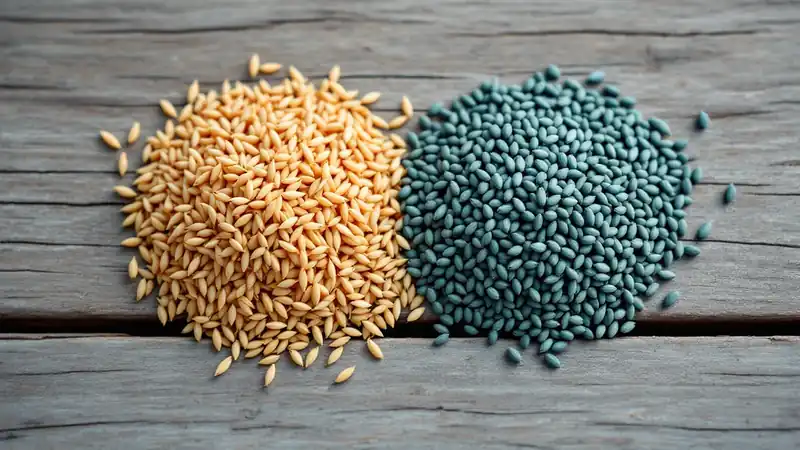
A 50 lb bag of turf-type tall fescue costs $99.99 to $169.99, Kentucky bluegrass $169.99 to $234.99 and perennial ryegrass $79.95 to $189.99 at published October 2026 prices. Coated bermudagrass runs $197.99 to $278.99 per 50 lb, coated centipedegrass $834.99 and coated zoysiagrass $1,249.99.
| 50 lb bag (unless noted) | Published price | Price per lb | What one bag covers at extension rates |
|---|---|---|---|
| Tall fescue, turf-type | $99.99 to $169.99 | $2.00–$3.40 | 6,250–8,333 sq ft (new); 12,500–16,667 sq ft (overseed) |
| Tall fescue, Kentucky 31 | $149.99 | $3.00 | 5,000–6,250 sq ft at Purdue’s 8–10 lb |
| Kentucky bluegrass | $169.99 to $234.99 | $3.40–$4.70 | 16,667–33,333 sq ft |
| Perennial ryegrass | $79.95 to $189.99 | $1.60–$3.80 | 8,333–12,500 sq ft |
| Fine fescue | $127.77 to $207.77 | $2.56–$4.16 | 10,000–16,667 sq ft |
| Bermudagrass, hulled and coated | $277.99 to $278.99 | $5.56–$5.58 | 12,500–25,000 sq ft |
| Bermudagrass, unhulled and coated | $197.99 | $3.96 | 12,500–25,000 sq ft |
| Bermudagrass, turf variety, hulled (25 lb) | $253.99 to $359.99 | $10.16–$14.40 | 12,500–25,000 sq ft per 25 lb |
| Centipedegrass, coated | $834.99 | $16.70 | 50,000–100,000 sq ft |
| Zoysiagrass, coated | $1,249.99 | $25.00 | 12,500–25,000 sq ft |
| Bahiagrass, Pensacola, raw | $209.99 | $4.20 | 5,000–10,000 sq ft |
Bermuda grass seed, 50 lb bag
The cheapest 50 lb bermudagrass bags are unhulled or coated seed, and the price gap tracks how much of the bag is seed. Hancock lists common bermuda four ways: coated and unhulled at $197.99, coated and hulled at $278.99, raw and unhulled at $317.99, and raw and hulled at $429.99 (out of stock in the 50 lb size when checked). Hulled seed has the husk removed and germinates faster; UT Extension says to double the rate for unhulled seed, which can take 14 to 21 days or longer to germinate (UT W160-B). Named turf varieties are sold in 25 lb bags at $10 to $14 a pound. One 50 lb bag of hulled, coated common bermuda covers 12,500 to 25,000 sq ft of new lawn.
Zoysia grass seed, 50 lb bag
Coated Compadre zoysiagrass is the only 50 lb zoysia bag we found in stock: $1,249.99, or $25.00 a pound. The seller’s label calls for 2 to 4 lb per 1,000 sq ft of the coated product for new seedings, so the bag covers 12,500 to 25,000 sq ft. Raw zoysia seed listed at $79.08 a pound (Compadre, 25 lb) and $64.33 a pound (Zenith, 30 lb), both out of stock. The University of Arkansas recommends 1 to 2 lb of pure live seed per 1,000 sq ft for fast cover and 0.5 lb where speed matters less; doubling the rate from 1 to 2 lb raised first-season coverage by at most 11 percent in the research it cites (University of Arkansas MP476). On zoysia, the low rate is usually the better buy.
Big-box, warehouse-club and garden-center bags
Home centers and warehouse clubs mostly sell branded mixes in 3 to 20 lb boxes and bags, many of them coated or blended with fertilizer and mulch. We could not retrieve those prices from a published list, so they are not in our table. Compare them the same way: divide the price by the pounds of seed (not the pounds of product), then multiply by the label’s rate per 1,000 sq ft. Some regional garden centers, such as Grass Pad in the Kansas City and Omaha areas, list their seed online without a price, so call for one.
Coated vs raw seed: read the label before you compare prices
Coated seed weighs more than the seed inside it, and you pay for the coating by the pound. Federal seed rules count it as inert matter: when a lab tests coated seed, “the percentage of coating material shall be included with the inert matter percentage,” and all percentages are figured on the original weight (7 CFR 201.51b). The model state seed law most states draw on goes further and asks coated-seed labels to show the pure seed percentage with the coating removed and the coating percentage by weight (RUSSL 2024, Section 2(g)).
That is why NC State says that if bermudagrass seed is coated, “the seeding rates may need to be doubled” (NC State Extension Gardener Handbook), and why one seller lists 1 to 3 lb of raw Compadre zoysia but 2 to 4 lb of the coated product per 1,000 sq ft.
Formula: pure live seed (PLS) and the real price per pound
PLS = pure seed % × germination %. Price per pound of live seed = bag price per lb ÷ PLS. Pounds of product to spread = target pounds of live seed ÷ PLS. The University of Arkansas defines PLS the same way, as germination percentage multiplied by purity (MP476).
Worked example with illustrative label values (not a specific product): a raw lot labeled 98 percent pure seed and 85 percent germination has a PLS of 0.98 × 0.85 = 83.3 percent. At $9.88 a pound, live seed costs $9.88 ÷ 0.833 = $11.86 a pound. A coated lot labeled 50 percent pure seed and 85 percent germination has a PLS of 42.5 percent; at $5.58 a pound, live seed costs $13.13 a pound, so the cheaper-looking coated bag is the more expensive one.
The germination percentage on the tag also sets how long you wait: our guide to grass seed germination time lists sprouting days by species and the federal lab test period for each.
You can run the break-even without knowing the coating share in advance. Hancock’s coated, hulled common bermuda costs $5.58 a pound against $9.88 for its raw hulled seed, 56 percent as much. If the coated label’s pure-seed share is more than about 56 percent of the raw label’s, the coated bag is cheaper per live seed; if it is less, the raw bag wins. Coated centipedegrass sits at the same 56 percent of the raw price ($16.70 vs $30.00 a pound), and coated zoysia at 32 percent of raw ($25.00 vs $79.08).
| Label item | What the rule says | Good-quality target (Purdue) |
|---|---|---|
| Kind and variety | Mixtures must say so and list each component in order of predominance (7 CFR 201.12a) | Named variety; avoid “variety not stated” |
| Pure seed % | Percent by weight of each component over 5 percent of the whole (RUSSL 2024) | Over 90% |
| Germination % | Required for each kind over 5 percent of the whole (7 CFR 201.20) | Over 85% |
| Inert matter % | Model law caps cool-season lawn seed at 10 percent (15 percent for bluegrass sold without a variety name); coating is reported separately on coated seed (RUSSL 2024) | Under 8% |
| Weed seed % | Model law caps lawn seed at 0.50 percent by weight (RUSSL 2024) | Under 0.3% |
| Other crop seed % | Listed as “crop seed” (RUSSL 2024) | Under 0.5% |
| Noxious weeds | Restricted noxious and “undesirable grass seeds” named by number per pound (RUSSL 2024) | None |
| Test date | Month and year of the germination test; Kentucky bluegrass, fescues and ryegrasses may ship interstate up to 15 months after testing (7 CFR 201.22) | Within the last 9 months |
The federal rules cover seed shipped across state lines; seed sold within a state falls under that state’s seed law, and states adopt the model law in their own versions, so exact limits vary. Certified seed is a separate layer: certifying agencies that belong to the Association of Official Seed Certifying Agencies follow minimum standards “for genetic purity and identity” (AOSCA). Certification tells you the variety is what the tag says; it does not replace the germination and purity numbers.
This page is general information, not legal advice. Seed labeling rules differ by state; check your state department of agriculture’s seed program for the limits that apply where you buy.
Starter fertilizer and straw: the rest of the materials bill
Purdue recommends a phosphorus-rich starter fertilizer at 1.5 lb of P2O5 per 1,000 sq ft at finish grade (Purdue AY-3); a soil test can tell you whether you need it. With an 18-24-12 product that is 6.25 lb of fertilizer per 1,000 sq ft. A 50 lb bag of LESCO 18-24-12 starter lists at $82.99 and covers about 12,000 sq ft at its label rate, or $6.92 per 1,000 sq ft; at Purdue’s rate it is $10.37. A 15-20-10 starter at $79.99 per 50 lb works out to $12.00 per 1,000 sq ft at the same phosphorus rate.
State university labs charge $0 to $40 for that test, and our soil test guide compares 25 of them.
How much straw to cover grass seed
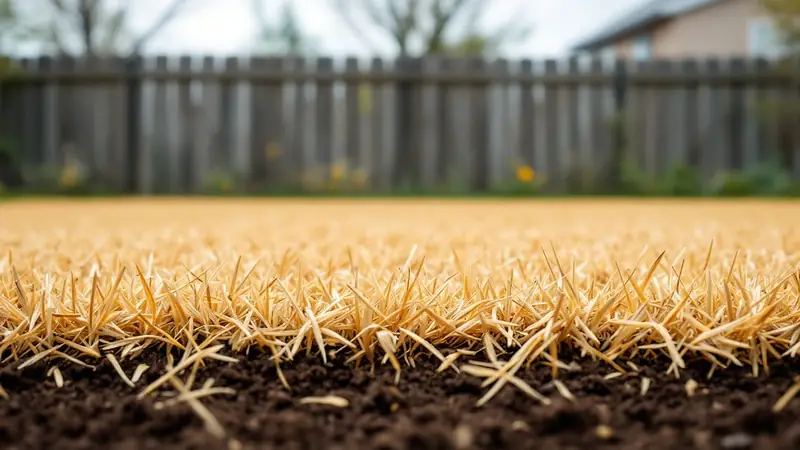
Use one bale of clean, weed-free straw per 1,000 sq ft, spread lightly enough that you can still see about half the soil (Purdue AY-3). UT Extension puts it the same way: one 50 lb bale covers about 1,000 sq ft with 50 to 75 percent of the soil covered (UT W160-B).
On a slope, erosion manuals call for heavier, anchored straw or a stapled blanket; our erosion control guide lists the rates by grade.
NC State allows one to two bales per 1,000 sq ft for cool-season grasses and one bale for warm-season grasses (NC State). An acre takes about 44 bales at one per 1,000 sq ft. Straw matters most where you cannot water often; Purdue warns that heavy mulch shades seedlings and then has to be raked off, while a light layer can stay where it is (Purdue AY-3).
Straw prices vary more than seed. USDA market reporters recorded small square bales of rye straw trading at $7.00 a bale in Iowa (USDA AMS Iowa Direct Hay Report, week ending Oct. 9, 2026) and wheat straw offered at $7.50 a bale in central Arizona (USDA AMS Arizona Direct Hay Report, week ending Oct. 2, 2026), both at the farm. One online seed seller lists a square bale of rye straw at $35.50. Garden-center prices usually fall between farm and shipped-retail prices.
How much to water new grass seed
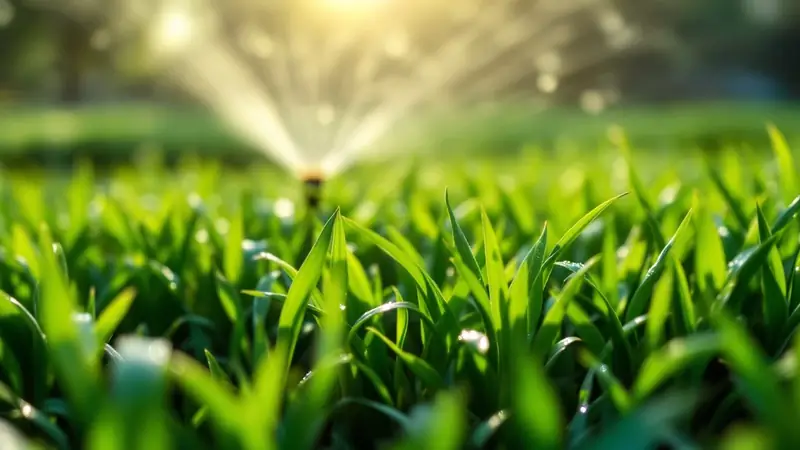
Water new grass seed lightly every day, often two to four times a day, so the top half inch to inch of soil never dries out. UT Extension puts the daily amount at 1/8 to 1/4 inch, about 75 to 150 gallons per 1,000 sq ft, for several weeks. Once seedlings root deeper, switch to about 1/2 inch every two to three days.
After the lawn is established, switch to deep early-morning waterings of about 1 inch a week, as set out in our guide to when and how long to water an established lawn.
| Stage | How often | How much | Gallons per 1,000 sq ft |
|---|---|---|---|
| Seeding to germination | 2 to 4 times a day (Purdue); up to 3 times a day in hot weather (K-State) | Keep the top 0.5 to 1 inch moist (Purdue) | About 75 to 150 per day in total (UT) |
| First several weeks | Daily (UT) | 1/8 to 1/4 inch per day | About 75 to 150 |
| Seedlings about 2 inches tall | Less often, deeper (Purdue) | About 1/2 inch every 2 to 3 days (UT) | About 300 per watering |
| After 2 or 3 mowings | Deep and infrequent (Purdue); about once a week, wetting 6 to 8 inches of soil (NC State) | As needed | n/a |
Formula: gallons of water for your lawn
Gallons = area in sq ft × inches of water × 0.623 (one inch over one square foot is 0.623 gallon). Worked example: 1/4 inch on a 5,000 sq ft seedbed is 5,000 × 0.25 × 0.623 = 779 gallons a day, split across two to four short cycles.
Should I water newly planted grass seed every day?
Yes, until it is up and rooted. NC State’s guidance is light watering two or three times a day for 7 to 21 days, keeping the top 1.5 inches moist, and longer for Kentucky bluegrass, which germinates 7 to 14 days later than other cool-season grasses (NC State). UF/IFAS gives two or three small waterings a day for about two weeks for southern lawns (UF/IFAS LH013).
Can new grass seed be watered too much?
Yes. Too much water at once floats seed off and washes it away (UF/IFAS), and Clemson warns that overwatering also encourages disease (Clemson HGIC). Puddles and runoff mean the cycle is too long; split it into shorter runs.
Is 30 minutes of watering enough?
It depends on how fast your sprinkler puts down water, so time it rather than guess. Set a few straight-sided cans on the seedbed, run the sprinkler for 15 minutes and measure the depth. Minutes needed = target inches ÷ inches caught in 15 minutes × 15. If the cans catch 1/8 inch in 15 minutes, a 1/4-inch day is 30 minutes in total, split into two or three cycles.
When to put grass seed down
Timing changes what you pay, because a failed seeding means buying the seed twice. NC State notes that seeding after its recommended dates increases the chance of failure (NC State Table 9-4).
Our lawn care calendar by month lists the seeding windows for each grass alongside the crabgrass preventer dates that can block them.
If the seed is going into aeration holes, plan both dates together with our lawn aeration timing guide, which counts back from Maryland’s mid-October seeding deadline.
| Grass | Best seeding window | Days to germinate |
|---|---|---|
| Tall fescue, Kentucky bluegrass (Indiana and Illinois) | Aug. 15 to Sept. 15 (Purdue) | 6–12 (tall fescue); 14–21 (bluegrass) (UT) |
| Tall fescue (North Carolina) | Aug. 15 to Sept. 1 in the mountains; Sept. 1 to 15 in the Piedmont; Sept. 15 to Oct. 15 on the coastal plain (NC State) | 6–12 |
| Perennial ryegrass | Fall; for winter overseeding, about 30 days before first frost (Clemson) | 3–7 (UT) |
| Bermudagrass, zoysiagrass | April to July (NC State) | 10–20 hulled bermuda; 10–14 zoysia (UT) |
| Centipedegrass | April to July (Alabama Extension) | 2 to 3 weeks (Alabama Extension) |
| Buffalograss (Nebraska) | Late spring; June 1 is a good target (Nebraska G1946) | 5–10 days for treated seed (Nebraska G1946) |
DIY seeding vs hiring a pro
Doing it yourself on prepared soil, a new 5,000 sq ft tall fescue lawn needs about $130 to $466 in materials. Seed is the biggest variable, and straw the second.
If the soil is not prepared yet, our guide to planting grass seed on bare soil adds the tilling, grading and rental costs, with extension rates for each step.
| Line item, 5,000 sq ft new tall fescue lawn | Quantity | Cost |
|---|---|---|
| Seed | 30–40 lb at 6–8 lb per 1,000 sq ft | $60–$228 |
| Starter fertilizer | Label rate to Purdue’s 1.5 lb P2O5 per 1,000 sq ft | $35–$60 |
| Straw | 5 bales (1 per 1,000 sq ft) | $35–$178 |
| Total materials | $130–$466 | |
| Water | About 375–750 gallons a day for several weeks | Your utility rate |
Hiring changes the math because labor and travel come in. Two public benchmarks frame it:
- Overseeding with aeration. For a 5,000 sq ft cool-season lawn, company price lists we compiled for our aeration cost guide mostly run $225 to $435 for aeration plus seed, and the seed rate explains most of the spread.
- Seeding open ground. On Oklahoma highway contracts from July 2024 to December 2025, seeding averaged $1,255.34 to $1,358.76 an acre and vegetative (straw) mulching $1,222.12 an acre, together about $57 to $59 per 1,000 sq ft (ODOT Weighted Average Item Price Report). Contracts under one acre were awarded at $250 to $9,256.94 an acre, which shows how much a small job’s fixed costs move the price.
Most of what you pay a contractor is labor and overhead, not seed. Landscaping and groundskeeping workers earned a national median of $18.82 an hour in May 2025 and their first-line supervisors $28.09 (BLS OEWS, May 2025); billing rates sit well above pay once payroll taxes, equipment, insurance and profit are added. Our landscaper salary data breaks that pay down by state.
Our view: for a cool-season lawn under about 5,000 sq ft on decent soil, DIY seeding pays if you can water two to four times a day for three weeks. Hire out when the job needs grading, topsoil or a slit seeder, or when nobody will be home to water. On sod, hydroseeding and full-yard projects, see sod installation cost, our sod vs seed comparison (which also covers where hydroseeding fits) and what landscaping costs overall.
What to ask for in a seeding quote
- Pounds of seed per 1,000 sq ft, the species and the named variety. “Premium blend” is not an answer.
- A copy or photo of the seed tag, with the germination test date. Kentucky bluegrass, fescue and ryegrass may ship up to 15 months after testing (7 CFR 201.22); Purdue prefers a test within 9 months (Purdue AY-25-W).
- Whether starter fertilizer, straw or hydromulch, and a return visit for thin spots are included.
- Who waters, and what happens if the seeding fails because it was not watered.
- Whether the company holds any license your state requires for the work, especially if a weed-control product goes down with the seed. Our guide to checking a landscaper’s license shows how.
Red flags on a bag of grass seed
- Annual ryegrass in a permanent-lawn mix. Purdue tells buyers to avoid mixes that contain it, along with ‘Linn’ perennial ryegrass, ‘Kenblue’ bluegrass and ‘KY31’ tall fescue for quality lawns (Purdue AY-25-W). Purdue lists KY31 only for roadside and low-maintenance areas, at 8 to 10 lb per 1,000 sq ft.
- Variety not stated (VNS). Purdue warns that VNS lots often include older cultivars not well adapted to lawns.
- Old test date. A tag past its sell-by or test window may have lost germination.
- High inert matter on raw seed. On uncoated seed, inert above about 8 percent means you are paying for chaff (Purdue AY-25-W).
- St. Augustinegrass “seed.” UF/IFAS lists St. Augustinegrass as established by sod, sprigs and plugs, not seed (UF/IFAS LH013).
How we built these numbers
We have no job or sales data of our own. On October 18, 2026, we recorded 62 bag prices for lawn grass seed from the published price lists of Hancock Seed, Lawn Synergy, Seed Barn, Seed World USA, Outsidepride and Nature’s Seed, including whether each size was in stock. Prices exclude shipping, sales tax and promotions. Big-box and warehouse-club prices are not included because we could not retrieve them from a published list.
Seeding rates come from land-grant university extension publications: K-State (tall fescue, bluegrass, overseeding), UT Extension W160-B (bluegrass, ryegrass, fine fescue, unhulled bermuda), NC State Table 9-4 (bermudagrass, centipedegrass, zoysiagrass) and NC State’s advice that coated bermudagrass seed may need double the rate, which we apply to all coated warm-season seed, Alabama Extension (raw centipedegrass), Nebraska G1946 (buffalograss) and UF/IFAS LH013 (bahiagrass). Where sources differ, we show the wider range.
Why Colorado State recommends 3 to 5 lb of buffalograss seed per 1,000 sq ft while Nebraska says 1 to 2 lb is laid out in our buffalo grass lawn guide.
Seed cost per 1,000 sq ft runs from the low seeding rate × the price per pound of the seller’s largest in-stock bag to the high rate × the 10 lb bag price (Hancock Seed, except buffalograss, whose high end uses Seed Barn’s 10 lb bag). Per-acre costs use 43,560 sq ft and bulk-bag prices only. Overseeding uses half the new-lawn rate, per K-State. Starter fertilizer runs from the LESCO label rate ($6.92 per 1,000 sq ft) to Purdue’s 1.5 lb P2O5 with a 15-20-10 product ($12.00). Straw is one bale per 1,000 sq ft at $7.00 (USDA AMS farm trade) to $35.50 (shipped retail). The calculator uses exactly these per-square-foot figures. All costs are estimates; your local price will differ. See our methodology for how we handle sources and corrections.
Grass seed cost questions
How much does it cost to seed a 1000 square foot lawn?
Seed alone costs about $5 to $18 for Kentucky bluegrass, $10 to $30 for perennial ryegrass and $12 to $46 for tall fescue at published October 2026 prices (estimate). Add about $7 to $12 for starter fertilizer and $7 to $36 for a bale of straw, so roughly $26 to $94 in materials for tall fescue.
Microclover is the expensive exception at $21.30 to $59.80 a pound in October 2026 listings; per-1,000 sq ft costs are in our clover lawn pros and cons guide.
How much does 100 lb of grass seed cost?
Two 50 lb bags of turf-type tall fescue cost about $200 to $340, Kentucky bluegrass about $340 to $470, and perennial ryegrass about $160 to $380 at published prices. One hundred pounds of coated hulled bermudagrass runs about $556 to $558.
What’s a good price for grass seed?
In 50 lb bags, $2.00 to $3.40 a pound is typical for turf-type tall fescue and $3.40 to $4.70 for Kentucky bluegrass. Judge price per 1,000 sq ft and per pound of pure live seed, not price per bag: a cheap coated or variety-not-stated bag can cost more per square foot of lawn.
How much will a 25 lb bag of grass seed cover?
At extension new-lawn rates, 25 lb covers about 3,125 to 4,167 sq ft of tall fescue, 4,167 to 6,250 sq ft of perennial ryegrass, 8,333 to 16,667 sq ft of Kentucky bluegrass and 12,500 to 25,000 sq ft of raw hulled bermudagrass. Overseeding at half rate doubles those figures.
How many 50 lb bags of grass seed per acre?
Six to seven bags of tall fescue (261 to 348 lb), two to three of Kentucky bluegrass (65 to 131 lb), four to six of perennial ryegrass and one to two of raw hulled bermudagrass for a new lawn, based on Purdue, UT and NC State rates.
Can I just throw grass seed on the ground?
You can, but much of it will not establish. Purdue recommends a drop spreader in two directions, then a light raking and rolling for good seed-to-soil contact, which it calls critical for quick germination (Purdue AY-3).
How long does it take for grass seed to grow 3 inches?
Germination alone takes 3 to 7 days for ryegrass, 6 to 12 for tall fescue and 14 to 21 for Kentucky bluegrass (UT W160-B), and growth to mowing height follows over the next few weeks depending on temperature and water. UT says to start mowing tall fescue and ryegrass at 2 inches once plants average 3 inches tall.
How long do you leave straw over grass seed?
If you spread one bale per 1,000 sq ft, you can leave it. Purdue says a light covering “will not have to be removed after germination”; only heavy layers that shade the seedlings need raking off (Purdue AY-3).
For more pricing guides, see our landscaping costs hub.
Sources
- Hancock Seed, Lawn grass seed product price pages (turf-type tall fescue, Titan RX, Kentucky bluegrass, Blue Velvet, perennial ryegrass, fine fescues, bermudagrass in six forms, centipedegrass, Compadre and Zenith zoysiagrass, buffalograss, Pensacola bahiagrass, rye straw), Prices checked Oct. 18, 2026. Accessed October 2026.
- Lawn Synergy, Tall fescue, perennial ryegrass, LESCO bermudagrass and starter fertilizer product price pages, Prices checked Oct. 18, 2026. Accessed October 2026.
- Seed Barn, Royal TXD bermudagrass, Texoca buffalograss and Tri Star perennial ryegrass price pages, Prices checked Oct. 18, 2026. Accessed October 2026.
- Seed World USA, Tri Star perennial ryegrass, SR 5130 chewings fescue and Tenacious hard fescue price pages, Prices checked Oct. 18, 2026. Accessed October 2026.
- Outsidepride, Lawn grass seed category page (Royal TXD bermudagrass, Legacy fine fescue), Prices checked Oct. 18, 2026. Accessed October 2026.
- Nature’s Seed, Lawn seed product pages (tall fescue, bluegrass and ryegrass mixes, Sundancer buffalograss), Prices checked Oct. 18, 2026. Accessed October 2026.
- Kansas State University, Fall Turfgrass Recommendations and Tips, August 2019. Accessed October 2026.
- University of Tennessee Extension, W160-B, Turfgrass Establishment: Seeding, Undated publication. Accessed October 2026.
- NC State Extension, Extension Gardener Handbook, Chapter 9: Lawns (Table 9-4), Current online edition. Accessed October 2026.
- Purdue University and University of Illinois, AY-3-W, Establishing Turfgrass Areas From Seed, Rev. May 2006. Accessed October 2026.
- Purdue University and University of Illinois, AY-25-W, Purchasing Quality Grass Seed for Your Lawn, Undated publication. Accessed October 2026.
- Alabama Cooperative Extension System, Home Lawns: Centipedegrass, Current web page. Accessed October 2026.
- University of Nebraska-Lincoln Extension, G1946, Establishing Buffalograss Turf in Nebraska, May 2009. Accessed October 2026.
- UF/IFAS Extension, ENH-03/LH013, Establishing Your Florida Lawn, Current EDIS edition. Accessed October 2026.
- University of Arkansas Cooperative Extension, MP476, Establishing Seeded Zoysiagrass on Lawns and Golf Courses, 2009. Accessed October 2026.
- Clemson Cooperative Extension, Home & Garden Information Center, Overseeding with Ryegrass, Current web page. Accessed October 2026.
- Electronic Code of Federal Regulations, 7 CFR Part 201, Federal Seed Act Requirements (sections 201.12a, 201.20, 201.22, 201.51b), Current as of Oct. 2026. Accessed October 2026.
- Association of American Seed Control Officials, Recommended Uniform State Seed Law (RUSSL), 2024 edition, Amended July 2024. Accessed October 2026.
- Association of Official Seed Certifying Agencies, About AOSCA, Current web page. Accessed October 2026.
- USDA Agricultural Marketing Service, Iowa Direct Hay Report (straw, small squares), Week ending Oct. 9, 2026. Accessed October 2026.
- USDA Agricultural Marketing Service, Arizona Direct Hay Report (straw, small squares), Week ending Oct. 2, 2026. Accessed October 2026.
- Oklahoma Department of Transportation, Weighted Average Item Price Report, July 1, 2024 to Dec. 31, 2025 (items 232 and 233), Published Jan. 22, 2026. Accessed October 2026.
- U.S. Bureau of Labor Statistics, Occupational Employment and Wage Statistics, Landscaping and Groundskeeping Workers (37-3011) and First-Line Supervisors (37-1012), May 2025. Accessed October 2026.
- Eartheasy, Grass Seed Calculator (seeding rates used), Checked Oct. 2026. Accessed October 2026.
- LawnStarter, How Much Does It Cost to Seed a Lawn in 2026?, Checked Oct. 2026 (cited only as an example of unsourced figures). Accessed October 2026.