When to aerate a lawn depends on the grass: aerate cool-season lawns in early fall or April, while soil is 50 to 65°F; aerate warm-season lawns in late spring to early summer, once soil at 4 inches holds 65°F.
Key takeaways
- Cool-season lawns (Kentucky bluegrass, tall fescue, perennial ryegrass) aerate best in September or April, the two months named by Purdue Extension AY-8 and Iowa State Extension.
- Most cool-season grasses grow their best roots at soil temperatures of 50 to 65°F, according to Penn State Extension, which is why fall beats summer.
- Warm-season lawns (bermudagrass, zoysiagrass, centipedegrass, St. Augustinegrass) aerate from late spring into summer; the University of Georgia ties the start to soil at the 4-inch depth holding 65°F and rising.
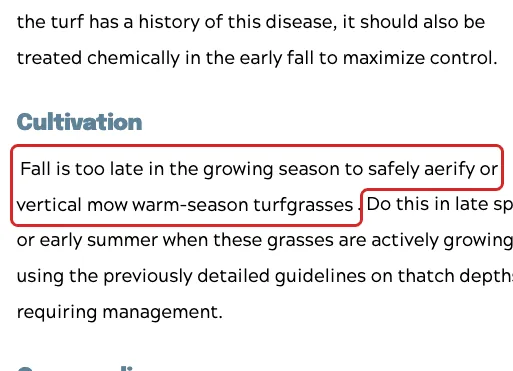
- Leave at least 4 weeks of good growing weather after aerating (Kansas State MF2130; Clemson Extension). Virginia Tech says fall is too late for warm-season grasses.
- Frequency follows soil: 2 to 3 times a year on poorly drained clay, every 2 to 3 years on silt loam and maybe never on sand (Nebraska turfgrass program, 2026).
When is the best time to aerate your lawn?
The best time to aerate a lawn is when the grass is growing fast enough to fill the holes. For cool-season grasses that means late summer to early fall, with April as the second window; for warm-season grasses it means late spring through midsummer. Nebraska Extension puts the rule in one line: wait until your lawn is actively growing to aerify.
| Timing threshold | Value | Applies to | Source |
|---|---|---|---|
| Best root growth, cool-season grasses | Soil at 50 to 65°F | Kentucky bluegrass, tall fescue, ryegrass, fine fescue | Penn State Extension, 2025 |
| Best leaf growth, cool-season grasses | Temperatures of 60 to 75°F | Same | Penn State Extension, 2025 |
| Start trigger, warm-season grasses | Soil at 4 inches consistently 65°F and rising | Bermudagrass, zoysiagrass, centipedegrass, St. Augustinegrass (Georgia) | UGA CAES Field Report, 2017 |
| Best growth, St. Augustinegrass | Temperatures of 80 to 95°F | St. Augustinegrass (Texas) | Texas A&M AgriLife, 2026 |
| Recovery time after aerating | At least 4 weeks of good growing weather | All lawns | K-State MF2130, 2018; Clemson HGIC 1200, 2020 |
| Core depth | At least 3 inches | All lawns | Nebraska Extension, 2022 |
| Hole density | 20 to 40 holes per sq ft | All lawns | Purdue AY-8; Iowa State, 2024 |
| Thatch trigger | More than 1/2 inch | All lawns | K-State MF2130, 2018 |
| Watering ahead in dry weather | Water deeply 2 days before | All lawns | Nebraska Extension, 2022 |
Soil moisture decides the day inside the window. Penn State Extension says dry soil keeps tines from going deep enough and can break them, while wet soil adds compaction because most ride-on aerators weigh well over 1,000 lb; aim for a full 2.5 to 4 inch core. Clemson’s test for too wet: if soil sticks to your shoes or to a soil probe, wait.
The same soil check applies to the mower; ruts, slope limits and wait times are in our guide to mowing wet grass.
What month should you aerate, by region and grass?
September is the month extension services name most often for cool-season lawns, and May through July for warm-season lawns. The table compiles 21 published windows from 17 publications at 14 land-grant universities, from Oregon to Georgia, each with its source and date, so you can match your own state and grass instead of a national rule of thumb.
Swipe the table sideways to see every column.
| State or region | Grass | Aeration window | Condition attached | Source |
|---|---|---|---|---|
| Iowa | Kentucky bluegrass, other cool-season | April; September | Allows quick recovery in mild weather | Iowa State, Apr. 2024 |
| Indiana | Kentucky bluegrass, ryegrass, fine and tall fescue | April or September | When actively growing | Purdue AY-8, rev. May 2026 |
| Indiana | Zoysiagrass | Early to mid-summer | Active growth | Purdue AY-8 |
| Kansas | Bluegrass, fescue, ryegrass | March, April or September | Before fertilizing, seeding or crabgrass preventers | K-State MF2130, Feb. 2018 |
| Kansas | Bermudagrass, buffalograss, zoysiagrass | Late May through July | Allow at least 4 weeks of good growing weather | K-State MF2130 |
| Nebraska | Kentucky bluegrass, fescues, perennial ryegrass | Early April to end of May; late August to end of October | Water deeply 2 days ahead if dry | Nebraska Extension, Apr. 2022 |
| Nebraska | Zoysiagrass, buffalograss | Late May to late August | Active growth | Nebraska Extension |
| Pennsylvania | Cool-season lawns | Early to mid-spring; late summer to early fall | Cool weather; spring can raise weed seeds | Penn State, Apr. 2025 |
| Illinois | Cool-season lawns | Fall | A few days after rain, soil slightly damp | Illinois Extension, Sept. 2024 |
| Maryland | Tall fescue, fine fescue | Mid-August to mid-October | Seed no later than mid-October | Univ. of Maryland, Mar. 2026 |
| Maryland | Zoysiagrass | Late spring into early summer | Dormant mid-October to mid-May | Univ. of Maryland |
| Virginia | Cool-season lawns | Fall | Refrain from aerifying until fall | Virginia Tech 430-520, 2025 |
| Virginia | Bermudagrass, zoysiagrass, St. Augustinegrass, centipedegrass | Late spring or early summer | Fall is too late | Virginia Tech 430-520 |
| North Carolina | Tall fescue | September through November | Delay aeration until fall | NC State, July 2021 |
| South Carolina | Kentucky bluegrass, tall fescue | Fall | Allow at least 4 weeks of good growing weather | Clemson HGIC 1200, Apr. 2020 |
| South Carolina | Zoysiagrass, centipedegrass, St. Augustinegrass, bermudagrass | Late spring and summer | Mild day, moderately moist soil | Clemson HGIC 1200; Clemson News, May 2025 |
| Georgia | Tall fescue | September or October | No summer aeration | University of Georgia, July 2020 |
| Georgia | Warm-season lawns | Late April through mid-May to speed green-up; May through August | Soil at 4 inches consistently 65°F | UGA Field Report, Mar. 2017; UGA Extension Fulton Co., May 2025 |
| Colorado | Colorado lawns (mostly cool-season) | Spring and fall best; any time the ground is not frozen | Not when extremely hot and dry | Colorado State PlantTalk 1505 |
| Western Oregon | Kentucky bluegrass | Spring or fall | Damp, not wet, soil | Oregon State Extension |
| Texas | St. Augustinegrass | When actively growing | Avoid frosts, high heat and drought | Texas A&M AgriLife, 2026 |
| Month | Cool-season sources naming it (of 6) | Warm-season sources naming it (of 4) |
|---|---|---|
| March | 1 | 0 |
| April | 4 | 1 |
| May | 1 | 4 |
| June | 0 | 3 |
| July | 0 | 3 |
| August | 2 | 2 |
| September | 6 | 0 |
| October | 3 | 0 |
The split mirrors the growth curves. Cool-season roots peak in 50 to 65°F soil, while Texas A&M AgriLife says St. Augustinegrass grows best at 80 to 95°F, and the two groups’ most-named months, May and September, sit four months apart. Every cool-season source that names months includes September; every warm-season source includes May. Our month-by-month lawn care schedule places aeration alongside fertilizer and preventer dates.
Spring or fall for cool-season grass?
Fall is the stronger window for Kentucky bluegrass and tall fescue; spring is the fallback. Clemson HGIC 1200 prefers fall because heat stress and weedy annual invasion are lower, and Penn State warns that spring aeration can bring weed seeds to the surface. Oregon State Extension still rates spring as good, because grasses build new roots then, and reports research showing aerated lawns can use 20 to 30 percent less water.
Goosegrass, prostrate knotweed and broadleaf plantain are classic signs of compacted soil, as our guide to common lawn weeds explains.
How early is too early, and how late is too late?
Too early means aerating before the grass is actively growing: a cool-season lawn before soil warms toward 50°F, or a warm-season lawn before soil at 4 inches holds 65°F. Too late means any date that leaves less than 4 weeks of good growing weather before summer heat, winter cold or dormancy closes the holes off from recovery.
Cool-season lawns: the 50 to 65°F root window
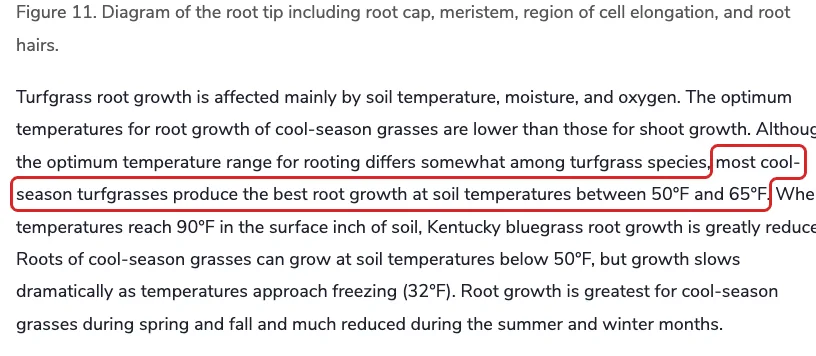
Penn State Extension sets the target: most cool-season turfgrasses produce their best root growth at soil temperatures between 50°F and 65°F. Roots still grow below 50°F but slow sharply toward 32°F, and Kentucky bluegrass root growth is greatly reduced when the top inch of soil reaches 90°F. That is why NC State Extension tells tall fescue owners to delay aeration until fall.
Warm-season lawns: wait for 65°F at 4 inches
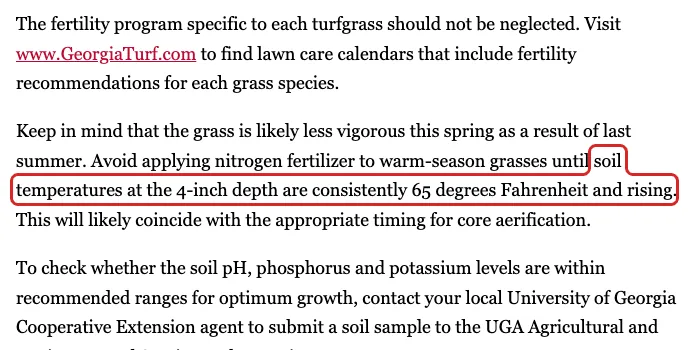
For bermudagrass, zoysiagrass, centipedegrass and St. Augustinegrass, the University of Georgia ties timing to a soil reading: hold nitrogen until soil at the 4-inch depth is consistently 65°F and rising, which it says will likely coincide with the right time to core aerate. Its field report recommended late April through mid-May for Georgia lawns recovering from drought. University of Maryland Extension notes zoysia stays dormant from mid-October to mid-May there.
Counting back from your deadline
The latest safe date is arithmetic: take the end of your growing or seeding window and subtract the recovery time. Clemson HGIC 1200 asks for at least 4 weeks of good growing weather after aerating and about a month for holes to heal before seeding into them; Colorado State Extension says lawns may be seeded immediately after aeration. The table runs both rules.
| Lawn and plan | Deadline input (source) | Rule applied (source) | Arithmetic | Latest aeration date |
|---|---|---|---|---|
| Tall fescue, central Maryland, aerate then overseed a month later | Sow seed no later than mid-October, taken as Oct. 15 (Univ. of Maryland) | Holes heal about a month before seeding (Clemson HGIC) | Oct. 15 minus 30 days | Sept. 15 |
| Same lawn, seed the same day as aerating | Oct. 15 seeding deadline (Univ. of Maryland) | Seed immediately after aerating (Colorado State); seed takes about 2 weeks to germinate (Univ. of Maryland) | Oct. 15 plus 14 days = Oct. 29 germination, before November killing frosts | Oct. 15 |
| Kentucky bluegrass, Iowa, September aeration | Aerate Sept. 15 (Iowa State window) | Fertilize 1 week before (Iowa State); water deeply 2 days before if dry (Nebraska) | Sept. 15 minus 7 days; minus 2 days | Fertilize Sept. 8, water Sept. 13, aerate Sept. 15 |
| Bermudagrass or zoysiagrass, Kansas | Window ends July 31 (K-State MF2130) | At least 4 weeks of good growing weather (K-State) | July 31 plus 28 days = Aug. 28 | July 31 |
| Warm-season lawn, metro Atlanta | Window ends Aug. 31 (UGA Extension Fulton Co.) | At least 4 weeks of good growing weather (K-State MF2130) | Aug. 31 plus 28 days = Sept. 28 | Aug. 31; fall is too late (Virginia Tech) |
How often should you aerate your lawn?
How often to aerate a lawn depends on soil texture and traffic, not on a fixed annual schedule. The University of Nebraska turfgrass program recommends 2 to 3 aerations a year on clay that drains poorly, once every 2 to 3 years on silt loam and maybe never on sandy soil. Clemson HGIC 1200 gives the same spread: once every couple of years to 2 to 4 times a season.
| Soil and use | How often | Source |
|---|---|---|
| Clay that drains poorly | 2 to 3 times a year | Nebraska turfgrass program, 2026 |
| Clay with heavy use, or heavy foot or pet traffic | Twice a year | K-State MF2130; Iowa State |
| Well-drained soil, light traffic | Once a year | K-State MF2130; Iowa State |
| Excessive thatch buildup | More than twice a year | K-State MF2130 |
| Silt loam | Every 2 to 3 years | Nebraska turfgrass program |
| Sandy soil | Maybe never | Nebraska turfgrass program |
| Georgia home lawns | At least every 3 to 4 years; once or twice a year where compacted | University of Georgia, 2020 |
| Centipedegrass and St. Augustinegrass in traffic | More often than bermudagrass or zoysiagrass | Clemson HGIC 1200 |
| Sodded lawns | Extra aeration, starting a few months after sodding | Nebraska turfgrass program |
Patience counts too. K-State says it takes three consecutive years of aeration for a yard to receive the full effect, so a single pass on hard clay is a start, not a fix. Prices for one or two passes are in our lawn aeration cost guide.
How do you tell if your lawn needs aeration?
Two five-minute tests settle it: a screwdriver probe for compaction and a cut wedge for thatch. Clemson HGIC 1200 says that if a screwdriver enters the soil with little resistance you probably do not need to aerify, and K-State says a thatch layer over 1/2 inch means the turf needs aeration. Do both on evenly moist soil, as Illinois Extension advises.
| Test | How to do it | Threshold | Source |
|---|---|---|---|
| Screwdriver probe | Push a long screwdriver into moist soil in several spots, including paths and dog runs | Hard to push in: aerate; slides in easily: skip | Clemson HGIC 1200; Illinois Extension |
| Thatch wedge | Cut a small wedge of turf down to the soil with a knife and measure the brown layer | More than 1/2 inch: aerate | K-State MF2130 |
| Thatch wedge, heavy | Same measurement | 1 inch or more: dethatch; thicker than 1 inch: sod cutter and re-establish | Penn State; Purdue AY-8 |
| Soil squeeze | Squeeze a ball of moist soil in your hand | Holds together: clay, aerate more often; breaks apart: loam | K-State MF2130 |
A thatch layer past 1 inch is a dethatching job rather than an aeration job; our lawn dethatching cost guide compares the two by price. Kansas State’s table of how deep children, dogs, cars and construction equipment compact soil sits in our aeration cost breakdown.
What should you do before and after aerating?
Start 7 days ahead with fertilizer, water 2 days ahead if the soil is dry, and leave the cores on the lawn afterward. Each step below carries its measurement or wait time and the extension source behind it. Two steps differ between sources, fertilizer timing and the seeding wait, so both versions are shown.
- 7 days before: fertilize, if you plan to; Iowa State recommends fertilizing one week prior to aeration. Colorado State instead allows fertilizing and seeding immediately after.
- 1 to 3 days before: flag every sprinkler head, shallow irrigation line and cable TV line (Colorado State). A cracked head means a repair call.
- 2 days before, if dry: water deeply so tines can reach depth (Nebraska Extension); Colorado State says to water thoroughly the day before.
- Day of: check that soil does not stick to your shoes (Clemson HGIC 1200), then pull cores 2.5 to 4 inches long (Penn State) and at least 3 inches deep (Nebraska Extension).
- Passes: go over the lawn twice, the second pass at a right angle (Clemson HGIC 1200), toward 20 to 40 holes per sq ft (Purdue AY-8). Rental machines usually need several passes to get there.
- Cores: leave them; Illinois Extension says they break down over the next few weeks, and Iowa State suggests a drag mat to speed it up.
- Water: water soon after aerating (Colorado State), especially if the weather is dry (Iowa State).
- Seed: seed the same day (Colorado State) or wait about a month so seedlings do not come up only in the holes (Clemson HGIC 1200, which also calls for 6 to 10 passes before seeding). Seed rates and prices are in our grass seed cost guide. The full seeding sequence is in our guide on how to overseed a lawn.
- Crabgrass preventer: apply it after aerating, not before (Clemson HGIC 1200; K-State MF2130). Preventer timing by soil temperature is in our crabgrass control guide.
Should you kill weeds before aerating?
In fall, yes: Illinois Extension names fall as the time to kill broadleaf weeds such as dandelion and creeping Charlie with a systemic herbicide, and cooler weather lets cool-season grass fill the gaps. In spring, the bigger risk is new weeds: Penn State says spring aeration can bring weed seeds to the surface. University of Maryland Extension warns that a preemergent can rule out seeding the same season.
Which systemic active ingredient controls creeping Charlie, and which grasses each one injures, is laid out in our guide to the best weed killer for lawns.
This page is general information, not pesticide advice. The product label is the law: check its reseeding interval before you spray and seed, and note that applying herbicide for hire requires a state license; see our guide to the pesticide applicator license for lawn care.
What do common aeration guides get wrong about timing?
Several high-ranking aeration guides repeat rules the primary sources do not support, such as timing aeration by USDA Hardiness Zone, a map the USDA builds from extreme minimum winter temperatures. The table sets six common claims against the extension or federal source that addresses each one; each can push an aeration into the wrong month or frequency.
| Common guide advice | What the primary source says | Source |
|---|---|---|
| Pick your aeration month from your USDA Hardiness Zone | The zone map is based on the average annual extreme minimum winter temperature, not growing-season soil temperature | USDA ARS Plant Hardiness Zone Map |
| Thatch must exceed 1 inch before it matters | Thatch over 1/2 inch means the turf needs aeration; 1 inch is Penn State’s dethatching threshold | K-State MF2130; Penn State |
| Most lawns need aeration once a year | 2 to 3 times a year on poorly drained clay; every 2 to 3 years on silt loam; maybe never on sand | Nebraska turfgrass program |
| Spike aerators are presented as an alternative to core aerators | Avoid spike devices; solid tines and spikes increase compaction between holes in clay and silt | Iowa State; Nebraska Extension |
| Aerating after a crabgrass preventer breaks the barrier (also stated in Clemson HGIC 1200) | Research cited by Nebraska found no loss of crabgrass control; it still advises aerating first where possible | Nebraska turfgrass program, citing Branham and Rieke 1986 |
| Liquid aeration can replace core aeration | There is no chemical substitute for physical relief of compaction; at best a wetting agent effect | Colorado State PlantTalk 1545 |
Should you aerate now or wait?
Aerate now if the grass is actively growing, the soil is moist but not sticky, a test shows compaction or thatch over 1/2 inch, and at least 4 weeks of good growing weather remain. Wait if any of those fails. The decision table and the flowchart below carry the same logic, each with the threshold and the source behind it.
| If your situation is | Do this | Why (source) |
|---|---|---|
| Cool-season lawn, late August to October, 4+ weeks of growing weather left | Aerate now | Fall window and recovery rule (Nebraska Extension; Clemson HGIC 1200) |
| Cool-season lawn in July or August heat | Wait for fall | Delay aeration until fall (NC State) |
| Cool-season lawn in spring, crabgrass preventer planned | Aerate first, then apply the preventer | Aerate before preventers (K-State MF2130) |
| Warm-season lawn, soil at 4 inches below 65°F or not fully green | Wait and recheck weekly | 65°F and rising trigger (UGA) |
| Warm-season lawn, September or later | Wait until late spring | Fall is too late (Virginia Tech) |
| Soil sticks to shoes or probe | Wait for it to dry | Wet soil adds compaction (Clemson HGIC 1200) |
| Soil too hard for the screwdriver after a dry spell | Water deeply, aerate 2 days later | (Nebraska Extension) |
| Screwdriver slides in, thatch under 1/2 inch, sandy soil | Skip this year | Sand may never need it (Nebraska turfgrass program) |
| Thatch 1 inch or more | Dethatch, or remove with a sod cutter if thicker | (Penn State; Purdue AY-8) |
| Sod laid in the last few months | Wait a few months | Lets roots anchor (Nebraska turfgrass program) |
| Ground frozen | Wait | (Colorado State) |
1Is the ground frozen, or is the weather extremely hot and dry?
YesWait. Colorado State says not to aerate frozen ground or during extreme heat and drought.
NoGo to the next question
2Does a screwdriver slide easily into moist soil, with thatch under 1/2 inch?
YesSkip aeration this season. Compaction is unlikely (Clemson HGIC 1200; K-State MF2130).
NoGo to the next question
3Was the lawn sodded in the last few months?
YesWait a few months so the sod can root (Nebraska turfgrass program).
NoGo to the next question
4Does soil stick to your shoes or a probe?
YesWait for the soil to dry to moist, not wet (Clemson HGIC 1200).
NoGo to the next question
5Is it a cool-season lawn (bluegrass, fescue, ryegrass)?
YesAerate from late August to October, or in April, with at least 4 weeks of good growing weather left (Nebraska Extension; Clemson HGIC 1200).
NoGo to the next question
6Is soil at 4 inches holding 65°F and rising, and is it before September?
YesAerate the warm-season lawn now, late spring through summer (UGA; K-State MF2130).
NoWait: recheck soil temperature weekly in spring, or wait until next late spring if it is fall (Virginia Tech).
Wait until the grass is actively growing.
New sod is a case for waiting: the Nebraska turfgrass program advises a few months of rooting first so the aerator does not pull pieces out of place. Our sod installation cost guide covers the install itself. Grass-by-grass guides sit in our Turf and Trees section.
How we compiled this
We compiled aeration timing rules from 23 primary documents: 22 publications from 14 land-grant university extension services and the USDA ARS Plant Hardiness Zone Map page, all accessed in October 2026. We read each source directly and recorded its stated window, condition and publication date; the month counts and the count-back dates are our own arithmetic from those rules. We did not aerate, test or survey any lawns.
Frequently asked questions
How early is too early to aerate a lawn?
It is too early if the grass is not actively growing yet. For warm-season lawns, the University of Georgia ties the start to soil at 4 inches holding 65°F and rising, usually late April to mid-May in Georgia. For cool-season lawns, wait for spring growth; Kansas State names March and April.
What month should I aerate my lawn?
For cool-season lawns, September is named by all 6 extension sources in our table that give months, with April second. For warm-season lawns, May is named by all 4, with June and July close behind. Check your own state’s row in the table above.
Should you dethatch or aerate first?
Measure the thatch first. Under 1/2 inch, aerate only; core aeration also breaks down thatch over time, though Purdue says that can take several years. At 1 inch or more, Penn State calls for dethatching, and Purdue says thatch thicker than 1 inch is easiest to remove with a sod cutter.
Should I pick up plugs after aerating?
No. Illinois Extension says to leave the soil cores to break down over the next few weeks, and Colorado State says to leave them on lawns with more than 1/2 inch of thatch so they work back in. A drag mat or a piece of fencing, as Iowa State suggests, speeds it up.
When should you not aerate your lawn?
Skip it on frozen ground, in extreme heat and drought (Colorado State), on soil wet enough to stick to your shoes (Clemson HGIC 1200), on warm-season grass in fall (Virginia Tech), and within a few months of laying sod (Nebraska turfgrass program).
Should I water immediately after aeration and overseeding?
Yes. Colorado State says to water the lawn soon after aeration, and Iowa State says to irrigate afterward if the weather is dry. If you seeded, keep the seedbed moist with light watering several times a day, as NC State advises for overseeded tall fescue.
Can you aerate the lawn too much?
On clay, more is usually fine: Clemson HGIC 1200 allows 2 to 4 times a season on heavy soils with heavy traffic, and Nebraska recommends 2 to 3 times a year on poorly drained clay. On sand, Nebraska says aeration may never be needed, so repeat passes there buy little.
Is it okay to aerate my lawn and then fertilize it?
Yes. Colorado State says lawns may be fertilized and seeded immediately after aeration. Iowa State prefers fertilizing one week before aerating to help recovery. Either order works; avoid aerating a cool-season lawn in summer heat to make a fertilizer date fit.
Sources
- Purdue University Extension, AY-8: Mowing, Dethatching, Aerifying and Rolling Turf, page modified May 11, 2026. Accessed October 2026.
- Kansas State University Research and Extension, MF2130 Aerating Your Lawn, February 2018. Accessed October 2026.
- Penn State Extension, The Cool-Season Turfgrasses: Basic Structures, Growth and Development, September 19, 2025. Accessed October 2026.
- Penn State Extension, Lawn Management through the Seasons, April 30, 2025. Accessed October 2026.
- Penn State Extension, Tips to Improve Your Lawn Care Program This Fall, September 11, 2025. Accessed October 2026.
- Nebraska Extension in Lancaster County, Getting Your Lawn Ready for Summer: Aeration, April 17, 2022. Accessed October 2026.
- University of Nebraska-Lincoln Turfgrass Science, Updated information on lawn aerification, August 20, 2026. Accessed October 2026.
- Iowa State University Extension, Core Aeration of Lawns, April 2024. Accessed October 2026.
- Clemson University Home and Garden Information Center, HGIC 1200: Aerating Lawns, revised April 29, 2020. Accessed October 2026.
- Clemson News, Healthy lawns in South Carolina: Why aeration matters, May 27, 2025. Accessed October 2026.
- University of Georgia CAES Field Report, Stimulate lawn growth early with aerification, March 9, 2017. Accessed October 2026.
- University of Georgia Integrated Pest Management, Stay on Schedule to Maintain Healthy Turfgrass, July 21, 2020. Accessed October 2026.
- UGA Extension Fulton County, May Lawn Care Update, May 2025. Accessed October 2026.
- NC State Extension, Tall Fescue Lawn Maintenance Calendar, July 8, 2021. Accessed October 2026.
- University of Maryland Extension, Lawn Maintenance Calendar, updated March 16, 2026. Accessed October 2026.
- Virginia Cooperative Extension, Virginia Tech, 430-520 Fall Lawn Care, 2025. Accessed October 2026.
- Colorado State University Extension, PlantTalk Colorado, 1505: Lawn Aeration, undated web page. Accessed October 2026.
- Colorado State University Extension, PlantTalk Colorado, 1545: Liquid Lawn Aeration, undated web page. Accessed October 2026.
- Oregon State University Extension Service, Best time to aerate?, undated web page. Accessed October 2026.
- University of Illinois Extension, Five fall tips for cool-season lawn care, September 5, 2024. Accessed October 2026.
- University of Illinois Extension, Lawn Aeration and Overseeding, September 10, 2020. Accessed October 2026.
- Texas A&M AgriLife Extension, St. Augustinegrass Lawn Management, 2026. Accessed October 2026.
- USDA Agricultural Research Service, USDA Plant Hardiness Zone Map, 2023 map. Accessed October 2026.