How long does it take grass seed to grow? Sprouts appear in 3 to 21 days for cool-season seed (ryegrass first, Kentucky bluegrass last) and 10 to 30 days for warm-season seed; mowing starts 2 to 6 weeks after seeding.
Key takeaways
- Perennial ryegrass sprouts in 3 to 7 days, tall fescue in 6 to 12, fine fescues in 6 to 14 and Kentucky bluegrass in 14 to 21, according to University of Tennessee Extension W160-B.
- Federal seed-testing rules give tall fescue and perennial ryegrass a 14-day lab germination test and Kentucky bluegrass, Japanese lawngrass (zoysia) and Pensacola bahiagrass 28 days (7 CFR 201.58, Table 2).
- The University of Maryland Extension puts the best soil temperature for grass seed germination at 50 to 70°F, measured about 1 inch deep.
- Iowa State Extension recommends 2 light waterings a day, up to 4 in hot, windy weather, for 3 weeks after seeding, then less often and deeper once seedlings reach 1 to 2 inches.
- Bahiagrass is the slow outlier: only 50 to 60 percent of its seed germinates within 30 days, and some waits until the next year (UGA Extension B1362).
3 to 7 days perennial ryegrass, the fastest lawn seed (UT Extension W160-B)
14 to 21 days Kentucky bluegrass in the field (UT Extension W160-B)
28 days federal lab test length for Kentucky bluegrass (7 CFR 201.58)
50 to 70°F soil at 1 inch for germination (Univ. of Maryland Extension)
| Number | What it means | Source |
|---|---|---|
| 3 to 21 days | Field germination range for cool-season lawn seed, ryegrass to Kentucky bluegrass | UT W160-B |
| 10 to 20 days | Hulled bermudagrass and centipedegrass; unhulled bermudagrass often 14 to 21 or longer | UT W160-B |
| 14 to 28 days | Final count of the federal lab germination test for common lawn grasses | 7 CFR 201.58 |
| 3 weeks | Period of light, frequent watering after seeding | Iowa State Extension |
| 4 to 6 weeks | When mowing typically begins on a seeded lawn under good conditions | Univ. of Maryland |
| 40°F or lower | Soil temperature for dormant seeding, so seed waits until spring | Iowa State Extension |
How long does grass seed take to germinate, by grass type?
Grass seed germination time runs from 3 days for ryegrass to about 30 days for bahiagrass. University of Tennessee Extension W160-B lists perennial and annual ryegrass at 3 to 7 days, tall fescue at 6 to 12, chewings, red and sheep fescue at 6 to 14, Kentucky bluegrass at 14 to 21, Zoysia japonica at 10 to 14, and hulled bermudagrass and centipedegrass at 10 to 20 days.
The ranges differ by publication because each extension service writes for its own climate and season. Fall-sown seed in Kansas is quicker: ryegrass in 4 to 5 days, tall fescue in 5 to 7 and bluegrass in 10 to 14 (K-State MF1126). The UC Statewide IPM Program gives California lawns a wider window, up to 30 days for Kentucky bluegrass, seeded bermudagrass and buffalograss.
| Grass | Days to germinate (UT W160-B) | Other extension figures | Source |
|---|---|---|---|
| Perennial ryegrass | 3 to 7 | 5 to 7 (Maine); 4 to 5, fall (Kansas); 5 to 10 (California) | UMaine 2367; K-State; UC IPM |
| Annual ryegrass | 3 to 7 | 5 to 10 (California) | UC IPM |
| Tall fescue | 6 to 12 | 5 to 10 (Georgia); 10 to 21 (North Carolina, fall); 5 to 7, fall (Kansas) | UGA; NC State TurfFiles; K-State |
| Fine fescues (chewings, red, sheep, hard) | 6 to 14 | 14 to 21 (Maine); 7 to 14 (California) | UMaine; UC IPM |
| Kentucky bluegrass | 14 to 21 | 2 to 4 weeks (Maine); 14 to 21 (K-State MF2262); 14 to 30 (California) | UMaine; K-State MF2262; UC IPM |
| Bermudagrass, hulled | 10 to 20 | Unhulled: 14 to 21 or longer (UT); seeded: 10 to 30 (California) | UT W160-B; UC IPM |
| Zoysiagrass (Zoysia japonica) | 10 to 14 | 10 or more days (Arkansas); up to 2 to 3 weeks (Florida) | U. of Arkansas MP476; UF/IFAS LH011 |
| Centipedegrass | 10 to 20 | Up to 2 to 3 weeks (Florida); 28 days (North Carolina) | UF/IFAS LH009; NC State |
| Buffalograss | Not listed | Treated seed emerges in 5 to 10 days (Nebraska); 14 to 30 (California) | Nebraska Extension; UC IPM |
| Bahiagrass | Not listed | 50 to 60% germinates within 30 days; TifQuik in 1 to 2 weeks (Georgia) | UGA B1362 |
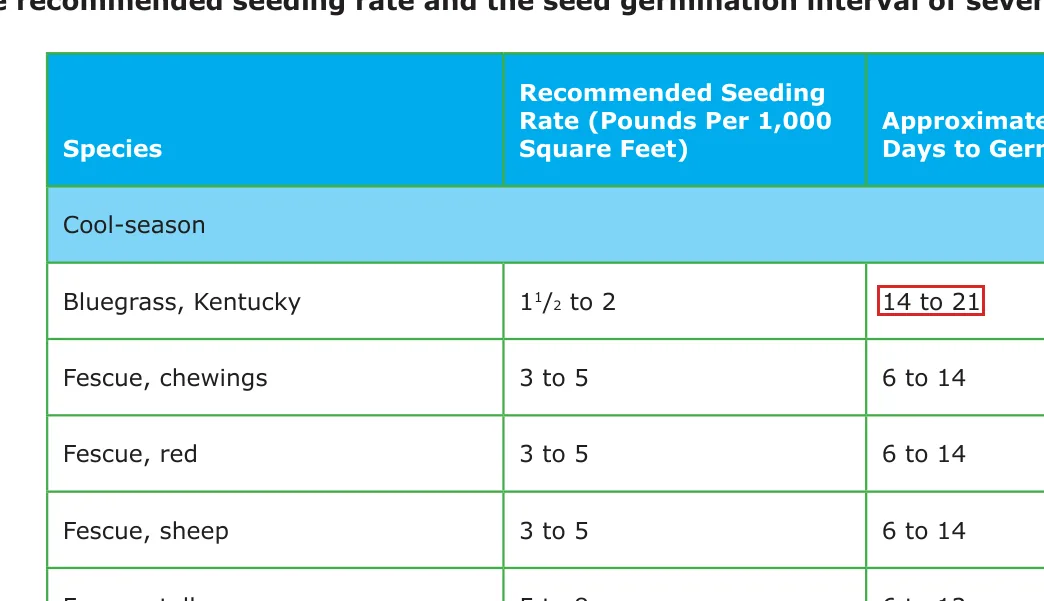
Use the slowest grass in a mix as the clock. A blend of 85 to 90 percent Kentucky bluegrass with 10 to 15 percent perennial ryegrass shows ryegrass in week 1 and bluegrass in week 3, and NC State Extension notes bluegrass takes 7 to 14 days longer to germinate than other cool-season grasses. Seeding rates for each species are on our grass seed cost and seeding rate guide.
How long do seed labs give each grass to germinate?
Federal seed-testing rules set a fixed test length for every lawn grass, and it is a useful outer limit. Under 7 CFR 201.58, labs count tall fescue and perennial ryegrass at day 5 and finish at day 14; bermudagrass finishes at day 21; Kentucky bluegrass, creeping bentgrass, Japanese lawngrass (zoysia) and Pensacola bahiagrass run 28 days, in germinators held at ideal temperature and moisture.
Swipe the table sideways to see every column.
| Kind of seed | First count (day) | Final count (day) | Lab temperature, 16 h / 8 h | Conditions in the rule |
|---|---|---|---|---|
| Perennial ryegrass | 5 | 14 | 59/77°F | Light optional; prechill 5 days if dormant |
| Annual ryegrass | 5 | 14 | 59/77°F | Light optional |
| Tall fescue | 5 | 14 | 59/77°F | Alternate 20 to 30°C allowed; prechill and test 21 days if dormant |
| Chewings, red, hard and sheep fescue | 7 | 21 | 59/77°F | Light and KNO3 optional |
| Rough bluegrass | 7 | 21 | 68/86°F | Light |
| Kentucky bluegrass | 10 | 28 | 59/77°F | Light; KNO3; prechill 5 days at 10°C if dormant |
| Creeping bentgrass | 7 | 28 | 59/86°F | Light; KNO3 |
| Bermudagrass | 7 | 21 | 68/95°F | Light; KNO3 |
| Japanese lawngrass (Zoysia japonica) | 10 | 28 | 95/68°F | Light; KNO3 |
| Bahiagrass, Pensacola | 7 | 28 | 68/95°F | Light |
| Bahiagrass, other varieties | 3 | 21 | 86/95°F | Glumes removed; light |
| Buffalograss, burs | 7 | 14 | 68/95°F | Light; KNO3; prechill 2 weeks if dormant |
| Carpetgrass | 10 | 21 | 68/95°F | Light |
Read the final count as the point where a lab stops waiting, not a typical field time. The rule lets a test end early once maximum germination is reached, treats the first count as approximate within 1 to 3 days, and allows 2 extra days if seedlings are too small to judge. A dash in a temperature, such as 15 to 25°C (59/77°F), means about 16 hours at the first temperature and 8 at the second each day.
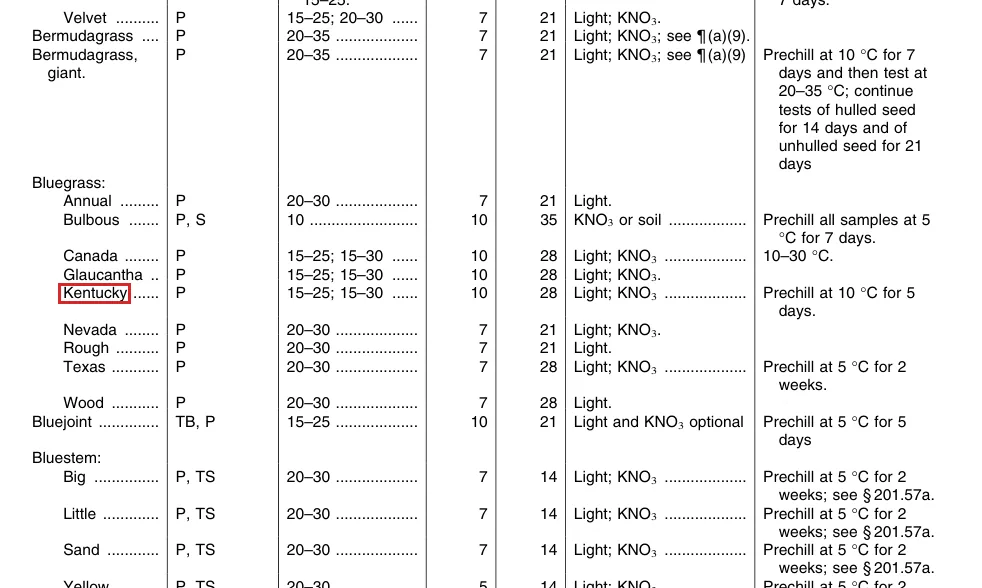
The lab numbers turn into a field rule of thumb. If a lawn kept moist at the right soil temperature shows nothing after the federal final count for its grass, 14 days for tall fescue or 28 for Kentucky bluegrass, the problem is usually the seedbed, the seed or the weather, not patience.
What soil temperature does grass seed need to germinate?
Most lawn seed germinates best with soil at 50 to 70°F at a 1-inch depth (University of Maryland Extension). Warm-season seed needs more: the University of Arkansas starts zoysia when the soil surface first reaches 68 to 72°F, and Nebraska Extension says buffalograss seed will not germinate until soil reaches 60°F.
| Grass group | Soil or air temperature | What it controls | Source |
|---|---|---|---|
| Cool-season lawn seed | Soil 50 to 70°F at about 1 inch | Best germination | Univ. of Maryland |
| Tall fescue | Air 68 to 77°F; soil above 60°F | Best germination | NC State TurfFiles |
| Cool-season roots | Soil 50 to 65°F | Best root growth after sprouting | Penn State Extension |
| Cool-season seed | Air cycling about 59 to 82°F | Rapid germination | UT W160-B |
| Warm-season seed | Air 68 to 95°F | Good germination | UT W160-B; UT Master Gardener ch. 10 |
| Zoysiagrass | Soil surface first reaches 68 to 72°F | Seeding start; peak germination at 86 to 95°F | U. of Arkansas MP476 |
| Buffalograss | Soil 60°F | No germination below it; usually after May 15 in eastern Nebraska | Nebraska Extension |
| Bermudagrass, hulled (lab) | 68/86°F best; below 59/77°F severely reduced | Germination rate and total | Evers and Parsons, Texas AgriLife (2009) |
| Dormant seeding, cool-season | Soil 40°F or lower | Holds seed dormant until spring | Iowa State; K-State MF1126 |
Timing matters as much as degrees. Purdue Extension AY-3 names Aug. 15 to Sept. 15 as the best seeding window for northern Indiana and Illinois and warns that waiting one week inside that window may mean the stand takes 2 to 4 more weeks to mature. Ungerminated fall-sown seed dies over winter, except Kentucky bluegrass (Univ. of Maryland).
Warm-season seed sown into cool soil sits and rots. Clemson Extension sets May 1 to 14 as the target seeding date across South Carolina because earlier planting meets below-optimal soil temperatures and more seed rot. Our profiles of bermudagrass and zoysiagrass lawns cover regional windows.
What do top-ranking guides get wrong about timing?
Four claims in the October 2026 top 10 for this query conflict with university extension publications, on seeding season, bahiagrass speed and first mowing height. The table pairs each claim with the primary source, so you can check which applies to your grass before you buy seed or book the job.
| Claim in top-ranking guides (Oct. 2026) | What the primary source says | Source |
|---|---|---|
| Plant cool-season grass in spring when air reaches 60 to 75°F | Late summer is optimal; spring seeding is difficult and often unsuccessful | Purdue AY-3 |
| Warm-season grass grows best when planted late summer to early fall | Plant bermudagrass, centipedegrass and zoysiagrass May 1 to June 30; fall seeding is undesirable in Florida | UT Master Gardener; UF/IFAS |
| Bahiagrass germinates in 7 to 30 days | Only 50 to 60% germinates within 30 days; some seed waits until the next year | UGA B1362 |
| Do not mow until new grass is about 5 inches tall, then cut at 3.5 to 4 inches | Mow new grass when it reaches 3 inches (Iowa State); first cuts at 1.5 inches, 2 for tall fescue, and most people wait too long (Purdue) | Iowa State; Purdue AY-3 |
What does new grass seed look like week by week?
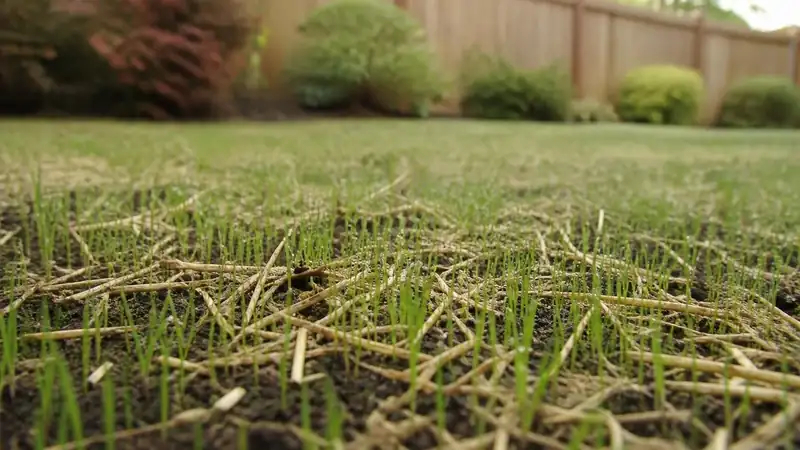
Nothing shows for the first few days because the seed is absorbing water, the first step of germination (Penn State Extension). A root (the radicle) breaks the seed coat first, then the first leaf. In a cool-season mix, ryegrass shows in week 1, fescue in week 2 and bluegrass in weeks 2 to 3.
| Time after seeding | What you should see | What to do | Source |
|---|---|---|---|
| Days 1 to 3 | Bare soil; seed swells as it absorbs water | Keep the top 0.5 to 1 inch moist | Penn State; Purdue AY-3 |
| Days 3 to 7 (week 1) | Perennial and annual ryegrass emerge as thin green threads | Keep watering 2 to 4 times a day | UT W160-B; UMaine |
| Days 5 to 14 (week 2) | Tall fescue and fine fescues emerge | No foot traffic; no weed control yet | UGA; UT W160-B |
| Days 10 to 21 (weeks 2 to 3) | Zoysiagrass (10 to 14), hulled bermudagrass (10 to 20) and Kentucky bluegrass (14 to 21) emerge | End the 3-week light-watering phase as plants reach 1 to 2 inches | Iowa State; UT W160-B |
| Weeks 2 to 3 | Tall fescue tall enough for its first mowing | First cut at 2 inches | UGA |
| Weeks 4 to 6 | Most seeded lawns ready to mow; centipedegrass emerging by day 28 | Feed 0.75 to 1 lb N per 1,000 sq ft, 4 to 6 weeks after germination | Univ. of Maryland; Purdue AY-3; NC State |
| Weeks 8 to 10 | Cool-season stand filling in | Second feeding 8 to 10 weeks after germination | Purdue AY-3 |
| 6 to 8 weeks after germination | Centipedegrass and zoysiagrass established in Florida | Shift to deep, less frequent irrigation | UF/IFAS LH009, LH011 |
| 2 to 3 years | Full centipedegrass lawn from seed | Expect slow fill on seeded centipede | NC State handbook |
In a bluegrass and ryegrass mix at week 2, the ryegrass is up and the bare spots between are usually bluegrass that has not emerged yet (14 to 21 days, UT W160-B). Maryland Extension advises waiting for the slowest species before you change the watering.
How often and how long should you water new grass seed?
Water new grass seed lightly 2 times a day, up to 4 in hot, windy weather, for about 3 weeks (Iowa State Extension). The goal is a top 0.5 to 1 inch that never dries (Purdue AY-3). UT Extension puts the daily amount at 1/8 to 1/4 inch, about 75 to 150 gallons per 1,000 sq ft.
| Stage | How often | How much | Source |
|---|---|---|---|
| Seeding to germination, cool-season | 2 light waterings a day; up to 4 in hot, windy weather | Keep the top 0.5 to 1 inch moist; avoid runoff | Iowa State; Purdue AY-3 |
| First 3 weeks, tall fescue (Georgia) | Daily | About 0.1 to 0.25 inch; keep top 1 to 2 inches moist | UGA |
| First several weeks, any seed | Daily | 1/8 to 1/4 inch (75 to 150 gal per 1,000 sq ft) | UT W160-B |
| Centipedegrass seed | Several light waterings a day for 28 days | Seedbed continually moist | NC State |
| Centipedegrass, Florida | Lightly every day for 2 to 3 weeks; more on sand | Moist, not soggy | UF/IFAS LH009 |
| Seedlings 1 to 2 inches tall | Less often | Deeper each time | Iowa State; Purdue AY-3 |
| After 2 or 3 mowings | About once a week, thorough | About 1/2 inch every 2 to 3 days (300 gal per 1,000 sq ft) as roots deepen | Iowa State; UT W160-B |
Daily totals add up. At UT’s 1/8 to 1/4 inch a day, a 5,000 sq ft seeding takes 375 to 750 gallons a day, or about 7,900 to 15,800 gallons over 3 weeks (our arithmetic). Time-of-day advice for established turf is in our guide to the best time to water a lawn.
How do you get grass seed to germinate faster?
You cannot make Kentucky bluegrass behave like ryegrass, but you can remove what slows any seed down: cold soil, dry seed, deep seed and loose seed. The 10 steps below come from extension establishment guides; Purdue AY-3 calls seed-to-soil contact critical for quick germination.
For a new lawn on bare soil, the seedbed work that comes before germination (grade, tilling depth and starter fertilizer) is laid out in our guide to how to plant grass seed.
- Seed inside the window. Cool-season: Aug. 15 to Sept. 15 in northern Indiana and Illinois, Sept. 1 to 30 in the south (Purdue AY-3). Warm-season: May 1 to June 30 in Tennessee (UT Master Gardener).
- Check soil temperature at 1 inch with a probe thermometer: 50 to 70°F for cool-season seed (Univ. of Maryland), 68 to 72°F at the surface for zoysia (Arkansas MP476).
- Spread seed with a drop spreader set low, half in one direction and half at right angles (Purdue AY-3).
- Rake the seed in 1/8 to 1/4 inch deep (Iowa State). Leave zoysia no deeper than 1/4 inch because it needs light (Arkansas MP476).
- Roll lightly with an empty water-ballast roller to press seed against soil (Purdue AY-3).
- Mulch with 1 bale of clean, weed-free straw per 1,000 sq ft, thin enough that about half the soil shows (Purdue AY-3).
- Water 2 to 4 times a day so the top 0.5 to 1 inch stays moist; 1/8 to 1/4 inch a day in total (Purdue AY-3; UT W160-B).
- Skip preemergence crabgrass control at seeding except siduron, which controls crabgrass for only 3 or 4 weeks (Purdue AY-3). More in our crabgrass control guide.
- For seeded zoysia, a clear polyethylene cover can raise germination if removed no later than 2 weeks after seeding (Arkansas MP476).
- Buy seed with at least 85 percent germination and 90 percent purity (Clemson HGIC) and a recent test date on the tag.
Will grass seed germinate on top of soil?
Some will, if the surface stays wet, but much of it dries out. Clemson says that if the soil surface dries after seeds swell and before roots develop, many seedlings die. Raking cool-season seed in 1/8 to 1/4 inch (Iowa State) cuts that risk; zoysia is the exception that needs light and stays near the surface (UF/IFAS).
Why hasn’t my grass seed germinated?
When seed fails, the cause is usually one of the nine below, and most show up within the 14 to 28 day federal test period for the grass. Match what you see to the row, then fix the cause before you reseed, or the second bag fails the same way.
| Cause | What you see | Fix | Source |
|---|---|---|---|
| Seedbed dried after seed swelled | Sprouts appeared, then patches died | Water 2 or 3 times a day for 2 to 3 weeks; mulch | Clemson HGIC |
| Seed too deep | Thin, late or no emergence | Cover only 1/8 to 1/4 inch | Iowa State |
| Seed on thatch or hard soil | Seed visible on the surface after a week | Rake, then roll for seed-to-soil contact | Purdue AY-3 |
| Soil too cold (late fall) | No sprouts past the expected days | Ungerminated seed dies over winter, except Kentucky bluegrass; reseed or dormant-seed at 40°F soil | Univ. of Maryland; Iowa State |
| Warm-season seed sown too early | Slow sprouting, seed rot | Seed May 1 to 14 in South Carolina | Clemson HGIC |
| Heavy rain or overwatering | Seed washed into streaks or puddles | Light applications; avoid runoff; reseed bare streaks | Iowa State; Univ. of Maryland |
| Preemergence herbicide | No grass in treated area | Wait out the label interval; only siduron is safe at seeding | Purdue AY-3 |
| Seedling disease (damping off) | Seedlings collapse in cool, wet spells | Pythium, Rhizoctonia and other fungi; avoid overwatering | UT W160-B |
| Hard or dormant seed (bahiagrass) | Half the seed still unsprouted at 30 days | Wait; dormant seed may come up the next year | UGA B1362 |
Should you wait or reseed?
Wait until the slowest grass in your mix has passed its federal lab final count (14 days for tall fescue, 28 for Kentucky bluegrass), then judge. Reseed earlier only when the cause is obvious, such as seed washed off a slope, and reseed late-fall failures in spring or by dormant seeding rather than in cold soil.
| If your situation is | Do this | Why (source) |
|---|---|---|
| Ryegrass or tall fescue, nothing at day 14, soil kept moist | Dig up a few seeds: swollen or split means alive; dry and hard means a seedbed problem. Reseed bare areas. | Lab final count 14 days (7 CFR 201.58); field 6 to 12 days (UT) |
| Kentucky bluegrass or bentgrass mix, ryegrass up but gaps at day 21 | Wait to day 28 before reseeding the gaps | Lab final count 28 days; field 14 to 21 days (UT); 2 to 4 weeks (UMaine) |
| Bermudagrass, nothing at day 21 | Check soil temperature and depth, then reseed; unhulled seed is slower | Lab final count 21 days; unhulled 14 to 21+ days (UT) |
| Centipedegrass or zoysia, nothing at day 21 | Keep watering to day 28 | Centipede 28 days (NC State); zoysia lab 28 days; 2 to 3 weeks (UF/IFAS) |
| Bahiagrass, half the seed up at day 30 | Do not reseed yet | 50 to 60% within 30 days (UGA B1362) |
| Cool-season seed sown in late fall, soil now under 50°F | Do not reseed now; reseed in spring or dormant-seed once soil is 40°F or lower | Optimum 50 to 70°F (Univ. of Maryland); dormant seeding (Iowa State) |
| Seed washed into streaks after a storm | Reseed bare streaks now, at the same rate | Erosion of ungerminated seed (Univ. of Maryland) |
| Stand up but thin at 6 weeks | Overseed in the next seeding window | Mowing starts 4 to 6 weeks after seeding (Univ. of Maryland) |
1Has seed washed into streaks or off a slope?
YesReseed the bare streaks now at the same rate.
NoGo to the next question
2Is it late fall with soil under 50°F at 1 inch?
YesDo not reseed now: reseed in spring or dormant-seed once soil is 40°F or lower.
NoGo to the next question
3Is it bahiagrass and fewer than 30 days since seeding?
YesWait: only 50 to 60% germinates within 30 days.
NoGo to the next question
4Has the slowest grass passed its lab final count (14 days ryegrass or tall fescue, 21 bermudagrass, 28 Kentucky bluegrass, zoysia or centipedegrass)?
Yes
NoKeep the top 0.5 to 1 inch moist and wait.
5Are dug-up seeds dry and hard, or buried deeper than 1/4 inch?
YesFix the seedbed (rake to 1/8 to 1/4 inch, roll, mulch) and reseed.
NoCheck the seed tag test date and run a home germination test before buying more seed.
Source: 7 CFR 201.58; UGA B1362; Univ. of Maryland; Iowa State Extension
For thin stands, the steps, rates and timing are in our guide on how to overseed a lawn. If a second failure is likely, such as a steep slope or a deadline, compare the cost of starting over in our sod vs seed comparison.
When will a lawn seeded today be ready to mow?
Add the germination days to the seeding date, then the time to first mowing. The worked examples below use 2026 dates inside each extension window; change the seeding date and the arithmetic still holds, provided soil temperature stays in range.
| Seeding | Germination days | Expected sprouts | First mowing or establishment rule | Expected date |
|---|---|---|---|---|
| Tall fescue, seeded Sept. 10 | 6 to 12 days (UT) | Sept. 16 to Sept. 22 | 2 to 3 weeks after seeding (UGA) | Sept. 24 to Oct. 1 |
| Kentucky bluegrass, seeded Sept. 10 | 14 to 21 days (UT) | Sept. 24 to Oct. 1 | 4 to 6 weeks after seeding (Univ. of Maryland) | Oct. 8 to Oct. 22 |
| Hulled bermudagrass, seeded May 20 | 10 to 20 days (UT) | May 30 to June 9 | Sod-forming grasses: mow at 1.5 inches once plants average 2.25 inches (UT) | After emergence; height-based |
| Centipedegrass, seeded May 15 | 10 to 28 days (UT; NC State) | May 25 to June 12 | Established 6 to 8 weeks after germination (UF/IFAS) | July 6 to Aug. 7 |
Mow by height, not by date. UT Extension starts bunch-type grasses such as tall fescue and perennial ryegrass at a 2-inch cut once plants average 3 inches, and sod-forming species such as bermudagrass and zoysiagrass at 1.5 inches once they average 2.25 inches; never remove more than one-third of the leaf. Profiles of tall fescue and centipedegrass give mature mowing heights.
How long is grass seed good for?
Grass seed loses germination with time, so the tag’s test date matters. Federal rules (7 CFR 201.22) allow Kentucky bluegrass, fescue, bentgrass and ryegrass to ship interstate up to 15 months after the germination test, most other agricultural seed 5 months, and seed in hermetically sealed containers 24 months.
To store leftover seed, UNH Extension says the air temperature in °F plus the relative humidity in percent should not exceed 100: 50°F at 50 percent humidity passes, a 70°F garage at 60 percent (130) does not. Seal bags in a metal can against mice. Bahiagrass is the exception that can improve: UGA notes seed stored for a year often germinates better than fresh seed.
Test old seed before you sow it. Iowa State Extension rolls at least 20 seeds (100 is best) in moist paper towel kept at 70 to 80°F. Count at the federal first count and stop at the final count for that grass: 5 and 14 days for tall fescue, 10 and 28 for Kentucky bluegrass.
| Step | Example: tall fescue tagged 90% germination | Result |
|---|---|---|
| Seeds rolled in damp paper towel | 100 seeds at 70 to 80°F (Iowa State) | 100 |
| Count sprouts at first count | Day 5 (7 CFR 201.58) | 61 sprouted (illustrative) |
| Count sprouts at final count | Day 14 (7 CFR 201.58) | 78 sprouted (illustrative) |
| Home germination | 78 ÷ 100 | 78% |
| Seed needed for the same live-seed count | 90 ÷ 78 = 1.15 | Sow about 15% more of this lot |
| Below about 70% at day 14 | Our threshold for buying fresh seed | Fresh seed costs less than a failed seeding |
Pure live seed arithmetic and current seed prices are on our grass seed cost page. More turf guides are collected on the Turf and Trees hub.
How we compiled this
We compiled germination days, temperatures and watering guidance from 26 primary documents: two sections of the Federal Seed Act regulations (7 CFR 201.58 and 201.22), 23 extension publications from 16 land-grant universities and one peer-reviewed study, all opened and read in October 2026. We did not test seed or seed any lawns. Date arithmetic and Celsius conversions are ours; company blogs and seed retailers were used only to find the questions people ask.
The full table, with each value, unit, source link and check date, is in the downloadable dataset.
Frequently asked questions
Can I just throw grass seed down?
You can, but much of it will not establish. Seed lying on hard soil or thatch dries out, and Clemson HGIC says seedlings die if the surface dries after the seed swells. Purdue AY-3 calls seed-to-soil contact critical. Rake the seed into the top 1/8 to 1/4 inch (Iowa State), roll it lightly and keep it moist for about 3 weeks.
What month should I put grass seed down?
For cool-season grass, late summer to early fall: Aug. 15 to Sept. 15 in northern Indiana and Illinois, Sept. 1 to 30 farther south (Purdue AY-3). For bermudagrass, centipedegrass and zoysiagrass, May through June: May 1 to June 30 in Tennessee and May 1 to 14 in South Carolina (Clemson).
How do you tell if grass seed is germinating?
Dig up a few seeds from 1/4 inch down. A seed that has swollen, split or pushed out a white root (the radicle) is germinating; Penn State Extension describes the root breaking through the seed coat first. A seed still dry and hard after 7 days of watering points to a seedbed or moisture problem.
Will grass seed germinate in 40 degree weather?
Little if any: extension services treat soil at 40°F or lower as cold enough to hold seed dormant until spring, which is the basis of dormant seeding (Iowa State Extension; K-State MF1126). The University of Maryland puts the optimum at 50 to 70°F soil at 1 inch.
Can new grass seed go a day without water?
In cool, cloudy weather a day may pass without harm, but in sun and wind it often cannot. Iowa State says the seedbed surface should not be allowed to dry and calls for up to 4 light waterings a day in hot, windy weather. Clemson notes seedlings that dry out after the seed swells often die.
What should grass seed look like after 2 weeks?
In a cool-season mix, ryegrass and tall fescue should be up as thin green blades, since UT Extension lists them at 3 to 7 and 6 to 12 days. Kentucky bluegrass may still be missing (14 to 21 days), so gaps at 2 weeks are normal. Warm-season seed may only be starting.
Do I need to cover grass seed?
Lightly. Iowa State covers cool-season seed 1/8 to 1/4 inch deep, and Purdue adds a thin straw layer of 1 bale per 1,000 sq ft with about half the soil visible. Zoysia is different: UF/IFAS says its seed needs light and cannot be covered with soil the usual way, so use an erosion blanket instead.
Should you pre-germinate grass seed?
None of the 23 extension publications we read recommends pre-germinating lawn seed at home. The federal lab rules (7 CFR 201.58) use prechilling and a 0.2 percent potassium nitrate solution only to break dormancy in test samples. Sprouted seed is fragile and must be sown and watered the same day.
How long does it take grass seed to grow in the fall?
Fall is the fast season for cool-season seed because the soil is still warm. Kansas State lists fall-sown ryegrass at 4 to 5 days, tall fescue at 5 to 7 and Kentucky bluegrass at 10 to 14. Seed sown too late into cold soil may not germinate at all and, except bluegrass, dies over winter (Univ. of Maryland).
Sources
- U.S. Department of Agriculture, Federal Seed Act regulations (eCFR), 7 CFR 201.58, Substrata, temperature, duration of test (Table 2), Current eCFR; 1-1-26 edition. Accessed October 2026.
- U.S. Government Publishing Office, 7 CFR 201.58, CFR annual edition, revised Jan. 1, 2026 (PDF), January 1, 2026. Accessed October 2026.
- U.S. Department of Agriculture, Federal Seed Act regulations (eCFR), 7 CFR 201.22, Date of test, Current eCFR. Accessed October 2026.
- University of Tennessee Extension (T. Samples, J. Sorochan), W160-B, Turfgrass Establishment: Seeding, October 2007. Accessed October 2026.
- University of Tennessee Extension, Master Gardener Handbook, Chapter 10: Turfgrass Management in Tennessee, Current online edition. Accessed October 2026.
- University of California Statewide IPM Program, UC Guide to Healthy Lawns: Seed germination rates, 2017. Accessed October 2026.
- Penn State Extension, The Cool-Season Turfgrasses: Basic Structures, Growth and Development, Current online edition. Accessed October 2026.
- Purdue University and University of Illinois, AY-3-W, Establishing Turfgrass Areas From Seed, Rev. May 2006. Accessed October 2026.
- Iowa State University Extension and Outreach, How should I water a newly seeded lawn?, June 9, 2026. Accessed October 2026.
- Iowa State University Extension and Outreach, Seeding a New Lawn, Current online edition. Accessed October 2026.
- Iowa State University Extension and Outreach, How to Store Seeds and Test Germination Rates, Current online edition. Accessed October 2026.
- University of Maryland Extension, Starting a New Lawn, Current online edition. Accessed October 2026.
- University of Maine Cooperative Extension, Bulletin #2367, Establishing a Home Lawn in Maine, Current online edition. Accessed October 2026.
- Kansas State University Research and Extension, MF1126, Planting a Home Lawn, Current PDF. Accessed October 2026.
- Kansas State University Research and Extension, MF2262, Kentucky Bluegrass Lawns, Current PDF. Accessed October 2026.
- University of Georgia CAES Field Report, September and October are perfect for seeding tall fescue lawns, Current online edition. Accessed October 2026.
- University of Georgia Extension, B1362, The Management and Use of Bahiagrass, Current online edition. Accessed October 2026.
- NC State Extension TurfFiles, Time for Fall Seeding of Tall Fescue, Current online edition. Accessed October 2026.
- NC State Extension, Extension Gardener Handbook, Chapter 9: Lawns, Current online edition. Accessed October 2026.
- NC State Extension, Centipedegrass Lawn Maintenance Calendar, Current online edition. Accessed October 2026.
- University of Florida IFAS Extension, ENH8/LH009, Centipedegrass for Florida Lawns, Current online edition. Accessed October 2026.
- University of Florida IFAS Extension, ENH11/LH011, Zoysiagrass for Florida Lawns, Current online edition. Accessed October 2026.
- University of Arkansas Division of Agriculture, MP476, Establishing Seeded Zoysiagrass on Lawns and Golf Courses, Current PDF. Accessed October 2026.
- Nebraska Extension, Establishing Buffalograss Turf in Nebraska, Current online edition. Accessed October 2026.
- Clemson Cooperative Extension, HGIC, Lawn Establishment, Current online edition. Accessed October 2026.
- G. W. Evers and M. J. Parsons, Texas AgriLife Research and Extension Center, Temperature Influence on Seeded Bermudagrass Germination, Texas Journal of Agriculture and Natural Resources 22:74 to 80, 2009. Accessed October 2026.
- UNH Cooperative Extension, Can I Save Unused Grass Seed for Next Year?, November 7, 2018. Accessed October 2026.