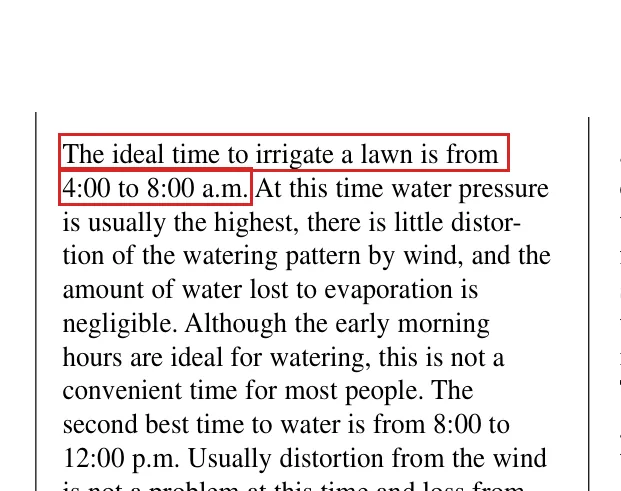
The best time to water grass is early morning, 4 to 8 a.m., when Purdue Extension says wind distortion is low and evaporation negligible. Apply about 1 inch a week in one or two deep soakings, not daily sprinkles.
Key takeaways
- Purdue Extension names 4 to 8 a.m. as the ideal watering window and 8 a.m. to noon as second best (Purdue AY-7); NC State says watering between 2 and 8 a.m. cuts some lawn diseases (NC State AG-367).
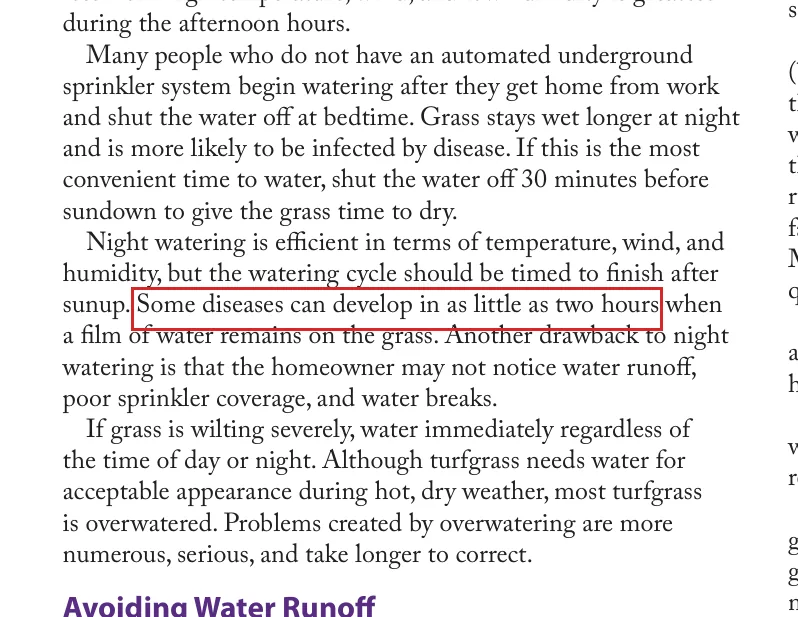
- Evening watering is the disease risk: some turf diseases can develop in as little as 2 hours under a film of water, so K-State says to stop at least 30 minutes before sundown (K-State MF2059).
- Most actively growing lawns need about 1 inch of water a week from rain plus irrigation, wetting the soil 4 to 6 inches deep (NC State AG-431; AG-367). In hot, dry climates that rises: UC’s July schedule for cool-season grass in the Southern California deserts works out to about 2.5 inches a week (UC IPM Zone 11).
- Run time depends on the nozzle: 1 inch takes about 38 minutes from a Rain Bird 15 Series spray nozzle at 1.58 in/hr (Rain Bird catalog) but 150 minutes from a Hunter MP Rotator at 0.4 in/hr (Hunter).
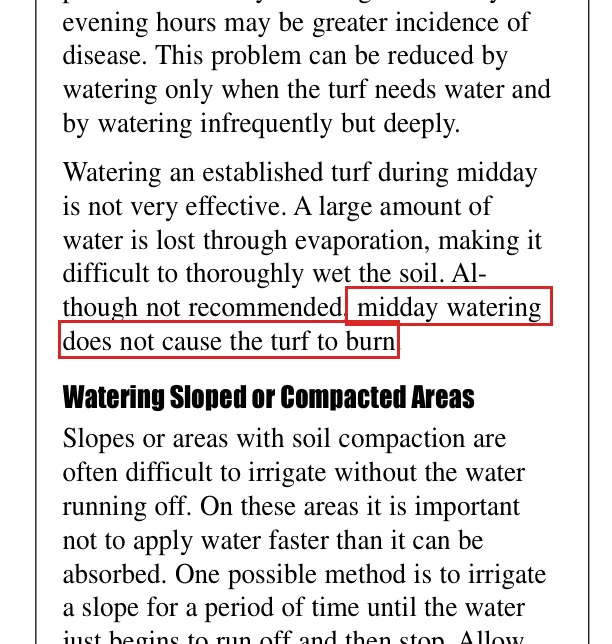
- Midday watering wastes water but does not burn turf (Purdue AY-7). Many cities ban it anyway: Dallas prohibits sprinklers from 10 a.m. to 6 p.m. on any day (Dallas Water Utilities).
What is the best time of day to water grass?
Early morning is the best time to water grass, ideally 4 to 8 a.m. Purdue Extension AY-7 picks that window because water pressure is usually highest, wind barely distorts the spray pattern and evaporation loss is negligible. The lawn then dries as the sun comes up, which shortens the time leaves stay wet. Late morning, 8 a.m. to noon, is Purdue’s second choice.
| Key number | Value | Source |
|---|---|---|
| Ideal watering window | 4 to 8 a.m. | Purdue AY-7 |
| Second-best window | 8 a.m. to noon | Purdue AY-7 |
| Disease-reducing window, tall fescue | 2 to 8 a.m. | NC State AG-367, 2021 |
| Leaf wetness that can start some diseases | As little as 2 hours | K-State MF2059, 2018 |
| Latest evening shut-off | 30 minutes before sundown | K-State MF2059, 2018 |
| Weekly water, actively growing lawn | About 1 inch, rain included | NC State AG-431, 2021 |
| Depth to wet the soil | 4 to 6 inches | NC State AG-367 |
| Outdoor water lost to wind, evaporation and runoff | As much as 50 percent | EPA WaterSense, 2026 |
Extension services agree on the morning but not on the exact hours: the 4 published windows that give clock times start anywhere from 9 p.m. to 4 a.m. The next table sets them beside the hours that 8 U.S. water utilities and agencies allow, so you can see where the advice overlaps with rules you may have to follow.
| Source | Type | Hours named for sprinkler watering | Reason given |
|---|---|---|---|
| Purdue Extension AY-7 | Extension (Indiana) | 4 to 8 a.m. ideal; 8 a.m. to noon second | High water pressure, little wind, negligible evaporation |
| NC State Extension AG-367 | Extension (North Carolina) | 2 to 8 a.m. | Decreases certain diseases, including brown patch |
| Nebraska Extension, UNL Water | Extension (Nebraska) | 4 to 10 a.m. | Blades dry, less evaporation and wind |
| Colorado State University Extension | Extension (Colorado) | 9 p.m. to 9 a.m. | Less evaporation; less wind drift early |
| UF/IFAS Extension LH025 | Extension (Florida) | Early morning | Daytime watering loses water; late watering stretches the dew period |
| K-State Research and Extension MF2059 | Extension (Kansas) | Morning; stop 30 minutes before sundown | Less evaporation and wind; disease in as little as 2 hours |
| EPA WaterSense | Federal agency | Early morning and evening after sundown | Heat-of-day evaporation |
| Georgia EPD | State rule | 4 p.m. to 10 a.m. | Water Stewardship Act schedule |
- Extension windows that include the hour (of 4)
- Utility or state rules that allow sprinklers (of 8)
Source: Green Industry Report count from Purdue AY-7, NC State AG-367, Nebraska Extension, CSU Extension and the published rules of Dallas, LADWP, SNWA, SFWMD, Georgia EPD, Denver Water, Austin Water and SAWS, checked Oct. 19, 2026 Each point counts the hour that starts at the label. SNWA hours are its May 1 to Aug. 31 rule; SAWS hours are Stage 3.
Show the numbers
| Extension windows that include the hour (of 4) | Utility or state rules that allow sprinklers (of 8) | |
|---|---|---|
| 12 a.m. | 1 | 7 |
| 1 a.m. | 1 | 7 |
| 2 a.m. | 2 | 7 |
| 3 a.m. | 2 | 7 |
| 4 a.m. | 4 | 7 |
| 5 a.m. | 4 | 8 |
| 6 a.m. | 4 | 8 |
| 7 a.m. | 4 | 8 |
| 8 a.m. | 2 | 8 |
| 9 a.m. | 1 | 7 |
| 10 a.m. | 0 | 1 |
| 11 a.m. | 0 | 0 |
| 12 p.m. | 0 | 0 |
| 1 p.m. | 0 | 0 |
| 2 p.m. | 0 | 0 |
| 3 p.m. | 0 | 0 |
| 4 p.m. | 0 | 3 |
| 5 p.m. | 0 | 3 |
| 6 p.m. | 0 | 5 |
| 7 p.m. | 0 | 7 |
| 8 p.m. | 0 | 7 |
| 9 p.m. | 1 | 8 |
| 10 p.m. | 1 | 8 |
| 11 p.m. | 1 | 8 |
| Hours | Extension windows that include these hours (of 4) | Watering rules that allow sprinklers (of 8) |
|---|---|---|
| midnight to 2 a.m. | 1 | 7 |
| 2 a.m. to 4 a.m. | 2 | 7 |
| 4 a.m. to 5 a.m. | 4 | 7 |
| 5 a.m. to 8 a.m. | 4 | 8 |
| 8 a.m. to 9 a.m. | 2 | 8 |
| 9 a.m. to 10 a.m. | 1 | 7 |
| 10 a.m. to 11 a.m. | 0 | 1 |
| 11 a.m. to 4 p.m. | 0 | 0 |
| 4 p.m. to 6 p.m. | 0 | 3 |
| 6 p.m. to 7 p.m. | 0 | 5 |
| 7 p.m. to 9 p.m. | 0 | 7 |
| 9 p.m. to midnight | 1 | 8 |
The overlap is 5 to 8 a.m.: all 4 extension windows include those hours, and all 8 rules allow sprinklers then. From 11 a.m. to 4 p.m. none of the 8 rules allows sprinkler watering, which matches EPA WaterSense advice to avoid the middle of the day, when the hot sun evaporates much of the water.
Why is evening watering riskier than morning watering?
Evening watering leaves grass wet through the night, and wet leaves are how fungal diseases start. K-State Research and Extension says some turf diseases can develop in as little as 2 hours when a film of water stays on the grass, so if evening is your only option, shut the water off at least 30 minutes before sundown. Night watering should be timed to finish after sunup.
The same leaf-wetness clock explains when extension services say to skip mowing wet grass and when a dew-wet cut is harmless.
Humidity and night temperature decide how big the risk is. NC State Extension says brown patch on tall fescue turns severe in overcast, wet weather when evening air stays above 68°F and days reach the mid to upper 80s, and gray leaf spot develops when nights stay above 70°F. In dry Colorado, Denver Water says watering at night is fine because low humidity keeps mildew from taking hold.
Is it bad to water grass in the middle of the day?
Midday watering wastes water but does not burn grass. Purdue Extension says midday watering is not very effective because a large amount evaporates, yet it does not cause the turf to burn, and K-State calls mid-afternoon the least efficient time while noting it is not harmful to the grass. If a lawn is severely wilted, K-State says to water immediately, whatever the hour.
The leaf-burn idea comes from water droplets acting as lenses. A 2010 study in New Phytologist (Egri and colleagues) found that sunlit drops on smooth, hairless maple and ginkgo leaves did not cause burn damage; only drops held above the leaf by water-repellent hairs, as on floating fern, focused enough light. Nebraska Extension even recommends a 5 to 10 minute afternoon run per zone on days above 90°F to cool turf (UNL Water).
How much water does grass need per week?
Most actively growing lawns need about 1 inch of water a week, counting rain, applied so the soil is wet 4 to 6 inches deep. That is the figure in NC State Extension calendars for bermudagrass, centipedegrass, St. Augustinegrass and tall fescue. Zoysiagrass gets by on 0.5 to 1 inch, sandy soils need about 1/2 inch every third day, and hot, dry climates need more.
| Grass or situation | Water per week | How to apply it | Source |
|---|---|---|---|
| Tall fescue (North Carolina) | About 1 inch | Not all at once; wet soil 4 to 6 inches deep | NC State AG-367 |
| Tall fescue in dry summer weather (Kansas) | 1 to 1.5 inches | Once or twice a week; morning is best | K-State MF736, 2015 |
| Bermudagrass | About 1 inch | Water at bluish-gray color or folded leaves | NC State AG-431 |
| Zoysiagrass | 0.5 to 1 inch | Wet soil 4 to 6 inches deep | NC State AG-432, 2025 |
| Centipedegrass | About 1 inch | Rain plus irrigation | NC State AG-381 |
| St. Augustinegrass | About 1 inch | Rain plus irrigation | NC State AG-540 |
| St. Augustinegrass and other Florida lawns | 1/2 to 3/4 inch per watering | Only when leaves fold or turn blue-gray | UF/IFAS LH025 |
| Any grass on sandy soil | About 1/2 inch every third day | Shorter, more frequent | NC State AG-381 |
| Indiana lawns | 1 to 1.5 inches | One soaking, or two 3 to 4 days apart | Purdue AY-7 |
| Georgia established lawns | About 1 inch | For example, two 1/2-inch waterings 3 to 4 days apart | UGA Extension |
| Minnesota lawns | As little as 1/2 inch | Once a week or less, wetting 6 inches | University of Minnesota Extension |
| Dormant lawn in a long drought | 1 to 1.5 inches every 4 to 6 weeks | Keeps crowns and roots alive | Purdue AY-7 |
Grass type sets how often, too. K-State MF2059 ranks irrigation frequency from least to most: buffalograss, bermudagrass, tall fescue, zoysiagrass, Kentucky bluegrass and perennial ryegrass. Our profiles of tall fescue, zoysia grass and St. Augustine grass carry the per-grass watering detail.
Why 1 inch a week is too little in hot, dry climates
The 1-inch rule is a humid-climate average; water need follows evaporation. The UC Guide to Healthy Lawns publishes weekly run times by California climate zone for a sprinkler applying 1 inch per hour, so each 60 minutes equals 1 inch. In July, cool-season grass needs 71 minutes (1.18 inches) on the Southern California coast and 151 minutes (2.52 inches) in the Southern California deserts.
- SoCal coast, cool-season
- SoCal inland valleys, cool-season
- SoCal deserts, cool-season
- SoCal inland valleys, warm-season
Source: UC Statewide IPM Program, UC Guide to Healthy Lawns, Zones 9, 10 and 11 (minutes per week for a 1 inch per hour sprinkler, divided by 60) Inches are Green Industry Report arithmetic from UC's published minutes.
Show the numbers
| SoCal coast, cool-season | SoCal inland valleys, cool-season | SoCal deserts, cool-season | SoCal inland valleys, warm-season | |
|---|---|---|---|---|
| Jan | 0.48 | 0.47 | 0.53 | 0.35 |
| Feb | 0.63 | 0.63 | 0.77 | 0.47 |
| Mar | 0.70 | 0.88 | 1.22 | 0.67 |
| Apr | 0.83 | 1.07 | 1.67 | 0.80 |
| May | 0.98 | 1.33 | 2.12 | 1 |
| Jun | 1.05 | 1.60 | 2.42 | 1.20 |
| Jul | 1.18 | 1.83 | 2.52 | 1.38 |
| Aug | 1.05 | 1.72 | 2.18 | 1.28 |
| Sep | 0.92 | 1.37 | 1.80 | 1.03 |
| Oct | 0.77 | 0.98 | 1.22 | 0.73 |
| Nov | 0.57 | 0.60 | 0.70 | 0.45 |
| Dec | 0.42 | 0.63 | 0.43 | 0.35 |
| Month | SoCal coast, cool-season | SoCal inland valleys, cool-season | San Joaquin Valley, cool-season | SoCal deserts, cool-season | SoCal inland valleys, warm-season | SoCal deserts, warm-season |
|---|---|---|---|---|---|---|
| January | 0.48 (29 min) | 0.47 (28 min) | 0.22 (13 min) | 0.53 (32 min) | 0.35 (21 min) | 0.45 (27 min) |
| February | 0.63 (38 min) | 0.63 (38 min) | 0.42 (25 min) | 0.77 (46 min) | 0.47 (28 min) | 0.63 (38 min) |
| March | 0.70 (42 min) | 0.88 (53 min) | 0.77 (46 min) | 1.22 (73 min) | 0.67 (40 min) | 1.02 (61 min) |
| April | 0.83 (50 min) | 1.07 (64 min) | 1.12 (67 min) | 1.67 (100 min) | 0.80 (48 min) | 1.38 (83 min) |
| May | 0.98 (59 min) | 1.33 (80 min) | 1.47 (88 min) | 2.12 (127 min) | 1.00 (60 min) | 1.77 (106 min) |
| June | 1.05 (63 min) | 1.60 (96 min) | 1.82 (109 min) | 2.42 (145 min) | 1.20 (72 min) | 2.02 (121 min) |
| July | 1.18 (71 min) | 1.83 (110 min) | 1.88 (113 min) | 2.52 (151 min) | 1.38 (83 min) | 2.10 (126 min) |
| August | 1.05 (63 min) | 1.72 (103 min) | 1.62 (97 min) | 2.18 (131 min) | 1.28 (77 min) | 1.82 (109 min) |
| September | 0.92 (55 min) | 1.37 (82 min) | 1.27 (76 min) | 1.80 (108 min) | 1.03 (62 min) | 1.50 (90 min) |
| October | 0.77 (46 min) | 0.98 (59 min) | 0.77 (46 min) | 1.22 (73 min) | 0.73 (44 min) | 1.02 (61 min) |
| November | 0.57 (34 min) | 0.60 (36 min) | 0.35 (21 min) | 0.70 (42 min) | 0.45 (27 min) | 0.58 (35 min) |
| December | 0.42 (25 min) | 0.63 (38 min) | 0.13 (8 min) | 0.43 (26 min) | 0.35 (21 min) | 0.37 (22 min) |
Warm-season grass in the same zone needs about a quarter less: in UC’s Southern California inland valleys table, July is 83 minutes for warm-season grass against 110 for cool-season, about 25 percent less. The same tables show why a timer set in spring overwaters in fall. Zone 10 cool-season need falls from 110 minutes a week in July to 59 in October.
How long should you water your lawn?
Water long enough to apply the target depth, usually 1/2 to 1 inch per session, and that time depends entirely on your sprinkler’s output in inches per hour. Divide the inches you want by the output and multiply by 60. A spray nozzle at 1.58 in/hr needs about 19 minutes for 1/2 inch; a rotary nozzle at 0.4 in/hr needs 75 minutes.
| Sprinkler and nozzle | Published output | Minutes for 1/2 inch | Minutes for 1 inch | Source |
|---|---|---|---|---|
| Rain Bird 15 Series MPR spray nozzle, 30 psi, square spacing (15 ft radius) | 1.58 in/hr | 19 min | 38 min | Rain Bird 2019 spray nozzle catalog |
| Rain Bird 15 Series MPR spray nozzle, 30 psi, triangular spacing (15 ft radius) | 1.83 in/hr | 16 min | 33 min | Rain Bird 2019 spray nozzle catalog |
| Hunter MP800 rotary nozzle (6 to 24 ft radius) | 0.8 in/hr | 38 min | 75 min | Hunter MP Rotator precipitation rates |
| Rain Bird R-VAN14 rotary nozzle, 45 psi, square spacing (14 ft radius) | 0.62 in/hr | 48 min | 97 min | Rain Bird 2019 spray nozzle catalog |
| Hunter MP Rotator standard nozzle (up to 35 ft radius) | 0.4 in/hr | 75 min | 150 min | Hunter MP Rotator precipitation rates |
| Your own system, measured with catch cups (UF example: 1/4 inch in 15 minutes) | 1 in/hr | 30 min | 60 min | UF/IFAS LH025 method |
Hose-end sprinklers are the slowest. Purdue Extension says most should stay in one spot for 2 to 3 hours to wet the root zone, while in-ground spray heads deliver a large volume in 10 to 15 minutes and single-stream rotors need 30 to 40 minutes. Those Purdue figures are rough guides; a catch-cup test replaces them with your own number.
How to measure your sprinkler output with catch cups
A catch-cup test turns guesswork into a run time in about 20 minutes. UF/IFAS Extension uses straight-sided cans set in a line from the sprinkler to the edge of its pattern and a 15-minute run; NDSU Extension spaces cups 5 to 10 feet apart. Multiply the average depth caught by 4 to get inches per hour.
- Set out 5 to 10 straight-sided cans or cups (tuna cans work) in a line or grid, 5 to 10 feet apart, from the head to the edge of the spray (NDSU; UF/IFAS).
- Run the zone, or the hose-end sprinkler, for exactly 15 minutes (UF/IFAS LH025).
- Measure the water in each can with a ruler. UF/IFAS looks for about equal amounts in every can; a can that stays nearly dry marks a clogged, tilted or blocked head to fix before setting times.
- Average the depths and multiply by 4 for inches per hour. Example: an average of 1/4 inch in 15 minutes is 1 in/hr.
- Divide your target by that rate and multiply by 60: 1/2 inch ÷ 1 in/hr × 60 = 30 minutes. UF/IFAS gives the same answer: 30 to 45 minutes for 1/2 to 3/4 inch.
- Watch the first full run. If water pools or runs off before the time is up, the sprinkler is applying water faster than the soil absorbs it (K-State MF2059); split the run into cycles as in the clay and slope section.
Once the run times are set, the controller does the scheduling. A WaterSense labeled controller that adjusts to weather can cut an average home’s irrigation water use by up to 30 percent (EPA WaterSense). Our guide to sprinkler system installation cost prices controllers and zones, and broken heads found in the cup test are priced in our sprinkler repair cost guide.
How often should you water your lawn?
Water an established lawn once or twice a week in most climates, only when it shows stress, and deeply each time. Purdue Extension prefers one thorough soaking or two equal waterings 3 to 4 days apart over light daily watering, which it says promotes shallow roots and crabgrass. Sandy soil and summer heat shorten the interval.
| Season | Pensacola (days between waterings) | Gainesville | Miami |
|---|---|---|---|
| Winter | 8 to 28 | 7 to 23 | 3 to 10 |
| Spring | 3 to 11 | 3 to 9 | 2 to 7 |
| Summer | 1 to 5 | 1 to 5 | 1 to 4 |
| Fall | 2 to 9 | 2 to 8 | 2 to 6 |
The seasonal swing is the point: in Pensacola the gap runs from 1 to 5 days in summer to 8 to 28 days in winter, so a timer left on its summer setting overwaters for months. UF/IFAS says to reset controllers each season and, after 1/2 to 3/4 inch of rain, to wait until the grass shows stress again. K-State adds a firm line: avoid watering every day or even every other day, except on a newly seeded lawn.
How do you water clay soil or a slope without runoff?
Use cycle and soak: split each zone’s run into 2 or 3 short cycles with a rest between them so water soaks in instead of running off. Clay absorbs water slowly, and a spray head can apply it 8 times faster than compacted clay takes it in. Colorado State Extension suggests about 1/4 inch per cycle, roughly 8 to 10 minutes on pop-up sprays.
| Soil under healthy sod | Water absorbed in an hour without runoff | Versus a spray nozzle at 1.58 in/hr |
|---|---|---|
| Coarse sandy loam | 1.3 inch | Spray is 1.2 times faster |
| Sandy loam | 1.0 inch | 1.6 times faster |
| Silt loam | 0.6 inch | 2.6 times faster |
| Silty clay loam | 0.5 inch | 3.2 times faster |
| Compacted clay | 0.2 inch | 7.9 times faster |
Slope cuts the safe rate further. K-State’s MF2059 reduces the watering rate by 0 to 10 percent on 0 to 5 percent slopes, 20 to 45 percent on 10 to 15 percent slopes and 60 percent or more above 20 percent. Denver Water rests flat lawns 30 minutes between cycles and slopes 60 minutes.
| Step | Input | Result |
|---|---|---|
| Target per watering day | 1/2 to 3/4 inch (CSU) | Plan 3 cycles of 1/4 inch = 3/4 inch |
| Nozzle output | Rain Bird 15 Series spray, 1.58 in/hr | 1/4 inch ÷ 1.58 × 60 = 9.5 minutes per cycle |
| Soak time between cycles | Flat lawn 30 minutes; slope 60 minutes (Denver Water) | Slope: 3 runs of 9.5 minutes + 2 rests of 60 minutes = 148.5 minutes |
| Slope of 10 to 15 percent | Cut the rate 20 to 45 percent (K-State) | Shorten each cycle to about 5 to 8 minutes and add a fourth cycle |
| Start time | Finish by 8 a.m. (Purdue) | Start the first cycle at about 5:30 a.m. |
- Run the zone until water starts to pool or run off, and note the minutes. That is your maximum cycle length (K-State MF2059; Purdue AY-7).
- Divide the zone’s total run time by that cycle length and round up to get the number of cycles, usually 2 or 3.
- Set the controller’s cycle-and-soak feature, or extra start times, with a 30-minute rest on flat ground and 60 minutes on slopes (Denver Water).
- On compacted clay at 0.2 in/hr, a 1/4-inch cycle needs about 75 minutes to soak in, so rest longer or core-aerate to raise intake.
Core aeration is the long-term fix for compacted clay: K-State recommends aerating clay soils 2 to 3 inches deep once or twice a year to increase water penetration. Our guide to when to aerate your lawn sets the month for each grass.
What watering hours do cities enforce?
Most large Western and Southern utilities ban sprinkler watering in the hottest hours, so the legal window often decides the best time for you. As of October 2026, the 8 rules below all allow sprinklers from 5 to 9 a.m., and none allows them from 11 a.m. to 4 p.m. Several also cap watering days, and Los Angeles caps minutes per station.
| Utility or agency | Sprinkler hours allowed | Days and other limits | Source, as of October 2026 |
|---|---|---|---|
| Dallas Water Utilities | Before 10 a.m. or after 6 p.m., any day of the year | Up to 2 assigned days a week; no watering Monday, Tuesday or Friday; hand watering, drip and soaker hoses any time | Save Dallas Water FAQ |
| LADWP, Los Angeles | Before 9 a.m. or after 4 p.m. | 3 assigned days; 8 minutes per station per day for standard sprays, or two 15-minute cycles for water-conserving nozzles; none during rain and for 48 hours after; fines $100 to $600 | LADWP watering days fact sheet |
| SNWA, Las Vegas Valley | May 1 to Aug. 31: not from 11 a.m. to 7 p.m. | 3 assigned days March to April and September to October; 1 day November to February; never Sunday | SNWA watering clock page |
| South Florida Water Management District | Not from 10 a.m. to 4 p.m., year-round | 2 or 3 days a week depending on area (Chapter 40E-24, F.A.C.) | SFWMD landscape irrigation |
| Georgia EPD, statewide | 4 p.m. to 10 a.m. | Statewide Drought Response Level 1 declared April 27, 2026 and kept Aug. 14, 2026; the hours are unchanged at Level 1 | Georgia EPD drought management |
| Denver Water | Not from 10 a.m. to 6 p.m. (summer rules, May 1 to Oct. 1) | 2026 Stage 1 drought: 2 assigned days a week; from Oct. 1, 2026 all lawn watering and spray irrigation prohibited until further notice | Denver Water summer rules; Denver Water drought notice |
| Austin Water | Midnight to 10 a.m. or 7 p.m. to midnight | Conservation Stage since Sept. 2, 2025: automatic systems 1 day a week; hose-end sprinklers 2 days | Austin Water watering day page |
| SAWS, San Antonio | 5 to 10 a.m. and 9 p.m. to midnight (Stage 2 and 3) | Once a week on your designated day; SAWS’s home page listed Stage 3 rules in effect on Oct. 19, 2026 | SAWS drought rules; SAWS home page |
The run-time caps change the math. Los Angeles allows 8 minutes per station on 3 days, or 24 minutes a week; at a spray nozzle’s 1.58 in/hr that is about 0.63 inch a week. SNWA in Las Vegas recommends 12 minutes per watering day split into three 4-minute cycles at least an hour apart, which is cycle and soak written into a utility’s advice.
How can you tell if your lawn needs water or is overwatered?
Underwatered grass shows three signs: leaf blades fold lengthwise, the color shifts to blue-gray, and footprints stay visible long after you walk across it, according to UF/IFAS Extension. Overwatered lawns show runoff, puddles, shallow roots and weeds such as dollarweed and sedges. A screwdriver that slides 4 to 6 inches into the soil means the root zone still has water.
Dollarweed, nutsedge and annual bluegrass are the weeds extension guides tie most often to wet soil; our common lawn weeds chart shows how to tell them apart.
| Sign | What it means | What to do | Source |
|---|---|---|---|
| Leaf blades folded lengthwise | Water stress | Water 1/2 to 3/4 inch | UF/IFAS LH025 |
| Blue-gray or bluish-green tint | Early water stress | Water now; no benefit to watering earlier | Purdue AY-7 |
| Footprints or tire tracks stay visible | Early water stress | Water, then wait until footprints show again | NC DEQ |
| Grayish-green and wilted | Advanced stress | Water without delay | Purdue AY-7 |
| Brown leaves after weeks of drought | Dormancy; crowns usually alive for 4 to 6 weeks | 1 to 1.5 inches every 4 to 6 weeks | Purdue AY-7 |
| Screwdriver slides in 4 to 6 inches | Soil still moist | Skip this watering | NC State AG-367 |
| Water running onto the street or sidewalk | Applied faster than soil absorbs | Shorten cycles; add soak time | Texas A&M AgriLife |
| Dollarweed and sedges spreading | Chronic overwatering | Cut frequency; water only at stress signs | UF/IFAS LH025 |
| Crabgrass, disease, shallow roots | Overwatering | Water deeply and less often | Purdue AY-7 |
What do lawn watering guides get wrong?
Several top-ranking watering guides repeat rules of thumb that the primary sources contradict or narrow. The four most common: that midday watering burns grass, that every lawn needs 1 to 1.5 inches a week, that 20 or 30 minutes per zone is a standard run time, and that evening watering is wrong everywhere. The table sets each claim beside what the source documents say.
| Common claim in lawn guides | What the primary source says | Source |
|---|---|---|
| Watering in midday sun burns the grass | Midday watering “does not cause the turf to burn”; it only wastes water to evaporation. Drops on smooth leaves did not burn them in a 2010 optics study | Purdue AY-7; New Phytologist, 2010 |
| Every lawn needs 1 to 1.5 inches a week | July need for cool-season grass ranges from 1.18 inches (Southern California coast) to 2.52 inches (Southern California deserts); Minnesota lawns may need only 1/2 inch | UC IPM; University of Minnesota |
| Run each zone 20 to 30 minutes | 20 minutes applies about 0.53 inch from a spray nozzle at 1.58 in/hr but 0.13 inch from a rotary nozzle at 0.4 in/hr | Rain Bird; Hunter; our arithmetic |
| Never water in the evening | Colorado State names 9 p.m. to 9 a.m.; Denver Water says night watering is fine in Colorado’s low humidity. The risk is humid nights above 68°F | CSU Extension; NC State AG-367 |
| Buffalograss is a cool-season grass | K-State lists buffalograss with the warm-season grasses and as the least frequently watered lawn grass | K-State MF2059 |
Should you water today, and how?
Water only when the lawn or the soil says so, then apply the full 1/2 to 1 inch in the early morning. Check rain first (1/2 inch or more resets the clock), then soil moisture at 4 to 6 inches, then stress signs, then soil type, which decides whether one run is enough or the water needs cycle and soak. The table and flowchart hold the same rules.
| If your situation is | Do this | Why (source) |
|---|---|---|
| 1/2 inch or more of rain fell in the past few days | Skip watering until stress signs return | Rain of 1/2 to 3/4 inch resets the interval (UF/IFAS LH025) |
| A screwdriver slides 4 to 6 inches into the soil | Wait and recheck in 1 to 2 days | Root zone is still moist (NC State AG-367) |
| Grass is severely wilted | Water now, any hour | Wilted turf recovers fast if watered without delay (Purdue AY-7; K-State MF2059) |
| Clay soil or slope, water runs off before 1/2 inch | Cycle and soak: 1/4 inch per cycle, 30 to 60 minute rests | Intake as low as 0.2 in/hr on compacted clay (K-State MF2059; CSU; Denver Water) |
| Sandy soil | About 1/2 inch every third day | Sand holds less water (NC State AG-381) |
| Humid region with nights above 68°F | Water only between 2 and 8 a.m. | Brown patch turns severe (NC State AG-367) |
| Dry Western climate, low humidity | Night or early morning, 9 p.m. to 9 a.m. | Less evaporation; low disease risk (CSU Extension; Denver Water) |
| Afternoon above 90°F, lawn not wilted | Optional 5 to 10 minute cooling run per zone | Reduces summer patch symptoms (Nebraska Extension) |
| Your utility bans midday watering or limits days | Follow the assigned days and hours first | Fines apply, for example $100 to $600 in Los Angeles (LADWP) |
| Otherwise, lawn shows stress | Apply 1/2 to 1 inch in one early-morning run, 4 to 8 a.m. | Purdue AY-7; NC State AG-367 |
1Has 1/2 inch or more of rain fallen in the past few days?
YesSkip watering until the grass shows stress again (UF/IFAS LH025).
NoGo to the next question
2Does a screwdriver slide 4 to 6 inches into the soil?
YesWait. The root zone is still moist; recheck in 1 to 2 days (NC State AG-367).
NoGo to the next question
3Is the grass severely wilted right now?
YesWater now, whatever the hour (K-State MF2059; Purdue AY-7).
NoGo to the next question
4Is the grass still green and springing back after you walk on it?
YesWait. There is no benefit to watering before stress signs appear (Purdue AY-7).
NoGo to the next question
5Is the soil clay, or is the lawn on a slope where water runs off?
YesCycle and soak between 4 and 8 a.m.: 1/4 inch per cycle with 30 to 60 minute rests, 1/2 to 3/4 inch in total (CSU; Denver Water).
NoGo to the next question
6Is the soil sandy?
YesApply about 1/2 inch early in the morning and expect to repeat every third day (NC State AG-381).
NoApply 1/2 to 1 inch in one run between 4 and 8 a.m. on a day your utility allows (Purdue AY-7; NC State AG-367).
Source: UF/IFAS LH025; NC State AG-367 and AG-381; K-State MF2059; Purdue AY-7; CSU Extension; Denver Water
New seed and new sod are the exception to deep, infrequent watering. Purdue AY-7 keeps a seedbed moist 1 to 2 inches deep with 2 to 4 light waterings a day, and new sod gets 1 or 2 a day until roots take hold. Our guide to grass seed germination time covers that schedule, and sod installation cost covers new sod. For the rest of the year’s tasks, see the lawn care schedule and our turf and trees hub.
How we compiled this
We compiled this guide from 40 primary documents: 22 extension publications and data pages from 11 land-grant universities, 3 EPA WaterSense pages, 2 manufacturer nozzle charts (Rain Bird, Hunter), 1 peer-reviewed study and 12 utility or state agency pages covering 8 watering rules, all accessed October 19, 2026. Run times and inches are our arithmetic from published precipitation rates and UC’s weekly minutes; we did not test sprinklers or measure any lawn. Company blogs and cost guides were read only for the SERP review and are not cited for any number.
Frequently asked questions
Is it okay to water grass at 6 p.m.?
It is acceptable in dry climates and legal in cities such as Dallas, which allows sprinklers again from 6 p.m. It is risky in humid weather: K-State says to stop at least 30 minutes before sundown so the grass dries, because some diseases start within 2 hours of leaf wetness (K-State MF2059). Early morning is still better.
Is it better to water your lawn in the morning or evening?
Morning is better. Purdue names 4 to 8 a.m. as ideal because of high water pressure, low wind and negligible evaporation (Purdue AY-7). Evening watering saves similar water but leaves grass wet overnight; NC State links that to brown patch when nights stay above 68°F. In arid Colorado, night watering is acceptable.
Should you water grass every day when it’s hot?
No. Deep watering 1 or 2 times a week builds deeper roots than daily watering, and K-State says to avoid watering every day or every other day except for new seed (K-State MF736). On days above 90°F, Nebraska Extension allows a 5 to 10 minute afternoon run per zone to cool the turf.
Is 10 minutes of sprinkler enough?
Usually not for a full watering. Ten minutes from a spray nozzle at 1.58 in/hr applies about 0.26 inch, and from a rotary nozzle at 0.4 in/hr only about 0.07 inch. A lawn that needs 1 inch a week would need about 38 minutes of spray or 150 minutes of rotary run time, split over 1 or 2 days.
Is 20 minutes enough time to water grass?
It is enough for about 1/2 inch only if your sprinkler applies around 1.5 in/hr, as spray heads do. Twice a week, that gives roughly 1 inch. With rotary nozzles at 0.4 in/hr, 20 minutes is 0.13 inch. EPA WaterSense notes that 20 minutes every day for a week equals more than 800 showers (EPA).
Is 1 hour too long to water grass?
It can be. An hour of spray-head output at 1.58 in/hr applies about 1.6 inches, more than most lawns need in a week and up to 8 times what compacted clay absorbs in that hour. An hour of rotary-nozzle output at 0.4 in/hr applies 0.4 inch, which is often too little. Measure output first.
Can I water my lawn 2 days in a row?
You can, but spacing waterings works better. Purdue and UGA both suggest splitting the week’s inch into two equal waterings 3 to 4 days apart (UGA Extension). Back-to-back days make sense only on sandy soil that holds little water, or when you split one deep watering into cycles because of runoff.
Can you overwater your lawn?
Yes. Purdue lists more crabgrass, more disease, shallow roots and higher water bills as results of overwatering, and says to err on the dry side. UF/IFAS adds thatch buildup and weeds such as dollarweed and sedges (UF/IFAS LH025). Runoff onto pavement is the visible sign that water is going on too fast.
When should you not water a lawn?
Skip watering during rain and after 1/2 to 3/4 inch has fallen, when a screwdriver still slides 4 to 6 inches into moist soil, in high wind, and during your utility’s banned hours. Los Angeles bans watering during rain and for 48 hours after, plus 9 a.m. to 4 p.m. every day (LADWP).
Do you need to water grass in fall and winter?
Less, and sometimes not at all. UC’s California schedules drop to 8 to 38 minutes a week in December for a 1 in/hr sprinkler, and say winter irrigation is usually unnecessary where rain falls (UC IPM). SNWA cuts Las Vegas watering to 1 day a week from Nov. 1 to Feb. 28. Dormant lawns survive dry spells with occasional watering.
Sources
- Purdue University Cooperative Extension Service, AY-7-W, Irrigation Practices for Homelawns (Throssell and Reicher), web edition posted Jan. 29, 2019. Accessed October 2026.
- NC State Extension, AG-367, Tall Fescue Lawn Maintenance Calendar, July 8, 2021. Accessed October 2026.
- NC State Extension, AG-431, Bermudagrass Lawn Maintenance Calendar, July 30, 2021. Accessed October 2026.
- NC State Extension, AG-432, Zoysiagrass Lawn Maintenance Calendar, July 10, 2025. Accessed October 2026.
- NC State Extension, AG-381, Centipedegrass Lawn Maintenance Calendar, Aug. 4, 2021. Accessed October 2026.
- NC State Extension, AG-540, St. Augustinegrass Lawn Maintenance Calendar, July 8, 2021. Accessed October 2026.
- K-State Research and Extension, MF2059, Watering Your Lawn (Hoyle and Braun), April 2018. Accessed October 2026.
- K-State Research and Extension, MF736, Tall Fescue Lawns, April 2015. Accessed October 2026.
- UF/IFAS Extension, ENH9/LH025, Watering Your Florida Lawn (Trenholm, Unruh and Cisar), current EDIS edition. Accessed October 2026.
- Nebraska Extension, UNL Water, Ten Quick Watering Tips, current page. Accessed October 2026.
- Colorado State University Extension, Watering Efficiently, reviewed August 2023. Accessed October 2026.
- University of Georgia CAES, Combatting effects of drought on your lawn, current page. Accessed October 2026.
- Texas A&M AgriLife Today, Water-wise tips for turfgrass offered by AgriLife Extension, July 18, 2018. Accessed October 2026.
- University of Minnesota Extension, Water-saving strategies for home lawns, current page. Accessed October 2026.
- NDSU Extension, The Right Way to Water Your Lawn, published September 2017, reviewed August 2023. Accessed October 2026.
- UC Statewide IPM Program, UC Guide to Healthy Lawns: Irrigation scheduling by zone, 2017. Accessed October 2026.
- UC Statewide IPM Program, Zone 9, Southern California Coast, cool-season grasses, 1 inch sprinkler output, 2017. Accessed October 2026.
- UC Statewide IPM Program, Zone 10, Southern California Inland Valleys, cool-season grasses, 2017. Accessed October 2026.
- UC Statewide IPM Program, Zone 10, Southern California Inland Valleys, warm-season grasses, 2017. Accessed October 2026.
- UC Statewide IPM Program, Zone 5, San Joaquin Valley, cool-season grasses, 2017. Accessed October 2026.
- UC Statewide IPM Program, Zone 11, Southern California Deserts, cool-season grasses, 2017. Accessed October 2026.
- UC Statewide IPM Program, Zone 11, Southern California Deserts, warm-season grasses, 2017. Accessed October 2026.
- U.S. EPA WaterSense, Statistics and Facts, updated March 11, 2026. Accessed October 2026.
- U.S. EPA WaterSense, Watering Tips, updated March 11, 2026. Accessed October 2026.
- U.S. EPA WaterSense, When It’s Hot, updated July 16, 2026. Accessed October 2026.
- Egri, Horváth, Kriska and Horváth, New Phytologist 185:979 to 987, Optics of sunlit water drops on leaves: conditions under which sunburn is possible, 2010. Accessed October 2026.
- Rain Bird Corporation, Spray Nozzles, 2019 turf catalog (15 Series MPR and R-VAN performance charts), 2019. Accessed October 2026.
- Hunter Industries, MP Rotator Nozzle: Precipitation Rates, current page. Accessed October 2026.
- Denver Water, How will watering 2 days a week affect your lawn?, 2026. Accessed October 2026.
- Denver Water, Get the facts: Summer watering rules run May 1 to Oct. 1, 2026. Accessed October 2026.
- Denver Water, Summer watering rules and drought notice, Oct. 2026. Accessed October 2026.
- Dallas Water Utilities, Save Dallas Water: Frequently asked questions, current page. Accessed October 2026.
- Los Angeles Department of Water and Power, Know Your Watering Days fact sheet, 2024. Accessed October 2026.
- Southern Nevada Water Authority, Change your irrigation clock, current page. Accessed October 2026.
- South Florida Water Management District, Landscape irrigation (year-round rule, Chapter 40E-24, F.A.C.), updated 2026. Accessed October 2026.
- Georgia Environmental Protection Division, Drought management, Aug. 14, 2026 update. Accessed October 2026.
- Austin Water, Find your watering day, Conservation Stage since Sept. 2, 2025. Accessed October 2026.
- San Antonio Water System, Drought restrictions, current page. Accessed October 2026.
- San Antonio Water System, Home page, Edwards Aquifer level and stage, Oct. 19, 2026. Accessed October 2026.
- North Carolina Department of Environmental Quality, Watering your lawn, current page. Accessed October 2026.