A soil test for a lawn costs $0 to $40 at 25 state and land-grant labs (median $15) and returns pH plus lime and fertilizer rates. Home kits get pH within about 1 unit but often miss phosphorus and potassium.
Key takeaways
- Routine lawn soil tests cost $0 to $40 at 25 state and land-grant labs in October 2026, median $15; North Carolina residents pay nothing from April 1 to November 30 (NCDA&CS).
- In a UC Cooperative Extension study, five color kits matched lab results 33 to 94 percent of the time, and every one reported nutrients only as low, medium or high (HortTechnology, 2007).
- Cheap kits read pH within about 1 unit of the lab on most soils, but Rapitest called for phosphorus on three soils the lab rated very high (SDSU Extension, 2025).
- Lawn sampling depth is set by the lab: 2 to 3 inches at Penn State, 4 inches at NCDA&CS and UGA, 6 inches at Rutgers.
- Brand-name mail-in lawn kits listed at $29.88 to $38 in October 2026, about twice the median state lab fee, and only one of the five names a standard extraction method (The Andersons; Lawnbright).
- Retest every 2 to 3 years with the same lab, because labs use different extractants and units (UGA C896; UMD Extension).
What does a soil test measure, and what does it skip?
A routine lawn soil test measures soil pH, buffer pH (which sets the lime rate), extractable phosphorus and potassium, and usually calcium, magnesium and organic matter. It does not measure nitrogen: University of Maryland Extension and the UF/IFAS soil testing lab both say no soil test predicts nitrogen supply, so nitrogen advice comes from the grass type.
| Soil test number | Value or rule | Source |
|---|---|---|
| Routine lawn test at a state university lab | $0 to $40; median $15 across 25 labs | Lab fee pages in the cost table below |
| Basic test at labs Maryland Extension lists | $11 to $30 plus mailing | UMD Extension |
| Slices or cores per sample | 8 to 10 (NC, Georgia); 10 to 15 (Rutgers); 12 or more (Penn State) | NCDA&CS; UGA C896; Rutgers FS797; Penn State AASL |
| Depth for an established lawn | 2 to 6 inches depending on the lab; 4 inches is the most common | Depth table below |
| Soil to send | About 1 cup (UMD); 1 pint (UGA, NDSU, Ohio State) | UMD; NDSU H1824 |
| Retest interval | Every 2 to 3 years; sandy soil 2 to 3, clay 3 to 4 | UGA C896; Ohio State HYG-1132 |
| Turf target ranges (Mehlich-3) | Phosphorus 25 to 50 ppm; potassium 40 to 80 ppm; pH 5.5 to 8.0 | Nebraska G2265 |
| Lime trigger for turf | Soil pH below 5.5, at the rate on the report | Nebraska G2265 |
| Unit conversion | lb per acre ÷ 2 = ppm (top 6 inches) | Nebraska G2265; SDSU |
The basic test is enough for most lawns. Maryland’s extension service lists basic tests at Maryland-recommended labs as pH, P, K, Ca and Mg, sometimes with sulfur, micronutrients, organic matter, cation exchange capacity (CEC) and lead, and says not to pay for extra tests such as soluble salts or micronutrients without a specific reason.
Lab test, DIY kit or pH meter: which is most accurate?
A lab test is the most accurate soil test, a calibrated handheld pH meter comes next, color kits follow, and two-prong probe meters come last. In a national comparison summarized by Oregon State University, a pH probe read 6.0 on three soils whose average lab pH was 7.9, 6.3 and 5.6.
How close do home soil test kits get to lab results?
Home kits matched lab results 33 to 94 percent of the time in the most-cited university comparison. Faber and colleagues at UC Cooperative Extension ran five colorimetric kits against UC Davis lab analyses on a Salinas clay loam with three cropping histories (HortTechnology, 2007). Every kit reported nitrate, phosphate and potash only as low, medium or high.
| Kit (maker) | Matched the lab | Strongest test or main weakness | Source |
|---|---|---|---|
| La Motte Soil Test Kit (La Motte Co.) | 94% | pH (most accurate of the five) | Faber et al. 2007 |
| Rapitest (Luster Leaf) | 92% | Nitrate and phosphate (top on both) | Faber et al. 2007 |
| Quick Soiltest (Hanna) | 64% | Nitrate (tied with Rapitest); pH and potash off | Faber et al. 2007 |
| Nitty-Gritty (La Motte Co.) | 36% | Potash; pH did not match the lab | Faber et al. 2007 |
| Soil Kit (La Motte Co.) | 33% | No pH test; least accurate on potash | Faber et al. 2007 |
Two details limit those scores. Rapitest read pH 6.5 on every soil, including one the lab measured at 7.8, which is past the kit’s 4.5 to 7.5 scale; the authors note the kits generally read pH lower than the lab. The study used one soil type, so the authors call La Motte and Rapitest accurate for this soil, not for every lawn.
What did the 2025 SDSU comparison of cheap kits find?
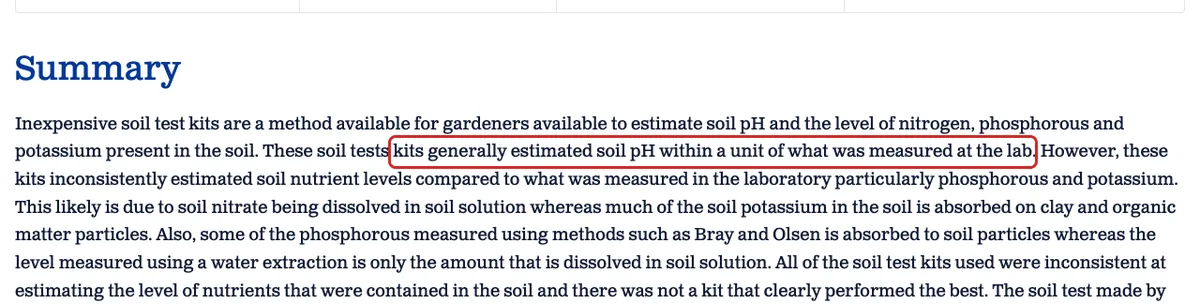
Cheap kits got pH roughly right and nutrients often wrong. South Dakota State University Extension tested the Rapitest, Pawfly and Yieri kits on five soils from sand to clay and compared each with Ward Laboratories results (updated July 2025). The kits generally landed within 1 pH unit of the lab, but the Yieri kit read 8.0 on a silt loam the lab measured at 6.2.
| Soil (texture) | Lab pH | Rapitest | Pawfly | Yieri | Source |
|---|---|---|---|---|---|
| Sparta (sand) | 5.8 | 6.0 | 5.0 | 7.0 | SDSU 2025 |
| Krantzburg (silt loam) | 6.2 | 6.25 | 6.5 | 8.0 | SDSU 2025 |
| Renshaw 1 (loam) | 8.0 | 7.5 or higher | 8.0 | 8.5 | SDSU 2025 |
| Renshaw 2 (loam) | 8.1 | 7.5 | 7.5 | 8.0 | SDSU 2025 |
| Opal (clay) | 8.0 | 7.5 | 7.5 | 8.0 | SDSU 2025 |
Nutrients were the bigger miss. On three soils the lab rated very high in phosphorus, Rapitest still recommended phosphorus fertilizer; on the Sparta sand, which the lab rated very low in potassium at 30 ppm, Rapitest called potassium sufficient. The LaMotte NPK kit rated potassium high on all five soils, including two the lab rated low. SDSU’s conclusion: send a composite sample to a lab.
Are soil pH meters and probes accurate?
A handheld pH meter with a glass electrode can match a lab when it is calibrated; a two-prong probe meter cannot. In the comparison against 82 laboratories that Oregon State reproduces, the handheld meter came within 0.2 units of the lab average on all three soils, while the probe read 6.0 every time.
| Method | Soil 1 | Soil 2 | Soil 3 | Largest miss vs lab | Source |
|---|---|---|---|---|---|
| Laboratory average (82 labs) | 7.9 | 6.3 | 5.6 | Reference | Oregon State |
| Handheld pH meter | 7.7 | 6.3 | 5.5 | 0.2 | Oregon State |
| Color kit | 8.0 | 6.5 | 5.5 | 0.2 | Oregon State |
| pH probe | 6.0 | 6.0 | 6.0 | 1.9 | Oregon State |
The study authors told extension agents not to use probes at all (Journal of Extension, 2001). The handheld meter’s accuracy depends on calibration with fresh buffer solutions before each use and a moist, intact electrode, Oregon State notes. Montana State adds that meters beat color strips because reading a color is more subjective than reading a number. A current glass-electrode example is the Hanna GroLine HI981030, listed at $154.99 with a stated accuracy of ±0.05 pH and automatic calibration with pH 4.01 and 7.01 buffers (October 2026).
How much does a soil test cost?
A routine lawn soil test costs $0 to $40 at the 25 state and land-grant labs in the table, with a median of $15, and most include lime and fertilizer recommendations. Brand-name mail-in kits list for $29.88 to $38. Montana State puts lab fees at about $15 to over $50 and color kits at $15 for 10 samples to $750 for 100.
Swipe the table sideways to see every column.
| Lab (state) | Routine lawn test | What it covers | Turnaround stated | Source |
|---|---|---|---|---|
| University of Arkansas, Marianna lab (AR) | $0 for Arkansas residents; $10 to $12 out of state | pH, Mehlich-3 nutrients, recommendations (submit via county office) | Not stated | Fee page (checked Oct. 28, 2026) |
| NCDA&CS Agronomic Division (NC) | $0 Apr. 1 to Nov. 30, 2026; $5 from Dec. 1 | pH, buffer pH, Mehlich-3 P, K, Ca, Mg, S, micronutrients, humic matter | Not stated | Fee page (page modified May 12, 2026) |
| University of Georgia AESL (GA) | $6 (S1); $20 kit with prepaid mailer | pH, lime requirement, P, K, Ca, Mg, Zn, Mn | 4 to 6 days (UGA C896) | Fee page (checked Oct. 28, 2026) |
| Clemson Agricultural Service Lab (SC) | $6 | pH, buffer pH, P, K, Ca, Mg, micronutrients, lime recommendation | Not stated | Fee page (checked Oct. 28, 2026) |
| University of Kentucky Regulatory Services (KY) | $8 plus 6% sales tax | pH, buffer pH, P, K, Ca, Mg, Zn | Not stated | Fee page (price list 2025-1b) |
| Virginia Tech Soil Testing Lab (VA) | $10 in state; $16 out of state | pH, buffer index, P, K, Ca, Mg, micronutrients, estimated CEC, recommendations | Usually 3 working days | Fee page (checked Oct. 28, 2026) |
| UF/IFAS Extension Soil Testing Lab (FL) | $10 | pH, lime requirement, P, K, Ca, Mg, S, micronutrients | 3 to 6 days after arrival | Fee page (form reviewed Aug. 2025) |
| Penn State AASL (PA) | $10 | pH, lime requirement, Mehlich-3 P, K, Mg, Ca, recommendations | Not stated | Fee page (forms rev. March 2026) |
| Auburn Soil, Forage and Water Lab (AL) | $10 | pH, P, K, Mg, Ca, lime and fertilizer recommendations | 3 to 7 days | Fee page (form rev. June 2022) |
| K-State Soil Testing Lab (KS) | $10.50 (Package 1) | pH, buffer pH, P, K | Not stated | Fee page (updated June 21, 2026) |
| LSU AgCenter STPAL (LA) | $11 | pH, Mehlich-3 nutrients, lime or sulfur requirement | Not stated | Fee page (form July 2025) |
| Texas A&M AgriLife SWFTL (TX) | $12 | pH, nitrate, salts, Mehlich III P, K, Ca, Mg, Na, S, B | Not stated | Fee page (pricing valid to Dec. 31, 2026) |
| Oklahoma State SWFAL (OK) | $15 | pH, lime requirement, nitrate, Mehlich-3 P and K | Not stated | Fee page (effective July 1, 2025) |
| University of Tennessee Soil, Plant and Pest Center (TN) | $15 | pH, buffer pH, Mehlich-1 nutrients, recommendations | Not stated | Fee page (2026 fee schedule) |
| UVM Agricultural and Environmental Testing Lab (VT) | $17 | pH, P, K, Ca, Mg, S, micronutrients, CEC, organic matter | Not stated | Fee page (price set July 1, 2023) |
| UConn Soil Nutrient Analysis Lab (CT) | $18 | pH, buffer pH, Modified Morgan nutrients, lead screen | Not stated | Fee page (checked Oct. 28, 2026) |
| Rutgers Soil Testing Lab (NJ) | $20 (landscape fertility) | pH, Adams-Evans lime requirement, Mehlich-3 nutrients | Not stated | Fee page (checked Oct. 28, 2026) |
| UMass Soil and Plant Nutrient Testing Lab (MA) | $20 | pH, acidity, Modified Morgan nutrients, lead | 6 to 8 business days | Fee page (updated Apr. 25, 2025) |
| University of Maine Soil Testing Service (ME) | $20 | pH, lime index, Modified Morgan nutrients, organic matter, metals scan | Not stated | Fee page (revised June 2026) |
| University of Minnesota Soil Testing Lab (MN) | $22 | P, K, pH and lime need, organic matter, estimated texture | About 2 weeks | Fee page (prices for 2026) |
| University of Delaware Soil Testing Program (DE) | $22.50 | pH, lime requirement, organic matter, Mehlich-3 nutrients, lead screen | Not stated | Fee page (prices effective Aug. 2024) |
| Utah State Analytical Laboratories (UT) | $25 | P, K, salinity, pH, texture, recommendations | Not stated | Fee page (checked Oct. 28, 2026) |
| UNH Extension Soil Testing Service (NH) | $25 | Ca, Mg, K, P, pH, organic matter, lead screen | About 3 weeks | Fee page (effective Apr. 1, 2026) |
| UW Soil and Forage Analysis Lab (WI) | $30 | pH, organic matter, P, K, recommendations | Not stated | Fee page (2025 brochure) |
| Colorado State Soil, Water and Plant Testing Lab (CO) | $40 (S2 Basic; no lime test) | pH, salts, organic matter, nitrate, P, K, sulfate | 7 to 10 business days | Fee page (effective July 1, 2026) |
Four things move the price. Residency: Virginia Tech charges $10 in state and $16 out of state, and Arkansas runs residents’ samples free. Add-ons: organic matter adds $4 at Virginia Tech and $10 at UGA, and texture adds $25 at Texas A&M. Season: North Carolina’s fee goes from $0 to $5 per sample on December 1. Handling: Georgia, Kentucky, Kansas, Tennessee and Penn State steer homeowners through county Extension offices, which can add their own fee.
What do mail-in soil test kits cost?
Brand-name mail-in kits cost $29.88 to $38 in October 2026, about twice the median state lab fee. They add a prepaid mailer and an app or plan. The Andersons, Yard Mastery and Lawnbright pages name no lab; MySoil runs its own lab but names no standard extractant; only Sunday names one (Mehlich III).
| Kit | Type | Price, Oct. 2026 | What it reports | Stated turnaround | Source |
|---|---|---|---|---|---|
| The Andersons Soil Test | Mail-in lab kit | $29.88 | pH plus 12 nutrients, fertilizer recommendations; lab and method not named | 6 to 8 days | The Andersons |
| Sunday Soil Test Kit and Analysis | Mail-in lab kit | $30 (page FAQ also says $24) | 15 metrics by Mehlich III, unnamed partner lab | 3 to 4 weeks after the lab receives it | Sunday |
| MySoil Soil Test Kit | Mail-in lab kit | $34.99 sale; $39.99 regular | pH plus 13 nutrients at its own lab (solution-based extraction), fertilizer recommendations | 6 to 8 days | MySoil |
| Yard Mastery Soil Testing Kit | Mail-in lab kit | $34.99 sale; $39.99 regular | 13 nutrient levels (not itemized), fertilizer recommendations | About 7 days | Yard Mastery |
| Lawnbright Soil Test Kit | Mail-in lab kit | $38 | pH, organic matter, P, K, Ca, Mg, Mn, CEC | About 10 business days | Lawnbright |
| Logan Labs Standard Soil Test | Lab test, no kit | $27 per sample | 16 values by Mehlich III; data only, recommendations extra | 3 to 5 business days | Logan Labs |
| Luster Leaf Rapitest 1601 | Color kit | Not listed by maker | 40 tests: 10 each pH, N, P, potash; low to high scale | Minutes | Luster Leaf |
| LaMotte Garden Guide 5679-02 | Color kit | Not listed by maker | 80 tests; pH 4.0 to 8.0; N, P, K in lb per acre bands | Minutes | LaMotte |
| Hanna GroLine HI981030 | pH meter | $154.99 | pH 0.00 to 12.00, accuracy ±0.05 pH, two-point calibration | Instant | Hanna Instruments |
The method matters because target ranges are tied to it. Nebraska’s 25 to 50 ppm phosphorus range is a Mehlich-3 number, and Montana State converts Mehlich-3 to Olsen phosphorus as Mehlich-3 divided by 2.05, minus 14, so the same soil can print two very different figures. Of the kits in the table, Sunday and Logan Labs state Mehlich III on their pages.
How can you get a soil test for free?
North Carolina residents get a free test from April 1 to November 30, 2026 through NCDA&CS, and Arkansas runs residents’ samples at no fee when they go through a county Extension office (University of Arkansas). Some Master Gardener groups hold free pH clinics; the Clackamas County, Oregon program runs them several times a year. A free pH check gives no phosphorus, potassium or lime rate.
How do you take a soil sample from a lawn?
Take 8 to 15 thin slices of soil across one area of lawn, at the depth your lab asks for, mix them in a clean plastic bucket and send about a cup to a pint. Most labs ask for 4 inches under turf, but Penn State wants 2 to 3 inches and Rutgers 6 inches, so read your lab’s form first.
- Pick the lab first. Download its form and note its depth and sample volume; the University of Maryland tells homeowners to follow the instructions of the lab they choose.
- Map one sample per area. Front lawn, back lawn and any problem patch each get their own bag, and so do areas limed or fertilized differently (Rutgers FS797).
- Check timing and moisture. Do not sample shortly after lime, fertilizer or manure (Rutgers), and skip wet soil: if it is too wet to till, it is too wet to sample (NCDA&CS).
- Use clean plastic. A plastic bucket plus a trowel, spade or soil probe; no brass, bronze or galvanized tools, which contaminate the sample (NCDA&CS).
- Peel back the thatch. Remove grass and thatch before cutting so organic matter does not read high (UGA C896; NDSU H1824).
- Cut 8 to 15 slices in a zigzag. Each slice about 1/4 inch thick and 2 inches wide, from the surface to the lab’s depth (UGA C896). Skip dog-urine spots and fertilizer spills (NDSU H1824).
- Mix and measure. Break up clumps, pull out roots and stones, and fill the bag or box to the lab’s line: about 1 cup for Maryland-listed labs, 1 pint for UGA, NDSU and Ohio State.
- Dry, label and mail. Air-dry a damp sample overnight on clean paper (UGA C896), label it FRONT or BACK, and mail it with the form and payment.
| Lab or extension service | Depth for an established lawn | Cores or slices | Source |
|---|---|---|---|
| Penn State Agricultural Analytical Services Lab | 2 to 3 inches | 12 or more | Penn State AASL |
| NC Department of Agriculture (NCDA&CS) | 4 inches | 8 to 10 | NCDA&CS, May 2026 |
| University of Georgia | 4 inches | 8 to 10 | UGA C896, 2024 |
| University of Maryland Extension | 4 inches | 10 to 12 | UMD HGIC |
| University of Delaware | 4 to 5 inches | At least 10 | Delaware Circular 19 |
| Ohio State University | 4 to 5 inches (new lawn 6 to 7) | 10 to 15 | HYG-1132, 2025 |
| North Dakota State University | 4 to 6 inches, below thatch | 7 to 10 (pros 15 to 20) | NDSU H1824, 2023 |
| University of Vermont | 4 to 6 inches | At least 10 up to 10,000 sq ft | UVM |
| University of Nebraska | 6 inches for lawns (4 for golf turf) | Not stated | Nebraska G2265 |
| Rutgers | 6 inches | 10 to 15 | Rutgers FS797 |
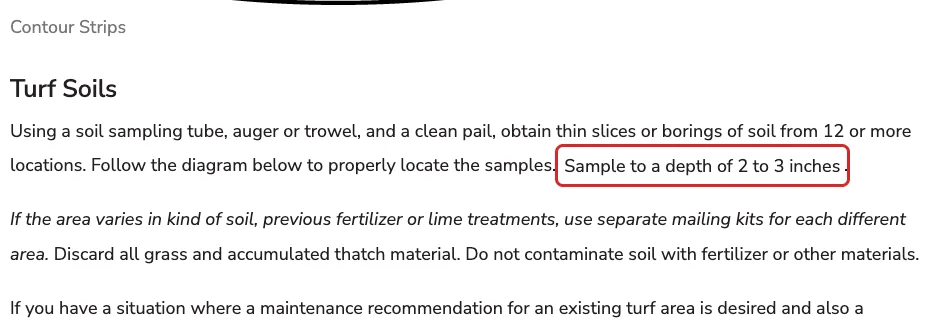
Depth changes the numbers. The University of Nebraska warns that moving from 3 to 6 inches will drastically change results, and that two labs using similar methods can still disagree, so use one lab and one depth every time. Remove the thatch before you cut the slice, or organic matter will read high (NDSU H1824).
When and how often should you test lawn soil?
Test an established lawn every 2 to 3 years, in late summer or fall, and before any new seeding or sodding. UGA Circular 896 names fall as the most practical time and a 2 to 3 year cycle once fertility is medium or high; Rutgers adds that a late-summer sample lines up with fall fertilization.
| Situation | When to test | Source |
|---|---|---|
| Established lawn, routine check | Every 2 to 3 years once levels are medium or high | UGA C896 |
| Sandy soil / clay soil | Every 2 to 3 years / every 3 to 4 years | Ohio State HYG-1132 |
| Before fall feeding of a cool-season lawn | Late summer | Rutgers FS797 |
| Before seeding, sodding or renovating | 2 to 3 months ahead, so lime can be mixed in before planting | UGA C896 |
| After lime, fertilizer or manure | Not shortly after; wait for it to react | Rutgers FS797 |
| Comparing pH year to year | Same season each time: pH runs 0.3 to 0.5 units higher in spring | Oregon State |
| Problem area (yellowing, thin turf) | Any time, with a separate sample from the good area | NCDA&CS; UVM |
How do you read a soil test report?
Read the results, then the lab’s recommendations: pH tells you whether the soil is too acid, buffer pH tells the lab how much lime it will take, and phosphorus and potassium in ppm decide the fertilizer grade. The University of Nebraska gives turf ranges of 25 to 50 ppm phosphorus and 40 to 80 ppm potassium by Mehlich-3.
| Line on the report | What it means | Lawn reading | Source |
|---|---|---|---|
| Soil pH (water) | Acidity of the soil itself | Nebraska limes turf below 5.5; your lab prints a target for your grass (5.5 for bahiagrass on the UF/IFAS sample) | Nebraska G2265 |
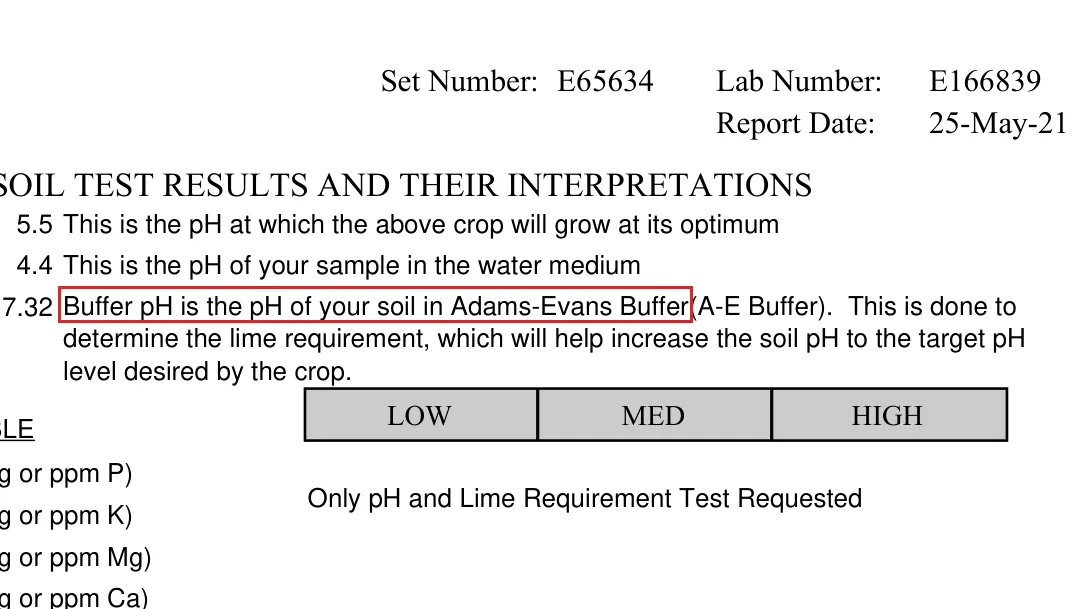
| Buffer pH (Adams-Evans, SMP or Mehlich) | Reserve acidity; the lab uses it to set the lime rate | Read it through the lime line: 79 lb per 1,000 sq ft a year on the UF/IFAS sample at pH 4.4 | UF/IFAS sample report |
| Phosphorus, ppm (Mehlich-3 or Olsen) | Plant-available P | Mehlich-3 25 to 50 ppm; over 50, no P needed | Nebraska G2265 |
| Potassium, ppm | Plant-available K | Mehlich-3 40 to 80 ppm; over 80, no K needed | Nebraska G2265 |
| Calcium and magnesium | Exchangeable bases | Ca:Mg:K ratios (base saturation) can be ignored for turf | Nebraska G2265 |
| Organic matter, % | Carbon-rich soil fraction | No target; track the trend. A fast rise points to thatch | Nebraska G2265 |
| CEC | How many nutrient cations the soil holds | Higher on clay soils, which hold more nutrients than sand | Ohio State HYG-1132 |
| Nitrogen | Not tested by most labs | Rate comes from the grass and the season | UMD; UF/IFAS |
| Soluble salts (EC) | Salt content | Bluegrass struggles above 1.5 dS/m ECe; most others above 3.0 | Nebraska G2265 |
What do ppm and lb per acre mean on a report?
Parts per million (ppm) and pounds per acre describe the same nutrient two ways: for the top 6 inches of soil, ppm times 2 is about lb per acre (SDSU), and Nebraska’s G2265 says to divide lb per acre by 2 to get ppm. To turn lb per acre into lb per 1,000 sq ft, divide by 43.56.
How do you turn soil test results into pounds of fertilizer?
Divide the nutrient rate on the report by the nutrient’s percentage on the bag, then multiply by your lawn area in thousands of square feet. A report asking for 1 lb of K2O per 1,000 sq ft, filled with 0-0-60 potash, needs 1 ÷ 0.60 = 1.67 lb of product per 1,000 sq ft.
The worked example uses a 5,000 sq ft established cool-season lawn and the turf tables in NDSU H1824, which are adapted from University of Minnesota recommendations. The soil values are an illustration we chose to sit inside NDSU’s middle rows: 12 ppm Olsen phosphorus and 80 ppm potassium, clippings returned.
| Step | Input or rule | Arithmetic | Result |
|---|---|---|---|
| 1. Lawn area | 5,000 sq ft | 5,000 ÷ 1,000 | 5 units of 1,000 sq ft |
| 2. Phosphorus rate | Olsen P 12 ppm, established lawn: 8 to 18 ppm row | NDSU Table 2 | 0.5 lb P2O5 per 1,000 sq ft |
| 3. Phosphorus product | 0-46-0 (triple superphosphate) | 0.5 ÷ 0.46 = 1.09 lb; × 5 | 5.4 lb of product, once |
| 4. Potassium rate | K 80 ppm (medium), clippings returned | NDSU Table 4, general turf | 2 lb K2O per 1,000 sq ft a year |
| 5. Split the potassium | Cap of 1.5 lb K2O per 1,000 sq ft at one time | 2 ÷ 2 feedings | 1 lb K2O per feeding |
| 6. Potassium product | 0-0-60 (muriate of potash) | 1 ÷ 0.60 = 1.67 lb; × 5 | 8.3 lb per feeding, 16.7 lb a year |
| 7. Nitrogen feeding | 1 lb N per 1,000 sq ft from a 29-3-5 grade | 1 ÷ 0.29 = 3.45 lb; × 5 | 17.2 lb of product per feeding |
| 8. Credit the extras | 3.45 lb of 29-3-5 also carries 3% P2O5 and 5% K2O | 3.45 × 0.03; 3.45 × 0.05 | 0.10 lb P2O5 and 0.17 lb K2O per 1,000 sq ft |
NDSU’s own bag check confirms step 7: a 50 lb bag of 29-3-5 holds 14.5 lb of nitrogen, enough for 14,500 sq ft at 1 lb per 1,000. If the report calls for lime, the rate and how to split it are covered in our guide to lime for lawns. State phosphorus rules for lawns, which can require a soil test before any phosphorus goes down, are in our lawn fertilizer guide.
What do soil test guides often get wrong?
The most common errors are a single sampling depth for every lab (labs range from 2 to 6 inches), treating ppm and lb per acre as the same number (they differ by a factor of 2), and trusting a kit or probe for fertilizer rates. The table sets each claim next to what the primary source says, with the source linked in each row.
| Claim you will see | What the primary source says | Source |
|---|---|---|
| Sample every lawn 6 inches deep | Lawn depth is set by the lab: 2 to 3 inches at Penn State, 4 at NC and Georgia, 6 at Rutgers and Nebraska | Penn State AASL; NCDA&CS; Rutgers |
| ppm on a report equals lb per acre | One extension fact sheet says so; Nebraska and SDSU use a factor of 2 (lb per acre ÷ 2 = ppm for the top 6 inches) | Ohio State HYG-1132; Nebraska G2265; SDSU |
| A home kit tells you how much fertilizer to apply | Only 1 of 4 kits in SDSU’s test gave rates; Montana State calls rates essentially impossible to set from low, medium and high ratings | SDSU; Montana State |
| A soil test measures nitrogen | Routine lawn tests do not; nitrogen rates come from the grass | UMD; UF/IFAS |
| Two-prong meters read soil pH | A probe read 6.0 on soils from 5.6 to 7.9 | Oregon State; J. of Extension |
| Balance your calcium to magnesium ratio | The base cation saturation ratio theory has been proven incorrect, including in turf | Nebraska G2265 |
| Vinegar fizz tells you the pH | Fizz means free calcium carbonate, a reason not to add sulfur; it gives no pH number | NDSU H1824 |
Should you use a lab, a kit or a meter?
Use a lab whenever you need a lime or fertilizer rate in pounds per 1,000 sq ft, and keep kits and meters for quick pH checks in the 2 to 3 years between lab tests. The table and the flowchart below hold the same rules: each row names the situation, what to do, and the source behind the threshold.
| If your situation is | Do this | Why (source) |
|---|---|---|
| New lawn, renovation or never tested | Send a routine lab test before seeding | Lime needs 2 to 3 months to react before planting (UGA C896) |
| You need a lime or fertilizer rate | Use a lab | Kits report only low, medium or high (Faber et al.; Montana State) |
| Lab test under 3 years old; checking pH drift | Color kit or calibrated handheld meter | Treat in-field pH as an estimate (Oregon State) |
| In-field pH outside your grass’s range | Confirm with a lab before liming | Oregon State |
| The only tool is a two-prong probe | Do not act on its reading | Probe could not separate soils 2 units apart (J. of Extension) |
| Report pH 7.5 or higher | Do a vinegar fizz test before buying sulfur | Fizz means carbonates resist sulfur (NDSU H1824) |
| Mehlich-3 phosphorus above 50 ppm | Use a phosphorus-free grade | No P required above 50 ppm (Nebraska G2265) |
| Potassium rate above 1.5 lb K2O per 1,000 sq ft | Split it into two or more feedings | NDSU H1824 |
| Soil wet, or recently limed or fertilized | Wait to sample | NCDA&CS; Rutgers |
| Front and back lawns look different | Send two samples | UMD |
1Is this a new lawn, a renovation, or a lawn that has never been lab tested?
YesSend a routine test to your state university lab before seeding; lime takes 2 to 3 months to react (UGA C896).
NoGo to the next question
2Do you need a lime or fertilizer rate in pounds per 1,000 sq ft?
YesUse a lab. Kits report only low, medium or high (Faber et al. 2007; Montana State).
NoGo to the next question
3Is your only tool a two-prong probe meter?
YesDo not act on it. A probe read pH 6.0 on soils from 5.6 to 7.9 (Oregon State; Journal of Extension).
NoGo to the next question
4Do you have a lab report from the last 3 years and only want to check pH?
YesUse a color kit or a handheld meter calibrated with fresh buffers; confirm any out-of-range reading with a lab (Oregon State).
NoSend a lab test; retest every 2 to 3 years with the same lab (UGA C896; UMD).
Send a lab test.
Once the report is back, fertilizer timing by month is in our lawn care schedule. Starter fertilizer for new seed is covered in our guide to planting grass seed and our overseeding guide. Whether a soil test can replace imported fill is covered in our topsoil cost guide. Compaction is a physical problem a chemical test does not measure; the screwdriver check is in our aeration timing guide. Grass-by-grass pH targets are in our Turf and Trees section.
This page is general information about soil testing. Fertilizer and pesticide products are governed by their labels and by state law; read the label and your state’s rules before you apply anything.
How we compiled this
We compiled this page from 52 primary documents read in October 2026: fee pages or forms from 25 state and land-grant soil labs, 14 extension publications, three accuracy studies, a UF/IFAS sample report and 9 kit seller and maker pages. Kit and meter results are the studies’ own numbers; the worked example is our arithmetic on NDSU tables with soil values we chose. No soil, kit or meter was tested for this page.
| Option | Typical price | Time to result | Gives lime and fertilizer rates? | Source |
|---|---|---|---|---|
| State or land-grant lab | $0 to $40 (median $15) | 3 working days (Virginia Tech) to about 3 weeks (UNH) after arrival | Yes | Lab fee pages |
| Brand mail-in kit | $29.88 to $38 | About 6 days to 4 weeks | Yes, per seller | Seller pages |
| Color kit | $10 to $50 for multiple tests | 1 to 2 days | No: low, medium or high | Faber et al. 2007 |
| Handheld pH meter | $154.99 (Hanna HI981030) | Instant | No: pH only | Hanna |
| Two-prong probe | Not compiled | Instant | No: unreliable | J. of Extension |
Frequently asked questions
Are DIY soil test kits accurate?
For pH, roughly: SDSU found cheap kits within about 1 unit of the lab on most soils, and the best kits in the UC study matched the lab 92 to 94 percent of the time. For phosphorus and potassium, often not: kits report only low, medium or high, and Rapitest called for phosphorus on soils the lab rated very high.
What is the most accurate soil tester?
A university or commercial lab is the most accurate soil test. For pH alone, a handheld glass-electrode meter calibrated with fresh buffers came within 0.2 units of the average of 82 labs in the study Oregon State reproduces. Two-prong probe meters read 6.0 on every soil in that study.
How much does it cost to get your soil tested?
A routine lawn test costs $0 to $40 at the 25 state and land-grant labs we checked in October 2026, with a median of $15. Organic matter, texture or lead screening add a few dollars to $40. Brand-name mail-in kits run $29.88 to $38.
How can I test my soil for free?
North Carolina residents get free tests from NCDA&CS from April 1 to November 30, 2026, and Arkansas residents get free tests through county Extension offices. Some Master Gardener groups, such as Clackamas County, Oregon, hold free pH clinics, which give pH only.
Why is vinegar used for soil testing?
Vinegar shows whether soil holds free calcium carbonate. NDSU says to add about 1 tablespoon of soil to 2 tablespoons of vinegar when a report shows pH 7.5 or higher: fizzing means carbonates are present and sulfur is unlikely to lower the pH. It does not give a pH number.
What is a good pH for lawn soil?
Most turfgrasses do well between pH 5.5 and 8.0 by Nebraska Extension’s turf ranges, and NDSU calls 6.5 ideal for most turf. Some grasses prefer lower: the UF/IFAS sample report sets 5.5 as the target for a bahiagrass lawn. Your lab prints the target for the grass you name on the form.
How long does a soil test take?
Most state labs report within one to three weeks of receiving the sample. UGA quotes 4 to 6 days, Virginia Tech usually 3 working days, UMass 6 to 8 business days and UNH about 3 weeks. Add mailing time, and test in fall to avoid the spring rush.
Sources
- Faber, Downer, Holstege and Mochizuki, HortTechnology 17(3), Accuracy Varies for Commercially Available Soil Test Kits Analyzing Nitrate-Nitrogen, Phosphorus, Potassium, and pH, July to September 2007. Accessed October 2026.
- SDSU Extension, Are Cheap Home Garden Soil Test Kits Accurate?, updated July 3, 2025. Accessed October 2026.
- Oregon State University Small Farms Program, Measuring Soil pH (Sam Angima), Fall 2010. Accessed October 2026.
- Journal of Extension 39(4), How to Diagnose Soil Acidity and Alkalinity Problems in Crops: A Comparison of Soil pH Test Kits (Stevens, Dunn and Phipps, University of Missouri), August 2001. Accessed October 2026.
- Montana State University Extension Soil Fertility, The Soil Scoop: Soil Testing: Test Kits vs. Laboratory Analysis, undated page. Accessed October 2026.
- UNH Extension, Are garden soil test kits a good alternative to lab testing?, April 2020. Accessed October 2026.
- University of Maryland Extension, Home and Garden Information Center, Soil Testing and Soil Testing Labs, page current October 2026. Accessed October 2026.
- NC Department of Agriculture and Consumer Services, Agronomic Services, Collect Soil Samples, last modified May 12, 2026. Accessed October 2026.
- University of Georgia Extension, Circular 896: Soil Testing for Home Lawns, Gardens and Wildlife Food Plots, minor revisions July 18, 2024. Accessed October 2026.
- Penn State Agricultural Analytical Services Laboratory, Soil Sampling Instructions, page current October 2026. Accessed October 2026.
- University of Delaware Cooperative Extension, Circular 19: How to Take a Soil Sample for Home Lawns and Gardens, undated PDF. Accessed October 2026.
- Ohio State University Extension, HYG-1132 Soil Testing for Horticultural Needs, May 20, 2025. Accessed October 2026.
- NDSU Extension, H1824 Interpreting the NDSU Soil Test Analysis for Managing Turfgrass, revised April 2023. Accessed October 2026.
- University of Vermont Agricultural and Environmental Testing Lab, How to Take a Soil Sample, PDF posted May 2024. Accessed October 2026.
- University of Nebraska-Lincoln Extension, NebGuide G2265 Simplifying Soil Test Interpretations for Turf Professionals (Bill Kreuser), July 2015. Accessed October 2026.
- Rutgers Cooperative Extension, FS797 Soil Testing for Home Lawns and Gardens (Joseph Heckman), page current October 2026. Accessed October 2026.
- UF/IFAS Extension Soil Testing Laboratory, Landscape and Vegetable Garden Test Report, sample report for a bahiagrass lawn, report dated May 25, 2021. Accessed October 2026.
- Oregon State University Extension, Clackamas County Master Gardeners, 10-Minute University: Testing Soil pH, undated handout. Accessed October 2026.
- University of Arkansas, Marianna lab, Routine soil analysis (free for Arkansans via county Extension office) fee, checked Oct. 28, 2026. Accessed October 2026.
- NCDA&CS Agronomic Division, Standard Analysis (homeowner, properties 1 acre or less) fee, page modified May 12, 2026. Accessed October 2026.
- University of Georgia AESL, S1 (Routine Test) fee, checked Oct. 28, 2026. Accessed October 2026.
- Clemson Agricultural Service Lab, Standard Soil Test fee, checked Oct. 28, 2026. Accessed October 2026.
- University of Kentucky Regulatory Services, Routine Soil Test (code 01) fee, price list 2025-1b. Accessed October 2026.
- Virginia Tech Soil Testing Lab, Routine Test Package fee, checked Oct. 28, 2026. Accessed October 2026.
- UF/IFAS Extension Soil Testing Lab, Standard Soil Fertility Test (Test code 15; ‘Test B’ on Landscape and Vegetable Garden form) fee, form reviewed Aug. 2025. Accessed October 2026.
- Penn State AASL, Standard Individual Soil Test Kit (standard soil fertility test) fee, forms rev. March 2026. Accessed October 2026.
- Auburn Soil, Forage and Water Lab, Routine Soil Analysis fee, form rev. June 2022. Accessed October 2026.
- K-State Soil Testing Lab, Package #1 (default package on the Lawns and Other Turf form) fee, updated June 21, 2026. Accessed October 2026.
- LSU AgCenter STPAL, Routine Soil Test (General Public form) fee, form July 2025. Accessed October 2026.
- Texas A&M AgriLife SWFTL, 1. Routine Analysis (R) – Urban and Homeowner Soil Sample Information Form fee, pricing valid to Dec. 31, 2026. Accessed October 2026.
- Oklahoma State SWFAL, Routine Analysis (Soil Fertility) fee, effective July 1, 2025. Accessed October 2026.
- University of Tennessee Soil, Plant and Pest Center, Nutrient test (form: ‘Soil pH and Nutrients’) fee, 2026 fee schedule. Accessed October 2026.
- UVM Agricultural and Environmental Testing Lab, Basic (routine) soil test – home garden/horticulture fee, price set July 1, 2023. Accessed October 2026.
- UConn Soil Nutrient Analysis Lab, Standard Nutrient Analysis (Modified Morgan) fee, checked Oct. 28, 2026. Accessed October 2026.
- Rutgers Soil Testing Lab, Landscape Fertility Test fee, checked Oct. 28, 2026. Accessed October 2026.
- UMass Soil and Plant Nutrient Testing Lab, Routine Soil Analysis fee, updated Apr. 25, 2025. Accessed October 2026.
- University of Maine Soil Testing Service, 1. Standard Soil Test fee, revised June 2026. Accessed October 2026.
- University of Minnesota Soil Testing Lab, Regular Test (Lawn & Garden) fee, prices for 2026. Accessed October 2026.
- University of Delaware Soil Testing Program, B3. Home Lawn and Garden Soil Test – Includes Lead Screen fee, prices effective Aug. 2024. Accessed October 2026.
- Utah State Analytical Laboratories, Routine Test (Home Soil Test) fee, checked Oct. 28, 2026. Accessed October 2026.
- UNH Extension Soil Testing Service, Standard Gardening (Home Grounds & Garden) fee, effective Apr. 1, 2026. Accessed October 2026.
- UW Soil and Forage Analysis Lab, Lawn & Garden and Wildlife Food Plots (Standard Analysis) fee, 2025 brochure. Accessed October 2026.
- Colorado State Soil, Water and Plant Testing Lab, S2 Basic (no separate homeowner package; Horticulture form covers lawn/turf and gardens) fee, effective July 1, 2026. Accessed October 2026.
- The Andersons, The Andersons Soil Test product page, price checked Oct. 28, 2026. Accessed October 2026.
- Sunday, Sunday Soil Test Kit & Analysis product page, price checked Oct. 28, 2026. Accessed October 2026.
- MySoil, MySoil Soil Test Kit product page, price checked Oct. 28, 2026. Accessed October 2026.
- Yard Mastery, Yard Mastery Soil Testing Kit – Mail-In Lab Analysis product page, price checked Oct. 28, 2026. Accessed October 2026.
- Lawnbright, Lawnbright Soil Test Kit product page, price checked Oct. 28, 2026. Accessed October 2026.
- Logan Labs, Our Services and Pricing Guide, price checked Oct. 28, 2026. Accessed October 2026.
- Luster Leaf, Luster Leaf Rapitest Soil Test Kit (cat. 1601) product page, price checked Oct. 28, 2026. Accessed October 2026.
- LaMotte, LaMotte Garden Guide Soil Test Kit (Model EL, order code 5679-02) product page, price checked Oct. 28, 2026. Accessed October 2026.
- Hanna Instruments, Hanna GroLine Soil pH Tester HI981030 product page, price checked Oct. 28, 2026. Accessed October 2026.