A lawn care schedule follows grass type: cool-season lawns get most nitrogen from late August to early December and crabgrass preventer before soil reaches 55°F; warm-season lawns get nitrogen only from green-up until 4 to 6 weeks before frost.
Key takeaways
- Cool-season grasses (tall fescue, Kentucky bluegrass, fine fescue, ryegrass) benefit most when the majority of nitrogen goes on from late summer through autumn, at no more than 1 lb of water-soluble N per 1,000 sq ft per application (Purdue AY-22).
- Warm-season grasses (bermudagrass, zoysiagrass, St. Augustinegrass, centipedegrass) get no nitrogen until soil at 4 inches is constantly 65°F and rising (UGA bermudagrass calendar), and the last feeding goes on 4 to 6 weeks before the first frost (Texas A&M EHT-144).
- Crabgrass germinates when the 24-hour mean soil temperature averages about 55°F for 3 or 4 days, so preventer goes down by the end of February in central North Carolina (NC State TurfFiles, 2024) and from mid-April to mid-May in Minnesota (UMN Extension).
- Mowing height runs 2.5 to 3.5 inches for tall fescue (3.5 in summer), 2.5 to 4 for St. Augustinegrass and 1 to 2.5 for bermudagrass, and every grass follows the one-third rule (NC State AG-367; AG-540; AG-431).
- State law overrides the calendar: Vermont bars turf fertilizer after Oct. 15 until April 1 (10 V.S.A. §1266b), New Jersey and Maryland bar nitrogen and phosphorus for homeowners after Nov. 15 until March 1 (Md. Code, Agric. §8-803.5), and three Florida counties ban both from June 1 to Sept. 30 (Pinellas County).
Which lawn care schedule fits your grass?
Pick the schedule by grass group, not by state. Cool-season grasses grow in spring and fall; warm-season grasses grow from late spring to early fall and go dormant after frost. A tall fescue lawn and a bermudagrass lawn in the same Georgia town need opposite feeding months: UGA marks May to August as no-nitrogen months for tall fescue and as the best feeding months for bermudagrass (UGA tall fescue calendar).
Mixed lawns follow the dominant grass. The University of Maryland says to base care on whatever grass is dominant, which for most Maryland lawns is tall fescue or zoysia (UMD lawn maintenance calendar). For a grass-by-grass profile of the most common cool-season lawn grass, see our guide to tall fescue.
| Grass | Group | Mowing height | Nitrogen, lb per 1,000 sq ft per year | Feeding months | Source |
|---|---|---|---|---|---|
| Tall fescue | Cool | 2.5 to 3.5 in (3.5 in summer) | 2 to 4 | Feb, Sept, Nov (NC); Sept to Nov (GA) | NC State AG-367; UGA |
| Kentucky bluegrass | Cool | 2.5 to 3.5 in | 3 to 4 | Feb to Mar, Oct to Dec (GA) | UMD; UGA |
| Fine fescue | Cool | 3 to 4 in | 1.4 max (MD) | Sept; optional May | UMD |
| Bermudagrass | Warm | 1 to 2.5 in | 2 to 5 | Apr or May to Aug; 0.5 lb max in Sept | NC State AG-431; UGA |
| Zoysiagrass | Warm | 1.5 to 2.5 in | 2 to 3 (4 max) | After green-up, late June, mid-Aug | UMD; NC State AG-432; UGA |
| St. Augustinegrass | Warm | 2.5 to 4 in | 2 to 5 (GA); 1 to 4 (TX) | May to Aug; none after mid-Sept | NC State AG-540; TAMU EHT-144 |
| Centipedegrass | Warm | 1 to 2 in | 1 to 2 | Mid-May; optional mid-Aug | NC State AG-381; UGA |
What does a month-by-month lawn care schedule look like for cool-season grass?
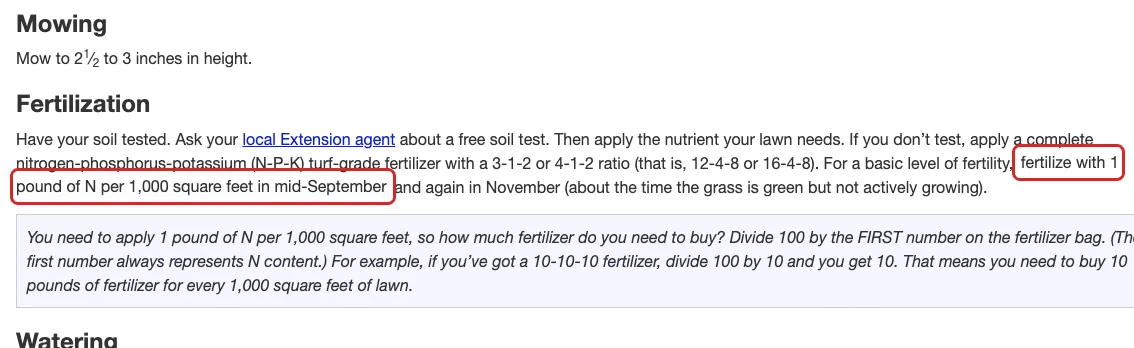
For tall fescue and Kentucky bluegrass, the year turns on September. NC State’s basic program is 1 lb of nitrogen per 1,000 sq ft in mid-September, 1 lb in November and 1 lb in February, with only 1/5 to 1/2 lb as needed in spring and summer (NC State AG-367). Northern calendars move everything earlier in fall and later in spring.
| Month | Transition zone (NC, VA, MD) | North (MN, WI, IN, IL) | Source |
|---|---|---|---|
| January | Mow to 3 in and clear leaves; no feeding listed | Dormant; no feeding listed in Purdue’s program | AG-367; AY-22 |
| February | 1 lb N; crabgrass preventer by end of month in central NC | Nothing | AG-367; TurfFiles |
| March | Preventer by early March; mow 2.5 to 3.5 in | 0 to 0.5 lb N mid-March onward (optional) | AG-367; AY-22 Table 2 |
| April | 0.2 to 0.5 lb N if needed; mow every 5 to 7 days by late spring | Preventer mid-April to mid-May; first mowing in the last week of April (MN) | AG-367; UMN |
| May | 0.2 to 0.5 lb N if needed | 0.5 to 0.75 lb N (May to mid-June); broadleaf weeds acceptable | AG-367; AY-22; UMN |
| June | Mow at 3.5 in; no herbicides June to August | No N on unirrigated lawns | AG-367; AY-22 |
| July | Water about 1 in a week, or let established tall fescue go dormant (UMD) | Preventive grub control early to mid-July | AG-367; UMD; Purdue E-271 |
| August | Overseed Aug. 15 to Sept. 1 in the NC mountains | Feed, aerate, dethatch and seed from early or mid-August | AG-367; UMN |
| September | 1 lb N mid-month; overseed Sept. 1 to Oct. 1 at 6 lb seed per 1,000 sq ft; aerate | Up to 1 lb N a month; broadleaf weed control | AG-367; AY-22; UMN |
| October | Mow at 2.5 to 3 in | 0.5 to 0.75 lb N about every 3 weeks; mowing continues to about the end of October | AG-367; AY-22; UMN |
| November | 1 lb N while grass is green but not growing (check state blackout dates) | Late-season N continues to early December | AG-367; AY-22 |
| December | Mow to 3 in; clear leaves | Purdue’s autumn window closes in early December | AG-367; AY-22 |
How much nitrogen does a cool-season lawn need in each season?
Purdue sets the total at 1 to 5 lb of nitrogen per 1,000 sq ft a year, split by how the lawn is kept. An unirrigated lawn with clippings returned gets 2 to 4 lb, none in summer; a watered lawn with clippings bagged gets 3 to 5 lb, up to 1 lb in summer (Purdue AY-22, Table 2). Any season total above 1 lb is split into two or more applications.
| Maintenance level | Year total | Mid-March to April | May to mid-June | Mid-June to August | Late Aug. to Sept. | Oct. to early Dec. |
|---|---|---|---|---|---|---|
| Lowest: clippings returned, not irrigated | 1 to 3 | 0 to 0.5 | 0 to 0.5 | 0 | 0.5 to 1 | 0 to 1 |
| Moderate: clippings returned, not irrigated | 2 to 4 | 0 to 0.75 | 0.5 to 0.75 | 0 | 0.5 to 1 | 1 to 2 |
| Moderate plus regular irrigation | 2 to 4 | 0 to 0.5 | 0.5 to 1 | 0 to 0.75 | 0.5 to 1 | 1 to 2 |
| Highest: irrigated, clippings removed | 3 to 5 | 0 to 0.5 | 0.5 to 1 | 0.5 to 1 | 1 to 2 | 1 to 2 |
Minnesota’s table lands in the same place by a different route. A lawn with some watering and clippings returned on medium organic-matter soil gets 1.5 lb a year in two feedings, September and May to June; a watered lawn with clippings removed gets 3.5 lb in four feedings, August, September, early October and May to June (UMN Extension, Fertilizing lawns).
What does the lawn care schedule look like for warm-season grass?
Warm-season lawns are fed only while they grow. NC State’s calendars list no fertilizer at all from December through February for bermudagrass, zoysiagrass, centipedegrass and St. Augustinegrass, and Texas A&M says the first nitrogen waits until the lawn has been mowed 2 to 3 times (Texas A&M ESC-042).
| Month | Bermudagrass, zoysiagrass, St. Augustinegrass, centipedegrass | Source |
|---|---|---|
| January | No fertilizer on any of the four grasses | AG-431; AG-432; AG-381; AG-540 |
| February | Crabgrass preventer mid-February to early March (bermudagrass, zoysiagrass); mid to late February (St. Augustinegrass) | AG-431; AG-432; AG-540 |
| March | Preventer on centipedegrass by March 1; first bermudagrass mowing at green-up, set as low as possible without scalping | AG-381; AG-431 |
| April | Bermudagrass: 0.5 to 1 lb N several weeks after full green-up (early April to May). Zoysiagrass: 0.5 lb about 3 weeks after green-up | AG-431; AG-432 |
| May | Centipedegrass: 1 lb N mid-May, never earlier. St. Augustinegrass: 0.5 lb. Dethatch bermudagrass or centipedegrass if thatch tops 1/2 in | AG-381; AG-540; AG-431 |
| June | Bermudagrass: 1 lb N every 4 to 6 weeks. St. Augustinegrass: 0.5 lb. Zoysiagrass: 0.5 to 1 lb late June. Aerate (UGA best May to August) | AG-431; AG-540; AG-432; UGA |
| July | St. Augustinegrass: 1 lb N. Dethatch bermudagrass or zoysiagrass (UGA best June to July) | AG-540; UGA |
| August | St. Augustinegrass: 0.5 lb N. Zoysiagrass: repeat mid-August. Centipedegrass: optional 1 lb mid-August | AG-540; AG-432; AG-381 |
| September | Bermudagrass: no more than 0.5 lb N. St. Augustinegrass: 0.5 lb or less, nothing after mid-month. Zoysiagrass: no N. 1 lb potash 4 to 6 weeks before frost | AG-431; AG-540; AG-432 |
| October | Overseed bermudagrass with ryegrass at 5 to 10 lb per 1,000 sq ft (UGA best month). Last N by Oct. 1 in Dallas, Oct. 15 in Austin and Houston | UGA; TAMU SCS-2005-15 |
| November | Last N by Nov. 1 in College Station, Laredo and Victoria; none elsewhere | TAMU SCS-2005-15 |
| December | No fertilizer | AG-431; AG-381; AG-540 |
Texas turns the frost rule into dates. Texas A&M’s fertilizer bulletin puts the first nitrogen after April 15 in Austin, San Antonio and Waco, after May 1 in Dallas and El Paso and after June 1 in Amarillo, and the last nitrogen by Sept. 15 in Amarillo (Texas A&M SCS-2005-15, Tables 3 and 4).
How do the monthly nitrogen programs compare?
Four of NC State’s calendars give month-specific rates, which makes the difference between grasses easy to see. Tall fescue is fed in the cool months, St. Augustinegrass spreads 3 lb over May to September, and centipedegrass, the lowest-input grass of the group, gets 1 lb in mid-May and an optional 1 lb in mid-August.
| Month | Tall fescue | St. Augustinegrass | Centipedegrass | Zoysiagrass |
|---|---|---|---|---|
| February | 1 | 0 | 0 | 0 |
| April or May | 0.2 to 0.5 if needed | 0.5 (May) | 1 (mid-May) | 0.5 (about 3 weeks after green-up) |
| June | 0.2 to 0.5 if needed | 0.5 | 0 | 0.5 to 1 (late June or early July) |
| July | 0.2 to 0.5 if needed | 1 | 0 | see June |
| August | 0.2 to 0.5 if needed | 0.5 | 1 (optional) | 0.5 to 1 (mid-August) |
| September | 1 (mid-month) | 0.5 or less | 0 | 0 |
| November | 1 | 0 | 0 | 0 |
When should crabgrass preventer go down in your region?
Apply preemergent herbicide before crabgrass germinates, which happens when the 24-hour mean soil temperature averages about 55°F for 3 or 4 days (NC State TurfFiles). Penn State aims 10 to 14 days ahead of the earliest expected germination, when the upper inch of soil reaches 55 to 58°F at daybreak for 4 to 5 days (Penn State Extension). Calendar dates below are the regional translations.
| Region | Apply by | Trigger or note | Source |
|---|---|---|---|
| South Texas | Before mid-February | Germination typically mid-February | Texas A&M ESC-042 |
| North and Central Texas | Before early March | Germination early March; Panhandle mid-March | Texas A&M ESC-042 |
| Georgia | February to March (April possible) | UGA calendar marks Feb. and March as best | UGA CAES |
| Central North Carolina | End of February | Mid-February east of Raleigh; very early March in the western piedmont | NC State TurfFiles, 2024 |
| Maryland | When soil holds 53 to 55°F for 5 days | Forsythia bloom is a rough guide only | UMD Extension |
| Southeastern Pennsylvania | March 15 to April 15 | Other PA areas April 1 to May 1; northern tier April 20 to May 10 | Penn State Extension |
| Wisconsin | When forsythia is past full bloom | Germination usually not until May or June | UW-Madison Extension |
| Minnesota | Mid-April to mid-May | Do not use crabgrass preventer in fall | UMN Extension |
Two conflicts to plan around: many preemergent products block grass seed too, so the University of Maryland notes you often cannot reseed in the same season (UMD), and products sold for crabgrass are pesticides whose label is the law. Product choice and split applications are covered in our crabgrass control guide.
How many pounds of fertilizer go on per application?
Divide the nitrogen you want by the nitrogen percentage on the bag. Illinois Extension’s worked example: for 1 lb of nitrogen per 1,000 sq ft from a 15-0-10 fertilizer on a 7,000 sq ft lawn, 1 ÷ 0.15 = 6.7 lb per 1,000 sq ft, and 6.7 × 7 = about 47 lb of product (Illinois Extension).
To compare named bags by what each pound of nitrogen costs, see our lawn fertilizer guide to labels, rates and price per pound of N.
The phosphorus and potassium side of that math starts with a lawn soil test, which also sets any lime rate.
Formula: pounds of product per 1,000 sq ft = target lb of N ÷ (first number on the bag ÷ 100). The worked example below applies Purdue’s moderate, unirrigated program to a 5,000 sq ft cool-season lawn using a 24-0-12 fertilizer, the grade the University of Minnesota’s turf program calls appropriate for most lawns (UMN Turfgrass Science, Sept. 2023).
| Application | Window | lb N per 1,000 sq ft | lb of 24-0-12 per 1,000 sq ft | lb of 24-0-12 for 5,000 sq ft |
|---|---|---|---|---|
| 1 | May to mid-June | 0.75 | 0.75 ÷ 0.24 = 3.13 | 15.6 |
| 2 | Late August to September | 1.0 | 1.0 ÷ 0.24 = 4.17 | 20.8 |
| 3 | October | 0.75 | 3.13 | 15.6 |
| 4 | November (where legal) | 0.75 | 3.13 | 15.6 |
| Year | 3.25 (inside Purdue’s 2 to 4) | 13.54 | 67.7 |
Two caps limit the per-application number. Purdue allows no more than 1.0 lb of water-soluble nitrogen per 1,000 sq ft in a single application, or up to 2.0 lb when more than half the nitrogen is slow-release, and no more than 2.0 lb a year on shaded turf (Purdue AY-22). Maryland law limits homeowners to 0.7 lb of water-soluble and 0.9 lb of total nitrogen per 1,000 sq ft per application, at least 20 percent of it slow-release (Md. Code, Agric. §8-803.5), so the 1.0 lb rows above become 0.9 lb there.
How does the Scotts 4 Step program line up with extension timing?
Scotts schedules its four bags from February to November: Step 1 by Easter, Step 2 near Memorial Day, Step 3 near Independence Day and Step 4 between Labor Day and mid-October (ScottsMiracle-Gro, How to start the Scotts 4 Step program). For a cool-season lawn, Step 4 matches extension timing, Steps 1 and 2 fit with caveats, and Step 3 does not.
| Step | Scotts’ window and cue | Extension guidance for the same weeks (cool-season) | Source |
|---|---|---|---|
| Step 1: crabgrass preventer plus lawn food | February to April, on or before Easter, while temperatures stay below 80°F | Preventer before soil holds about 55°F; 0 to 0.5 lb N mid-March to April | Scotts; AY-22; TurfFiles |
| Step 2: weed control plus lawn food | April to June, 4 to 6 weeks after Step 1, near Memorial Day | 0.5 to 0.75 lb N May to mid-June; broadleaf weed control acceptable May to late June, best September to late October | AY-22; UMN |
| Step 3: lawn food with 2% iron | June to August, near Independence Day | 0 lb N mid-June to August on unirrigated lawns; UMN: do not fertilize in hot mid-summer | AY-22; UMN |
| Step 4: fall lawn food | August to November, Labor Day to mid-October | Majority of yearly N from late summer through autumn | AY-22 |
The practical difference is weighting. The program puts three of its four feedings in spring and summer, while Purdue’s moderate program puts 1.5 to 3 lb of a 2 to 4 lb year into late August through early December. A cool-season owner who uses the program can skip Step 3 on an unwatered lawn and add a second fall feeding; a pre-emergent product in Step 1 still has to be timed to soil temperature rather than to Easter, which falls anywhere from March 22 to April 25.
Which states ban lawn fertilizer at certain times of year?
Six states and several Florida counties write fertilizer dates into law. Vermont bans turf fertilizer after Oct. 15 until April 1 (10 V.S.A. §1266b); New York bans it Dec. 1 to April 1 (N.Y. ECL §17-2103); New Jersey and Maryland bar homeowners from nitrogen and phosphorus after Nov. 15 (N.J. P.L.2010, c.112; Md. Code, Agric. §8-803.5); three Florida counties ban both June 1 to Sept. 30.
Swipe the table sideways to see every column.
| Jurisdiction | Restricted window or rule | Applies to | Nitrogen cap per application, per 1,000 sq ft | Water setback | Source |
|---|---|---|---|---|---|
| Vermont | After Oct. 15 until April 1: no fertilizer on turf; also when ground is frozen | Everyone | Turf nitrogen must be at least 15% slow-release | 25 ft | 10 V.S.A. §1266b |
| New York | Dec. 1 to April 1: no fertilizer on lawns | Everyone, including contractors | None in statute | 20 ft (3 ft with deflector or drop spreader) | N.Y. ECL §17-2103 |
| New Jersey | After Nov. 15 until March 1: no nitrogen or phosphorus (professionals: after Dec. 1); never on frozen ground | Homeowners; professionals | 0.7 lb water-soluble and 0.9 lb total N, at least 20% slow-release (professionals 1.0 lb total) | 25 ft (10 ft with deflector or drop spreader) | N.J. P.L.2010, c.112 |
| Maryland | After Nov. 15 until March 1: no nitrogen or phosphorus; professionals may apply up to 0.5 lb N Nov. 16 to Dec. 1; never on frozen ground | Everyone; professionals | 0.7 lb water-soluble and 0.9 lb total N, at least 20% slow-release (homeowners) | 15 ft (10 ft with deflector or drop spreader) | Md. Code, Agric. §8-803.5 |
| Connecticut | Dec. 1 to March 15: no phosphate-containing fertilizer, soil amendment or compost on lawns | Everyone | None | 20 ft for phosphate products (15 ft with deflector or drop spreader) | Conn. Gen. Stat. §22-111yy |
| Pennsylvania | After Dec. 15 until March 1: no more than 0.5 lb total N per 1,000 sq ft; none on ground frozen 2 in deep or snow-covered | Everyone | 0.7 lb readily available and 0.9 lb total N | 15 ft | 3 Pa.C.S. §6813 |
| Pinellas County, Fla. | June 1 to Sept. 30: no nitrogen or phosphorus; also during National Weather Service storm watches or warnings | Everyone | Granular 1 lb, at least 50% slow-release; liquid 0.5 lb | 10 ft | Pinellas County fertilizer ordinance |
| Sarasota County, Fla. | June 1 to Sept. 30: no nitrogen or phosphorus on residential turf or landscape plants | Everyone | 1 lb, at least 50% slow-release; 4 lb a year | 10 ft | UF/IFAS Extension Sarasota County, county fertilizer code summary |
| Lee County, Fla. (unincorporated) | June 1 to Sept. 30: no nitrogen or phosphorus | Everyone | At least 50% slow-release; 4 lb a year | 10 ft | Lee County Ord. 08-08, §7 |
| Wisconsin | No dates; no fertilizer on frozen ground (cannot dig down 6 to 8 in); phosphorus only with a soil test or new turf | Everyone | None | None in this section | Wis. Stat. §94.643 (DATCP fact sheet) |
| Massachusetts | No dates; no nutrients on soil frozen 2 in deep, snow-covered or saturated soil, or dormant turf | Everyone | UMass annual rate | 20 ft broadcast (10 ft with deflector or drop spreader) | 330 CMR 31.05(4) |
| Minnesota | No dates; phosphorus only with a soil test within 3 years or on new turf | Everyone | None | None in this section | Minn. Stat. §18C.60 |
| Washington | No dates; no phosphorus-labeled turf fertilizer on frozen ground; phosphorus only with a soil test or new turf | Everyone | None | None | RCW 15.54.500 |
| Virginia | No dated blackout; contractor-applicators must follow state nutrient management standards | Contractor-applicators | Set by DCR standards, not the statute | Label warning only | Va. Code §3.2-3602.1 |
These dates cut into the extension calendars. Several popular month-by-month calendars, including the one ranking near the top for this search, list a November ‘winterizer’ feeding with no date attached. In New Jersey and Maryland a homeowner’s last legal day is Nov. 15, and Maryland professionals are limited to 0.5 lb of nitrogen per 1,000 sq ft from Nov. 16 to Dec. 1 (Md. Code, Agric. §8-803.4). In Vermont, Scotts’ Step 4 window of August to November runs past the Oct. 15 cut-off, while its ‘Labor Day to mid-October’ cue fits.
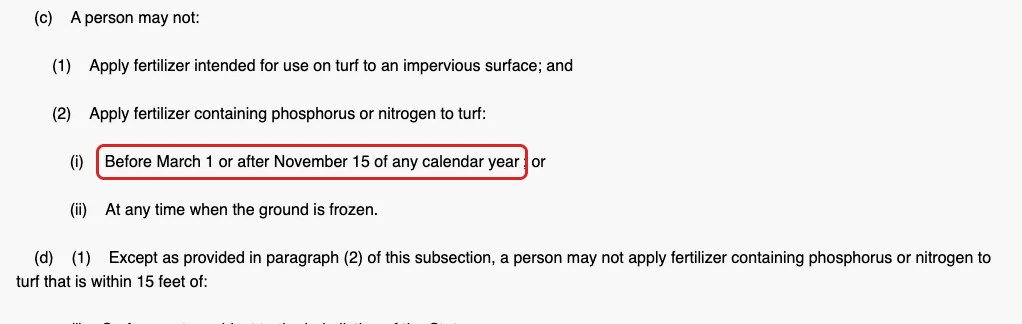
Frozen ground is the other line. New Jersey, Maryland and Vermont ban fertilizer on frozen ground outright; Wisconsin defines frozen as soil you cannot dig down 6 to 8 inches into (Wisconsin DATCP), and Pennsylvania and Massachusetts use ground frozen at least 2 inches deep (3 Pa.C.S. §6813; 330 CMR 31.05(4)). Lawn companies applying for hire also need a state license; requirements are on our pesticide applicator license page.
How much water and mowing does the schedule need in summer?
About 1 inch of water a week from rain or irrigation while the grass is growing, wetting the soil 4 to 6 inches deep (NC State AG-367); zoysiagrass gets by on 0.5 to 1 inch (AG-432). Sandy soils need about 1/2 inch every third day instead. Water between 2 a.m. and 8 a.m. to cut disease. Timing and run-time detail is in our guide to when to water grass.
To find your run time, Clemson’s method is to set out 5 to 10 straight-sided cans, run the sprinkler 15 minutes and multiply the average depth by 4 for inches per hour. At 0.5 in per hour, 1 inch takes 120 minutes; at 2 in per hour, 30 minutes (Clemson HGIC 1207).
| Sprinkler output (in per hour) | Minutes to apply 1 in | Minutes to apply 0.5 in |
|---|---|---|
| 0.5 | 120 | 60 |
| 1.0 | 60 | 30 |
| 1.5 | 40 | 20 |
| 2.0 | 30 | 15 |
Mowing follows the one-third rule: to hold a 3-inch lawn, mow when it reaches 4 inches (UMD); Minnesota’s version is to mow a 3-inch lawn before it reaches 4.5 inches (UMN). NC State raises tall fescue to 3.5 inches from June to August, and returning clippings supplies up to 25 percent of the lawn’s fertilizer needs (AG-367). For what a crew charges per visit through that season, see our lawn mowing cost guide.
When do aeration, dethatching and overseeding fit in?
In the same windows as the heaviest growth: late summer to early fall for cool-season lawns, late spring to early summer for warm-season lawns. The University of Minnesota puts aeration and vertical mowing between late August and early October, and treats thatch over 1/2 inch as the trigger for management (UMN Extension).
| Job | Cool-season window | Warm-season window | Source |
|---|---|---|---|
| Core aeration | Fall (NC); mid-August to mid-October, or late April to May (MN) | Late spring to early summer; UGA best May to August | AG-367; UMN; UGA |
| Dethatching (thatch over 1/2 in) | Mid-August through September (MN); rarely needed on tall fescue | Late May after full green-up (bermudagrass, centipedegrass) | UMN; AG-431; AG-381 |
| Overseeding | Sept. 1 to Oct. 1 in the NC piedmont at 6 lb tall fescue per 1,000 sq ft; early August to late September in MN | Centipedegrass seeded in May; bermudagrass overseeded with ryegrass in October | AG-367; UMN; AG-381; UGA |
| Broadleaf weed control | September to late October (best); May to late June | Winter-weed preemergent in September (UGA) | UMN; UGA |
Each of these jobs has its own page. Timing by soil and grass is in when to aerate your lawn, and prices are in our lawn aeration cost and dethatching cost guides. Seeding steps and rates are in how to overseed a lawn, and seed prices per pound in grass seed cost.
What should you do on your lawn this month?
Start from the grass group and the calendar, then check the legal window. The table and flowchart below hold the same rules, each threshold sourced in the last column. A state law overrides any extension date inside its blackout: a November feeding recommended by a calendar is illegal for a Maryland homeowner after Nov. 15.
| If your situation is | Do this | Why (source) |
|---|---|---|
| Cool-season lawn, late August to early November | Feed up to 1 lb N per 1,000 sq ft a month; aerate and overseed by Oct. 1 (NC piedmont) | AY-22; AG-367 |
| Cool-season lawn, mid-June to August, not irrigated | No nitrogen; mow at 3.5 in; no herbicides | AY-22; AG-367 |
| You will fertilize only once a year (cool-season) | Late summer to early fall: Aug. 15 to Sept. 15 in central Illinois | Illinois Extension |
| Soil nearing 55°F for 3 to 4 days in spring | Apply crabgrass preemergent now, unless you plan to seed this spring | TurfFiles; UMD |
| Warm-season lawn: full green-up, mowed 2 to 3 times, 4-in soil at 65°F | Start N at 0.5 to 1 lb per 1,000 sq ft, 4 to 8 weeks apart | ESC-042; UGA |
| Warm-season lawn within 4 to 6 weeks of first frost | Stop nitrogen; bermudagrass and centipedegrass take 1 lb potash | EHT-144; AG-431 |
| Centipedegrass before mid-May | No nitrogen yet | AG-381 |
| Shaded cool-season turf | Halve the rates; 2 lb N a year at most | AY-22 |
| Product more than 50% slow-release N | Up to 2 lb N per application; otherwise 1 lb | AY-22 |
| Thatch deeper than 1/2 in | Dethatch during active growth only | UMN; AG-431 |
| Homeowner in New Jersey or Maryland, Nov. 16 to the end of February | No nitrogen or phosphorus; make the late feeding by Nov. 15 | N.J. P.L.2010, c.112; Md. Code, Agric. §8-803.5 |
| Vermont lawn after Oct. 15 | No fertilizer until April 1 | 10 V.S.A. §1266b |
| Pinellas, Sarasota or Lee County, Fla., June 1 to Sept. 30 | No nitrogen or phosphorus; feed before June 1 and after Sept. 30 | Pinellas County fertilizer ordinance; Lee County Ord. 08-08, §7 |
| Ground frozen | No fertilizer (banned outright in NJ, MD, VT, PA, WI and MA) | Wis. DATCP; 3 Pa.C.S. §6813 |
1Is the ground frozen, or is today inside a legal blackout (after Oct. 15 in Vermont, after Nov. 15 for New Jersey or Maryland homeowners, Dec. 1 to April 1 in New York, June 1 to Sept. 30 in Pinellas, Sarasota or Lee County, Fla.)?
YesDo not fertilize. Mow only if the grass is growing and keep leaves off the lawn.
NoGo to the next question
2Is it a cool-season lawn (tall fescue, Kentucky bluegrass, fine fescue, ryegrass) between late August and early November?
YesFertilize at up to 1 lb N per 1,000 sq ft a month; aerate and overseed by Oct. 1 in the NC piedmont (Purdue AY-22; NC State AG-367).
NoGo to the next question
3Is soil about to hold 55°F for 3 to 4 days (late February in central NC, mid-April to mid-May in Minnesota)?
YesApply crabgrass preemergent now, unless you plan to seed this spring.
NoGo to the next question
4Is it a warm-season lawn that is fully green, mowed 2 to 3 times, with 4-inch soil at 65°F and rising?
YesFeed 0.5 to 1 lb N per 1,000 sq ft every 4 to 8 weeks until 4 to 6 weeks before first frost (Texas A&M ESC-042, EHT-144).
NoGo to the next question
5Is it a cool-season lawn between mid-June and August?
YesNo nitrogen on unirrigated turf; mow at 3.5 in; water about 1 in a week or let it go dormant; preventive grub control early to mid-July if grubs were a problem.
NoMow at your grass's height, removing no more than one-third of the blade, and wait for the next window.
How we compiled this
We compiled this schedule from 32 university and extension publications and from the statute, ordinance or state-agency text of 14 state and Florida county fertilizer laws, plus ScottsMiracle-Gro’s published 4 Step timing, all read at the source in October 2026. The worked fertilizer example is our arithmetic on Purdue’s rates. We did not test products or lawns; Michigan and Illinois are omitted because their statute sites could not be loaded.
This page is general information, not legal or pesticide-use advice. Fertilizer and pesticide rules change and local ordinances can be stricter than state law; read the product label and confirm with the agency linked for your state before applying.
Frequently asked questions
What is the proper schedule for lawn care?
Match it to your grass. Cool-season lawns are fed mostly from late August to early December, get crabgrass preventer before soil holds 55°F and are aerated and seeded in early fall (Purdue AY-22). Warm-season lawns are fed from green-up until 4 to 6 weeks before frost and aerated in late spring or early summer (Texas A&M EHT-144).
What is the 150 rule for lawns?
A rule of thumb for Pythium blight, a hot-weather turf disease: if average nighttime temperature in °F plus average relative humidity in percent equals 150, risk is high. The pathologists who describe it say it may over-predict (American Phytopathological Society, Pythium blight lesson). Maryland Extension’s fuller conditions: days of 86 to 95°F, nights above 68°F and humidity over 90 percent for 14 hours or more (UMD FS-2024-0707).
Is 20 minutes of watering the lawn enough?
Only if your sprinkler puts out about 3 inches an hour, which few do. Measure it: Clemson’s can test gives the output, and at 1 inch per hour a 1-inch watering takes 60 minutes; at 0.5 inch per hour it takes 120 (Clemson HGIC 1207). Most lawns need about 1 inch a week while growing (NC State AG-367).
What should I put on my lawn in October?
On a cool-season lawn, nitrogen: Purdue suggests 0.5 to 0.75 lb per 1,000 sq ft about every 3 weeks from early October to early December, mostly water-soluble (Purdue AY-22). On a warm-season lawn, usually none: NC State’s calendars stop nitrogen in September, and Texas A&M’s latest cut-offs are Oct. 15 in Austin and Houston and Nov. 1 in College Station and the Rio Grande Valley (Texas A&M SCS-2005-15).
What is the 1/3 rule in lawn care?
Never remove more than one-third of the grass blade in one mowing. To keep a lawn at 3 inches, mow when it reaches 4 inches (University of Maryland Extension). In late spring that can mean mowing tall fescue every 5 to 7 days (NC State AG-367).
When a rainy week pushes the lawn past that limit, our guide to whether you can mow wet grass gives the deck, discharge and slope rules from the mower manuals.
What month should I fertilize my lawn in the fall?
September for cool-season lawns in most of the country: mid-September in North Carolina (AG-367), Aug. 15 to Sept. 15 in central Illinois (Illinois Extension) and early August to mid-October in Minnesota (UMN). Warm-season lawns get their last, smaller feeding in September or earlier.
Can I fertilize my lawn every 2 months?
On warm-season grass in summer, yes: Texas A&M spaces bermudagrass feedings 4 to 8 weeks apart at 0.5 to 1 lb N per 1,000 sq ft (ESC-042). On a cool-season lawn, an every-2-months plan lands a feeding in midsummer, when Purdue lists zero nitrogen for unirrigated lawns (Purdue AY-22).
When is it too late to fertilize a lawn in the fall?
For warm-season grass, 4 to 6 weeks before the first frost (Texas A&M EHT-144). For cool-season grass, Purdue runs late-season feeding into early December, but law can end it sooner: Oct. 15 in Vermont (10 V.S.A. §1266b), Nov. 15 for homeowners in New Jersey and Maryland (Md. Code, Agric. §8-803.5) and Dec. 1 in New York (N.Y. ECL §17-2103).
Does New Jersey have a lawn fertilizer schedule law?
Yes. New Jersey’s fertilizer law bars homeowners from applying nitrogen or phosphorus to turf after Nov. 15 and before March 1, and professionals after Dec. 1. Each application is capped at 0.7 lb of water-soluble and 0.9 lb of total nitrogen per 1,000 sq ft, at least 20 percent slow-release, with a 25 ft setback from water (N.J. P.L.2010, c.112).
Sources
- NC State Extension, Tall Fescue Lawn Maintenance Calendar (AG-367), July 8, 2021. Accessed October 2026.
- NC State Extension, Tall Fescue and Kentucky Bluegrass Home Lawn Calendar (AG-930), June 27, 2022. Accessed October 2026.
- NC State Extension, Bermudagrass Lawn Maintenance Calendar (AG-431), July 30, 2021. Accessed October 2026.
- NC State Extension, Zoysiagrass Lawn Maintenance Calendar (AG-432), July 10, 2025. Accessed October 2026.
- NC State Extension, Centipedegrass Lawn Maintenance Calendar (AG-381), Aug. 4, 2021. Accessed October 2026.
- NC State Extension, St. Augustinegrass Lawn Maintenance Calendar (AG-540), July 8, 2021. Accessed October 2026.
- NC State TurfFiles, When to Apply Preemergent Herbicides for Turfgrasses, Feb. 8, 2024. Accessed October 2026.
- Purdue Extension, Fertilizing Established Cool-season Lawns (AY-22-W), Aug. 2013. Accessed October 2026.
- Purdue Extension Entomology, Managing White Grubs in Turfgrass (E-271), current edition. Accessed October 2026.
- University of Minnesota Extension, Lawn care calendar, reviewed 2024. Accessed October 2026.
- University of Minnesota Extension, Fertilizing lawns, reviewed 2024. Accessed October 2026.
- University of Minnesota Extension, How to control thatch in your lawn, reviewed 2024. Accessed October 2026.
- University of Minnesota Extension, Mowing practices for healthy lawns, reviewed 2024. Accessed October 2026.
- University of Minnesota Turfgrass Science, Home Lawn Care Newsletter, September 2023, Sept. 15, 2023. Accessed October 2026.
- University of Georgia CAES, Bermudagrass Lawn Calendar, 2024. Accessed October 2026.
- University of Georgia CAES, Turf-Type Tall Fescue Lawn Calendar, 2024. Accessed October 2026.
- University of Georgia CAES, Kentucky Bluegrass Lawn Calendar, 2024. Accessed October 2026.
- University of Georgia CAES, Zoysiagrass Lawn Calendar, 2024. Accessed October 2026.
- University of Georgia CAES, Centipedegrass Lawn Calendar, 2024. Accessed October 2026.
- Texas A&M AgriLife Extension, Bermudagrass Lawn Management Calendar (ESC-042), 2016. Accessed October 2026.
- Texas A&M AgriLife Extension, St. Augustinegrass Lawn Management (EHT-144), 2020. Accessed October 2026.
- Texas A&M AgriLife Extension, Lawn Fertilization for Texas Warm-Season Grasses: FAQ (SCS-2005-15), SCS-2005-15. Accessed October 2026.
- University of Maryland Extension, Maintaining an Established Lawn, updated Sept. 14, 2026. Accessed October 2026.
- University of Maryland Extension, Lawn Maintenance Calendar, current. Accessed October 2026.
- University of Maryland Extension, Crabgrass, updated March 13, 2023. Accessed October 2026.
- University of Maryland Extension, Turfgrass Diseases: Pythium Blight (FS-2024-0707), Oct. 22, 2024. Accessed October 2026.
- Penn State Extension, Lawn and Turfgrass Weeds: Smooth Crabgrass and Large Crabgrass, updated Sept. 10, 2025. Accessed October 2026.
- Penn State Extension, Control of Summer Annual Grass Weeds in Turfgrasses, updated Sept. 30, 2024. Accessed October 2026.
- UW-Madison Extension, Crabgrass Management in Lawns, April 2026. Accessed October 2026.
- University of Illinois Extension, Fertilizing your lawn, current. Accessed October 2026.
- Clemson Home & Garden Information Center, Watering Lawns (HGIC 1207), Oct. 7, 2019. Accessed October 2026.
- American Phytopathological Society, Pythium blight of turfgrass (The Plant Health Instructor), 2004, updated. Accessed October 2026.
- ScottsMiracle-Gro, How to start the Scotts 4 Step program, current. Accessed October 2026.
- Vermont General Assembly, 10 V.S.A. chapter 47, §1266b, Application of phosphorus fertilizer (as amended, eff. April 30, 2026), 2026. Accessed October 2026.
- New York State Senate, Environmental Conservation Law §17-2103, current. Accessed October 2026.
- New Jersey State Library, Acts of the Legislature 2010, Chapter 112 (fertilizer law), 2010. Accessed October 2026.
- Maryland General Assembly, Annotated Code, Agriculture §8-803.5, current. Accessed October 2026.
- Maryland General Assembly, Annotated Code, Agriculture §8-803.4, current. Accessed October 2026.
- Connecticut General Assembly, General Statutes chapter 427b, §22-111yy, current. Accessed October 2026.
- Pennsylvania Department of Agriculture, Fertilizer law, 3 Pa.C.S. §§6812 and 6813 (unofficial copy), Act 20 of 2023. Accessed October 2026.
- Pinellas County, Pinellas County Fertilizer Ordinance, current. Accessed October 2026.
- UF/IFAS Extension Sarasota County, Sarasota County fertilizer codes brochure, 2025. Accessed October 2026.
- Lee County Board of County Commissioners, Ordinance No. 08-08, May 13, 2008. Accessed October 2026.
- Wisconsin DATCP, Turf fertilizer restrictions (Wis. Stat. §94.643), April 2022. Accessed October 2026.
- Massachusetts Department of Agricultural Resources, 330 CMR 31.00, Plant nutrient application requirements, current. Accessed October 2026.
- Minnesota Revisor of Statutes, Minn. Stat. §18C.60, current. Accessed October 2026.
- Washington State Legislature, RCW 15.54.500, 2011. Accessed October 2026.
- Virginia Law, Va. Code §3.2-3602.1, current. Accessed October 2026.