Grubs in lawn are beetle larvae that chew grass roots: confirm them with a 1 sq ft dig, treat only above about 5 to 10 per sq ft, and time curative products for August to mid-September.
Key takeaways
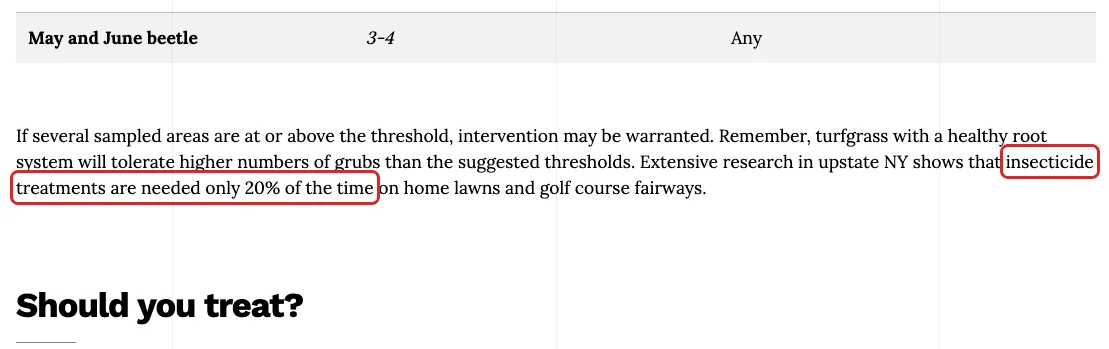
- Most turf tolerates up to 5 grubs per sq ft without visible damage, and 20 per sq ft may not show damage in healthy turf (Purdue E-271, June 2023). Cornell reports that insecticide was needed only 20 percent of the time on upstate New York lawns and fairways (Cornell IPM).
- Thresholds depend on the species, which you identify from the spine pattern under the tail: 3 to 4 May/June beetle grubs per sq ft, 5 to 8 European chafer, 8 to 10 Japanese beetle and 18 to 20 Asiatic garden beetle (Cornell IPM threshold table).
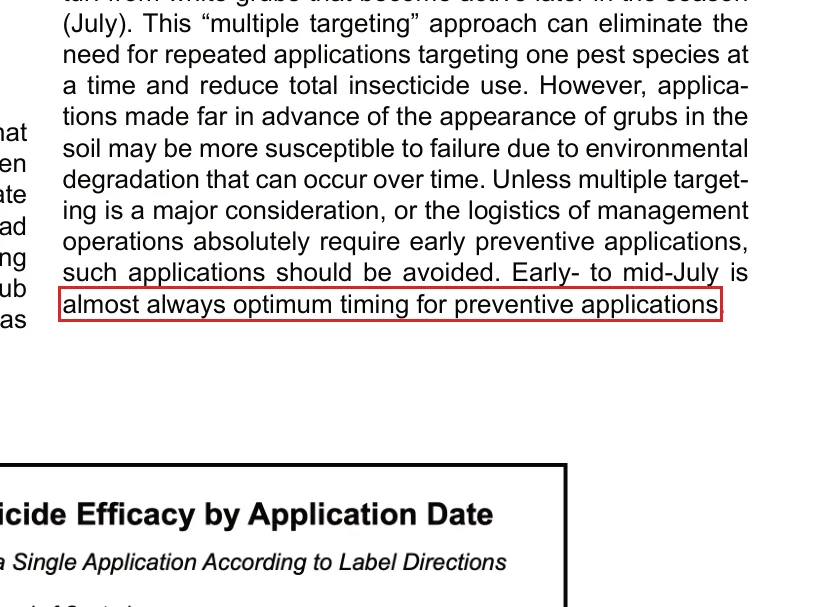
- Purdue calls early to mid-July almost always the optimum time for a preventive product (Purdue E-271); curative products work best from mid-August to early September, while grubs are still small (Rutgers FS1009).
- Scotts GrubEx1 is chlorantraniliprole (EPA Reg. No. 538-306), applied April to early August at 2.87 lb per 1,000 sq ft and watered in with about 1 inch (EPA label). Imidacloprid and thiamethoxam are ineffective against Asiatic garden beetle grubs (Rutgers).
- GardenTech’s Sevin Insect Killer Lawn Granules are bifenthrin plus zeta-cypermethrin, not carbaryl (GardenTech SDS, EPA Reg. No. 279-3346-71004); the carbaryl Sevin grub granule (432-1212) was cancelled in February 2024, and UNH Extension, citing Michigan State research, says pyrethroid-only products do not control grubs (2019 article).
What are grubs in a lawn?
Lawn grubs are the C-shaped, cream-white larvae of scarab beetles. They have a tan to chestnut head, three pairs of legs and a darker rear end, and they live in the top few inches of soil, where they chew grass roots. Purdue lists the Japanese beetle, two masked chafers, European chafer, Asiatic garden beetle, Oriental beetle, green June beetle, May/June beetles and black turfgrass ataenius as the turf species (Purdue E-271).
| Fact | Figure | Source |
|---|---|---|
| Mature grub length | About 3/4 inch (Asiatic garden beetle) to about 1 inch (Japanese beetle, Oriental beetle, northern masked chafer) to 2 inches (green June beetle) | Rutgers FS1009 |
| Where they feed | Mostly within 2 inches below the thatch | Rutgers FS1009 |
| Overwintering depth | 6 to 18 inches | UMD Extension |
| Egg hatch | About 10 days after laying (UMD); about 14 days for Japanese beetle (Penn State) | UMD; Penn State |
| Density most turf tolerates | Up to 5 per sq ft; under 5 rarely needs treatment | Purdue E-271 |
| How often treatment was needed | 20 percent of the time on upstate New York lawns and fairways | Cornell IPM |
| Best preventive timing | Early to mid-July in Indiana and nearby states | Purdue E-271 |
| Best curative timing | Mid-August to early September, while grubs are small | Rutgers FS1009 |
| Typical kill from a good curative treatment | 75 to 90 percent | Rutgers FS1009 |
| Thatch that blocks insecticide | More than 1/2 inch | Rutgers FS1009 |
Most of them are annual: adults fly and lay eggs in early to mid-summer, the grubs feed from late July into fall, move 6 to 18 inches down for winter and come back up for several weeks in spring before pupating (University of Maryland Extension). May/June beetles need 2 to 3 years per generation and do their worst damage in the second year (Purdue).
What are the signs of grubs in a lawn?
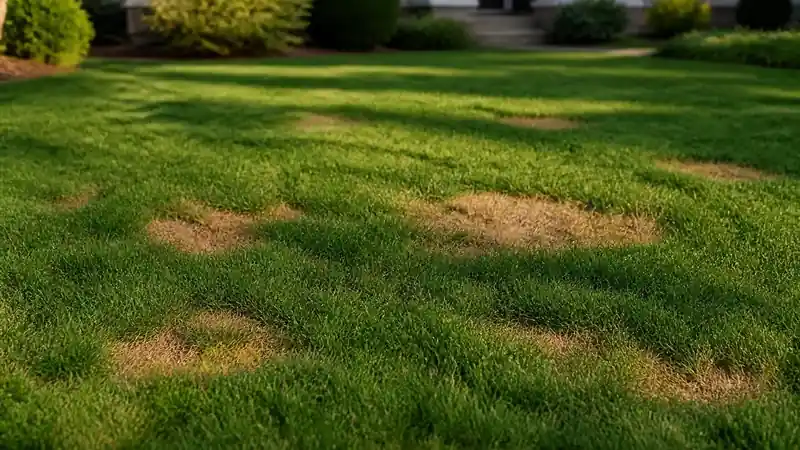
The signs of grubs in a lawn are wilting, discolored patches that do not green up after watering, turf that feels spongy and peels back like carpet because the roots are gone, and animals tearing up the sod. Purdue notes that wilting turf may take on a blue or purple cast before it collapses into dead patches (Purdue E-271). None of these signs proves grubs on its own.
Damage shows in two windows: late summer to fall, when growing grubs meet heat and dry soil, and April to May, when they feed again before pupating (Penn State Extension). Rutgers puts the fastest losses from late August through mid-October (Rutgers FS1009). Kentucky bluegrass, perennial ryegrass and creeping red fescue are the most susceptible lawns; Maryland Extension says tall fescue, zoysia and bermudagrass rarely show noticeable damage (UMD Extension). Rutgers rates tall fescue the most grub-tolerant cool-season grass and perennial ryegrass the least (Rutgers FS1009); mowing heights and seeding rates for the tolerant option are in our tall fescue guide.
| Sign | Points to grubs when | Also caused by | Source |
|---|---|---|---|
| Brown or wilted patches | Patches do not respond to irrigation and grow and merge | Drought, disease, shade, compaction | Purdue; UNH |
| Sod peels back like carpet | Roots are chewed off and C-shaped grubs lie under the mat | Root disease (no grubs found in the dig) | Cornell; Penn State |
| Spongy feel underfoot | Soil under the sod is loose from tunneling | Thatch | Rutgers |
| Skunks, raccoons, crows, armadillos or turkeys digging | A dig confirms grubs in the same spot | Earthworms and other insects these animals also eat | Purdue; UNH |
| Small soil mounds with finger-wide holes | Green June beetle grubs; mounds show after heavy rain | Earthworm castings (pencil-thin holes) | UMD |
| Brown patches in June to July with broken stems | Not grubs: stems pull away at the crown in a tug test | Bluegrass billbug larvae | UW-Madison, Feb. 2026 |
| Beetles at porch lights or on roses | Not a predictor of grub damage | Normal beetle flight | Purdue |
How do you check a lawn for grubs?
You check a lawn for grubs by digging: cut a 1 sq ft flap of sod 2 to 4 inches deep at several spots, peel it back and count the grubs in the thatch and top 2 to 3 inches of soil. Cornell notes that salt or soapy-water drenches, which flush caterpillars to the surface, do not work on white grubs (Cornell IPM). Dig in August, when grubs are near the surface and still small.
- Pick the date. Begin sampling in August (Northeastern IPM Center); Cornell gives early August for southeastern New York and mid-August upstate (Cornell).
- Pick the spots. Sample the edges of thin or brown areas, sunny spots and places with a history of damage; Rutgers spaces samples 6 to 10 ft apart on lawns because grubs cluster in patches (Rutgers FS1009).
- Cut three sides of a 12 by 12 inch square with a flat spade, 2 to 4 inches deep (Penn State), and fold the sod back like a hinge (NE IPM).
- Break up the soil and thatch and count every grub. A 10x hand lens shows the spine pattern under the tail that tells you the species (UMD).
- Using a golf-course cup cutter or bulb planter instead? A 4.25-inch core is about 1/10 sq ft, so multiply the average grubs per core by 10 (Northeastern IPM Center).
- Fold the sod back, press it down and water it so the flap does not dry out (Penn State).
- Average the counts, compare them with the threshold for the species you found, and mark which spots are over it. Treat those spots, not the whole lawn.
Worked example: the table below averages eight 4.25-inch cup-cutter cores from a hypothetical 5,000 sq ft front lawn. The arithmetic is the method; the counts are illustrative, not field data.
| Step | Input | Result |
|---|---|---|
| Grubs found in 8 cores | 0, 1, 0, 2, 1, 0, 1, 3 | 8 grubs |
| Average per core | 8 grubs / 8 cores | 1.0 per core |
| Convert to per sq ft (core = about 0.1 sq ft) | 1.0 x 10 | About 10 per sq ft |
| Species from raster | V-shaped spine row | Japanese beetle |
| Cornell threshold for that species | 8 to 10 per sq ft | At threshold: treat the sampled area |
| Hot-spot cores (2, 3) vs rest | Cores with 2 and 3 grubs = 20 and 30 per sq ft | Spot-treat around those cores first |
Which grub is it, and how many per square foot is too many?
The species sets the threshold. Larger grubs do more damage each, so Cornell treats 3 to 4 May/June beetle grubs per sq ft as damaging but tolerates 18 to 20 of the smaller Asiatic garden beetle (Cornell IPM). Identify grubs by the raster, the pattern of spines in front of the anal slit on the underside of the last segment, with a 10x lens (UMD Extension).
Thresholds are guides, not laws. The Northeastern IPM Center sets lower numbers for unirrigated turf and tells managers to raise them 30 percent for irrigated turf (Northeastern IPM Center). Rutgers reports well-kept tall fescue plots carrying 60 grubs per sq ft without damage (Rutgers FS1009).
| Species | Raster and anal slit (10x lens) | Mature length | Cornell threshold, grubs per sq ft | NE IPM threshold, unirrigated | Life cycle | Product notes |
|---|---|---|---|---|---|---|
| Japanese beetle | Transverse slit; short V-shaped row of spines pointing to the head | About 1 in | 8 to 10 | 6 to 12 | 1 year | Milky spore strain works only on this species; nematodes work best on it |
| Oriental beetle | Transverse slit; two almost parallel rows of spines | About 1 in | 8 | 6 to 12 | 1 year | Nematodes less effective |
| European chafer | Branched (Y) slit; two rows that spread apart like an opening zipper | About 3/4 in or more | 5 to 8 | 4 to 6 | 1 year | Damages at lower densities; imidacloprid somewhat less effective |
| Asiatic garden beetle | Branched slit; distinct semicircle of spines in front of it | About 3/4 in | 18 to 20 | 10 to 20 | 1 year | Imidacloprid and thiamethoxam ineffective |
| Northern masked chafer | Transverse slit; scattered spines, no pattern | About 1 in | 8 to 12 | Not listed | 1 year | Imidacloprid somewhat less effective |
| May/June beetles (Phyllophaga) | Two parallel rows, like a closed zipper | 1 in or more | 3 to 4 | 3 to 5 | 2 to 3 years | Hardest grub to control (UW-Madison) |
| Green June beetle | Transverse slit; two compact parallel rows; crawls on its back | About 2 in | 5 | Not listed | 1 year | Makes soil mounds; damage at low densities |
| Black turfgrass ataenius | Small grub of golf turf | Small | 30 to 50 | Not listed | 2 generations a year | Not known to damage home lawns (Purdue) |
Two cautions. Mixed populations are common, so look at several grubs from each spot (Purdue). Japanese beetle traps do not reduce the grubs in your soil and can pull more foliage-feeding adults into the yard (NC State TurfFiles); UW-Madison’s 2026 training slides say not to use them (UW-Madison).
When should you treat grubs in a lawn?
Treat grubs in one of two windows. Preventive products go down before or at egg hatch, usually June to mid-July, and Purdue says early to mid-July is almost always optimum (Purdue E-271). Curative products go down after a dig finds grubs over threshold, ideally mid-August to early September while the grubs are small (Rutgers FS1009). Spring treatments rarely pay.
Rutgers calls late-April-to-May applications the least effective and rarely justified, because the grass can outgrow most spring populations (Rutgers). NC State’s tall fescue calendar says spring curative applications are not effective (NC State AG-367). Cornell says grubs found in October are too late to treat (Cornell).
| Month | What the grubs are doing (annual species) | What to do | Source |
|---|---|---|---|
| January to March | Inactive, 6 to 18 inches deep | Nothing | UMD |
| April to May | Back in the root zone feeding 4 to 6 weeks, then pupating 2 to 8 inches deep | Repair and reseed; skip curative products | Rutgers |
| June to July | Adults emerge, mate and lay eggs 1 to 4 inches deep | Preventive window; early to mid-July is the Purdue optimum | Purdue; Rutgers |
| Late July to August | Eggs hatch; small grubs start on roots | Dig to sample in August | NE IPM; Cornell |
| Mid-August to mid-September | Second and third instars feed near the surface | Curative window, spot-treat over threshold | Rutgers; Penn State |
| Late September to October | Large grubs; damage and animal digging peak | Trichlorfon or nematodes only; otherwise repair | Cornell |
| November to December | Moving down to overwinter | Nothing; plan next July | UMD |
| Species or region | Preventive window | Curative window | Source |
|---|---|---|---|
| Japanese beetle (Wisconsin) | June to July | August to October | UW-Madison Extension |
| European chafer (Wisconsin) | Late May to mid-July | August to October | UW-Madison |
| Northern masked chafer (Wisconsin) | June to July | August to October | UW-Madison |
| May/June beetle (Wisconsin) | May to early June | July to September | UW-Madison |
| Japanese beetle and northern masked chafer (central Pennsylvania) | Mid-June to mid-July | August to mid-September | Penn State |
| Tall fescue lawns (North Carolina) | June, when adults fly | After egg hatch, about 24 hours after a heavy rain | NC State AG-367 |
| St. Augustinegrass (Texas) | June in South Texas, July in North Texas | When grubs are present over 5 to 10 per sq ft | Texas A&M EHT-144 |
Which grub killers work, and what do their labels require?
Grub killers fall into two groups. Long-residual preventives (chlorantraniliprole, imidacloprid, clothianidin, thiamethoxam) kill young grubs for months; fast curatives (trichlorfon, carbaryl) kill grubs already feeding but last days. UW-Madison puts preventive control at 90 percent or more and curative residual at under 10 days (UW-Madison, 2026). The table compiles the EPA-accepted label for one product per active ingredient.
| Active ingredient (class) | Example product, EPA Reg. No. | Label timing for grubs | Lawn rate on label | Watering in | Bee statement on label |
|---|---|---|---|---|---|
| Chlorantraniliprole (diamide) | Scotts GrubEx1 (registered as GrubEx III), 538-306 | Anytime between April and early August; works best before grubs hatch | 2.87 lb per 1,000 sq ft; 1 application a year | About 1 inch | None |
| Chlorantraniliprole (diamide) | Acelepryn, 100-1489 (professional) | Early April to early September for preventive control | 0.18 to 0.37 fl oz per 1,000 sq ft | Irrigate immediately or let rain move it in | None |
| Imidacloprid (neonicotinoid) | BioAdvanced Season Long Grub Control granules, 92564-16 | Once, May through mid-August | 2.4 lb per 1,000 sq ft | Water thoroughly within 24 hours | None; bans use on linden and basswood |
| Imidacloprid (neonicotinoid) | Merit 2F, 101563-60, label shows 432-1312 (professional) | Before egg hatch of the target pest | 0.46 to 0.6 fl oz per 1,000 sq ft | Irrigate if no rain within 24 hours | Highly toxic to bees exposed to direct treatment |
| Clothianidin (neonicotinoid) | Arena 50 WDG, 59639-152 (professional) | Through peak egg hatch; lower rate if applied June 1 to July 15 | 0.14 to 0.29 oz per 1,000 sq ft; 0.1 oz June 1 to July 15 for 3 species | Enough irrigation or rain to move it through thatch | Toxic to bees for more than 5 days after treatment |
| Thiamethoxam (neonicotinoid) | Meridian 25WG, 100-943 (professional) | Up to 45 days before peak flight; best from peak flight to peak egg hatch | 3 to 4 oz per 10,000 sq ft | Within 7 days (prevent) or 1 day (control) | Highly toxic to bees |
| Trichlorfon (organophosphate) | BioAdvanced 24 Hour Grub Killer Plus, 92564-40 | When grubs or damage first appear; best July through September | 2 lb per 1,000 sq ft; 10 lb bag covers 5,000 sq ft | Water thoroughly within 24 hours | None |
| Trichlorfon (organophosphate) | Dylox 420 SL, 5481-643, label shows 432-1464 (professional) | Curative; no calendar date on the label | 6.9 fl oz per 1,000 sq ft | Irrigate the same day; pre-water if dry | None |
| Carbaryl (carbamate) | Andersons 8% Granular Carbaryl, 9198-146 | When grubs feed near the surface: late March to May or July to early September | 2.4 lb per 1,000 sq ft | Must be watered in immediately | Highly toxic to honeybees and other bees |
| Bifenthrin + zeta-cypermethrin (pyrethroids) | GardenTech Sevin Insect Killer Lawn Granules, 279-3346-71004 (base label now 101563-303) | Late summer and early fall | 4 lb per 1,000 sq ft | 1/2 inch immediately | None found |
| Paenibacillus popilliae (milky spore) | Milky Spore Powder, 63191-1 | Any season when the ground is not frozen | 1 level tsp every 4 ft in rows 4 ft apart; 10 oz per 2,500 sq ft | Water lightly | None; Japanese beetle grubs only |
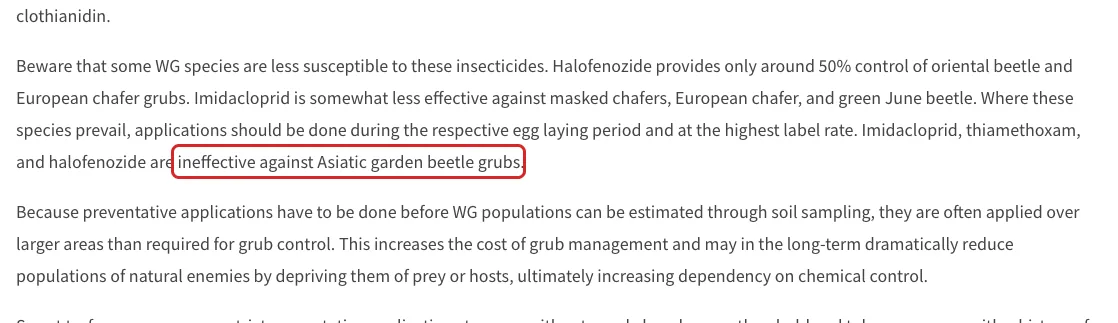
Species matters here too. Rutgers reports that imidacloprid, thiamethoxam and halofenozide are ineffective against Asiatic garden beetle grubs, and that imidacloprid is somewhat weaker on masked chafers, European chafer and green June beetle (Rutgers FS1009). Where those species dominate, chlorantraniliprole for prevention and trichlorfon for rescue match the evidence better.
What several guides say vs what the EPA record shows in 2026
Older extension pages still name products that changed or left the market. Every row below was checked in EPA’s Pesticide Product Label System in October 2026. Penn State, Rutgers and NC State pages remain useful for biology and timing; only the product names need updating.
| What several guides say | What the EPA record shows | Source |
|---|---|---|
| GrubEx is imidacloprid (Rutgers FS1009) | Current GrubEx1 is chlorantraniliprole (538-306); the imidacloprid GrubEx 2 (538-303) was cancelled Oct. 16, 2024 | GrubEx1 label |
| Sevin is a carbaryl curative (UNH; Rutgers) | The carbaryl Sevin Grub Killer Granules (432-1212) were cancelled Feb. 23, 2024 (EPA PPLS); GardenTech’s Sevin Insect Killer Lawn Granules (279-3346-71004) are bifenthrin plus zeta-cypermethrin, a registration transferred to Envu as 101563-303 in March 2025 | GardenTech SDS; 101563-303 label |
| Halofenozide (MACH 2) is a preventive option (Rutgers) | All MACH 2 registrations are inactive; 62719-473 was cancelled March 17, 2015 | EPA PPLS registration record |
| Pyrethroid-only products control grubs (some product labels list grubs) | UNH, citing Michigan State research, says lambda-cyhalothrin, gamma-cyhalothrin, bifenthrin and similar pyrethroids alone do not work on grubs; Purdue warns that products ineffective on grubs are also sold under the Sevin name | UNH; Purdue E-271, Fig. 13 |
How do grub killers affect bees?
Neonicotinoid and carbaryl labels carry bee warnings; the chlorantraniliprole and trichlorfon labels in the table carry none. In a University of Kentucky study, bumble bee colonies foraging on flowering white clover sprayed with clothianidin gained weight slowly and produced no new queens, while colonies on chlorantraniliprole-treated clover developed normally (Larson, Redmond and Potter, PLOS ONE, 2013).
The same study found no harm once the treated lawn was mowed to remove the clover blooms present at treatment and new blooms had formed. The practical rule: mow off flowering clover and dandelions before applying any neonicotinoid, and never let granules or spray land on blooming plants, which the Merit, Arena and Meridian labels prohibit while bees are foraging (Merit 2F label). Lawns kept with flowering clover on purpose, as described in our clover lawn guide, are the case where chlorantraniliprole fits best.
Which states restrict neonicotinoid grub products?
As of October 2026, the 12 states below limit neonicotinoids (imidacloprid, clothianidin, thiamethoxam, dinotefuran, acetamiprid) on lawns. New Jersey, Nevada and Maine bar turf use by everyone, and New York’s turf ban on imidacloprid and thiamethoxam starts December 31, 2026. Most of the rest limit sale and use to certified applicators. Chlorantraniliprole, trichlorfon and carbaryl are not neonicotinoids, and none of these laws restricts them.
| State | Rule for lawn and turf use | Effective | Source |
|---|---|---|---|
| New York | No outdoor ornamental or turf use by anyone; exceptions for agriculture, structural treatments within 1 ft of a foundation and invasive pests on woody plants | Clothianidin and dinotefuran Dec. 31, 2024; imidacloprid, thiamethoxam and acetamiprid Dec. 31, 2026 | N.Y. ECL 33-1301(13) |
| New Jersey | No outdoor non-agricultural use, homeowner or licensed pro | Oct. 31, 2023 | NJDEP Compliance Advisory 2025-07 |
| Nevada | No purchase or use on plants, turf included, except commercial agriculture | Jan. 1, 2024 | AB 162 (2023) |
| Maine | Imidacloprid, clothianidin, dinotefuran and thiamethoxam prohibited for all persons in outdoor residential landscapes, lawns and turf included | Rule adopted Aug. 5, 2021 | Maine Board of Pesticides Control |
| Connecticut | Restricted use (certified applicators only); from 2027 no neonicotinoid use on lawns and turf without a state finding | Restricted since 2018; use ban Oct. 1, 2027 | Public Act 25-33, sec. 32 |
| Washington | No use on nonproduction ornamentals, trees and turf except licensed applications, tree injection or agriculture | Jan. 1, 2026 | RCW 15.58.485 |
| California | Turf and ornamental products sold only by licensed dealers and used only by certified commercial applicators | Jan. 1, 2025 | CDPR notice on AB 363 |
| Maryland | Use limited to certified applicators, farmers and veterinarians; sale only to certified applicators or farmers | Jan. 1, 2018 | Md. Code, Agric. 5-2A-02 |
| Massachusetts | Turf, tree, shrub and ornamental products are state restricted use | July 1, 2022 | MDAR neonicotinoid FAQ |
| Vermont | Outdoor-labeled products registered as restricted use (certified applicators only) | In force | 6 V.S.A. 918 |
| Colorado | Only licensed dealers may sell neonicotinoid products | 2023 act; dealer-only sales from 2024 | SB23-266 |
| Minnesota | No statewide ban; cities of the first class may ban pollinator-lethal pesticides | 2023 law | Minn. Stat. 18B.09 |
Product labels add their own geography. The GrubEx1, Acelepryn and BioAdvanced imidacloprid labels prohibit sale and use in Nassau, Suffolk, Kings and Queens counties of New York (GrubEx1 label; Acelepryn label), and Cornell notes that on Long Island imidacloprid may be applied only by a certified applicator (Cornell IPM). Anyone applying grub control for pay needs a state pesticide license; our guide to the pesticide applicator license for lawn care lists the turf category in each state.
Do natural grub treatments work?
Some do, inconsistently. Beneficial nematodes (Heterorhabditis bacteriophora) give good control of Japanese beetle grubs but less of Oriental beetle, Asiatic garden beetle and European chafer (Rutgers FS1009). Milky spore is the weakest bet: Purdue says commercial formulations act only on Japanese beetle grubs and have not proven effective as a stand-alone single application (Purdue E-271).
| Method | What one guide says | What other primary sources report | Source |
|---|---|---|---|
| Milky spore | Works best applied late September or early October on soil pH 6 to 7; effects last many years (NC State TurfFiles) | Japanese beetle only (label); not effective in recent university research (UW-Madison); not shown effective in the Northeast (NE IPM); spring soils in northern New England too cold (UNH) | Label; UW; NE IPM; UNH |
| Beneficial nematodes (H. bacteriophora) | Good on Japanese beetle grubs; weaker on Oriental beetle, Asiatic garden beetle, European chafer | Best on larger grubs as a curative; refrigerate, apply early morning or evening, irrigate immediately, under 50 psi with screens removed | Rutgers; Purdue |
| Bacillus thuringiensis galleriae (Btg) | 35 to 100 percent control, varying by species (Purdue) | 70 to 80 percent on young Japanese beetle and masked chafer grubs; some granular trials failed (UMD) | Purdue; UMD |
| Metarhizium brunneum fungus | 40 to 70 percent control from fall applications on older grubs (Purdue) | Up to 50 percent lower grub density in 3-year studies (UMD) | Purdue; UMD |
| Dish soap or salt drench | Popular online | Does not bring white grubs to the surface; works on caterpillars only | Cornell IPM |
| Japanese beetle traps | Sold to cut beetle numbers | No real impact on grubs in the soil; can attract adults | NC State |
| Letting the lawn go dry in July | Kills eggs and young grubs | Works on eggs, but the grass browns until watered; irrigation in July attracts egg-laying females | Penn State; Rutgers |
Nematodes carry no EPA registration number to check: federal rules exempt biological control agents other than microorganisms and viruses from registration (40 CFR 152.20), while milky spore, a bacterium, is registered (EPA Reg. No. 63191-1). For nematodes, buy from a supplier that ships cold and states the species and count, and keep the soil moist for 1 to 2 weeks after application (Rutgers).
How much does grub control cost?
Grub control costs about $4.90 to $6.40 per 1,000 sq ft for one application of a retail granule bought from the maker on Oct. 28, 2026: GrubEx1 $5.95 to $6.40, trichlorfon $4.90 to $5.80 and imidacloprid $5.65 to $5.80. Milky spore runs $9.35 to $14.00 and nematodes $1.82 to $25.00 per 1,000 sq ft, depending on pack size. Bag size moves the price more than brand does.
| Product (active ingredient) | Seller and price, Oct. 28, 2026 | Coverage | Cost per 1,000 sq ft |
|---|---|---|---|
| Scotts GrubEx1 (chlorantraniliprole) | Scotts, $31.99; $59.49 | 5,000 sq ft; 10,000 sq ft | $6.40; $5.95 |
| BioAdvanced 24 Hour Grub Killer Plus (trichlorfon) | BioAdvanced, $28.99 for 10 lb; $48.99 for 20 lb | 5,000 sq ft; 10,000 sq ft | $5.80; $4.90 |
| BioAdvanced Season Long Grub Control Plus Turf Revitalizer (imidacloprid) | BioAdvanced, $28.99 for 12 lb; $56.49 for 24 lb | 5,000 sq ft; 10,000 sq ft | $5.80; $5.65 |
| BioAdvanced Season Long Grub Control Ready-to-Spread (lambda-cyhalothrin, a pyrethroid) | BioAdvanced, $18.49 for 10 lb | 5,000 sq ft | $3.70 |
| Acelepryn G (chlorantraniliprole 0.2%, professional) | Intermountain Turf, $107.10; Sunspot Supply, $127.50, 25 lb | 10,870 to 21,739 sq ft at the label rate of 1.15 to 2.3 lb per 1,000 sq ft | $4.93 to $11.73 |
| Sevin 2% granules (carbaryl; the Sevin carbaryl grub granule registration, 432-1212, was cancelled in 2024, so this may be older stock) | Paris Farmers Union, $15.99 for 10 lb | 4,292 sq ft | $3.73 |
| St. Gabriel Milky Spore Powder (Japanese beetle grubs only) | ARBICO Organics, $34.99 for 10 oz; $93.49 for 40 oz | 2,500 sq ft; 10,000 sq ft | $14.00; $9.35 (one-time) |
| NemaSeek Hb nematodes (H. bacteriophora) | ARBICO Organics, $40.00 for 5 million; $47.25 for 10 million; $79.20 for 50 million | 1,600 sq ft; 3,200 sq ft; 1 acre | $25.00; $14.77; $1.82, plus shipping |
| Professional grub control, municipal bid (product not named) | Middletown, Conn., Bid 2025-019, item 39: $75, $250 and $275 per acre | Per acre | $1.72 to $6.31 |
| Professional organic grub control, same bid | Item 83: $901 and $1,150 per acre | Per acre | $20.68 to $26.40 |
- Water to apply at 1/4 inch (gallons)
- 779
- Water to apply at 1 inch, GrubEx1 label (gallons)
- 3,117
- GrubEx1 product at 2.87 lb per 1,000 sq ft (lb)
- 14.4
Cost = area x share treated x cost per 1,000 sq ft from our Oct. 28, 2026 price table. You buy whole bags, so the checkout total can be higher. Water: 1 inch over 1,000 sq ft = 623 gallons. Follow the label on your product.
Worked example: a 5,000 sq ft lawn where an August dig put 1,200 sq ft over threshold. The table compares a whole-lawn preventive next year with spot treatment now, using the label rates and Oct. 28, 2026 prices above.
| Option | Area | Product needed at label rate | What you buy | Cost |
|---|---|---|---|---|
| Spot curative now: trichlorfon | 1,200 sq ft | 2 lb x 1.2 = 2.4 lb | One 10 lb bag | $28.99 (7.6 lb left; label allows 3 applications a year) |
| Spot curative now: Hb nematodes | 1,200 sq ft | 5 million covers 1,600 sq ft | One 5 million pack | $40.00 plus shipping |
| Whole-lawn preventive next season: GrubEx1 | 5,000 sq ft | 2.87 lb x 5 = 14.35 lb | One 5,000 sq ft bag | $31.99 |
| Water in GrubEx1 at about 1 inch | 5,000 sq ft | 623.4 gal x 5 | About 3,117 gallons | Your water rate |
| Municipal bid rate, conventional | 5,000 sq ft = 0.115 acre | Contractor supplies | Service | $8.61 to $31.57 at $75 to $275 per acre; home-lawn visits add trip minimums |
Municipal bid prices understate what a homeowner pays, because they price acres of park turf in one visit. When a lawn company quotes grub control, ask for the active ingredient, whether it is preventive or curative, whether the price covers spot treatment of sampled areas only, and who waters it in. Our commercial lawn care guide shows how the same bid tabulation prices other program steps.
How do you apply grub control so it reaches the grubs?
Grub insecticides only work in the root zone, so the steps that matter are thatch, water and timing. Rutgers advises irrigating about 1/4 inch right after treatment (Rutgers FS1009), UW-Madison says about 1/2 inch (UW-Madison), and the GrubEx1 label says about 1 inch (label). Follow the label on your bag; it is the legal instruction.
- Confirm the need with a dig and note which spots are over the threshold for your species (Cornell).
- Measure thatch. If it is over 1/2 inch, dethatch first, because thatch binds the insecticide (Rutgers; UMD). Our dethatching cost guide covers when a power rake is worth paying for.
- Mow first, and mow off any flowering clover or dandelions if you are using a neonicotinoid or carbaryl (Larson et al., 2013; UNH).
- For a curative product in dry weather, water the day before so grubs move up toward the surface (NC State; Dylox 420 SL label).
- Set the spreader to the label rate: for example 2.87 lb per 1,000 sq ft for GrubEx1 or 2 lb per 1,000 sq ft for 24 Hour Grub Killer Plus. Spread granules on dry grass so they sift into the thatch.
- Water in on the label schedule: within 24 hours for the BioAdvanced products, the same day for Dylox, immediately for carbaryl. Exception: NC State says carbaryl aimed at green June beetles should not be watered in (NC State).
- Check results after 1 to 2 weeks and no later than 3: treated grubs turn yellow or brown. If the first product failed, switch to a different chemical class (Rutgers).
| Product or source | Watering-in instruction | Gallons per 1,000 sq ft |
|---|---|---|
| GrubEx1 label | About 1 inch, to activate | About 623 |
| Sevin Insect Killer Lawn Granules label (grubs) | 1/2 inch immediately | About 312 |
| UW-Madison Extension | About 1/2 inch after any grub product | About 312 |
| Rutgers FS1009 | About 1/4 inch immediately after treatment | About 156 |
| 24 Hour Grub Killer Plus label | Water thoroughly within 24 hours | Depth not stated |
| Dylox 420 SL label | Irrigate the same day; pre-water if dry | Depth not stated |
A sprinkler’s output in inches per hour sets the run time for those depths; our lawn watering guide shows the catch-can test for measuring it.
Should you treat, wait or repair?
Treat only when a dig finds grubs at or above the threshold for the species present (3 to 20 per sq ft, depending on species) and the calendar still gives the product a target. Below threshold, or after October, the better spend is on recovery. The table and flowchart below hold the same logic, from the extension thresholds and the label windows above.
| If your situation is | Do this | Why (source) |
|---|---|---|
| Every sample under 5 grubs per sq ft | Do not treat; mow high and water in late summer | Most turf tolerates up to 5 per sq ft (Purdue) |
| Japanese beetle, Oriental beetle or masked chafer at 8 or more per sq ft, found mid-August to mid-September | Spot-treat with trichlorfon or carbaryl and water in the same day | Small grubs, short-residual curatives work (Rutgers; Cornell) |
| European chafer at 5 or more per sq ft | Curative now; next year a chlorantraniliprole preventive | Damages at lower densities (Purdue); imidacloprid weaker (Rutgers) |
| Asiatic garden beetle at 18 to 20 per sq ft | Avoid imidacloprid and thiamethoxam; use chlorantraniliprole or trichlorfon | Those two neonicotinoids are ineffective on this species (Rutgers) |
| May/June beetle at 3 or more per sq ft | Curative July to September | Large grubs, 2 to 3 year cycle (UW-Madison; Cornell) |
| Grub damage last year on the same lawn | One preventive: chlorantraniliprole April to early August, or a neonicotinoid early to mid-July | Labels; Purdue optimum timing (Purdue) |
| Grubs found in October, or in April to May | Skip insecticide; reseed bare spots and fertilize in fall | Too late or rarely justified (Cornell; Rutgers) |
| Animals digging but the dig finds few grubs | Do not treat for grubs; repair turf | Animals also eat earthworms (UNH); Milorganite at 0.02 lb per sq ft cut further digging 75 percent or more (Purdue) |
| Thatch over 1/2 inch | Dethatch before any grub product | Thatch binds the insecticide (Rutgers) |
| Lawn in Nassau, Suffolk, Kings or Queens County, N.Y. | Do not use GrubEx1, Acelepryn or the BioAdvanced imidacloprid granule | Labels prohibit sale and use there (GrubEx1 label) |
1Did a 1 sq ft dig find fewer grubs than the threshold for your species (5 for most)?
YesDo not treat. Mow high, water in late summer and dig again next August (Purdue, Cornell).
NoGo to the next question
2Is it October, or April to May?
YesSkip insecticide. Reseed bare spots, feed in fall, and plan a preventive application for June to July (Cornell, Rutgers).
NoGo to the next question
3Is it mid-August to mid-September with grubs over threshold?
YesCurative: spot-treat with trichlorfon or carbaryl at the label rate and water in the same day.
NoGo to the next question
4Are the grubs Asiatic garden beetle?
YesUse chlorantraniliprole or trichlorfon; imidacloprid and thiamethoxam are ineffective on this species (Rutgers).
NoGo to the next question
5Did this lawn have grub damage last year?
YesPreventive: chlorantraniliprole April to early August, or a neonicotinoid in early to mid-July, mowing off flowering weeds first.
NoMonitor only: dig in August and decide then.
Source: Purdue E-271, Cornell IPM, Rutgers FS1009, EPA product labels
Recovery is usually possible while the crowns are still green, because grubs chew roots close to the soil surface rather than the shoots (Rutgers). Cornell recommends regular watering, good fertility and reseeding damaged areas, and reports that fall nitrogen speeds recovery from grub damage (Cornell IPM). On cool-season lawns, reseed bare patches from late August to September; our guide on how to overseed a lawn gives seeding rates, and our lawn care schedule places grub work in the rest of the year. More turf problems and grass profiles are collected in our Turf and Trees section.
How we compiled this
We compiled 15 extension publications and research papers (Purdue, Cornell, Rutgers, Penn State, UW-Madison, Maryland, New Hampshire, NC State, Texas A&M, Colorado State, the Northeastern IPM Center, a 2002 UMass article and a 2013 PLOS ONE study), 12 EPA-accepted product labels from the Pesticide Product Label System, state statutes and agency notices for 12 states, manufacturer and retailer prices for 8 products checked on Oct. 28, 2026, and one municipal bid tabulation in October 2026. We did no field sampling or product testing; the worked examples are arithmetic on published figures.
| Decision | Number to use | Source |
|---|---|---|
| Treat or not | Species threshold: 3 to 4 (May/June) up to 18 to 20 (Asiatic garden beetle) per sq ft | Cornell |
| Preventive date | Early to mid-July (neonicotinoids); April to early August (GrubEx1) | Purdue; label |
| Curative date | Mid-August to early September | Rutgers |
| Water in | 1/4 to 1 inch, per label | GrubEx1; Rutgers |
This page is general information, not pesticide advice. The label is the law: read and follow the label on the product you buy, and check your state’s rules before applying any insecticide.
Frequently asked questions
Does Dawn dish soap really kill grubs?
No. Cornell’s IPM program says salt or soapy-water drenches, which push caterpillars to the surface, do not work on white grubs, so soap neither kills grubs nor reveals them (Cornell IPM). Dish soap is not registered as a grub insecticide. A 1 sq ft dig is the only reliable check.
Will a lawn recover from grubs?
Usually, yes. Grubs eat roots, and turf regrows roots when watered and fed. Cornell reports fall nitrogen speeds recovery from grub damage (Cornell IPM). Patches that peel up with no green crowns need reseeding; on cool-season lawns late August to September is the window.
What brings grubs to your yard?
Egg-laying beetles. Japanese beetles and European chafers prefer sunny turf near their favorite food plants, and May/June beetles lay eggs near exterior lights (Northeastern IPM Center). Watering in July, when females lay eggs, attracts them and helps eggs survive (Rutgers FS1009).
What month should I put down grub killer?
For a preventive product, June to mid-July; Purdue calls early to mid-July almost always optimum (Purdue E-271). GrubEx1’s label allows April to early August, and UW-Madison moves the window to May to early June for May/June beetles (UW-Madison). For a curative product, mid-August to early September after a dig confirms grubs (Rutgers).
What kills lawn grubs fastest?
Trichlorfon. BioAdvanced sells it as 24 Hour Grub Killer Plus (EPA Reg. No. 92564-40), labeled at 2 lb per 1,000 sq ft and best July through September (label). Rutgers calls trichlorfon the usual best choice for late applications and thatchy lawns. Rutgers says treated grubs usually turn yellow or brown within a week and that soil insecticides never work overnight.
Does grub control really work?
When timed to the label and watered in, yes: Rutgers reports successful treatments kill 75 to 90 percent of grubs (Rutgers FS1009). Many applications are unnecessary, though: Cornell found treatment was needed only 20 percent of the time on upstate New York lawns (Cornell IPM).
Is it too late to treat grubs in October?
Usually. Cornell says grubs found in October are too late to treat and money is better spent on repair (Cornell IPM). Grubs are large and moving deeper. Mark the damaged areas, reseed, and plan a preventive application for June to July next year.
What do lawn grubs turn into?
Beetles. Grubs pupate in the soil in late spring and emerge as Japanese beetles, chafers, Oriental beetles, Asiatic garden beetles or May/June beetles between June and August (Rutgers FS1009). Adult Japanese beetles chew leaves of more than 350 plants (UW-Madison).
Sources
- Purdue University Extension Entomology, Douglas S. Richmond, E-271-W, Managing White Grubs in Turfgrass, June 2023. Accessed October 2026.
- Cornell University, New York State IPM Program, What’s Bugging You: Grubs (threshold table and treatment timing), Current page. Accessed October 2026.
- Rutgers Cooperative Extension, Albrecht Koppenhofer, FS1009, An Integrated Approach to Insect Management in Turfgrass: White Grubs, Current fact sheet. Accessed October 2026.
- Penn State Extension, White Grubs in Home Lawns, Current page. Accessed October 2026.
- University of Maryland Extension, White Grubs in Lawn and Garden Soil, Current page. Accessed October 2026.
- Northeastern IPM Center, School Pest Solutions: White Grubs, Reviewed February 2020. Accessed October 2026.
- UW-Madison Extension, PJ Liesch and Vijai Pandian, White Grub Control in Turfgrass, Current page. Accessed October 2026.
- UW-Madison Insect Diagnostic Lab, PJ Liesch, White Grubs and Other Turf Pests (training slides), February 2026. Accessed October 2026.
- University of New Hampshire Extension, How do I treat for grubs in my lawn?, Sept. 20, 2019. Accessed October 2026.
- NC State Extension, TurfFiles, White Grubs in Turf, Current page. Accessed October 2026.
- NC State Extension, AG-367, Tall Fescue Lawn Maintenance Calendar, July 8, 2021. Accessed October 2026.
- Texas A&M AgriLife Extension, EHT-144, St. Augustinegrass Lawn Management, Posted July 2026. Accessed October 2026.
- Colorado State University Extension, Billbug and White Grub Management in Lawns, Current page. Accessed October 2026.
- Pat Vittum, Turfgrass Trends (archived by MSU Turfgrass Information Center), Thresholds Pinpoint Insecticide Timing, November 2002. Accessed October 2026.
- Larson, Redmond and Potter, PLOS ONE 8(6): e66375, Assessing Insecticide Hazard to Bumble Bees Foraging on Flowering Weeds in Treated Lawns, 2013. Accessed October 2026.
- Electronic Code of Federal Regulations, 40 CFR 152.20, Exemptions for pesticides regulated by another Federal agency and biological control agents, Current text. Accessed October 2026.
- The Scotts Company, EPA Reg. No. 538-306, GrubEx III / GrubEx1 label (chlorantraniliprole 0.08%), EPA PPLS, Accepted Jan. 11, 2012. Accessed October 2026.
- Syngenta, EPA Reg. No. 100-1489, Acelepryn insecticide label (chlorantraniliprole 18.4%), EPA PPLS, Jan. 11, 2024. Accessed October 2026.
- SBM Life Science (BioAdvanced), EPA Reg. No. 92564-16, Season Long Grub Control granules label (imidacloprid 0.25%), EPA PPLS, March 12, 2019. Accessed October 2026.
- Bayer / Envu, EPA Reg. No. 432-1312 (now 101563-60), Merit 2F insecticide label (imidacloprid 21.4%), EPA PPLS, Oct. 24, 2016. Accessed October 2026.
- Valent U.S.A., EPA Reg. No. 59639-152, Arena 50 WDG insecticide label (clothianidin 50%), EPA PPLS, July 23, 2021. Accessed October 2026.
- Syngenta, EPA Reg. No. 100-943, Meridian 25WG label (thiamethoxam 25%), EPA PPLS, Feb. 9, 2016. Accessed October 2026.
- SBM Life Science (BioAdvanced), EPA Reg. No. 92564-40, 24 Hour Grub Killer Plus granules label (trichlorfon 9.3%), EPA PPLS, Jan. 9, 2018. Accessed October 2026.
- Bayer / AMVAC, EPA Reg. No. 432-1464 (now 5481-643), Dylox 420 SL insecticide label (trichlorfon 37.3%), EPA PPLS, Sept. 18, 2014. Accessed October 2026.
- The Andersons, EPA Reg. No. 9198-146, 8.0% Granular Carbaryl label, EPA PPLS, April 9, 2025. Accessed October 2026.
- Envu, EPA Reg. No. 101563-303 (formerly FMC 279-3346), F6130 G Insecticide label (bifenthrin 0.115%, zeta-cypermethrin 0.029%), EPA PPLS, Sept. 30, 2026. Accessed October 2026.
- GardenTech, Safety Data Sheet, GardenTech Sevin Insect Killer Lawn Granules (EPA Reg. No. 279-3346-71004), May 22, 2017. Accessed October 2026.
- St. Gabriel Organics, EPA Reg. No. 63191-1, Milky Spore Powder label, EPA PPLS, April 22, 2010. Accessed October 2026.
- New York State Senate, N.Y. Environmental Conservation Law 33-1301 (Birds and Bees Protection Act, subdivision 13), Current text. Accessed October 2026.
- New Jersey Department of Environmental Protection, Compliance Advisory 2025-07, neonicotinoid restrictions, June 2025. Accessed October 2026.
- Nevada Legislature, AB 162 (2023), enrolled bill, Approved May 30, 2023. Accessed October 2026.
- Maine Board of Pesticides Control, Neonicotinoids: restrictions on outdoor residential landscape use, Current page. Accessed October 2026.
- Connecticut General Assembly, Public Act 25-33 (Substitute Senate Bill 9), section 32, Approved June 10, 2025. Accessed October 2026.
- Washington State Legislature, RCW 15.58.485, neonicotinoid use on nonproduction plants and turf, Current text. Accessed October 2026.
- California Department of Pesticide Regulation, Notice of new law regarding neonicotinoid pesticides for non-agricultural outdoor use (AB 363), Sept. 30, 2024. Accessed October 2026.
- Maryland General Assembly, Agriculture Article 5-2A-02 (Pollinator Protection Act), Current text. Accessed October 2026.
- Massachusetts Department of Agricultural Resources, Neonicotinoid FAQ, Current document. Accessed October 2026.
- Vermont General Assembly, 6 V.S.A. 918, registration of neonicotinoid pesticides, Current text. Accessed October 2026.
- Colorado General Assembly, SB23-266, Pesticide Act, 2023 session. Accessed October 2026.
- Minnesota Revisor of Statutes, Minn. Stat. 18B.09, pollinator-lethal pesticides, Current text. Accessed October 2026.
- Syngenta, EPA Reg. No. 100-1500, Acelepryn G label (chlorantraniliprole 0.2%), EPA PPLS, April 22, 2014. Accessed October 2026.
- ScottsMiracle-Gro, Scotts GrubEx1 Season Long Grub Killer, 5,000 sq ft (SKU 99605), price page, Price as of Oct. 28, 2026. Accessed October 2026.
- ScottsMiracle-Gro, Scotts GrubEx1, 10,000 sq ft (SKU 99610), product page, Price as of Oct. 28, 2026. Accessed October 2026.
- BioAdvanced, 24 Hour Grub Killer Plus Granules, 10 lb and 20 lb, Prices as of Oct. 28, 2026. Accessed October 2026.
- BioAdvanced, Season Long Grub Control Plus Turf Revitalizer, 12 lb and 24 lb, Prices and not-for-sale states as of Oct. 28, 2026. Accessed October 2026.
- BioAdvanced, Season Long Grub Control Ready-to-Spread Granules (lambda-cyhalothrin), 10 lb, Price as of Oct. 28, 2026. Accessed October 2026.
- Intermountain Turf, Acelepryn Granular Insecticide, 25 lb, Price as of Oct. 28, 2026. Accessed October 2026.
- Sunspot Supply, Acelepryn Granular Insecticide, 25 lb, Price as of Oct. 28, 2026. Accessed October 2026.
- Paris Farmers Union, Sevin 2% Granules, 10 lb, Price as of Oct. 28, 2026. Accessed October 2026.
- ARBICO Organics, Milky Spore Powder (St. Gabriel Organics), Prices as of Oct. 28, 2026. Accessed October 2026.
- ARBICO Organics, NemaSeek Hb Beneficial Nematodes, Prices as of Oct. 28, 2026. Accessed October 2026.
- City of Middletown, Conn., Bid 2025-019 Turf Care Services, bid tabulation (items 39 and 83), Printed March 24, 2026. Accessed October 2026.