
How to sharpen a lawn mower blade: disconnect the spark plug or battery, tip the mower air filter up, remove the blade, file the top bevel at its original angle, balance it, then torque the bolt to spec.
Key takeaways
- Blade bolt torque in the 17 owner’s manuals we compiled runs from about 26 ft-lb (Ryobi RY401018, printed as 310 to 360 in-lb) to 90 ft-lb (Cub Cadet XT1 and XT2 spindle nut); all 3 Toro Recycler manuals here say 60 ft-lb (Toro Form 3456-222).
- Where a manual prints a sharpening angle it is 22 to 30 degrees: 25 to 30 for Cub Cadet (Form 769-10184D), 22 to 28 for a Snapper commercial mower, and 30 on every Oregon replacement blade (Oregon).
- Intervals differ tenfold: Cub Cadet checks blades every 10 hours, Husqvarna every 25 and John Deere sharpens or replaces every 100 hours or yearly; University of Maryland Extension says every 10 hours is ideal, twice a year is enough (UMD Extension).
- Replace rather than sharpen when the tips sit more than 1/8 inch (3 mm) apart on a flat surface (Toro TimeCutter manual), when a slot forms near the sail, or when 1 inch of the original width is gone (Oregon). Deere says never straighten or weld a blade.
- Not every maker wants owners grinding: Husqvarna’s LC221RH manual says “We do not recommend sharpening blade” and sends the job to an authorized workshop (Husqvarna 1158593-27).
- A dull blade costs fuel and turf: Cornell’s turfgrass program says it raises fuel use by up to 20 percent and shreds leaf tips (Cornell).
26 to 90 ft-lb blade bolt torque across 17 manuals (Ryobi to Cub Cadet)
22 to 30° factory bevel where a maker prints one (Snapper, Cub Cadet, Oregon)
1/8 in tip-height difference that means a bent blade (Toro, John Deere)
Up to 20% more fuel burned with dull blades (Cornell Turfgrass Program)
How do you sharpen a lawn mower blade, step by step?
Disable the engine, tip the deck the way your manual says, take the blade off, then file or grind only the beveled top of each cutting edge until the nicks are gone. Remove the same metal from both ends, check balance on a cone or nail, and reinstall the blade sail side up with a torque wrench set to the manual’s figure: 26 to 90 ft-lb across the 17 manuals compiled here.
You need gloves, eye protection, a socket that fits the blade bolt (Honda’s HRN216 manual calls for a 14 mm six-point socket and EGO’s for a 9/16 in), a block of wood to stop the blade turning, a bench vise, a 10-inch mill file or a grinder, a balancer and a torque wrench. University of Illinois Extension tells owners to tighten the bolt to the manual’s figure with a torque wrench (Illinois Extension, Mower Maintenance).
- Disable the engine. Pull the spark plug wire and tuck it away from the plug; on battery mowers remove the battery pack and safety key. Every manual in this set starts here, and Briggs & Stratton adds: secure the wire away from the plug “to prevent accidental starting” (Briggs & Stratton).
- Empty or shut off the fuel. Toro says run the tank dry or pump the fuel out, never siphon (Toro Form 3381-204); Craftsman says let the engine run until it is out of fuel; Honda says turn the fuel valve off (Honda HRN216 manual).
- Tip the mower the way your manual says. Most say air filter up; Honda says right side, fuel cap up. Never past 90 degrees, per the Craftsman manual. The table below lists each maker’s instruction.
- Mark the blade. Paint or scratch the side that faces the ground. Cub Cadet stamps it “Bottom” or with the part number, and Deere’s walk-behind manual says the sharpened tips must face upward when you reinstall.
- Wedge and loosen. Jam a wood block between blade and deck so it cannot turn, then turn the bolt counterclockwise. Keep the washers, adapter and any second blade in order; Honda’s twin-blade HRN216 and HRX217 must go back as a set.
- Inspect before you grind. Look for cracks, a notch or slot at the tip or sail, and bends. Any of those means replace, not sharpen (see the replacement rules below).
- Clamp and clean. Clamp the blade flat in a vise, beveled edge up, and scrape off packed grass so you can see the original grind.
- Sharpen the top bevel only. Follow the existing angle, usually 25 to 30 degrees, stroking in one direction along the edge. Snapper’s manual stops the grind about 3-1/2 inches in from the tip (Snapper manual 2-8428). Leave the flat underside alone.
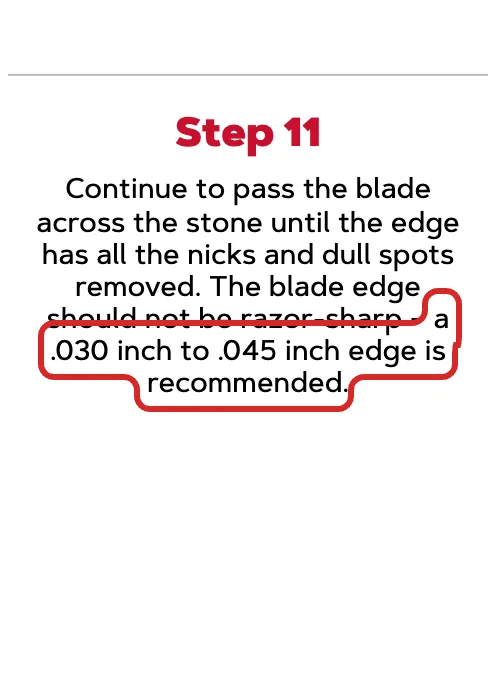
- Stop short of razor sharp. Oregon recommends a .030 to .045 inch edge, roughly the 0.76 mm thickness of a credit card, because a razor edge rolls over and chips (Oregon). John Deere’s spec is thinner: a 0.40 mm (1/64 inch) cutting edge.
- Match the other end. Give it the same number of strokes. Purdue’s turf program says equal passes and equal pressure on each side keep the blade in balance (Purdue).
- Balance it. Hang the blade on a cone or a round shaft through its center hole. If one end drops, take more metal off that end’s cutting edge and test again. The balance section below covers the tools.
- Reinstall at spec torque. Sail (the bent-up trailing edge) toward the deck, washers in their original order, bolt tightened with a torque wrench to the figure in the torque table below. Reconnect the plug wire.
- Test the blade stop. On a walk-behind, start the mower and release the bail. Federal rule 16 CFR 1205.5 requires the blade to stop within 3.0 seconds of releasing the control (16 CFR 1205.5). If it coasts longer, have the brake checked before you mow.
Mowing height and timing by grass type are covered in our turf and trees guides. Every number in the steps traces to one of 17 manuals, a maker’s support page or a federal rule; the table lists them by step, with the maker that prints each one.
| Step | Number to hit | Who prints it | Source |
|---|---|---|---|
| Disable | Spark plug wire off; battery and key out | All 17 manuals | Toro 3456-222, p. 19 |
| Tip | Air filter up, no more than 90 degrees | Craftsman, Husqvarna, Toro, Troy-Bilt | Craftsman 769-17053, p. 16 |
| Sharpen | Original angle, usually 25 to 30 degrees | Cub Cadet 25 to 30; Oregon 30 | Cub Cadet 769-10184D, p. 28 |
| Sharpen | Cutting surface about 3-1/2 in from the tip | Snapper Commercial 21in | Snapper 2-8428, p. 8 |
| Edge | .030 to .045 in (Oregon); 0.40 mm or 1/64 in (Deere) | Oregon; John Deere | Oregon how-to |
| Balance | Grind the heavy end; Husqvarna: 5/8 in (16 mm) bolt or cone, never a nail | Husqvarna LC221RH | Husqvarna 1158593-27, p. 23 |
| Reinstall | 26 to 90 ft-lb depending on model | 17 manuals | Torque table below |
| Test | Blade stops within 3.0 seconds of release | Federal standard | 16 CFR 1205.5(a)(1)(iii) |
Which way do you tip a lawn mower to take the blade off?
Tip a gas walk-behind with the air filter and carburetor facing up, which is the instruction in the Toro, Husqvarna, Troy-Bilt and Craftsman manuals and on Briggs & Stratton’s support pages. Honda is the named exception: its HRN216 and HRX217 manuals say tilt to the right so the fuel cap side is up. The riding-mower manuals here do not tip the machine; you work under a removed or raised deck.
| Mower | Which side up | Other condition | Source |
|---|---|---|---|
| Toro 21in Recycler 21321 | “onto its side with the air filter up” | Run fuel dry or pump it out first | Form 3456-222 |
| Troy-Bilt TB200, Craftsman CMXGMAM1125501 | Air filter and carburetor facing up | Craftsman: never more than 90 degrees | 769-09193; 769-17053 |
| Husqvarna LC221RH | Air filter “in the highest position” | Spark plug cap off first | 1158593-27 |
| Honda HRN216, HRX217 | Right side, fuel cap side up | Fuel valve OFF; avoids flooding and leaks | 00X31VR8 B103 |
| John Deere JS60H to JS63C | On its left side | “To help prevent air cleaner damage” | OMGX21222 (manuals.deere.com (HTTP only, not linked)) |
| Snapper Commercial 21in Hi-Vac | Up on its rear wheels | Never spark plug or carburetor down | 2-8428 |
| Briggs & Stratton engines (general) | Air filter or spark plug side up | Support page guidance | Briggs & Stratton |
| Ryobi RY401018, EGO LM2135SP (battery) | On its side | Battery and key out; Ryobi’s tilt sensor blocks starting past 45 degrees | Ryobi 998000762 |
| Riding mowers (Cub Cadet XT1, Deere X300, Husqvarna TS 142) | Not tipped | Remove the deck (Cub Cadet) or raise it to the top position (Husqvarna) | 769-10184D |
The reasons are printed too: Deere’s JS60H to JS63C manual (OMGX21222) tips left “to help prevent air cleaner damage and hard starting,” and Honda tips right to prevent “fuel leakage and hard starting due to carburetor flooding.” If oil does reach the filter, our lawn mower oil guide covers the oil grade and check-and-fill steps each maker lists.
What angle should you sharpen a mower blade to?
Sharpen to the angle already on the blade, which in the manuals that print a number is 22 to 30 degrees. Cub Cadet specifies 25 to 30 degrees, a 1995 Snapper commercial manual 22 to 28, and Oregon grinds all its replacement blades at 30 (Oregon 88-023 manual calls 30 degrees the usual OEM angle).
The Toro TimeCutter, Troy-Bilt TB200, Craftsman, EGO LM2130SP and John Deere X300 and JS63 manuals print no number; each says to keep or follow the original angle or bevel. Guides that quote a single figure disagree with each other, and few say which face they measure from. The table sets the claims side by side.
| Who says it | Angle | Type of source | Source |
|---|---|---|---|
| Cub Cadet XT1, XT2 manual | 25 to 30 degrees, parallel to the trailing edge | Maker manual | 769-10184D, p. 28 |
| Snapper Commercial 21in manual | 22 to 28 degrees (drawn as 25 ±3) | Maker manual, 1995 | 2-8428, p. 8 |
| Oregon replacement blades | 30 degrees, all Oregon blades | Blade maker | Oregon how-to |
| Oregon 88-023 grinder manual | Original OEM angle, “usually 30 degrees” | Grinder maker | 88-023 manual, p. 9 |
| Toro TimeCutter manual | “Maintain the original angle” | Maker manual | 3399-367, p. 43 |
| Grasshopper | 30 degrees most common; match the factory edge | Mower maker blog | Grasshopper, 2024 |
| All American Sharpener (jig maker) | Many John Deere blades need its 45-degree setting; EGO 35 to 45; Kubota 35 to 40 | Tool maker, customer reports | Blade Guide |
| Purdue Turfgrass Science | About 45 degrees (file angle) | Extension, 2010 | Purdue |
| Virginia Cooperative Extension | 60 degrees with an angle grinder | Extension news, 2024 | Virginia Tech |
A 30-degree bevel measured from the flat underside is the same edge as 60 degrees measured from vertical, which likely explains the Virginia figure. Purdue’s 45 degrees matches the setting All American Sharpener reports for many John Deere blades, so no single number fits every brand. If the blade still shows its factory grind, lay the file flat on that bevel and the angle takes care of itself.
Do mulching and twin-blade mowers sharpen differently?
Mulching and stacked blades take the same top-bevel sharpening, but the parts go back as a matched set. Honda’s HRN216 and HRX217 use an upper and lower blade and the manual says always install both as a set; EGO’s Select Cut stack uses a 36 to 43 ft-lb shaft bolt plus blade-set nuts at 22 ft-lb (EGO manual).
Some mulching blades also carry a second, inner cutting edge. All American Sharpener, which makes grinder jigs, says it sets 30 degrees for the outer edge and 15 degrees for the inner mulching edge on those blades (All American Sharpener blade guide); that is a tool maker’s setting, not a mower maker’s spec, so check your blade’s own grind first.
How tight should the blade bolt be?
Tighten the blade bolt to the figure in your mower’s manual, because the 17 manuals compiled here range from about 26 ft-lb to 90 ft-lb. Toro’s walk-behind Recyclers take 60 ft-lb, Honda’s HRN216 and HRX217 take 36 to 43 ft-lb, MTD-built Troy-Bilt and Craftsman walk-behinds 450 to 600 in-lb, and a Cub Cadet XT1 tractor’s spindle nut 70 to 90 ft-lb.
Swipe the table sideways to see every column.
| Mower (maker, model) | Torque as printed | ft-lb | Fastener | Manual date | Source |
|---|---|---|---|---|---|
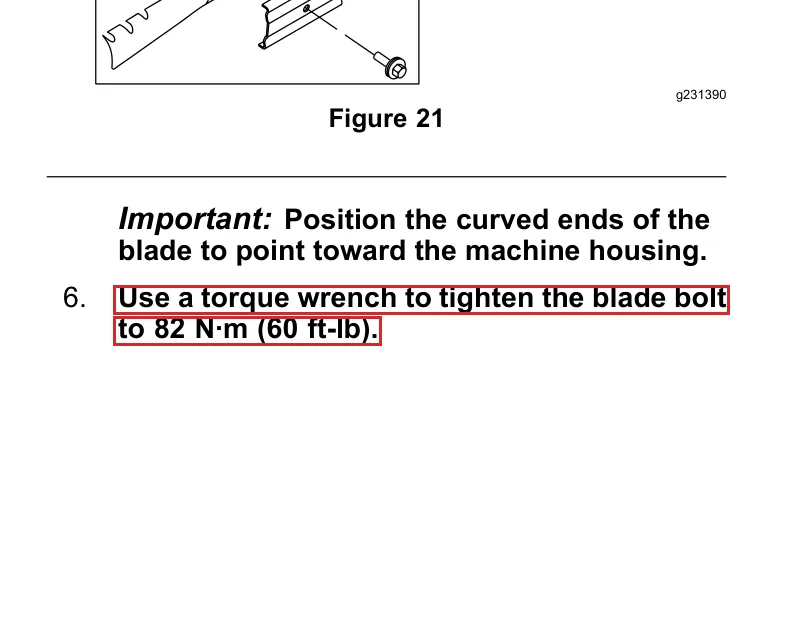
| Toro 21in Recycler 21321 | 82 N·m (60 ft-lb) | 60 | blade bolt | 2025 | Form 3456-222 Rev B |
| Toro 22in Recycler 20372, 20374 | 60 ft-lb (82 N-m) | 60 | blade bolt | 2013 | Form 3381-204 Rev A |
| Toro Super Recycler 20092, 20095 | 60 ft-lb (82 N-m) | 60 | blade bolt | 2011 | Form 3363-703 Rev C |
| Toro TimeCutter SS 4250, SS 5000, MX 5000 | 47 to 88 N·m (35 to 65 ft-lb) | 35 to 65 | blade bolt | 2017 | Form 3399-367 Rev B |
| Honda HRN216VKAA, HRN216VKPA | 36 to 43 ft-lb (49 to 59 N·m) | 36 to 43 | blade bolts (twin blades) | 2020 to 2022 | 00X31VR8 B103 |
| Honda HRX217VKA | 36 to 43 ft-lb (49 to 59 N·m) | 36 to 43 | blade bolts (twin blades) | 2013 | 00X31VH7 N030 |
| EGO LM2130SP, LM2150SP (manual shipped with LM2135SP, LM2156SP) | 36 to 43 ft-lb (50 to 60 N.m.) | 36 to 43 | shaft bolt; blade set nuts 22 ft-lb | 2021 | 21-0713 v2 |
| Husqvarna LC221RH | 35 to 40 ft-lb (47 to 54 Nm) | 35 to 40 | blade bolt | 2016 | 1158593-27 |
| Husqvarna TS 142 lawn tractor | 45 to 55 ft-lb (62 to 75 Nm) | 45 to 55 | blade bolt (heat treated) | 2020 | 114 14 52-28 Rev. 3 |
| Troy-Bilt (MTD) TB200 | 450 to 600 in-lb | 37.5 to 50 | hex bolt | 2013 | Form 769-09193 |
| Craftsman (MTD-built) CMXGMAM1125501, CMXGMAM1125502 | 450 to 600 in-lb | 37.5 to 50 | hex bolt | 2018 | Form 769-17053 |
| Cub Cadet (MTD) XT1 and XT2 Enduro lawn tractors | 70 to 90 ft-lb | 70 to 90 | spindle hex flange nut | 2015 | Form 769-10184D |
| Ryobi RY401018 40V | 310 to 360 in-lb | 25.8 to 30 | blade nut | 2021 | 998000762 Rev 01 |
| John Deere X330 to X394 Select Series tractors | 68 N·m (50 lb-ft) | 50 | cap screw, 42A/48A/54A decks | 2016 | OMM174375 (manuals.deere.com (HTTP only, not linked)) |
| John Deere Z335E, Z345M, Z355E and related ZTraks | 68 N·m (50 lb-ft) | 50 | blade bolt or nut | 2016 | OMGX26531 (manuals.deere.com (HTTP only, not linked)) |
| John Deere JS60H, JS61, JS63, JS63C walk-behinds | 75 N·m (55 lb-ft) | 55 | blade bolt | about 2009 | OMGX21222 (manuals.deere.com (HTTP only, not linked)) |
| Snapper (Briggs & Stratton) Commercial 21in Hi-Vac Series 1 and 2 | 30 ft. lbs. | 30 | blade capscrew | 1995 | Manual 2-8428 Rev. 2 |
Manuals print torque in three units. The conversions are fixed: divide inch-pounds by 12 to get foot-pounds, and multiply foot-pounds by 1.356 to get newton-meters. Worked through for the in-lb specs above, with every input shown:
| Fastener | Printed spec | Arithmetic | ft-lb | N·m |
|---|---|---|---|---|
| Ryobi RY401018 blade nut | 310 to 360 in-lb | 310 ÷ 12 = 25.8; 360 ÷ 12 = 30.0 | 25.8 to 30.0 ft-lb | 35 to 41 N·m |
| Troy-Bilt TB200, Craftsman CMXGMAM1125501 hex bolt | 450 to 600 in-lb | 450 ÷ 12 = 37.5; 600 ÷ 12 = 50.0 | 37.5 to 50.0 ft-lb | 51 to 68 N·m |
| Toro 21in Recycler blade bolt | 60 ft-lb | 60 × 1.356 = 81.4 | 60 ft-lb | 81 N·m (Toro prints 82) |
| Cub Cadet XT1 spindle nut | 70 to 90 ft-lb | 70 × 1.356 = 94.9; 90 × 1.356 = 122.0 | 70 to 90 ft-lb | 95 to 122 N·m |
Do not guess down. Toro’s 22-inch Recycler manual notes that a bolt at 60 ft-lb “is very tight” and “very difficult to overtighten” (Toro Form 3381-204), while Honda’s older HRX manual warns that overtightened blade bolts “could break” (Honda 31VH7H20). The same 40 ft-lb would be right for a Honda and 20 ft-lb short on a Toro.
How do you balance a mower blade after sharpening?
Hang the sharpened blade level on a cone, a round shaft or a magnetic balancer through its center hole and watch which end drops. Grind a little more off the heavy end’s cutting edge and retest until it stays level. Toro’s TimeCutter manual (Form 3399-367, p. 43) says a blade keeps its balance if you remove the same amount of metal from both cutting edges.
| Method | Manuals or sources that name it | Notes | Price (Oct. 19, 2026) | Source |
|---|---|---|---|---|
| Nail or round shaft in a vise | Deere (nail), Troy-Bilt (round shaft screwdriver), EGO and Ryobi (nail or screwdriver) | Husqvarna LC221RH: “Do not use a nail” | Free | Troy-Bilt 769-09193 |
| Cone balancer | Illinois Extension; Purdue (plastic balancer) | Oregon 42-100 zinc cone | $8.88 | Oregon store |
| 5/8 in (16 mm) steel bolt or pin | Husqvarna LC221RH | Husqvarna’s stated alternative to a cone | Free | Husqvarna 1158593-27 |
| Magnetic wall-mount balancer | Oregon 88-023 grinder manual | Oregon 42-047, also flags bent blades | $161.99 | Oregon |
Makers disagree on where to take the metal off. Oregon says grind the sharpened edge only and “never grind material from the ends or back of the blade” (Oregon), while Toro’s TimeCutter manual (p. 43) says to file “only the end of the sail area” of the heavy side. Follow your own mower’s manual; both aim at the same level blade.
An unbalanced blade shakes the deck. Illinois Extension says the wobble strains the mower and can leave an uneven cut, and Grasshopper recommends checking balance before you sharpen too, because a blade that wobbles when spun on the balancer is warped (Grasshopper).
Can you sharpen a mower blade without removing it?
You can touch up a lightly dulled edge in place with a file, but you cannot check balance or see the whole bevel that way. The blade procedures in all 17 manuals compiled here take the blade off first, and on riding mowers they remove the deck (Cub Cadet XT1) or raise it to its top position (Husqvarna TS 142). Disconnect the plug and tip the mower per its manual even for a quick touch-up.
The trade-off is balance. Purdue’s turf program describes a quick file for a lightly dulled edge and taking the blade off for a duller one (Purdue). A file run unevenly along an installed blade can leave one end heavier, which a cone balancer would catch and an installed blade hides. On a Cub Cadet XT1 tractor each blade comes off a spindle nut torqued to 70 to 90 ft-lb, so a breaker bar and a torque wrench are part of the job either way.
Which lawn mower blade sharpener should you buy?
For one or two home mowers, a 10-inch mill file plus an $8.88 cone balancer does the job; a drill attachment such as the Oregon 55-001 at $7.27 is faster. An angle grinder from $39.99 suits several blades a season, a grinder jig at $175 to $220 holds the angle, and a 1/2 HP bench blade grinder costs $1,226.07.
| Tool | Type | Price (Oct. 19, 2026) | Source |
|---|---|---|---|
| 10-inch mill bastard file (any brand) | hand file | Price not captured (big-box pages blocked our checks) | Purdue and Virginia Tech name a file |
| Oregon 55-001 drill-attachment blade sharpener | drill attachment | $7.27 | Oregon Products online store |
| Oregon 42-100 cone blade balancer | balancer | $8.88 | Oregon Products online store |
| Smith’s 50603 handheld carbide mower blade sharpener | handheld sharpener | $16.99 | Smith’s Consumer Products |
| BAUER 20V brushless 4-1/2 in. angle grinder (tool only) | angle grinder | $39.99 | Harbor Freight Tools |
| BAUER 8 Amp 4-1/2 in. corded angle grinder | angle grinder | $49.99 | Harbor Freight Tools |
| HERCULES 11 Amp 4-1/2 in. corded angle grinder | angle grinder | $64.99 | Harbor Freight Tools |
| Oregon 42-047 precision (magnetic) blade balancer | balancer | $161.99 | Oregon Products |
| All American Sharpener grinder jigs (3 models) | angle grinder jig | $175 to $220 | All American Sharpener |
| Oregon 88-023 1/2 HP bench blade grinder with light | blade grinder | $1,226.07 | Oregon Products online store |
“Lawn mower blade sharpener Harbor Freight” is a common search, but on Oct. 19, 2026 a search for “blade sharpener” on Harbor Freight’s site returned 6 items and none was a mower blade sharpener (Harbor Freight search). The closest tools it lists are 4-1/2 inch angle grinders, the tool Virginia Cooperative Extension’s steps use: the BAUER 8 Amp corded model at $49.99, the HERCULES 11 Amp at $64.99 and the BAUER 20V cordless at $39.99 without a battery (Harbor Freight listing).
Each tool trades speed for control. The table compares them on the points that decide the purchase.
| Tool | Speed | Angle control | Hazard | Best fit |
|---|---|---|---|---|
| Mill file | Slowest | Highest; easy to hold the bevel | Low | 1 or 2 mowers |
| Handheld carbide (Smith’s 50603) | Fast touch-ups | Fixed carbide angle | Low | Light dulling only |
| Drill attachment (Oregon 55-001) | Fast | Set by the attachment; check it against the factory bevel | Low | Homeowners with a drill |
| Angle grinder (4-1/2 in.) | Fastest hand method | Freehand; easy to change the angle by accident | Sparks, kickback | Several blades a season |
| Grinder jig (All American Sharpener) | Fast | Fixed 30 or 15 degrees (Model 5000); adjustable up to 45 (Model 5005) | Sparks | Small crews |
| Bench blade grinder (Oregon 88-023) | Fast, repeatable | Adjustable table set to the OEM angle | Tongue guards within 1/4 in and bottom guard within 1/8 in of the stone | Shops and fleets |
Is buying the gear cheaper than a shop? At $8 a blade, the median posted price when you bring the blade in on our lawn mower repair cost survey, a cone balancer and a drill attachment pay for themselves after 3 sharpenings. The worked arithmetic:
| Setup | Inputs | Total | Break-even | Blades sharpened before it pays |
|---|---|---|---|---|
| Drill attachment + cone balancer | $7.27 + $8.88 | $16.15 | $16.15 ÷ $8 | 3 sharpenings (2.02, rounded up) |
| Smith’s 50603 + cone balancer | $16.99 + $8.88 | $25.87 | $25.87 ÷ $8 | 4 sharpenings (3.23) |
| BAUER 8 Amp grinder + cone balancer | $49.99 + $8.88 | $58.87 | $58.87 ÷ $8 | 8 sharpenings (7.36) |
| Lowest grinder jig + BAUER grinder + cone | $175 + $49.99 + $8.88 | $233.87 | $233.87 ÷ $8 | 30 sharpenings (29.23) |
| Oregon 88-023 + 42-047 balancer | $1,226.07 + $161.99 | $1,388.06 | $1,388.06 ÷ $8 | 174 sharpenings (173.51) |
How often should you sharpen lawn mower blades?
Sharpen every 10 to 25 hours of mowing, or at least twice a season, and sooner when the grass tips look torn. Makers’ own intervals run from 10 hours (Cub Cadet XT1) to 100 hours or once a year (John Deere X300 and Z335E), and University of Maryland Extension calls every 10 hours ideal and twice a year sufficient.
Swipe the table sideways to see every column.
| Source | Interval | Type | Source link |
|---|---|---|---|
| Cub Cadet XT1, XT2 tractor | Check, sharpen or replace every 10 hours and before storage | Maker manual | 769-10184D, p. 21 |
| University of Maryland Extension | Ideally every 10 hours; twice a year (early spring, late summer) will suffice | Extension | UMD |
| Grasshopper | Every 8 to 12 hours of run time; sooner in sand | Mower maker | Grasshopper |
| Toro Super Recycler (2011) | Every 25 hours, sharpen or replace | Maker manual | 3363-703 |
| Husqvarna LC221RH and TS 142 | Check or replace every 25 hours; more often in sandy soil | Maker manual | 114 14 52-28 |
| John Deere X300 Select, Z335E | Sharpen or replace every 100 hours or annually | Maker manual | OMM174375, OMGX26531 (manuals.deere.com (HTTP only, not linked)) |
| Toro 21in Recycler 21321 (2025) | Yearly, more often if the edge dulls quickly | Maker manual | 3456-222, p. 19 |
| EGO LM2130SP, LM2150SP | Twice during a mowing season | Maker manual | EGO, p. 44 |
| Honda HRN216, HRX217 | Inspect blades before each use | Maker manual | 00X31VR8 B103, p. 11 |
| Snapper (Briggs & Stratton) | Sharpened once a year | Maker support page | Snapper |
| Oregon | About once a year for home use | Blade maker | Oregon |
| UF/IFAS, St. Augustinegrass (LH010) | Monthly in the growing season | Extension | UF/IFAS LH010 |
| UC Statewide IPM | Every 1 to 2 months while grass grows actively | Extension | UC IPM |
| Virginia Cooperative Extension | At least 3 times: before the season, late spring, mid to late summer | Extension | Virginia Tech |
| Purdue Turfgrass Science | At least twice a year; up to 4 to 6 times | Extension | Purdue 2012; 2010 |
| UF/IFAS Gardening Solutions | At least twice a year | Extension | UF/IFAS |
| Cornell Turfgrass Program | At least once a season, or at ragged brown tips | Extension | Cornell |
| University of Nevada, Reno Extension | At least once a year | Extension | UNR |
| UW-Madison Extension | Every 1 to 3 years, depending on use | Extension | UW Extension |
Several how-to guides repeat “every 20 to 25 hours” and one says most manufacturers suggest it. In this set of manuals only Toro’s 2011 Super Recycler and Husqvarna use 25 hours; Cub Cadet uses 10 and Deere 100, so check your own schedule rather than a rule of thumb.
Let the grass tell you. UC IPM says lawns cut with dull blades turn grayish soon after mowing and the torn tips go yellow to brown and die (UC IPM, Dull mower blades), and Purdue suggests owning 2 sets of blades so a sharp one goes on while the dull one waits (Purdue). St. Augustinegrass, with its wide leaves, needs it monthly, per our St. Augustine grass guide.
Professionals sharpen far more often. Purdue suggests weekly, bimonthly or monthly sharpening for crews depending on the turf they cut (Purdue, 2012), and Grasshopper says many contractors swap blades daily in peak season and sharpen the dull set back at the shop. Operators pricing that wear into a route can start from our lawn mowing cost breakdown.
Cornell also advises chopping dry fall leaves with a sharp blade while some grass still shows through (Cornell). Our leaf removal cost guide explains when mulching that way replaces a paid cleanup.
When should you replace a mower blade instead of sharpening it?
Replace the blade if it is cracked, bent so the tips sit more than 1/8 inch (3 mm) apart, notched or slotted near the tip or sail, or worn back by about an inch of its original width. Toro, John Deere, Snapper and Oregon print those limits, and Deere adds that a blade should never be straightened or welded.
| Condition | Limit | Who prints it | Source |
|---|---|---|---|
| Bent | Tips more than 3 mm (1/8 in) apart, measured to a flat surface | Toro TimeCutter; John Deere X300, Z335E | Toro 3399-367, p. 42 |
| Slot or notch | “a slot forming” in the sail area; notch or crack in either tip | Toro TimeCutter; Snapper | Snapper 2-8428, p. 8 |
| Width worn | 1 inch of the original width removed | Oregon | Oregon |
| Cutting length | Do not sharpen beyond the original 3-1/2 in cutting edge | Snapper | Snapper 2-8428 |
| Already resharpened | “If the cutting edge of the blade has previously been sharpened, or if any metal separation is present, replace” | Cub Cadet XT1, XT2 | 769-10184D, p. 28 |
| Unbalanced, hit an object | Replace if it hits a solid object, is out of balance or is bent | Toro TimeCutter | 3399-367, p. 43 |
| Repairs | “Never straighten or weld them” | John Deere | OMM174375 (manuals.deere.com (HTTP only, not linked)) |
| Rust | Badly damaged blades “too rusty or deformed” | University of Maryland Extension | UMD |
Work down the table below from the top and stop at the first row that matches. Rows near a limit, such as a tip 1/8 inch low, are judgment calls; the flowchart under the table runs the same logic as yes or no questions.
| If your situation is | Do this | Why (source) |
|---|---|---|
| Crack, notch or a slot at the tip or sail | Replace now | Toro 3399-367; Snapper 2-8428 |
| Tips more than 1/8 in (3 mm) apart on a flat floor | Replace; never straighten or weld | Toro 3399-367; Deere OMM174375 |
| 1 in of width gone, or edge ground past 3-1/2 in from the tip | Replace | Oregon; Snapper |
| Husqvarna LC221RH or other dealer-only manual | Take it to an authorized workshop | Husqvarna 1158593-27 |
| Honda twin blade bent or one blade damaged | Dealer inspection; replace both as a set | Honda 00X31VR8 B103 |
| Still unbalanced after grinding the heavy end | Replace | Toro 3399-367 |
| Dull or lightly nicked, straight, balanced | Sharpen at the original angle and reinstall at spec torque | Toro, MTD, EGO manuals |
| Torn grass tips within 10 hours of a sharpening, sandy soil | Sharpen more often or keep a spare set | Husqvarna TS 142 note; Purdue |
1Is there a crack, a notch at either tip or a slot forming near the sail?
YesReplace the blade now (Toro TimeCutter manual; Snapper manual).
NoGo to the next question
2Do the two tips sit more than 1/8 in (3 mm) apart when measured to a flat floor?
YesThe blade is bent: replace it, and never straighten or weld it (Toro; John Deere).
NoGo to the next question
3Is about 1 in of the original width gone, or has the edge been ground past 3-1/2 in from the tip?
YesReplace it (Oregon; Snapper).
NoGo to the next question
4Does your manual send sharpening to a dealer, as Husqvarna's LC221RH manual does?
YesTake it to an authorized service workshop.
NoGo to the next question
5After sharpening, does one end still drop on the balancer after you grind the heavy end?
YesReplace it (Toro TimeCutter manual).
NoSharpen the top bevel at its original angle, balance it, and reinstall it at your manual's torque.
Source: Toro Form 3399-367; John Deere OMM174375; Snapper 2-8428; Oregon; Husqvarna 1158593-27
If you hand the job to a shop instead, our lawn mower repair cost guide lists posted per-blade sharpening and replacement-blade prices from 26 shops.
This page is general information, not professional advice. Blade work is done near a sharp edge: disconnect the spark plug wire or remove the battery, wear gloves and eye protection, and follow your own mower’s manual where it differs from the figures here.
How we compiled this
In October 2026 we read the blade-service pages of 17 owner’s and operator’s manuals from Toro, Honda, EGO, Husqvarna, MTD (Troy-Bilt, Craftsman, Cub Cadet), Ryobi, John Deere and Snapper, plus Briggs & Stratton and Oregon support pages, 13 university extension pages and 16 CFR 1205.5. Torque, angle and interval figures are as printed; in-lb conversions are our arithmetic. Tool prices come from 4 sellers’ own pages on Oct. 19, 2026. We did not test tools or blades.
Frequently asked questions
What is the easiest way to sharpen a lawn mower blade?
For most homeowners, a mill file and a vise: file each edge at its original angle, then check the blade on a cone balancer. A drill attachment such as the $7.27 Oregon 55-001 is quicker. Husqvarna’s LC221RH manual recommends an authorized workshop instead (Husqvarna).
Are lawn mower blades worth sharpening?
Yes, while the blade is straight and uncracked. Cornell says dull blades raise fuel use by up to 20 percent (Cornell), and UC IPM says the torn tips turn yellow to brown and leave turf more open to drought and disease. A bent, cracked or slotted blade is not worth sharpening.
Do you sharpen both sides of a lawn mower blade?
Sharpen both ends, not both faces. Each cutting edge gets filed only on its top bevel at the original angle, 25 to 30 degrees on a Cub Cadet XT1, removing the same metal from each end so the blade stays balanced. Leave the flat underside alone; Oregon says never grind the ends or back of the blade.
How many times can you sharpen a mower blade before replacing it?
Until a wear limit is reached rather than a set count: Oregon says replace when 1 inch of the original width is gone, Snapper says do not sharpen past the original 3-1/2 inch cutting edge, and Cub Cadet’s XT1 manual is strictest, replacing a blade whose edge has previously been sharpened.
Do lawn mower blades need to be balanced after sharpening?
Yes. Toro, Husqvarna, Troy-Bilt, Craftsman, EGO and Ryobi all call for a balance check, and Cub Cadet warns that a poorly balanced blade causes excessive vibration and may damage the tractor. A cone balancer costs $8.88 from Oregon’s store; a nail or round screwdriver shank works for most makers, though Husqvarna’s LC221RH manual rules out a nail.
Can you over-sharpen a lawn mower blade?
Yes. Oregon recommends a .030 to .045 inch edge and says a razor edge tends to roll over, nick and dull faster, so it needs sharpening more often. Grinding too long also eats into the blade toward the limits makers print for replacement: 1 inch of lost width for Oregon, 3-1/2 inches of cutting edge for Snapper.
Is it OK to sharpen a mower blade with an angle grinder?
Yes, if you hold the factory bevel; a grinder removes metal fast, so check the angle and the balance often. Virginia Cooperative Extension’s steps use an angle grinder with goggles and hearing protection, and Harbor Freight’s 4-1/2 inch grinders ran $39.99 to $64.99 on Oct. 19, 2026. A jig such as All American Sharpener’s ($175 to $220) holds the angle for you.
How long do lawn mower blades stay sharp?
Roughly 10 to 100 hours of mowing, depending on the maker and the ground. Cub Cadet checks at 10 hours, Husqvarna at 25 with more often in sandy soil, and John Deere at 100 hours or yearly. Sticks, roots and sand dull an edge sooner; Grasshopper puts its own interval at 8 to 12 hours of run time.
Sources
- Toro, 21in Recycler/Rear Bagging Lawn Mower 21321 Operator’s Manual, Form 3456-222 Rev B, 2025. Accessed October 2026.
- Toro, 22in Recycler Lawn Mower 20372/20374 Operator’s Manual, Form 3381-204 Rev A, 2013. Accessed October 2026.
- Toro, Super Recycler Lawn Mower 20092/20095 Operator’s Manual, Form 3363-703 Rev C, 2011. Accessed October 2026.
- Toro, TimeCutter SS 4250, SS 5000, MX 5000 Operator’s Manual, Form 3399-367 Rev B, 2017. Accessed October 2026.
- American Honda Motor Co., HRN216VKAA/HRN216VKPA Owner’s Manual, 00X31VR8 B103, 2020 to 2022. Accessed October 2026.
- American Honda Motor Co., HRX217VKA Owner’s Manual, 00X31VH7 N030, 2013. Accessed October 2026.
- American Honda Motor Co., HRX217HMA/HXA Owner’s Manual, 31VH7H20, 2003 to 2006. Accessed October 2026.
- EGO Power+, LM2130SP/LM2130/LM2150SP Operator’s Manual (supplied with LM2135SP and LM2156SP), June 2021. Accessed October 2026.
- Husqvarna, LC221RH Operator’s Manual, 1158593-27, Nov. 22, 2016. Accessed October 2026.
- Husqvarna, TS 142 Operator’s Manual, 114 14 52-28 Rev. 3, Nov. 8, 2020. Accessed October 2026.
- MTD Products, Troy-Bilt TB200 Operator’s Manual, Form 769-09193, Oct. 3, 2013. Accessed October 2026.
- MTD Products, Craftsman Front Wheel Drive Mower Instruction Manual, Form 769-17053, Aug. 24, 2018. Accessed October 2026.
- MTD Products, Cub Cadet XT1 and XT2 Enduro Series Tractor Operator’s Manual, Form 769-10184D, March 25, 2015. Accessed October 2026.
- Ryobi (TTI), RY401018 20 in. 40V Lawn Mower Operator’s Manual, 998000762, Sept. 8, 2021. Accessed October 2026.
- Briggs & Stratton (Snapper), Snapper Commercial 21″ Hi-Vac Walk Mowers Series 1 and 2, Manual 2-8428 Rev. 2, December 1995. Accessed October 2026.
- Briggs & Stratton, How to Change Small Engine Oil (support page), current page. Accessed October 2026.
- Snapper, How to winterize your Snapper mower, current page. Accessed October 2026.
- Oregon Tool, Operator’s Manual for Model 88-023 Blade Grinder, n.d.. Accessed October 2026.
- Oregon Products (Oregon Tool), How to Sharpen a Lawn Mower Blade, current page. Accessed October 2026.
- Oregon Products, 42-047 Precision Blade Balancer (product page, list price), checked Oct. 19, 2026. Accessed October 2026.
- Oregon Products online store, Oregon 42-100 Blade Balancer, checked Oct. 19, 2026. Accessed October 2026.
- Oregon Products online store, Oregon 55-001 Blade Sharpener (drill attachment), checked Oct. 19, 2026. Accessed October 2026.
- Oregon Products online store, Oregon 88-023 1/2 HP Blade Grinder w/ Light, checked Oct. 19, 2026. Accessed October 2026.
- Smith’s Consumer Products, Lawn Mower Blade Sharpener, SKU SP-50603, checked Oct. 19, 2026. Accessed October 2026.
- All American Sharpener, Lawn mower blade sharpening jigs (home page price range), checked Oct. 19, 2026. Accessed October 2026.
- All American Sharpener, Mower Blade Guide, checked Oct. 19, 2026. Accessed October 2026.
- Harbor Freight Tools, Search results for “blade sharpener”, checked Oct. 19, 2026. Accessed October 2026.
- Harbor Freight Tools, Search results listing BAUER and HERCULES 4-1/2 in. angle grinders, checked Oct. 19, 2026. Accessed October 2026.
- Consumer Product Safety Commission (via Cornell LII), 16 CFR 1205.5, Walk-behind rotary power mower controls, current CFR. Accessed October 2026.
- University of Maryland Extension, Lawn Problems Not Caused by Pests or Diseases, current page. Accessed October 2026.
- Purdue University Turfgrass Science, Sharpen Mower Blades, June 7, 2010. Accessed October 2026.
- Purdue University Turfgrass Science (A. Patton), Don’t Forget to Sharpen Those Mower Blades, May 12, 2012. Accessed October 2026.
- Virginia Tech News (Virginia Cooperative Extension, M. Goatley), Sharpen lawnmower blades now for a perfect spring lawn, April 12, 2024. Accessed October 2026.
- UF/IFAS Gardening Solutions, Lawn Mower Care and Safety, current page. Accessed October 2026.
- UF/IFAS Extension, LH010, St. Augustinegrass for Florida Lawns, current EDIS revision. Accessed October 2026.
- University of California Statewide IPM Program, UC Guide to Healthy Lawns: Equipment maintenance, 2017. Accessed October 2026.
- University of California Statewide IPM Program, UC Guide to Healthy Lawns: Dull mower blades, 2017. Accessed October 2026.
- Cornell Turfgrass Program, Make Adjustments: Keep the mower blade sharp, current page. Accessed October 2026.
- University of Nevada, Reno Extension, Mowing publication (PubID 2062), current page. Accessed October 2026.
- University of Wisconsin-Madison Extension, Lawn Maintenance, current page. Accessed October 2026.
- University of Illinois Extension, Mower Maintenance, current page. Accessed October 2026.
- Grasshopper Company, Are you sharpening your blades like you should be?, September 23, 2024. Accessed October 2026.
- Deere & Company, John Deere Select Series Tractors X330 to X394 Operator’s Manual, OMM174375 Issue 19, manuals.deere.com (served over HTTP only, so not linked), 2016. Accessed October 2026.
- Deere & Company, Z335E, Z335M, Z345M, Z345R, Z355E, Z355R, Z375R ZTrak Operator’s Manual, OMGX26531 Issue 19, manuals.deere.com (HTTP only, not linked), 2016. Accessed October 2026.
- Deere & Company, Walk-Behind Rotary Mowers JS60H, JS61, JS63, JS63C Operator’s Manual, OMGX21222 Issue J2, manuals.deere.com (HTTP only, not linked), about 2009. Accessed October 2026.