St. Augustine grass is a coarse, shade-tolerant warm-season lawn grass planted only as sod, plugs or sprigs, mowed at 3.5 to 4 inches and fed 2 to 6 lb of nitrogen per 1,000 sq ft a year in Florida.
Key takeaways
- No St. Augustine grass seed is sold: Texas A&M says seed is not currently available, and UF/IFAS says the grass is established by vegetative propagation only (Texas A&M EHT-144; UF/IFAS LH010).
- Across the 2016 national trial (2017 to 2020 ratings), CitraBlue averaged 6.2, Palmetto 6.1, Raleigh 5.8 and Floratam 5.4 for turf quality on a 1 to 9 scale; gaps of 0.4 or more are significant (NTEP report 21-14).
- Floratam lost 96 percent of its cover to winter kill at Stillwater, Okla., in 2025, against 20 percent for Raleigh, and kept only 30 percent summer cover in the Gainesville, Fla., shade plot (NTEP 2023 test, 2025 data).
- St. Augustinegrass sod averaged 54.25 cents per sq ft at the farm nationally in April to June 2026, the highest weighted average of any grass in the USDA report (USDA AMS).
- Treat chinch bugs only at about 20 to 25 per square foot; populations have developed resistance to pyrethroids, neonicotinoids, organochlorines and organophosphates (UF/IFAS ENY-325).
| Key number | Value | Source |
|---|---|---|
| Seed available | None; sod, plugs or sprigs only | Texas A&M EHT-144 |
| Mowing height, standard cultivars | 3.5 to 4 in (rotary) | UF/IFAS LH010 |
| Mowing height, dwarf cultivars | 2 to 2.5 in | UF/IFAS LH010 |
| Minimum daily light | 4 to 6 hours | Texas A&M EHT-144 |
| Annual nitrogen, Florida | 2 to 4 lb (north), 2 to 5 (central), 4 to 6 (south) per 1,000 sq ft | UF/IFAS EP353 |
| Chinch bug treatment threshold | 20 to 25 bugs per sq ft | UF/IFAS ENY-325 |
| Verticut when thatch exceeds | 1 in; blades 3 in apart | UF/IFAS LH010 |
| Sod, national farm price | 54.25¢ per sq ft (Q2 2026) | USDA AMS |
| Florida sod acreage, 2024 | 14,157 acres, more than any other grass | UF/IFAS EP658 |
What is St. Augustine grass, and where does it grow?
St. Augustine grass (Stenotaphrum secundatum) is a coarse, broad-bladed warm-season turfgrass that spreads by above-ground stolons and grows best at 80°F to 95°F (Texas A&M EHT-144). UF/IFAS calls it the most commonly used lawn grass in Florida, and UF/IFAS Gardening Solutions estimates it covers more than two million acres of Florida lawns (UF/IFAS LH010; UF/IFAS Gardening Solutions).
Its range is the humid South and the Gulf and Atlantic coasts. The NC State Extension Gardener Plant Toolbox lists it as a perennial for USDA hardiness zones 7a to 12b, but Clemson warns it is very susceptible to winter injury west of Columbia, S.C., and has documented winter injury along the northern South Carolina coast (NC State Plant Toolbox; Clemson HGIC 1211). Profiles of the other warm- and cool-season lawn grasses are in our Turf & Trees section.
Florida’s sod farms show how dominant the grass is: 21 producers had 14,157 acres of St. Augustinegrass in production in 2024, more than any other species (UF/IFAS EP658). In North Carolina, by contrast, only six of 21 surveyed sod farms (29 percent) grow it (NC State sod report).
| Species | Florida sod acres in production, 2024 | Producers growing it | Source |
|---|---|---|---|
| St. Augustinegrass | 14,157 | 21 | UF/IFAS EP658 |
| Bahiagrass | 12,110 | 14 | UF/IFAS EP658 |
| Zoysiagrass | 2,753 | 16 | UF/IFAS EP658 |
| Bermudagrass | 2,664 | 13 | UF/IFAS EP658 |
| Centipedegrass | 155 | 3 (all in north Florida) | UF/IFAS EP658 |
What does St. Augustine grass look like?
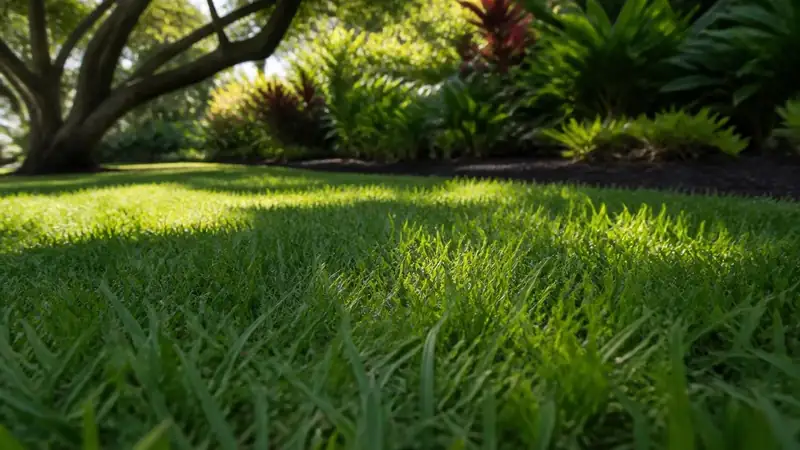
St. Augustine grass looks like a thick mat of flat, wide, blunt-tipped blades on long runners, green to blue-green, with a coarse texture. In the 2016 national trial, Floratam rated 3.0 and Palmetto 4.9 for leaf texture on a 1 to 9 scale where 9 is very fine (NTEP report 21-14, Table 14). Clemson compares its broad, flat stems to centipedegrass.
Unlike bermudagrass and zoysiagrass, it produces no rhizomes (below-ground stems), so Texas A&M warns that heavy above-ground injury from scalping hurts it more than it hurts those grasses (Texas A&M EHT-144). Floratam has visibly reddish stolons, and CitraBlue has a blue-green color that UF/IFAS says is easy to tell from other cultivars (Clemson HGIC 1211; UF/IFAS LH010).
What are the downsides of St. Augustine grass?
The downsides of St. Augustine grass are poor wear tolerance, no seed, a short list of herbicides for grassy weeds, cold injury outside the coastal South and one dominant pest, the southern chinch bug. UF/IFAS lists all of these, plus thatch under heavy fertilizer and water, and three diseases: gray leaf spot, large patch and take-all root rot (UF/IFAS LH010).
- Traffic: UF/IFAS says it does not hold up to repeated foot or vehicle traffic (UF/IFAS LH010).
- Water: Texas A&M says current cultivars are less drought tolerant than bermudagrass or buffalograss and may need more irrigation (Texas A&M EHT-144).
- Weeds: Clemson says postemergent control of grassy weeds is limited, so control relies largely on preemergents (Clemson HGIC 1211).
- Maintenance: Clemson calls it a high-maintenance turfgrass, fertilized monthly on sandy soils and every 6 weeks on clay during the growing season (Clemson HGIC 1211).
Which types of St. Augustine grass can you buy?
More than a dozen St. Augustine grass cultivars are sold as sod or plugs, split by UF/IFAS into standard types mowed at 3.5 to 4 inches and dwarf types mowed at 2 to 2.5 inches (UF/IFAS LH010). Floratam is the most widely produced in Florida. The table below compiles 17 cultivars from university release notes and extension ratings, with the source for each row.
Swipe the table sideways to see every column.
| Cultivar | Type and texture | Origin or release | Mowing height | Cold tolerance | Shade tolerance | Chinch bug resistance | What sets it apart | Source |
|---|---|---|---|---|---|---|---|---|
| Floratam | Standard, coarse | UF and Texas A&M, 1973 | 3.5 to 4 in | Poor | Fair; needs 6+ hours of sun | Lost its original resistance | Most widely used in Florida; injured by atrazine above 85°F | UF/IFAS; Texas A&M |
| Raleigh | Standard, coarse | NC State, 1980 | 3 to 4 in | Very good | Good; 5 to 6 hours of sun | Poor | Cold-hardy pick for north Florida and the Carolinas; highly susceptible to gray leaf spot (UF) | UF/IFAS; Texas A&M |
| Palmetto | Semi-dwarf, medium | Found by a Florida grower in 1988; released mid-1990s | 3 to 4 in | UF: very good; Clemson: fair | UF: very good; Clemson: fair; about 5 hours of sun (Texas A&M) | UF: very good; Clemson: slight | Lighter green; UF says research shows no extra drought tolerance | UF/IFAS; Clemson; Texas A&M |
| CitraBlue (FSA 1602) | Standard, coarse, prostrate | University of Florida; on the market since 2018 | 2 to 3 in | Fair | Very good | Slight | Blue-green; best NTEP 2016 quality and gray leaf spot scores; thatch-prone | UF/IFAS; NTEP; UF Innovate |
| Bitterblue | Standard; relatively fine for St. Augustine (UF text) | Selected in the 1930s | 3.5 to 4 in | Good | Good | Slight | Dark blue-green; Clemson says intolerant of some St. Augustine herbicides | UF/IFAS; Clemson |
| Classic | Standard, medium | Woerner Turf, early 2000s (proprietary) | 3.5 to 4 in | Good | UF table: very good, but UF says shade tolerance is not verified by research | Unknown | Dark green | UF/IFAS |
| ProVista | Standard, coarse | Based on Floratam genetics | Not listed | Fair | Very good | Unknown | First glyphosate-tolerant turf on the market; slower growth than Floratam | UF/IFAS |
| Seville | Dwarf, fine | Not listed | 2 to 2.5 in | Fair | Very good | Unknown (UF); susceptible to chinch bugs and webworms | Thatch-prone; cold sensitive; shallow-rooted (Clemson) | UF/IFAS; Clemson |
| Captiva | Dwarf, fine | Florida Agricultural Experiment Station | 2 to 3 in | Good | Good | Resistant; the only resistant commercial cultivar, per UF ENY-325 | Slow-growing; limited availability | Clemson; UF ENY-325 |
| Delmar | Dwarf (Texas A&M) or semi-dwarf (Clemson) | Not listed | 2 to 3 in | Good | Good | Poor | Susceptible to sod webworms and large patch | Clemson; Texas A&M |
| Sapphire | Dwarf | Not listed | 2 to 3 in | Fair | Fair | Poor | Folded blade gives a fine-textured look | Clemson |
| Jade | Semi-dwarf | Not listed | 2 to 3 in | Good | Good | Poor | Cold sensitive (Clemson text) despite a good cold rating in Clemson’s table | Clemson |
| Mercedes | Standard, fine | Not listed | 3 to 4 in | Good | Good | Poor | Finer leaf than other standard types | Clemson |
| Amerishade | Semi-dwarf, medium | Not listed | Not listed | Not listed | Most shade-tolerant on the market, per Texas A&M | Not listed | Highly susceptible to disease | Texas A&M |
| Texas Common | Standard | Grown in Texas since the 1920s | Not listed | Not listed | Not listed | Highly susceptible (Texas A&M E-420) | Natural variation across Texas | Texas A&M; Texas A&M E-420 |
| Cobalt | Hybrid, wide blade | Texas A&M AgriLife (embryo rescue) | Not listed | Better than Floratam (breeder) | Better than Floratam (breeder) | Not listed | Top 2025 NTEP quality (6.4) and shade cover (96%) | Texas A&M Dallas; NTEP |
| Sola (XSA 11377) | Standard | NC State, August 2022 | Not listed | Comparable to Raleigh | Improved over Raleigh (breeder) | Better than Raleigh (breeder) | Licensed through Sod Solutions | NC State |
The extension record disagrees on Palmetto. UF/IFAS rates its cold tolerance, shade tolerance and chinch bug resistance all “very good,” while Clemson rates the same three “fair,” “fair” and “slight” (UF/IFAS LH010; Clemson HGIC 1211). The 2025 NTEP shade plot sits between them: Palmetto kept 83.3 percent summer cover, behind Cobalt at 96.0 percent (NTEP 2023 test).
Which is better, Palmetto or Floratam?
Palmetto is better than Floratam where a lawn gets cold winters or afternoon shade; Floratam is the established choice for full sun in central and south Florida. In the 2016 national trial Palmetto averaged 6.1 for turf quality against 5.4 for Floratam, and in 2025 Floratam lost 96.0 percent of its Oklahoma plot to winter kill against 42.7 percent for Palmetto (NTEP 21-14; NTEP 2023 test).
Floratam’s case rests on heat and sun. Texas A&M credits it with good resistance to large patch and drought, and in the College Station drought plot (2017 to 2020) Floratam rated 5.4 for wilting against 4.6 for Palmetto on a 1 to 9 scale (Texas A&M EHT-144; NTEP Table 11). It needs at least 6 hours of direct sun.
What is the difference between Raleigh and Palmetto St. Augustine?
Raleigh is the more cold-hardy of the two; Palmetto is finer, lighter green and holds more shade cover. In 2025, Raleigh lost 20.0 percent of its Stillwater, Okla., plot to winter kill against 42.7 percent for Palmetto, while Palmetto kept 83.3 percent summer cover in the Gainesville shade plot against 70.0 percent for Raleigh (NTEP 2023 test, 2025 data).
How did St. Augustine cultivars score in national trials?
In the 2016 National St. Augustinegrass Test, rated 2017 to 2020 at 10 sites from Florida to Texas and North Carolina, CitraBlue posted the highest quality mean of the four commercial entries at 6.2, followed by Palmetto 6.1, Raleigh 5.8 and Floratam 5.4 on a 1 to 9 scale (NTEP report 21-14). NTEP calls 6 or above generally acceptable; a gap of 0.4 or more is significant.
| Rating (1 to 9, 9 = best unless noted) | CitraBlue | Palmetto | Raleigh | Floratam | LSD (0.05) | Source |
|---|---|---|---|---|---|---|
| Turf quality, all sites, 2017 to 2020 | 6.2 | 6.1 | 5.8 | 5.4 | 0.4 | NTEP Appendix |
| Quality, low fertilizer, Ft. Lauderdale, 2018 to 2020 | 8.0 | 6.8 | 6.2 | 6.4 | 0.5 | NTEP Table 10 |
| Quality, drought, College Station, Texas | 5.6 | 6.2 | 5.7 | 6.0 | 0.6 | NTEP Table 11 |
| Genetic color (9 = dark green) | 7.6 | 6.2 | 6.1 | 6.3 | 0.6 | NTEP Table 12 |
| Spring green-up | 4.1 | 4.9 | 4.7 | 3.6 | 0.5 | NTEP Table 13 |
| Leaf texture (9 = very fine) | 3.2 | 4.9 | 4.4 | 3.0 | 0.6 | NTEP Table 14 |
| Spring living ground cover, % (after winter) | 54.0 | 77.9 | 78.6 | 43.5 | 11.7 | NTEP Table 18 |
| Winter kill, %, Dallas, 2018 to 2019 (lower is better) | 43.3 | 25.8 | 32.5 | 69.2 | 21.9 | NTEP Table 22 |
| Gray leaf spot (9 = none) | 8.3 | 6.9 | 6.1 | 6.6 | 1.8 | NTEP Table 26 |
| Seedheads (9 = none) | 7.2 | 5.2 | 5.1 | 7.6 | 1.1 | NTEP Table 31 |
Read the cold rows together. CitraBlue led on quality, color and disease but kept only 54.0 percent spring cover across four sites, and at Raleigh, N.C., it held 60.0 percent against 89.8 percent for Raleigh and 25.0 percent for Floratam (NTEP Table 18). That fits UF/IFAS rating CitraBlue’s cold tolerance only “fair.”
What did the 2023 national trial add?
The 2023 National St. Augustinegrass Test added Cobalt from Texas A&M as a standard entry, and its first full-year report (2025 data) put Cobalt at a 6.4 quality mean, Palmetto 6.3, Raleigh 6.1 and Floratam 5.7, with 0.3 points needed for significance (NTEP 2023 test, 2025 data). CitraBlue is not in this trial. The shade and winter-kill plots separated the cultivars most.
| Rating, 2025 data (1 to 9 unless noted) | Cobalt | Palmetto | Raleigh | Floratam | LSD (0.05) | Source |
|---|---|---|---|---|---|---|
| Turf quality, all sites | 6.4 | 6.3 | 6.1 | 5.7 | 0.3 | NTEP Appendix |
| Shade quality, Gainesville, Fla. | 5.7 | 4.7 | 4.3 | 2.3 | 0.9 | NTEP Table 5 |
| Summer cover in shade, %, Gainesville | 96.0 | 83.3 | 70.0 | 30.0 | 16.1 | NTEP Table 5 |
| Winter kill, %, Stillwater, Okla. (lower is better) | 85.0 | 42.7 | 20.0 | 96.0 | 18.2 | NTEP Table 15 |
| Spring living ground cover, %, six sites | 75.2 | 77.4 | 82.5 | 60.2 | 7.8 | NTEP Table 12 |
| Quality under drought, Dallas | 7.2 | 4.7 | 3.8 | 5.5 | 2.6 | NTEP Table 4 |
| Gray leaf spot, Raleigh, N.C. (9 = none) | 8.9 | 7.8 | 8.6 | 7.7 | 0.8 | NTEP Table 24 |
| Take-all root rot, %, College Station, Texas | 33.3 | 46.7 | 33.3 | 36.7 | 27.9 | NTEP Table 23 |
Shade is where the gap is widest. In the Gainesville shade plot, Floratam kept 30.0 percent summer cover and a 2.3 quality mean, the same weakness UF/IFAS describes when it says Floratam does not persist with less than 6 hours of sunlight (UF/IFAS LH010). Cobalt’s 85.0 percent winter kill in Oklahoma shows its shade advantage does not extend to cold.
Can you grow St. Augustine grass from seed?
No. St. Augustine grass seed is not sold for lawns: Texas A&M says “seed is not currently available,” and UF/IFAS says the grass is established by vegetative propagation only, meaning sod, plugs or sprigs (Texas A&M EHT-144; UF/IFAS LH010). Every St. Augustine lawn starts from living runners.
Wikipedia, the top organic result for the head term, says “only recently has commercially valuable and viable seed for St. Augustine become available” (Wikipedia). Neither land-grant source above supports that; Texas A&M’s EHT-144, posted to its site in July 2026, still lists seed as unavailable. If you want a seeded warm-season lawn, UF/IFAS lists common bermudagrass and Zoysia japonica cultivars such as Zenith, and our grass seed cost guide prices them.
| Method | Rate or spacing | Watering until rooted | Notes | Source |
|---|---|---|---|---|
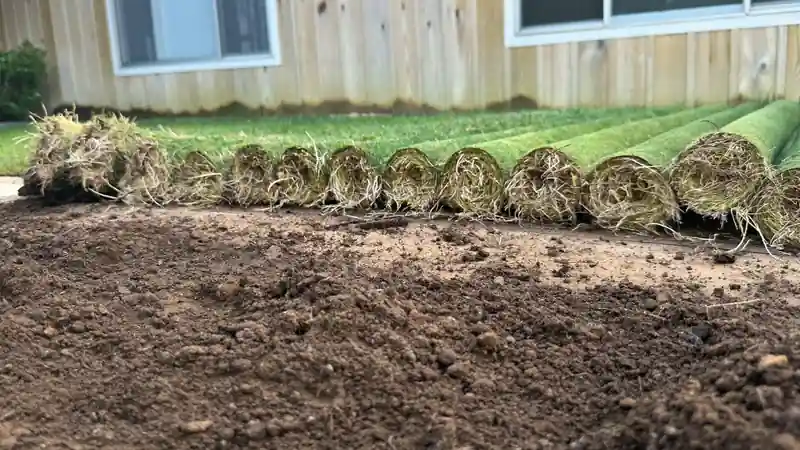
| Solid sod | 100% of the area; staggered, brick-like seams over bare, moist soil | 5 to 10 minute cycles several times a day for 7 to 10 days, then daily 1/4 to 1/2 in for 7 to 10 days, then 2 to 3 times a week | Fully established 3 to 4 weeks after sodding; no mowing until it pegs down, generally 14 to 21 days | UF/IFAS LH010 |
| Plugs | 6 to 24 in apart (UF); 12 to 24 in centers for bare areas (NC State) | Keep continuously moist until runners form | Closer spacing covers faster and leaves less room for weeds | UF/IFAS; NC State AG-540 |
| Sprigs | Furrows 6 to 12 in apart; 1 bushel per 1,000 sq ft (UF) or 1.5 bushels (NC State) | Keep soil moist until shoots and roots grow | 1 sq yd of sod pulled apart equals 1 bushel of sprigs (NC State) | UF/IFAS; NC State AG-540 |
| Seed | Not available | Not applicable | Seed is not currently available | Texas A&M EHT-144 |
How to plant St. Augustine plugs
Plugging is the cheapest route to a St. Augustine lawn only if the plugs are cut from sod or spaced wide, and the spacing you choose sets both the plug count and the wait. The steps below combine UF/IFAS, NC State and Texas A&M instructions; plug counts come from geometry (144 square inches in a square foot divided by the spacing squared).
- Plant in late spring or early summer while the grass is actively growing (Texas A&M), in May or once daytime temperatures stay above 60°F in North Carolina (NC State), and avoid cold winters and hot, dry summers in central and north Florida (UF/IFAS LH010).
- Test the soil first; UF/IFAS asks for pH and salinity before planting, and Texas A&M warns that alkaline soils above pH 7.5 cause iron chlorosis (Texas A&M EHT-144).
- Kill or remove existing weeds and grass in the area, because open gaps between plugs are where weeds establish.
- Set plugs on 12-inch centers (1,000 per 1,000 sq ft), 18-inch centers (444) or 24-inch centers (250) in holes the same size as the plug, and tamp them in (UF/IFAS).
- Water thoroughly at planting, then keep the area continuously moist with light, frequent watering until runners develop (UF/IFAS).
- Wait 30 to 60 days after planting before the first fertilizer, because new roots cannot take it up and nutrients can leach (UF/IFAS).
- Shift to 1/2 to 3/4 inch per watering, applied only when blades fold or footprints stay visible, once the runners have knitted (UF/IFAS).
How fast plugs close depends on spacing and season. In NTEP’s 2017 establishment plots at Auburn, Ala., the four commercial cultivars went from 2.7 to 5.3 percent cover on July 2 to 68.3 to 71.7 percent by Oct. 15, with no significant differences among them (NTEP Table 36).
- CitraBlue
- Raleigh
- Floratam
- Palmetto
Source: NTEP 2016 National St. Augustinegrass Test, final report 21-14, Table 36 No significant differences on Oct. 15 (LSD 22.6).
Show the numbers
| CitraBlue | Raleigh | Floratam | Palmetto | |
|---|---|---|---|---|
| July 2 | 5.30 | 3.70 | 4.30 | 2.70 |
| Aug. 2 | 11.70 | 10 | 9.30 | 9.30 |
| Aug. 18 | 21.70 | 21.70 | 18.30 | 20 |
| Sept. 15 | 55 | 55 | 51.70 | 50 |
| Oct. 15 | 68.30 | 71.70 | 68.30 | 68.30 |
How much does St. Augustine sod or plugs cost?
St. Augustinegrass sod sold at a national weighted average of 54.25 cents per sq ft at the farm in the second quarter of 2026, in a 52 to 85 cent range, before delivery of $0.05 to $0.12 a sq ft (USDA AMS). Florida farms averaged 29 to 33 cents in 2024, and Florida retail pallets ran 51 to 65 cents a sq ft in October 2026.
| Source and product | Price as published | Per sq ft | Date | Source |
|---|---|---|---|---|
| USDA national farm price, St. Augustinegrass | 52 to 85¢ range; 54.25¢ weighted average | $0.54 | Apr. to Jun. 2026 | USDA AMS |
| North Carolina farms, on-farm | $0.53 to $0.65; average $0.60 | $0.60 | 2026 survey | NC State |
| North Carolina farms, delivered | $0.57 to $0.74; average $0.64 | $0.64 | 2026 survey | NC State |
| Florida farms, licensed cultivars | $0.31 to $0.35 by region; state average $0.33 | $0.33 | 2024 prices | UF/IFAS EP658 |
| Florida farms, non-licensed cultivars | $0.26 to $0.30 by region; state average $0.29 | $0.29 | 2024 prices | UF/IFAS EP658 |
| Floratam pallet, Pasco County, Fla. | $309.95 for about 500 sq ft, plus $12 pallet deposit | $0.62 | Oct. 19, 2026 | Gladiator Sod |
| Palmetto or Bitter Blue pallet, Pasco County | $324.95 for about 500 sq ft | $0.65 | Oct. 19, 2026 | Gladiator Sod |
| Floratam single piece, Pasco County | $2.75 per 24 by 16.5 in piece (2.75 sq ft) | $1.00 | Oct. 19, 2026 | Gladiator Sod |
| Palmetto pallet, Tampa Bay area | $254.99 for 500 sq ft; $151.99 for 200 sq ft | $0.51 to $0.76 | Oct. 19, 2026 | Tampa Bay Sod |
| Palmetto plugs, 72-count tray | $64.99 per tray | $0.90 per plug | Oct. 19, 2026 | Sod Solutions |
| Palmetto plugs, 64 pack | $109.98 (16 pack $44.98; 32 pack $59.98) | $1.72 per plug | Oct. 19, 2026 | SodPods |
St. Augustine is the priciest sod in the USDA report: its 54.25 cent average sits above zoysiagrass at 52.32 cents, tall fescue at 50.03 cents and bermudagrass at 38.04 cents (USDA AMS). Supply is part of it. In North Carolina, 66 percent of St. Augustinegrass growers expected shortages in 2026, against 34 percent who reported adequate to excellent inventory (NC State).
The worked table below prices 1,000 sq ft of material by method. It uses the USDA farm price for sod, posted October 2026 prices for plug trays, and assumes home-cut plugs are 2-inch squares. Labor and delivery are excluded; our sod installation cost guide covers installed prices.
| Method, per 1,000 sq ft | Material needed | Arithmetic | Material cost | Cost for 5,000 sq ft |
|---|---|---|---|---|
| Solid sod, farm price | 1,000 sq ft | 1,000 × $0.5425 | $542.50 | $2,713 |
| Solid sod, retail Floratam pallets | 2 pallets of about 500 sq ft | 2 × $309.95 (+ $24 deposits) | $619.90 | $3,100 |
| Tray plugs, 12 in centers | 1,000 plugs = 14 trays of 72 | 14 × $64.99 | $909.86 | $4,549 (70 trays) |
| Tray plugs, 18 in centers | 444 plugs = 7 trays | 7 × $64.99 | $454.93 | $2,015 (31 trays) |
| Tray plugs, 24 in centers | 250 plugs = 4 trays | 4 × $64.99 | $259.96 | $1,170 (18 trays) |
| Home-cut 2 in plugs, 12 in centers | 1,000 plugs = 27.8 sq ft of sod | 1,000 × 4 sq in ÷ 144 × $0.5425 | $15.07 | $75 |
| Sprigs | 1 to 1.5 bushels = 9 to 13.5 sq ft of sod | 9 to 13.5 × $0.5425 | $4.88 to $7.32 | $24 to $37 |
The surprise is the tray plugs. At 12-inch centers, store-bought trays cost $909.86 per 1,000 sq ft, about $367 more than solid sod at the farm price, so trays only save money at 18-inch spacing or wider. Cutting plugs from a pallet of sod is the cheap route, at about $15 of sod per 1,000 sq ft. Our sod vs seed comparison runs the same trade-off for seeded grasses.
How do you mow, water and fertilize St. Augustine grass?
Mow standard St. Augustine grass at 3.5 to 4 inches with a sharp rotary blade, water 1/2 to 3/4 inch only when blades fold or turn blue-gray, and feed 2 to 6 lb of nitrogen per 1,000 sq ft a year depending on region (UF/IFAS LH010; UF/IFAS EP353). Too much water and nitrogen are the habits UF/IFAS ties to thatch, large patch and gray leaf spot.
How tall should you mow St. Augustine grass?
Mow standard St. Augustine cultivars such as Floratam, Bitterblue and Classic at 3.5 to 4 inches and dwarf types such as Seville at 2 to 2.5 inches, removing no more than one-third of the blade per cut (UF/IFAS LH010). Texas A&M gives 2 to 4 inches overall and tells homeowners to use the mower’s highest setting or one notch below (Texas A&M EHT-144).
| Cultivar or group | Recommended height | Note | Source |
|---|---|---|---|
| Standard (Floratam, Bitterblue, Classic) | 3.5 to 4 in | Raise it in shade or drought | UF/IFAS LH010 |
| Palmetto, Raleigh | 3 to 4 in | UF/IFAS Table 1 | UF/IFAS LH010 |
| CitraBlue | 2 to 3 in | Prostrate growth allows a lower cut; watch thatch | UF/IFAS LH010 |
| Seville and other dwarf types | 2 to 2.5 in | Clemson lists Captiva, Delmar, Jade, Sapphire and Seville at 2 to 3 in | UF/IFAS; Clemson |
| Floratam under a robotic mower | 2.4 in year-round | UF research found no negative effects with constant small cuts | UF/IFAS LH010 |
| All St. Augustine, Texas | 2 to 4 in | Highest setting or one below | Texas A&M EHT-144 |
| All St. Augustine, North Carolina | 2.5 to 4 in | Mow to 2.5 in before green-up with a newly sharpened blade | NC State AG-540 |
Sharpen the blade monthly during the growing season, because a dull blade shreds the wide leaves and gives the lawn a brownish cast (UF/IFAS LH010). Texas A&M advises against spring scalping to clear thatch, since St. Augustine has no rhizomes to recover from.
How often should you water St. Augustine grass?
Water an established St. Augustine lawn when leaf blades fold, wilt or turn blue-gray, or when footprints stay visible, and apply 1/2 to 3/4 inch each time to wet the top 8 inches of soil (UF/IFAS LH010). Texas A&M says one or two waterings a week is usually enough in warm months, between 3 a.m. and 9 a.m. (Texas A&M EHT-144).
NC State puts actively growing St. Augustinegrass at about 1 inch a week from rain or irrigation, or 1/2 inch every third day on sandy soil (NC State AG-540). To set run times, place straight-sided cans in each zone and time how long they take to fill to 1/2 or 3/4 inch. Our guide to the best time to water a lawn covers timing and local restrictions.
UF/IFAS lists St. Augustinegrass with bermudagrass and bahiagrass as the deeper-rooted grasses for deep sands; our page on growing grass in sand has the watering and feeding numbers.
What is the best fertilizer for St. Augustine grass?
The best fertilizer for St. Augustine grass is the one a soil test calls for. Without a test, NC State recommends a turf-grade fertilizer in a 3-1-2 or 4-1-2 ratio, such as 12-4-8 or 16-4-8, starting at 1/2 lb of nitrogen per 1,000 sq ft in May or two weeks after green-up (NC State AG-540).
| Source and region | Nitrogen per 1,000 sq ft per year | Timing or per-application rule |
|---|---|---|
| UF/IFAS, north Florida (north of Ocala) | 2 to 4 lb | First feeding mid-April (UF/IFAS LH010) |
| UF/IFAS, central Florida | 2 to 5 lb | First feeding early April (UF/IFAS LH010) |
| UF/IFAS, south Florida | 4 to 6 lb | Year-round growth; feedings in any month |
| Florida Urban Turf Fertilizer Rule (5E-1.003) | Not an annual cap | No more than 0.7 lb soluble N per application; up to 2 lb with 65%+ controlled-release N in spring or summer |
| Texas A&M, Texas | 1 to 4 lb | Start after the lawn has been mowed twice; last feeding 4 to 6 weeks before first frost; quick-release N at 1 lb or less per application |
| Texas A&M E-420, chinch-prone lawns | No more than 3 to 4 lb in sun; 2 lb in shade | Slow-release sources lower the risk of overfeeding |
| NC State, North Carolina | 2.5 to 3 lb (calendar sum); never above 4 lb | 1/2 lb in May, June and August, 1 lb in July, 1/2 lb or less in September |
| Clemson, South Carolina | Per HGIC 1201 | Monthly on sandy soil; every 6 weeks on clay |
Bag math turns those rates into pounds of product. NC State’s shortcut: divide 100 by the first number on the bag for 1 lb of nitrogen per 1,000 sq ft, or 50 by the first number for 1/2 lb (NC State AG-540). The worked rows below use that formula and the Florida limits.
| Bag analysis | Target per 1,000 sq ft | Formula | Product per 1,000 sq ft | Product for 5,000 sq ft |
|---|---|---|---|---|
| 16-4-8 | 1/2 lb nitrogen | 50 ÷ 16 | 3.1 lb | 15.6 lb |
| 16-4-8 | 1 lb nitrogen (NC State July rate) | 100 ÷ 16 | 6.25 lb | 31.3 lb |
| 16-4-8, all soluble N | 0.7 lb nitrogen (Florida soluble cap) | 70 ÷ 16 | 4.4 lb | 21.9 lb |
| 15-0-15, 65%+ controlled-release N | 2 lb nitrogen (Florida maximum, spring or summer) | 200 ÷ 15 | 13.3 lb | 66.7 lb |
| 10-10-10 | 1/2 lb nitrogen | 50 ÷ 10 | 5 lb (also 0.5 lb phosphate) | 25 lb |
| Ferrous sulfate spray | Iron for yellowing on high-pH soil | 2 oz in 5 gal of water per 1,000 sq ft | 2 oz | 10 oz in 25 gal |
The 10-10-10 row shows why balanced garden fertilizers are a poor fit in Florida. At 1/2 lb of nitrogen it delivers 0.5 lb of phosphate per 1,000 sq ft, double the 0.25 lb per-application limit the Florida rule sets unless a soil test shows phosphorus deficiency (UF/IFAS EP353). Iron greens a yellow lawn, but UF/IFAS stresses it does not replace nitrogen.
If a fed lawn still looks pale, our guide to why grass turns yellow explains the spring chlorosis UF/IFAS links to nitrogen on St. Augustine and how to test for it.
When should you dethatch St. Augustine grass?
Dethatch St. Augustine grass when the thatch layer exceeds 1 inch, by verticutting with blades spaced 3 inches apart between early spring and midsummer while the grass is actively growing (UF/IFAS LH010). UF/IFAS follows with 1/2 lb of nitrogen per 1,000 sq ft a week later. NC State plans dethatching when thatch reaches 3/4 inch, and Texas A&M flags problems above 1/2 inch.
Cut in two directions only, east to west or north to south, not all four, then rake or vacuum the debris and irrigate right away (UF/IFAS LH010). Our dethatching cost guide prices the job if you hire it out. Do not overseed St. Augustine with ryegrass for winter color; our overseeding guide explains why Clemson advises against it.
Check the rental reel first, because many are tighter than 3 inches; our dethatching how-to lists reel specs by machine.
What pests and diseases attack St. Augustine grass?
The southern chinch bug (Blissus insularis) is the most damaging insect pest of St. Augustinegrass in the United States, and gray leaf spot, large patch and take-all root rot are its main diseases (UF/IFAS ENY-325; Texas A&M EHT-144). Most outbreaks trace to stress: heavy nitrogen, overwatering, low mowing and thick thatch.
| Problem | When and where | What to look for | Action threshold or control | Source |
|---|---|---|---|---|
| Southern chinch bug | Hot, dry weather; sunny spots by sidewalks and drives; 3 to 4 generations a year in north Florida, 7 to 10 in south Florida | Yellow patches that turn brown and spread outward; mistaken for drought | 20 to 25 bugs per sq ft; check with a can flotation test (bugs float within 5 minutes) | UF ENY-325; UF LH010 |
| Large patch (Rhizoctonia solani) | Spring and fall; cool, wet weather | Circular patches with yellow to orange borders; shoots pull easily from the sheath | Preventive fungicide when soil cools to 80°F, monthly until below 60°F (NC State); 50°F to 70°F soil (Texas A&M) | NC State; Texas A&M |
| Gray leaf spot (Pyricularia grisea) | Summer rainy season; lush new growth after heavy N | Tan or gray oblong lesions with purple to brown margins | Bag clippings; fungicides generally not needed in home lawns (Texas A&M) | UF; Texas A&M |
| Take-all root rot | Spring and early summer green-up; alkaline soil above pH 7 | Brown irregular patches 1 to 20 ft across; short, black, rotten roots | Drainage, deep and infrequent watering, acidifying amendments | Texas A&M EHT-144 |
| White grubs | Adults emerge late May (South Texas) to July (North Texas) | Dead patches that lift like carpet; animals digging | 5 to 10 grubs per sq ft; preventive treatment in June (South) or July (North Texas) | Texas A&M EHT-144 |
| Mole crickets | Florida lawns | Tunnels and soft mounds | Flush test: 1.5 oz liquid soap in 2 gal water over 2 sq ft | UF/IFAS LH010 |
| Nematodes | Population peaks late April to early May and late August to early September | Thin stand, weak roots, slow recovery after rain | Lab assay; raise mowing height, water deeply, keep potassium up | UF/IFAS LH010 |
How do you get rid of chinch bugs in St. Augustine grass?
Confirm chinch bugs before spraying, then treat only when counts reach 20 to 25 per square foot, which UF/IFAS says is enough to warrant an insecticide; about one-third of St. Augustine lawns carry some chinch bugs below that level (UF/IFAS ENY-325). Texas A&M uses 25 per square foot (Texas A&M EHT-144).
- Scout weekly in spring, summer and fall where turf is off-color in direct sun, along sidewalks and driveways (Texas A&M E-420).
- Push a 6-inch can with both ends removed 2 inches into the soil at the edge of the damage, fill it with water and count the bugs that float (Texas A&M EHT-144).
- Spot-treat the off-color turf and the surrounding infested area, then re-inspect every 3 to 5 days for at least 2 weeks (Texas A&M E-420).
- Rotate insecticides by IRAC mode-of-action group, because Florida populations have developed resistance to pyrethroids, neonicotinoids, organochlorines and organophosphates (UF/IFAS ENY-325).
- Cut the causes: thatch, drought stress and excess nitrogen. Texas A&M caps chinch-prone sunny lawns at 3 to 4 lb of nitrogen a year.
Resistant grass has not solved the problem for long. Floratam was released in 1973 as chinch bug resistant, and UF/IFAS says Florida populations overcame that resistance within 15 years (UF/IFAS ENY-325); UF’s species profile puts it at twelve (UF/IFAS IN383). UF/IFAS names Captiva as the only commercially available resistant cultivar.
What weed killer is safe for St. Augustine grass?
Use only herbicides whose label lists St. Augustinegrass. UF/IFAS names atrazine as a postemergence option and pendimethalin, benefin, bensulide or atrazine as preemergents, applied by Feb. 1 in south Florida, Feb. 15 in central Florida and March 1 in north Florida for crabgrass (UF/IFAS LH010). Do not spray atrazine above 85°F or on drought-stressed turf; Floratam is injured by atrazine above 85°F.
When bermuda invades a St. Augustine lawn, the selective bermuda grass killer program is narrow and label-specific.
For nutsedge in St. Augustine, UGA Bulletin 978 rates halosulfuron tolerant and sulfentrazone sensitive; our nutsedge control guide compares 11 sedge herbicide labels by lawn grass.
Clemson adds that broadleaf products are limited by summer heat above 90°F and by turf sensitivity during spring green-up (Clemson HGIC 1211). UF/IFAS advises weed-and-feed only where weeds cover the whole lawn, because the herbicide can reach the roots of nearby landscape plants. ProVista is the exception to the grassy-weed problem: it tolerates glyphosate. Our crabgrass guide covers preemergent timing in other regions.
This page is general information, not pesticide advice. The product label is the law: confirm the label lists St. Augustinegrass and your state’s rules before applying any herbicide or insecticide, and check whether your state requires a license for anyone you hire to apply it.
What do popular St. Augustine guides get wrong?
Three claims in widely read St. Augustine guides conflict with land-grant sources: that seed is now available, that the grass can be mowed at 1 to 3 inches, and that it spreads by rhizomes. Extension publications also disagree with each other on the chinch bug threshold’s unit and on which chinch bug species attacks St. Augustine. The table sets each claim beside the primary source.
| Topic | What the guide says | What the primary source says | Source |
|---|---|---|---|
| Seed | “Only recently has commercially valuable and viable seed for St. Augustine become available” (Wikipedia) | “Currently, seed is not available”; established by sod, sprigs and plugs | Texas A&M EHT-144; UF/IFAS LH010 |
| Mowing height | Maintain “between 1” and 3”” (Sunday) | 3.5 to 4 in for standard cultivars; 2 to 2.5 in for dwarf types; mowing lower discourages deep rooting and invites scalping | UF/IFAS LH010 |
| Growth habit | “Spreads by rhizomes and, if used as lawn grass, will rarely need mowing” (NC State Plant Toolbox) | Does not produce rhizomes; typically needs weekly mowing in the growing season | Texas A&M EHT-144; UF/IFAS LH010 |
| Chinch bug threshold | Treat at “20 or more chinch bugs per 1,000 square feet” (NC State AG-540) | 20 to 25 per square foot (UF/IFAS); 25 per square foot (Texas A&M) | UF/IFAS ENY-325; Texas A&M EHT-144 |
| Chinch bug species | Lists the pest as Blissus leucopterus (Texas A&M EHT-144) | The St. Augustine pest is the southern chinch bug, Blissus insularis; B. leucopterus leucopterus is the common chinch bug of grain crops | Texas A&M E-420; UF/IFAS ENY-325 |
The threshold row matters most in practice. A count of 20 bugs per 1,000 sq ft is roughly 0.02 per square foot, a level UF/IFAS would not treat; spraying at that density adds insecticide exposure that speeds the resistance UF/IFAS documents (UF/IFAS ENY-325).
St. Augustine vs bermuda vs zoysia: which fits your yard?
St. Augustine grass beats bermudagrass and zoysiagrass in shade and loses to both on wear and on seed availability. UF/IFAS rates bermudagrass’s wear tolerance excellent and its shade tolerance poor (UF/IFAS LH007), and calls St. Augustine’s wear tolerance poor (UF/IFAS LH010). The table compares the three on numbers from the same sources.
For the head-to-head by yard conditions, see our St. Augustine vs bermuda grass comparison, which covers shade hours, water use and winter kill.
| Factor | St. Augustinegrass | Bermudagrass | Zoysiagrass | Source |
|---|---|---|---|---|
| Sod, national farm price, Q2 2026 | 54.25¢ per sq ft | 38.04¢ | 52.32¢ | USDA AMS |
| Nitrogen, north Florida (lb per 1,000 sq ft per year) | 2 to 4 | 3 to 5 | 2 to 3 | UF/IFAS EP353 |
| Nitrogen, south Florida | 4 to 6 | 5 to 7 | 2.5 to 4.5 | UF/IFAS EP353 |
| Seed available | No | Common bermudagrass only | Zoysia japonica only (for example Zenith) | Texas A&M; UF/IFAS LH007; UF/IFAS LH011 |
| Spreads by | Stolons only | Stolons and rhizomes | Stolons and rhizomes | Texas A&M EHT-144; UF/IFAS LH007 |
| Shade | Most shade-tolerant warm-season grass; 4 to 6 hours of light minimum | Poor | Good | Texas A&M; UF/IFAS LH007; UF/IFAS LH011 |
| Wear or traffic | Poor | Excellent | Good | UF/IFAS LH010; UF/IFAS LH007; UF/IFAS LH011 |
Pick St. Augustine for a lawn with 4 to 6 hours of sun and light traffic in the coastal South, bermudagrass for full sun and heavy use, and zoysia for a denser, lower-cut lawn that tolerates some shade and traffic. Our guides to bermuda grass and zoysia grass cover each in depth.
Is St. Augustine grass right for your lawn?
St. Augustine grass suits a lawn in the coastal South that gets 4 to 6 or more hours of direct light, sees light foot traffic and has an owner willing to irrigate, scout for chinch bugs and buy sod or plugs (Texas A&M EHT-144). It is a poor fit for deep shade, play areas, Oklahoma-style winters with cold-sensitive Floratam, or anyone who wants to seed.
| If your situation is | Do this | Why (source) |
|---|---|---|
| Under 4 hours of direct light a day | Use mulch or shade plantings instead of turf | Texas A&M sets 4 to 6 hours as the minimum to survive (Texas A&M) |
| Partial tree shade, 4 to 6 hours | Choose Cobalt or Palmetto, or a dwarf such as Seville; skip Floratam | Summer cover in NTEP shade: Cobalt 96.0%, Palmetto 83.3%, Floratam 30.0% (NTEP 2025) |
| Cold winters (north of Columbia, S.C., Oklahoma, north Texas) | Choose Raleigh or Sola | Winter kill at Stillwater: Raleigh 20.0%, Floratam 96.0% (NTEP 2025); Sola matches Raleigh’s cold hardiness (NC State) |
| Central or south Florida, full sun | Floratam or CitraBlue | CitraBlue led 2016 NTEP quality (6.2) and gray leaf spot (8.3); Floratam is Florida’s most-used cultivar (NTEP; UF/IFAS) |
| Repeated chinch bug damage | Consider Captiva; scout before every spray | Only commercially available resistant cultivar; treat at 20 to 25 bugs per sq ft (UF/IFAS ENY-325) |
| Daily dog or play traffic | Plant bermudagrass instead | UF/IFAS rates St. Augustine wear tolerance poor (UF/IFAS) |
| You want to start from seed | Choose a seeded grass | No St. Augustine seed is available (Texas A&M) |
| Budget under $300 per 1,000 sq ft and time to wait | Cut 2 in plugs from sod, or plant tray plugs on 24 in centers | $15.07 of sod or $259.96 of trays per 1,000 sq ft (worked example above) |
| Lawn yellow on soil above pH 7.5 | Spray foliar iron; test for take-all root rot | Iron chlorosis and take-all risk rise on alkaline soil (Texas A&M) |
| Thatch deeper than 1 inch | Verticut with blades 3 in apart in spring to midsummer | UF/IFAS threshold and blade spacing (UF/IFAS) |
1Does the area get less than 4 hours of direct light a day?
YesDo not plant turf there; use mulch or shade plantings (Texas A&M).
NoGo to the next question
2Do you need to start the lawn from seed?
YesChoose a seeded grass; St. Augustine seed is not available (Texas A&M).
NoGo to the next question
3Does the lawn take daily dog or play traffic?
YesPlant bermudagrass; UF/IFAS rates St. Augustine wear tolerance poor.
NoGo to the next question
4Do winters reach Oklahoma or upstate South Carolina lows?
YesPlant Raleigh or Sola; Floratam lost 96% of its cover at Stillwater in 2025 (NTEP).
NoGo to the next question
5Is the lawn partly shaded by trees?
YesPlant Cobalt or Palmetto, or a dwarf such as Seville; avoid Floratam (NTEP shade plot).
NoGo to the next question
6Is the lawn in central or south Florida in full sun?
YesPlant Floratam or CitraBlue (UF/IFAS, NTEP).
NoPlant a cultivar suited to your region as sod in late spring, or cut 2 inch plugs from sod on 12 inch centers if budget matters more than speed.
Source: Texas A&M EHT-144; UF/IFAS LH010; NTEP reports 21-14 and 2023 test 2025 data; NC State Sola release
How we compiled this
We compiled this page from 18 primary documents read in October 2026: UF/IFAS, Texas A&M, Clemson and NC State extension publications; release notes for CitraBlue, Cobalt and Sola; NTEP’s 2016 and 2023 St. Augustinegrass trial reports; and USDA AMS, NC State and UF/IFAS sod price reports. We also checked four retail price pages and two widely read guides. We did not grow, test or price any grass; plug, sprig and fertilizer quantities are our arithmetic from published rates. Experimental NTEP entries were left out.
Frequently asked questions
Is St. Augustine grass hard to care for?
Moderately. Clemson calls it high maintenance, fed monthly on sandy soil, and it needs weekly mowing in the growing season, irrigation in dry spells and chinch bug scouting (Clemson HGIC 1211). Most failures UF/IFAS describes trace to overwatering, overfeeding or mowing too low.
Is St. Augustine grass the same as crabgrass?
No. St. Augustine grass is a perennial lawn grass (NC State Plant Toolbox); crabgrass is a weed that UF/IFAS tells St. Augustine owners to stop with a preemergent applied by Feb. 1 to March 1, depending on region (UF/IFAS LH010). Both have wide blades.
Will St. Augustine grass choke out weeds?
A dense lawn crowds out many weeds; UF/IFAS calls a healthy, vigorous lawn the best weed control and says CitraBlue’s flatter growth competes with weeds better than Floratam (UF/IFAS LH010). Texas A&M adds that mowing at the top of the 2 to 4 inch range shades out weeds.
What is better, St. Augustine or zoysia?
St. Augustine is better for shade and quick cover from sod; zoysia is better for traffic and needs less nitrogen: 2 to 3 lb a year in north Florida against 2 to 4 for St. Augustine (UF/IFAS EP353). Their sod cost 52.32 and 54.25 cents per sq ft in mid-2026 (USDA AMS).
When should I plant St. Augustine grass plugs?
Plant plugs in late spring or early summer while the grass is actively growing (Texas A&M EHT-144), in May or once days stay above 60°F in North Carolina (NC State AG-540). In south Florida, UF/IFAS lists late fall, winter or spring.
Is 10-10-10 fertilizer good for St. Augustine grass?
It works but is not ideal. NC State recommends a 3-1-2 or 4-1-2 ratio such as 16-4-8 without a soil test (NC State AG-540), and 10-10-10 at 1/2 lb of nitrogen also applies 0.5 lb of phosphate per 1,000 sq ft, twice Florida’s 0.25 lb per-application limit (UF/IFAS EP353).
Can St. Augustine grass recover from chinch bugs?
Lightly damaged turf can recover once the bugs are controlled, but heavily infested grass turns dark brown and dies (UF/IFAS Gardening Solutions). Replant dead areas with sprigs at 1 bushel per 1,000 sq ft, 2-inch plugs every 12 inches, or sod (UF/IFAS LH010).
Sources
- UF/IFAS Extension, ENH5/LH010, St. Augustinegrass for Florida Lawns, Current EDIS edition. Accessed October 2026.
- UF/IFAS Extension, ENH1089/EP353, The Florida Fertilizer Label (Urban Turf Fertilizer Rule summary), Current EDIS edition. Accessed October 2026.
- UF/IFAS Extension, ENH1394/EP658, Florida Sod Inventory and Pricing Report, 2025, 2024 prices, survey January 2025. Accessed October 2026.
- UF/IFAS Extension, ENY-325, Managing Southern Chinch Bug in Warm Season Turfgrasses, Revised June 2018. Accessed October 2026.
- UF/IFAS Extension, EENY-IN383, Southern Chinch Bug, Blissus insularis Barber, 2024 revision. Accessed October 2026.
- UF/IFAS Gardening Solutions, Chinch Bugs, Current page. Accessed October 2026.
- UF Innovate, CitraBlue, a New St. Augustinegrass, Released, Release notice. Accessed October 2026.
- Texas A&M AgriLife Extension, EHT-144, St. Augustinegrass Lawn Management, Posted July 2026. Accessed October 2026.
- Texas A&M AgriLife Extension, E-420, Chinch Bugs in St. Augustine Lawns, 10-06 edition, posted 2025. Accessed October 2026.
- Texas A&M AgriLife Research, Dallas, Cobalt St. Augustinegrass, Oct. 8, 2025. Accessed October 2026.
- Clemson Cooperative Extension, Home & Garden Information Center, HGIC 1211, St. Augustinegrass, Published Jan. 27, 2016. Accessed October 2026.
- NC State Extension, AG-540, St. Augustinegrass Lawn Maintenance Calendar, Published July 8, 2021. Accessed October 2026.
- NC State Extension Gardener Plant Toolbox, Stenotaphrum secundatum (St. Augustinegrass), Current page. Accessed October 2026.
- NC State Crop and Soil Sciences, NC State University Releases Sola, the Newest St. Augustinegrass, August 2022. Accessed October 2026.
- NC State Extension, Sod Producers’ Report for North Carolina, 2026, Survey March 2026, published May 1, 2026. Accessed October 2026.
- National Turfgrass Evaluation Program (NTEP), 2016 National St. Augustinegrass Test, 2016 to 2020 Data, Final Report NTEP No. 21-14, 2017 to 2020 ratings. Accessed October 2026.
- National Turfgrass Evaluation Program (NTEP), 2023 National St. Augustinegrass Test, 2025 Data, Progress Report, 2025 ratings. Accessed October 2026.
- USDA Agricultural Marketing Service, National Quarterly Sod Report (April 1 to June 30, 2026), Q2 2026, released July 17, 2026. Accessed October 2026.
- Gladiator Sod (Pasco County, Fla.), Floratam: sod prices, Price list checked Oct. 19, 2026. Accessed October 2026.
- Tampa Bay Sod, Palmetto St Augustine (pallet prices), Price checked Oct. 19, 2026. Accessed October 2026.
- Sod Solutions, Palmetto St. Augustine Grass Plugs, 72-count tray, Price checked Oct. 19, 2026. Accessed October 2026.
- SodPods, St. Augustine Palmetto Grass Plugs (16, 32 and 64 packs), Price checked Oct. 19, 2026. Accessed October 2026.
- Wikipedia, St. Augustine grass, Page as of October 2026. Accessed October 2026.
- Sunday, St. Augustine Grass guide, Page as of October 2026. Accessed October 2026.
- UF/IFAS Extension, ENH19/LH007, Bermudagrass for Florida Lawns, Current EDIS edition. Accessed October 2026.
- UF/IFAS Extension, ENH11/LH011, Zoysiagrass for Florida Lawns, Current EDIS edition. Accessed October 2026.
- NTEP, 2016 National St. Augustinegrass Test, final report 21-14 (HTML tables), 2017 to 2020 ratings. Accessed October 2026.
- NTEP, 2023 National St. Augustinegrass Test, 2025 progress report (HTML tables), 2025 ratings. Accessed October 2026.