Bermuda grass vs St Augustine: choose bermuda for full sun, foot traffic and limited watering; choose St. Augustine for 4 to 6 hours of sun and light use. Same-trial data: Tifway bermuda needed 1.8 times the daily light of Floratam St. Augustine.
Most bermuda grass vs St Augustine pages grade each grass good or poor and stop. This one puts both species in the same trials: a University of Florida light study, a Texas A&M 60-day drought test in San Antonio, a three-year watering study at College Station and the Kim and Beard water-use plots. Two results change the usual advice. The peak water gap is only 12 to 14 percent, and the St. Augustine cultivar moves drought survival more than the species does: Floratam recovered to 88.8 percent cover, Raleigh to 25.0 percent.
| Trait | Bermuda grass | St. Augustine grass | Source |
|---|---|---|---|
| Direct sun | Prefers at least 6 to 8 hours | Daily minimum of 4 to 6 hours | UGA Extension; Texas A&M EHT-144 |
| NC State shade score (6 = best) | 1 | 5 | NC State Table 9-1 |
| NC State wear score (6 = best) | 6 | 1 (Piedmont), 2 (Coastal Plain) | NC State Table 9-1 |
| Mowing height | 1 to 2 in. | 3.5 to 4 in.; dwarf types 2 to 2.5 in. | Texas A&M ESC-042; UF/IFAS LH010 |
| Mower | Rotary; reel below 1 in. | Rotary | NC State AG-431; AG-540 |
| Water use, ample water | 5.1 to 5.2 mm a day | 5.8 mm a day | Kim and Beard, 1988 |
| Spreads by | Stolons and rhizomes | Stolons only | Texas A&M EHT-144 |
| Planted as | Seed (common types), sod, sprigs, plugs | Sod, plugs, sprigs; no seed | NC State |
| Sod delivered, N.C., 2026 | $0.47 per sq ft | $0.64 per sq ft | NC State sod report |
| Nitrogen, N.C. Piedmont | 3 to 6 lb per 1,000 sq ft a year (hybrid) | 2 to 3 lb per 1,000 sq ft a year | NC State Table 9-1 |
| Signature pest | Bermudagrass mite | Southern chinch bug | UF/IFAS; UF/IFAS ENY-325 |
How many hours of sun does each grass need?
St. Augustine gets by on less light, but its margin is smaller than sod sellers imply. Texas A&M sets a daily minimum of 4 to 6 hours, Mississippi State P2892 says about 4 hours of direct sun or a full day of good filtered light, and Floratam needs at least 6 (UF/IFAS). Bermuda needs the most light of any maintained turfgrass (Mississippi State), and UGA Extension says it prefers at least 6 to 8 hours.
Hours ignore how bright the light is, so researchers measure the daily light integral (DLI): moles of usable light per square meter per day. In the University of Florida greenhouse study, Tifway needed 21.0 mol in summer to hold acceptable quality, Celebration 19.6, Floratam 11.8 and Captiva 10.9.
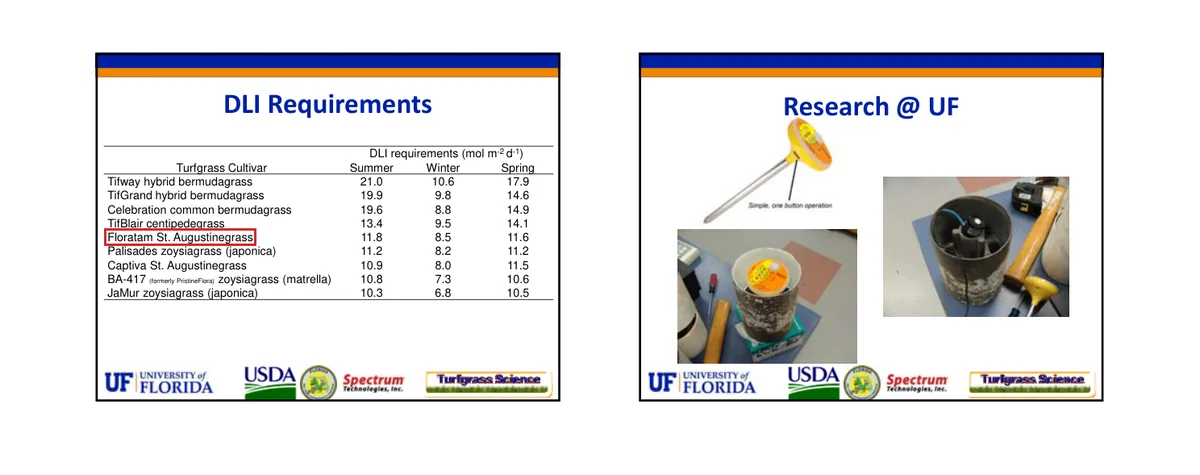
Field numbers for bermuda run higher. Texas A&M plots at College Station put it at 24 to 26 mol in summer when full sun averaged about 47 mol there, so bermuda needs roughly half of a Texas midsummer day. Read all of this as a ranking, not a meter reading: Arkansas researchers got 26.8 mol for common bermuda in research plots and 11.5 mol on shaded golf course sites.
Floratam shows why cultivar matters here too. Its 11.8 mol looks generous, yet it kept only 30.0 percent summer cover in NTEP’s 2025 Gainesville, Fla., shade plot, against 83.3 percent for Palmetto and 96.0 percent for Cobalt. For a shaded yard, buy by the name on the pallet.
| Cultivar | Stated sun | Summer light minimum, UF greenhouse (mol) | NTEP shade plot (quality, 9 = best) |
|---|---|---|---|
| Tifway bermuda | 6 to 8 hours preferred (species) | 21.0 | 3.8, College Station |
| TifGrand bermuda | Fewer hours than Tifway | 19.9 | Not entered |
| Celebration bermuda | Slightly more shade than other bermudas | 19.6 | 5.4, College Station |
| Floratam St. Augustine | At least 6 hours | 11.8 | 2.3; 30.0% cover, Gainesville |
| Captiva St. Augustine | Not stated in the sources we read | 10.9 | Not entered |
| Raleigh St. Augustine | 5 to 6 hours | Not tested | 4.3; 70.0% cover, Gainesville |
| Palmetto St. Augustine | About 5 hours | Not tested | 4.7; 83.3% cover, Gainesville |
| Cobalt St. Augustine | Not stated | Not tested | 5.7; 96.0% cover, Gainesville |
The two grasses also want opposite mower moves in shade. Texas A&M tells St. Augustine owners to mow taller to add leaf area, but in the College Station plots, Tifway and TifGrand needed significantly more light at 2 inches than at 0.75 inch. Do not raise a shaded bermuda lawn and expect help. Under about 4 hours of sun, neither grass holds; UGA Extension points clients to a low ground cover.
Mowing height and mower type
Bermuda home lawns are mowed at 1 to 2 inches with a rotary mower (Texas A&M ESC-042). Below 1 inch you need a reel mower and very level ground, plus several cuts a week. St. Augustine sits at 3.5 to 4 inches, or 2 to 2.5 inches for dwarf types such as Seville (UF/IFAS), and NC State specifies a rotary mower. Check your deck first: a mower that tops out under 3.5 inches suits only the dwarfs.
The one-third rule explains why bermuda feels like more work. A 1-inch lawn is due for mowing at 1.5 inches, after 1/2 inch of growth (ESC-042). A 3.5-inch lawn is due near 5.25 inches, after 1.75 inches. Scalping costs St. Augustine more, because it has no rhizomes to regrow from.
Which grass uses less water?
Bermuda uses less, by less than the usual charts claim. Sod-seller guides list as much as 1 to 1.25 inches a week for bermuda against 1.5 to 2 inches for St. Augustine. In Kim and Beard’s College Station plots, kept well watered and mowed alike at 1.5 inches, Texas Common St. Augustine used 5.8 mm a day against 5.1 to 5.2 mm for three bermudas.
| Grass | Aug. 1982 | May 1984 | Sept. 1984 | Authors’ mean | Inches a week | Gallons per 1,000 sq ft a week |
|---|---|---|---|---|---|---|
| Arizona Common bermuda | 5.8 | 4.2 | 4.9 | 5.1 | 1.41 | 876 |
| Tifgreen bermuda | 5.4 | 4.6 | 5.2 | 5.2 | 1.43 | 893 |
| Tifway bermuda | 5.9 | 4.1 | 4.9 | 5.2 | 1.43 | 893 |
| Texas Common St. Augustine | 6.3 | 4.8 | 5.6 | 5.8 | 1.60 | 996 |
That gap is 12 to 14 percent, or about 103 to 120 gallons per 1,000 sq ft a week at those rates. On 5,000 sq ft it is 515 to 600 gallons a week. It is a measurement of ample-water use on sand, on 1980s grasses, so treat it as the size of the difference. Watering schedules are in our guide to the best time to water a lawn.
The bigger gap opens when water is rationed. In the College Station study (2.5-inch rotary cut, 2017 to 2019), weekly watering plus rain generally kept Celebration bermuda and Floratam St. Augustine acceptable. Below once a week, Floratam generally fell under the acceptable line, while in year 3 Celebration stayed acceptable at every frequency and beat Floratam at all of them except 8 waterings a month. If your city limits you to less than weekly, that study favors bermuda.
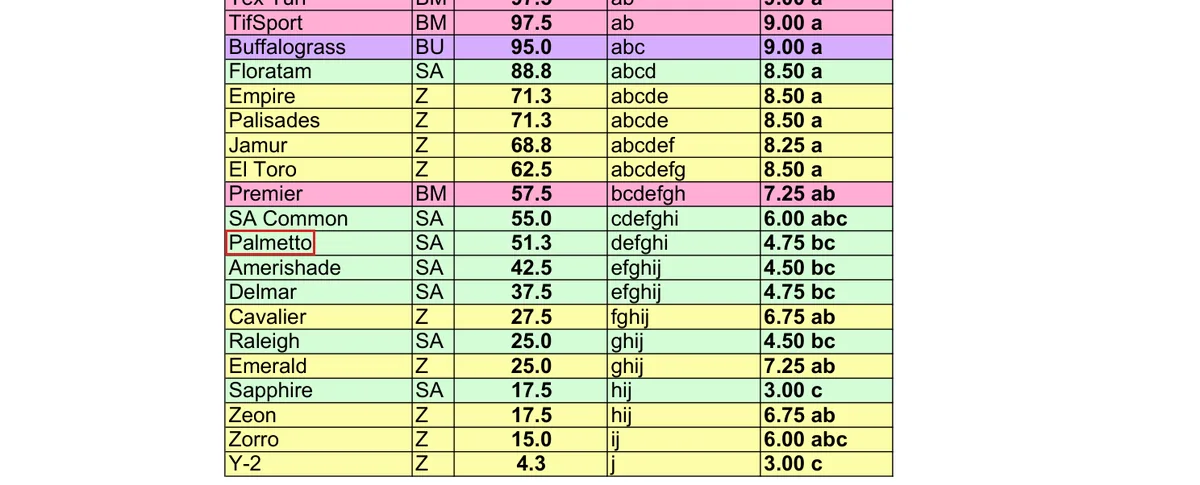
Now the drought. Texas A&M’s San Antonio plots went without water from July 23 to Sept. 20, 2006, then got 60 days of irrigation. Floratam finished in the same statistical group as most bermudas. Raleigh, the cold-hardy pick, recovered to 25.0 percent. On 4 inches of soil over a barrier, no grass recovered at all, a reason to price topsoil before sod.
Swipe the table sideways to see every column.
| Cultivar | Species | Living cover after recovery (%) | Stat. group | Uniformity (9 = best) |
|---|---|---|---|---|
| Celebration | Bermuda | 100.0 | a | 9.00 |
| Grimes EXP | Bermuda | 100.0 | a | 9.00 |
| Common | Bermuda | 98.8 | ab | 9.00 |
| GN1 | Bermuda | 98.8 | ab | 9.00 |
| Tifway 419 | Bermuda | 98.8 | ab | 9.00 |
| Tex Turf | Bermuda | 97.5 | ab | 9.00 |
| TifSport | Bermuda | 97.5 | ab | 9.00 |
| Floratam | St. Augustine | 88.8 | abcd | 8.50 |
| Premier | Bermuda | 57.5 | bcdefgh | 7.25 |
| SA Common | St. Augustine | 55.0 | cdefghi | 6.00 |
| Palmetto | St. Augustine | 51.3 | defghi | 4.75 |
| Amerishade | St. Augustine | 42.5 | efghij | 4.50 |
| Delmar | St. Augustine | 37.5 | efghij | 4.75 |
| Raleigh | St. Augustine | 25.0 | ghij | 4.50 |
| Sapphire | St. Augustine | 17.5 | hij | 3.00 |
Foot traffic and wear
Bermuda is the only one of the two built for daily use. NC State scores it 6 of 6 for wear against 1 of 6 for St. Augustine in the Piedmont and 2 of 6 on the Coastal Plain. UF/IFAS calls bermuda’s wear tolerance excellent and St. Augustine’s poor: it “does not hold up to repeated foot or vehicular traffic.” Rhizomes are the mechanism, since bermuda regrows from below ground. Put St. Augustine on a dog run or play area and budget for patches.
Cold limits by city
Bermuda reaches farther north. NC State calls St. Augustine the least cold-tolerant lawn grass and places it on the Coastal Plain, with Raleigh on the eastern Piedmont, while Riviera and Yukon bermuda are more likely to survive western and northern North Carolina. One caution: the same handbook’s Table 9-1 scores St. Augustine 2 for cold and common bermuda 1, which contradicts its own text and the field data below.
| Place | St. Augustine result | Bermuda result | Source |
|---|---|---|---|
| St. Louis | No trial in the sources we read | Warm-season lawns start to become common roughly here | Illinois Extension |
| Stillwater, Okla. | 2025 winter kill: Raleigh 20.0%, Palmetto 42.7%, Cobalt 85.0%, Floratam 96.0% | Riviera and Yukon were bred here; Arkansas rates them adapted statewide | NTEP Table 15; U. of Arkansas |
| Raleigh, N.C. | Spring cover, 2016 to 2020: Raleigh 89.8%, Palmetto 82.0%, CitraBlue 60.0%, Floratam 25.0% | 19 of 21 N.C. sod farms grow it; 6 of 21 grow St. Augustine | NTEP Table 18; NC State |
| Dallas | 2018 to 2019 winter kill: Palmetto 25.8%, Raleigh 32.5%, CitraBlue 43.3%, Floratam 69.2% | Not rated in the sources we read | NTEP Table 22 |
| Lab freezer, Stillwater | Not tested in this study | 50% killed at 19.4°F (Tifway), 15.6°F (Tahoma 31) | Gopinath et al., 2021 |
North of that line, compare tall fescue or zoysia instead. Our zoysia vs bermuda comparison covers that choice for lawns in the transition zone.
Seed or sod, and what each costs in 2026
St. Augustine has no seed option: Texas A&M says seed is not currently available, so every lawn starts from sod, plugs or sprigs. Common bermuda seeds at 1 to 2 lb per 1,000 sq ft, while hybrids such as Tifway go in vegetatively. At the $9.88 to $11.00 a pound in our grass seed cost guide, 5,000 sq ft of hulled seed costs about $49 to $110.
| Price point | Bermuda | St. Augustine | Date |
|---|---|---|---|
| USDA national weighted average | 38.04¢ (range 23 to 72¢) | 54.25¢ (range 52 to 85¢) | Apr. to Jun. 2026 |
| USDA national weighted average | 55.29¢ (range 41 to 135¢); South 47.12¢ | No row published | Jul. to Sep. 2026 |
| North Carolina farms, on-farm | $0.41 ($0.30 to $0.62) | $0.60 ($0.53 to $0.65) | 2026 survey |
| North Carolina farms, delivered | $0.47 ($0.30 to $0.99) | $0.64 ($0.57 to $0.74) | 2026 survey |
| Florida farms, state average | $0.29 non-certified; $0.37 certified | $0.29 non-licensed; $0.33 licensed | 2024 |
| The Grass Outlet, Texas, 450 sq ft pallet | Tifway $220 ($0.49) | Floratam $230 ($0.51); Raleigh $205 ($0.46) | Nov. 5, 2026 |
| Gladiator Sod, Fla., 500 sq ft pallet | Not listed | Floratam $309.95 ($0.62) | Nov. 5, 2026 |
St. Augustine usually costs more at the farm, and the gap can vanish at retail. At North Carolina delivered prices, 5,000 sq ft runs $2,350 in bermuda and $3,200 in St. Augustine, an $850 difference; at the Texas pallet prices above, Tifway against Floratam is about $110. Do not lean on USDA’s bermuda jump from 38.04 to 55.29 cents: only 15 producers reported that quarter. Installed costs are in our sod installation cost guide, and sod vs seed weighs the wait.
Chinch bugs vs bermuda mites
| Southern chinch bug | Bermudagrass mite | |
|---|---|---|
| Attacks | St. Augustine | Bermuda only, as far as is known (NC State) |
| Size and scouting | Count bugs per sq ft; treat at 20 to 25 per sq ft | About 1/100 inch; pull back leaf sheaths with a 10x to 20x lens |
| What you see | Circular yellow patches that brown and expand, first in open sun; often mistaken for drought (UF/IFAS) | Witch’s-broom tufts, stunted knots, spring thinning |
| First response | Insecticide only at threshold; resistance reported to pyrethroids, neonicotinoids, organochlorines and organophosphates (UF/IFAS) | Scalp and remove clippings, then water for several days (UF/IFAS) |
| Resistant cultivars | Captiva, the only commercial one; Floratam’s original resistance is gone | TifSport, Midlawn, Midiron, FloraTex and Cardinal (UF/IFAS) |
Tifway is the disputed case. NC State calls it particularly susceptible, Oklahoma State lists it as highly resistant, and UF/IFAS calls it intermediate after mixed test results. UF/IFAS also lists Celebration as susceptible and highly symptomatic. Disease splits the same way: St. Augustine draws gray leaf spot, large patch and take-all root rot, while bermuda has poor tolerance of many insects, diseases and nematodes.
How to tell bermuda and St. Augustine apart
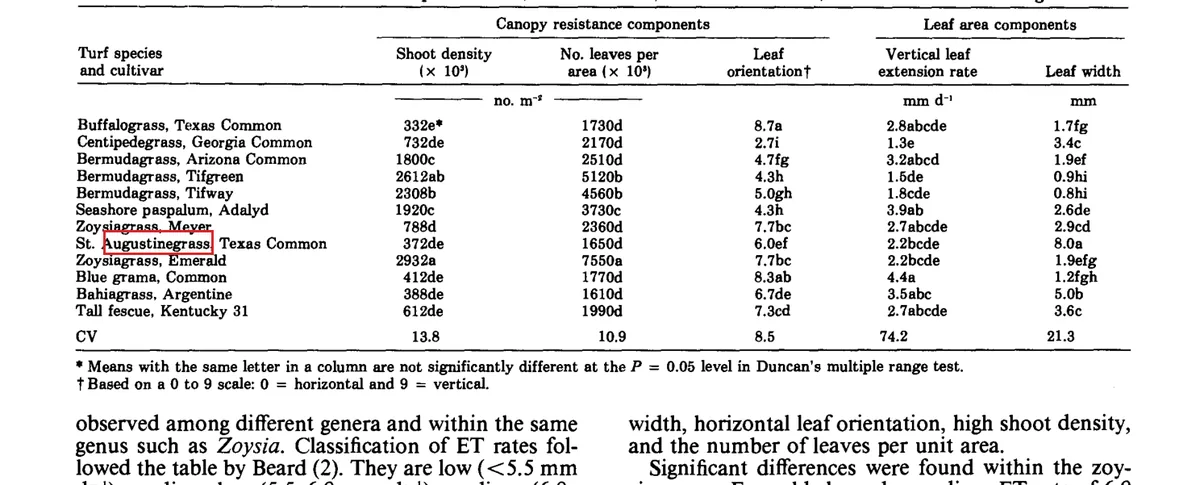
Leaf width settles it in seconds. Kim and Beard measured Texas Common St. Augustine at 8.0 mm wide against 0.8 mm for Tifway, 0.9 mm for Tifgreen and 1.9 mm for Arizona Common bermuda, so a St. Augustine blade is 4 to 10 times as wide. UGA allows wider blades on weedy bermuda, up to 1/4 inch, so measure more than one leaf.
| Check | Bermuda | St. Augustine |
|---|---|---|
| Blade | Narrow, pointed; 0.8 to 1.9 mm on the lawn types measured | Flat and broad; 8.0 mm on Texas Common |
| Density | Tifway about 6 times as many shoots per area | Sparse, coarse mat |
| Under the soil | Rhizomes, usually 1 to 6 in. deep | None; only surface runners |
| Seedhead | Fingerlike spikes from one point | Single spike with flowers sunken into pits on one side |
| Ligule | Fringe of hairs | Short fringe of hairs, so it does not separate them |
One published mismatch to ignore: the NC State Plant Toolbox entry says St. Augustine spreads by rhizomes and rarely needs mowing, while Texas A&M and NC State’s own handbook describe a stoloniferous grass that is mowed frequently. Pull a runner: rhizomes mean bermuda.
What happens when one invades the other
In sun, bermuda wins. UGA Bulletin 1393 says St. Augustine lawns are often unable to compete with bermuda during summer. In shade the balance reverses, because bermuda thins at light levels St. Augustine holds (Mississippi State). We found no trial that measured takeover speed in feet per year, so any such number you read is a guess.
Removing bermuda from St. Augustine is possible but professional. UF/IFAS AG499 says no bermuda herbicide is available to homeowners through big-box retailers, and calls the trifloxysulfuron-plus-safener product Recognition tank-mixed with fluazifop the first effective selective option. Recognition alone does not control bermuda. Reduced safety was seen on Captiva, ProVista and Seville, and risk rises in late summer and fall, so UF/IFAS advises small test areas and spring timing. Details are in how to kill bermuda grass.
The older ethofumesate-plus-atrazine route is weaker: UGA describes ethofumesate as labeled for nonresidential St. Augustine, UF/IFAS notes the label does not mention the atrazine mix, and Floratam is injured by atrazine.
St. Augustine moving into bermuda is the less documented case. We found no extension publication naming a selective fix. The biology favors low mowing: a 1-inch bermuda height is well under St. Augustine’s 2-inch floor in Texas A&M’s range, and it has no rhizomes to fall back on, but no trial has tested that as a control. To convert a lawn outright, start with how to kill grass before replanting.
This page is general information, not pesticide advice. Herbicide registrations differ by state and turf site; the label is the law. Confirm the product, site and rate on the current label before applying.
Which one to plant, by yard conditions
1Does the spot get under about 4 hours of direct sun in summer?
YesNeither. Plant a ground cover or mulch the area.
NoGo to the next question
2Does it get under 6 hours, or does shade cover it for much of the day?
YesSt. Augustine: Palmetto, Raleigh or Cobalt, mowed at 3.5 to 4 inches. Avoid Floratam, which needs at least 6 hours.
NoGo to the next question
3Will people or dogs use it daily?
YesBermuda. It scores 6 of 6 for wear against 1 or 2 for St. Augustine.
NoGo to the next question
4Is watering limited to less than once a week?
YesBermuda, or Floratam if you want St. Augustine and have 6 or more hours of sun.
NoGo to the next question
5Are you north of the Gulf and coastal South, such as Oklahoma or the N.C. Piedmont?
YesBermuda: Tahoma 31, Latitude 36, Riviera or Yukon. Raleigh is the only St. Augustine with low winter kill at Stillwater.
NoGo to the next question
6Do you want a seeded lawn?
YesCommon bermuda, at 1 to 2 lb of hulled seed per 1,000 sq ft. St. Augustine has no seed.
NoEither works. Choose bermuda for a fine, low lawn and St. Augustine for a wide-bladed one you mow at 3.5 to 4 inches.
| If your yard is | Plant | Why | What you give up |
|---|---|---|---|
| Full sun, 6 to 8+ hours | Bermuda: TifTuf, Celebration or common from seed | Highest light need of any maintained turfgrass; wear 6 of 6 | Weekly mowing, edging, a tan lawn from first frost |
| 4 to 6 hours under high canopy, Gulf or coastal South | St. Augustine: Palmetto, Raleigh or Cobalt | 83.3%, 70.0% and 96.0% cover in NTEP shade | More irrigation, chinch bug scouting, poor wear |
| Under about 4 hours | Neither; ground cover or mulch | Below Mississippi State’s 4-hour St. Augustine floor | No turf in that spot |
| Dog run or daily play | Bermuda | Wear 6 vs 1 or 2 of 6 | Thins if shade increases |
| Watering limited to under once a week | Bermuda; Floratam if it must be St. Augustine | Celebration stayed acceptable in year 3; 88.8% Floratam recovery | Floratam needs 6 hours of sun |
| Only 4 in. of soil over rock or caliche | Add soil first | No grass recovered from the 60-day drought on 4 in. | Cost of topsoil |
| Alkaline soil above pH 7.5 | Bermuda, or budget for iron on St. Augustine | St. Augustine develops iron chlorosis above pH 7.5 (Texas A&M) | Foliar iron sprays |
| Salt spray or brackish irrigation | Decide on shade, not salt | UF/IFAS rates bermuda salt tolerance excellent, St. Augustine relatively good | Nothing extra |
| Transition zone: Oklahoma, Piedmont, north Texas | Bermuda: Tahoma 31, Latitude 36, Riviera or Yukon | Tahoma 31 lab kill at 15.6°F; Floratam lost 96.0% at Stillwater | Tan from first frost to spring; Raleigh only if shade forces St. Augustine |
| Sunny front, shaded back | Both, split by a bed or hard edge | Mowing heights of 1 to 2 and 3.5 to 4 in. cannot share a deck setting | Edging the boundary all season |
| Bermuda creeping into sunny St. Augustine | Accept it, hire the spring tank mix, or convert | UGA: St. Augustine often cannot compete in summer | Risk of injury; test patch first |
| Old bermuda thinning as trees mature | St. Augustine under the canopy | Bermuda thins in shade; raising the deck did not help Tifway | Two grasses, two mowing heights |
How we compiled this
We compiled trial reports, peer-reviewed papers, extension publications, USDA and state sod price reports and two dated retail price lists in November 2026; we ran no field tests. Where a study included both grasses, we used it over separate single-grass sources. Limits: the San Antonio numbers are Year 1 of 2, because the San Antonio Water System copy holds only that year and we could not open the 2008 final report, and we could not open Maier et al. (1994), so this page gives no lab freezing number for St. Augustine.
Frequently asked questions
Is bermuda grass better than St. Augustine grass?
For full sun, wear and limited water, yes: NC State scores it 6 of 6 for wear against 1 or 2, and Celebration held quality better than Floratam under less-than-weekly watering. For 4 to 6 hours of sun, no. St. Augustine scores 5 of 6 for shade against 1.
Can bermuda grass overtake St. Augustine?
Yes, in sun. UGA Bulletin 1393 says St. Augustine lawns are often unable to compete with bermuda in summer. Under trees the bermuda usually thins first, because it needs roughly half of full summer light.
Will St. Augustine overtake bermuda grass?
In shade it can, since bermuda needs about 20 to 26 mol of light a day and thins below that. In a sunny bermuda lawn mowed at 1 to 2 inches, St. Augustine sits below its 2 to 4 inch range, which should hold it back, though we found no trial testing it.
Can you mix bermuda and St. Augustine grass?
Not in one lawn area. Bermuda wants 1 to 2 inches and St. Augustine 3.5 to 4, so one mowing height shortchanges one grass, and the blades differ by 4 to 10 times in width. Split them with a bed or hard edge.
What are the drawbacks of bermuda grass?
Poor shade tolerance, a tan lawn from first frost to spring, aggressive spread into beds and thatch, plus poor tolerance of many pests (UF/IFAS LH007). Our bermuda grass guide scores 11 cultivars on these traits.
What are the downsides of St. Augustine grass?
No seed, poor wear, chinch bugs at 20 to 25 per sq ft, more irrigation and iron chlorosis above pH 7.5. Our St. Augustine grass guide compares 17 cultivars, and types of lawn grass sets both against 12 others.
Sources
- J. Zhang et al., Comparative Performance and Daily Light Integral Requirements of Warm-Season Turfgrasses in Different Seasons, Crop Science 57:2273 to 2282 (abstract), 2017. Accessed November 2026.
- J. B. Unruh, UF/IFAS, Daily Light Requirements for Grass Species (DLI table by cultivar), 2015. Accessed November 2026.
- USGA Green Section (C. Thompson), Minimum Daily Light Integrals: Do Cultivars, Cutting Heights and PGRs Matter?, October 2019. Accessed November 2026.
- B. Wherley et al., Texas A&M, Minimum Daily Light Integral Requirements for Warm-Season Fairway/Tee and Rough Cultivars, USGA research summary, 2017. Accessed November 2026.
- T. Russell et al., University of Arkansas, Determining Precise Light Requirements for Various Turfgrass Systems, USGA research summary, 2017. Accessed November 2026.
- K. S. Kim and J. B. Beard, Comparative Turfgrass Evapotranspiration Rates and Associated Plant Morphological Characteristics, Crop Science 28, 1988. Accessed November 2026.
- D. Chalmers et al., Texas A&M, Evaluation of Sixty-Day Drought Survival in San Antonio of Established Turfgrass Species and Cultivars: Year 1, December 2006. Accessed November 2026.
- R. Hejl, B. Wherley and C. Fontanier, Long-term Performance of Warm-season Turfgrass Species under Municipal Irrigation Frequency Restrictions, HortScience 56(10), 2021. Accessed November 2026.
- Texas A&M AgriLife Extension, EHT-144, St. Augustinegrass Lawn Management, July 2026 posting. Accessed November 2026.
- Texas A&M AgriLife Extension, ESC-042, Bermudagrass Lawn Management Calendar, 2023 posting. Accessed November 2026.
- UF/IFAS Extension, LH007, Bermudagrass for Florida Lawns, checked Nov. 5, 2026. Accessed November 2026.
- UF/IFAS Extension, LH010, St. Augustinegrass for Florida Lawns, reviewed October 2025. Accessed November 2026.
- UF/IFAS Extension, AG499, Common Bermudagrass Contamination Management in Florida Turfgrasses, checked Nov. 5, 2026. Accessed November 2026.
- UF/IFAS Extension, EP658, Florida Sod Inventory and Pricing Report, 2025, 2024 data. Accessed November 2026.
- UF/IFAS Extension, ENY-325, Managing Southern Chinch Bug in Warm Season Turfgrasses, checked Nov. 5, 2026. Accessed November 2026.
- P. A. Boeri et al., UF/IFAS, Bermudagrass Mite, Eriophyes cynodoniensis, 2018. Accessed November 2026.
- Mississippi State University Extension, P2892, Selecting and Managing Turfgrass for Shade, checked Nov. 5, 2026. Accessed November 2026.
- UGA Extension, Lincoln County, Options for when your lawn won’t grow, April 2025. Accessed November 2026.
- University of Georgia Extension (P. McCullough), Bulletin 1393, Bermudagrass Control in Southern Lawns, June 2024. Accessed November 2026.
- NC State Extension, Extension Gardener Handbook, Chapter 9: Lawns (Table 9-1), checked Nov. 5, 2026. Accessed November 2026.
- NC State Extension, AG-431, Bermudagrass Lawn Maintenance Calendar, checked Nov. 5, 2026. Accessed November 2026.
- NC State Extension, AG-540, St. Augustinegrass Lawn Maintenance Calendar, checked Nov. 5, 2026. Accessed November 2026.
- NC State Extension, Bermudagrass Mites, TurfFiles, reviewed August 2025. Accessed November 2026.
- NC State Extension Gardener Plant Toolbox, Stenotaphrum secundatum, checked Nov. 5, 2026. Accessed November 2026.
- NC State Extension, 2026 Sod Producers’ Report for North Carolina, 2026. Accessed November 2026.
- USDA Agricultural Marketing Service, National Quarterly Sod Report (link opens the latest quarter; Apr. to Jun. 2026 figures from our saved copy), Jul. to Sep. 2026. Accessed November 2026.
- National Turfgrass Evaluation Program, 2023 National St. Augustinegrass Test, 2025 Data, Tables 5 and 15, 2025 data. Accessed November 2026.
- National Turfgrass Evaluation Program, 2016 National St. Augustinegrass Test, Final Report 21-14, Tables 18 and 22, 2016 to 2020 data. Accessed November 2026.
- National Turfgrass Evaluation Program, 2019 National Bermudagrass Test, Table 25A (College Station shade), 2020 to 2023 data. Accessed November 2026.
- L. Gopinath, J. Q. Moss and Y. Wu, Oklahoma State University, Evaluating the freeze tolerance of bermudagrass genotypes, Agrosystems, Geosciences and Environment, 2021. Accessed November 2026.
- University of Arkansas Cooperative Extension, Bermudagrass in Arkansas, checked Nov. 5, 2026. Accessed November 2026.
- University of Illinois Extension (E. Wahle), Bermudagrass: You either love it or hate it, October 2022. Accessed November 2026.
- Oklahoma State University Extension, Bermudagrass and Zoysiagrass Mites, checked Nov. 5, 2026. Accessed November 2026.
- UC Statewide IPM Program, Pest Notes: Bermudagrass, checked Nov. 5, 2026. Accessed November 2026.
- The Grass Outlet, 419 Tifway Bermuda (pallet price), checked Nov. 5, 2026. Accessed November 2026.
- The Grass Outlet, Floratam St. Augustine (pallet price), checked Nov. 5, 2026. Accessed November 2026.
- The Grass Outlet, Raleigh St. Augustine (pallet price), checked Nov. 5, 2026. Accessed November 2026.
- Gladiator Sod, Floratam sod prices, checked Nov. 5, 2026. Accessed November 2026.