How to kill bermuda grass depends on where it grows: spray topramezone plus triclopyr in fescue from late summer, fluazifop in beds, glyphosate twice before replanting, or solarize 4 to 6 summer weeks. Repeat sprays: one a year left 67 to 79 percent cover.
Learning how to kill bermuda grass starts with what else is growing there, because the spray that clears a flower bed will kill a St. Augustine lawn, and the one built for fescue kills zoysia. The matrix below gives each site its active ingredient, EPA registration number, rate per 1,000 sq ft, repeat interval and reseeding wait. We converted acre rates to backyard scale. The label on your bottle is the law, and it overrides this table.
The rule matrix: what kills bermuda grass, by where it grows
Swipe the table sideways to see every column.
| Where it grows | What to use (EPA Reg. No.) | One spray per 1,000 sq ft (per acre) | Repeat | Wait to seed |
|---|---|---|---|---|
| Tall fescue, Kentucky bluegrass | Topramezone (Pylex, EPA Reg. No. 7969-327) plus triclopyr ester and 0.5 to 1% methylated seed oil | 0.023 to 0.030 fl oz (1 to 1.3 fl oz/A) | 3 sprays, 3 to 4 weeks apart, starting 9 to 12 weeks before killing frost; 4 fl oz/A yearly cap | 3 weeks after the last spray |
| Tall fescue | Triclopyr ester (Turflon Ester Ultra, 62719-566), the partner in the mixes here; half rate on bluegrass and fine fescue | 0.73 fl oz (1 qt/A) | Label: 3 to 4 more sprays at 4-week intervals | 3 weeks |
| Fescue, ryegrass, bluegrass, retail bottle | BioAdvanced Bermudagrass Control For Lawns Ready-To-Use, 92564-86: topramezone 0.0033% plus sodium bentazon | Ready to use; spray to lightly cover | Up to 2 sprays, 3 weeks apart, spring to late summer, below 90°F | Bare spots 4 weeks; bluegrass 3 weeks; fescue and ryegrass none |
| Tall fescue, zoysia | Fenoxaprop (Acclaim Extra, 432-950) plus triclopyr ester at 16 to 32 fl oz/A | 0.46 to 0.64 fl oz (20 to 28 fl oz/A) | Every 4 to 6 weeks, up to 5 a season; 120 fl oz/A yearly cap | 3 weeks (triclopyr label) |
| Tall fescue, overspray | Fluazifop (Fusilade II, 100-1084) with nonionic surfactant | 0.115 to 0.138 fl oz (5 to 6 fl oz/A) | April or May, then September or October; not in the hot months | 14 days |
| Tall fescue, hand sprayer | Fluazifop (Ornamec 170, filed as EH 951, 2217-751); not for California | 2 fl oz in 1 gal per 1,000 sq ft | Spring and fall, 14 to 21 days apart on regrowth | 14 days |
| Zoysia, overspray | Fluazifop (Fusilade II) with nonionic surfactant; adding triclopyr cut injury in Tennessee trials | 0.069 to 0.092 fl oz (3 to 4 fl oz/A); 5 fl oz/A at most | About June 1, then every 28 to 30 days | 14 days |
| Zoysia, hand sprayer | Fluazifop (Ornamec 170); not for California | 1.3 fl oz in 1 gal per 1,000 sq ft | Every 30 days from about June 1; 1 to 2 seasons | None stated for zoysia |
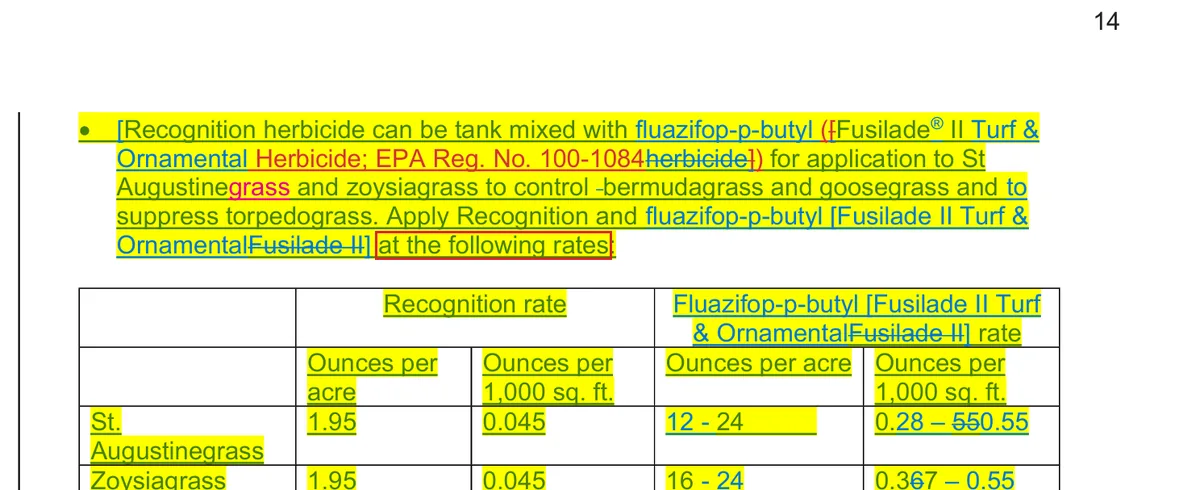
| Zoysia | Trifloxysulfuron plus safener (Recognition, 100-1658) plus Fusilade II; not for California | 0.045 oz by weight plus 0.367 to 0.55 fl oz (1.95 oz/A plus 16 to 24 fl oz/A) | At least 4 weeks apart; 3 a year at this rate | 14 days (Fusilade II) |
| St. Augustine, not ProVista or Captiva | Recognition plus Fusilade II; not for California | 0.045 oz by weight plus 0.28 to 0.55 fl oz (1.95 oz/A plus 12 to 24 fl oz/A) | 4 weeks at 12 to 18 fl oz, 5 to 6 weeks at 24 | 14 days (Fusilade II) |
| Centipede | Sethoxydim (Segment II, 7969-398); runners 6 inches or shorter | 0.6 fl oz (1.5 pt/A) | About every 3 weeks in growth; 3 pt/A season cap, so 2 full-rate sprays | None stated |
| Flower beds, shrubs | Fluazifop (Fusilade II) with nonionic surfactant; runners 4 to 8 inches | 0.4 to 0.6 fl oz (16 to 24 fl oz/A) | Re-treat regrowth before it passes 6 inches | Not a lawn use; 30 days on bare ground |
| Flower beds, retail bottle | Ortho Grass-B-Gon Garden Grass Killer, 239-2620: fluazifop 0.48% | Ready to use; just wet foliage | 2 sprays, 7 days apart, on established bermuda | Not a lawn product |
| Whole lawn or patch, replanting | Glyphosate (Roundup Super Concentrate, 71995-25, 50.2%) | 8.3 fl oz (2.5 fl oz per gal per 300 sq ft) | 2 or 3 sprays, 3 to 4 weeks apart, on green growth | Label: 3 days for lawn grass |
| Whole lawn or patch, replanting | Glyphosate at 2 to 3 lb ai/A plus Fusilade II | 0.55 fl oz Fusilade II (24 fl oz/A) | Second spray at 3 to 4 weeks | 30 days to seed; 7 days to sprig |
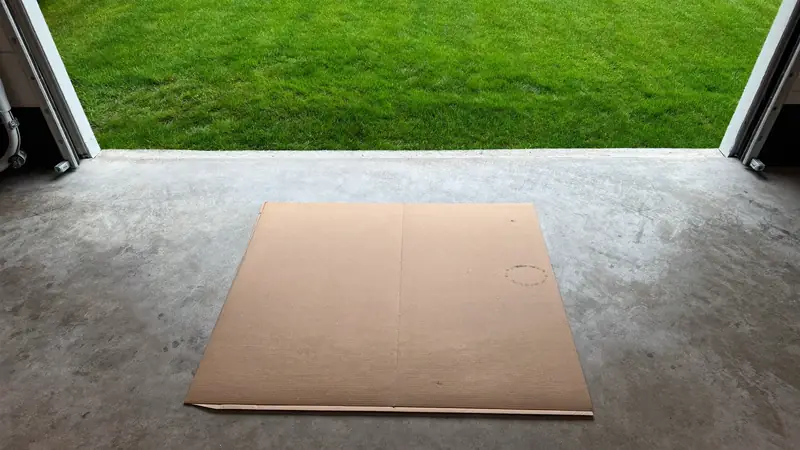
| Any bare-able area, no herbicide | Clear UV-protected plastic after mowing close and watering | 2 feet past the runners | 4 to 6 weeks at peak sun | After removal; till no deeper than 3 inches |
| Any bare-able area, no herbicide | Black polyethylene, no holes, after mowing and watering | Full cover | At least 6 to 8 weeks in summer; not in winter | After removal |
1Is it in a bed or around shrubs, with no lawn grass in the spray zone?
YesSpray a grass-only herbicide (fluazifop) on 4 to 8 inch runners and repeat on regrowth. Check the label's plant list; keep it off lawn and ornamental grasses.
NoGo to the next question
2Are you replanting this patch or lawn anyway?
YesGlyphosate on green growth, 2 or 3 sprays, 3 to 4 weeks apart, then seed or sod. Confirm the bottle contains glyphosate.
NoGo to the next question
3Do you want no synthetic herbicide?
YesClear plastic for 4 to 6 weeks or black plastic for at least 6 to 8, in peak summer. Everything under it dies.
NoGo to the next question
4Is the lawn tall fescue or Kentucky bluegrass?
YesMow at 3.5 to 4 inches. Spray topramezone plus triclopyr 3 times, 3 weeks apart, starting 9 to 12 weeks before killing frost. Reseed in fall.
NoGo to the next question
5Is the lawn zoysia?
YesFluazifop at 3 to 4 fl oz/A every 28 to 30 days, with triclopyr, for 2 years, or Recognition plus fluazifop. Never topramezone.
NoGo to the next question
6Is the lawn St. Augustine (not ProVista or Captiva, not in California)?
YesRecognition plus Fusilade II at least 4 weeks apart.
NoGo to the next question
7Is the lawn centipede?
YesSethoxydim up to 1.5 pints per acre, about 3 weeks apart, 2 full-rate sprays a season. Expect suppression.
NoWe found no selective program for other grasses, such as bahia. Spot-spray glyphosate on the patch, then replant it; UGA calls spot treatment the most effective method.
Source: EPA labels, Virginia Tech, UGA and UC IPM, compiled November 2026
- Product (fl oz)
- 0.009
- Product (mL)
- 0.26
Default: 300 sq ft of Pylex at 1.3 fl oz/A is 0.009 fl oz, 0.26 mL. Area times the rate in the table above; it checks no yearly cap, and your label governs. Add adjuvant and water per the label.
Worked example: a 300 sq ft fescue patch at the Pylex rate of 1.3 fl oz/A needs 0.009 fl oz, or 0.26 mL, per spray, a job for a syringe and not a kitchen spoon.
Why one spray does not kill bermuda grass
Bermuda grass regrows from stolons and from rhizomes that UC IPM puts 1 to 6 inches deep in undisturbed soil and deeper in tilled or sandy ground, under sidewalks and against foundations. A foliar spray has to reach that network, and UC IPM says cut fragments left in moist soil can root and regrow. The cleanest measure of a single spray is a 2-year University of California trial at Riverside in a 6-year-old common bermuda stand.
Before spraying, confirm the patch is bermuda and not crabgrass, which has no rhizomes and dies at the first frost; our crabgrass vs bermuda grass ID key lists 6 checks.
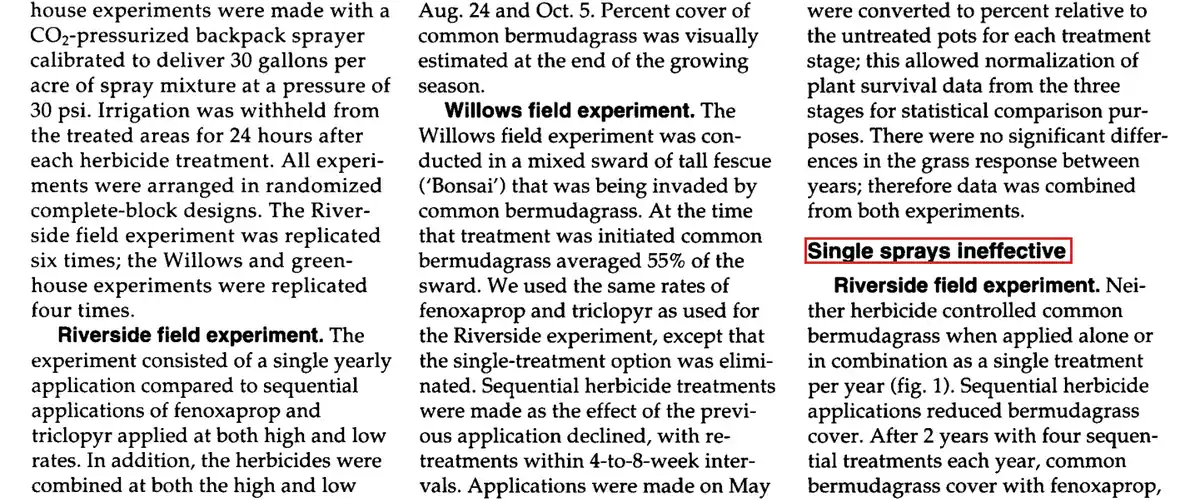
Repeat sprays went on 4 to 6 weeks apart, and perennial ryegrass filled in as the bermuda declined. The paper’s text lists the 11, 4 and 3 percent figures in a different order than its Figure 1; we use the figure, which fits its conclusion that fenoxaprop beat triclopyr. Other trials agree, and two warn that the kill is not permanent.
| Trial | Treatment | Result | Catch |
|---|---|---|---|
| Willows, Calif., tall fescue, 1994 to 1995 | 4 sprays a year of fenoxaprop, triclopyr or both | 8, 28 and 8 percent cover after 2 years; 68 percent untreated | Authors expect re-treatment as bermuda reinvades |
| Tennessee, 2004 to 2005 | 3 sprays, 28 days apart | Fluazifop 74 percent suppression; fluazifop plus triclopyr 69; fenoxaprop 39; fenoxaprop plus triclopyr 67 | Bermuda regrew in year 2 once spraying stopped |
| Kansas State, 1996, 15-year-old plot | 2 percent glyphosate on July 15 and Aug. 15 | No regrowth more than 1 year later | Kills the lawn too, so you reseed |
| New Mexico State, Las Cruces, 2017 | Fluazifop, clethodim or glyphosate alone, then 0 to 2 glyphosate follow-ups | Every single spray was inferior to programs with a glyphosate follow-up, rated to 78 days | Short study; no rhizome count |
| Texas A&M-Kingsville poster, pasture | 4 glyphosate sprays at 9 L/ha, Sept. to Feb. | More than 90 percent reduction | Authors call it short-term suppression |
In tall fescue or Kentucky bluegrass: raise the mower, spray late
Mow at 3.5 to 4 inches first. Virginia Tech SPES-350 says research shows tall fescue can completely kill bermuda at 4 inches without herbicide, and that mowing at the low end of the recommended range makes herbicide control nearly impossible. It also says no control is absolute in the mid-Atlantic, so treat 4 inches as a condition for success, not a cure. Mow every 7 days or less, and not within 3 days either side of a spray. Our tall fescue guide has the seeding and fertilizer side.
Timing beats product choice. In Virginia Tech’s chart of how much bermuda returns the next summer, every program does better from a late-summer or early-fall start.
The Pylex label sets the calendar: begin 9 to 12 weeks before the first killing frost, spray 3 times at 3-week intervals with triclopyr ester and methylated seed oil, and delay seeding 3 weeks after the last spray. At 1.3 fl oz/A, 3 sprays total 3.9 fl oz, just under the 4 fl oz/A yearly cap. A 12-week start leaves the most room for fall seeding.
| Average first killing frost | Spray 1 | Spray 2 | Spray 3 | Earliest seeding |
|---|---|---|---|---|
| Oct. 1 | July 9 | July 30 | Aug. 20 | Sept. 10 |
| Oct. 20 | July 28 | Aug. 18 | Sept. 8 | Sept. 29 |
| Nov. 10 | Aug. 18 | Sept. 8 | Sept. 29 | Oct. 20 |
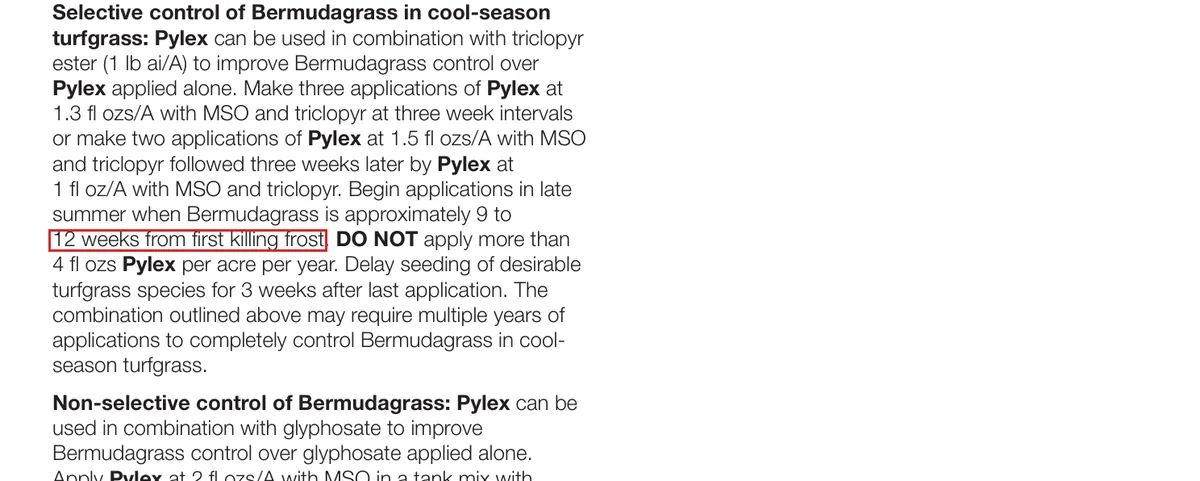
Expect the bermuda to bleach white, and expect a follow-up. Virginia Tech pairs the fall program with Tenacity (mesotrione, EPA Reg. No. 100-1267) at 4 fl oz/A plus triclopyr the next spring, repeated 3 to 4 times at 3-week intervals when the bermuda is about 50 percent green. That spring program only slows spread: the chart shows about 90 percent returning. Its label caps it at 16 fl oz/A a year, with 14 days between sprays.
Kentucky bluegrass has narrower limits. Fluazifop is not labeled on it (Fusilade II lists zoysia, fine fescue and tall fescue), and Virginia Tech says the triclopyr rate drops by half on bluegrass and fine fescue. Segment II must stay off tall fescue turf, per its label.
Two retail bottles share the BioAdvanced Bermudagrass Control name, so read the registration number on the back. EPA Reg. No. 92564-86 is topramezone plus sodium bentazon: up to 2 sprays, 3 weeks apart. EPA Reg. No. 92564-32 is 0.41 percent fenoxaprop: up to 7 monthly sprays may be required, but no more than 3 a year, which works out to 3 seasons. Neither label allows use on bermuda, zoysia, St. Augustine or centipede lawns.
In zoysia: fluazifop at the zoysia rate, never topramezone
Zoysia and bermuda have similar herbicide tolerance, so the margin is thin. Pylex is off the table: its label lists zoysia as a weed it controls with 3 late-summer sprays, and Tenacity calls zoysia sensitive. Fluazifop is the labeled route, at a lower rate than on fescue.
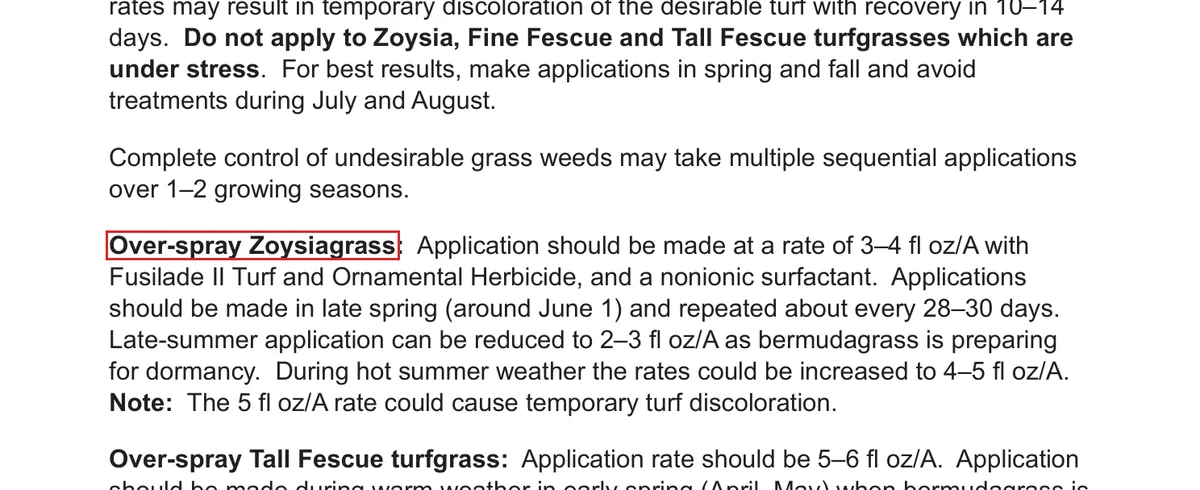
Adding triclopyr protects the zoysia without losing much control. In the University of Tennessee trials, fluazifop alone injured zoysia 9 to 38 percent across 3 experiments, while fluazifop plus triclopyr caused none, and suppression was statistically equal at 74 and 69 percent. Their strategy runs 2 years at 4-week intervals, mid-May to Sept. 15, and warns that a longer gap lets bermuda recover. It writes Fusilade II at 6 fl oz/A for zoysia, above the 5 fl oz/A top of the current label, so use the label rate. Our zoysia guide covers re-sodding.
Recognition (EPA Reg. No. 100-1658) contains metcamifen, and its label allows a Fusilade II tank mix on zoysia at 16 to 24 fl oz/A. A 2025 University of Kentucky thesis reports complete bermuda suppression without unacceptable zoysia injury from that chemistry. At 0.045 oz per 1,000 sq ft, about 1.3 grams, you need a gram scale.
In St. Augustine or centipede: the short list
St. Augustine has one practical selective program, and older references miss it. UGA Bulletin 1393 lists only ethofumesate plus atrazine, for nonresidential St. Augustine, started at spring green-up and repeated after 30 days, with stunting expected. The Recognition label stamped Feb. 16, 2024 adds Fusilade II at 12 to 24 fl oz/A with 0.25 to 0.5 percent nonionic surfactant, and it covers residential lawns outside California. Syngenta says Recognition alone does not control bermuda. Leave out ProVista and Captiva unless you can accept injury. Our St. Augustine guide helps identify the cultivar.
Centipede tolerates sethoxydim and clethodim. UGA calls the result suppression, schedules sprays about every 3 weeks during active growth, and says to skip mowing for a week either side. Segment II allows 1.5 pints per acre on runners up to 6 inches and 3 pints per season on mature centipede, so you get 2 full-rate sprays a year. Seedlings get 1 pint at most. More on that grass is in our centipede guide.
In flower beds and around shrubs: a grass-only spray
Grass-selective herbicides leave most broadleaf plants alone, and NC State rates fluazifop and clethodim good on bermuda, sethoxydim fair to good and fenoxaprop poor. Spray young growth: UC IPM wants the first spray on new growth under 6 inches and the next before regrowth reaches 6 inches, and NC State says Fusilade II and Envoy work better in early summer at 6 to 8 inches than in late summer when the grass is flowering. The Grass-B-Gon label calls for 2 sprays 7 days apart on established bermuda and says treated grass dies in 1 to 4 weeks.
Check the plant list first. NC State’s table marks Bar Harbor juniper unsafe for Fusilade, and marks azaleas and other junipers directed-spray only, on certain varieties. Blue fescue is listed as unsafe for both Fusilade and Envoy, and UC IPM says not to use these products near ornamental grasses. Overspray counts too: the Grass-B-Gon label lists St. Augustine, tall fescue and centipede among the grasses it kills.
UC IPM says wood chips fail, while geotextile fabric under mulch works if sheets overlap with no holes. For small patches, Maryland Extension says dig out every rhizome and do not rototill live plants, since pieces left within a few inches of the surface resprout.
Before replanting: glyphosate, at least twice
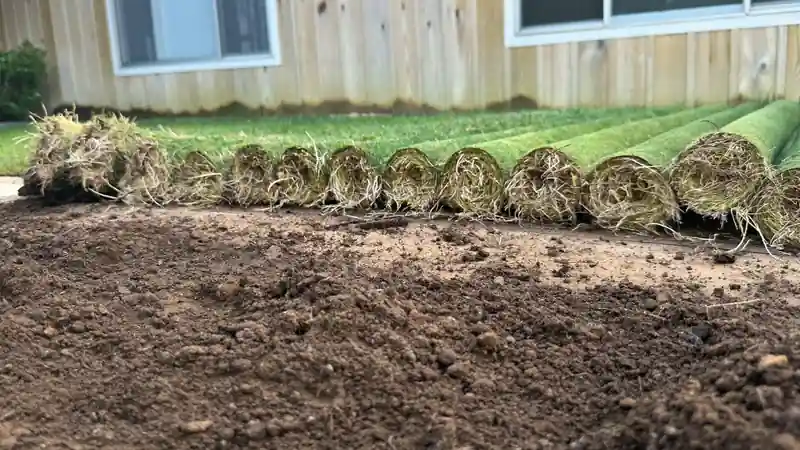
Where bermuda dominates, killing everything and starting over is the most reliable route: Virginia Tech estimates about 3 percent return after 2 glyphosate sprays from a fall program. Our broader guide to killing grass before replanting compares methods for other grasses.
- Two weeks ahead, water and fertilize as if you meant to keep the lawn (University of Arizona AZ1371), and stop mowing 2 to 3 weeks before spraying (UC IPM). Scalped grass absorbs too little.
- Spray in full growth. Roundup Super Concentrate (71995-25) calls for 2.5 fl oz per gallon over 300 sq ft, a mix close to the 2 percent solution in the Kansas State trial. Start in late June to mid-July for fall seeding.
- Leave it alone for 7 days, with no mowing or tilling, so the herbicide reaches the rhizomes (UC IPM).
- About 2 weeks after the first spray, Kansas State scalps the lawn and removes clippings so dead thatch cannot shield any recovering bermuda.
- Spray again at 3 to 4 weeks on anything green, keeping the area irrigated so it regrows. Arkansas MP477 uses a third spray, with sprays in May, June and August.
- Seed or sod 1 week after the second spray per Virginia Tech, or 2 weeks per Kansas State; the 71995-25 label allows lawn grass after 3 days.
Adding fluazifop buys little. A University of Delaware turf post puts 2 to 3 glyphosate sprays at 97 percent control or better, with fluazifop adding 1 or 2 points. That post seeds 14 days after fluazifop, but the renovation section of the July 2026 Fusilade II label says 30 days, so plan on 30. For a spring planting, Kansas State found one autumn glyphosate spray before dormancy cut green cover the next spring, and adding mesotrione or fluazifop did not cut it further.
Check the active ingredient on a Roundup bottle before you rely on it. Roundup Concentrate 71995-64 contains triclopyr, fluazifop and diquat and no glyphosate; its label says bermuda may need a repeat and to wait at least 28 days before one. Concentrate Plus 71995-29 has 18 percent glyphosate and 71995-25 has 50.2. Our page on how long Roundup stays in soil covers the planting waits for each formula. Maryland Extension also notes that Baltimore City prohibits glyphosate on lawns and Montgomery County bars most synthetic pesticides on them, so check local rules.
Without herbicide: plastic, drying or digging
Non-chemical methods work only when they reach the rhizomes. UC IPM’s solarization guide aims for daily highs of 110 to 125°F in the top 6 inches of soil, and it says rhizomes are controlled when they are close to the surface. It is also the only treatment UC IPM credits with killing bermuda seed, which stays viable for years.
| Method | How | Time | What makes it fail | Source |
|---|---|---|---|---|
| Clear plastic | Mow close, remove clippings, water well, cover 2 feet past the runners with UV-protected film; 1 to 4 mil, 1.5 to 2 mil where windy | 4 to 6 weeks; June to August in California’s Central Valley | Shade, north-facing slopes, or early spring, which can promote growth; tilling deeper than 3 inches afterward | UC IPM 7453 |
| Black polyethylene | Mow, irrigate, cover with intact film | At least 6 to 8 weeks in summer | Winter use, when dormant grass is unaffected; any hole, including planting holes | UC IPM 7453 |
| Drying by tilling | Withhold water, till dry soil 2 or 3 times in summer, rake out rhizomes | All summer; passes 4 to 7 days apart for a faster kill, per Cornell | Rain or water during the process; tilling moist soil spreads it | Cornell: rhizomes do not resprout after 7 days in completely dry soil |
| Cardboard and mulch | Scalp, 1/2 inch compost, 2 layers of wet cardboard overlapped 6 inches, 3 inches mulch | 4 to 6 months or more | Holes cut for planting; gardener report, not a trial | Organic Growers School |
| Wood chips alone | Spread as mulch | Not effective | Bermuda pushes up through it | UC IPM 7453 |
| Vinegar or other contact sprays | Burn top growth; repeat | Suppression only | Roots and rhizomes are unaffected | UC IPM 7453 |
Household options fall short too. Our pages on vinegar weed killer, salt and bleach cover each.
How we compiled this
In November 2026 we read 14 EPA-stamped pesticide labels and the extension and research documents listed under Sources, and converted acre rates to 1,000 sq ft by dividing by 43.56. We ran no field tests. The Virginia Tech chart values are read from unlabeled bars, so treat them as approximate; Virginia Tech itself calls them estimates. Where an extension program and a current label disagree, this page follows the label. Forum threads supplied question wording only.
This page is general information, not pesticide-use advice. The label is the law: rates, sites and state registrations change, and several products here are not for California. Read the current label for your product before you mix or spray.
Frequently asked questions
What will permanently kill Bermuda grass?
Nothing short of fumigation is certain. A University of Delaware turf post says only a restricted-use soil fumigant reaches 100 percent, at about $40,000 an acre. For homeowners, the closest result is 2 glyphosate sprays a month apart in summer, which left no regrowth after more than 1 year in a Kansas State trial. Neighboring bermuda can still reinvade.
Will vinegar kill my Bermuda grass?
No. UC IPM lists acetic acid products among contact sprays that may suppress bermuda, and says contact herbicides do not affect roots or rhizomes. The top burns and rhizomes up to 6 inches down regrow. Concentrations are on our vinegar weed killer page.
Will boiling water kill Bermuda grass?
It will scald what it touches, but we found no extension trial showing it kills bermuda. Expect regrowth: UC IPM needs 4 to 6 weeks of soil heating at 110 to 125°F in the top 6 inches to control rhizomes near the surface, and a kettle cannot hold that.
What is the best time of year to kill Bermuda grass?
Late summer to early fall for herbicides, while it is still green. Virginia Tech estimates about 5 percent returning after a fall Pylex plus triclopyr program against about 50 percent after a summer one, and UGA says fall glyphosate generally beats summer. Plastic needs the hottest 4 to 8 weeks of summer. Fully dormant brown grass has no green leaf to absorb a spray.
Why isn’t Roundup killing my Bermuda grass?
Usually one of 4 reasons: a single spray, drought-stressed or recently mowed grass, a dormant lawn, or a bottle with no glyphosate in it. UC IPM says to spray actively growing grass that has not been mowed for 2 to 3 weeks and to wait 7 days before mowing. Roundup Concentrate 71995-64 contains triclopyr, fluazifop and diquat instead of glyphosate.
Sources
- Virginia Cooperative Extension, SPES-350NP: Selective Bermudagrass Control for Lawns, 2021. Accessed November 2026.
- UC Statewide IPM, Pest Notes: Bermudagrass (Publication 7453), updated July 2025. Accessed November 2026.
- UC Statewide IPM, Soil Solarization for Gardens and Landscapes, current page. Accessed November 2026.
- Cudney, Elmore, Gibeault, Krueger and Reints, California Agriculture, Sequential herbicide sprays control bermudagrass in cool-season turf, Nov.-Dec. 1997. Accessed November 2026.
- University of Georgia Extension, Bulletin 1393: Bermudagrass Control in Southern Lawns, reviewed June 12, 2024. Accessed November 2026.
- McElroy and Breeden, University of Tennessee, Controlling Bermudagrass in Zoysiagrass and Tall Fescue Turf, undated reprint of 2006 work. Accessed November 2026.
- Kansas State University, Bermudagrass Control Options for Reseeding, July 11, 2019. Accessed November 2026.
- NC State Extension, Postemergence Grass Control in Landscapes and Nurseries, reviewed Feb. 13, 2024. Accessed November 2026.
- N.C. Cooperative Extension, Polk County, How to Keep Bermuda Grass Out of Your Fescue, updated Sept. 3, 2024. Accessed November 2026.
- University of Maryland Extension, Bermudagrass (Wiregrass), updated Oct. 15, 2026. Accessed November 2026.
- University of Arizona Cooperative Extension, AZ1371: How to Eliminate a Bermudagrass Lawn Using Glyphosate, Sept. 2005. Accessed November 2026.
- University of Arkansas, MP477: Establishing Seeded Bermudagrass, PDF. Accessed November 2026.
- Cornell CALS, Bermudagrass weed profile, current page. Accessed November 2026.
- Clayton, University of Kentucky, Zoysiagrass tolerance to selective herbicides for the removal of bermudagrass (thesis), 2025. Accessed November 2026.
- University of Delaware turf blog, Bermudagrass Control Prior to Fall Renovation, July 19, 2024. Accessed November 2026.
- Beck and Serena, via GCM magazine, Sequential-application herbicides for bermudagrass control, Oct. 2019. Accessed November 2026.
- Texas A&M-Kingsville, CKWRI, Evaluation of 4 Different Bermudagrass Removal Techniques (poster), 2019 upload. Accessed November 2026.
- Organic Growers School, Ask OGS: Eradicating Bermuda Grass from Your Garden, current page. Accessed November 2026.
- Syngenta GreenCast, How to remove bermudagrass from St. Augustinegrass with Recognition, current page. Accessed November 2026.
- U.S. EPA PPLS, Pylex, EPA Reg. No. 7969-327, Sept. 12, 2018. Accessed November 2026.
- U.S. EPA PPLS, Turflon Ester Ultra, EPA Reg. No. 62719-566, Mar. 21, 2019. Accessed November 2026.
- U.S. EPA PPLS, Acclaim Extra, EPA Reg. No. 432-950, Aug. 24, 2016. Accessed November 2026.
- U.S. EPA PPLS, Tenacity, EPA Reg. No. 100-1267, Sept. 28, 2022. Accessed November 2026.
- U.S. EPA PPLS, Fusilade II Turf and Ornamental, EPA Reg. No. 100-1084, July 15, 2026. Accessed November 2026.
- U.S. EPA PPLS, Segment II, EPA Reg. No. 7969-398, Sept. 12, 2024. Accessed November 2026.
- U.S. EPA PPLS, EH 951 Grass Herbicide (Ornamec 170), EPA Reg. No. 2217-751, Sept. 25, 2026. Accessed November 2026.
- U.S. EPA PPLS, Recognition, EPA Reg. No. 100-1658, Feb. 16, 2024. Accessed November 2026.
- U.S. EPA PPLS, Grass-B-Gon Grass Killer Formula II, EPA Reg. No. 239-2620, Oct. 28, 2024. Accessed November 2026.
- U.S. EPA PPLS, Roundup Weed & Grass Killer Super Concentrate, EPA Reg. No. 71995-25, Jan. 28, 2021. Accessed November 2026.
- U.S. EPA PPLS, Roundup Weed & Grass Killer Concentrate Plus, EPA Reg. No. 71995-29, Apr. 6, 2022. Accessed November 2026.
- U.S. EPA PPLS, Roundup Concentrate master label, EPA Reg. No. 71995-64, June 5, 2023. Accessed November 2026.
- U.S. EPA PPLS, BioAdvanced topramezone plus bentazon label, EPA Reg. No. 92564-86, Nov. 20, 2024. Accessed November 2026.
- U.S. EPA PPLS, BioAdvanced fenoxaprop label, EPA Reg. No. 92564-32, May 24, 2023. Accessed November 2026.