How long does Roundup stay in the soil? Glyphosate’s half-life ran 2.6 to 140.6 days in EPA field trials and standard sprays allow grass seed in 3 to 7 days, but imazapic 365 formulas bar planting for 12 months.
The trap is the brand name. EPA’s Pesticide Product and Label System now lists Roundup registrations with no glyphosate at all: Roundup Weed & Grass Killer4 is triclopyr, fluazifop-P-butyl and diquat (EPA Reg. No. 71995-65). NPIC’s consumer sheet still says Roundup products contain at least one active ingredient called glyphosate, and most half-life answers assume the same. Read the EPA Reg. No. on the back panel first, then find it in the table below.
We compiled 16 current EPA-accepted labels, because a half-life and a planting wait are different numbers. Glyphosate’s median field half-life was 13.9 days (EPA RED, 1993), yet a bottle with the same glyphosate plus imazapic carries a 1-year wait.
What each Roundup label says about replanting
Find your EPA Reg. No. in the left column. Times below are days or months after the last application, quoted from each label’s When to Replant section. EPA master labels bracket optional wording, so your own container prints one version and it governs: the label is the law.
Swipe the table sideways to see every column.
| Chemistry | Product (EPA Reg. No.) | Active ingredients, % | Flowers, ornamentals | Lawn grass, sod, seed | Vegetables | Rainproof | EPA accepted |
|---|---|---|---|---|---|---|---|
| Glyphosate | Roundup Weed & Grass Killer Super Concentrate (71995-25) | Glyphosate IPA salt 50.2 | 1 day | 3 days | 3 days (herbs, fruit, vegetable gardens) | 30 min | Jan. 28, 2021 |
| Glyphosate | Roundup Weed & Grass Killer Concentrate Plus (71995-29) | Glyphosate IPA salt 18; diquat 0.73 | 1 day | 3 days | 3 days (herbs, fruit, vegetable gardens) | 10 or 30 min | Apr. 6, 2022 |
| Glyphosate | Roundup Weed & Grass Killer Ready-To-Use Plus (71995-33) | Glyphosate IPA salt 2; pelargonic acid 2 | 1 day | 3 days | 3 days | 10 or 30 min | Sept. 20, 2017 |
| Glyphosate | Roundup Poison Ivy Plus Tough Brush Killer, ready-to-use (71995-36) | Glyphosate IPA salt 1; triclopyr TEA 0.1 | 7 days | 7 days (no lawn renovation) | Not for edibles or garden prep | 30 min | May 22, 2017 |
| Glyphosate | Roundup Poison Ivy Plus Tough Brush Killer, concentrate (71995-37) | Glyphosate IPA salt 18; triclopyr TEA 2 | 7 days | 7 days (no lawn renovation) | Not for edibles or garden prep | 30 min | Mar. 28, 2019 |
| Glyphosate | Roundup Extended Control, ready-to-use (71995-47) | Glyphosate IPA salt 1; pelargonic acid 2; imazapic 0.017 | 4 months | 4 months (not for lawns) | Not for garden prep | 10 min | Apr. 5, 2023 |
| Glyphosate | Roundup Extended Control, concentrate (71995-40) | Glyphosate IPA salt 18; imazapic 0.30; diquat 0.73 | 4 months | 4 months (not for lawns) | Not for garden prep | 30 min | Nov. 21, 2025 |
| Glyphosate | Roundup Max Control 365, ready-to-use (71995-51) | Glyphosate IPA salt 1; imazapic 0.08; diquat 0.04 | 1 year | 1 year (not for lawns) | Not for garden prep | 30 min | Nov. 21, 2025 |
| Glyphosate | Roundup Max Control 365, concentrate (71995-49) | Glyphosate IPA salt 18; imazapic 1.6; diquat 0.73 | 1 year | 1 year (not for lawns) | Not for garden prep | 30 min | Nov. 21, 2025 |
| No glyphosate | Roundup Weed & Grass Killer4 and Poison Ivy Plus Tough Brush Killer2, ready-to-use (71995-65) | Triclopyr TEA 0.122; fluazifop-P-butyl 0.097; diquat 0.073 | 1 day | 7 days | Not on or around edible crops | 10 or 30 min | Nov. 29, 2023 |
| No glyphosate | Roundup Weed & Grass Killer4 and Poison Ivy Plus Tough Brush Killer2, concentrate (71995-64) | Triclopyr TEA 2.5; fluazifop-P-butyl 2.0; diquat 1.5 | 1 day | 7 days | Not on or around edible crops | 10 or 30 min | June 5, 2023 |
| No glyphosate | Roundup Super Concentrate Weed & Grass Killer2 (71995-72) | Triclopyr TEA 5.0; fluazifop-P-butyl 3.6; diquat 1.5 | 1 day | 7 days | Not on or around edible crops | 30 min at 3 fl oz | June 18, 2026 |
| No glyphosate | Roundup Dual Action Plus 4 Month Preventer, ready-to-use (71995-66) | Triclopyr TEA 0.122; fluazifop-P-butyl 0.097; diquat 0.073; imazapic 0.015 | 4 months | 4 months (not for lawns) | Not for garden prep | 10 or 30 min | Oct. 15, 2024 |
| No glyphosate | Roundup Dual Action Plus 4 Month Preventer, concentrate (71995-69) | Triclopyr TEA 2.5; fluazifop-P-butyl 2.0; diquat 1.5; imazapic 0.30 | 4 months | 4 months (not for lawns) | Not for garden prep | 10 or 30 min | June 5, 2023 |
| No glyphosate | Roundup Dual Action 365 Plus 12 Month Preventer, ready-to-use (71995-67) | Triclopyr TEA 0.122; fluazifop-P-butyl 0.097; imazapic 0.078; diquat 0.073 | 12 months | 12 months (not for lawns) | Not for garden prep | 10 or 30 min | Apr. 7, 2022 |
| No glyphosate | Roundup Dual Action 365 Plus 12 Month Preventer, concentrate (71995-68) | Triclopyr TEA 2.5; fluazifop-P-butyl 2.0; imazapic 1.6; diquat 1.5 | 12 months | 12 months (not for lawns) | Not for garden prep | 10 or 30 min | Apr. 7, 2022 |
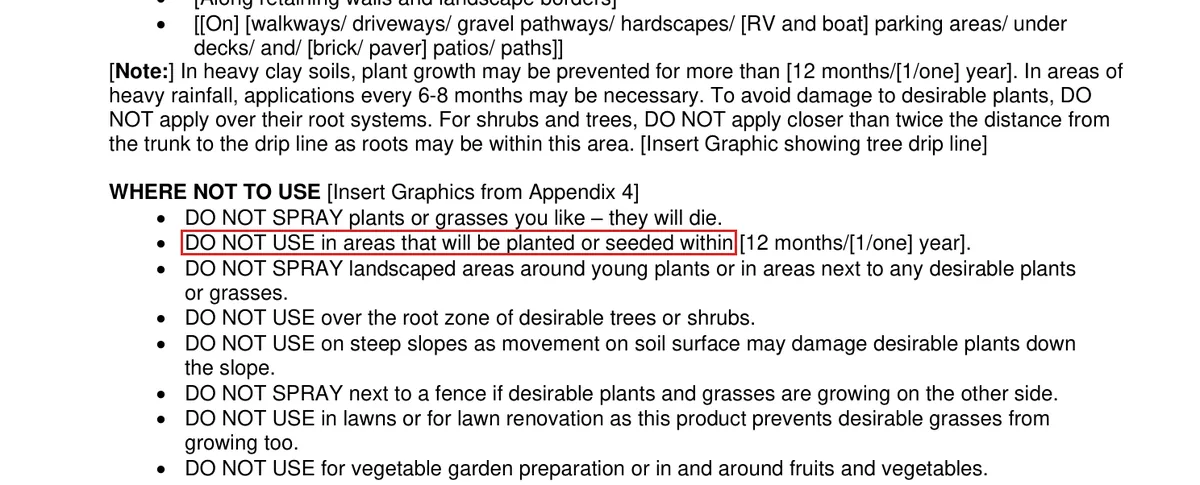
Look at imazapic, the one active that moves the calendar. On the glyphosate-free ready-to-use products, triclopyr, fluazifop-P-butyl and diquat stay at 0.122, 0.097 and 0.073 percent. Imazapic goes from 0.015 percent (71995-66, 4 months) to 0.078 percent (71995-67, 12 months), about 5 times as much. The concentrates show the same step: 0.30 to 1.6 percent. Those labels also say do not use them in lawns or for lawn renovation, because they stop desirable grass from growing too.
One disagreement to check on your bottle. Roundup’s replanting page lists 3 days for lawn grasses after ready-to-use Weed & Grass Killer4 and 7 days after the concentrate. All 3 accepted versions of the 71995-65 master label (Dec. 2, 2021; Nov. 15, 2023; Nov. 29, 2023) say 7 days. Wait 7 unless your own booklet prints a shorter time. Selective Roundup For Lawns products are a separate family: listed turf species can be seeded 4 weeks after application, and our lawn weed killer comparison covers them.
How long does glyphosate stay in the soil? 8 EPA field sites
EPA’s 1993 Reregistration Eligibility Decision gives site-level U.S. field data that the top-ranking pages we read do not quote. On bare ground at 7.95 lb acid equivalent per acre, the median half-life was 13.9 days, from 2.6 days in Texas to 140.6 in Iowa. In the lab at 25 degrees C, aerobic soil half-lives were about 2 days (1.85 in Kickapoo sandy loam, 2.06 in Dupo silt loam).
| Field site | Glyphosate half-life, days | AMPA half-life, days |
|---|---|---|
| Texas | 2.6 | 131 |
| Minnesota | 28.7 | 302 |
| New York | 127.8 | 240 |
| Iowa | 140.6 | Not calculated |
| Arizona | Not listed by site | 142 |
| California | Not listed by site | 958 |
| Georgia | Not listed by site | 896 |
| Ohio | Not listed by site | 119 |
| Median of 8 sites | 13.9 | 240 |
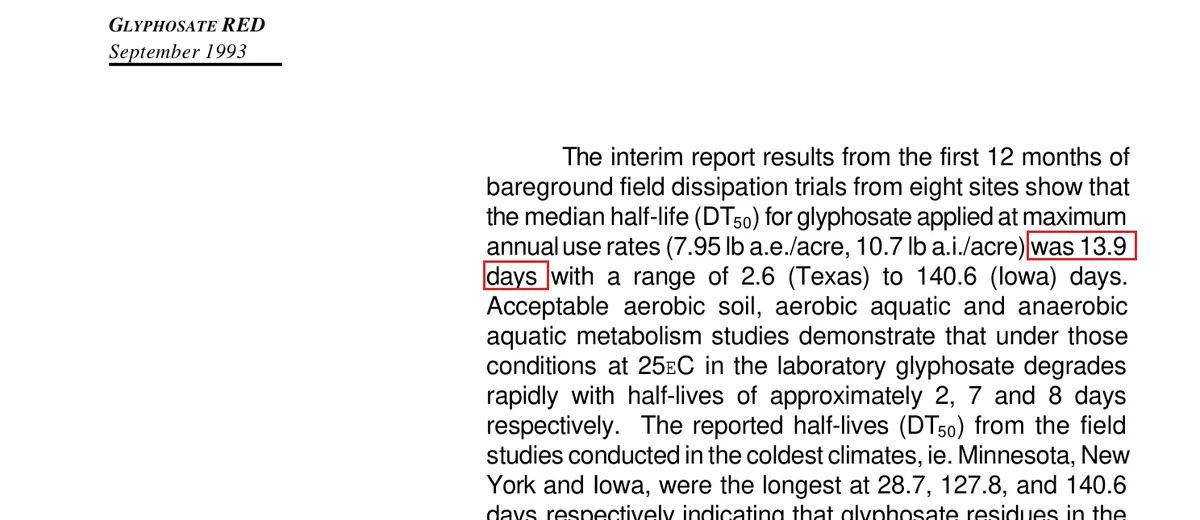
Other agencies land in the same range with different framing. NPIC’s technical sheet reports 2 to 197 days in the literature and suggests 47 days as typical; its general sheet says glyphosate can persist up to 6 months. The EU’s 2023 dossier, as summarized by the University of Hertfordshire PPDB, gives field half-lives of 1.1 to 13.5 days and a 90 percent loss time of 31.8 to 192 days across 6 soils. So a practical answer is roughly 1 to 6 months until about 90 percent is gone in field soil.
A half-life is not an end date. The table shows what first-order decay leaves after each interval, our arithmetic from the published half-lives: remaining = 100 x 0.5^(days / half-life). Strong binding can slow breakdown in real soil (see the factors table below), so read these as estimates, not measurements.
- 13.9 days (EPA median)
- 47 days (NPIC typical)
- 140.6 days (Iowa, EPA high)
Source: Our arithmetic from EPA RED (1993) and NPIC half-lives First-order decay; x axis is days after application. A model, not a field measurement; values match the table below.
Show the numbers
| 13.9 days (EPA median) | 47 days (NPIC typical) | 140.6 days (Iowa, EPA high) | |
|---|---|---|---|
| 0 | 100 | 100 | 100 |
| 14 | 49.80 | 81.30 | 93.30 |
| 30 | 22.40 | 64.20 | 86.30 |
| 60 | 5 | 41.30 | 74.40 |
| 90 | 1.10 | 26.50 | 64.20 |
| 180 | 0 | 7 | 41.20 |
| 365 | 0 | 0.50 | 16.50 |
| Half-life used | 14 days | 30 days | 60 days | 90 days | 180 days | 365 days |
|---|---|---|---|---|---|---|
| 2.6 days (Texas, EPA low) | 2.4% | <0.1% | <0.1% | <0.1% | <0.1% | <0.1% |
| 13.9 days (EPA median) | 50% | 22% | 5.0% | 1.1% | <0.1% | <0.1% |
| 47 days (NPIC typical) | 81% | 64% | 41% | 27% | 7.0% | 0.5% |
| 140.6 days (Iowa, EPA high) | 93% | 86% | 74% | 64% | 41% | 17% |
| 197 days (top of NPIC range) | 95% | 90% | 81% | 73% | 53% | 28% |
Why diquat outlasts everything and imazapic sets the calendar
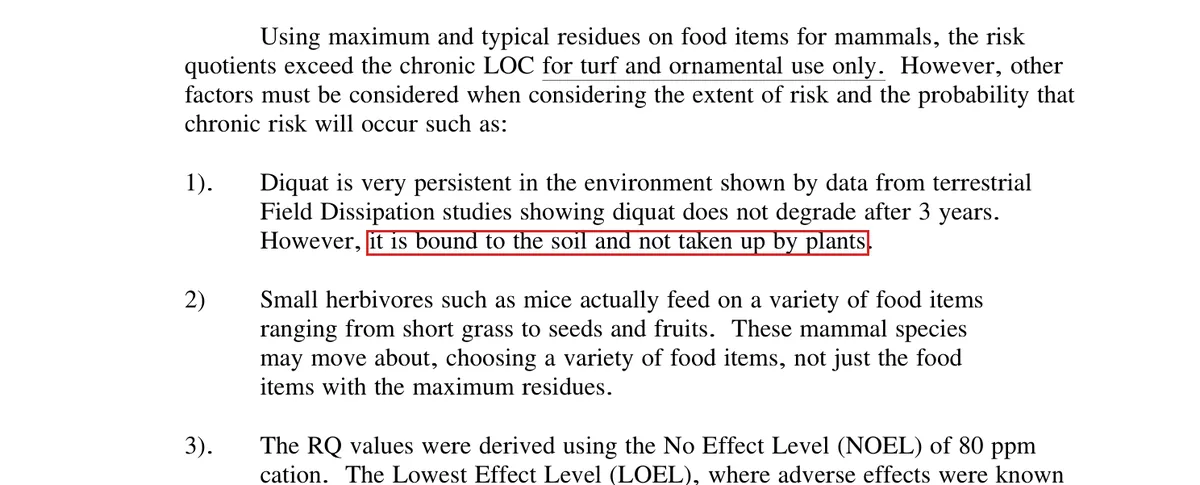
The longest-lasting active in current Roundup is not glyphosate. UK field half-lives for diquat dibromide run 1 to 20 years (PPDB), and EPA’s 1995 diquat RED says it binds nearly irreversibly and did not degrade after 3 years in field studies. It also says diquat is bound to the soil and not taken up by plants, which fits the 1-day flower wait on labels that contain it.
Imazapic works the other way. The 71995-67 label says it prevents new weeds by creating an invisible barrier in the soil, and the PPDB lists a typical half-life of 120 days with a literature range of 31 to 410. Soil changes the wait: that label warns that in heavy clay, plant growth may be prevented for more than 12 months, and 71995-66 says more than 4 months on the same soil. Heavy rainfall works in the other direction: those labels say reapplication may be needed every 6 to 8 months and every 2 to 3 months.
How long does weed killer stay in soil? 20 actives compared
Half-lives below come from one database, so they compare fairly; the PPDB draws mainly on EU regulatory dossiers, with U.S. EPA data where noted. Typical means the database’s preferred soil value, usually a lab figure at 20 degrees C. A 120-day half-life means about 12 percent left after 1 year, which is why preventers carry seeding waits: our grass seed guide lists those label times.
Swipe the table sideways to see every column.
| Active ingredient | Where you meet it | Typical half-life, days | Field half-life, days | Reported range, days | Source |
|---|---|---|---|---|---|
| Glyphosate | Older Roundup, generics | 17.3 | 6.45 | Field 1.1 to 13.5; lab 0.7 to 78.6 (EU 2023) | PPDB |
| Diquat dibromide | Most current Roundup sprays | 2,345 | 5,500 | Field 1 to 20 years (UK); lab 598 to over 1,000 days | PPDB |
| Triclopyr | Weed & Grass Killer4; broadleaf lawn mixes | 18.81 | 30 | Lab 8.11 to 53.1 (EU 2018) | PPDB |
| Fluazifop-P-butyl | Weed & Grass Killer4 | 1.0 | 8.2 | Field 2.1 to 38; lab 0.3 to 3.3 (EU 2012) | PPDB |
| Imazapic | Roundup 365 and 4-month products | 120 | 232 | Literature range 31 to 410 | PPDB |
| 2,4-D | Broadleaf lawn mixes | 4.4 | 28.8 | Field 22 to 38; lab 1.2 to 94.6 (EU 2017) | PPDB |
| Dicamba | Broadleaf lawn mixes | 4.0 | 3.9 | Field 3.2 to 4.9; lab 3.2 to 24.6 (EU 2021) | PPDB |
| MCPA | Roundup For Lawns1 | 12.07 | 25 | Lab 3.12 to 34.9 (EU 2022) | PPDB |
| Mecoprop-P (MCPP-p) | Three-way lawn mixes | 5.24 | 21 | Lab 4.0 to 8.2 (EU 2023) | PPDB |
| Quinclorac | Crabgrass killers; Roundup For Lawns1 | 450 | not listed | U.S. sources 168 to 913 | PPDB |
| Sulfentrazone | Sedge and lawn mixes | 541 | not listed | Other literature 121 to 302 | PPDB |
| Topramezone | Roundup For Lawns Crabgrass Destroyer | 218 | 26.1 | Field 10.8 to 69.3 (EU 2014) | PPDB |
| Glufosinate | Non-selective sprays | 7.4 | 7 | Lab 6 to 11 (EU 2007) | PPDB |
| Prodiamine | Crabgrass preventers | 120 | 69 | Literature 60 to 80; U.S. 120 | PPDB |
| Dithiopyr | Crabgrass preventers | 39 | 39 | Literature 17 to 61 | PPDB |
| Pendimethalin | Crabgrass preventers; Roundup Landscape Weed Preventer | 182.3 | 100.6 | Field 39.8 to 187 (EU 2016) | PPDB |
| Atrazine | St. Augustine and centipede lawn products | 75 | 29 | Field 6 to 108 (USA); lab 28 to 150 | PPDB |
| Clopyralid | Lawn and turf broadleaf products | 23.2 | 8.2 | Field 2.0 to 13.5 (EU 2017) | PPDB |
| Aminopyralid | Pasture and hayfield products | 35 | 12.1 | Field 3.75 to 21.6 (EU 2008) | PPDB |
| Picloram | Pasture products | 23.0 | 33.7 | Field 20 to 49 (EU 2009) | PPDB |
Short half-lives can mislead. Clopyralid and aminopyralid have field half-lives under 22 days, yet NC State Extension reports picloram, clopyralid and aminopyralid remaining active in hay, grass clippings, manure and compost, with deactivation taking from 30 days to several years, and residual activity in hay after 3 years of dry storage. If a new bed fails after composted manure, suspect those before Roundup. Home remedies have their own pages: salt, bleach and vinegar.
What speeds up or slows down glyphosate breakdown
| What changes | Measured effect | Source |
|---|---|---|
| Cold climate | Coldest EPA sites had the longest half-lives: Minnesota 28.7, New York 127.8, Iowa 140.6 days; Texas 2.6 | EPA RED, p. 32 |
| Binding strength | Kd of 22 (Lintonia sandy loam), 62 (Drummer silty clay loam), 70 (Spinks sandy loam), 90 (Ray silt), 175 (swamp sediment) | EPA RED, p. 31 |
| Clay, organic matter, iron and aluminum oxides | Set adsorption; strong binding to iron and aluminum oxides can block microbes and slow breakdown | Kanissery et al., 2019 |
| Depth | Glyphosate and AMPA stayed mainly in the top 6 inches at all 8 sites | EPA RED, pp. 32 to 34 |
| Phosphorus | Competes with glyphosate for the same soil binding sites; the review calls crop-level evidence sparse | Kanissery et al., 2019 |
| Dead leaves | Median half-life of 8 to 9 days in red alder and salmonberry leaf litter | NPIC |
AMPA, the main breakdown product, lasts longer than its parent: EPA’s median was 240 days, and 12 months after treatment the 0 to 6 inch layer still held 0.12 ppm in Ohio and 0.44 ppm in Georgia. ATSDR summarizes glyphosate as sticking tightly to soil and being quickly broken down by bacteria. Warmer soil is the clearest accelerator in EPA’s data, and waiting for planting soil temperature suits the seed as well.
Can you plant vegetables after Roundup?
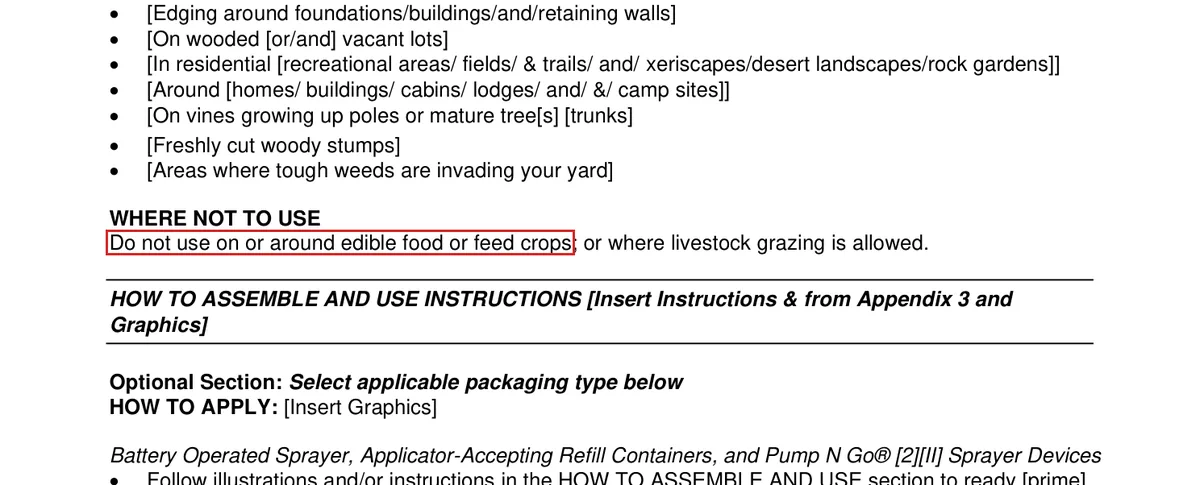
It depends on the bottle, and that is a label question before a chemistry one. Three glyphosate labels (71995-25, 71995-29, 71995-33) allow vegetable gardens 3 days after application. None of the glyphosate-free Roundups in the table do: 71995-65 says do not use on or around edible food or feed crops, and the 4-month and 12-month labels rule out vegetable garden preparation. If that is the bottle you used on a future garden, the label gives no vegetable replant time.
EPA’s rotational-crop study shows what plants pick up from glyphosate-treated sandy loam. Residues fell as the planting date moved away from spraying, and all stayed below the 40 CFR 180.364 tolerances for those food groups.
| Crop part at harvest | Planted day 30, ppm | Planted day 119, ppm | Planted day 364, ppm | EPA tolerance, ppm |
|---|---|---|---|---|
| Lettuce | 0.097 | 0.037 | 0.028 | 0.2 (leafy vegetables, group 4) |
| Carrot roots | 0.037 | 0.017 | 0.0096 | 5.0 (carrot) |
| Carrot tops | 0.051 | 0.028 | 0.018 | 0.2 (leaves of root and tuber, group 2) |
| Barley grain | 0.188 | 0.078 | 0.047 | 30 (cereal grains, group 15) |
Scale matters here. The lawn renovation rate on 71995-25 is 2.5 fl oz per gallon over 300 sq ft at 3.7 lb acid equivalent per gallon, which works out to 10.5 lb acid equivalent per acre: about 1.3 times EPA’s field-trial rate and about 3.8 times this crop study’s (3.71 lb active ingredient is roughly 2.8 lb acid equivalent, using the ratio EPA states for its trial). Treat the table as a low-rate case, not a ceiling. Spot spraying puts down far less per bed than a full plot treatment.
What to do before you replant
1Does the label say 365, 12 Month or Max Control?
YesWait 12 months (1 year) for ornamentals, trees, shrubs, sod and seed. The label rules out lawns and vegetable garden preparation. Bioassay with tomato, cucumber or spinach before planting.
NoGo to the next question
2Does it say 4 Month Preventer or Extended Control?
YesWait 4 months for ornamentals, trees, shrubs, sod and seed. Not for lawns or vegetable garden preparation.
NoGo to the next question
3Is it Roundup For Lawns?
YesListed turf species can be seeded 4 weeks after application, per the brand; check the container.
NoGo to the next question
4Does the ingredient list show triclopyr?
YesLawn grass 7 days; flowers 1 day (no glyphosate) or 7 days (71995-36, -37); other trees and shrubs 14 days; conifers 30 days. Not for edible crops.
NoGo to the next question
5Is glyphosate listed with no imazapic or triclopyr?
YesFlowers, trees and shrubs 1 day; lawn grass, herbs, fruit and vegetable gardens 3 days (71995-25, -29, -33).
NoUnknown product or no label: run the 3-week NC State pot bioassay before planting anything you care about.
Source: EPA-accepted labels in the table above; NC State Extension bioassay
- Read the EPA Reg. No. on the container and find it above, or search EPA’s label system for the stamped label. If the old bottle is gone, assume the longest wait for what you remember buying.
- Count from the last application, not the first: 71995-25 and 71995-65 both time bed preparation that way, so a respray on day 6 restarts the count.
- Prepare the bed at the label’s time. 71995-25 allows raking or rototilling after 3 days and 71995-65 after 7; both suggest watering dry soil before spraying and 2 to 3 days after. For the choice between herbicide, smothering and a sod cutter, see how to kill grass before replanting.
- Run a bioassay if you are unsure or used a residual product. NC State’s method: take the top 2 inches of soil (4 on sand) from several spots, fill 3 to 4 inch pots, also pot known-clean soil, and grow test plants for about 3 weeks. For imazapic it suggests tomato, cucumber or spinach and looks for stunting and yellow new growth. For dinitroanilines such as prodiamine or pendimethalin it suggests oats or ryegrass.
- If the test fails, wait and retest, or try activated carbon. NC State’s rate is 100 lb per acre (2.3 lb per 1,000 sq ft) for each pound of active ingredient suspected, tilled 4 to 6 inches deep. It warns that carbon does not detoxify all residues, so test it in pots first.
None of the 8 imazapic labels above permit lawn use, so a lawn sprayed with one needs that pot test before you follow our overseeding steps. More soil and turf work is in Turf and Trees.
How we compiled this
In November 2026 we downloaded the newest EPA-accepted label for 16 Roundup registrations through the Pesticide Product and Label System and read each When to Replant, Where Not to Use and rainproof section. Half-life figures come from EPA’s 1993 glyphosate and 1995 diquat decisions, NPIC, and the PPDB. The decay table is our own arithmetic. We ran no soil tests or field trials, and this page makes no health or legal claims.
This page is general information, not pesticide-use advice. Read and follow the label on your container: the label is the law. Your state or county extension office can advise on local soils.
Frequently asked questions
Does Roundup permanently damage soil?
We found no primary source showing permanent damage at label rates, though what we read covers glyphosate, not the newer mixes. A 2016 meta-analysis in Soil Biology and Biochemistry found field rates (under 10 mg per kg) had no significant effect on soil microbial respiration or biomass; biomass was lower at 10 to 100 mg per kg. The authors say results should be qualified by conditions. Imazapic products do block planting for up to 12 months by label.
Is it safe to grow vegetables in soil that has been sprayed with Roundup?
That depends on the formula, and we do not give a safety verdict. Labels 71995-25, -29 and -33 allow vegetable gardens after 3 days. Glyphosate-free 71995-65 says do not use on or around edible crops, and 365 labels rule out vegetable garden preparation.
Is Roundup still toxic after it dries?
The label rule is about wet spray: 71995-65 says do not allow people or pets to enter the treated area or touch treated plants until spray has dried. It makes no claim about dried residue. For exposure questions, NPIC answers at 800-858-7378.
How do you get Roundup out of soil?
No label gives a removal step. Soil bacteria do the work (ATSDR), so time in warm soil is the main route. For a residual product that fails a pot test, NC State suggests 100 lb of activated carbon per acre per pound of active ingredient suspected, tilled 4 to 6 inches deep, tested in pots first because it does not work on every residue.
Is glyphosate still in soil after 3 years?
Very little from one spray, by the arithmetic: a 140.6-day half-life leaves about 0.45 percent after 3 years and a 197-day half-life about 2.1 percent. Sensitive lab methods can still find traces, and AMPA lasts longer. A British Columbia study found residues up to 12 years later, but in tissues of perennial forest plants in northern zones, not in soil.
Is the half-life of glyphosate 22 years?
We could not trace that figure to a primary study. The ranges in EPA’s 1993 decision (2.6 to 140.6 days) and NPIC’s sheet (2 to 197 days) are far shorter. The longest number we found is an EU lab time for 90 percent loss, 1,660 days, listed in the PPDB, which is still not a half-life.
Sources
- U.S. EPA, Reregistration Eligibility Decision: Glyphosate, September 1993. Accessed November 2026.
- U.S. EPA, Reregistration Eligibility Decision: Diquat Dibromide, July 1995. Accessed November 2026.
- U.S. EPA PPLS, Roundup Weed & Grass Killer Super Concentrate master label, EPA Reg. No. 71995-25, Jan. 28, 2021. Accessed November 2026.
- U.S. EPA PPLS, Roundup Weed & Grass Killer Concentrate Plus master label, EPA Reg. No. 71995-29, Apr. 6, 2022. Accessed November 2026.
- U.S. EPA PPLS, Roundup Weed & Grass Killer Ready-To-Use Plus master label, EPA Reg. No. 71995-33, Sept. 20, 2017. Accessed November 2026.
- U.S. EPA PPLS, Poison Ivy Plus Tough Brush Killer ready-to-use master label, EPA Reg. No. 71995-36, May 22, 2017. Accessed November 2026.
- U.S. EPA PPLS, Poison Ivy Plus Tough Brush Killer concentrate master label, EPA Reg. No. 71995-37, Mar. 28, 2019. Accessed November 2026.
- U.S. EPA PPLS, Extended Control ready-to-use master label, EPA Reg. No. 71995-47, Apr. 5, 2023. Accessed November 2026.
- U.S. EPA PPLS, Extended Control concentrate master label, EPA Reg. No. 71995-40, Nov. 21, 2025. Accessed November 2026.
- U.S. EPA PPLS, Max Control 365 ready-to-use master label, EPA Reg. No. 71995-51, Nov. 21, 2025. Accessed November 2026.
- U.S. EPA PPLS, Max Control 365 concentrate master label, EPA Reg. No. 71995-49, Nov. 21, 2025. Accessed November 2026.
- U.S. EPA PPLS, Weed & Grass Killer4 ready-to-use master label, EPA Reg. No. 71995-65, Nov. 29, 2023. Accessed November 2026.
- U.S. EPA PPLS, Weed & Grass Killer4 concentrate master label, EPA Reg. No. 71995-64, June 5, 2023. Accessed November 2026.
- U.S. EPA PPLS, Super Concentrate Weed & Grass Killer2 master label, EPA Reg. No. 71995-72, June 18, 2026. Accessed November 2026.
- U.S. EPA PPLS, Dual Action Plus 4 Month Preventer ready-to-use master label, EPA Reg. No. 71995-66, Oct. 15, 2024. Accessed November 2026.
- U.S. EPA PPLS, Dual Action Plus 4 Month Preventer concentrate master label, EPA Reg. No. 71995-69, June 5, 2023. Accessed November 2026.
- U.S. EPA PPLS, Dual Action 365 ready-to-use master label, EPA Reg. No. 71995-67, Apr. 7, 2022. Accessed November 2026.
- U.S. EPA PPLS, Dual Action 365 concentrate master label, EPA Reg. No. 71995-68, Apr. 7, 2022. Accessed November 2026.
- National Pesticide Information Center, Glyphosate Technical Fact Sheet, archived sheet. Accessed November 2026.
- National Pesticide Information Center, Glyphosate General Fact Sheet, undated. Accessed November 2026.
- National Pesticide Information Center, When to plant after using weed killer?, undated. Accessed November 2026.
- University of Hertfordshire, Pesticide Properties Database, glyphosate and the other actives linked in the table, checked Nov. 5, 2026. Accessed November 2026.
- Roundup brand site, How Soon Can I Replant After Using Roundup Weed & Grass Killer Products?, checked Nov. 5, 2026. Accessed November 2026.
- Roundup brand site, How Soon Can I Reseed After Using Roundup For Lawns Products?, checked Nov. 5, 2026. Accessed November 2026.
- Cornell LII, 40 CFR 180.364, Glyphosate; tolerances for residues, current regulation. Accessed November 2026.
- NC State Extension, Conducting a Bioassay For Herbicide Residues, checked Nov. 5, 2026. Accessed November 2026.
- NC State Extension, Herbicide Carryover in Hay, Manure, Compost and Grass Clippings, checked Nov. 5, 2026. Accessed November 2026.
- Kanissery et al., Glyphosate: Its Environmental Persistence and Impact on Crop Health and Nutrition, Plants 8(11):499, 2019. Accessed November 2026.
- Nguyen et al., Impact of glyphosate on soil microbial biomass and respiration: A meta-analysis, Soil Biology and Biochemistry 92:50 to 57, January 2016. Accessed November 2026.
- Botten et al., Glyphosate remains in forest plant tissues for a decade or more, Forest Ecology and Management 493:119259, 2021. Accessed November 2026.
- ATSDR, Glyphosate ToxFAQs, undated. Accessed November 2026.