Does bleach kill weeds? Yes, it burns whatever leaf it touches, grass included. But 0 of 12 EPA bleach labels we read mention weeds, a USDA-commissioned report says not to use it as an herbicide, and one cup can leave 31 g of salt.
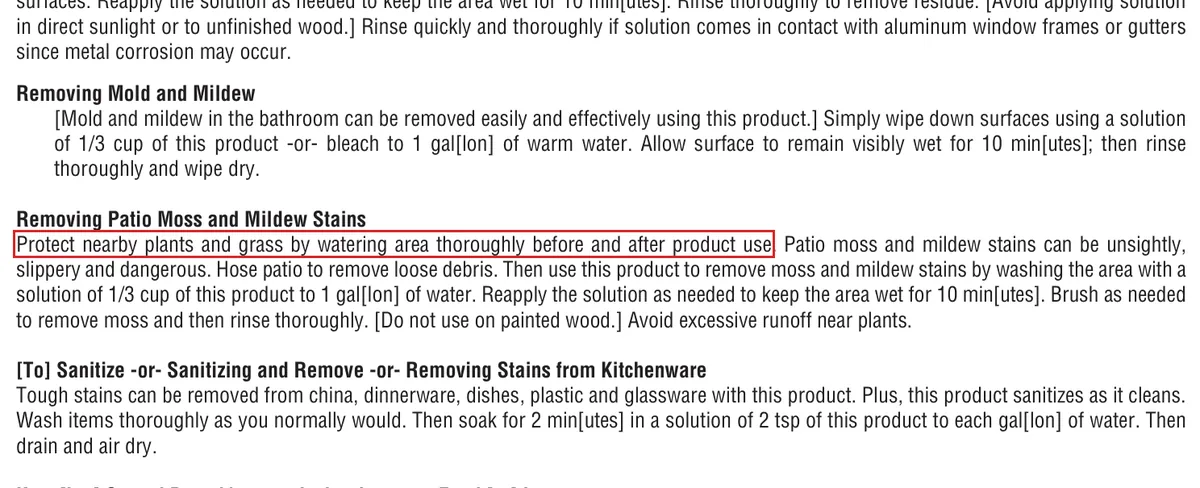
The results we could read answer “does bleach kill weeds” with a warning and no paperwork, so we pulled the paperwork. Across 12 sodium hypochlorite labels in EPA’s Pesticide Product and Label System, the word “weed” appears 0 times. “Grass” appears only as a laundry stain or, on 9 labels, as something to shield: the current Clorox label (EPA Reg. No. 5813-120) says to water nearby plants and grass before and after use.
What people say about bleach and weeds, against the record
| Claim you will see | What the primary document says | Source |
|---|---|---|
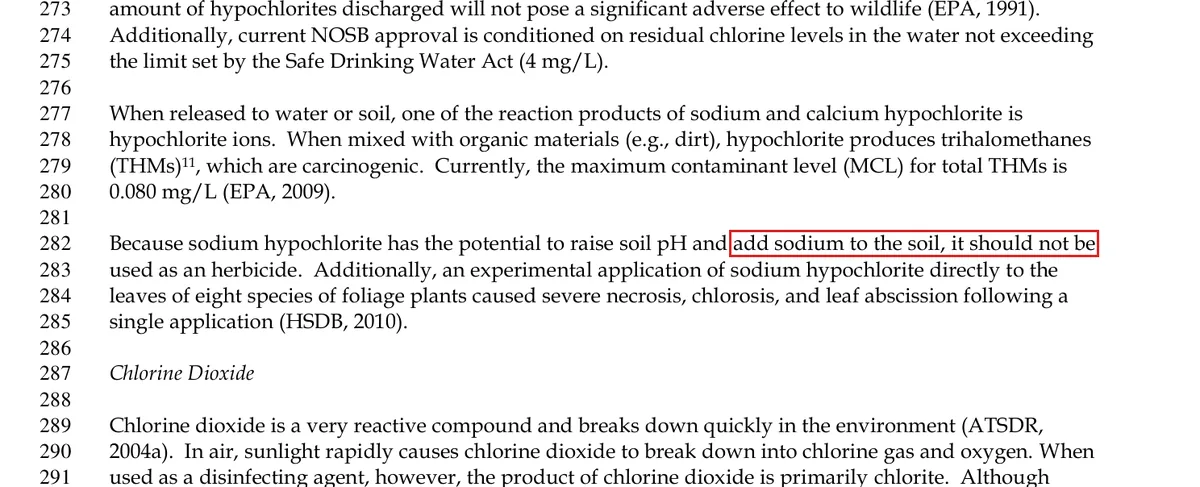
| It is a proven weed killer | Mixes using bleach “have not been tested” for the most part, and a 2011 report for USDA’s organic program says sodium hypochlorite “should not be used as an herbicide.” We found no field trial on established weeds. | UF/IFAS EP580; USDA NOP report, line 282 |
| It “will not harm your grass or plants when used as directed” | That line is from a Clorox article. The directions are the catch: the label’s outdoor moss use says to water plants and grass first and after, and to avoid excessive runoff near plants. | Clorox; EPA Reg. No. 5813-120, p. 16 of 56 |
| Dilute it and it is safe around plants | The label’s own moss mix is about 1,600 mg/L chlorine, roughly 640 times the 2.5 mg/L threshold that hurt 4 of 5 nursery shrubs over 6 weeks. | Cayanan et al., HortScience, 2008 |
| Bleach is an acid | One extension news note groups it with vinegar as an acid. Clorox lists pH 11.8 to 12.4, which is strongly alkaline, and USDA’s report says it can raise soil pH. | NC State Extension; Clorox SDS, section 9 |
| It ruins soil for seasons | We found no measured duration for this. The chlorine fraction breaks down “very quickly”; chloride and sodium stay until water moves them. Our salt table below shows why dose per square foot decides it. | USDA NOP report, line 384; NOSB, 2027 sunset review |
| It kills the roots, so weeds stay gone | No root-kill data exists for bleach on established weeds that we could find. Registered contact products do not translocate, and spurge, crabgrass and oxalis fully recovered 4 weeks after them. | UF/IFAS EP580, p. 4 |
What the 12 bleach labels allow outdoors
A bleach bottle with an EPA Reg. No. is a registered pesticide, and EPA notes that pesticide labels are legally enforceable. Find your number on the back panel. The table records what the 12 labels and their EPA records list; the full dataset is a CSV. None lists lawn or turf as a site or weeds as a pest. Moss and mold on hard surfaces are the closest they come.
| EPA Reg. No. | Names on the EPA record | Sodium hypochlorite | PDF date | Outdoor hard sites listed | Patio moss mix per gallon (first option) | Says to protect plants and grass? |
|---|---|---|---|---|---|---|
| 5813-120 | Clorox Regular Bleach, Clorox Disinfecting Bleach, Clorox Bleach | 7.5% | Jul. 8, 2024 | Walks, stone patios | 1/3 cup | Yes |
| 5813-121 | Clorox Performance Bleach, Clorox Germicidal Bleach | 7.55% | Oct. 25, 2022 | Sidewalks, walks | 1/3 cup | Yes |
| 5813-100 | Clorox Regular-Bleach1, Clorox Disinfecting Bleach1 | 8.25% | Dec. 8, 2017 | Brick, stone patios | 3/4 cup | Yes |
| 5813-111 | Clorox Disinfecting Bleach2, Clorox Mold Killer | 6% | Sep. 24, 2025 | Brick, stone patios | 3/4 cup | Yes |
| 5813-114 | Clorox Germicidal Bleach3, Clorox Performance Bleach1 | 6.05% | Apr. 28, 2026 | Driveways, patios, brick | 3/4 cup | Yes |
| 5813-122 | Clorox Splash-Less Bleach, Clorox Scented Bleach (label text; EPA record name Spy) | 4.5% | Jun. 21, 2023 | Driveways, sidewalks, brick | 1 cup | Yes |
| 5813-50 | Ultra Clorox Regular Bleach | 6% | Mar. 3, 2011 | Brick, stone patios | 1 cup | Yes |
| 67619-32 | CloroxPro Clorox Germicidal Bleach | 8.25% | Sep. 1, 2020 | Driveways, sidewalks, walks, brick | 3/4 cup | Yes |
| 67619-8 | Clorox Commercial Solutions Ultra Clorox Germicidal Bleach | 6.15% | Aug. 29, 2012 | Brick, stone patios | 3/4 cup | Yes |
| 70271-13 | Pure Bright Germicidal Ultra Bleach, HDX Germicidal Bleach1 | 6% | Sep. 8, 2025 | None listed | None | No: grass appears only as a laundry stain |
| 70271-19 | KIK 2.75% Scented Sodium Hypochlorite Bleach | 2.75% | Oct. 4, 2010 | Patios | None | No: grass appears only as a laundry stain |
| 70271-23 | Wampatuck C (EPA record name) | 8.5% | Dec. 9, 2010 | Patios | None | No: grass appears only as a laundry stain |
One oddity: EPA’s record for 5813-50 carries an “Herbicide Terrestrial” type tag, the only one of the 12. Its 43-page label never says weed or herbicide; the plant it names as a target is moss, on patio stone and siding at 1 cup per gallon. We read the tag as a moss coding, which is our inference, not an EPA statement.
Is it illegal to use bleach as a weed killer?
For a registered bottle on a lawn or garden bed, it is off-label. 7 U.S.C. 136j(a)(2)(G) makes it unlawful to use a registered pesticide inconsistently with its labeling, and 7 U.S.C. 136(t) names weeds as pests. The 5813-120 label repeats it: “It is a violation of Federal law to use this product in a manner inconsistent with its labeling.” The label is the law.
Two honest limits. Section 136(ee)(2) lets you treat an unlisted pest on a site the label does list, so a weed in a driveway crack on a label naming driveways is a closer call than a lawn, and one for your state lead agency. Second, a bottle with no EPA number falls outside that clause. It still has no directions, and sodium hypochlorite is not on the 40 CFR 152.25(f) minimum-risk list, which does include sodium chloride and citric acid.
Crews have less room. UF/IFAS states it is illegal for commercial applicators to apply homemade herbicides under a landscape contract. The federal civil maximum for a commercial applicator is $5,000 per offense in the statute, now $24,885 after inflation adjustment. Anyone else can be fined only after a written warning or prior citation, up to $3,650 per offense. See our state guide to applicator licensing for what your state requires.
This is general information, not legal advice. State lead agencies enforce pesticide use and can go further than federal rules.
What bleach does to plant tissue, and why dilution does not make it selective
The direct evidence is thin. The USDA report cites one experimental application to the leaves of 8 foliage species that caused severe necrosis, chlorosis and leaf abscission after a single application. A 2017 lab test on young mustard seedlings put the concentration that cut root growth in half at 0.56 mg/L free chlorine, against 0.97 mg/L for shoots. Those are not weed trials, and we will not present them as such.
The nearest usable threshold comes from nursery work: Cayanan and colleagues found 2.5 mg/L free chlorine was critical for 4 of 5 woody shrubs and 5 mg/L for the fifth, under overhead irrigation for 6 weeks. Set against that, here is the arithmetic for the current 7.1% available chlorine bottle at the 1.1 specific gravity Clorox lists for its regular bleach.
| Solution | Chlorine, mg/L | Times the 2.5 mg/L shrub threshold | Basis |
|---|---|---|---|
| Shrub injury threshold | 2.5 | 1 | HortScience 43(6):1882 |
| Drinking water limit, used for organic crop contact | 4 | 1.6 | USDA NOP report, line 385 |
| Label moss mix: 1/3 cup per gallon | about 1,600 | about 640 | Our arithmetic from 5813-120 |
| 1 part bleach, 9 parts water | about 7,800 | about 3,120 | Our arithmetic |
| 1 part bleach, 1 part water | about 39,000 | about 15,600 | Our arithmetic |
| Undiluted | about 78,100 | about 31,200 | Our arithmetic |
So “will diluted bleach kill grass?” has a conditional answer: nobody has published a turfgrass dose we could find, and a brief label-strength splash that you rinse is what the label itself plans for. Any dilution people use as a weed spray sits far above the plant thresholds we found, and it cannot tell a dandelion from the fescue beside it.
What stays in the soil after the chlorine is gone
Chlorine does not linger. The USDA report calls these materials highly reactive, breaking down very quickly, and the National Organic Standards Board says chlorine converts easily to chloride, which is stable and moves through soil. The board adds that high concentrations of sodium are toxic to plants and destroy soil structure. We found no measured soil half-life for hypochlorite. Two side effects are documented: reaction with organic matter forms trihalomethanes, and misuse can kill beneficial microorganisms, though the report says there is too little data to quantify it.
The residue you can calculate is salt. If all the hypochlorite ends as chloride, each 74.44 g leaves 58.44 g of sodium chloride. A cup (236.6 mL) at specific gravity 1.1 and 7.5% holds 19.5 g of hypochlorite, which leaves 15.3 g of salt. Manufacture also makes salt: EPA says sodium hypochlorite and sodium chloride are produced in equal amounts. Clorox’s SDS lists only sodium hypochlorite, so the high figure assumes all of that salt stays in the jug.
| Label strength | Salt per cup from hypochlorite breaking down, g | Adding an equal manufacturing co-product, g |
|---|---|---|
| 2.75% | 5.6 | 11.2 |
| 4.5% | 9.2 | 18.4 |
| 6% | 12.3 | 24.5 |
| 7.5% | 15.3 | 30.6 |
| 8.25% | 16.9 | 33.7 |
Dose per square foot is what matters. We modeled the top 6 inches of soil with the USDA Handbook 60 inputs: bulk density 1.2, saturation percentage 40, and 640 ppm of salt per dS/m of conductivity, with no rain or leaching. Soil at over 4 dS/m counts as saline.
| Scenario, 7.5% bleach | Salt, g per sq ft | Estimated rise in soil EC, dS/m |
|---|---|---|
| 1 cup poured on 1 sq ft | 15.3 to 30.6 | 3.5 to 7.0 |
| 1 gallon poured on 10 sq ft | 24.5 to 49.0 | 5.6 to 11.3 |
| 1 cup spread over 10 sq ft | 1.5 to 3.1 | 0.4 to 0.7 |
| 1 gallon spread over 100 sq ft | 2.5 to 4.9 | 0.6 to 1.1 |
| Label moss mix: 1/3 cup in 1 gallon, over 100 sq ft | 0.05 to 0.10 | 0.01 to 0.02 |
Pouring a cup on one weed puts that square foot at the edge of saline, before counting the salt already in the soil, and that is the range where UC’s bands put Kentucky bluegrass and red fescue in trouble. The same cup spread over 10 sq ft adds under 1 dS/m, so damage at that dose is more likely chlorine burn than salt. Rock salt on its own is a separate page: does salt kill weeds and grass.
Why bleach and vinegar is the one recipe to refuse
Vinegar is an acid, and the 5813-120 label, p. 2 of 56 reads: “Mix only with water according to label directions,” warning that mixing with ammonia or acids may release hazardous gases irritating to eyes, lungs and mucous membranes. ATSDR’s chlorine fact sheet warns that chlorine gas can be released when bleach meets other cleaners, and Poison Control names vinegar specifically. That rules out the bleach, vinegar and dish soap sprays too, since the label allows water only.
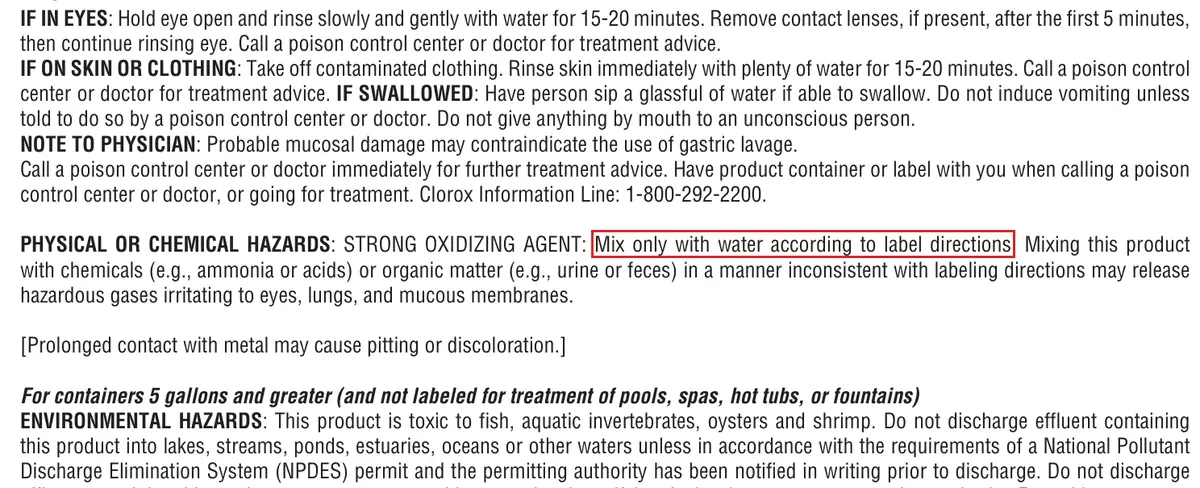
Runoff is the other reason to stop. The label says the product is toxic to fish, aquatic invertebrates, oysters and shrimp, and Clorox’s SDS lists a 96-hour LC50 of 0.038 to 0.065 mg/L for Chinook salmon and tells spill responders to avoid discharge “into drains, water courses or onto the ground.” A driveway that slopes to a storm drain sends it there directly.
What to use instead, by where the weed is
| Spot | Use this | Rate or method | What you give up | Source |
|---|---|---|---|---|
| Seedlings in pavement cracks, paver joints | Hand pull, or a propane flamer | 2 to 5 seconds of heat is usually enough; do not burn to the ground. Recheck after 1 day. | Top growth only, so perennials and grasses return. Fire risk near dry mulch or buildings. Hot water and steam work only on very small weeds. | UC IPM; UF/IFAS HS1170 |
| Established perennials in cracks or gravel | Glyphosate labeled for the site | Spot spray at 1% to 2% by volume, per your label | Some Roundup formulas bar replanting for up to 12 months: see how long Roundup stays in soil | UF/IFAS EP580 |
| Small annuals in gravel or along edging | Pelargonic acid or ammonium nonanoate | 3% to 10% (Scythe) or 10% to 13% (Axxe), wetting all leaf surfaces | Contact only, so expect repeat rounds; weaker on grasses and sedges | UF/IFAS EP580, Table 1 |
| Weeds in a lawn you want to keep | Selective lawn herbicide | Match active and grass type: see our lawn weed killer comparison | Heat limits and grass restrictions on the label | Our EPA label comparison |
| Beds around ornamentals | Hand weed, then mulch | Medium mulch (3/4 inch) kept 3 to 4 inches deep | Labor, plus replenishing mulch | UC IPM |
| Near a storm drain, pond or stream | Hand removal or heat | No liquid product that can run off | Labor | 5813-120 environmental hazards |
1Could runoff reach a storm drain, pond or stream?
YesHand remove it or use heat. The bleach label says the product is toxic to fish, aquatic invertebrates, oysters and shrimp.
NoGo to the next question
2Is it in a lawn you want to keep?
YesUse a selective lawn herbicide matched to the weed and your grass type. Bleach kills the lawn with it.
NoGo to the next question
3Is it a small seedling in a crack or joint?
YesPull it, or pass a propane flamer over it for 2 to 5 seconds and recheck in 1 day.
NoGo to the next question
4Is it an established perennial such as dandelion or nutsedge?
YesUse a systemic herbicide labeled for the site. Contact products, heat and bleach leave the roots to regrow.
NoHand weed, then mulch 3 to 4 inches deep if it is a planting bed.
For a whole patch you plan to reseed, killing grass before replanting has its own methods. Vinegar has its own page too: our vinegar weed killer guide covers the 5% to 30% strengths. Other home remedies share the gap bleach has: University of Illinois Extension notes they carry no labels with safety or rate information for weed control.
If bleach already hit your grass
- Water now. The label’s own protection step is to water thoroughly before and after use; apply it as soon as you can, and rinse hard surfaces away from drains.
- Soak the spot. Utah State Extension puts it at 6 inches of water to cut EC by 50%, 12 inches for 80% and 24 inches for 90%. UC adds that the frequency and amount depend on soil texture, and leaching works only with internal drainage.
- Skip the amendments for plain salt. UC notes no amendment removes salts from the root zone: only leaching does. Gypsum applies only where a test shows a sodium problem.
- Test before reseeding a large area. Ask the lab for soluble salts (EC) and sodium; our soil test guide covers where to send it. Aim for under 4 dS/m, and under the band in the table above for your grass.
- Reseed once the spot tests clear or test-sown seed comes up. Our grass seeding guide has rates and timing.
How we compiled this
On Nov. 5, 2026 we pulled 12 sodium hypochlorite registrations from EPA’s PPLS: 7 Clorox, 2 Clorox professional and 3 KIK. That is a sample, not every bleach registration. For each we read the record’s sites, pests and types, then text-searched the latest master label (the only near match for weed is seaweed, in a direction for Maine lobster ponds). Older scanned labels came through OCR, so we also relied on the EPA site and pest fields for those. Salt, chlorine and EC figures are our arithmetic with the inputs shown. We ran no tests and sprayed nothing. We found no field trial of bleach on established weeds, no measured soil half-life and no turfgrass dose; we say so rather than quote blog figures.
Frequently asked questions
How long will it take for bleach to kill weeds?
We found no measured time for bleach on weeds. Registered contact herbicides show burn sometimes within only a few hours, depending on weather, per UF/IFAS, and blog claims for bleach sit in that range without data. Browning is not the same as root death, so judge at 4 weeks, when UF saw contact-treated spurge, crabgrass and oxalis fully recover.
Does bleach kill weeds permanently?
Not reliably. We found no data on bleach and roots of established weeds. Perennials such as yellow nutsedge and dollarweed quickly regrow after contact products, per UF/IFAS. A heavy pour may stop regrowth by salting and oxidizing the soil, which also stops whatever you plant next until it is leached.
Is bleach or vinegar better for killing weeds?
Neither household bottle carries weed directions, but only acetic acid has registered herbicide products and published trials behind it. Bleach adds sodium and chloride, and never mix the two: the label warns about acids. Strengths and regrowth data are in our vinegar weed killer guide.
Does bleach kill weeds better than Roundup?
No trial compares them that we could find. They work differently: glyphosate is systemic and moves through the plant, reaching roots of annuals and perennials, while bleach burns what it touches. Formula matters for replanting, so check how long Roundup stays in the soil by EPA Reg. No.
Will bleach and Dawn kill weeds?
The 5813-120 label says to mix only with water, so adding dish soap is off-label on top of off-label. We found no test of the mix, and soap does nothing about the salt left in the soil. If the leaves are the problem, the contact products in our table above come with rates and directions.
What happens if you pour bleach on grass?
Expect a brown patch where it landed. A single cup on 1 sq ft adds an estimated 3.5 to 7 dS/m of salt, around or above the under 4 dS/m band for Kentucky bluegrass and red fescue. Water it as soon as you can, soak it to leach the salt, then test before reseeding.
Sources
- U.S. EPA, Pesticide Product and Label System: master label, Clorox Regular Bleach, EPA Reg. No. 5813-120, July 8, 2024. Accessed November 2026.
- U.S. EPA, PPLS master labels for 5813-121, 5813-100, 5813-111, 5813-114, 5813-122, 5813-50, 67619-32, 67619-8, 70271-13, 70271-19, 70271-23 (each linked in the label table), 2010 to 2026. Accessed November 2026.
- U.S. EPA, Introduction to Pesticide Labels, Checked November 2026. Accessed November 2026.
- U.S. EPA, Sodium Hypochlorite Supply Chain Profile, 2023. Accessed November 2026.
- U.S. Code, via Cornell LII, 7 U.S.C. 136: definitions, including 136(t) and 136(ee), Current. Accessed November 2026.
- U.S. Code, via Cornell LII, 7 U.S.C. 136j: unlawful acts, Current. Accessed November 2026.
- U.S. Code, via Cornell LII, 7 U.S.C. 136l: penalties, Current. Accessed November 2026.
- eCFR, 40 CFR 19.4: civil monetary penalty inflation adjustment, Current. Accessed November 2026.
- eCFR, 40 CFR 152.25: exemptions for pesticides of a character not requiring FIFRA regulation, Current. Accessed November 2026.
- USDA National Organic Program (compiled by ICF International), Chlorine/Bleach, Crops: Technical Evaluation Report, January 31, 2011. Accessed November 2026.
- USDA National Organic Standards Board, Formal Recommendation: 2027 Crops Sunset Reviews, January 14, 2026. Accessed November 2026.
- USDA Agricultural Research Service, Handbook 60: Diagnosis and Improvement of Saline and Alkali Soils, 1954. Accessed November 2026.
- UF/IFAS Extension, EP580: Use of Glyphosate and Herbicide Alternatives for Weed Control in Florida Landscape Planting Beds, January 2020. Accessed November 2026.
- UF/IFAS Extension, HS1170: Nonchemical Weed Control for Home Landscapes and Gardens, Checked November 2026. Accessed November 2026.
- UC IPM, Pest Notes 7441: Weed Management in Landscapes, Checked November 2026. Accessed November 2026.
- University of California Cooperative Extension, Managing Saline, Sodic or Saline-Sodic Soils for Turfgrasses, 1984. Accessed November 2026.
- Utah State University Extension, Soil Salinity, 2023. Accessed November 2026.
- University of Illinois Extension, Homemade herbicide considerations, April 2018. Accessed November 2026.
- N.C. Cooperative Extension, Henderson County, Eco-Friendly Herbicides: A New Era in Home Weed Control, Updated July 2024. Accessed November 2026.
- Cayanan, Zheng, Zhang, Graham, Dixon, Chong, Llewellyn, Sensitivity of Five Container-grown Nursery Species to Chlorine in Overhead Irrigation Water, HortScience 43(6):1882-1887, 2008. Accessed November 2026.
- Fargasova, Nova Biotechnologica et Chimica, Plant stress activated by chlorine from disinfectants prepared on the base of sodium hypochlorite, 16(2):76-85, 2017. Accessed November 2026.
- The Clorox Company, Safety Data Sheet, Clorox Disinfecting Bleach (EPA 5813-120-AA), April 28, 2021. Accessed November 2026.
- The Clorox Company, Safety Data Sheet, Clorox Regular-Bleach1, December 10, 2020. Accessed November 2026.
- Clorox, Refresh the Outdoors: Diluted Bleach for Plants, Checked November 2026. Accessed November 2026.
- CDC ATSDR, ToxFAQs: Chlorine, Checked November 2026. Accessed November 2026.
- U.S. FDA, Sodium in Your Diet, Checked November 2026. Accessed November 2026.
- National Capital Poison Center, No, vinegar is not always safe, Checked November 2026. Accessed November 2026.