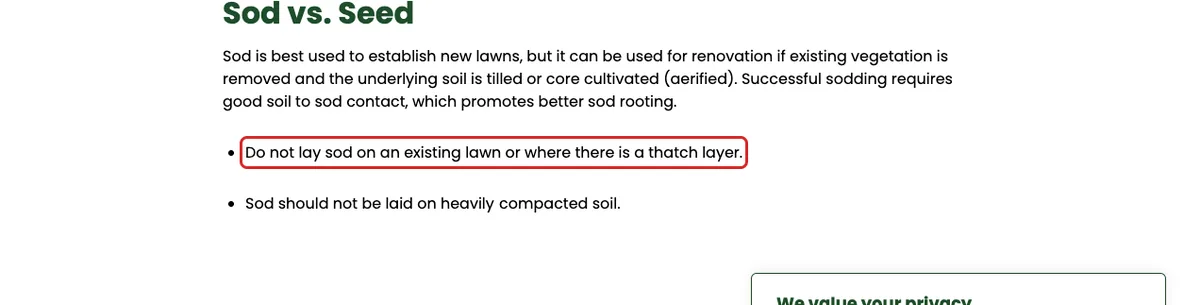
Can you lay sod over existing grass? No. New sod must root into bare, loosened soil, and Colorado State Extension says not to lay it on an existing lawn or a thatch layer. Kill or strip the old turf, clear the dead layer and regrade.
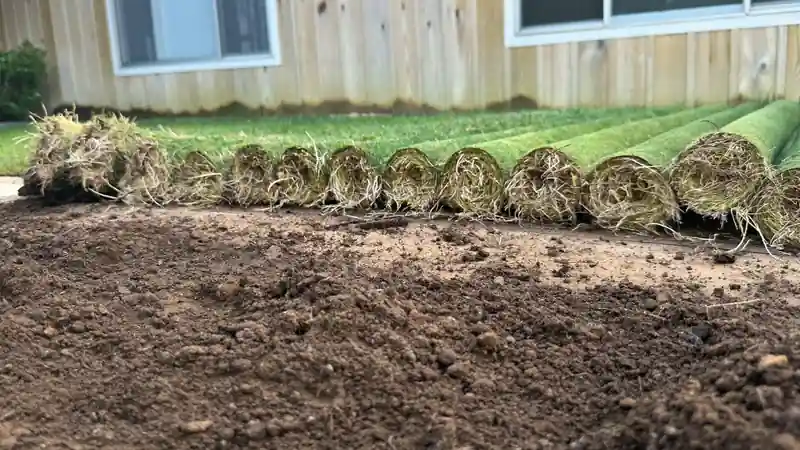
Can you lay sod over existing grass and let the old lawn die underneath? Every extension publication we read says no, and the most direct is Colorado State University Extension: “Do not lay sod on an existing lawn or where there is a thatch layer.” The reason is the root zone. Fresh sod carries only 0.5 to 0.75 inch of soil (Purdue AY-28), so its roots have to reach your soil within days, and a mat of old grass sits in the way.
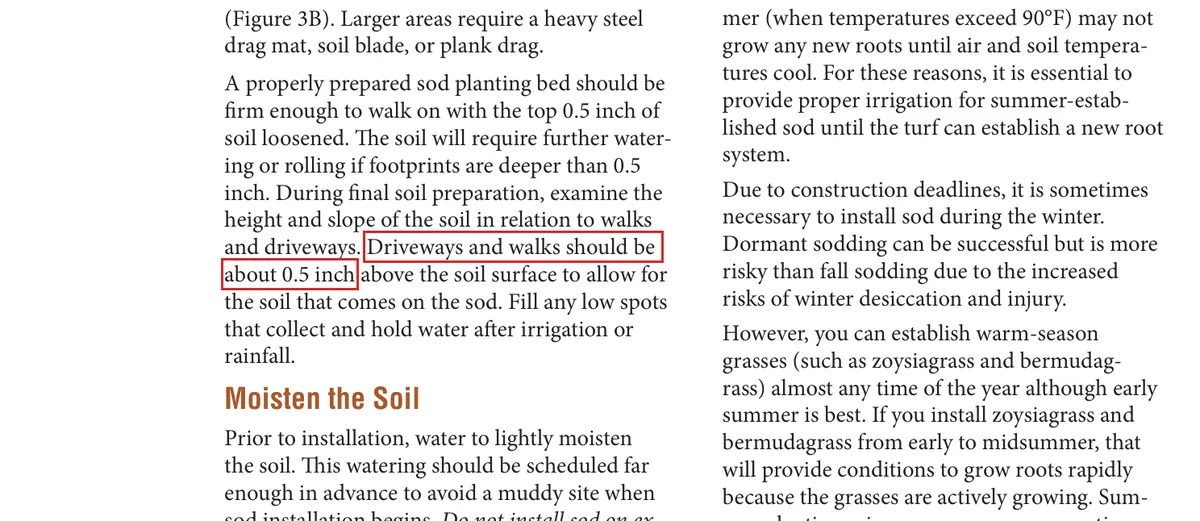
The cost of the shortcut is easy to measure. Purdue sets walks and drives about 0.5 inch above the prepared soil so the sod’s own soil lands flush. Leave a lawn scalped to 3/4 inch plus 1/2 inch of thatch under it and the new sod finishes 1.25 to 1.5 inches proud of the walk, before the buried layer starts to rot and sink unevenly. Below are five common claims checked against the sources, the root-zone reasons, that grade arithmetic, and what 17 publications and sellers tell you to do instead.
Five claims about laying sod over grass, checked
The shortcut survives because each claim sounds reasonable. Here is what the primary sources say about each one. Where a claim is partly right, the table says so: dead grass really does work as mulch for seed (Penn State), which is why people assume it works under sod.
| Claim | What the source says | Verdict |
|---|---|---|
| “The old grass will rot and feed the new sod.” | The parts of grass that resist decay (stem nodes, crowns, vascular fibers and roots) make up the bulk of thatch, and about 25 percent of thatch is lignin (Penn State). A layer past 1/2 to 3/4 inch restricts air and water, and once dry it “cannot be rewetted easily” (UMass). | False |
| “Water it heavily and the roots will push through.” | Purdue: even sod watered right after laying on dry soil has retarded root growth. Penn State: roots that grow into thatch dry out when it dries, and wet thatch holds excess water and cuts oxygen (Managing Thatch). | False |
| “Sod is thick enough to smother the grass underneath.” | Sod is cut with 0.25 to 0.5 inch of soil in Nebraska (UNL) and 0.5 to 0.75 inch in Indiana (Purdue). Bermudagrass rhizomes sit 1 to 6 inches deep and the weed pushes up through mulch and short ground covers (UC IPM). | False for bermuda, quackgrass, bentgrass |
| “If the old lawn is dead, it’s fine.” | For seed, Penn State lets dead vegetation serve as mulch and uses a disk seeder to reach soil (Renovation of Lawns). For sod, UF/IFAS says to remove as much dead material as possible for soil contact (LH013) and Mississippi State says to till it under (P2951). | Partly: kill it, then remove or till it |
| “An inch of height won’t matter.” | Purdue sets walks 0.5 inch above the soil so the sod lands flush. Old turf under the sod adds its full height to that, and Penn State notes mowers scalp where wheels sink into thick thatch. | False: expect a ridge at every edge |
Why old grass under sod blocks rooting
New sod is a thin slab of turf with most of its roots cut off at harvest. The University of Maryland Extension puts it at only about 1 inch of attached root and soil, which is why it is “highly perishable” and why every source pushes for fast, firm contact with moist soil. Four things go wrong when the old lawn stays.
1. The old lawn becomes a thatch layer
Thatch is the layer of living and dead stems, crowns and roots between green leaves and the soil (Penn State). Bury a lawn under sod and you have made a thick one. UMass says a layer past 1/2 to 3/4 inch restricts air, water and fertilizer movement, roots then stay in the thatch, and thatch is a poor growing medium that lowers drought tolerance (UMass Extension). Penn State’s line for trouble is more than 1 inch.
2. Air gaps dry the sod from below
Purdue rolls new sod because rolling “removes air pockets, and establishes good contact between the sod and soil,” and UF/IFAS tamps or rolls so roots touch the soil “so that it does not dry out during establishment” (UF/IFAS LH013). Stubble and runners hold the sod off the ground like a mattress. A Houston sod farm makes the same point to its buyers: without bare dirt under the pieces, the first watering may not be able to eliminate the air pockets (Houston Grass South).
3. A buried organic layer stops water at the boundary
Purdue warns of layering when sod’s soil differs sharply from the site soil, because two distinct layers impede water and air movement and cut rooting; its fix is core aeration at 20 to 40 holes per square foot, no sooner than 2 months after planting. A mat of dead grass is a sharper boundary than any soil mismatch. Wisconsin’s A3434 bulletin says buried debris causes “localized dry areas in the lawn” (UW Extension A3434).
4. Some grasses grow straight through
Spreading grasses do not stay buried. UC IPM says bermudagrass rhizomes run 1 to 6 inches deep in undisturbed soil and the weed “can push up through” wood-chip mulch (UC IPM Pest Notes 7453). Purdue names creeping bentgrass and quackgrass as perennials to control before sodding, and Wisconsin says quackgrass “cannot be selectively removed from established turf” once it comes through. For those grasses, see our page on killing bermuda grass before you order sod.
How much higher sod sits on top of an old lawn
Purdue’s grade rule is the cleanest yardstick: driveways and walks about 0.5 inch above the prepared soil “to allow for the soil that comes on the sod.” Washington State University gives the same figure from the other side: a finished grade about one-half inch below fixed points such as curbing and sidewalks. The table adds whatever is left under the sod to that allowance, assuming the old lawn’s soil already sits 0.5 inch below the walk.
| What is left under the sod | Organic layer (in) | Sod soil (in) | Sod soil surface vs. the walk | Layer figure from |
|---|---|---|---|---|
| Stripped to soil and loosened (the extension method) | 0 | 0.5 to 0.75 | Flush to 0.25 in above | Purdue AY-28 |
| Killed, scalped to 3/4 in, thin thatch of 1/2 in | 1.25 | 0.5 to 0.75 | 1.25 to 1.5 in above | Mow height: Penn State renovation; thatch: Penn State, UMass |
| Killed, scalped to 3/4 in, thatch of 1 in | 1.75 | 0.5 to 0.75 | 1.75 to 2.0 in above | Penn State: past 1 in, problems likely |
| Living lawn mowed to 2 in, thatch of 1/2 in (uncompressed) | 2.5 | 0.5 to 0.75 | 2.5 to 2.75 in above | Illustration; leaves compress as they die |
The raised edge is only half the problem. The buried layer then shrinks as it decays, and not evenly. Purdue makes the same point about tree stumps left in a lawn: they “eventually decay and leave depressions.” A layer that shrinks by different amounts under different strips leaves the bumps that Maryland says cause mowers to cut the high spots too short (UMD). Our guide to leveling a lawn covers fixing dips after the fact.
What to do instead: kill or strip, grade, then lay
The extension sequence is the same whether the old lawn is green, patchy or brown. The table matches what you have to the step that fixes it, and the flow below runs the same checks in order. Methods for killing turf (spray, plastic, sod cutter) and their day counts are compared in our guide on how to kill grass before replanting, so this page only gives the sod-specific thresholds.
| If what you have is | Do this before the sod arrives | Threshold and source |
|---|---|---|
| Bermudagrass, quackgrass, creeping bentgrass or nimblewill in the lawn | Kill it with a nonselective herbicide first, then strip. Expect repeat sprays. | UF/IFAS: second glyphosate application 14 to 21 days after the first, a third for bermudagrass; Purdue: 2 to 4 weeks apart for over 95 percent control |
| More than 1/2 inch of compressed thatch | Remove the existing sod including the thatch with a sod cutter, or till and rake it out | Penn State Program III; Colorado State |
| Dead or living cover over the soil, thatch at or under 1/2 inch | Strip it with a sod cutter set 1/4 to 1/2 inch deep, or kill and till it under | Oregon State blade depth; Mississippi State |
| Soil surface more than about 0.5 inch below walks after stripping | Add soil that matches the native soil until it sits about 0.5 inch below hard edges | Purdue; WSU; UConn |
| Preemergence herbicide used in the last 2 months | Wait; only glyphosate is acceptable within 2 months before sodding | Purdue AY-28; UC IPM |
| Site ready, sod not yet ordered | Schedule delivery for a day you can lay it all and water the same day | Purdue: within 24 hours of harvest |
1Is any bermudagrass, quackgrass, creeping bentgrass or nimblewill growing in the old lawn?
YesKill it first with a nonselective herbicide at the label rate, with repeat sprays (UF/IFAS: second spray 14 to 21 days later, a third for bermudagrass), then strip it.
NoGo to the next question
2Does a plug show more than 1/2 inch of compressed thatch above the soil?
YesRemove the existing sod and thatch with a sod cutter, or till and rake both out (Penn State Program III). Colorado State: never sod over a thatch layer.
NoGo to the next question
3Is any grass, living or dead, still covering the soil?
YesStrip it with a sod cutter set 1/4 to 1/2 inch deep (Oregon State), or kill it and till it under (Mississippi State). Rake out debris; do not bury it.
NoGo to the next question
4After stripping, is the soil more than about 0.5 inch below walks and drives, or above them?
YesAdd or remove matching soil until the bed sits about 0.5 inch below hard edges (Purdue, WSU), firm enough that footprints sink no more than 0.5 inch.
NoGo to the next question
5Was a preemergence herbicide applied in the last 2 months?
YesWait. Purdue allows no herbicide except glyphosate within 2 months before sodding.
NoGo to the next question
6Can you lay every piece within 24 hours of harvest and water it the same day?
YesLay on lightly moistened soil, butt the seams, roll, and water at once (Purdue AY-28).
NoReschedule delivery. Sod deteriorates within 24 to 48 hours in warm weather (Penn State).
Lay on lightly moistened soil, roll and water at once.
The order of work, with the numbers each step needs:
- Test the soil from the top 4 to 6 inches at 10 or more spots (Purdue). A lab test is cheaper than a failed lawn; see our soil test guide.
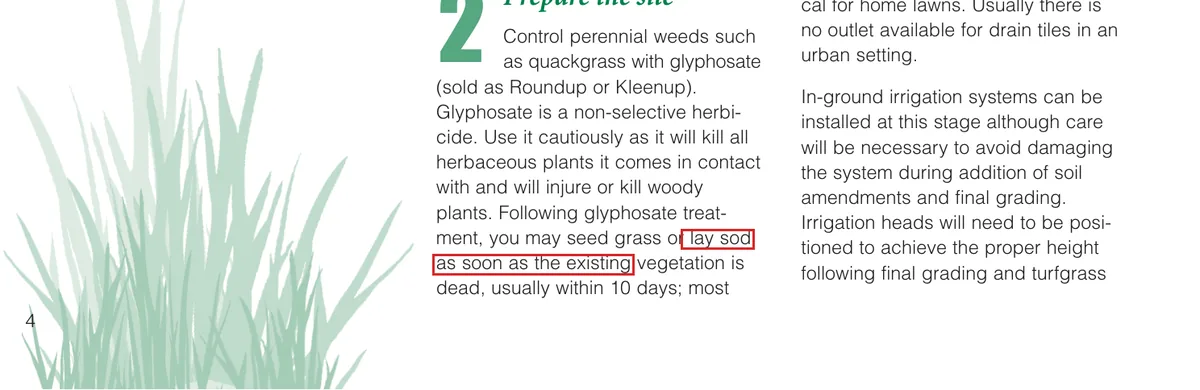
- Kill perennial grasses first if you have them. Follow the product label for rate and wait: the label is the law. Wisconsin says you can lay sod as soon as the vegetation is dead, usually within 10 days, while most other herbicides need 6 weeks to 6 months.
- Strip the old turf. A rental sod cutter cuts an 18-inch strip up to 2.5 inches deep (Wheeler Machinery rate sheet); Oregon State sets the blade at 1/4 to 1/2 inch to keep topsoil. Penn State: remove sod and thatch, or till and rake both out.
- Rough-grade so the soil falls away from the house. Purdue uses a 1-foot drop in 50 feet, at least 15 feet out, and allows a week for settling before final grading.
- Work in amendments the soil test calls for into the top 4 to 6 inches, plus 1 to 3 cubic yards of compost per 1,000 sq ft if organic matter is low, mixed 6 to 8 inches deep (Purdue).
- Final-grade to about 0.5 inch below walks and drives. The bed should be firm enough that footprints sink no more than 0.5 inch, with the top 0.5 inch loose (Purdue).
- Moisten the soil a few days ahead (NC State) and never lay on wet soil (Penn State). Lay within 24 hours of harvest, butt seams tight without overlapping, roll, and water at once.
- Turf and soil removed (cubic yards)
- 1.54
- Turf and soil removed (cubic feet)
- 42
- Matching soil to put the same depth back (cubic yards)
- 1.54
Area x depth in inches / 12 = cubic feet; / 27 = cubic yards. Default: 1,000 sq ft at 1/2 inch is 1.54 cubic yards. Put back only what grading needs, keeping the bed about 0.5 inch below walks (Purdue).
Stripping is the step people underestimate. Each inch of cut removes 3.09 cubic yards per 1,000 sq ft (1,000 x 1 / 12 / 27), and the calculator scales that to your lawn and blade depth. Disposal, rental and labor prices are in our sod installation cost breakdown.
How long sod can wait once it is cut
Once the site is ready, the clock that matters is harvest to installation. The publications agree on 24 to 48 hours, with the short end applying in warm weather. Two of them count from delivery rather than harvest, which matters if the farm cuts the day before.
| Source | Install window | Clock starts at |
|---|---|---|
| Purdue AY-28 (Indiana) | Within 24 hours | Harvest |
| UNL Extension (Nebraska) | Within 24 hours | Harvest |
| RTF sod specification sheet | Within 24 hours, unless a preservation method is approved | Harvest, delivery and installation combined |
| NC State Extension Gardener Handbook | Within 24 hours; unstack and unroll if not laid within 48 | Delivery |
| Texas A&M AgriLife | Within 36 hours | Harvest |
| UW Extension A3434 (Wisconsin) | 24 to 48 hours | Harvest |
| Penn State Extension | Deteriorates within 24 to 48 hours in warm weather | Delivery |
| UF/IFAS LH013 (Florida) | Pallet life under 48 hours in summer | On the pallet |
Watering new sod for the first 2 to 4 weeks
Sod laid on stripped soil roots in about 10 to 21 days. Lack of water is the most common cause of sod failure according to Penn State, and the schedules below all start the moment the last piece is rolled. Check rooting by lifting a corner: white roots and resistance mean it is anchored (Purdue, UMD). When to make the first cut is covered in when to mow new grass.
| Source | First phase | Then | Rooted by |
|---|---|---|---|
| UF/IFAS LH013 | Several 5 to 10 minute cycles a day for 7 to 10 days | Once a day, 1/4 to 1/2 inch, for the next 7 to 10 days; then 2 to 3 times a week | Fully established 3 to 4 weeks after sodding |
| Purdue AY-28 | Thorough soaking right after rolling, then daily each morning | Fewer, heavier waterings once rooted; multiple times a day in warm, dry spells | About 10 days; 10 to 14 days at optimum temperatures |
| University of Maryland | Water regularly, possibly daily, for the first 2 to 3 weeks | Work up to about 1 inch per watering, keeping the top 4 to 6 inches moist | Roots typically established in 2 to 3 weeks |
| Penn State | Water so it moves through the sod and wets the soil underneath | Daily if needed until well rooted | Up to 4 weeks |
What 17 publications and sellers say about sod over existing grass
None of the 15 extension documents we read endorses laying sod on living turf. They split only on how to handle dead turf: remove it (UF/IFAS, Oregon State, UConn), till it under (Mississippi State, Vermont), or either (Penn State, Colorado State). One Texas sod farm describes a spray, wait and cut-to-the-soil method as workable but not recommended, and one national brand claims the shortcut kills both lawns, a stronger statement than any extension source makes.
Swipe the table sideways to see every column.
| Publisher | Document | What it says about the old lawn | Numbers given |
|---|---|---|---|
| Colorado State University Extension | Renovating the Home Lawn | Do not lay sod on an existing lawn or a thatch layer; sod for renovation only after existing vegetation is removed and soil tilled or core cultivated | None given |
| UF/IFAS Extension | LH013, Establishing Your Florida Lawn | Glyphosate where over 50 percent is weeds or the species changes; remove as much dead material as possible for soil contact | 2nd spray 14 to 21 days; 3rd for bermudagrass |
| Purdue Extension | AY-28-W, Establishing a Lawn from Sod | Control perennial weeds such as creeping bentgrass and quackgrass before sodding; walks 0.5 in above soil | Sprays 2 to 4 weeks apart; sod soil 0.5 to 0.75 in; lay within 24 h |
| Penn State Extension | Renovation of Lawns | Thatch over 1/2 in: remove existing sod and thatch with a sod cutter, or till and rake out | 1/2 in thatch; mow to about 3/4 in |
| Penn State Extension | Lawn Establishment | Soil prep for sod is identical to seed; never lay sod on wet soil | Deteriorates in 24 to 48 h warm weather |
| Mississippi State Extension | P2951, Sod Installation and Maintenance | Kill the existing turf and weeds; sod establishes best over bare ground; till them under | Pallet 450 to 500 sq ft; buy 5 percent extra |
| University of Wisconsin Extension | A3434, Lawn Establishment and Renovation | Kill quackgrass first; till; do not bury debris (localized dry areas) | Sod as soon as dead, usually within 10 days of glyphosate; lay within 24 to 48 h |
| University of Maryland Extension | Starting a New Lawn | Start with weed-free, bare soil | About 1 in of root and soil on sod; roots in 2 to 3 weeks |
| Kansas State Research and Extension | MF1126, Planting a Home Lawn | Sod needs the same soil preparation as seed and should not cover up poor soil | 111 sq yd per 1,000 sq ft |
| UConn Home and Garden Education Center | Lawn Renovation and Repair | Remove existing vegetation with a sod cutter; add soil if needed for an even transition | None given |
| University of Vermont Extension | Lawn Renovation and Establishment | Eliminate existing turf and weeds to bare soil; dead vegetation can be rototilled in; remove excessive thatch | None given |
| NC State Extension | Extension Gardener Handbook, ch. 9 | Roll after laying for sod-to-soil contact | Install within 24 h of delivery; unroll if not laid within 48 h |
| University of Nebraska-Lincoln | Establishing Lawns From Sod | Choose sod soil similar to site soil to avoid layers | Cut 0.25 to 0.5 in deep; lay within 24 h of harvest |
| Texas A&M AgriLife | How to Select and Install Sod | Plant on well prepared, moist soil | Install within 36 h of harvest |
| Washington State University Extension | Home Lawns | Set finished grade by fixed points | About 1/2 in below curbing and sidewalks |
| Houston Grass South (Texas sod seller) | Can I Lay Grass Sod Over Existing Grass? | Not recommended; can work if sprayed, cut to soil level and debris removed | Wait 7 to 10 days after spraying |
| Scotts Miracle-Gro (brand how-to) | How to Lay Sod | Never lay sod over existing turf; claims it kills both the sod and the old grass | None given |
How we compiled this
The compiled table covers 15 university extension publications from 14 states, one Texas sod farm page and one brand how-to, read in full in November 2026. We added Penn State and UMass thatch fact sheets, UC IPM’s bermudagrass note, Oregon State, one sod specification sheet and one rental rate sheet. The grade table and strip volumes are our arithmetic from those figures. We did not lay or test sod ourselves.
Frequently asked questions
What happens if I lay sod over existing grass?
The sod roots poorly. The old lawn becomes a thick thatch layer that restricts air and water and dries out (UMass, Penn State), air gaps dry the sod from below, and the surface ends up about 1.25 to 2.75 inches above walks by our arithmetic. Bermudagrass and quackgrass can grow back through.
Can you lay sod over dead grass?
Not on top of it as it stands. Kill it, then remove as much dead material as possible (UF/IFAS) or till it under (Mississippi State). Colorado State says no sod on any thatch layer, and Penn State strips sod and thatch with a sod cutter when thatch tops 1/2 inch.
Is it okay to lay sod over weeds?
No. Purdue says to control perennial weeds such as quackgrass and creeping bentgrass before sodding, with glyphosate sprays 2 to 4 weeks apart for over 95 percent control. Annual weeds are less of a threat: Maryland says well-kept new sod tends to stay weed-free for its first 2 growing seasons.
How do you remove old grass before laying sod?
Rent a sod cutter and set the blade 1/4 to 1/2 inch deep (Oregon State); rental machines cut up to 2.5 inches. On bermuda or quackgrass, spray first and strip after the kill. Each inch stripped removes 3.09 cubic yards per 1,000 sq ft.
What month is best to lay sod?
Fall for cool-season sod such as tall fescue and Kentucky bluegrass, and early to midsummer for zoysia and bermuda (Purdue). NC State notes warm-season sod does not root until soil tops 55°F for several weeks. Maryland allows sod any time the ground is not frozen and days stay below 90°F.
Can you just throw sod down?
Only on prepared soil. Kansas State says sod needs the same preparation as seed and declines on poorly prepared ground. Lay it within 24 hours of harvest on moist, firm soil, roll it, and water it at once (Purdue).
Sources
- Colorado State University Extension, Renovating the Home Lawn, Current online edition. Accessed November 2026.
- University of Florida IFAS Extension, ENH-03/LH013, Establishing Your Florida Lawn, 2025 revision. Accessed November 2026.
- Purdue University Extension, AY-28-W, Establishing a Lawn from Sod, Current PDF. Accessed November 2026.
- Penn State Extension, Renovation of Lawns, Current online edition. Accessed November 2026.
- Penn State Extension, Lawn Establishment, Current online edition. Accessed November 2026.
- Penn State Extension, Managing Thatch in Lawns, Updated Oct. 14, 2025. Accessed November 2026.
- UMass Extension Turf Program, What is Thatch?, Current online edition. Accessed November 2026.
- Mississippi State University Extension, P2951, Sod Installation and Maintenance, Current online edition. Accessed November 2026.
- University of Wisconsin Extension, A3434, Lawn Establishment and Renovation (J. C. Stier), PDF posted 2023. Accessed November 2026.
- University of Maryland Extension, Starting a New Lawn, March 2026. Accessed November 2026.
- Kansas State University Research and Extension, MF1126, Planting a Home Lawn, Current PDF. Accessed November 2026.
- UConn Home and Garden Education Center, Lawn Renovation and Repair, Current online edition. Accessed November 2026.
- University of Vermont Extension, Lawn Renovation and Establishment, PDF posted October 2024. Accessed November 2026.
- NC State Extension, Extension Gardener Handbook, Chapter 9: Lawns, Current online edition. Accessed November 2026.
- University of Nebraska-Lincoln Extension, Establishing Lawns From Sod, Turf 2012m, 2012. Accessed November 2026.
- Texas A&M AgriLife Extension, How to Select and Install Sod, Current online edition. Accessed November 2026.
- Washington State University Extension, Home Lawns, Current online edition. Accessed November 2026.
- UC Statewide IPM Program, Pest Notes: Bermudagrass, Publication 7453, Current online edition. Accessed November 2026.
- Oregon State University, When it’s time to say goodbye to lawn, uproot it first, News release. Accessed November 2026.
- Wheeler Machinery, 2025 Construction Equipment Rental Rates (sod cutter: 18 in. cut, 2.5 in. max depth), 2025. Accessed November 2026.
- Todd Valley Farms, RTF turfgrass sod specifications, June 2025 PDF. Accessed November 2026.
- Houston Grass South, Can I Lay Grass Sod Over Existing Grass?, Current online edition. Accessed November 2026.
- Scotts Miracle-Gro, How to Lay Sod, Current online edition. Accessed November 2026.