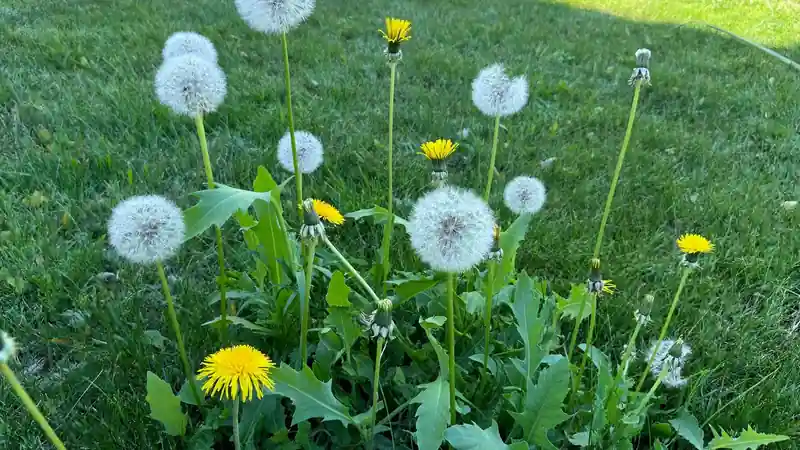
How to kill dandelions but not grass: spray a selective broadleaf herbicide whose EPA label lists dandelion and your grass, usually 2,4-D, MCPP and dicamba, in fall at the label rate. For a handful, dig the taproot out 4 to 5 inches deep.
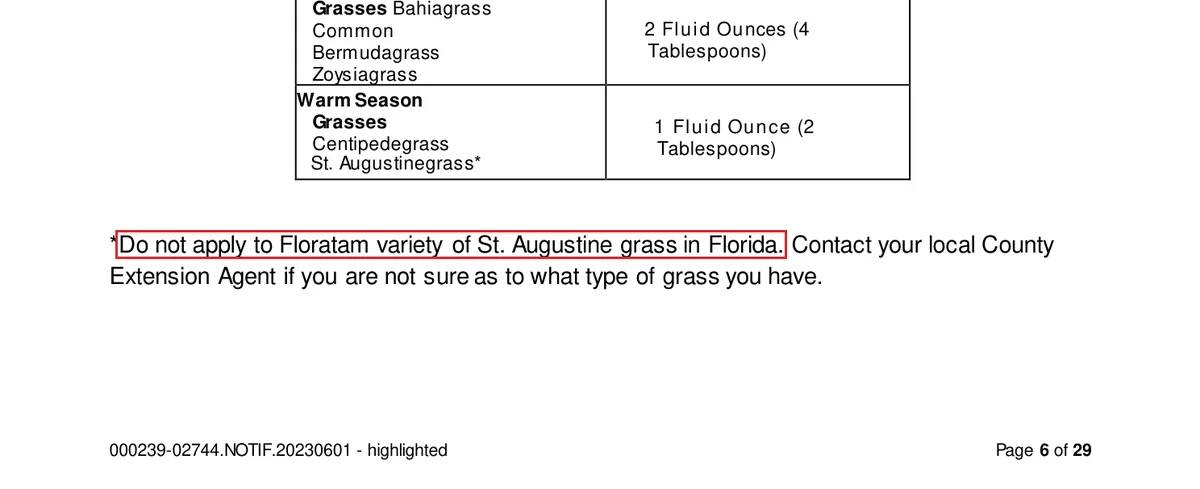
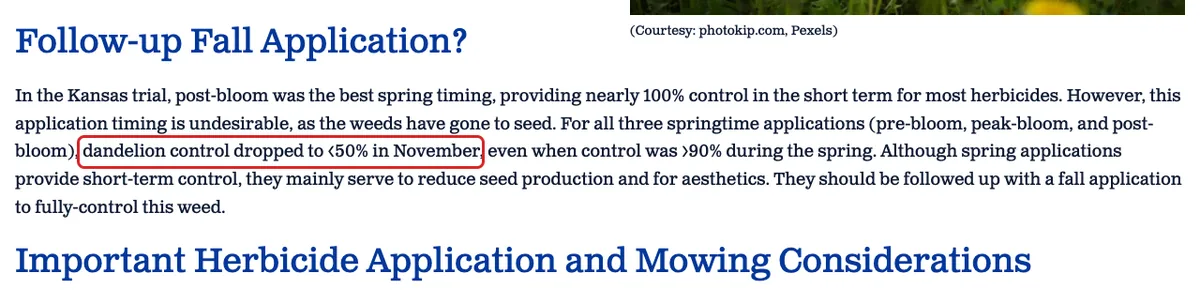
No single bottle is safe on every lawn, so we lined up 12 EPA labels that name dandelion by the grass they allow. The same Ortho concentrate goes on at 4 fl oz per 1,000 sq ft on fescue and 1 fl oz on centipede, and only 2 of the 12 list Floratam St. Augustine as allowed. Timing matters as much: in Kansas State trials, pre-bloom spring sprays that gave 87 percent control or better at 60 days averaged 47 percent by mid-November on a thin stand, and peak-bloom sprays averaged 26 percent. Download the label matrix (CSV).
General information, not pesticide or legal advice, and no product endorsement. The label is the law: the label on your container overrides this page, and a retail package may list fewer weeds than the EPA master label.
Which dandelion killers are safe on your grass?
These products kill dandelions and spare grass because of how grasses process synthetic auxins: most grasses inactivate 2,4-D, MCPP and dicamba by conjugation, while broadleaf weeds cannot (Raudenbush and Keeley 2014). That selectivity has limits by grass species, which is why the same bottle carries 3 different rates. All 12 labels below list common dandelion; check the grass column before the price.
| Product (EPA Reg. No.) | Actives | Do not use on | Rate per 1,000 sq ft | Heat limit | Wait to seed | Rain and water |
|---|---|---|---|---|---|---|
| Ortho WeedClear / Weed B Gon Lawn Weed Killer concentrate (239-2744) | 2,4-D, MCPP-p, dicamba | Bentgrass, carpetgrass, dichondra, lippia, Floratam St. Augustine | 4 fl oz cool-season; 2 fl oz bahia, common bermuda, zoysia; 1 fl oz centipede, St. Augustine (pressure sprayer) | Below 90°F; 85°F on hybrid bermuda | 3 to 4 weeks | No rain expected for 24 hours |
| Spectracide Weed Stop For Lawns Concentrate2 (9688-342) | 2,4-D, MCPP-p, dicamba, sulfentrazone | Floratam and Bitterblue St. Augustine, carpetgrass, dichondra | 4 fl oz cool-season and zoysia; 2 fl oz bahia, bentgrass, bermuda, centipede; 1.5 fl oz St. Augustine | 45 to 90°F | 3 to 4 weeks | Watering right after may wash it off |
| Gordon’s Trimec Lawn Weed Killer (2217-539) | 2,4-D, MCPP-p, dicamba | Carpetgrass, dichondra; Floratam St. Augustine in Florida | 4 fl oz cool-season, bahia, bermuda, zoysia; 2 fl oz centipede, St. Augustine | 60 to 90°F | 3 to 4 weeks | Do not water for 24 hours |
| BioAdvanced Weed Killer for Lawns concentrate (92564-4) | 2,4-D, MCPP-p, dicamba | Carpetgrass, dichondra, Floratam St. Augustine | 4 fl oz cool-season, bermuda, buffalo, zoysia; 2 fl oz bahia, centipede, St. Augustine | Most of the day below 90°F | 3 to 4 weeks | Rainfast in 1 hour |
| Preen Lawn Weed Control granules (961-418) | 2,4-D, MCPP-p, dicamba | Carpetgrass, dichondra, St. Augustine | 2 lb granules | Not when consistently above 90°F | 3 weeks | Do not wash off for 1 to 2 days |
| Scotts Turf Builder Weed & Feed5 (538-333) | 2,4-D, dicamba, fertilizer | Creeping bentgrass, St. Augustine (including Floratam), dichondra, carpetgrass, lippia | 2.82 lb granules on wet grass | 60 to 90°F | 1 month | No rain for 24 hours; no watering or mowing for 24 hours |
| Scotts Turf Builder Bonus S (538-18) | Atrazine, fertilizer | Bahia, bluegrass, fine and tall fescue, ryegrass, bentgrass, dichondra | 3.45 lb granules | 60 to 90°F | 6 months for seed; 1 month for sod or sprigs | Water in immediately |
| Roundup For Lawns1, Northern (no glyphosate) (2217-917) | MCPA, quinclorac, dicamba, sulfentrazone | Bentgrass, St. Augustine, bahia, centipede, carpetgrass, dichondra | Ready to use; spot spray | 45 to 90°F; 85°F on bermuda | 4 weeks | Rainfast in 3 hours |
| Roundup For Lawns Southern concentrate (no glyphosate) (2217-1010) | 2,4-D, dicamba, penoxsulam, sulfentrazone | Bentgrass, carpetgrass, dichondra (Floratam allowed) | 5.2 to 8.6 fl oz St. Augustine; 7.2 to 10.6 fl oz Kentucky bluegrass | 45 to 90°F; 85°F on St. Augustine and centipede | Not stated in the directions | Rainfast in 4 hours; no irrigation for 3 |
| Ortho Weed B Gon Chickweed, Clover & Oxalis Killer (239-2491) | Triclopyr | Bahia, bermuda, centipede, kikuyu, St. Augustine | 5 fl oz (1 fl oz per 200 sq ft); cool-season, buffalo and zoysia only | Below 90°F; wind under 10 mph | 1 week | Rain within 6 hours may reduce effect |
| Sunday Dandelion Doom (67702-27) | Iron HEDTA | Bentgrass; not on drought-stressed grass | Ready to use; wet the weeds; repeat in 3 to 4 weeks, up to 4 times a year | 50 to 85°F | 1 day | No rain or irrigation within 3 hours |
| SpeedZone EW (professional) (2217-1053) | 2,4-D ester, MCPP-p, dicamba, carfentrazone | St. Augustine, bahia, centipede, seashore paspalum, carpetgrass, dichondra | Up to 1.8 fl oz (5 pt per acre) | 90°F unless injury is acceptable; works best above 50°F | 1 week | Rainfast in 3 to 4 hours |
Warm-season lawns get the narrowest choice. On centipede and St. Augustine the three-way concentrates drop to 1 to 2 fl oz per 1,000 sq ft, and the Gordon‘s label warns that tolerance of those two grasses can range from sensitive to tolerant. For Floratam, only Roundup For Lawns Southern (spray at 85°F or cooler, not as the grass goes dormant, not if temperatures will drop below 40°F within 10 days) and Bonus S (atrazine granules, watered in at once, no seeding for 6 months) name it as allowed.
Cool-season lawns have the widest menu. Triclopyr (Ortho 239-2491) is cool-season, buffalo and zoysia only, but it lets you seed after 1 week instead of 3 to 4. Iron HEDTA (Sunday 67702-27) allows seeding the next day; University of Maryland Extension notes iron products were tested mostly on tall fescue, ryegrass and bluegrass and still need testing on bermuda and zoysia. Our lawn weed killer comparison covers the same labels for other weeds.
1Do you want to keep clover in the lawn?
YesDig the dandelions 4 to 5 in deep. Broadleaf herbicides, iron HEDTA included, list clover as a target or warn off lawns with desirable clover.
NoGo to the next question
2Is the lawn Floratam St. Augustine?
YesUse a label that allows Floratam: Roundup For Lawns Southern (2217-1010) at 85 F or cooler, or Bonus S atrazine granules (538-18), which bar seeding for 6 months.
NoGo to the next question
3Is it another St. Augustine or centipede?
YesA three-way concentrate at the reduced rate: 1 to 2 fl oz per 1,000 sq ft (Ortho, Gordon's, BioAdvanced), below 85 to 90 F.
NoGo to the next question
4Will you seed bare spots within 4 weeks?
YesIron HEDTA (seed in 1 day; expect regrowth) or, on cool-season grass, triclopyr (seed in 1 week).
NoCool-season, bermuda or zoysia lawn: a 2,4-D, MCPP and dicamba concentrate at the label rate in fall, at most 2 broadcasts a year, 30 days apart.
Source: EPA labels 239-2744, 2217-539, 92564-4, 2217-1010, 538-18, 239-2491, 67702-27; Ask Extension 867602
When should you spray dandelions?
Spray cool-season lawns in fall: early September to early November in Colorado (CSU Extension), mid-October to early November in Kansas (K-State), on days of 50°F or warmer. As days shorten, dandelions move sugars down to the taproot and a fall spray rides along. A second reason is the seedling flush: K-State says new dandelions sprout in late September, and those small plants die easily.
| Timing | What the trial or extension service found | Source |
|---|---|---|
| Fall, early September to early November (Colorado); mid-October to early November (Kansas) | K-State: fall treatment often gives over 90% control the following spring, against 50% or less from one spring or summer spray. Days of 50°F or warmer | K-State 2021; CSU |
| Late September seedling flush | New dandelions sprout in late September; small plants are easily controlled with 2,4-D mixes | K-State Extension, 2023 |
| Spring, pre-bloom (green, under 10% of plants flowering) | 2010 dense stand: 80 to 94% at 30 days. 2011 thin stand: 87% or more at 60 days for every 2,4-D product; 47% mean by mid-November | Raudenbush and Keeley 2014 |
| Spring, peak bloom (70% of plants flowering) | 2011: 16 to 72% at 60 days; most products under 40%; 26% mean by mid-November. Best: carfentrazone + 2,4-D ester | Raudenbush and Keeley 2014 |
| Spring, post-bloom (flowers withered) | 2010: 98 to 100% at 30 days. 2011: 35 to 97% at 60 days; 42% mean by mid-November. Seed has already blown | Raudenbush and Keeley 2014 |
If you must spray in spring, go before the flowers. The 2011 plots in Raudenbush and Keeley were the harder test (thin crested wheatgrass, large dandelions, irrigation every 10 to 14 days), and peak-bloom sprays gave 16 to 72 percent control at 60 days. The authors’ explanation: during bloom, flowers and seeds pull sugars upward, so less herbicide reaches the root. The one product type that held up at peak bloom paired a 2,4-D ester with carfentrazone, as in SpeedZone.
Spring sprays mostly buy a season. SDSU Extension reads the same trial this way: control fell below 50 percent by November at all 3 spring timings, even where it topped 90 percent in spring, so spring work mainly cuts seed production and should be followed by a fall spray. For the spring window, SDSU wants highs of 60 to 85°F for several days and lows above 40°F.
Warm-season lawns follow the grass. Gordon‘s label says to avoid spraying during spring green-up of warm-season grasses and in extreme heat, and Roundup For Lawns Southern bars St. Augustine applications as the grass goes dormant in fall. Month-by-month timing for fertilizer and preemergents is in our lawn care schedule.
How much concentrate do you need?
Multiply your lawn area in thousands of square feet by your label’s rate, then mix it into 0.5 to 1 gallon of water per 1,000 sq ft (Gordon‘s; Ortho). The calculator does the first step for 6 label rates; the table shows the same arithmetic for 4 lawn sizes.
- Concentrate (fl oz)
- 20.0
- Concentrate (tablespoons)
- 40
- Share of a 32 fl oz bottle
- 0.63
Label rates as read November 2026. Mix in 0.5 to 1 gallon of water per 1,000 sq ft. Most labels allow 2 broadcasts a year, 30 days apart. Your container's label wins.
| Lawn area | Cool-season, 4 fl oz (Ortho, Gordon’s, BioAdvanced, Spectracide) | Bahia, common bermuda, zoysia, 2 fl oz (Ortho) | St. Augustine, 1.5 fl oz (Spectracide) | Centipede or St. Augustine, 1 fl oz (Ortho pressure sprayer) | Water, at 1 gal per 1,000 sq ft |
|---|---|---|---|---|---|
| 1,000 sq ft | 4 fl oz | 2 fl oz | 1.5 fl oz | 1 fl oz | 1 gal |
| 2,500 sq ft | 10 fl oz | 5 fl oz | 3.75 fl oz | 2.5 fl oz | 2.5 gal |
| 5,000 sq ft | 20 fl oz | 10 fl oz | 7.5 fl oz | 5 fl oz | 5 gal |
| 10,000 sq ft | 40 fl oz | 20 fl oz | 15 fl oz | 10 fl oz | 10 gal |
Two caps apply on the common concentrates. Gordon‘s and Ortho allow 2 broadcast applications a year at least 30 days apart, with a seasonal maximum of 8 fl oz per 1,000 sq ft. Spot sprays have their own limit on Gordon’s: 2 a year, on no more than 1,000 sq ft per acre. Doubling the dose is not a shortcut; Ortho warns that exceeding directed rates may damage turf.
How to spray dandelions without hurting the lawn
- Confirm the grass. If you cannot name it, the Ortho label tells you to ask your county Extension agent before spraying; our lawn grass identification guide helps.
- Mow on the label’s schedule. Gordon‘s and BioAdvanced say mow 1 to 3 days before; Ortho says no mowing for 2 days before or after.
- Water a dry lawn 24 hours ahead (Gordon‘s); drought-stressed grass is more easily injured.
- Check the forecast: inside the heat limit in the matrix, wind under 10 mph (SDSU), and dry for the label’s rain-free time, from 1 hour to 24 hours.
- Use a coarse spray and wet each rosette without runoff. Keep dicamba products off the root zone of trees and shrubs (UMD).
- For weed-and-feed granules, spread on grass wet with dew so they stick, then no watering or mowing for 24 hours (Scotts 538-333).
- Judge at 30 days. In cool spring weather, products without a fast-acting partner such as carfentrazone took longer to finish the job in the Kansas trial, and Gordon’s says hard-to-kill weeds may need a spot spray at 30 days.
- Seed bare spots only after the label’s wait, then follow our overseeding steps.
What works without a herbicide, and how well?
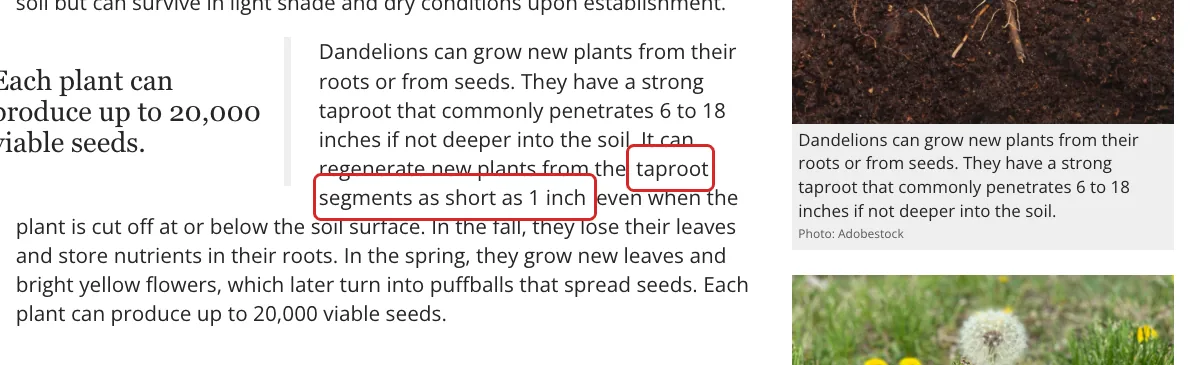
Digging is the only method that is both selective and measured to work, and it is slow. A dandelion taproot commonly runs 6 to 18 inches deep, and pieces as short as 1 inch regrow even after the plant is cut at the soil line (Oregon State EM 9510). Nebraska Extension says to cut the root 4 to 5 inches below the crown, in moist soil.
| Method | Measured result | Safe for grass? | Source |
|---|---|---|---|
| Selective herbicide (Trimec Classic, 2,4-D + MCPP + dicamba) | Over 96% control in a 2-year Kansas comparison | Benchmark | Raudenbush 2012 |
| Hand-weeding | 58 to 71% control in the same trial; an older study found no control from hand-weeding alone | Yes | Raudenbush 2012; Mann 1981, cited in Raudenbush and Keeley 2014 |
| Dandelion digger | Cut the taproot 4 to 5 in below the crown; roots run 6 to 18 in or deeper and 1 in pieces regrow | Yes | Nebraska Extension; OSU EM 9510 |
| Iron HEDTA (Fiesta, 3 rates, fall) | Dandelion cover under 1% at 7 days; by spring, no different from untreated plots (near 100% regrowth) | Yes, mostly cool-season tested | OMAFRA, Guelph 2009 |
| Iron HEDTA, highest label rate, repeated | Dandelion and clover control equal to two three-way herbicides in a 2-year ryegrass trial | Yes | Carroll and others 2022 |
| Corn gluten meal, 10 to 40 lb per 1,000 sq ft | No better than urea or Milorganite at the same nitrogen; under 25% control in the Kansas comparison | Yes; does not touch established plants | St. John and DeMuro 2013; Raudenbush 2012 |
| Horticultural vinegar, 20% acetic acid | Under 25% control; household 5% vinegar is not strong enough | No: burns any grass it wets | Raudenbush 2012; OSU |
| Fertilizer only | Under 25% control | Yes | Raudenbush 2012 |
Iron HEDTA is the fast, short-lived option. In a Guelph Turfgrass Institute trial, dandelion leaves blackened within 24 hours of a fall spray, yet by the next April the iron plots had no fewer dandelions than untreated turf, while the three-way plots did. Repeats are the fix: Carroll and others (2022) matched three-way herbicides only at the highest labeled Fiesta rate, and the Sunday label says repeat in 3 to 4 weeks, up to 4 times a year.
Corn gluten meal does not kill dandelions you can see. Iowa State labels it a preemergence product at 20 lb per 1,000 sq ft with no effect on established weeds, and a 3-year K-State trial found it no better than urea or Milorganite supplying the same nitrogen (St. John and DeMuro 2013). Vinegar, boiling water and salt all kill the grass they touch; our vinegar weed killer page has the acetic acid numbers.
Stopping seed is the cheap part. One plant makes up to 15,000 seeds (UMD) or up to 20,000 viable seeds (OSU), and seeds form without pollination. Mow or pick flowers before the puffballs open.
Does thicker grass keep dandelions out?
Yes, and the Kansas trial shows how much. In 2010, on dense, well-irrigated tall fescue, every product at every spring timing still gave 89 percent control or better in November. In 2011, on a thin stand watered every 10 to 14 days, the same products averaged 26 to 47 percent (Raudenbush and Keeley 2014). The authors credit turf competition and smaller dandelions.
Nitrogen helps more than mowing height alone. In the K-State trial, Kentucky bluegrass fed 3.6 lb of nitrogen per 1,000 sq ft a year had fewer dandelions, whatever the nitrogen source (St. John and DeMuro 2013). In a 2-year Canadian study, mowing height by itself did not reduce dandelion density, and mowing at 3 to 5 cm (about 1.2 to 2 in) let more survive treatment (Abu-Dieyeh and Watson 2005). SDSU recommends about 3 inches, removing no more than one-third of the blade; see our mowing frequency guide and lawn fertilizer guide.
How we compiled this
We read 12 EPA master labels from EPA’s Pesticide Product Label System that list common dandelion, and recorded each one’s grass exclusions, rates per 1,000 sq ft, temperature limits, seeding waits and rain rules. Timing and method results come from 1 peer-reviewed field trial (Raudenbush and Keeley 2014), 1 thesis abstract (Raudenbush 2012), 2 iron HEDTA studies, a trade-journal summary of St. John and DeMuro (2013), 1 mowing study and 9 extension pages. We did not test any product. Sources accessed November 2026.
Frequently asked questions
What will kill dandelions permanently?
No single spray. In Kansas trials, pre-bloom sprays at 87 percent control or better after 60 days averaged 47 percent by November as taproots regrew, while a dense lawn held 89 percent or better. Spray in fall at the label rate, repeat once if the label allows, and thicken the turf.
Does vinegar kill dandelions but not grass?
No. Vinegar is non-selective and burns grass it touches. Household 5 percent vinegar is not strong enough for dandelions (OSU), and 20 percent horticultural vinegar gave under 25 percent control in a K-State comparison.
What kills dandelions but not clover?
Nothing selective. Broadleaf herbicides that kill dandelions also kill clover (Ask Extension), and the Ortho label says not to spray lawns where desirable clovers are present. Dig the dandelions instead; our clover lawn guide covers the trade-off.
What month is best to spray dandelions?
September to early November for cool-season lawns (CSU), on days of 50°F or warmer. In spring, spray before bloom, when highs run 60 to 85°F (SDSU).
Why shouldn’t you kill dandelions?
They bloom early, when bees find little else, though OSU Extension calls them a snack rather than a full meal. If you keep some, mow off the flowers before they seed.
Sources
- EPA, Ortho WBG 553 Concentrate (WeedClear / Weed B Gon Lawn Weed Killer) label, Reg. 239-2744, Aug. 2023. Accessed November 2026.
- EPA, Spectracide Weed Stop For Lawns Concentrate2 (Chemsico) label, Reg. 9688-342, June 2021. Accessed November 2026.
- EPA, Gordon’s BL 8000 (Trimec) Lawn Weed Killer label, Reg. 2217-539, Aug. 2021. Accessed November 2026.
- EPA, Lawn Herbicide JD Concentrate (BioAdvanced Weed Killer for Lawns) label, Reg. 92564-4, June 2026. Accessed November 2026.
- EPA, Turf Broadleaf Weed Control (Preen Lawn Weed Control) label, Reg. 961-418, July 2020. Accessed November 2026.
- EPA, Scotts Turf Builder Weed & Feed (Weed & Feed5) label, Reg. 538-333, Sept. 2026. Accessed November 2026.
- EPA, Scotts Bonus S label, Reg. 538-18, March 2025. Accessed November 2026.
- EPA, EH-1462 Herbicide (Roundup For Lawns1) label, Reg. 2217-917, Sept. 2025. Accessed November 2026.
- EPA, EH-1573 Herbicide (Roundup For Lawns Southern) label, Reg. 2217-1010, June 2024. Accessed November 2026.
- EPA, Ortho Weed B Gon Chickweed, Clover & Oxalis (triclopyr) label, Reg. 239-2491, Aug. 2024. Accessed November 2026.
- EPA, NEU1173H RTU (Sunday Dandelion Doom) label, Reg. 67702-27, Sept. 2026. Accessed November 2026.
- EPA, SpeedZone EW (EH-1681) label, Reg. 2217-1053, June 2023. Accessed November 2026.
- Raudenbush and Keeley, HortScience 49(9): 1212 to 1216, Springtime dandelion control with seven postemergence herbicides applied at three anthesis stages, 2014. Accessed November 2026.
- Kansas State University (K-REx), Raudenbush, Springtime dandelion control in turfgrass using conventional and organic methods (thesis abstract), 2012. Accessed November 2026.
- SDSU Extension, Spring Dandelion Control, Apr. 28, 2025. Accessed November 2026.
- K-State Research and Extension, Wild West District, Fall Is the Best Time to Control Dandelions and Perennial Weeds, Oct. 14, 2021. Accessed November 2026.
- K-State Horticulture, Dandelion (common pest problems), Oct. 25, 2023. Accessed November 2026.
- Colorado State University Extension, Broadleaf Weed Control in Lawns, current. Accessed November 2026.
- Oregon State University Extension, EM 9510, Dandelions: Living with, or without, them, Apr. 2025. Accessed November 2026.
- Nebraska Extension in Lancaster County, Spring Dandelion Control, Apr. 2, 2017. Accessed November 2026.
- University of Maryland Extension, Dandelion, Mar. 2, 2023. Accessed November 2026.
- University of Maryland Extension, Iron-based herbicides, current. Accessed November 2026.
- Iowa State University Extension, How to Use Corn Gluten Meal as an Herbicide in the Lawn and Garden, current. Accessed November 2026.
- Golf Course Management, Summary of St. John and DeMuro, Applied Turfgrass Science, doi:10.1094/ATS-2013-0426-01-RS, 2013 study. Accessed November 2026.
- OMAFRA, Guelph Turfgrass Institute (Charbonneau), Efficacy of Iron Chelate Herbicide for Broadleaf Weed Control in Turf, 2009 to 2010. Accessed November 2026.
- Carroll and others, International Turfgrass Society Research Journal, Organic and bio-herbicides for dandelion and white clover control, 2022. Accessed November 2026.
- Abu-Dieyeh and Watson, Journal of Plant Interactions, Effect of turfgrass mowing height on biocontrol of dandelion, 2005. Accessed November 2026.
- Ask Extension, How to kill dandelions but not clover, question 867602, May 2024. Accessed November 2026.