How often should you mow your lawn? When grass reaches 1.5 times your mowing height, not by calendar. At 3 inches, cut at 4.5 inches: about every 7 days in fast growth. A Purdue trial at 2.75 inches averaged 10 to 15 days.
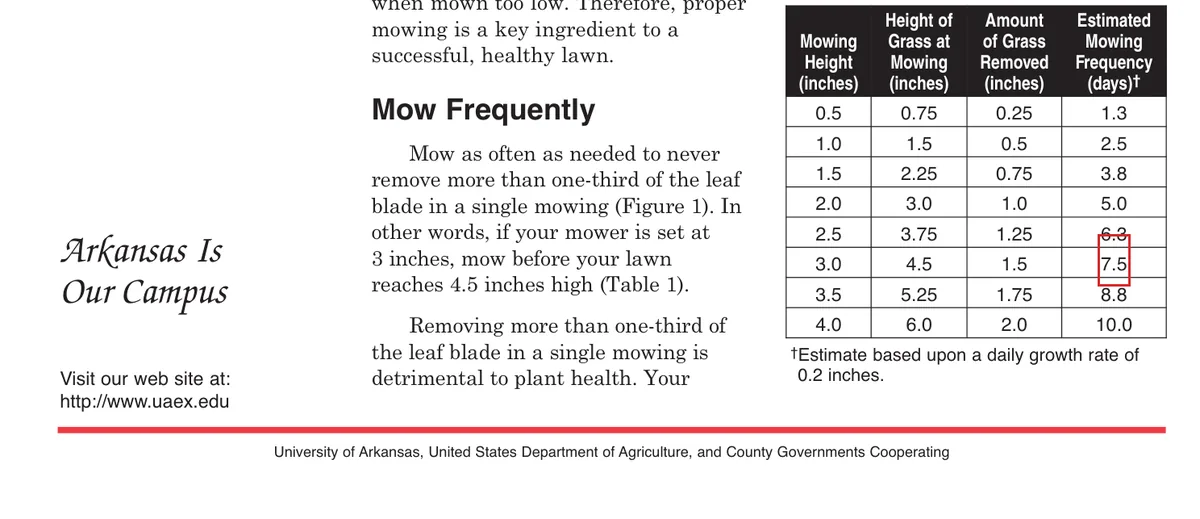
How often should you mow your lawn comes down to one division: half your mowing height divided by daily growth. University of Arkansas Extension runs it at 0.2 inch a day, which gives 5 days at a 2-inch height and 10 days at 4 inches. Below, that single rate is replaced with growth measured in a two-year Purdue trial, and with a month-by-month estimate for 12 grass and city pairs built from NOAA temperature normals.
How often should you mow your lawn? Enter your height and growth
- Days between mows
- 7.5
- Weeks between mows
- 1.1
Default: 3-inch height at 1.4 inches a week gives 7.5 days, with the mow at 4.5 inches. Days = (height / 2) / inches of growth per day.
The formula is days between mows = (mowing height / 2) / inches of growth per day. To find your own rate, push a ruler into the lawn the day after mowing and read it again 7 days later. The difference is your weekly growth; rerun it in each season, because the rate changes.
| Mowing height | Mow when grass reaches | Removed per cut | Days at 0.6 in a week | Days at 0.9 in a week | Days at 1.4 in a week | Days at 1.9 in a week |
|---|---|---|---|---|---|---|
| 1 in | 1.5 in | 0.5 in | 5.8 | 3.9 | 2.5 | 1.8 |
| 1.5 in | 2.25 in | 0.75 in | 8.8 | 5.8 | 3.8 | 2.8 |
| 2 in | 3 in | 1 in | 11.7 | 7.8 | 5.0 | 3.7 |
| 2.5 in | 3.75 in | 1.25 in | 14.6 | 9.7 | 6.2 | 4.6 |
| 3 in | 4.5 in | 1.5 in | 17.5 | 11.7 | 7.5 | 5.5 |
| 3.5 in | 5.25 in | 1.75 in | 20.4 | 13.6 | 8.8 | 6.4 |
| 4 in | 6 in | 2 in | 23.3 | 15.6 | 10.0 | 7.4 |
A 14-day interval has a quick test: divide your mowing height by 4. That is the most the lawn can add per week and still stay inside the rule, so 0.75 inch a week at 3 inches and 1 inch a week at 4 inches.
Trigger height and interval for each grass
| Grass | Mowing height, inches | Height used | Mow at | Days at 0.9 in a week | Days at 1.4 in a week | NC State frequency rating |
|---|---|---|---|---|---|---|
| Kentucky bluegrass | 2.5 to 3.5 (Arkansas) | 3 in | 4.5 in | 11.7 | 7.5 | Medium |
| Tall fescue | 2.5 to 4 (Purdue, Arkansas) | 3.5 in | 5.25 in | 13.6 | 8.8 | High |
| Perennial ryegrass | 2 to 3.5 (Purdue) | 2.5 in | 3.75 in | 9.7 | 6.2 | Med-High, mixed with bluegrass |
| Fine fescue | 2 to 3.5 (Purdue) | 2.5 in | 3.75 in | 9.7 | 6.2 | Medium, mixed with bluegrass |
| Common bermudagrass | 1.5 to 2.5 (Arkansas) | 1.5 in | 2.25 in | 5.8 | 3.8 | Med-High |
| Hybrid bermudagrass | 0.5 to 1.5 (Arkansas, UF) | 1 in | 1.5 in | 3.9 | 2.5 | High to Very High |
| Zoysiagrass | 0.75 to 2.5 (Arkansas) | 1.5 in | 2.25 in | 5.8 | 3.8 | Low to High |
| St. Augustinegrass, standard | 3.5 to 4 (UF) | 3.5 in | 5.25 in | 13.6 | 8.8 | Med-High |
| St. Augustinegrass, dwarf (Captiva, Delmar, Seville) | 2.5 (UF) | 2.5 in | 3.75 in | 9.7 | 6.2 | Med-High |
| Centipedegrass | 1.5 to 2 (Arkansas, UF) | 1.5 in | 2.25 in | 5.8 | 3.8 | Low |
| Bahiagrass | 3 to 4 (UF) | 3.5 in | 5.25 in | 13.6 | 8.8 | High |
Height is the setting you control. The University of Minnesota puts a 3-inch lawn at about every 7 days and a 4-inch lawn at every 10 to 12, and calls the idea that shorter grass needs less mowing a misconception. Sources split on seasonal changes: Purdue says not to vary height during the year, while Ohio State HYG-5816 favors higher cuts in summer. Purdue does advise 0.5 to 1 inch higher in shade, which adds about 1 to 2.5 days at 1.4 inches a week. Check your species on our lawn grass types guide.
Why published answers run from twice a week to every 2 weeks
| Source | What it says | Conditions |
|---|---|---|
| Arkansas FSA6023 | 1 to 2 times a week is typical | Growing season; table assumes 0.2 inch a day |
| NC State, Carolina Lawns | Biweekly and weekly in most instances | Bermudagrass: at least twice a week for best results |
| Purdue AY-8-W | Twice a week in spring and fall, once every 2 weeks in summer | Says some lawns may need this |
| University of Minnesota | About every 7 days at 3 inches; 10 to 12 days at 4 inches | Most of Minnesota |
| UF/IFAS ENH5 | Weekly in the growing season | St. Augustinegrass; less often in cooler months |
| UF/IFAS ENH6 | Every 7 to 14 days | Bahiagrass in active growth, at 3 to 4 inches |
| Law, Bigelow and Patton, Purdue trial | Measured seasonal averages of 10 to 15 days | Irrigated cool-season plots at 7 cm (2.76 in) |
Each row assumes a different height, climate and grass, so all can be correct. Purdue’s own example is also stricter than the rule: cut at 3 inches, mow at 4, which removes 25 percent, while Arkansas, NC State and Ohio State all use 4.5 inches.
How fast does grass grow? Rates from a 2-year trial
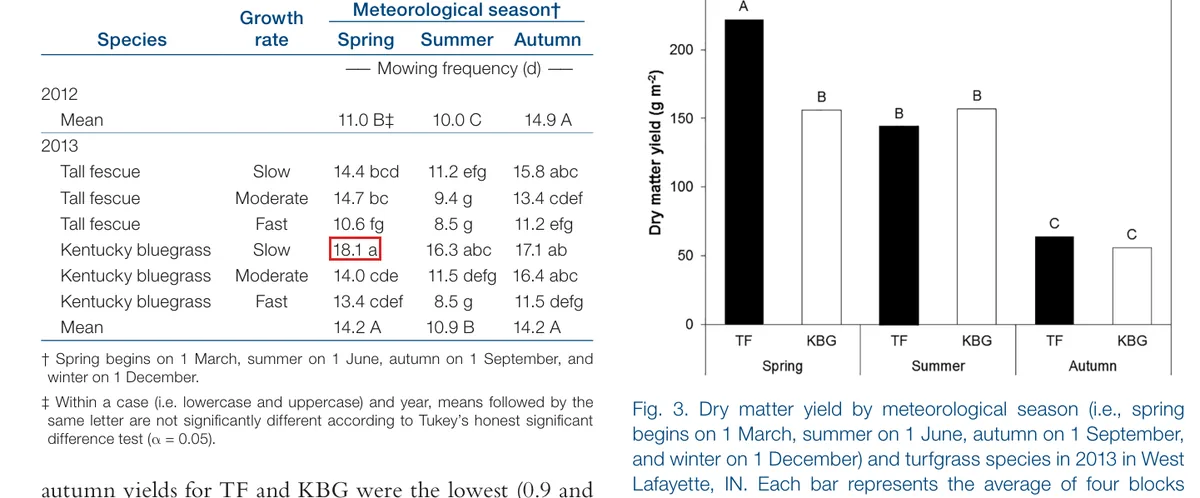
Law, Bigelow and Patton grew six cultivars at West Lafayette, Ind., in 2012 and 2013, mowed at 7 cm (2.76 in) and measured height daily, cutting the one-third plots at 10.5 cm (4.13 in). The plots were irrigated and received 142 kg of nitrogen per hectare, about 2.9 lb per 1,000 sq ft a year. Mowing ran from March 20 to Oct. 30 in 2012 and April 4 to Nov. 8 in 2013.
| Cultivar and growth class | Spring days between mows | Summer days | Autumn days | Summer growth, inches a week | Mows in 2013 by the one-third rule | Mows in 2013, weekly plan |
|---|---|---|---|---|---|---|
| Tall fescue, Gazelle II (slow) | 14.4 | 11.2 | 15.8 | 0.86 | 17.8 | 29.0 |
| Tall fescue, Tar Heel II (moderate) | 14.7 | 9.4 | 13.4 | 1.03 | 21.3 | 29.3 |
| Tall fescue, Endeavor (fast) | 10.6 | 8.5 | 11.2 | 1.13 | 24.3 | 29.5 |
| Kentucky bluegrass, Prosperity (slow) | 18.1 | 16.3 | 17.1 | 0.59 | 14.3 | 24.0 |
| Kentucky bluegrass, Moonshine (moderate) | 14.0 | 11.5 | 16.4 | 0.84 | 17.5 | 28.0 |
| Kentucky bluegrass, Thermal Blue (fast) | 13.4 | 8.5 | 11.5 | 1.13 | 22.5 | 28.0 |
| Mean of all six | 14.2 | 10.9 | 14.2 | 0.88 |
Watered summer was the fastest season, at 10 to 11 days, against 14 to 15 in autumn and 11 to 14 in spring. Many guides call summer the slow season for cool-season grass, and Purdue’s every-2-weeks figure fits a dry July, but the authors note irrigation likely raised summer yields. Plan on the summer rate if you water through summer.
Three inputs move the rate. Cultivar: fast Thermal Blue took 22.5 mows in 2013 against 14.3 for slow Prosperity. Clippings: returning them added about 2 mows a year, and what to do with grass clippings covers the trade. Nitrogen: Rutgers recorded 38 lb of dry clippings per 1,000 sq ft a year at 2 lb of nitrogen and 58 lb at 4 lb, or 53 percent more, on irrigated Kentucky bluegrass mowed weekly. Rutgers also found slow-release nitrogen curbs the spring surge, which our fertilizer guide explains.
The same trial answers the weekly-or-not question. Plots mowed by the rule took 18 cuts in each year against 25 and 27 for weekly plots, 31 percent fewer, without unacceptable appearance, and the weekly plots were skipped whenever grass had grown under 1.3 cm (0.5 in). The rule is not always slower: the authors report brief periods when it called for more than one cut a week. At the $50 median list price for 4,000 sq ft, 8 fewer cuts is about $400, though crews sell weekly or biweekly plans and biweekly visits cost 25 to 50 percent more each.
How often to mow by month, grass and city
| Grass, height, city | Mar | Apr | May | Jun | Jul | Aug | Sep | Oct | Nov |
|---|---|---|---|---|---|---|---|---|---|
| Kentucky bluegrass, 3 in, Minneapolis | >21 | >21 | 11 | 8 | 9 | 8 | 8 | >21 | >21 |
| Kentucky bluegrass, 3 in, Denver | >21 | >21 | 13 | 8 | 10 | 8 | 8 | >21 | >21 |
| Tall fescue, 3 in, Indianapolis | >21 | >21 | 8 | 8 | 10 | 9 | 8 | 16 | >21 |
| Tall fescue, 3 in, Philadelphia | >21 | 19 | 8 | 9 | 13 | 11 | 8 | 12 | >21 |
| Tall fescue, 3 in, Raleigh | >21 | 10 | 8 | 11 | 16 | 13 | 8 | 9 | >21 |
| Perennial ryegrass, 2.5 in, Seattle | >21 | >21 | 11 | 7 | 6 | 6 | 7 | 17 | >21 |
| Bermudagrass, 1.5 in, Atlanta | >21 | >21 | 10 | 5 | 4 | 5 | 7 | >21 | >21 |
| Bermudagrass, 1.5 in, Dallas | >21 | >21 | 7 | 4 | 4 | 4 | 5 | 16 | >21 |
| Bermudagrass, 1.5 in, Phoenix | 19 | 8 | 4 | 4 | 4 | 4 | 4 | 6 | >21 |
| St. Augustinegrass, 3.5 in, Houston | >21 | >21 | 13 | 10 | 9 | 9 | 11 | >21 | >21 |
| St. Augustinegrass, 3.5 in, Orlando | >21 | 21 | 13 | 10 | 10 | 10 | 10 | 15 | >21 |
| Bahiagrass, 3.5 in, Orlando | >21 | 21 | 13 | 10 | 10 | 10 | 10 | 15 | >21 |
Numbers are days between mows; “>21” means growth is slow enough to check height before bothering. Growth potential is a temperature curve from Gelernter and Stowell (2005), peaking at 68°F for cool-season grass and 88°F for warm-season grass. We multiplied it by Arkansas’s 0.2 inch a day, so this table is a planning estimate, not a measurement.
Checked against real intervals, it holds up best where trial data exists. For Indianapolis at 2.76 inches it gives about 14 days in spring (April and May), 8.5 in summer and 11 in autumn (September and October); the Purdue plots averaged 14, 11 and 14, and its fast cultivars 8.5 in summer. Warm-season rows match published figures at peak, with bermudagrass near 4 days against NC State‘s twice a week and Orlando bahiagrass near 10 against UF‘s 7 to 14, but St. Augustinegrass at 10 days runs longer than UF‘s weekly. Warm-season spring cells run long too, because a monthly mean ignores warm afternoons. Heavy rain, fertilizer or drought will override any cell.
For the seasonal searches: spring mowing starts when the lawn first reaches its trigger, which came March 20 one year and April 4 the next in Indiana. Stop in fall when it no longer reaches the trigger, which came by Oct. 30 and Nov. 8. In winter a dormant lawn needs no cut; UF/IFAS says even north Florida may skip winter mowing.
Where the one-third rule comes from
The rule traces to a 1955 USDA bulletin. Law and colleagues and a 2025 review both credit Franklin Crider for the limit of 30 to 40 percent. He clipped grass to set shares of top volume and tracked which roots kept growing. No root stopped at 40 percent or less, and repeated clipping over 33 days gave the same cutoff across Rhodes grass, Kentucky bluegrass and smooth brome.
| Share of top removed | Roots that stopped growing | How long stoppage lasted | Main roots at day 33 |
|---|---|---|---|
| 90% | 100% | 17 days complete, partial to day 33 | 32 |
| 80% | 100% | 12 days complete, partial to day 33 | 44 |
| 70% | 78% | 28 days | 70 |
| 60% | 50% | 17 days | 75 |
| 50% | 2% | 14 days | 94 |
| 40% | None | None | 107 |
| 30% | None | None | 115 |
| 20% | None | None | 132 |
| 10% | None | None | 132 |
| 0% (unclipped check) | None | None | 135 |
Treat this as the reason for the rule, not a lawn trial. Crider worked in pots, in a greenhouse, and measured volume rather than blade height. The rule also leaves little margin at peak: the Purdue team saw growth as fast as 1.3 cm (0.5 in) a day, enough to carry a 2.76-inch lawn from the one-third mark into the 40 to 50 percent range in 1 day. If rain is coming, cut early.
What happens if you mow every 2 or 3 weeks?
| Mowing plan at 2.5 in | Mean grass height before mowing | Removed at each cut | Mean bee count | Mean lawn flower count |
|---|---|---|---|---|
| Every 7 days | 11.2 cm (4.4 in) | 4.85 cm (1.9 in), 43% | 35.6 | 773 |
| Every 12 to 14 days | 12.5 cm (4.9 in) | 6.15 cm (2.4 in), 49% | 54.4 | 914 |
| Every 18 to 21 days | 15.1 cm (5.9 in) | 8.75 cm (3.4 in), 58% | 33.1 | 1,894 |
Lerman’s 16 Massachusetts yards broke the rule on every schedule, even weekly at 43 percent. The 2-week lawns had over 30 percent more bees than the others, the 3-week lawns had up to 2.5 times the flowers, and neighbors found 3 weeks “unkempt”. At 58 percent the 3-week cut sits close to Crider’s 60 percent line, where half the roots stopped. The study did not measure grass health, a gap the 2025 review points out.
A higher deck is the fix. If growth stays at the 2.4 inches those lawns added in about 2 weeks, cutting at 4 inches instead of 2.5 removes 38 percent rather than 49, which is under Crider’s 40. That is our arithmetic, not a trial result, and it assumes your grass tolerates 4 inches.
No Mow May has weaker support. The 2020 Appleton, Wis., paper behind much of its publicity was retracted by PeerJ on Nov. 18, 2022 over inconsistencies in data handling and reporting. A month without mowing also leaves far more than one-third to remove, so the 2025 review warns the lawn may need several cuts to come back down. Adding flowers without cutting less is the alternative it describes, including clover in the lawn.

Should you mow today?
1Is the grass taller than about 1.67 times your mowing height, so a normal cut would remove over 40 percent?
YesRaise the deck, take off no more than one-third, and step down over later cuts a few days apart (Ohio State, Minnesota, Arkansas).
NoGo to the next question
2Has it reached 1.5 times your mowing height?
YesMow at the next dry window. Above 90 degrees F with dry soil, wait for early morning or evening (Purdue).
NoGo to the next question
3Has it grown less than 0.5 inch since the last cut?
YesSkip it. The Purdue trial skipped its weekly plots below that growth.
NoA cut is optional. Waiting for the trigger means fewer mows; check again in 3 days.
If you are past the trigger, Ohio State says to mow once at the highest setting, let clippings dry, then lower the deck and cut again in a different direction; Arkansas steps the height down over later weeks, and Minnesota leaves a few days between cuts. Wet weather has its own rules in our wet-grass guide, start times are in how early you can mow, and Purdue’s 4 to 6 blade sharpenings a year are covered in our blade guide. More turf topics are in Turf and Trees.
A lawn still in its first weeks follows its own first-cut rules, set out grass by grass in when to mow new grass.
How we compiled this
In November 2026 we read 9 extension publications, 3 journal papers, a retraction notice, a trade article on growth potential and USDA Technical Bulletin 1102, then pulled NOAA 1991 to 2020 monthly normals for 11 stations. Trial and study figures are as published. Interval tables, implied growth rates, the month table and the 4-inch example are our arithmetic and are labeled so. We did not mow or measure any lawn. The price figure comes from our posted-price sample.
Frequently asked questions
Is it okay to cut grass every 2 weeks?
Yes, if the lawn adds no more than your mowing height divided by 4 each week: 0.75 inch at 3 inches. Slow growth makes that realistic; UF/IFAS lists 7 to 14 days for bahiagrass. Massachusetts lawns cut to 2.5 inches lost 49 percent on a 2-week plan (Lerman, 2018).
What is the 1/3 rule of mowing?
Never remove more than one-third of the blade in one mowing, so cut when grass reaches 1.5 times your height: 4.5 inches for a 3-inch lawn (Arkansas FSA6023). It rests on Crider’s 1955 finding that no roots stopped growing with 40 percent or less of the top removed.
Does frequent mowing thicken grass?
Yes, within limits. A 2025 Crop Science review says frequent mowing increases density and verdure, citing Beard (1973). You need not exceed the rule to get an acceptable lawn: Purdue plots mown by it took 31 percent fewer cuts than weekly plots without unacceptable appearance (Law et al., 2016).
Does grass grow faster the more you cut it?
The sources we read do not show that. Arkansas says mowing prompts the plant to replace leaf tissue, and that removing too much pulls energy from roots toward new leaves. What did add cuts in the Purdue trial was returning clippings, at about 2 more mows a year, and faster cultivars.
How often is too often to mow a lawn?
More often than the rule requires, unless a low height demands it. Water use rose 15 percent going from weekly to 6 mowings a week in Shearman and Beard (1973), per the 2025 review. Bermudagrass cut low is the exception: NC State advises at least twice a week.
How many times do you mow your lawn in a year?
About 18 times by the one-third rule and 25 to 27 times weekly, in irrigated Indiana plots over a roughly 7-month season. By cultivar the rule ranged from 14.3 to 24.3 cuts in 2013 with clippings returned. We found no matching trial for long Southern seasons, which will run higher.
Sources
- Law, Bigelow and Patton, Crop Science 56:3318-3327, Selecting Turfgrasses and Mowing Practices that Reduce Mowing Requirements, 2016. Accessed November 2026.
- Patton et al., Crop Science, Why mow?: A review of the resulting ecosystem services and disservices, 2025. Accessed November 2026.
- Crider, USDA Technical Bulletin 1102, Root-growth Stoppage Resulting from Defoliation of Grass, 1955. Accessed November 2026.
- Lerman, Contosta, Milam and Bang, Biological Conservation 221:160-174, To mow or to mow less, 2018. Accessed November 2026.
- PeerJ Editorial Office, Retraction: No Mow May lawns have higher pollinator richness and abundances, Nov. 18, 2022. Accessed November 2026.
- University of Arkansas Cooperative Extension, FSA6023, Mowing Your Lawn, undated PDF. Accessed November 2026.
- Purdue University and University of Illinois, AY-8-W, Mowing, Dethatching, Aerifying and Rolling Turf, undated PDF. Accessed November 2026.
- NC State Extension, Carolina Lawns: A Guide to Maintaining Quality Turf in the Landscape, web edition. Accessed November 2026.
- University of Minnesota Turfgrass Science (Jon Trappe), Still bagging your grass clippings?, Aug. 8, 2019. Accessed November 2026.
- Ohio State University Extension, HYG-5816, Lawn mowing, Dec. 27, 2023. Accessed November 2026.
- UF/IFAS Extension, ENH10, Mowing Your Florida Lawn, reviewed April 2025. Accessed November 2026.
- UF/IFAS Extension, ENH6, Bahiagrass for Florida Lawns, current edition. Accessed November 2026.
- UF/IFAS Extension, ENH5, St. Augustinegrass for Florida Lawns, reviewed October 2025. Accessed November 2026.
- Rutgers Cooperative Extension, The Soil Profile, Vol. 9 No. 1, Spring 1999. Accessed November 2026.
- PACE Turf, Turfgrass Growth Potential, web page. Accessed November 2026.
- Gelernter and Stowell, Golf Course Management, Improved overseeding programs 1. The role of weather, March 2005. Accessed November 2026.
- NOAA National Centers for Environmental Information, U.S. Climate Normals, 1991 to 2020 monthly mean temperature, 1991 to 2020. Accessed November 2026.