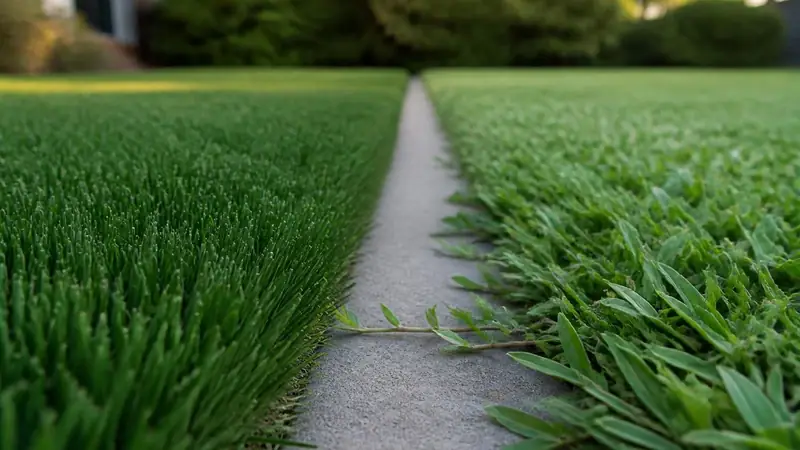
The main types of grass for U.S. lawns split into cool-season grasses (Kentucky bluegrass, tall fescue, perennial ryegrass, fine fescues) and warm-season grasses (bermudagrass, zoysiagrass, St. Augustinegrass, centipedegrass, bahiagrass, buffalograss); climate, sun and water decide which fits.
Key takeaways
- No lawn grass wins every column: NC State rates common bermudagrass 6 of 6 for drought and wear but 1 for shade, and St. Augustinegrass 5 for shade but 1 for wear (NC State Extension Gardener Handbook, Table 9-1).
- St. Augustinegrass, seashore paspalum, kikuyugrass and hybrid bermudagrass go in only as sod, sprigs or plugs, and only Zoysia japonica (Zenith, Compadre) is seeded among the zoysias (Texas A&M EHT-144; UF/IFAS LH005; UF/IFAS LH011; UC IPM).
- Recommended lawn mowing heights run from 0.75 inch for bermudagrass and zoysiagrass to 4 inches for St. Augustinegrass and bahiagrass, so one height for all warm-season lawns does not exist (NC State Table 9-1; UF/IFAS LH006).
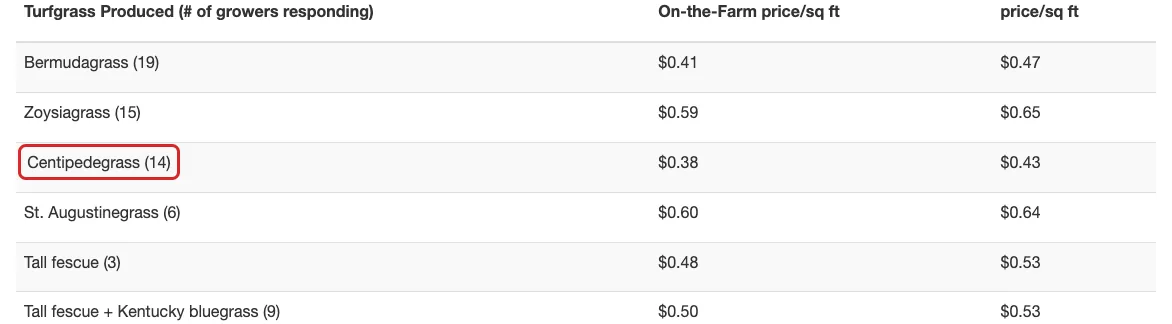
- North Carolina sod farms charged 38 cents a square foot for centipedegrass, 41 for bermudagrass, 48 for tall fescue, 50 for Kentucky bluegrass, 59 for zoysiagrass and 60 for St. Augustinegrass in 2026 (NC State 2026 Sod Producers’ Report).
- To tell the two groups apart, check the ligule: none of the cool-season turfgrasses has a ligule that is a fringe of hairs, while that feature is common on most warm-season turfgrasses (Penn State Extension).
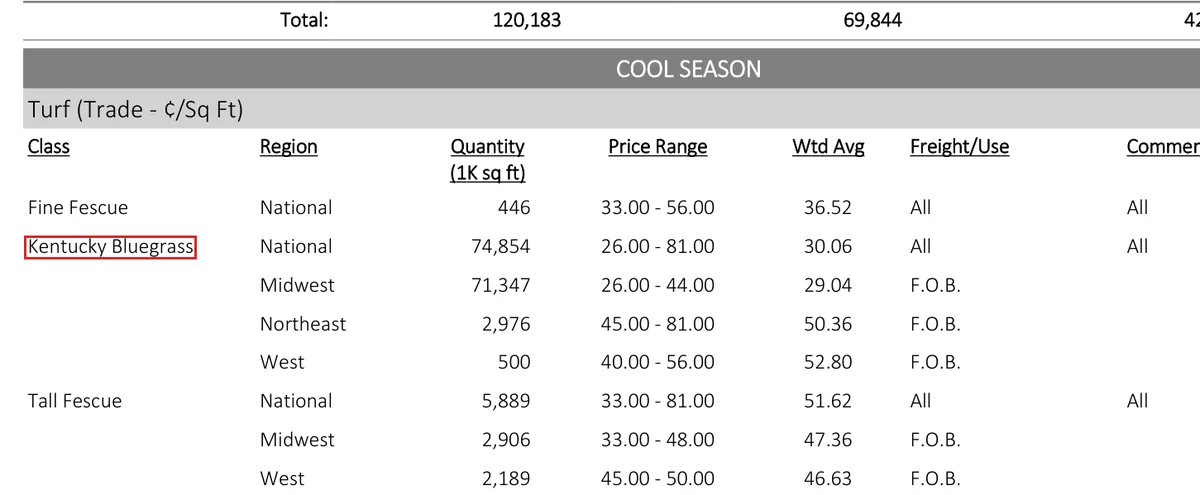
- Kentucky bluegrass was the most-sold sod in USDA’s July to September 2026 report: 74.9 million sq ft at a 30.06-cent national weighted average, against 77.46 cents for zoysiagrass (USDA AMS National Quarterly Sod Report).
14 lawn grasses compared on one table, 11 of them with a seed option
0.75 to 4 in recommended mowing heights, bermudagrass to St. Augustinegrass (NC State; UF/IFAS)
38¢ to 60¢ per sq ft at the farm, centipedegrass to St. Augustinegrass sod (NC State, 2026)
11,506 grass species worldwide in 768 genera; about a dozen make U.S. lawns (Soreng et al., 2017)
| Key number | Value | Source |
|---|---|---|
| Grass species worldwide | 11,506 in 768 genera | Soreng et al., 2017 |
| Lawn grasses compared here | 14 (5 cool-season, 9 warm-season) | This page; sources per row below |
| Lowest recommended lawn mowing height | 0.75 in (bermudagrass, zoysiagrass) | NC State Table 9-1 |
| Highest recommended lawn mowing height | 4 in (St. Augustinegrass, bahiagrass) | NC State Table 9-1; UF/IFAS LH006 |
| Cool-season seeding window, N.C. piedmont | Sept. 1 to Sept. 15 (tall fescue) | NC State Table 9-4 |
| Warm-season sod can go down when soil exceeds | 55°F | NC State Table 9-4, note a |
| Cheapest sod at N.C. farms, 2026 | Centipedegrass, $0.38 per sq ft | NC State 2026 |
| Most-sold U.S. sod, Q3 2026 | Kentucky bluegrass, 74.9 million sq ft | USDA AMS |
What are the main types of lawn grass?
Fourteen grasses cover nearly every U.S. lawn: five cool-season species that grow best in spring and fall and nine warm-season species that grow in summer and brown after frost. They differ most in mowing height (0.75 to 4 inches), yearly nitrogen (0.5 to 6 lb per 1,000 sq ft) and whether seed exists. Each figure comes from a land-grant extension publication or federal rule, led by NC State’s Table 9-1.
Swipe the table sideways to see every column.
| Grass (botanical name) | Group and where it fits | Mowing height (in) | Nitrogen (lb per 1,000 sq ft per year) | Planted as | Source |
|---|---|---|---|---|---|
| Kentucky bluegrass (Poa pratensis) | Cool-season; North, upper transition zone; full sun | 1.5 to 2.5 | 2 to 3 | Seed, 1.5 to 2 lb; 10 to 21 days to sprout; or sod | NC State 9-1, 9-4; UK AGR-52 |
| Tall fescue (Festuca arundinacea) | Cool-season; transition zone; sun to medium shade | 2.5 to 3.5 | 2 to 4 | Seed, 6 lb; 7 to 10 days to sprout; or sod | NC State 9-1, 9-4; UK AGR-52 |
| Perennial ryegrass (Lolium perenne) | Cool-season; mild summers, mixes, winter overseeding | 1.5 to 2.5 | About 3 (Pa.) | Seed, 4 to 6 lb | Penn State; UT W160-B |
| Fine fescues (Festuca rubra and relatives) | Cool-season; shade and low-input sites | 2.5 to 4, or unmowed | 0.5 to 2 | Seed, 3 to 6 lb by type | Purdue TURF-13; TURF-64 |
| Creeping bentgrass (Agrostis stolonifera) | Cool-season; golf and bowling greens, rarely lawns | 0.5 or less | 4 to 6 (Calif.) | Seed, 0.5 to 1 lb, sod or plugs | UC IPM |
| Bermudagrass (Cynodon dactylon and hybrids) | Warm-season; South, warm transition zone; full sun | 0.75 to 2 (1 to 2 with a rotary mower) | 4 to 4.5 common; 3 to 6 hybrid (N.C.) | Common: seed, 1 to 2 lb hulled; hybrids: sod, sprigs, plugs | NC State 9-1, 9-4; Texas A&M ESC-042 |
| Zoysiagrass (Zoysia spp.) | Warm-season; transition zone and South; sun to part shade | 0.75 to 2 (N.C.); 1.75 to 2.5 coarse types (Fla.) | 1 to 3 | Seed, 1 to 2 lb (Z. japonica only); sod, plugs | NC State; UF/IFAS LH011 |
| St. Augustinegrass (Stenotaphrum secundatum) | Warm-season; Gulf and South Atlantic coasts; 4 to 6 hours of sun | 2.5 to 4 (N.C.); 3.5 to 4 standard, 2 to 2.5 dwarf (Fla.) | 2 to 3 (N.C.); 2 to 6 (Fla.) | Sod, plugs, sprigs only | NC State; UF/IFAS LH010; Texas A&M EHT-144 |
| Centipedegrass (Eremochloa ophiuroides) | Warm-season; Southeast, acid soil (pH 5.0 to 6.0) | 1 to 1.5 (N.C. table); 1 to 2 (AG-381) | 1 to 2 | Seed, 0.25 to 0.5 lb, or sod | NC State; AG-381; UGA C1003 |
| Bahiagrass (Paspalum notatum) | Warm-season; Florida, Gulf coastal plain; acid, sandy soil | 3 to 4 (Fla.) | 1 to 2 (Fla.) | Seed, 5 to 10 lb, or sod | UF/IFAS LH006; LH013 |
| Buffalograss (Bouteloua dactyloides) | Warm-season native; Great Plains, 15 to 30 in of rain | 2.5 to 4, or unmowed | 2 at most | Seed (burs), 1 to 2 lb, or plugs | K-State MF658; UNL G1946 |
| Seashore paspalum (Paspalum vaginatum) | Warm-season; coastal, salt-affected sites | 1 to 2 | 2 to 5 (Ga.); 2 to 3 (Calif.) | Sod, sprigs, plugs only | UF/IFAS LH005; UGA; UC IPM |
| Carpetgrass (Axonopus spp.) | Warm-season; wet, acid Southeast soils | 1.5 to 2.5 (Fla.); 2 (N.C.) | 1 | Seed, 2 lb, or sprigs | UF/IFAS LH005; NC State AG-541 |
| Kikuyugrass (Pennisetum clandestinum) | Warm-season; coastal California, where it is treated as a weed | 1 to 1.5 | 2 | Sod or plugs; federal noxious weed | UC IPM; 7 CFR 360.200 |
Each species page goes deeper than this table, with national trial scores for 11 bermudagrass cultivars in our bermuda grass guide, 15 in our zoysia grass guide and 132 entries in our tall fescue guide.
The Southern specialists get the same treatment: 17 cultivars in our St. Augustine grass guide, pH 5.0 to 6.0 care rules in our centipede grass guide, Argentine vs Pensacola in our bahia grass guide and 1 to 2 lb seeding in our buffalo grass lawn guide.
Every species guide we publish, from seed to sod to weeds, is indexed in our Turf and Trees section.
Two rows need a warning before anyone plants them. Kikuyugrass is listed as a federal noxious weed in 7 CFR 360.200(c), a designation meant to prevent its introduction into or spread within the United States, and UC IPM calls it a weed in coastal California (UC IPM). Creeping bentgrass needs mowing at 0.5 inch or less and 4 to 6 lb of nitrogen a year; UC IPM says the skill and expense usually rule it out for home lawns, and K-State says it forms puffy, scalp-prone patches at lawn height (UC IPM; K-State).
Which types of grass are cool-season and which are warm-season?
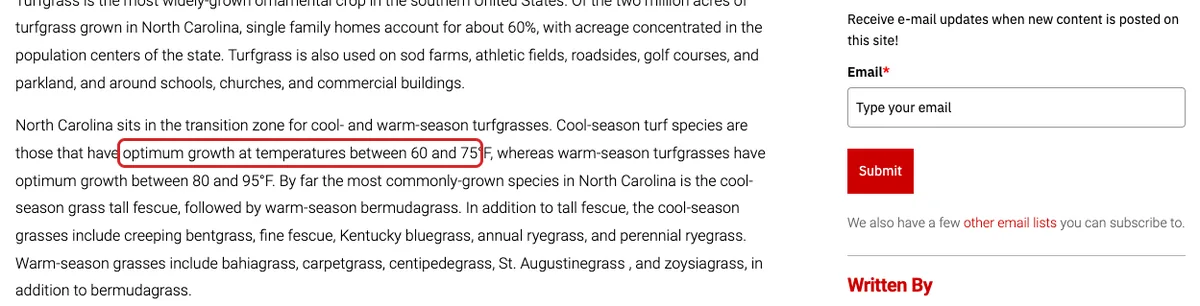
Cool-season grasses (bluegrasses, fescues, ryegrasses, bentgrasses) grow fastest in spring and fall and stay green through most winters; warm-season grasses (bermudagrass, zoysiagrass, St. Augustinegrass, centipedegrass, bahiagrass, buffalograss) grow in summer and turn tan after frost. NC State puts optimum growth at 60 to 75°F for cool-season turf and 80 to 95°F for warm-season turf (NC State TurfFiles). The split decides planting month, mowing height and fertilizer timing.
| Trait | Cool-season grasses | Warm-season grasses | Source |
|---|---|---|---|
| Optimum growth temperature | 60 to 75°F | 80 to 95°F | NC State TurfFiles |
| Winter color | Green through most of the winter | Tan and dormant after frost | NC State |
| Seeding window, N.C. | Aug. 15 to Oct. 15, by region | March to July | NC State Table 9-4 |
| Sod can be laid | Any time the ground is not frozen | When soil exceeds 55°F | NC State Table 9-4 |
| Lawn mowing heights | 1.5 to 3.5 in (bentgrass greens excepted) | 0.75 to 4 in | NC State Table 9-1 |
| Species on this page | Kentucky bluegrass, tall fescue, perennial ryegrass, fine fescues, creeping bentgrass | Bermudagrass, zoysiagrass, St. Augustinegrass, centipedegrass, bahiagrass, buffalograss, seashore paspalum, carpetgrass, kikuyugrass | This page |
Between the two belts lies the transition zone, which University of Kentucky describes as including Virginia, Kentucky, southern Indiana and Missouri (UK AGR-228). Arkansas, also in it, gets summers too hot for cool-season grasses and winters often cold enough to injure or kill warm-season grasses (Arkansas FSA2112). In North Carolina alone, NC State recommends tall fescue for a lawn that stays green year-round in the mountains and piedmont but warns it will not perform well in full sun on sandy coastal plain soil, where bermudagrass, centipedegrass and St. Augustinegrass take over (NC State).
For yards that are mostly sand, our guide to which grass can grow in sand compares drought, salt and nematode ratings with sand fit.
City-by-city heat and freeze counts for the most common transition-zone choice are in our fescue vs bermuda grass comparison.
Soil temperature, not the calendar, sets each window; the thresholds by grass are in our soil temperature for planting guide.
| Region | Climate signal | Grasses extension services list first | Source |
|---|---|---|---|
| North (Northeast, Upper Midwest, northern Rockies) | Average daily July temperature at or below 75°F suits Kentucky bluegrass | Kentucky bluegrass, fine fescues, perennial ryegrass | Penn State; Purdue TURF-13 |
| Transition zone (Va., Ky., southern Ind., Mo., Ark.) | Summers too hot for cool-season grasses, winters cold enough to injure warm-season ones | Tall fescue first; zoysiagrass or bermudagrass in the warmest parts | UK AGR-228; Arkansas FSA2112; UK AGR-52 |
| Southeast piedmont and coastal plain | Warm-season grasses mostly recommended | Bermudagrass, zoysiagrass, centipedegrass, St. Augustinegrass; carpetgrass on wet, acid soil | NC State AG-69 |
| Florida and the Gulf Coast | Five of seven warm-season species adapted statewide | St. Augustinegrass, bahiagrass, bermudagrass, zoysiagrass, seashore paspalum; centipedegrass in north Florida | UF/IFAS LH005 |
| Great Plains | 15 to 30 in of rain a year, clay soils | Buffalograss | USDA NRCS |
How do the grasses compare on shade, drought and wear?
NC State scores each lawn grass from 1 (very poor) to 6 (excellent) for shade, heat, cold, drought and wear. Hybrid bermudagrass and common bermudagrass score 6 for drought and wear but 1 for shade; St. Augustinegrass reverses that with 5 for shade and 1 for wear; tall fescue scores 4 or 5 in every column, which is why it anchors transition-zone lawns (NC State Table 9-1).
If your choice has narrowed to those two, our bermuda vs St. Augustine grass guide picks by sun hours, traffic and watering limits.
| Grass (NC State row) | Shade | Heat | Cold | Drought | Wear | Source |
|---|---|---|---|---|---|---|
| Kentucky bluegrass | 4 | 3 | 5 | 4 | 4 | NC State 9-1 |
| Tall fescue | 4 | 4 | 5 | 5 | 5 | NC State 9-1 |
| Zoysiagrass | 4 | 5 | 4 | 6 | 4 | NC State 9-1 |
| Bermudagrass, common | 1 | 5 | 1 | 6 | 6 | NC State 9-1 |
| Bermudagrass, hybrid | 1 | 5 | 2 | 6 | 6 | NC State 9-1 |
| Bahiagrass | 4 | 4 | 2 | 6 | 4 | NC State 9-1 |
| Centipedegrass | 4 | 4 | 2 | 4 | 1 | NC State 9-1 |
| St. Augustinegrass | 5 | 5 | 2 | 4 | 1 | NC State 9-1 |
Five grasses fall outside NC State’s table, and their limits come from other land-grant publications. UF/IFAS rates seashore paspalum excellent for salt but poor for shade, and carpetgrass poor for drought, salt and wear but suited to acid, wet soil (UF/IFAS LH005). UC IPM rates creeping bentgrass low for drought and wear (UC IPM). Buffalograss needs 6 to 8 hours of direct sun (K-State MF658) but roots 3 feet or deeper, against 8 inches for Kentucky bluegrass (UNL G1946).
| Florida lawn grass | Drought | Salt | Shade | Wear | Soil |
|---|---|---|---|---|---|
| Bahiagrass | Excellent | Very poor | Fair | Poor | Acid, sandy |
| Bermudagrass | Excellent | Good | Poor | Excellent | Wide range |
| Carpetgrass | Poor | Poor | Fair | Poor | Acid, wet |
| Centipedegrass | Good | Poor | Fair | Fair | Acid, infertile |
| Seashore paspalum | Good | Excellent | Poor | Good to excellent | Wide range |
| St. Augustinegrass | Good | Good | Good to excellent (by cultivar) | Poor to fair | Wide range |
| Zoysiagrass | Excellent | Good | Good to excellent (by cultivar) | Good to excellent | Wide range |
What type of grass do I have?
Pull a healthy shoot and check five things in order: how the newest leaf is packed in the shoot (folded or rolled), the ligule where blade meets sheath (membrane or fringe of hairs), any auricles, the leaf tip (boat-shaped or pointed) and how the plant spreads (stolons, rhizomes or clumps). Purdue and Penn State keys use these same traits.
- Confirm it is a grass. Grasses carry leaves in two ranks and round stems; sedges such as nutsedge have leaves in ranks of three and a triangular stem (Purdue). Sedges are weeds, covered in our nutsedge control guide.
- Roll the shoot between thumb and finger. If it rolls like a straw, the vernation is rolled; if it lies flat with edges, it is folded (Penn State).
- Bend the leaf back at the collar and look for the ligule: a thin membrane, a fringe of hairs or nothing. Penn State notes that none of the cool-season turfgrasses has a fringe-of-hairs ligule, while most warm-season turfgrasses do; bahiagrass and centipedegrass are the warm-season exceptions with a short membrane (Penn State; TurfFiles).
- Look for auricles, the small ear-like flaps at the collar. Perennial ryegrass has small, rudimentary auricles and annual ryegrass long, clasping ones; Kentucky bluegrass, the fine fescues and creeping bentgrass have none (Penn State).
- Check the leaf tip and the veins. Kentucky bluegrass has a boat-shaped (keeled) tip and one prominent mid-vein that looks like two lines down the leaf; tall fescue has a pointed tip and many equal-sized veins (Penn State).
- Dig up a runner. Above-ground stolons point to bermudagrass, St. Augustinegrass, centipedegrass, zoysiagrass, buffalograss, carpetgrass or creeping bentgrass; below-ground rhizomes to Kentucky bluegrass, bermudagrass, zoysiagrass or bahiagrass; no runners to tall fescue or perennial ryegrass (NC State TurfFiles).
- Note the winter color. A lawn that browns after the first hard frost is warm-season; one that stays green through most of the winter is cool-season (NC State).
Swipe the table sideways to see every column.
| Grass | Vernation | Ligule | Auricles | Leaf tip and blade | Spreads by | Source |
|---|---|---|---|---|---|---|
| Kentucky bluegrass | Folded | Membrane, 0.2 to 1 mm | None | Boat-shaped; two clear lines beside the midrib; 2 to 4 mm wide | Rhizomes | TurfFiles |
| Rough bluegrass | Folded | Membrane, pointed, 4 to 6 mm | None | Boat-shaped; glossy; 1 to 4 mm | Stolons | TurfFiles |
| Tall fescue | Rolled | Membrane, 0.5 mm or less, jagged | Rudimentary (TurfFiles); absent (Penn State) | Pointed; deeply ridged above, glossy below | Clumps; occasional short rhizomes | TurfFiles; Penn State |
| Perennial ryegrass | Folded | Membrane, 0.5 to 1.5 mm | Rudimentary | Pointed; glossy underside; 2 to 5 mm | Clumps | TurfFiles |
| Annual ryegrass | Rolled | Membrane, 1 to 2 mm | Claw-like, clasping | Pointed; glossy underside; 3 to 7 mm | Clumps | TurfFiles |
| Fine fescues | Folded | Membrane, 0.3 mm | None | Bristle-like, needle-thin | Clumps; short rhizomes in creeping red fescue | TurfFiles |
| Creeping bentgrass | Rolled | Membrane, 1 to 2 mm | None | Pointed; flat, ridged; 2 to 5 mm | Slender stolons | TurfFiles |
| Bermudagrass | Folded | Fringe of hairs, 1 to 3 mm | None | Pointed; soft; 1.5 to 3 mm | Stout stolons and rhizomes | TurfFiles |
| Zoysiagrass | Rolled | Short fringe of hairs, 0.2 mm | None | Pointed; stiff, a few long hairs near the base; 2 to 4 mm | Stolons and rhizomes | TurfFiles |
| St. Augustinegrass | Folded | Short fringe of hairs, 0.3 mm | None | Boat-shaped, blunt; 4 to 10 mm | Stout stolons | TurfFiles |
| Centipedegrass | Folded | Short membrane topped by longer hairs, 0.5 mm | None | Boat-shaped or pointed; short; grayish hair tufts at the sheath throat | Stolons | TurfFiles |
| Bahiagrass | Rolled (may look folded) | Membrane, 1 mm, white hairs on the back | None | Pointed; 4 to 8 mm; V-shaped seedhead | Stout rhizomes at the surface | TurfFiles |
| Buffalograss | Rolled | Fringe of hairs, 0.5 to 1 mm | None | Pointed; bluish-gray; 1 to 3 mm | Stout stolons | TurfFiles |
| Carpetgrass | Folded | Fringe of hairs fused at the base | None | Boat-shaped; 4 to 8 mm | Stolons | TurfFiles |
1Is the stem triangular, with leaves in ranks of three?
YesA sedge such as yellow nutsedge, not a lawn grass (Purdue).
NoGo to the next question
2Is the blade 4 to 10 mm wide with a blunt, boat-shaped tip, on thick above-ground runners?
YesSt. Augustinegrass. If the ligule hairs are fused at the base and the soil is wet and acid, check carpetgrass (TurfFiles).
NoGo to the next question
3Is the ligule a fringe of hairs, the leaf folded and 1.5 to 3 mm wide, with runners above and below ground?
YesBermudagrass; its seedhead is 3 to 5 spikes joined at the top (TurfFiles).
NoGo to the next question
4Is the ligule a very short fringe of hairs, the leaf rolled and stiff, with a few long hairs near its base?
YesZoysiagrass (TurfFiles).
NoGo to the next question
5Is the leaf bluish-gray, 1 to 3 mm wide, on stolons, in a dry Plains yard?
YesBuffalograss (TurfFiles).
NoGo to the next question
6Is the leaf short and folded, with grayish hair tufts at the sheath throat and a membrane-plus-hairs ligule?
YesCentipedegrass (TurfFiles).
NoGo to the next question
7Is the blade 4 to 8 mm wide with a V-shaped seedhead and stout rhizomes at the soil surface?
YesBahiagrass (TurfFiles).
NoGo to the next question
8Does the leaf have a boat-shaped tip and two clear lines down the middle?
YesKentucky bluegrass if it has rhizomes; rough bluegrass if it has stolons; annual bluegrass (a weed) if it has neither and whitish seedheads (TurfFiles).
NoGo to the next question
9Is the leaf rolled, wide and deeply ridged with no single midline, growing in clumps?
YesTall fescue (Penn State; TurfFiles).
NoGo to the next question
10Is the leaf folded, glossy underneath, bright green, in clumps?
YesPerennial ryegrass. Rolled with claw-like, clasping auricles: annual ryegrass (TurfFiles).
NoGo to the next question
11Are the blades needle-thin and bristle-like?
YesA fine fescue (TurfFiles).
NoGo to the next question
12Is the leaf rolled, on slender stolons, forming puffy patches at lawn height?
YesCreeping bentgrass (TurfFiles; K-State).
NoTake a plug with roots and runners attached to your county extension office.
Source: NC State TurfFiles species data; Penn State Extension; Purdue Turfgrass Science; K-State
If the key still leaves two candidates, take a plug with roots and runners attached to your county extension office, and ask them to confirm vernation, ligule and spreading habit rather than judge from a phone photo. Purdue advises examining several representative plants that are healthy and actively growing, because wilted or damaged shoots are harder to identify and species mix changes between sunny and shaded parts of a lawn (Purdue).
How much does each type of grass cost to plant?
Seed for a new 1,000 sq ft lawn costs about $5 to $46 for the common cool-season grasses and bermudagrass but $50 to $276 for coated zoysiagrass, based on our October 2026 compilation of 62 seed-bag prices. Sod costs more: 38 to 60 cents a square foot at North Carolina farms in 2026, before delivery and labor (NC State).
| Grass | Seeding rate (lb per 1,000 sq ft) | Seed cost per 1,000 sq ft | Sod, N.C. farm price 2026 | Sod, U.S. weighted average | Sources |
|---|---|---|---|---|---|
| Kentucky bluegrass | 1.5 to 3 | $5 to $18 | $0.50 | 30.06¢ | UT W160-B; NC State; USDA AMS |
| Tall fescue, turf-type | 6 to 8 | $12 to $46 | $0.48 | 51.62¢ | NC State; USDA AMS |
| Tall fescue + Kentucky bluegrass sod | n/a | n/a | $0.50 | 37.89¢ | NC State; USDA AMS |
| Perennial ryegrass | 4 to 6 | $10 to $30 | n/r | n/r | UT W160-B |
| Fine fescues | 3 to 5 | $9 to $30 | n/r | 36.52¢ | UT W160-B; USDA AMS |
| Bermudagrass (hulled seed; hybrid sod) | 1 to 2 | $10 to $22 | $0.41 | 55.29¢ | NC State 9-4; NC State; USDA AMS |
| Zoysiagrass (coated seed) | 2 to 4 | $50 to $276 | $0.59 | 77.46¢ | NC State; USDA AMS |
| St. Augustinegrass | No seed sold | n/a | $0.60 | n/r | Texas A&M EHT-144; NC State |
| Centipedegrass (raw seed) | 0.25 to 0.5 | $8 to $18 | $0.38 | n/r | NC State 9-4; NC State |
| Bahiagrass (Pensacola) | 5 to 10 | $21 to $66 | $0.17 (Fla. farms, 2024) | n/r | UF/IFAS LH013; UF/IFAS EP658 |
| Buffalograss (burs) | 1 to 2 | $36 to $82 | n/r | n/r | UNL G1946 |
The national report moves every quarter, and its mix of grasses changes with it. USDA’s July to September 2026 edition priced only five classes (fine fescue, Kentucky bluegrass, tall fescue, bermudagrass and zoysiagrass) from 15 producers, with bermudagrass averaging 55.29 cents nationally but 47.12 in the South (USDA AMS).
Worked example: seed or sod for a 5,000 sq ft lawn
Multiply lawn area in thousands of square feet by the per-1,000 figure. For 5,000 sq ft of tall fescue that is 5 x $12 to $46, or $60 to $230 of seed, against 5,000 x $0.48, or $2,400, of sod at a North Carolina farm. Delivery and installation come on top of sod; our sod installation cost page prices them.
| Grass, 5,000 sq ft | Seed needed (lb) | Seed cost | Sod at N.C. farm price | Sod to seed ratio (midpoints) |
|---|---|---|---|---|
| Tall fescue | 30 to 40 | $60 to $230 | $2,400 | 17 to 1 |
| Kentucky bluegrass | 7.5 to 15 | $25 to $90 | $2,500 | 43 to 1 |
| Bermudagrass (common seed vs hybrid sod) | 5 to 10 | $50 to $110 | $2,050 | 26 to 1 |
| Zoysiagrass (coated seed) | 10 to 20 | $250 to $1,380 | $2,950 | 4 to 1 |
| Centipedegrass (raw seed) | 1.25 to 2.5 | $40 to $90 | $1,900 | 29 to 1 |
| St. Augustinegrass | No seed sold | n/a | $3,000 | n/a |
Seed: extension seeding rates x sellers' published bag prices checked Oct. 18, 2026 (see our grass seed cost guide). Sod: NC State 2026 on-the-farm to delivered averages. Materials only; no labor, soil prep, tax or shipping.
St. Augustinegrass and seashore paspalum are sold only as sod, sprigs or plugs, which settles the question for them (UF/IFAS LH005). For the other grasses, our sod vs seed guide compares weeks to full cover and slope erosion.
Which type of grass should you plant?
Start with sun hours and winter low, then water. Bermudagrass needs more light than any other maintained turfgrass (Mississippi State P2892), St. Augustinegrass gets by on 4 to 6 hours (Texas A&M EHT-144), fine fescues suit low-input sites with some shade (UK AGR-52), and buffalograss is native where 15 to 30 inches of rain fall a year (USDA NRCS).
| If your yard is | Plant | Why (source) |
|---|---|---|
| North of the transition zone, full sun, irrigated | Kentucky bluegrass, 1.5 to 2 lb seed Aug. 15 to Sept. 1 | Rhizomes repair damage; needs irrigation when fed heavily (NC State 9-4; UK AGR-52) |
| North, shade under trees or low-input | Fine fescue, or 1.5 + 1.5 lb fine fescue and Kentucky bluegrass | Fine fescues take some shade and 0.5 to 2 lb nitrogen a year; no grass takes heavy shade (Purdue TURF-13; UK AGR-52) |
| Transition zone, green year-round wanted | Turf-type tall fescue, 6 lb seed in early fall | NC State calls it the best grass for a green lawn year-round in its mountains and piedmont (NC State) |
| South, full sun, heavy traffic from kids, dogs or play | Bermudagrass: hulled seed 1 to 2 lb, or hybrid sod | Wear 6 of 6, shade 1 of 6 (NC State 9-1); it needs more light than any other maintained turfgrass (Mississippi State P2892) |
| South, 4 to 6 hours of direct sun | St. Augustinegrass sod, or zoysiagrass in the transition zone | St. Augustinegrass needs 4 to 6 hours of light (Texas A&M EHT-144); both rate good to excellent for shade by cultivar (UF/IFAS LH005) |
| Southeast, acid sandy soil, minimal mowing and feeding | Centipedegrass (0.25 to 0.5 lb seed) or, in Florida, bahiagrass (5 to 10 lb) | 1 to 2 lb nitrogen a year for either; centipedegrass yellows above about pH 6.5 (UGA C1003; UF/IFAS LH006) |
| Great Plains, no irrigation, 6 to 8 hours of sun | Buffalograss, 1 to 2 lb treated burs once soil reaches 60°F | Native to 15 to 30 in of rain; roots 3 ft deep (USDA NRCS; UNL G1946) |
| Coastal yard with salty soil or brackish irrigation | Seashore paspalum sod or sprigs | Only lawn grass UF/IFAS rates excellent for salt; poor in shade (UF/IFAS LH005) |
| Wet, acid, low spot where other grasses fail | Carpetgrass, 2 lb seed | Performs on wet, shady, acid soils; does not tolerate drought, salt or wear (NC State AG-541) |
| Bermudagrass lawn, want winter green | Overseed perennial ryegrass, 5 to 10 lb in fall | Ryegrass covers winter, then competes with bermudagrass green-up (UGA) |
1Is the yard north of the transition zone, where July averages 75°F or less?
YesKentucky bluegrass in sun; fine fescue or a fine fescue and bluegrass mix in shade (Penn State; NC State; Purdue).
NoGo to the next question
2Is it in the transition zone, and do you want green grass in winter?
YesTurf-type tall fescue, 6 lb per 1,000 sq ft in early fall (NC State).
NoGo to the next question
3Is the soil or irrigation water salty near the coast?
YesSeashore paspalum, planted as sod or sprigs (UF/IFAS).
NoGo to the next question
4Is it a dry Great Plains yard with no irrigation and 6 to 8 hours of sun?
YesBuffalograss (K-State; UNL).
NoGo to the next question
5Does it get full sun and heavy traffic?
YesBermudagrass (NC State).
NoGo to the next question
6Does it get only 4 to 6 hours of direct sun?
YesSt. Augustinegrass on the Gulf and South Atlantic coasts; zoysiagrass in the transition zone (Texas A&M; UF/IFAS).
NoGo to the next question
7Is the soil acid and sandy, and do you want to mow and feed as little as possible?
YesCentipedegrass in the Carolinas and Georgia; bahiagrass in Florida (UGA; UF/IFAS).
NoGo to the next question
8Is the spot wet and acid where other grasses fail?
YesCarpetgrass, 2 lb seed per 1,000 sq ft (NC State AG-541).
NoZoysiagrass or bermudagrass; ask your county extension office which cultivars its state trials favor.
Source: Decision table above; NC State, UF/IFAS, Texas A&M, K-State, UNL, UGA, Purdue, Penn State
Can you mix different types of grass?
Cool-season species mix within limits that University of Kentucky spells out, and warm-season lawns take a cool-season partner only for winter color. University of Kentucky pairs Kentucky bluegrass with perennial ryegrass or fine fescue but says tall fescue should not be mixed with either, and stands seeded with 25 percent or more perennial ryegrass by weight end up dominated by it (UK AGR-52).
| Mix | Seed rate or ratio | What each grass adds or risks | Source |
|---|---|---|---|
| Kentucky bluegrass + perennial ryegrass | 1.5 + 1 lb (N.C.); about 15% ryegrass by weight, 0.25 + 1.75 lb (Ky.) | Ryegrass sprouts fast for quick cover; at 25% or more by weight it takes over the stand | NC State 9-4; UK AGR-52 |
| Kentucky bluegrass + fine fescue | 1.5 + 1.5 lb | Fine fescue adds shade and low-fertility tolerance; it will not survive heavy nitrogen | NC State 9-4; UK AGR-52 |
| Tall fescue + Kentucky bluegrass | 5 + 1 lb (N.C.); 90 to 95% tall fescue by seed weight (Iowa) | Bluegrass rhizomes help fill gaps the bunch-type fescue leaves; Kentucky reserves the mix for sod farms | NC State 9-4; Iowa State; UK AGR-52 |
| Tall fescue + perennial ryegrass or fine fescue | Not recommended | Texture and growth differ too much, so the lawn looks patchy | UK AGR-52 |
| Bermudagrass + perennial ryegrass (winter only) | 5 to 10 lb ryegrass into dormant bermudagrass in fall | Green winter lawn; the ryegrass competes with bermudagrass green-up in spring | UGA |
Warm-season lawns get a cool-season partner only for winter color. Georgia extension seeds 5 to 10 lb of perennial ryegrass per 1,000 sq ft into dormant bermudagrass in fall, and the ryegrass then competes with the bermudagrass as it greens up in spring (UGA). Our perennial ryegrass guide covers that transition; the steps for thickening a cool-season lawn are in our overseeding guide.
Where do popular grass-type guides disagree with extension data?
One widely read grass-type guide gives a single summer mowing height for most warm-season grasses and another for cool-season grasses. The table quotes both statements as published on Oct. 30, 2026, next to the extension figure, so readers can check both. The largest gap is St. Augustinegrass, which UF/IFAS mows at 3.5 to 4 inches, above one guide’s 2 to 3 inch warm-season range (UF/IFAS LH010).
| What a guide says (as published) | What the extension source says | Source |
|---|---|---|
| “For most warm-season grasses, mowing height should be 2 to 3 inches” in summer (Lawn Love) | Bermudagrass 1 to 2 in with a rotary mower; centipedegrass 1 to 1.5 in (N.C.); St. Augustinegrass 3.5 to 4 in for standard cultivars; bahiagrass 3 to 4 in | Texas A&M ESC-042; NC State 9-1; UF/IFAS LH010; UF/IFAS LH006 |
| “For cool-season grasses, keep mowing height at 3 to 4 inches in summer” (Lawn Love) | Kentucky bluegrass 1.5 to 2.5 in (N.C.); perennial ryegrass 1.5 to 2.5 in (Pa.); tall fescue 3.5 in in summer, never below 2.5 in | NC State 9-1; Penn State; NC State AG-367 |
Which grasses in a lawn are weeds, not lawn types?
Several grasses that show up in lawns are weeds or ornamentals, not turf types, and a lawn-grass ID key will not place them. Crabgrass is a summer annual, johnsongrass a rhizome-spreading perennial (NC State TurfFiles; TurfFiles), and nutsedge is a sedge, not a grass (Purdue). Our common lawn weeds guide covers the broader ID.
The most common mix-up, crabgrass in or beside a bermudagrass lawn, has its own side-by-side crabgrass vs bermuda grass key with ligule and blade-width measurements.
| Plant in the lawn | What it is | Tell-tale trait | Where we cover it |
|---|---|---|---|
| Crabgrass | Summer annual grassy weed | Rolled leaf, hairy on both sides, 5 to 15 mm wide; membrane ligule, often reddish | TurfFiles; our crabgrass guide |
| Annual bluegrass (Poa annua) | Winter annual grassy weed | Boat-shaped tip like Kentucky bluegrass but no rhizomes; light green; whitish seedheads | TurfFiles; our common lawn weeds guide |
| Johnsongrass | Perennial grassy weed | Blades 10 to 30 mm wide with a white raised midvein; rhizomes; purplish seedhead | TurfFiles; our johnsongrass control guide |
| Yellow foxtail | Summer annual grassy weed | Rolled leaf with long hairs on the upper surface near the base; dense fringe-of-hairs ligule; bristly spike seedhead | TurfFiles; our foxtail guide |
| Dallisgrass | Perennial grassy weed | Rolled, 7 to 15 mm blade; membrane ligule up to 5 mm; seedhead of 3 to 8 branches with hairy spikelets | TurfFiles |
| Yellow nutsedge | Perennial sedge, not a grass | Triangular stem, leaves in ranks of three, tan tubers | TurfFiles; Purdue; our nutsedge guide |
Pampas grass, pink muhly and other unmowed ornamentals belong in beds; our ornamental grasses guide lists them.
Where no turfgrass fits, compare a clover lawn or artificial turf before reseeding.
Artificial turf still needs a weekly rinse and regular brushing, and our guide to cleaning artificial grass sets out the schedule from the makers’ manuals.
How we compiled this
This page draws on 63 primary documents: extension publications from 14 land-grant universities, NC State’s 2026 sod producer survey, USDA’s quarterly sod report and the Soreng et al. grass classification, all accessed in October 2026. Seed costs reuse our Oct. 18, 2026 compilation of 62 published bag prices. We did no field trials, plant identification or price surveys of our own.
This page is general information. Seed and herbicide labels, state fertilizer rules and local ordinances govern what you can apply; confirm with your county extension office before you plant or treat a lawn.
Swipe the table sideways to see every column.
| Grass | Group | Mow (in) | Seed? | Best trait (source) |
|---|---|---|---|---|
| Kentucky bluegrass | Cool | 1.5 to 2.5 | Yes | Self-repair by rhizomes (UK) |
| Tall fescue | Cool | 2.5 to 3.5 | Yes | Transition-zone all-rounder, 4 to 5 of 6 (NC State) |
| Perennial ryegrass | Cool | 1.5 to 2.5 | Yes | Fastest cover; winter overseeding (UGA) |
| Fine fescues | Cool | 2.5 to 4 | Yes | Shade, low fertility (Purdue) |
| Creeping bentgrass | Cool | 0.5 or less | Yes | Putting greens only (UC IPM) |
| Bermudagrass | Warm | 0.75 to 2 | Common types | Wear and drought, 6 of 6 (NC State) |
| Zoysiagrass | Warm | 0.75 to 2.5 | Z. japonica only | Drought 6 of 6, shade 4 (NC State) |
| St. Augustinegrass | Warm | 2 to 4 | No | Shade 5 of 6 (NC State) |
| Centipedegrass | Warm | 1 to 2 | Yes | 1 to 2 lb nitrogen a year (NC State) |
| Bahiagrass | Warm | 3 to 4 | Yes | Low input on sandy soil (UF/IFAS) |
| Buffalograss | Warm | 2.5 to 4 | Yes (burs) | Roots 3 ft deep (UNL) |
| Seashore paspalum | Warm | 1 to 2 | No | Salt tolerance excellent (UF/IFAS) |
| Carpetgrass | Warm | 1.5 to 2.5 | Yes | Wet, acid soil (NC State) |
| Kikuyugrass | Warm | 1 to 1.5 | No | Federal noxious weed (7 CFR 360.200) |
Frequently asked questions
How many types of grass are there?
The grass family, Poaceae, holds about 11,506 species in 768 genera, according to the 2017 worldwide classification by Soreng and colleagues (Journal of Systematics and Evolution). Only about 14 are planted as U.S. lawn turf: 5 cool-season and 9 warm-season species, compared in the master table above.
What is the most common type of lawn grass?
No national count of lawns by species exists in the sources we checked, but sod sales are tracked. Kentucky bluegrass was 74.9 million of the 120.2 million sq ft of sod in USDA’s July to September 2026 report (USDA AMS). In North Carolina, NC State names tall fescue the most commonly grown species, followed by bermudagrass (NC State TurfFiles).
What grass grows best in shade?
Among warm-season grasses, St. Augustinegrass scores 5 of 6 for shade in NC State’s table (NC State) and still needs 4 to 6 hours of sun (Texas A&M). Among cool-season grasses, fine fescues are the low-input pick where some shade is present, though University of Kentucky says no grass is adapted to heavy shade (UK AGR-52).
What is the most drought-tolerant grass?
NC State scores bermudagrass, zoysiagrass and bahiagrass 6 of 6 for drought (NC State). UF/IFAS notes that an excellent rating reflects dormancy that helps a grass survive drought, not a lawn that stays green without water (UF/IFAS LH005). Buffalograss roots 3 feet or deeper on the Plains (UNL G1946).
Can you mix different types of grass seed?
Yes, within limits. Kentucky bluegrass mixes with perennial ryegrass or fine fescue, but stands seeded with 25 percent or more ryegrass by weight end up dominated by it, and tall fescue should not be mixed with ryegrass or fine fescue (UK AGR-52). NC State lists 5 lb tall fescue plus 1 lb bluegrass per 1,000 sq ft.
Which grass spreads fastest to make a thick lawn?
NC State rates common bermudagrass and tall fescue fast to establish, Kentucky bluegrass moderate and zoysiagrass very slow (NC State 9-1); zoysia plugs take two to four years to cover (NC State AG-432). Once established, tall fescue grows in clumps and needs reseeding, while bluegrass rhizomes regrow into thin spots (UK AGR-52).
Sources
- NC State Extension, Extension Gardener Handbook, Chapter 9: Lawns (Tables 9-1 and 9-4), Current online edition. Accessed October 2026.
- NC State Extension, 2026 Sod Producers’ Report for North Carolina (Table: on-the-farm and delivered price per sq ft), Survey 2026. Accessed October 2026.
- USDA Agricultural Marketing Service, National Quarterly Sod Report, July 1 to Sept. 30, 2026, Q3 2026, released Oct. 21, 2026. Accessed October 2026.
- UF/IFAS Extension, ENH1394/EP658, Florida Sod Inventory and Pricing Report, 2025, 2024 prices, survey January 2025. Accessed October 2026.
- Penn State Extension (P. Landschoot), The Cool-Season Turfgrasses: Identification, Updated Sept. 11, 2025. Accessed October 2026.
- Penn State Extension, Turfgrass Species for Pennsylvania, Updated Nov. 10, 2016. Accessed October 2026.
- Purdue University Turfgrass Science, How to Identify a Turfgrass (identification tool instructions), Undated web page. Accessed October 2026.
- University of Kentucky Cooperative Extension, AGR-52, Selecting the Right Grass for Your Kentucky Lawn, Issued Aug. 2019. Accessed October 2026.
- University of Tennessee Extension, W160-B, Turfgrass Establishment: Seeding, October 2007. Accessed October 2026.
- Texas A&M AgriLife Extension, ESC-042, Bermudagrass Lawn Management Calendar, June 2016. Accessed October 2026.
- UF/IFAS Extension, ENH11/LH011, Zoysiagrass for Florida Lawns, Current EDIS edition. Accessed October 2026.
- UF/IFAS Extension, ENH5/LH010, St. Augustinegrass for Florida Lawns, Current EDIS edition. Accessed October 2026.
- Texas A&M AgriLife Extension, EHT-144, St. Augustinegrass Lawn Management, Posted July 2026. Accessed October 2026.
- NC State Extension, AG-381, Centipedegrass Lawn Maintenance Calendar, Aug. 4, 2021. Accessed October 2026.
- University of Georgia Cooperative Extension, Circular 1003, Centipedegrass Decline, Full review June 21, 2022. Accessed October 2026.
- UF/IFAS Extension, ENH6/LH006, Bahiagrass for Florida Lawns, Revised May 2026. Accessed October 2026.
- UF/IFAS Extension, ENH-03/LH013, Establishing Your Florida Lawn (PDF), Revised August 2025. Accessed October 2026.
- K-State Research and Extension, MF658, Buffalograss Lawns, November 2014. Accessed October 2026.
- University of Nebraska-Lincoln Extension, G1946, Establishing Buffalograss Turf in Nebraska, May 2009. Accessed October 2026.
- NC State Extension, AG-367, Tall Fescue Lawn Maintenance Calendar, Published July 8, 2021. Accessed October 2026.
- UGA Cooperative Extension, Colquitt County (C. Waltz), Managing Overseeded Grasses in Georgia, Nov. 4, 2021. Accessed October 2026.
- Iowa State University Extension and Outreach, All About Tall Fescue: A Low-Maintenance Alternative to Kentucky Bluegrass, Current web page. Accessed October 2026.
- Soreng et al., Journal of Systematics and Evolution, A worldwide phylogenetic classification of the Poaceae (Gramineae) II, vol. 55, no. 4, pp. 259 to 290, 2017. Accessed October 2026.
- Lawn Love, Grass types guide, /blog/guide-to-grass-types/ (as published), Checked Oct. 30, 2026. Accessed October 2026.
- NC State TurfFiles, Turfgrass identification: Kentucky bluegrass (species data), Current page. Accessed October 2026.
- NC State TurfFiles, Turfgrass identification: tall fescue, Current page. Accessed October 2026.
- NC State TurfFiles, Turfgrass identification: perennial ryegrass, Current page. Accessed October 2026.
- NC State TurfFiles, Turfgrass identification: fine fescue, Current page. Accessed October 2026.
- NC State TurfFiles, Turfgrass identification: creeping bentgrass, Current page. Accessed October 2026.
- NC State TurfFiles, Turfgrass identification: bermudagrass, Current page. Accessed October 2026.
- NC State TurfFiles, Turfgrass identification: zoysiagrass, Current page. Accessed October 2026.
- NC State TurfFiles, Turfgrass identification: St. Augustinegrass, Current page. Accessed October 2026.
- NC State TurfFiles, Turfgrass identification: centipedegrass, Current page. Accessed October 2026.
- NC State TurfFiles, Turfgrass identification: bahiagrass, Current page. Accessed October 2026.
- NC State TurfFiles, Turfgrass identification: buffalograss, Current page. Accessed October 2026.
- NC State TurfFiles, Turfgrass identification: carpetgrass, Current page. Accessed October 2026.
- NC State TurfFiles, Turfgrass identification: rough bluegrass, Current page. Accessed October 2026.
- NC State TurfFiles, Turfgrass identification: annual ryegrass, Current page. Accessed October 2026.
- NC State TurfFiles, Weeds in turf: johnsongrass, Updated Oct. 7, 2022. Accessed October 2026.
- NC State TurfFiles, Weeds in turf: yellow foxtail, Current page. Accessed October 2026.
- NC State TurfFiles, Weeds in turf: large crabgrass, Current page. Accessed October 2026.
- NC State TurfFiles, Weeds in turf: annual bluegrass, Current page. Accessed October 2026.
- NC State TurfFiles, Weeds in turf: dallisgrass, Current page. Accessed October 2026.
- NC State TurfFiles, Weeds in turf: yellow nutsedge, Oct. 7, 2022. Accessed October 2026.
- Mississippi State University Extension, P2892, Selecting and Managing Turfgrass for Shade, POD-07-24. Accessed October 2026.
- USDA Natural Resources Conservation Service, Plant Guide: Buffalograss, Bouteloua dactyloides (BODA2), September 2013. Accessed October 2026.
- NC State Extension, AG-432, Zoysiagrass Lawn Maintenance Calendar, Published July 10, 2025. Accessed October 2026.
- NC State TurfFiles, Grasses (index page: cool-season vs warm-season optimum temperatures), Updated Oct. 27, 2025. Accessed October 2026.
- NC State Extension, AG-69, Carolina Lawns: A Guide to Maintaining Quality Turf in the Landscape, July 2, 2021. Accessed October 2026.
- NC State Extension, AG-541, Carpetgrass Lawn Maintenance Calendar, Aug. 5, 2021. Accessed October 2026.
- UF/IFAS Extension, ENH04/LH005, Selecting a Turfgrass for Florida Lawns, Table 1 (PDF page 4), Revised August 2025. Accessed October 2026.
- University of Georgia CAES, GeorgiaTurf, Seashore Paspalum (species page), Undated page. Accessed October 2026.
- UC Statewide IPM Program, UC Guide to Healthy Lawns: Planting and management tips for seashore paspalum, 2017. Accessed October 2026.
- UC Statewide IPM Program, UC Guide to Healthy Lawns: Kikuyugrass, Pennisetum clandestinum, 2017. Accessed October 2026.
- UC Statewide IPM Program, UC Guide to Healthy Lawns: Planting and management tips for kikuyugrass, 2017. Accessed October 2026.
- U.S. Code of Federal Regulations (eCFR), 7 CFR 360.200(c), Designation of noxious weeds: terrestrial weeds, Current as of October 2026. Accessed October 2026.
- UC Statewide IPM Program, UC Guide to Healthy Lawns: Planting and management tips for creeping bentgrass, 2017. Accessed October 2026.
- UC Statewide IPM Program, UC Guide to Healthy Lawns: Turf species not adapted to hot climates (adaptations and tolerances table), 2017. Accessed October 2026.
- K-State Research and Extension, Turfgrass, Lawn Problem Solver: Creeping Bentgrass, Undated page. Accessed October 2026.
- Purdue Extension, TURF-13-W, Fine Fescues: Maintenance Calendar for Fine Fescue Lawns, March 2022. Accessed October 2026.
- Purdue Extension, TURF-64-W, Fine Fescues: Establishment of Fine Fescues, March 2022. Accessed October 2026.
- University of Kentucky Cooperative Extension, AGR-228, Optimizing Bermudagrass Athletic Field Winter Survival in the Transition Zone, Issued May 2017. Accessed October 2026.
- University of Arkansas Cooperative Extension Service, FSA2112, Choosing a Grass, Rev. May 2007. Accessed October 2026.
- Penn State Extension, Kentucky Bluegrass, Updated Sept. 8, 2025. Accessed October 2026.