A clover lawn saves fertilizer and feeds bees: microclover in grass cuts nitrogen by 1 to 2 lb per 1,000 sq ft yearly, but clover wears poorly, browns in winter, fails in shade and dies under most broadleaf herbicides.
Key takeaways
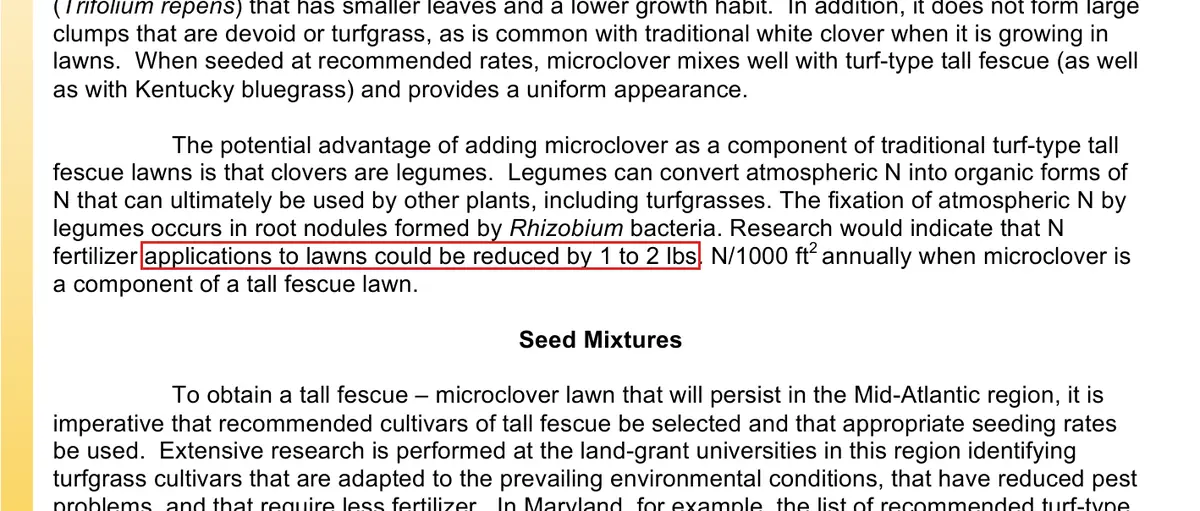
- Microclover mixed into tall fescue at 3 to 5 percent of the seed weight lets a Mid-Atlantic lawn get by on 1 to 2 lb of fertilizer nitrogen per 1,000 sq ft a year instead of 2 to 3 lb (University of Maryland TT-121).
- A vigorous white clover stand fixes 75 to 150 lb of nitrogen per acre a year in pasture, which works out to about 1.7 to 3.4 lb per 1,000 sq ft (University of Arkansas FSA-2160).
- DLF, the company that bred Microclover, says a pure white clover lawn will not tolerate traffic and does not recommend planting one (DLF Microclover guide, 2024).
- Microclover has very poor shade tolerance and can die out entirely in long heat and drought, as in Maryland in summer 2012, so plan on reseeding (TT-121).
- Herbicides with dicamba, clopyralid, fluroxypyr or quinclorac control white clover best, so a clover lawn gives up blanket broadleaf spraying; fall applications work best (Penn State Extension, 2025).
- Seed for 1,000 sq ft cost about $1 to $8 for pure white Dutch clover and $43 to $90 for pure microclover at three sellers’ October 2026 prices (Hancock Seed; Earthwise Seed).
| Key number | Value | Source |
|---|---|---|
| Microclover share of a grass seed mix | 3 to 5% by weight; above 10% the stand turns mostly clover | UMD TT-121 |
| Fertilizer nitrogen, tall fescue alone vs with microclover | 2 to 3 vs 1 to 2 lb N per 1,000 sq ft a year | UMD TT-121 |
| Soil pH for nitrogen-fixing bacteria | 6.0 to 7.0 | UMD TT-121 |
| Seeding depth for white clover | 1/8 to 1/4 inch | USDA NRCS |
| White clover seeds per pound | About 776,000 | USDA NRCS |
| Minimum direct sun for Microclover | 4 hours, or 6 to 8 hours filtered | DLF guide |
| Mowing height, tall fescue and microclover lawn | 3 to 3.5 in | UMD TT-121 |
| Bee species collected from lawn white clover and dandelions | 37 (about 50 pollinator species in all) | Larson et al., 2014 |
What is a clover lawn, and which clover goes in it?
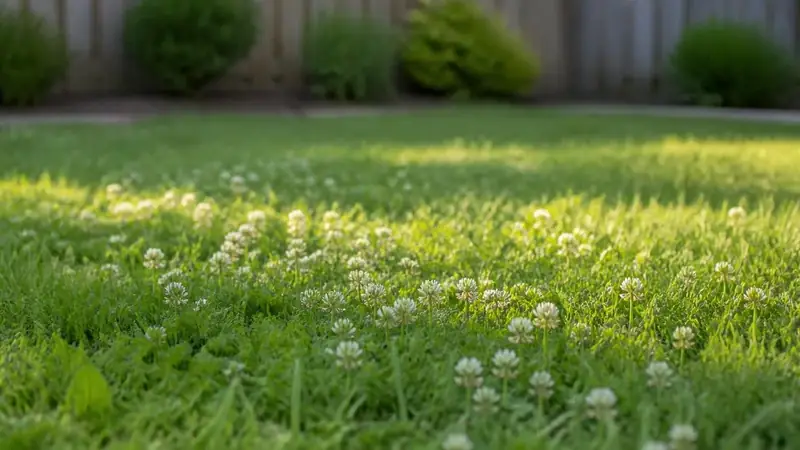
A clover lawn is either a pure stand of low white clover or, more often, a cool-season grass lawn seeded with 3 to 5 percent clover by weight. Four clovers come up in searches: white Dutch clover and microclover, both Trifolium repens, strawberry clover (T. fragiferum) and red clover (T. pratense). Only the first three stay low enough to mow as a lawn (USDA NRCS).
Clover was a valued part of lawn seed mixtures until broadleaf herbicides arrived in the 1950s, and those sprays often damaged or killed it (University of Maryland Extension; Illinois Extension). Microclover is the name for small-leaved white clover selections, chiefly ‘Pirouette’ and ‘Pipolina’, bred to grow lower, flower less and form fewer clumps than white Dutch clover.
| Clover | Species | Height | Lawn use | Main limit | Source |
|---|---|---|---|---|---|
| White Dutch clover (small and intermediate white clover) | Trifolium repens | Small types seldom exceed 3 in; seller lists 4 to 8 in | Pure clover lawn or a minor share of a grass mix | Short-lived perennial that forms patches | UGA B1251; Hancock; U. of Idaho |
| Microclover (‘Pirouette’, ‘Pipolina’) | T. repens selections | About 6 in unmown; 6 to 8 in per its breeder | 3 to 5% of the seed in tall fescue or Kentucky bluegrass | Poor shade tolerance; dies out in long heat and drought | UMD TT-121; DLF; Hancock |
| Ladino (large white clover) | T. repens | 2 to 4 times the size of common white clover | Forage, not lawns | Too large and upright for mowing short | USDA NRCS |
| Strawberry clover (‘Salina’) | T. fragiferum | 8 to 14 in | Wet, saline or alkaline soils, mainly in the West | May attract gophers in California | USDA NRCS |
| Red clover, often searched as purple clover | T. pratense | Stems average 18 in (medium) or 24 to 30 in (mammoth) | Pasture and cover crop, not lawns | Short-lived; productive for about 3 years | USDA NRCS |
Strawberry clover is the clover for problem soils. USDA NRCS rates it the most salt-tolerant clover sold, tolerant of soil pH 5.3 to 8.2, salinity up to 3 percent and flooding for up to 2 months (NRCS strawberry clover guide). White clover, by contrast, thrives in cool, moist climates and is limited by dry soils and by cold winters without snow cover.
What are the pros and cons of a clover lawn?
The pros are nitrogen, bees and slow growth on fertile, sunny, moist sites. The cons are traffic damage, winter browning, losses in shade and heat, bee stings, and a weed control program that has to work around the clover. The University of Maryland reports that tall fescue and microclover lawns usually keep better summer color than tall fescue alone, yet the clover can die out entirely in a hot, dry summer (UMD TT-121).
| Pro or con | The number or finding | Source |
|---|---|---|
| Pro: less fertilizer | Lawn nitrogen falls from 2 to 3 to 1 to 2 lb per 1,000 sq ft a year with microclover in tall fescue | UMD TT-121 |
| Pro: summer color | A tall fescue and microclover lawn usually has significantly better summer color than tall fescue alone | UMD TT-121 |
| Pro: pollinators | About 50 pollinator species, 37 of them bees, collected from white clover and dandelions in Kentucky lawns | Larson et al., 2014 |
| Pro: less water in mixed eco-lawns | Oregon State estimates an ecolawn of grasses, clover and other broadleaves needs 1/4 to 1/3 the water of a conventional lawn | Oregon State Extension |
| Con: foot traffic | A pure white clover lawn will not tolerate traffic, and clothing stains more | DLF guide |
| Con: shade | Microclover needs 4 hours of direct sun; UMD rates its shade tolerance very poor | DLF; UMD |
| Con: heat and drought | Microclover may die out entirely in extended heat and drought, as in summer 2012 | UMD TT-121 |
| Con: winter gaps | Top growth dies back in early winter; heavy seeding leaves bare soil prone to erosion | UMD TT-121 |
| Con: disease | Southern blight can kill microclover patches 2 feet or more across in humid, warm-night spells | UMD TT-121 |
| Con: persistence | White clover is a short-lived perennial; in Florida it often acts like an annual | U. of Idaho; UF/IFAS |
| Con: bees | Flowers attract bees, a problem for people with sting allergies | UMD Extension |
| Con: herbicides | Most broadleaf herbicides labeled for tall fescue severely injure or kill microclover | UMD TT-121 |
Do clover lawns attract bees?
Yes. University of Kentucky entomologists collected more than 2,100 pollinators from about 50 species, including 37 bee species, on white clover and dandelions in central Kentucky lawns in 2011 and 2012 (University of Kentucky). Honey bees and bumble bees made up a larger share of visitors on white clover than on dandelions, especially in summer, and 2 of the 6 bumble bee species found are considered uncommon.
That has two practical consequences. The same Kentucky team found that mowing flowering weeds before or soon after a grub insecticide treatment greatly reduces bee exposure (UK College News). For a lawn meant to feed bees, a 2016 University of Minnesota bee lawn handout lists a mix for about 1,000 sq ft of 4 lb of fine fescue, 1.1 oz of Dutch white clover, 1.2 oz of self-heal and 0.16 oz of creeping thyme (UMN bee lawn handout).
Which clover lawn claims hold up?
Most of the claims in clover lawn marketing are true somewhere and false somewhere else. The table sets five common claims from seed sellers and lawn blogs, as they appeared in October 2026, against what extension services and the clover’s own breeder publish. The largest gap is fertilizer: the breeder of Microclover still recommends 1 lb of nitrogen per 1,000 sq ft in spring or early summer (DLF guide).
| Common claim | What the primary source says | Source |
|---|---|---|
| Clover lawns need no fertilizer | DLF recommends 1 lb N per 1,000 sq ft in spring or early summer to keep Microclover above 50% of the stand; Hancock’s microclover page advises fertilizing every 3 to 4 months | DLF; Hancock |
| Clover is drought tolerant | Dry soils limit white clover establishment and persistence, and it seldom roots deeper than 2 ft | USDA NRCS |
| Clover handles shade | Microclover has very poor shade tolerance and should not be expected to persist under trees | UMD TT-121 |
| Clover stays green all year | White clover foliage typically dies back in winter and regrows from the crown in spring | Penn State |
| Clover never needs mowing | Unmown Microclover grows 6 to 8 in tall; DLF suggests mowing once or twice a year in no-mow mixes | DLF |
How much nitrogen does a clover lawn actually supply?
Published figures run from about 1 to 8 lb of nitrogen per 1,000 sq ft a year, depending on who measured what. Pasture research puts a vigorous white clover stand at 75 to 150 lb per acre, or 1.7 to 3.4 lb per 1,000 sq ft (U. of Arkansas). The only lawn figure, from the University of Maryland, credits microclover with replacing 1 to 2 lb of fertilizer nitrogen in tall fescue.
| Source and setting | Published figure | Conversion | lb N per 1,000 sq ft a year |
|---|---|---|---|
| U. of Arkansas FSA-2160: white clover pasture | 75 to 150 lb N per acre | ÷ 43.56 (thousand sq ft per acre) | 1.72 to 3.44 |
| U. of Arkansas FSA-2160: thin clover stands | 40 to 50 lb legume N per acre | ÷ 43.56 | 0.92 to 1.15 |
| UGA B1251: vigorous white clover stand | 100 to 150 lb N per acre | ÷ 43.56 | 2.30 to 3.44 |
| DLF: Microclover, breeder’s maximum | Up to 400 kg N per hectare | × 0.8922 = 356.9 lb per acre, ÷ 43.56 | up to 8.19 |
| UMD TT-121: microclover in tall fescue lawn | Fertilizer N cut by 1 to 2 lb per 1,000 sq ft | none needed | 1.00 to 2.00 |
| UMD TT-121: tall fescue need without clover | 2 to 3 lb per 1,000 sq ft | none needed | 2.00 to 3.00 |
Grass in a clover lawn sees less nitrogen than the pasture figures suggest. Arkansas reports that about 75 to 80 percent of a clover plant’s nitrogen sits in its topgrowth and does not leach freely into the soil, so companion grass gets it only as clippings, roots and nodules decay (FSA-2160). UGA adds that in the first year, nitrogen fixed by clover is not yet available to grasses (UGA B1251).
Three conditions decide whether fixation happens at all. Soil pH must sit between 6.0 and 7.0 for the root-nodule bacteria (UMD TT-121). Seed needs the matching Rhizobium (type B for white clover), which most clover seed carries as a coating, so check the tag date (UGA B1251). Extra fertilizer works against the clover: UMD warns that nitrogen beyond its 1 to 2 lb recommendation may shrink the microclover population.
To compare clover with bagged sources, our table on how to add nitrogen to soil lists pounds per 1,000 sq ft and price per pound of nitrogen for 18 of them.
Clover lawn vs grass: how do they compare?
A pure clover lawn is cheaper to seed and feed than tall fescue but loses on traffic, shade and winter looks. Grass with 3 to 5 percent microclover sits between them: it costs about $4 to $14 more per 1,000 sq ft than tall fescue alone to seed, needs 1 to 2 lb less nitrogen a year, and mixed stands held up to simulated traffic in a 2014 Kentucky study.
| Factor | Pure white Dutch clover | Tall fescue with 3 to 5% microclover | Tall fescue alone | Source |
|---|---|---|---|---|
| Seed per 1,000 sq ft | 1/4 to 1/2 lb (seller rates) | 6 lb tall fescue plus about 0.2 to 0.3 lb microclover | 6 to 8 lb | Hancock; Earthwise; UMD TT-121 |
| Seed cost per 1,000 sq ft, Oct. 2026 | $0.82 to $7.95 | $15.83 to $60.25 | $12 to $46 | Cost table below; our grass seed cost page |
| Fertilizer N a year | Little or none once inoculated and established | 1 to 2 lb per 1,000 sq ft | 2 to 3 lb per 1,000 sq ft | USDA NRCS; UMD TT-121 |
| Mowing height | Grows 4 to 8 in unmown; UMN bee lawns are cut at 3.5 to 4 in | 3 to 3.5 in; below 2.5 in weeds increase | 3 to 3.5 in | Hancock; UMN; UMD |
| Foot traffic | Will not tolerate traffic | Mixed stands withstood several weeks of simulated traffic | Grass carries the wear | DLF; Sparks, 2014 |
| Winter appearance | Foliage dies back to the crown | Bare spots only if clover is seeded too heavily | Grass carries the color | Penn State; UMD |
| Broadleaf weed control | No blanket spraying without killing clover | MCPA had minimal long-term impact on microclover at labeled rates | Any labeled broadleaf herbicide | UMD TT-121 |
If the reason for clover is less mowing and watering rather than nitrogen, compare the full alternatives. Our artificial turf vs real grass comparison prices the water and upkeep side, and our tall fescue guide covers the grass most often paired with microclover. Oregon State’s ecolawn mixes, which can add microclover, English daisy, Roman chamomile or alyssum to grass, are mowed every 2 to 3 weeks (Oregon State Extension).
How much does a clover lawn cost?
Seed for a clover lawn cost about $1 to $8 per 1,000 sq ft for white Dutch clover and $43 to $90 for pure microclover at three sellers’ October 2026 prices; overseeding microclover into existing grass ran $21 to $46. The spread comes from bag size and from each seller’s own seeding rate: Hancock’s microclover is $42.99 for 1 lb but $21.30 a pound in a 10 lb bag (Hancock Seed).
| Option | Seller and product | Seller’s rate per 1,000 sq ft | Price, Oct. 19, 2026 | Seed cost per 1,000 sq ft |
|---|---|---|---|---|
| Pure white Dutch clover | Hancock White Dutch Clover | 1/4 lb | $36.99 (5 lb) to $164.99 (50 lb) | $0.82 to $1.85 |
| Pure white Dutch clover | Earthwise White Dutch Clover | 1/2 lb | $7.95 (1/2 lb) to $49.95 (5 lb) | $5.00 to $7.95 |
| Pure microclover | Hancock Microclover, coated | 2 lb | $49.99 (2 lb) to $212.99 (10 lb) | $42.60 to $49.99 |
| Pure microclover | Earthwise Microclover | 2 lb (1 lb per 500 sq ft) | $44.95 (1 lb) to $189.95 (5 lb) | $75.98 to $89.90 |
| Pure microclover | Stover Micro Clover, 50% coating | 1 lb | $47.50 (1 lb) | $47.50 |
| Overseed microclover into grass | Hancock Microclover | 1 lb | $42.99 (1 lb) to $212.99 (10 lb) | $21.30 to $42.99 |
| Overseed microclover into grass | Earthwise Microclover | 1 lb | $44.95 (1 lb) to $189.95 (5 lb) | $37.99 to $44.95 |
| Overseed microclover into grass | Stover Micro Clover | 8 to 15.4 oz (65 to 125 sq ft per oz) | $47.50 (1 lb) | $23.75 to $45.67 |
| New tall fescue lawn with 3 to 5% microclover | UMD rate with the cheapest and dearest microclover above | 6 lb fescue plus 0.18 to 0.30 lb clover | Tall fescue $12 to $46 per 1,000 sq ft (our seed cost page) | $15.83 to $60.25 |
| New tall fescue lawn, no clover | Our grass seed cost compilation | 6 to 8 lb | Six products, two sellers | $12.00 to $46.00 |
Coating changes what a pound buys. Stover lists its Micro Clover as at least 45 percent seed and 50 percent Nitro Coat by weight, so a 1 lb bag holds roughly 0.45 lb of seed (Stover Seed). Hancock says the same of its coated microclover: the clay coating with inoculant takes up part of the bag. Compare coated and raw prices per pound of seed, not per pound of product.
Hired work is priced as overseeding. Lawn companies that post combined aeration and overseeding packages mostly charge $225 to $435 for a 5,000 sq ft lawn, per our lawn aeration cost survey. Ask whether the quote includes microclover at your chosen rate, since a 5,000 sq ft overseed at 1 lb per 1,000 sq ft adds $119.99 (one 5 lb Hancock bag) to $237.50 (five 1 lb Stover bags) of seed.
Does clover’s free nitrogen pay for the seed?
Rarely, on fertilizer savings alone. At Hancock’s 16-04-08 lawn fertilizer price, nitrogen cost $2.87 a pound in October 2026, so UMD’s 1 to 2 lb saving is worth $2.87 to $5.75 per 1,000 sq ft a year (Hancock Seed). Overseeding microclover at the prices above takes 3.7 to 15.9 years to repay, and Fairfax County Master Gardeners report microclover persisting about 2 to 3 years (Fairfax Master Gardeners).
| Step | Input | Result |
|---|---|---|
| 1. Price of fertilizer nitrogen | $22.99 for 50 lb of 16-04-08; 50 × 16% = 8 lb N | $2.87 per lb N |
| 2. Nitrogen saved with microclover | 1 to 2 lb per 1,000 sq ft a year (UMD TT-121) | $2.87 to $5.75 per 1,000 sq ft a year |
| 3. Microclover overseed cost | Cheapest and dearest per-1,000 sq ft cost in the cost table | $21.30 to $45.67 |
| 4. Years to repay seed | Step 3 ÷ step 2 (best case: low cost ÷ high saving) | 3.7 to 15.9 years |
| 5. 5,000 sq ft lawn | Steps 2 and 3 × 5, at per-1,000 sq ft costs | Seed $106.50 to $228.37; saving $14.37 to $28.74 a year |
The stronger cases for clover are the ones the arithmetic leaves out. UMD Extension says microclover may remove one nitrogen application a year, which saves a spreader pass, and Maryland’s Lawn Fertilizer Law aims to limit nitrogen runoff into the Chesapeake Bay (UMD Extension). A pure white Dutch clover lawn changes the math, since its seed costs $0.82 to $7.95 per 1,000 sq ft, but it gives up traffic tolerance.
How do you plant a clover lawn?
Plant clover when the soil is cool and moist: late summer to early fall for a tall fescue and microclover lawn in the Mid-Atlantic (UMD), October 15 to November 15 in Florida (UF/IFAS), or as a dormant seeding in late fall in Minnesota. Seed belongs only 1/8 to 1/4 inch deep, so contact with bare soil decides whether it grows (USDA NRCS).
- Test the soil and lime to pH 6.0 to 7.0; below that, the nitrogen-fixing bacteria in the root nodules work poorly (UMD TT-121).
- Check for herbicide carryover. UGA’s pasture guide gives 2,4-D a residual activity of 2 to 3 weeks and dicamba 120 days; your product label sets the legal reseeding interval (UGA B1251).
- Pick the rate: 1 lb of coated microclover per 1,000 sq ft into existing grass (DLF), 3 to 5 percent of the seed weight in a new tall fescue mix and never over 10 percent (UMD), or 1/4 to 1/2 lb of white Dutch clover for a pure stand (Hancock).
- Confirm the seed tag shows inoculant that has not expired. Fairfax County Master Gardeners note a 6-month shelf life on pre-inoculated microclover (Fairfax Master Gardeners).
- Mow the existing grass low, to about 1 inch for a Minnesota bee lawn overseed, and core aerate to expose soil (UMN; Illinois Extension).
- Broadcast half the seed in each of two directions, then rake lightly or topdress with 1/4 inch of compost so seed ends up 1/8 to 1/4 inch deep (NRCS; Fairfax).
- Water daily for the first 7 to 10 days (Illinois Extension). Germination takes 7 to 14 days and Microclover usually establishes within 2 to 3 weeks (Stover; DLF).
- Keep foot traffic off for 4 to 8 weeks while roots develop (Fairfax Master Gardeners).
- Once established, mow a tall fescue and microclover lawn at 3 to 3.5 inches and remove no more than 1/3 of the growth per cut (UMD TT-121).
The chart shows why seller rates look so different: they mix pure stands, overseeding and coated weights. A pure white Dutch stand takes 4 to 8 oz per 1,000 sq ft, while coated microclover runs 16 to 32 oz, of which half may be coating. Our overseeding guide covers mowing, aerating and watering for the grass side of the job.
Can I just throw clover seed on my lawn?
You can broadcast clover onto an existing lawn, but seed left on top of thick grass or thatch rarely establishes. Illinois Extension has you mow at the lowest setting, rake and core aerate first, then water every day for 7 to 10 days (Illinois Extension). DLF adds that a late-summer seeding must go down at least 6 weeks before the expected killing frost (DLF guide).
When should you plant clover in your region?
Timing follows soil temperature and moisture more than the calendar. White clover germinates in soil between 41°F and 83°F, best at 52°F to 63°F, according to Fairfax County Master Gardeners (Fairfax). Most sources favor fall seeding because summer heat and spring weeds both hurt seedlings; Florida is the exception, where clover behaves as a winter crop. The table lists the window each source gives.
| Region or setting | Planting window | Watch for | Source |
|---|---|---|---|
| Mid-Atlantic, tall fescue and microclover | Late summer to early fall | Spring seeding risks heat, drought and crabgrass competition | UMD TT-121 |
| Illinois, microclover overseed | Early spring to late summer | Keep soil moist 7 to 10 days | Illinois Extension |
| Minnesota, bee lawn | Dormant seed late October to early November, when soil drops below 40°F; or May after frost | Spring seeding needs regular watering and faces more weeds | UMN; UMN |
| Florida | October 15 to November 15 | Freezes below 25°F can kill seedlings; clover often acts as an annual | UF/IFAS SS-AGR-54 |
| Intermountain West (NRCS Idaho guide), unirrigated | Early April to mid-May | Seed late summer or fall only with irrigation and 6+ weeks of growing season left | USDA NRCS |
| Seller guidance, all regions | Spring nights at 40°F or warmer; fall at least 8 weeks before first frost | Coated seed, 7 to 14 day germination | Hancock Seed |
What kills clover but not grass, and what spares clover?
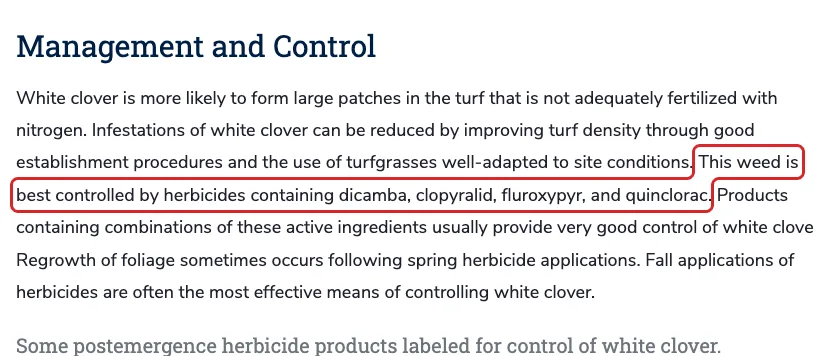
Herbicides containing dicamba, clopyralid, fluroxypyr or quinclorac control white clover best, and fall applications are usually the most effective, according to Penn State Extension. Clopyralid products are for non-residential turf only. The reverse question is harder: UMD’s 2015 bulletin says most broadleaf herbicides labeled for tall fescue severely injure or kill microclover, so a clover lawn gives up blanket broadleaf spraying.
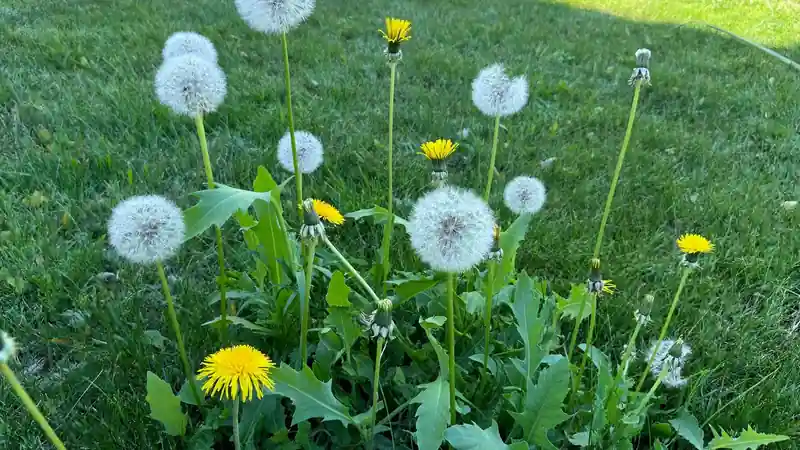
If you want dandelions gone but the clover kept, digging is the only selective option; our page on killing dandelions without harming the lawn gives the dig depth and the trial results.
This section is general information, not pesticide advice. The product label is the law: confirm that white clover and your turf species are listed, and follow its rate, temperature and reseeding limits.
To get rid of clover in a lawn without killing the grass, combine fertility, mowing and a fall spot treatment. University of Idaho’s 2026 bulletin and Penn State give the numbers in the steps below (U. of Idaho BUL 1125). White clover patches signal a lawn short of nitrogen, so the steps fix the cause as well as the weed. Our crabgrass guide covers the grassy-weed side of the same program.
- Raise the mower to 2.5 to 3 inches; short mowing thins grass and lets light reach clover seedlings (U. of Idaho).
- Feed 1/2 lb of nitrogen per 1,000 sq ft for each month of active grass growth, spread across the season (U. of Idaho).
- Hand-pull young plants before they spread by stolons; established patches need more than pulling.
- In fall, spot-spray a product labeled for white clover, ideally one that combines two or more actives such as 2,4-D, MCPP and dicamba (Penn State; U. of Idaho).
- Skip applications near trees, shrubs and garden plants when temperatures will exceed 85°F in the next 72 hours (U. of Idaho).
- Expect some regrowth after spring treatments and plan a second, fall application (Penn State).
Commercial applicators need a state pesticide license for weed-and-feed and broadleaf sprays, which our pesticide applicator license guide covers by state.
Which herbicides can a clover lawn tolerate?
Very few, and the sources disagree on the details. DLF says Microclover tolerates 2,4-D, and a 2014 University of Kentucky greenhouse study found 2,4-D the only broadleaf herbicide safe on both white clover types tested (Sparks, 2014). Penn State, however, lists 2,4-D combinations among white clover controls. Treat any herbicide in a clover lawn as a spot test on a small area first.
| Active ingredient | What each source reports | Source |
|---|---|---|
| 2,4-D | Microclover tolerates it (DLF); safe on both white clover varieties in a greenhouse test (Sparks); combination products listed as white clover controls (Penn State) | DLF; Sparks; Penn State |
| MCPA | Minimal long-term impact on microclover at labeled rates, per Penn State research cited by UMD | UMD TT-121 |
| Quinclorac | Microclover tolerated it in a greenhouse test (Sparks); listed as a best white clover control (Penn State) | Sparks; Penn State |
| Dicamba, fluroxypyr, triclopyr | Control white clover; avoid in a clover lawn | Penn State |
| Clopyralid | Controls white clover; not for residential lawns | Penn State |
| Annual grass preemergence herbicides | Shown safe on established microclover | UMD TT-121 |
Should you plant a clover lawn?
Plant clover where the lawn gets at least 4 hours of direct sun, the soil can be limed to pH 6.0 to 7.0 and nobody plays sports on it daily. For most cool-season lawns the safer form is grass with 3 to 5 percent microclover rather than pure clover. Skip clover where you rely on broadleaf weed sprays or where someone in the household has a bee sting allergy.
| If your situation is | Do this | Why (source) |
|---|---|---|
| Kids or dogs run on the lawn daily | Keep grass; add microclover at 3 to 5% at most | A pure white clover lawn will not tolerate traffic (DLF) |
| Under 4 hours of direct sun, or under trees | Do not rely on clover there | Microclover has very poor shade tolerance (UMD; DLF) |
| Soil pH below 6.0 | Lime to 6.0 to 7.0 before seeding | Nodule bacteria work poorly in acid soil (UMD) |
| Cool-season tall fescue or bluegrass lawn, want fewer feedings | Overseed microclover at 1 lb per 1,000 sq ft in early fall, or mix 3 to 5% into new seed | N need falls from 2 to 3 to 1 to 2 lb per 1,000 sq ft (UMD) |
| You spray weed-and-feed or broadleaf herbicide each year | Stay with grass, or switch to spot treatment | Most broadleaf herbicides kill microclover (UMD) |
| Someone has a bee sting allergy | Skip clover or mow off the flowers in late spring | Flowers attract bees (UMD Extension) |
| Upper Midwest, want a pollinator lawn | Sow a bee lawn mix: 4 lb fine fescue, 1.1 oz white clover per 1,000 sq ft | UMN bee lawn recipe (UMN) |
| Florida or Deep South | Treat clover as a winter annual sown Oct. 15 to Nov. 15, or skip it | Often acts as an annual in Florida (UF/IFAS) |
| Wet, saline or alkaline soil in the West | Use strawberry clover | Tolerates pH 5.3 to 8.2 and 3% salinity (NRCS) |
| You want existing clover gone | Raise mowing to 2.5 to 3 in, feed 1/2 lb N per month of growth, spot-spray in fall | Clover marks low-nitrogen turf (U. of Idaho; Penn State) |
1Does the area get less than 4 hours of direct sun?
YesDo not rely on clover there: microclover has very poor shade tolerance (UMD; DLF).
NoGo to the next question
2Do you spray weed-and-feed or broadleaf herbicide every year?
YesStay with grass, or switch to spot treatment first: most broadleaf herbicides kill microclover (UMD).
NoGo to the next question
3Does someone in the household have a bee sting allergy?
YesSkip clover, or mow off the flowers each late spring (UMD Extension).
NoGo to the next question
4Do kids or dogs run on the lawn daily?
YesKeep grass and add microclover at no more than 3 to 5% of the seed weight (DLF; UMD).
NoGo to the next question
5Is the soil wet, saline or alkaline (western states)?
YesUse strawberry clover, which tolerates pH 5.3 to 8.2 (USDA NRCS).
NoGo to the next question
6Is the lawn in Florida or the Deep South?
YesTreat clover as a winter annual sown Oct. 15 to Nov. 15 (UF/IFAS).
NoLime to pH 6.0 to 7.0, then overseed microclover at about 1 lb per 1,000 sq ft in early fall, or sow white Dutch clover at 1/4 to 1/2 lb for a low-traffic pure stand.
Source: UMD TT-121; DLF Microclover guide; UF/IFAS SS-AGR-54; USDA NRCS
Clover fits into a year of lawn work alongside fertilizing and weed control, and our month-by-month lawn care schedule shows where a 1 lb per 1,000 sq ft early-fall overseed falls. Profiles of the grasses clover is usually paired with are in our Turf & Trees section.
How we compiled this
We compiled this page in October 2026 from 25 primary documents: extension publications from 9 land-grant universities, 3 USDA NRCS plant guides, DLF’s Microclover guide, a University of Kentucky thesis and journal study, a master gardener report and 6 seller product pages for dated prices. We did not plant or test any lawn. Costs, nitrogen conversions and payback years are our arithmetic, shown in the worked tables.
Frequently asked questions
What are the downsides of clover lawns?
The main downsides are poor wear, shade and heat tolerance, winter dieback and herbicide conflicts. Microclover needs at least 4 hours of direct sun, DLF says a pure white clover lawn will not tolerate traffic, and UMD found microclover can die out entirely in extended heat and drought and is killed by most broadleaf herbicides labeled for tall fescue. Flowers also draw bees, a concern with sting allergies.
Will clover eventually take over grass?
It can. White clover spreads by stolons and forms large patches in turf short of nitrogen, according to Penn State Extension. In seed mixes, UMD found microclover above 10 percent of the seed weight may produce a stand that is mostly clover, which is why it recommends 3 to 5 percent with tall fescue.
How long does it take micro clover to grow from seed?
Microclover seed germinates in 7 to 14 days under good temperature and moisture, per Stover Seed and Hancock Seed, and DLF says it usually establishes within 2 to 3 weeks if the seedbed stays moist. Keep foot traffic off for 4 to 8 weeks while roots develop, as Fairfax County Master Gardeners advise.
How much does a clover lawn cost?
Seed alone cost about $1 to $8 per 1,000 sq ft for pure white Dutch clover and $43 to $90 for pure microclover at Hancock, Earthwise and Stover prices on Oct. 19, 2026. Overseeding microclover into grass at about 1 lb per 1,000 sq ft cost $21 to $46. Lime, compost and labor are extra.
Can clover withstand dog urine?
No land-grant publication we reviewed measures clover’s tolerance to dog urine, so seller claims on this point are unverified. The documented limit is wear: DLF says a pure white clover lawn will not tolerate traffic, and a dog run combines urine and heavy traffic in the same spots. Grass with 3 to 5 percent microclover keeps grass to carry the wear.
Is red or purple clover good for a lawn?
No. Red clover, the plant usually meant by purple clover, has stems averaging 18 inches in medium types and 24 to 30 inches in mammoth types, and it is productive for only about 3 years, per USDA NRCS. It is a pasture and cover crop. For a lawn, use low white Dutch clover or microclover.
Do clover lawns need mowing?
Yes, but less often. DLF says Microclover grows 6 to 8 inches tall if never cut and suggests mowing once or twice a year in no-mow mixes. A tall fescue and microclover lawn is mowed at 3 to 3.5 inches like any fescue lawn (UMD), and Minnesota bee lawns at 3.5 to 4 inches.
Does a clover lawn stay green in winter?
No. Penn State’s 2025 fact sheet says white clover foliage typically dies back in winter and regrows from the crown in spring, though leaves may persist in mild winters. UMD notes that microclover seeded too heavily can leave bare, erosion-prone ground from early winter to spring. In Florida, white clover often behaves as a cool-season annual (UF/IFAS).
Sources
- University of Maryland (Thomas Turner and Mark Carroll), Maryland Turf Council, TT-121, Microclover and Tall Fescue Lawns in the Mid-Atlantic Region, Turfgrass Technical Update, 2015. Accessed October 2026.
- University of Maryland Extension, Home & Garden Information Center, Lawns and Microclover, Reviewed April 2019. Accessed October 2026.
- Penn State Extension, Lawn and Turfgrass Weeds: White Clover, Updated Oct. 28, 2025. Accessed October 2026.
- University of Idaho Extension, BUL 1125, Integrated Pest Management of White Clover, Published January 2026. Accessed October 2026.
- USDA Natural Resources Conservation Service, Plant Guide: White Clover, Trifolium repens, Published January 2009. Accessed October 2026.
- USDA Natural Resources Conservation Service, Plant Guide: Strawberry Clover, Trifolium fragiferum, 2010. Accessed October 2026.
- USDA Natural Resources Conservation Service, Plant Guide: Red Clover, Trifolium pratense, Edited December 2008. Accessed October 2026.
- University of Arkansas Cooperative Extension, FSA-2160, Value of Nitrogen Fixation From Clovers and Other Legumes, Revised January 2026. Accessed October 2026.
- University of Georgia Cooperative Extension, B1251, White Clover Establishment and Management Guide, 2016 edition. Accessed October 2026.
- UF/IFAS Extension, SS-AGR-54, White Clover, Current EDIS edition. Accessed October 2026.
- Illinois Extension, Microclovers making a comeback as lawns grow in biodiversity, June 20, 2022. Accessed October 2026.
- Oregon State University Extension, Ecolawn: Less work and water, February 2013, reviewed 2024. Accessed October 2026.
- University of Minnesota (Meyer, Spivak, Watkins, Wolfin) for LCCMR, Bee Lawns: Installing and Maintaining, 2018 project final report. Accessed October 2026.
- University of Minnesota (Meyer, Spivak, Watkins, Wolfin) for LCCMR, Bee Lawns: Turf Grass with Flowering Plants, 2018 project final report. Accessed October 2026.
- University of Kentucky, Larson, Kesheimer and Potter, Pollinator assemblages on dandelions and white clover in urban and suburban lawns, Journal of Insect Conservation 18(5), 2014. Accessed October 2026.
- University of Kentucky College of Agriculture, Food and Environment, UK researchers find pesky lawn weeds good for pollinators, News release on the 2014 study. Accessed October 2026.
- University of Kentucky, Bret A. Sparks, Reduced Inputs Turfgrass Through White Clover Inclusion (M.S. thesis), 2014. Accessed October 2026.
- DLF (breeder of Microclover), Microclover Management Guide, North America, July 18, 2024. Accessed October 2026.
- Fairfax County Master Gardeners (Pat Dickey), The Promise of a Low-Input Tall Fescue/Microclover Lawn, April 7, 2023. Accessed October 2026.
- Hancock Seed, White Dutch Clover Seed (product and price page), Price checked Oct. 19, 2026. Accessed October 2026.
- Hancock Seed, Hancock’s Microclover Seed (product and price page), Price checked Oct. 19, 2026. Accessed October 2026.
- Hancock Seed, 16-04-08 Lawn & Pasture Fertilizer (product and price page), Price checked Oct. 19, 2026. Accessed October 2026.
- Earthwise Seed, White Dutch Clover Alternative Lawn Seed (product and price page), Price checked Oct. 19, 2026. Accessed October 2026.
- Earthwise Seed, Microclover Natural Alternative Lawn Seed (product and price page), Price checked Oct. 19, 2026. Accessed October 2026.
- Stover Seed, Micro Clover (product and price page), Price checked Oct. 19, 2026. Accessed October 2026.