How to add nitrogen to soil: spread a measured dose, and water it in. One lb of nitrogen per 1,000 sq ft takes 2.2 lb of urea (46-0-0), 4.8 lb of ammonium sulfate (21-0-0), 8.3 lb of blood meal (12-0-0) or 100 lb of compost.
How to add nitrogen to soil comes down to three numbers most guides leave out: the N percent on the label, the share plants can use this season and the price per pound of N. Our table of 18 sources shows them side by side. At November 2026 listings, a pound of N cost $1.32 as urea and at least $24.92 as feather meal, and 100 lb of compost holds 1 lb of N but releases only about 0.05 to 0.13 lb in its first season (Oregon State; UMass).
How to add nitrogen to soil, step by step
- Read the leaves. Uniform yellowing, veins included, that starts on older leaves points to nitrogen; yellowing with green veins on new growth points to iron (Colorado State).
- Set a target. Use 2 to 4 lb of N per 1,000 sq ft a year on a moderate-care cool-season lawn (Purdue AY-22), 2 lb for a vegetable bed and 3 lb for heavy feeders such as tomatoes and broccoli (University of Maryland).
- Pick the speed. Quick-release sources green turf in days. Meals suit a bed you are preparing. Compost and legume cover crops build supply for later seasons.
- Do the math. Pounds of product = lb of N wanted ÷ (N percent ÷ 100) × area in thousands of sq ft.
- Apply, then water. Keep any lawn feeding of quick-release N under 1 lb per 1,000 sq ft and water it in with 1/8 to 1/4 inch (UF/IFAS). Mix organic sources into the top 2 to 3 inches of a bed (OSU EC 1503).
- Wait 7 to 10 days before judging an ammonium or urea feeding, since that is how long Purdue gives turf to respond.
Nitrogen sources compared: N percent, dose, speed and price
Every dose below uses the same target, 1 lb of N per 1,000 sq ft, so the column reads straight across. “Usable” percentages come from the Oregon State organic fertilizer calculator, whose full-season figures come from field trials in Corvallis and whose 28-day figures add lab incubations at 70°F. Colder soil will run slower.
Swipe the table sideways to see every column.
| Source | Grade or N content | Product for 1 lb N per 1,000 sq ft (lb) | When the N becomes usable | Price per lb of N, Nov. 2026 | Source |
|---|---|---|---|---|---|
| Urea | 46-0-0 | 2.2 | Quick: 7 to 10 days on turf | $1.32 to $1.52 | Purdue; $30.40, $34.99 per 50 lb |
| Ammonium sulfate | 21-0-0 | 4.8 | Quick: 7 to 10 days on turf; acidifies soil | $2.55 to $7.61 | UT W161-E; $26.73, $79.95 per 50 lb |
| Calcium nitrate | 15-0-0 | 6.7 | Quick: a few days on turf | Not priced | UT W161-E; Purdue |
| Blood meal | 12-0-0 | 8.3 | 60% in 28 days, 75% by season end | $31.65 to $51.98 | Down To Earth label; OSU; $75.95 per 20 lb, $24.95 per 4 lb |
| Feather meal | 12-0-0 | 8.3 | 60% in 28 days, 75% by season end | $24.92 to $45.81 | Down To Earth label; OSU; $14.95 per 5 lb, $21.99 per 4 lb |
| Corn gluten meal | 9-0-0 | 11.1 | 1 to 4 months; hold seeding 1 to 4 months | Not priced | CSU |
| Soybean meal | 7-2-1 | 14.3 | 60% in 28 days, 75% by season end | Not priced | CSU; OSU |
| Cottonseed meal | 6-0.4-1.5 | 16.7 | 60% in 28 days, 75% by season end | Not priced | CSU; OSU |
| Milorganite (biosolids) | 6-4-0 | 16.7 | Slow: soil microbes do the work | $10.40 | UT W161-E; $19.97 per 32 lb, Oct. 28 |
| Fish emulsion | 5-2-2 | 20.0 | 1 to 4 months (CSU); no OSU estimate for liquids | Not priced | CSU |
| Alfalfa meal | 2.5% N | 40 | 26% by season end | Not priced | OSU |
| Spent coffee grounds | 1 to 2.28% N | 50 | 0% in 28 days, 15% by season end (2% N) | Free | OSU; Texas A&M; OSU model |
| Poultry manure | 1.3% N | 77 | About 75% in the first year | Not priced | OSU EC 1503 |
| Finished compost | About 1% N | 100 | 5 to 13% in the first year | Not priced | UMass; OSU |
| Horse manure | 0.7% N | 143 | 25 to 50% in the first year | Not priced | OSU EC 1503 |
| Dairy manure | 0.5% N | 200 | 25 to 50% in the first year | Not priced | OSU EC 1503 |
| Stored human urine | 3 to 7 g N per liter | 17 to 40 gal (not lb) | Quick; work it into the soil | Free | EcoSanRes |
| Returned grass clippings | Recycled, not bought | Supplies 1 to 2 lb N a year | Over the season | Free | Rutgers |
Price runs wider than most buyers expect. Blood meal at $31.65 per lb of N costs about 24 times as much as urea at $1.32, and the premium pays for the organic source, not for more nitrogen. Bag grade also misleads: Colorado State lists feather meal at 7 to 12 percent N depending on the process, so read the label on the bag you actually hold. For bag labels, blends and the slow-release coatings, our lawn fertilizer guide covers the rest.
The arithmetic: how much product to spread
Divide the N you want by the first number on the bag as a decimal. University of Maryland Extension runs the same sum: 2 lb of N per 1,000 sq ft takes 4.35 lb of 46-0-0 or 33.3 lb of cottonseed meal. Enter your own area and source here.
- Pounds of product
- 10.9
- Ounces of product
- 174
- Cups, at about 2 per lb (meals 2.5 to 3)
- 21.7
Label math only: it counts total N, so organic sources release less in season (see our usable-N table). Default: 5,000 sq ft of urea at 1 lb N = 10.9 lb, about $7 (displayed rounded to the nearest $5). Split a 2 or 3 lb bed target into feedings if using quick-release N.
| Job | Math | Spread | Check |
|---|---|---|---|
| 5,000 sq ft lawn, 1 lb N, urea | 1 ÷ 0.46 × 5 | 10.9 lb, about $7 | Purdue cap for quick-release N |
| 5,000 sq ft Maryland lawn, 0.7 lb N, ammonium sulfate | 0.7 ÷ 0.21 × 5 | 16.7 lb, $9 to $27 | Md. Agric. §8-803.5(f) homeowner cap |
| 5,000 sq ft lawn, 1 lb N, Milorganite | 1 ÷ 0.06 × 5 | 83.3 lb, 3 bags of 32 lb, about $60 | Adds 0.67 lb of phosphate per 1,000 sq ft: see state rules |
| 100 sq ft vegetable bed, 0.2 lb N, blood meal | 0.2 ÷ 0.12 | 1.7 lb, about 5 cups | OSU lists 1.5 to 2 lb per 100 sq ft; 3 cups per lb |
| 100 sq ft vegetable bed, 0.2 lb N, urea | 0.2 ÷ 0.46 | 0.43 lb, a scant cup | OSU: about 2 cups per lb of fertilizer |
| 10 ft row, sidedress, ammonium sulfate | 1/2 cup, about 1/4 lb × 0.21 | 0.05 lb N | OSU; skip peas and tomatoes |
| 1 gallon pot, feather meal | Maker’s rate | 1 to 2 tbsp a month | Down To Earth directions |
Does your soil need nitrogen? A soil test will not say
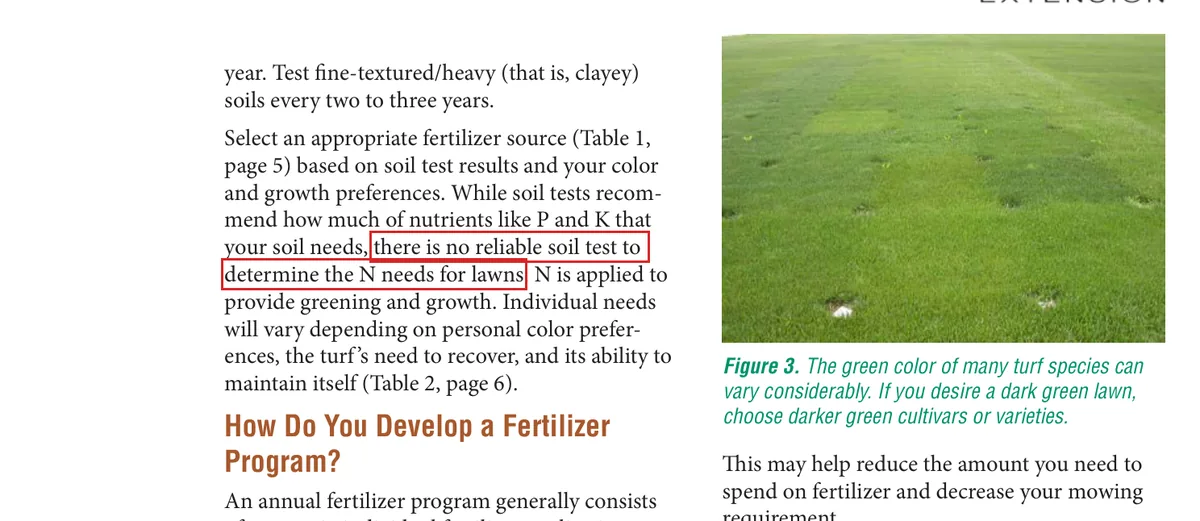
Several top-ranking guides tell you to test the soil for nitrogen first. Purdue says the opposite for lawns, and Iowa State says soil tests for N are unreliable because nitrate moves with water. University of Maryland leaves it off routine reports because it keeps shifting between organic and plant-available forms. A routine test still earns its fee by reporting organic matter, and our soil test guide compares the labs.
Organic matter is your nitrogen estimate. Maryland credits about 0.4 lb of N per 1,000 sq ft for each 1 percent of organic matter and calls that conservative; Iowa State uses 0.7 lb. SARE gives 10 to 40 lb per acre, or 0.2 to 0.9 lb per 1,000 sq ft, with cold wet clay at the low end. The right two columns are our arithmetic for a vegetable bed, using Maryland’s lower credit.
| Organic matter on your test | Credit, Maryland (lb N per 1,000 sq ft) | Credit, Iowa State | Top-up for a 2 lb target | Top-up for a 3 lb target |
|---|---|---|---|---|
| 1% | 0.4 | 0.7 | 1.6 | 2.6 |
| 2% | 0.8 | 1.4 | 1.2 | 2.2 |
| 3% | 1.2 | 2.1 | 0.8 | 1.8 |
| 4% | 1.6 | 2.8 | 0.4 | 1.4 |
| 5% | 2.0 | 3.5 | 0.0 | 1.0 |
Two nitrate readings are worth acting on. Mid-season vegetable beds can use the pre-sidedress test, 10 to 20 cores to 12 inches: at 0 to 25 ppm apply the full sidedress, at 25 to 30 ppm cut it in half, and above 30 ppm add none (UMass; sweet corn differs). On a routine report, Iowa State treats nitrate-N below 10 ppm as low and 20 to 25 ppm as high. If the lab reports nitrate rather than nitrate-N, those same marks read 44 ppm and 89 to 111 ppm.
1Is the yellowing on new growth with green veins?
YesLikely iron, not nitrogen: check soil pH before adding N (Colorado State).
NoGo to the next question
2Did you recently mix sawdust, straw or wood chips into the soil?
YesLikely nitrogen tie-up: material above 24:1 C:N borrows soil N (USDA NRCS). Keep woody material on the surface and add a quick source.
NoGo to the next question
3Is this turf in a blackout window or a county with a slow-release rule?
YesWait, or use the compliant blend your rule requires (Md., N.J., Pinellas County).
NoGo to the next question
4Do you want green turf or plants within about 2 weeks?
YesUrea or ammonium sulfate, under 1 lb N per 1,000 sq ft, then 1/8 to 1/4 inch of water (Purdue, UF/IFAS).
NoGo to the next question
5Are you preparing a warm bed for planting in the next month?
YesBlood, feather or seed meal at 8 to 17 lb per 1,000 sq ft per lb of N, mixed into the top 2 to 3 inches (OSU).
NoBuilding soil for next season: compost at 1/3 inch or more, or a legume cover crop tilled in at bloom (UMass, SARE).
Source: Colorado State, USDA NRCS, Purdue AY-22, UF/IFAS, OSU, UMass and SARE
Lawn yellowing has more causes than leaves in a bed, so our page on why grass turns yellow sorts them first. In beds, Maryland warns that crowding, low light, compacted soil and root-knot nematodes copy the same pale, stunted look. For iron chlorosis, more N will not fix green-veined leaves.
How fast each source works, and how much of the label you get
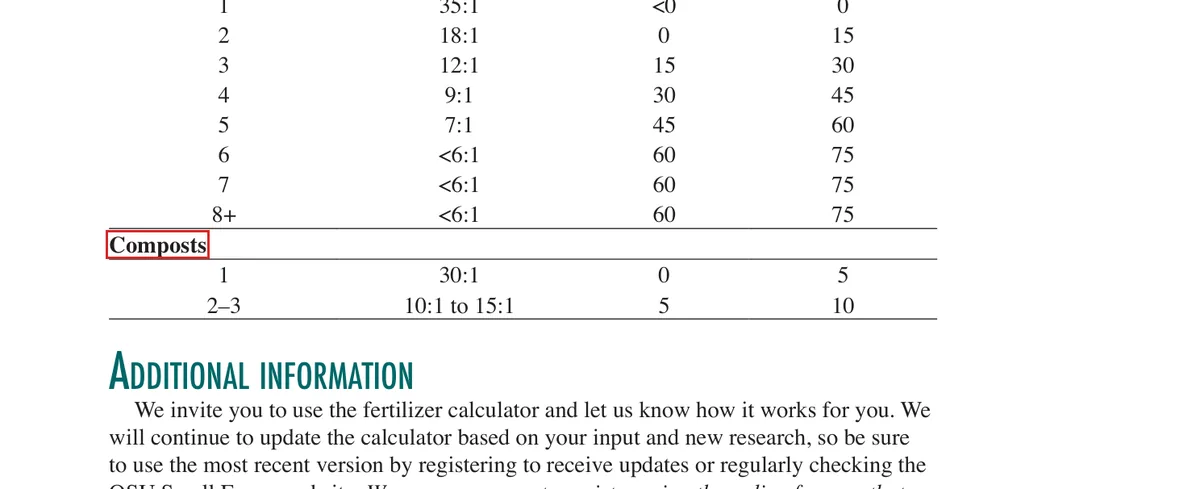
Organic nitrogen must be converted by microbes, and the conversion tracks total N. This table is Oregon State’s model; the right column converts it into what most guides skip, pounds needed for 1 lb of N usable by season end. Alfalfa meal uses OSU’s worked 26 percent at 2.5 percent N.
| Material | Total N | Usable at 28 days | Usable by season end | Label math (lb) | Lb for 1 lb usable N |
|---|---|---|---|---|---|
| Blood or feather meal | 12% | 60% | 75% | 8.3 | 11.1 |
| Soybean meal | 7% | 60% | 75% | 14.3 | 19.0 |
| Cottonseed meal | 6% | 60% | 75% | 16.7 | 22.2 |
| Alfalfa meal | 2.5% | Under 15% | 26% | 40 | 154 |
| Uncomposted material at 2% N, such as coffee grounds | 2% | 0% | 15% | 50 | 333 |
| Finished compost | 1% | 0% | 5 to 13% | 100 | 800 to 2,000 |
Compost is a soil builder, not a quick nitrogen fix. At UMass‘s figures, a cubic yard holds 8 lb of N and gives up a little over 1 lb in year one, so 1 lb of usable N per 1,000 sq ft takes about 1 to 2.5 cubic yards, a layer 0.3 to 0.8 inch deep. C:N matters too: Oregon State EM 9217 found compost above 20:1 can raise your fertilizer need, 10 to 20:1 gives about 5 percent of total N, and under 10:1 gives 10 to 20 percent.
Feather meal is sold as slow-release (Down To Earth), and Colorado State lists it at 4+ months. University of California work reads differently: a model fit to 113 published datasets put 61 percent of feather meal N in mineral form after 100 days under optimal conditions (Geisseler et al., 2021). UC ANR incubations show the shape across organic fertilizers other than composts: a spike in the first 10 days, steady release to 40 days, little after. The practical read: in warm soil, apply meals close to when plants need them, not months ahead.
Clover and other legumes: how much nitrogen they really fix
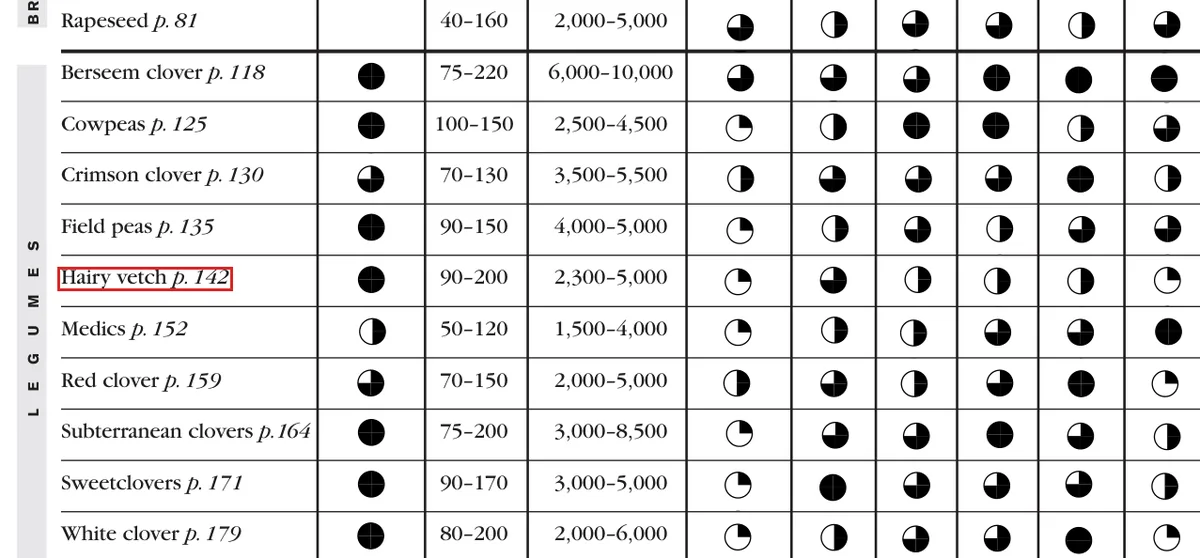
Legumes add nitrogen once they die and decompose, and the SARE cover crop manual supplies the numbers. Its chart gives total N across all plant parts; SARE then says to divide by 2 for a tilled-in cover crop, or by 4 for one left on the surface in a northern no-till plot (by 2 in the South). N content peaks around flowering, and SARE puts the typical credit to the next crop at 50 to 100 lb per acre, or 1.1 to 2.3 lb per 1,000 sq ft.
| Legume | Total N (lb per acre) | Total N (lb per 1,000 sq ft) | Usable if tilled in (lb per 1,000 sq ft) |
|---|---|---|---|
| Hairy vetch | 90 to 200 | 2.1 to 4.6 | 1.0 to 2.3 |
| Berseem clover | 75 to 220 | 1.7 to 5.1 | 0.9 to 2.5 |
| White clover | 80 to 200 | 1.8 to 4.6 | 0.9 to 2.3 |
| Field peas | 90 to 150 | 2.1 to 3.4 | 1.0 to 1.7 |
| Cowpeas | 100 to 150 | 2.3 to 3.4 | 1.1 to 1.7 |
| Red clover | 70 to 150 | 1.6 to 3.4 | 0.8 to 1.7 |
| Crimson clover | 70 to 130 | 1.6 to 3.0 | 0.8 to 1.5 |
A cover crop means giving up the bed for a season, and the numbers assume you kill it around bloom rather than pick it. In a lawn, clover works differently, since the plant stays alive: our clover lawn guide shows Maryland’s figure of 1 to 2 lb less fertilizer N a year with microclover in tall fescue, and why it is not zero.
Returning clippings is the cheapest N a lawn gets. Rutgers estimated 1 to 2 lb of N per 1,000 sq ft a year recycled on a 2 lb N program, and Purdue says lawns that bag every cut may need 25 to 50 percent more N a year. Our page on what to do with grass clippings has the math for your lawn size.
What people add that does not work the way they think
| Common advice | What the source says | Do this instead |
|---|---|---|
| Dump coffee grounds on the soil for nitrogen | 1 to 2 percent N (OSU), 2.28 percent in one analysis (Texas A&M). In a field trial at 2.5 to 25 percent grounds, all 5 test plants grew poorly (Hardgrove and Livesley, 2016) | Compost them, at no more than 20 percent of pile volume (WSU) |
| Add Epsom salt for green growth | Magnesium sulfate, MgSO4 (WSU): no nitrogen in the formula | Use a source from our table; test the soil first if you suspect low magnesium |
| Mix wood chips or straw into the soil | Microbes need about 24:1 C:N; wheat straw is 80:1, so they take soil N while decomposing (USDA NRCS) | Keep woody mulch on the surface; our wood chips page compares them |
| Use fresh manure for a fast boost | Over 50 percent of its N can be lost in storage or after surface application, and it needs 90 days before harvest if not composted (OSU EC 1503) | Compost it first, or dig it in at least 90 days before harvest |
| Add wood ash with ammonium fertilizer | Ash causes ammonia loss (OSU EC 1503) | Do not apply them together |
Limits: burn, loss and state nitrogen rules
Burn follows salt and rate. UT W161-E rates salt per unit of nutrient at 3.3 for ammonium sulfate, 1.7 for urea and 0.7 for Milorganite. Purdue caps quick-release N at 1.0 lb per 1,000 sq ft in one pass and allows about 2 lb only where more than 50 percent is slow-release. Unwatered urea on turf lost 20 to 30 percent as ammonia on average in Florida trials, up to 59 percent, and 95 percent of that went in 7 days (UF/IFAS).
| Place (who is covered) | Per application on turf | Yearly | No nitrogen during | Water setback | Source |
|---|---|---|---|---|---|
| Maryland (non-farm; caps apply to homeowners) | 0.7 lb water-soluble, or 0.9 lb total with at least 20% slow-release | University of Maryland rate | Before March 1, after Nov. 15, or frozen ground | 15 ft; 10 ft with drop or deflector spreader | Md. Agric. §8-803.5 |
| New Jersey (homeowners) | 0.7 lb water-soluble and 0.9 lb total; at least 20% slow-release | 3.2 lb | Before March 1, after Nov. 15, or frozen ground | 25 ft; 10 ft with drop or deflector spreader | N.J. P.L.2010, c.112 |
| Pinellas County, Fla. (turf and landscape) | Granular 1 lb at 50% or more slow-release; liquid 0.5 lb | 4 lb | June 1 to Sept. 30; storm watches and warnings | 10 ft | Pinellas County |
Read literally, those slow-release floors matter for straight sources. Urea and ammonium sulfate are fully water-soluble, so a New Jersey homeowner or a Pinellas granular user would appear to need a blend with 20 percent or 50 percent slow-release N instead. Milorganite raises a different issue: at 6-4-0, each lb of N brings 0.67 lb of phosphate, and our lawn fertilizer page lists 10 state phosphorus laws. Timing by month is on our lawn care schedule.
This page is general information, not legal advice. Fertilizer rules change and local ordinances can be stricter; confirm with your state agriculture department or county before you apply. Follow every product label.
How we compiled this
We compiled this in November 2026 from 38 documents: extension publications from 12 land-grant universities, the SARE manual, a USDA NRCS note, a Stockholm Environment Institute guideline, 2 journal abstracts, 2 state fertilizer laws, 1 county ordinance, 2 maker labels and 9 retail listings for dated prices. Dose, price-per-lb-N and legume conversions are our arithmetic from those figures. We ran no trials or soil tests. Single-store prices will differ near you.
Frequently asked questions
What is the fastest way to add nitrogen to the soil?
Spread a water-soluble source such as urea, ammonium sulfate or calcium nitrate and water it in. Purdue gives turf a few days for nitrate forms and 7 to 10 days for ammonium forms (Purdue AY-22). Stay under 1 lb of N per 1,000 sq ft in a single pass.
If the goal is color rather than growth, our guide on how to make grass greener compares a 0.5 lb nitrogen feeding with foliar iron and turf colorant by how fast each shows and how long it lasts.
Do coffee grounds add nitrogen to the soil?
A little, and slowly. Grounds hold about 1 to 2 percent N, and microbes tie up soil N while breaking them down fresh (Oregon State). Compost them at 20 percent or less of pile volume (WSU) rather than spreading them directly.
Is Epsom salt a nitrogen fertilizer?
No. Epsom salt is magnesium sulfate, MgSO4, which contains no nitrogen (WSU). It supplies only magnesium and sulfur.
What is the best homemade nitrogen fertilizer?
Returned grass clippings for a lawn, at about 1 to 2 lb of N per 1,000 sq ft a year (Rutgers), and compost for beds, though compost releases little in year one. Stored urine is the most concentrated household source at 3 to 7 g of N per liter (EcoSanRes); it needs 17 to 40 gallons per 1,000 sq ft for 1 lb of N and should be worked into the soil.
How can I naturally add nitrogen to my lawn?
Leave clippings on, overseed microclover and use an organic source such as Milorganite (6-4-0) or feather meal at 16.7 or 8.3 lb per 1,000 sq ft per lb of N. Release from these sources can depend on soil temperature and moisture, because microbes do the work (Purdue AY-22).
When should I add nitrogen to my lawn?
For cool-season grass, late August through early November, up to 1 lb per 1,000 sq ft a month (Purdue). Warm-season lawns get it from green-up until 4 to 6 weeks before frost, as our lawn care schedule details.
Sources
- Purdue Extension, AY-22-W, Fertilizing Established Cool-season Lawns, August 2013. Accessed November 2026.
- University of Tennessee Extension, W161-E, Turfgrass Maintenance: Fertilizers, Current PDF. Accessed November 2026.
- University of Maryland Extension, Fertilizing Vegetable Gardens, Current page. Accessed November 2026.
- University of Maryland Extension, Soil Testing and Soil Testing Labs, Current page. Accessed November 2026.
- Iowa State University Extension, How to Interpret Soil Test Results, Current page. Accessed November 2026.
- Colorado State University Extension, Organic Fertilizers, Current page. Accessed November 2026.
- Colorado State University Extension, Iron Chlorosis of Woody Plants, Current page. Accessed November 2026.
- Oregon State University Extension, EM 8936, Organic Fertilizer Calculator user guide, USDA copy, 2007. Accessed November 2026.
- Oregon State University Extension, EC 1503, Fertilizing Your Garden, Current page. Accessed November 2026.
- Oregon State University Extension, EM 9217, Interpreting Compost Analyses, Current page. Accessed November 2026.
- Oregon State University Extension, Coffee grounds boost soil health, News article. Accessed November 2026.
- UMass Extension, Compost Use and Soil Fertility, Current page. Accessed November 2026.
- UMass Extension, Pre-Sidedress Nitrate Test, Current page. Accessed November 2026.
- Geisseler, Smith, Cahn and Muramoto, Journal of Environmental Quality 50:1325-1338, Nitrogen mineralization from organic fertilizers and composts (abstract), 2021. Accessed November 2026.
- UC ANR, Small and Organic Farm Advisor, Many organic soil amendments provide nitrogen, but when?, Blog post. Accessed November 2026.
- Sustainable Agriculture Research and Education, Managing Cover Crops Profitably, 3rd ed., Chart 2, 2007. Accessed November 2026.
- USDA NRCS, Carbon to Nitrogen Ratios in Cropping Systems, January 2011. Accessed November 2026.
- Washington State University Extension, FS207E, Using Coffee Grounds in Gardens and Landscapes, Current page. Accessed November 2026.
- Hardgrove and Livesley, Urban Forestry and Urban Greening, via U.S. EPA HERO, Applying spent coffee grounds directly to urban agriculture soils greatly reduces plant growth, 2016. Accessed November 2026.
- Texas A&M AgriLife Extension, Travis County, Grounds in the Garden, Current page. Accessed November 2026.
- Washington State University (Chalker-Scott), Epsom salts, Spring 2007. Accessed November 2026.
- Stockholm Environment Institute, EcoSanRes, Guidelines on the Use of Urine and Faeces in Crop Production, April 2005. Accessed November 2026.
- Rutgers Cooperative Extension, The Soil Profile, Vol. 9 No. 1, Spring 1999. Accessed November 2026.
- UF/IFAS (Augustin and Peacock), via Florida Green, Gaseous Loss of Nitrogen from Turf, Winter 1986. Accessed November 2026.
- Maryland General Assembly, Md. Code, Agriculture §8-803.5, Current law. Accessed November 2026.
- New Jersey State Library, P.L.2010, c.112 (fertilizer law), Chapter 112, Laws of 2010. Accessed November 2026.
- Pinellas County, Fla., Pinellas County Fertilizer Ordinance, Current page. Accessed November 2026.
- Down To Earth Fertilizer, Blood Meal 12-0-0 label and directions, Viewed Nov. 5, 2026. Accessed November 2026.
- Down To Earth Fertilizer, Feather Meal 12-0-0 label and directions, Viewed Nov. 5, 2026. Accessed November 2026.
- Seven Springs Farm Supply, Urea (46-0-0) 50 lb listing, $30.40, Nov. 5, 2026. Accessed November 2026.
- Country Max, 46-0-0 Urea Fertilizer 50 lb listing, $34.99, Nov. 5, 2026. Accessed November 2026.
- Justin Seed, Bagged 21-0-0 Fertilizer listing, $26.73, Nov. 5, 2026. Accessed November 2026.
- Pestrong, Ammonium Sulfate 21-0-0 50 lb listing, $79.95, Nov. 5, 2026. Accessed November 2026.
- Down To Earth Home, Garden and Gift, Blood Meal 12-0-0 20 lb listing, $75.95, Nov. 5, 2026. Accessed November 2026.
- Pinetree Garden Seeds, Down to Earth Blood Meal 4 lb listing, $24.95, Nov. 5, 2026. Accessed November 2026.
- EcoGarden Supply, Down To Earth Feather Meal 5 lb listing, $14.95, Nov. 5, 2026. Accessed November 2026.
- The Old Farmer’s Almanac Store, Feather Meal 12-0-0 4 lb listing, $21.99, Nov. 5, 2026. Accessed November 2026.
- Walmart.com, Milorganite 6-4-0, 32 lb listing, $19.97, Oct. 28, 2026. Accessed November 2026.