How to make grass greener: for color within 2 days, spray turf colorant or foliar iron (24 to 48 hours, 2 to 4 weeks). For lasting color, feed 0.5 lb quick-release nitrogen per 1,000 sq ft, water 1 inch weekly and overseed a darker cultivar.
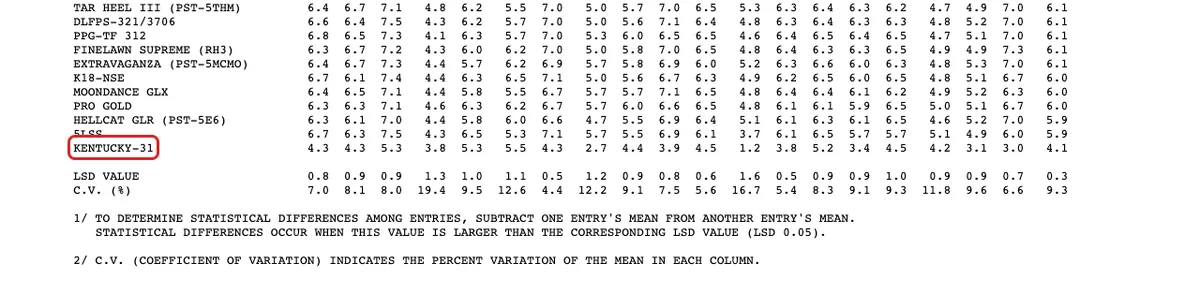
How to make grass greener depends on whether you need color for a weekend or for years. Paint and iron act within 2 days but fade in 1 to 6 weeks; nitrogen and water take days to weeks. The only permanent fix is genetic: in national trials the palest common seed, Kentucky-31 tall fescue, rated 4.1 on a 9-point color scale against 6.9 for the darkest entry (NTEP Table 32), and NTEP scores color only on unstressed, actively growing turf, so the gap is the plant, not the feeding.
The table below ranks every option by how soon the lawn looks greener and how long that lasts, with the rate and the cost per 1,000 sq ft where a dated price exists. Yellow or patchy grass needs a diagnosis first, because iron does not fix nitrogen yellowing (UF/IFAS EP551); the leaf-by-leaf check is in our guide on why grass turns yellow.
Fast vs lasting: every option with its numbers
| Option | Rate per 1,000 sq ft | Visible green | How long it lasts | Material cost per 1,000 sq ft | Source |
|---|---|---|---|---|---|
| Turf colorant (grass paint) | 1 gal per 2,000 to 4,000 sq ft (Green Up label); 8.8 to 29.4 fl oz of high-binder product (3 to 10 gal per acre) | As soon as it dries | 7 to 14 days for pigment types; 30 to 45 days before a second coat on dormant turf | $8.99 to $17.98 (Green Up, $35.95 per gal); $4.59 to $22.96 (NC State, $200 to $1,000 per acre) | NC State AG-843; Bare Ground |
| Foliar iron (ferrous sulfate spray) | About 1 to 2 oz of 20% iron sulfate in 1 to 5 gal water (0.012 to 0.024 lb iron) | 24 to 48 hours | About 2 weeks (NDSU); up to 4 weeks (UF/IFAS); 3 to 4 weeks (Texas A&M) | Not priced | NDSU H1824; K-State; UF/IFAS; Texas A&M |
| Nitrate nitrogen (calcium or potassium nitrate) | 0.5 lb N; never over 1.0 lb water-soluble N per application | A few days | Short residual; Purdue calls the response feast or famine | Not priced | Purdue AY-22, Table 1 |
| Urea or ammonium sulfate | 0.5 lb N = 1.09 lb urea (46-0-0) or 2.38 lb ammonium sulfate (21-0-0) | 7 to 10 days | Short residual; repeat light feedings about every 21 days for steady color | $0.76 for urea ($34.99 per 50 lb, Nov. 2026) | Purdue AY-22; Country Max |
| Slow-release nitrogen | Up to 2 lb N when more than 50% is slow-release | Slower than soluble N | Longer residual greening | Not priced | Purdue AY-22 |
| Water a drought-dormant lawn | 1 to 1.5 in in one application, repeated | After the second soak (Iowa State); at least 2 weeks after the soil is fully wet (Wisconsin) | As long as about 1 in a week continues | Your water rate | Iowa State; UW-Madison |
| Sharpen the mower blade | One sharpening | Next mowing | Until the blade dulls | Not priced | UGA B1258 |
| Overseed a darker cultivar | Your grass’s overseeding rate | After germination and fill-in | Permanent: genetic color | Seed cost | NTEP rating guide |
| Epsom salt (magnesium sulfate) | Sold for lawns at no tested rate | No response unless magnesium is short | Not applicable | Not applicable | WSU (Chalker-Scott) |
| Ammonia, soda and dish-soap tonic | One batch per 250 sq ft = about 0.1 lb N per 1,000 sq ft | Not measured | Not measured | Not applicable | Colorado State; Purdue Turf |
Read the table as two lists. Rows 1 and 2 change color without changing the plant, so they wear off as leaves grow and get mowed. Rows 3 to 7 fix a real shortage and do nothing on a lawn already fed and watered. Row 8 alone raises the ceiling, because NTEP rates genetic color on unstressed, growing turf with chlorosis excluded (NTEP).
1Do you need it green within 3 days, or is it dormant brown in winter?
YesTurf colorant: 1 gal per 2,000 to 4,000 sq ft; pigment types last 7 to 14 days, dormant-turf coats 30 to 45 days (NC State AG-843).
NoGo to the next question
2Is it brown from drought, with live white crowns?
YesWater 1 to 1.5 in at once and repeat; expect green after the second soak, at least 2 weeks after the soil is fully wet (Iowa State; Wisconsin).
NoGo to the next question
3Are the newest leaves yellow-striped, often on soil above pH 7?
YesFoliar iron: about 1 to 2 oz iron sulfate in 1 to 5 gal per 1,000 sq ft; green in 24 to 48 hours, lasting 2 to 4 weeks (NDSU; UF/IFAS).
NoGo to the next question
4Is the whole lawn evenly pale, older leaves yellow first, and unfed for 6 weeks or more?
YesFeed 0.5 lb quick-release N per 1,000 sq ft (1.09 lb urea) and water it in; green in a few to 10 days (Purdue AY-22).
NoGo to the next question
5Do cut tips look gray-white with frayed threads?
YesSharpen the mower blade; the cast clears at the next mowing (UGA B1258).
NoFed, watered and sharp but still light green: the cultivar is pale. Overseed one rated 6.5 or higher for genetic color (NTEP).
Same day: turf colorant
Turf colorant is the only option that makes grass greener the day you apply it, and it works on winter-dormant grass that nothing else will green. NC State’s turfgrass team, testing products for 10 years, found pigment-type colorants usually last 7 to 14 days, while high-binder products on fully dormant bermudagrass need a second coat in about 30 to 45 days (NC State AG-843). On growing grass the color leaves with the clippings.
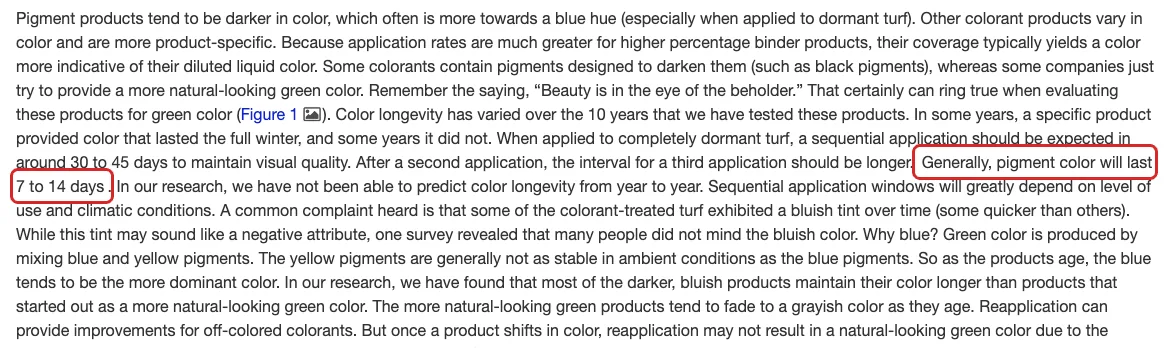
For cost, NC State gives $30 to $75 per gallon of professional colorant and $200 to $1,000 per acre per application, which is $4.59 to $22.96 per 1,000 sq ft. A homeowner gallon of Just Scentsational Green Up listed at $35.95 on the maker’s store on Nov. 8, 2026, with a label coverage of 2,000 to 4,000 sq ft (Bare Ground), or $8.99 to $17.98 per 1,000 sq ft: 1.25 to 2.5 gallons per coat for 5,000 sq ft.
Two cautions from the same NC State work: colors drift toward blue as the yellow pigment breaks down, and fresh colorant rubs off; in its transfer trial, 5 of 7 high-transfer products reached acceptable levels 2 weeks after application and 2 took longer. NC State also warns that once dormant leaf tissue is worn away, repeat coats have little left to cling to.
24 to 48 hours: foliar iron
Iron is the fastest fix that works through the plant. NDSU says iron sulfate at 0.25 lb of iron per 1,000 sq ft greens turf in 24 to 48 hours and lasts about two weeks, and its foliar rate is lower: 0.012 to 0.024 lb of iron in 1 to 5 gallons of water (NDSU H1824). At the 20 percent iron UF/IFAS lists for iron sulfate, that foliar rate is about 1 to 2 oz of product per 1,000 sq ft. K-State gives the same 24 to 48 hours (K-State).
Spray rather than spread. UF/IFAS found only foliar iron sulfate improved color in Florida trials, for up to 4 weeks, while iron oxide and iron sucrate produced none (UF/IFAS EP551). On alkaline soil expect to need more: in Texas A&M’s 1994 trial on St. Augustinegrass at pH 8.0, iron sulfate needed 3 times its 2 oz low rate to reach a 7 of 9 color rating, and Texas A&M puts the usual effect at 3 to 4 weeks (Texas A&M).
- Spray on a cool, dry day; NDSU warns foliar iron can burn grass under heat or drought stress.
- Hold irrigation for 3 to 4 hours so the leaves absorb it (NDSU).
- Sweep or rinse concrete before it dries: iron sulfate stains sidewalks and drives reddish-brown (UF/IFAS; NDSU).
A few days to 10 days: quick-release nitrogen
Purdue says nitrogen promotes green color and overall growth, and the speed depends on the form. Purdue’s Table 1 says turf takes up nitrate sources within a few days and ammonium sources, which include urea, within 7 to 10 days (Purdue AY-22). Its cap for quick-release products is under 1.0 lb of actual N per 1,000 sq ft per application, with 1/3 to 1.0 lb as the lawn target, and it notes that light feedings such as 0.5 lb every 21 days give more consistent color than heavy ones.
For a color feeding use 0.5 lb of N: 1.09 lb of urea or 2.38 lb of ammonium sulfate per 1,000 sq ft. Urea at $34.99 per 50 lb bag (Country Max, Nov. 8, 2026) puts that at $0.76 per 1,000 sq ft. Water it in: Purdue flags a higher burn risk. Grade math, phosphorus rules and spreader settings are in our lawn fertilizer guide, and organic sources in our page on how to add nitrogen to lawn soil.
- Iron sulfate (20% iron) for a foliar spray, oz (2 oz per 1,000 sq ft, NDSU top rate)
- 10.0
- Spray water for the iron, gallons (3 per 1,000 sq ft; NDSU allows 1 to 5)
- 15.0
- Urea (46-0-0) for 0.5 lb N per 1,000 sq ft, lb
- 5.4
- Colorant at 3,000 sq ft per gallon (label midpoint), gallons
- 1.67
- Water for a 1-inch soak, gallons
- 3,115
Default: 5,000 sq ft, one application. Colorant from the Green Up label and price (Nov. 8, 2026); urea from Country Max (Nov. 8, 2026); iron from NDSU H1824 at 20 percent iron; 1 inch over 1 sq ft is 0.623 gallons.
Timing matters as much as rate. For cool-season lawns from early October to early December, Purdue prefers a product with nearly 100 percent water-soluble N at slightly lower rates; warm-season timing is in our lawn care schedule. If you bag clippings, Purdue says to raise yearly nitrogen 25 to 50 percent; leaving them returns it, as our page on what to do with grass clippings shows.
About two weeks: water and a sharp blade
A lawn that is brown from drought is dormant, not starving, and color returns only with water. Iowa State says about 1 inch a week keeps a cool-season lawn green; to wake a dormant one, apply 1 to 1.5 inches in a single application and repeat, and the grass should begin to green after the second application (Iowa State). Wisconsin’s estimate is at least two weeks after the soil is fully wet (UW-Madison Extension).
Only wake a lawn you can keep watering: Iowa State warns against pulling it out of dormancy and letting it slip back. Our guide to the best time to water a lawn covers run times, and how to revive dead grass covers the crown test.
A gray or whitish cast after mowing is usually the blade. UGA’s Bulletin 1258 says dull blades shred leaf tips, which turn straw-brown with small threads at the cut end and give the whole canopy a grayish cast (UGA B1258). The fix shows at the next mowing; our page on how to sharpen a lawn mower blade has the steps.
Permanent: grow a darker grass
Every option above has a ceiling set by the grass itself. The National Turfgrass Evaluation Program (NTEP) scores genetic color from 1 (light green) to 9 (dark green) on plots rated across 10 to 19 sites per trial (NTEP rating guide). In the most recent multi-year national trials the spread inside one species is wide: 114 perennial ryegrasses ran from 3.8 to 7.4, and 89 Kentucky bluegrasses from 4.8 to 7.3.
Swipe the table sideways to see every column.
| Species | Cultivar | Role in trial | Genetic color (1 to 9) | Mean of all entries | LSD (0.05) | Source, data years |
|---|---|---|---|---|---|---|
| Tall fescue | RAD-TF 115 (Turbo SS) | Darkest entry (tied) | 6.9 | 6.37 | 0.3 | NTEP, 2019 to 2023 |
| Tall fescue | Titanium G-LS (PPG-TF 255) | Named cultivar | 6.6 | 6.37 | 0.3 | NTEP, 2019 to 2023 |
| Tall fescue | Falcon Supreme (RH1) | Named cultivar | 6.5 | 6.37 | 0.3 | NTEP, 2019 to 2023 |
| Tall fescue | Kentucky-31 | Palest entry | 4.1 | 6.37 | 0.3 | NTEP, 2019 to 2023 |
| Kentucky bluegrass | After Midnight | Darkest entry | 7.3 | 6.30 | 0.3 | NTEP, 2018 to 2022 |
| Kentucky bluegrass | Midnight | Named cultivar | 7.0 | 6.30 | 0.3 | NTEP, 2018 to 2022 |
| Kentucky bluegrass | Blue Devil | Named cultivar | 6.8 | 6.30 | 0.3 | NTEP, 2018 to 2022 |
| Kentucky bluegrass | Kenblue | Palest entry | 4.8 | 6.30 | 0.3 | NTEP, 2018 to 2022 |
| Perennial ryegrass | Hatrick (BSP-17) | Darkest entry (tied) | 7.4 | 6.45 | 0.4 | NTEP, 2017 to 2021 |
| Perennial ryegrass | Fireball (BWH) | Darkest entry (tied) | 7.4 | 6.45 | 0.4 | NTEP, 2017 to 2021 |
| Perennial ryegrass | Slugger 3GL (PPG-PR 343) | Named cultivar | 6.8 | 6.45 | 0.4 | NTEP, 2017 to 2021 |
| Perennial ryegrass | Linn | Palest entry | 3.8 | 6.45 | 0.4 | NTEP, 2017 to 2021 |
| Bermudagrass | FB 1628 | Darkest entry (experimental) | 7.1 | 6.27 | 0.5 | NTEP, 2020 to 2023 |
| Bermudagrass | Celebration Hybrid (MSB-1017) | Named cultivar | 6.6 | 6.27 | 0.5 | NTEP, 2020 to 2023 |
| Bermudagrass | Tifway | Named cultivar | 6.5 | 6.27 | 0.5 | NTEP, 2020 to 2023 |
| Bermudagrass | Latitude 36 | Named cultivar | 6.3 | 6.27 | 0.5 | NTEP, 2020 to 2023 |
| Bermudagrass | TifTuf | Named cultivar | 6.1 | 6.27 | 0.5 | NTEP, 2020 to 2023 |
| Bermudagrass | Astro | Palest entry (tied) | 5.5 | 6.27 | 0.5 | NTEP, 2020 to 2023 |
| Zoysiagrass | DALZ 1701 | Darkest entry (experimental, tied) | 7.3 | 6.75 | 0.4 | NTEP, 2020 to 2023 |
| Zoysiagrass | Meyer | Named cultivar | 7.0 | 6.75 | 0.4 | NTEP, 2020 to 2023 |
| Zoysiagrass | Empire | Named cultivar | 6.8 | 6.75 | 0.4 | NTEP, 2020 to 2023 |
| Zoysiagrass | Zeon | Named cultivar | 6.6 | 6.75 | 0.4 | NTEP, 2020 to 2023 |
| Zoysiagrass | FZ 1721 | Palest entry (experimental) | 6.1 | 6.75 | 0.4 | NTEP, 2020 to 2023 |
The pattern is clear in the cool-season grasses. Kentucky-31 tall fescue scored 4.1 against a 6.37 trial mean, a gap of more than seven times the 0.3 LSD. Purdue’s seed-buying bulletin tells buyers to avoid mixes containing ‘Linn’ perennial ryegrass, ‘Kenblue’ Kentucky bluegrass and ‘KY31’ tall fescue, the three palest entries named here (Purdue AY-25). If your seed tag lists one, overseeding a cultivar rated 6.5 or higher changes the base color. Our tall fescue and perennial ryegrass guides list the full trial results.
Warm-season grass gives less room. The 35 bermudagrasses spanned only 5.5 to 7.1, and common lawn cultivars sat close together: Celebration 6.6, Tifway 6.5, Latitude 36 6.3 and TifTuf 6.1 (NTEP Table 32A). Among 39 zoysiagrasses, Meyer rated 7.0 and Zeon 6.6 (NTEP Table 20). Switching between those is a sod decision, not a color fix; seed changes are made by overseeding, covered in our guide on how to overseed a lawn.
What does not work: Epsom salt, ammonia and lawn tonics
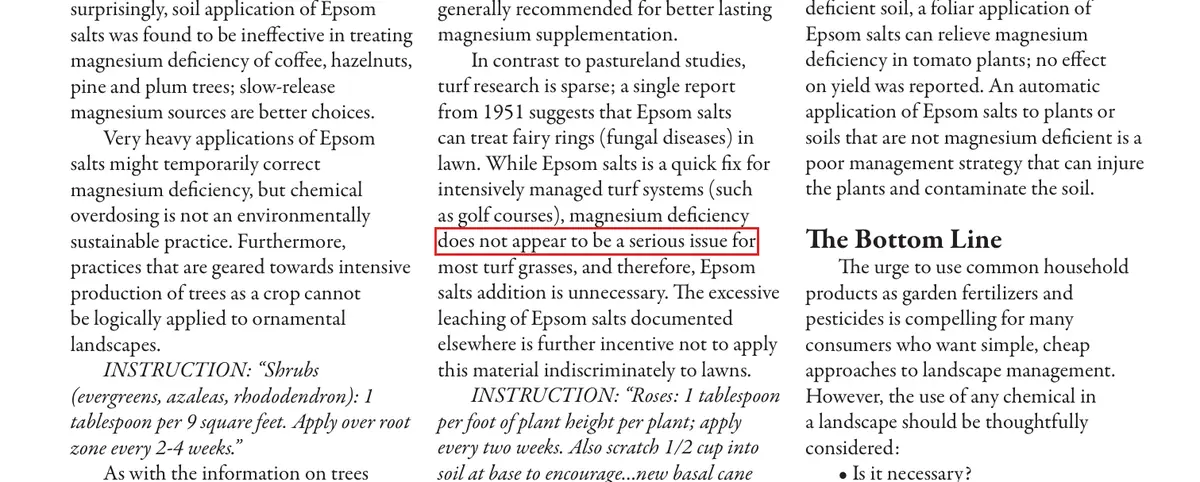
Epsom salt is magnesium sulfate heptahydrate, about 9.9 percent magnesium by weight (our arithmetic from MgSO4 with 7 waters). Washington State University’s Linda Chalker-Scott reviewed the claims and concluded that magnesium deficiency does not appear to be a serious issue for most turf grasses, so adding Epsom salts is unnecessary, and that the salt leaches readily (WSU, 2007). A soil test that reports low magnesium is the only case for it.
Ammonia, soda, beer and dish soap tonics fail on dose. Colorado State Extension’s Tony Koski calculated that one batch spread over only 250 sq ft supplies about 0.1 lb of N per 1,000 sq ft, a fifth of one light feeding; the soap may act as a wetting agent on dry, thatchy turf (CSU Extension). Purdue’s Zac Reicher found little or no scientific basis for such tonics, and using them on weeds or pests would be illegal because they are not labeled pesticides (Purdue Turf).
Iron products sold to kill moss are registered pesticides with their own rates, covered in our guide to moss in the lawn. The label is the law: follow the rate, the site list and the re-entry directions on the product in your hand. This page is general information, not pesticide or agronomic advice.
How we compiled this
In November 2026 we read 13 extension publications and articles from NC State, NDSU, K-State, UF/IFAS, Texas A&M, Purdue, Iowa State, Wisconsin, Georgia, Washington State and Colorado State, and parsed the genetic color tables of NTEP’s five most recent multi-year national trials for tall fescue, Kentucky bluegrass, perennial ryegrass, bermudagrass and zoysiagrass (409 entries). Prices are two retail listings checked on Nov. 8, 2026. Per-1,000 sq ft rates, costs and trial means are our arithmetic. We did not test any product or treat any lawn.
Frequently asked questions
Does Epsom salt make grass greener?
Only if the soil is short of magnesium, which WSU’s review found is not a serious issue for most turf grasses. Epsom salt is about 9.9 percent magnesium and leaches readily. Test the soil first; for color, foliar iron or 0.5 lb of nitrogen per 1,000 sq ft has published response times.
What does Dawn dish soap do to your lawn?
Little for color. Colorado State Extension says dish soap may act as a wetting agent on dry, thatchy turf but recommends against lawn tonics, and Purdue says they have little or no scientific basis. It supplies no nitrogen or iron.
Can I get my grass green in 3 days?
Yes, in two ways. Turf colorant is green as soon as it dries and lasts about 7 to 14 days for pigment types (NC State). Foliar iron greens iron-short grass in 24 to 48 hours (NDSU, K-State). Nitrate nitrogen takes a few days; urea takes 7 to 10.
Can yellow grass turn green again?
Yes, if the crowns are alive. Iron-short grass greens in 24 to 48 hours and nitrogen-short grass in a few to 10 days. Drought-dormant grass needs 1 to 1.5 inches of water, repeated, and at least 2 weeks once the soil is fully wet (Iowa State; Wisconsin).
What chemical makes grass green?
Nitrogen and iron. Nitrogen in urea, ammonium sulfate or nitrate forms drives growth and color; Purdue caps quick-release N under 1.0 lb per 1,000 sq ft per feeding. Ferrous sulfate at about 1 to 2 oz per 1,000 sq ft as a spray deepens color in 24 to 48 hours where iron is short.
Sources
- NC State Extension (Miller, Pinnix), AG-843, Guide to Using Turf Colorants, Aug. 2018, revised July 2023. Accessed November 2026.
- Bare Ground Solutions, Just Scentsational Green Up Grass Colorant (gallon $35.95), Viewed Nov. 8, 2026. Accessed November 2026.
- North Dakota State University Extension, H1824, Interpreting the NDSU Soil Test Analysis for Managing Turfgrass, Current web edition. Accessed November 2026.
- Kansas State University Research and Extension, A Guide to Turfgrass Nutrient Recommendations Based on K-State Soil Test Results (county copy), Current PDF. Accessed November 2026.
- UF/IFAS Extension (Shaddox, Unruh), ENH1287/EP551, Iron for Florida Turfgrasses, Reviewed October 2025. Accessed November 2026.
- Texas A&M University (Duble), hosted on PlantAnswers, Iron Chlorosis in Turfgrass, 1994 trial. Accessed November 2026.
- Purdue Extension, AY-22-W, Fertilizing Established Cool-season Lawns, Current PDF. Accessed November 2026.
- Country Max, 46-0-0 Urea Fertilizer, 50 lb ($34.99), Viewed Nov. 8, 2026. Accessed November 2026.
- Iowa State University Extension, Summer Dormancy in Cool-Season Lawns, Current page. Accessed November 2026.
- University of Wisconsin-Madison Extension, Keeping Your Grass Alive During Periods of Extended Drought, Current page. Accessed November 2026.
- University of Georgia Extension, Bulletin 1258, Abiotic Injuries and Disorders of Turfgrasses in Georgia, Current edition. Accessed November 2026.
- National Turfgrass Evaluation Program (NTEP), How are turfgrass ratings evaluated? (color definitions), Current page. Accessed November 2026.
- NTEP, 2018 National Tall Fescue Test, Final Report 24-9, Table 32: Genetic color, 2019 to 2023 data. Accessed November 2026.
- NTEP, 2017 National Kentucky Bluegrass Test, Report 23-11, Table 29: Genetic color, 2018 to 2022 data. Accessed November 2026.
- NTEP, 2016 National Perennial Ryegrass Test, Final Report 22-12, Table 27: Genetic color, 2017 to 2021 data. Accessed November 2026.
- NTEP, 2019 National Bermudagrass Test, Final Report 24-11, Table 32A: Genetic color, 2020 to 2023 data. Accessed November 2026.
- NTEP, 2019 National Zoysiagrass Test, Final Report 24-12, Table 20: Genetic color, 2020 to 2023 data. Accessed November 2026.
- Purdue University and University of Illinois, AY-25-W, Purchasing Quality Grass Seed for Your Home Lawn, Current PDF. Accessed November 2026.
- Washington State University (Chalker-Scott), The Myth of Epsom Salts, MasterGardener, Spring 2007. Accessed November 2026.
- Colorado State University Extension (Koski), Lawn Tonics, CO-Horts blog, April 16, 2013. Accessed November 2026.
- Purdue University Turfgrass Science (Reicher), Don’t Trust the Tonics You Hear on TV, May 6, 2005. Accessed November 2026.