How to revive dead grass: you cannot, because dead crowns never regrow, but dormant grass can. If roots hold and crowns show white tissue, give it 1/2 inch of water every 2 weeks. If the plant pulls free, reseed or sod.
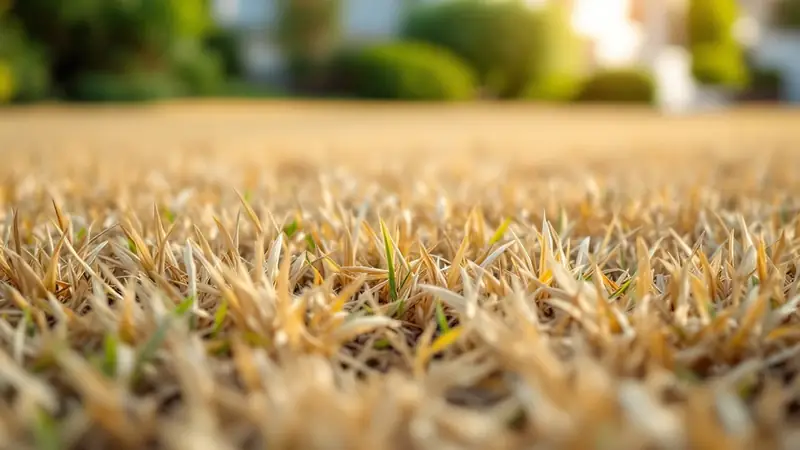
Knowing how to revive dead grass starts with one fact from Iowa State Extension: the brown blades on a dormant lawn are already dead, while the crowns and roots stay alive. So color settles nothing. This page gives the test, then something no top result shows: living cover for 25 named cultivars at 15, 30, 46 and 62 days of water after a 60-day drought, from a Texas A&M rain-shelter trial.
Is it dormant or dead? The 5-minute test
- Pick 3 spots: the worst brown area, a middling one, and the edge where brown meets green.
- Tug a fistful at each. Roots that are firmly attached to the crown and hard to pull loose are a good sign, per University of Wisconsin turf specialist Doug Soldat. Blades that snap off prove nothing, since dormant blades are dead too. If a whole mat lifts like carpet, skip to grubs in the pattern table below (Utah State).
- Lift a 2-inch plug with a trowel. Peel the old leaf sheaths off the crown, the point at the soil line where blades and roots meet, and pick off some roots. Any white tissue there, or any green in a leaf, means that plant is alive.
- Check the runners on bermudagrass, zoysiagrass, St. Augustinegrass and Kentucky bluegrass. UMass Extension says nodes on rhizomes and stolons, not only crowns, can regenerate shoots at the first significant rain.
- Still unsure, or testing in winter? Use the UF/IFAS St. Lucie County pot test: plant a piece with roots in a pot in a warm, sunny place. If it grows, the lawn is resting. UF gives no deadline; Wisconsin’s 2-week minimum for green-up is a fair first check.
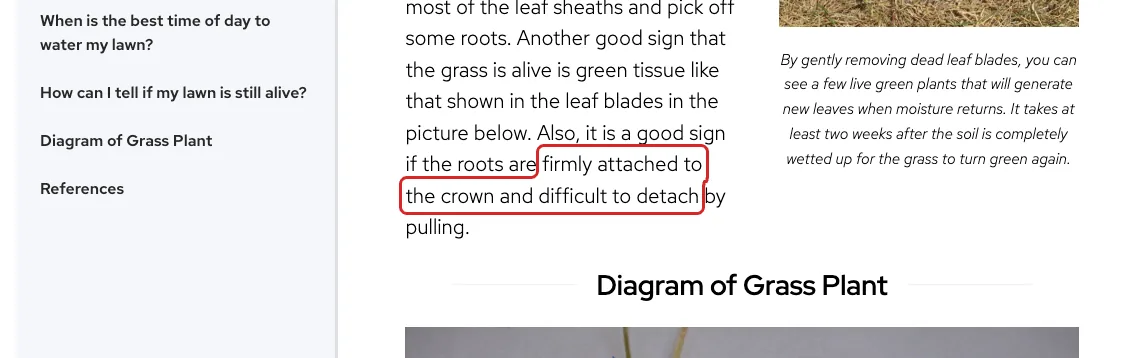
Soldat also warns it is “quite difficult” to judge a crown by eye, so count any one live sign as alive and sample more than one plant. Do not lean on the common rule that dormant lawns brown evenly and dead ones in patches. Utah State’s Kelly Kopp says “brown or golden patches” in a dry spell are usually just dormancy, and Wisconsin and Illinois both say compacted, trafficked, clay or sandy areas fail sooner, which makes a live lawn look patchy.
Season can answer it before you dig. Zoysiagrass and buffalograss stay tan from midautumn to midspring, per Kansas State, and buffalograss browns at the first hard freeze. Any warm-season lawn that browned after frost is on schedule, and its verdict comes at spring green-up. A lawn that is only wilting, darker in color and holding footprints still has green tissue: water it now with the 1 inch a week it needs, because that is the stage where Illinois Extension says to start.
1Is it a warm-season lawn (bermudagrass, zoysiagrass, St. Augustinegrass, centipedegrass, buffalograss) between first frost and spring?
YesNormal winter dormancy. Do not fertilize. Pot a rooted piece in a warm, sunny spot to confirm, and judge the lawn at spring green-up.
NoGo to the next question
2Does the turf lift like a carpet when you pull it?
YesDig 1 sq ft and count grubs. Treat only above about 5 to 10 per sq ft, then repair the dead area.
NoGo to the next question
3Do roots hold firm, with white crown tissue or any green leaf?
YesAlive and dormant. Give 1/2 inch of water every 2 weeks and stay off it until rain or full watering returns.
NoGo to the next question
4Is the sample mixed, with some plants holding and some pulling free?
YesWater test once the heat breaks: 1 to 1.5 inches, repeated 7 days later. Judge new shoots by the Decide after column.
NoDead. Find the cause in the pattern table, measure the dead share, then patch, overseed (under 50 percent) or renovate (50 percent or more).
Source: Wisconsin Extension; Iowa State; Utah State; UF/IFAS; Penn State
How long can dormant grass survive, and how much water does it need?
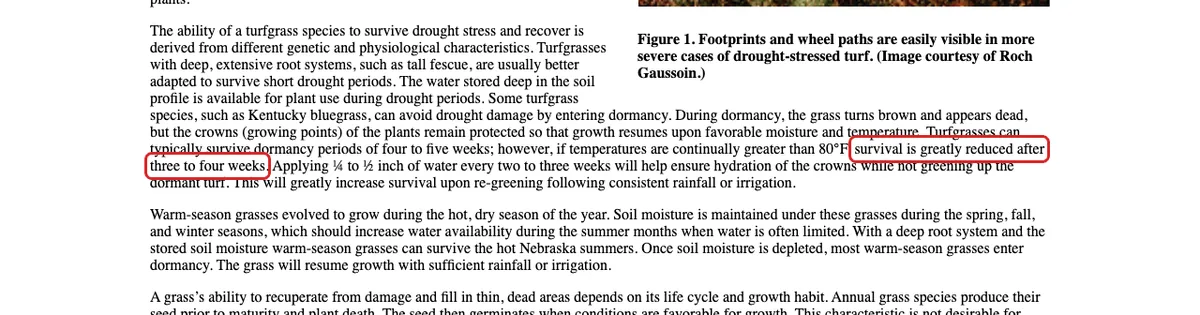
Published survival limits run from 3 weeks to past 60 days, and no source below is wrong: they describe different grass, heat and soil. The cautious planning number is Nebraska’s: 4 to 5 weeks, cut to 3 to 4 weeks if temperatures stay above 80°F. After that, start survival watering, which holds crowns alive without greening the lawn.
| Source | How long dormant grass lasts | Survival water | Inches over 8 weeks | Gallons, 5,000 sq ft |
|---|---|---|---|---|
| Nebraska G2191 | 4 to 5 weeks; 3 to 4 weeks above 80°F | 1/4 to 1/2 in every 2 to 3 weeks | 0.7 to 2 | 2,100 to 6,200 |
| Iowa State | 4 to 6 weeks (cool-season) | 1/4 in a week, or 1 to 1.5 in once at week 4 to 6 | 1 to 2 | 3,100 to 6,200 |
| Illinois | Defines extreme drought as over 4 hot weeks without rain | 1/4 in every 2 weeks or 1/2 in every 4 weeks | 1 | 3,100 |
| Utah State | Recovers in fall if crowns live | 1 in a month (cool-season) | About 1.8 | 5,700 |
| Wisconsin | Kentucky bluegrass: 60 days or more | 1/4 in a week, or 1/2 in every other week | 2 | 6,200 |
| LSU AgCenter | At least 3 to 4 weeks (Louisiana grasses) | After week 4, wet the soil 5 in deep over 1 to 2 days | Depends on soil | Depends on soil |
| City of Golden, Colo. | Up to 4 weeks | 0.25 in a week | 2 | 6,200 |
| UMass | 45 to 60+ days: only 70% recovery possible | Not stated | n/a | n/a |
| Stay-green comparison (Wisconsin, Iowa State) | No dormancy | 1 in a week | 8 | 24,900 |
Take 1/2 inch every 2 weeks as the working schedule: it sits inside the Wisconsin and Nebraska ranges and uses about 25 percent of the water a green lawn takes. Measure with a tuna can or rain gauge (LSU); UNH Extension says a sprinkler needs 20 to 60 minutes for 1/2 inch. Do not exceed it. Wisconsin warns that more pushes out green leaves that then need far more water, and UMass says improper watering during dormancy drains the carbohydrate reserves recovery depends on. Morning hours and run times are on our page on the best time to water a lawn.
Two groups should not lean on dormancy at all. Iowa State says lawns seeded or sodded this year or last may not survive it, and the Kansas State trial agrees: first-summer Kentucky bluegrass sod went dormant in about 7 to 11 weeks and recovered in no irrigation treatment, in either year, even at 50 percent of evapotranspiration. And Texas A&M B-6126 rates St. Augustinegrass and centipedegrass poor at going dormant, with significant loss in long droughts. If local rules allow, keep new lawns on Iowa State’s 1 inch a week and St. Augustinegrass on LSU’s 0.5 to 0.75 inch every 7 to 10 days. Stay off any dormant lawn too: Iowa State says moderate traffic will likely damage crowns.
Will watering dead grass bring it back?
No. Water greens only plants with live crowns, and it cannot rush them in peak heat: Kopp says at a certain level of heat and drought no amount of water coaxes grass out of dormancy. When the heat breaks, the Iowa State wake-up dose is 1 to 1.5 inches in one application, repeated 7 days later, with green starting after the second. Run it only if you can keep watering, because Illinois says breaking dormancy in a hot, dry stretch drains reserves the plant may not replace.
Then allow time. Wisconsin says at least 2 weeks after the soil is fully wetted; Texas A&M says up to 3 months in the growing season. The real timeline depends on the grass, as the table shows. The last column is our reading of these sources, not a published cutoff: if a spot shows no new shoots after that long in growing weather, treat it as dead.
| Grass | Without water | Time to come back | Decide after (our reading) | Source |
|---|---|---|---|---|
| Bermudagrass | Browned at about 50 days; 7 of 8 cultivars at 97.5 to 100% cover after 60 dry days and 62 days of water | 2.5 to 3 weeks | 3 weeks | LSU; Texas A&M |
| Buffalograss | 609 at 95% after 60 dry days and 62 days of water | 80% cover by day 15 of water | 3 weeks | Texas A&M |
| St. Augustinegrass | Browned at about 45 days; 17.5 to 88.75% cover, Floratam highest | About 1 month | 5 weeks | LSU; Texas A&M |
| Zoysiagrass | Browned at 30 to 35 days; 4.25 to 71.25% cover, coarse types highest | 5 to 6 weeks | 6 weeks | LSU; Texas A&M |
| Kentucky bluegrass, established | Complete recovery after 60 to 88 dry days in one study; full recovery not until spring after 88 days in one year | 2 weeks or more | 4 weeks | Domenghini et al., 2013, citing Goldsby; Wisconsin |
| Tall fescue | No dormancy through 83 and 60 dry days; can die rather than go dormant under extreme drought | 3.5 and 6.7 weeks to acceptable cover, no water during drought | 7 weeks | Kansas State; Illinois |
| Fine fescue | Survives as well as or better than Kentucky bluegrass | Not stated | 4 weeks | Wisconsin |
| Perennial ryegrass | “Probably near death” in a drought bluegrass survives | Not stated | Reseed if tests fail | Wisconsin |
- Tifway 419 bermudagrass
- Floratam St. Augustinegrass
- Palisades zoysiagrass
- Raleigh St. Augustinegrass
- Zeon zoysiagrass
Source: Chalmers et al., Texas A&M, December 2006, Table 6 San Antonio, native soil. X axis is days of irrigation after 60 days with no water. The bermudagrass dip at day 21 is mower scalping, per the report.
Show the numbers
| Tifway 419 bermudagrass | Floratam St. Augustinegrass | Palisades zoysiagrass | Raleigh St. Augustinegrass | Zeon zoysiagrass | |
|---|---|---|---|---|---|
| 2 | 50% | 20% | 1.25% | 1.75% | 6.75% |
| 8 | 56.25% | 40% | 4.50% | 4.75% | 1% |
| 15 | 68.75% | 46.25% | 10% | 5.50% | 1.25% |
| 21 | 33.75% | 43.75% | 17.50% | 7.50% | 2.75% |
| 30 | 66.25% | 68.75% | 23.75% | 8.75% | 5.75% |
| 38 | 83.75% | 72.50% | 35% | 11.25% | 6.25% |
| 46 | 92.50% | 77.50% | 48.75% | 12.50% | 5.50% |
| 62 | 98.75% | 88.75% | 71.25% | 25% | 17.50% |
The chart holds the lesson most guides miss: slow is not the same as dead. Palisades zoysiagrass sat at 23.75 percent cover after 30 days of water and reached 71.25 percent by day 62. Zeon, in the same species, was at 5.75 percent and finished at 17.5 percent. Pulling a zoysia lawn at week 4 would have thrown away Palisades; keeping Zeon would have meant replanting anyway. The bermudagrass dip at day 21 is not drought damage: the report says lowering the mowing height to 2.25 inches scalped those plots.
Swipe the table sideways to see every column.
| Grass | Cultivar | Day 15 | Day 30 | Day 46 | Day 62 |
|---|---|---|---|---|---|
| Bermudagrass | Celebration | 95% | 73.75% | 92.5% | 100% |
| Bermudagrass | Common | 80% | 60% | 87.5% | 98.75% |
| Bermudagrass | GN-1 | 53.75% | 51.25% | 87.5% | 98.75% |
| Bermudagrass | Grimes EXP | 77.5% | 71.25% | 93.75% | 100% |
| Bermudagrass | Premier | 4.25% | 16.25% | 37.5% | 57.5% |
| Bermudagrass | TexTurf | 90% | 55% | 92.5% | 97.5% |
| Bermudagrass | TifSport | 77.5% | 66.25% | 93.75% | 97.5% |
| Bermudagrass | Tifway 419 | 68.75% | 66.25% | 92.5% | 98.75% |
| Buffalograss | 609 | 80% | 80% | 93.75% | 95% |
| St. Augustinegrass | Floratam | 46.25% | 68.75% | 77.5% | 88.75% |
| St. Augustinegrass | Common | 10% | 22.5% | 30% | 55% |
| St. Augustinegrass | Palmetto | 10% | 17.5% | 27.5% | 51.25% |
| St. Augustinegrass | Amerishade | 13.75% | 26.25% | 25% | 42.5% |
| St. Augustinegrass | Delmar | 13.75% | 21.25% | 25% | 37.5% |
| St. Augustinegrass | Raleigh | 5.5% | 8.75% | 12.5% | 25% |
| St. Augustinegrass | Sapphire | 5.5% | 6.75% | 11.25% | 17.5% |
| Zoysiagrass | Empire | 12.5% | 26.25% | 48.75% | 71.25% |
| Zoysiagrass | Palisades | 10% | 23.75% | 48.75% | 71.25% |
| Zoysiagrass | JaMur | 10% | 21.25% | 55% | 68.75% |
| Zoysiagrass | El Toro | 13.75% | 21.25% | 47.5% | 62.5% |
| Zoysiagrass | Cavalier | 2.25% | 6.25% | 15% | 27.5% |
| Zoysiagrass | Emerald | 1% | 3.75% | 7.5% | 25% |
| Zoysiagrass | Zeon | 1.25% | 5.75% | 5.5% | 17.5% |
| Zoysiagrass | Zorro | 2% | 4.5% | 5% | 15% |
| Zoysiagrass | Y-2 | 2% | 2.25% | 2% | 4.25% |
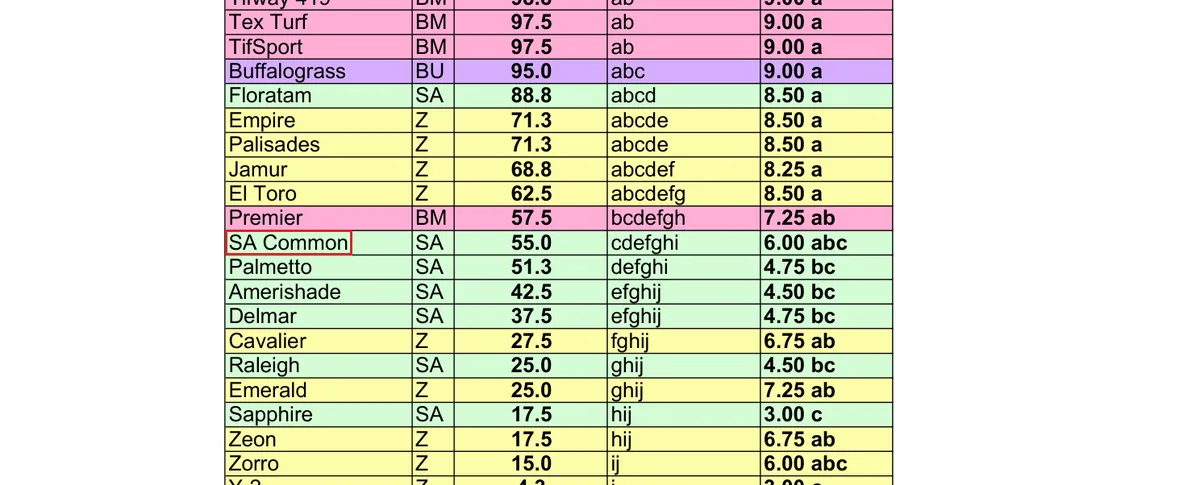
Read it with three limits. It is one year at one site, in 4 by 4 foot plots, and the report’s statistics group many neighbors together: the 95 percent cultivar is not significantly different from those at 55 percent or more. Cool nights late in recovery may have slowed regrowth. The biggest finding sits outside the table: no grass survived on 4 inches of soil over a plastic barrier, while all 25 survived on deep native soil. If your trowel hits rock, gravel or construction fill within 4 inches, expect that area to fail first in the next drought.
What killed it? Read the pattern before you replant
Replanting over a live cause wastes the seed. Utah State starts by running a manual sprinkler cycle to catch plugged or misaligned heads, then pulling on the dead turf. Match what you see here; yellowing without death belongs to our page on why grass turns yellow.
If the dead grass follows narrow winding trails that showed up as the snow melted, voles grazed it; our page on vole vs mole damage in lawns shows how to confirm it and when the turf fills in without help.
| What you see | Likely cause | How to confirm | What to do |
|---|---|---|---|
| Whole unwatered lawn straw-colored after 2 to 4 dry weeks | Drought dormancy (UMass) | Tug and crown test | Survival water; recheck when rain returns |
| Brown first on paths, clay, sand | Compaction, wear or poor soil (Illinois) | Compare a sample with the same test | Limit traffic; aerate after drought ends |
| Brown first over rock, fill or a slab | Shallow root zone: 4 in was fatal in 60 days (Texas A&M) | Dig: is soil under 4 in deep? | Add soil depth before replanting |
| Mat lifts like carpet | White grubs (Utah State) | Count grubs in 1 sq ft | Treat only above about 5 to 10 per sq ft, then reseed |
| Irregular patches spreading in hot, dry St. Augustinegrass | Chinch bugs: damage at 20 to 25 per sq ft (Texas A&M) | Flush test: 1 tbsp lemon dish soap per gallon at the patch edge; bugs surface in 5 to 10 minutes (LSU) | Control the bugs before repairing |
| Smooth round patches, about 1 ft across at first, after wet weather | Brown patch (LSU) | Check timing and edges | Lawn fungus page |
| Straw spots, often with a darker, lusher rim | Dog urine (Maryland) | Same spot, dog access | Water is the only neutralizer; on dead spots remove 0.5 to 1 in of soil before reseeding or sodding (Colorado State) |
| Stripes or a spill shape | Fertilizer burn from spreader overlap (Maryland) | Lines match spreader passes | Soak with 1 in of water, 2 or 3 times; replant what dies |
| Strip along a walk or road after winter | Ice-melt salt (Maryland) | Location | Treat like fertilizer salts: soak, then replant what dies |
| Bleached white blades within a week of spraying | Mesotrione whitening (Maryland) | Spray record | Often temporary: the grass can grow out over several weeks |
If it is dead: patch, overseed or renovate?
Size the damage first. Measure each dead patch as length times width, add them up and divide by the lawn’s square footage. Penn State and Utah State both draw the line at 50 percent: with at least half the lawn in grass you want, repair it; below that, start over. Penn State also requires thatch of 1/2 inch or less and no perennial grass weeds for the repair route.
| Dead area | Do this | Expect | Cost anchor | Steps |
|---|---|---|---|---|
| Smaller than your fist | Nothing | Fills in from surrounding grass in a few weeks (Wisconsin) | $0 | n/a |
| Small spot, warm-season lawn growing well | Wait, or cut plugs from your own lawn | Runners may fill it (USGA); plugs a few inches wide, about 6 in apart; zoysia may take until after next summer | $0 from your own lawn | Zoysia, St. Augustine pages |
| Spots larger than a fist, cool-season lawn | Rake until soil shows, sow a seed and soil mix, keep moist | Green in 2 to 4 weeks (Iowa State); blending takes longer | Seed prices | Plant grass seed |
| Thin or under 50% dead | Overseed the lawn at about half the new-lawn rate | Seedlings need moisture more than once a day; first mow 2 to 4 weeks after germination (USGA) | $140 to $299 DIY, $225 to $435 hired, 5,000 sq ft (Oct. 2026) | Overseed |
| 50% or more dead, or perennial grass weeds | Renovate: kill what remains, prepare soil, seed | Bare soil until germination; weeds must be gone first (Penn State) | $334 to $647 DIY, 5,000 sq ft (Oct. 2026) | Kill, then seed |
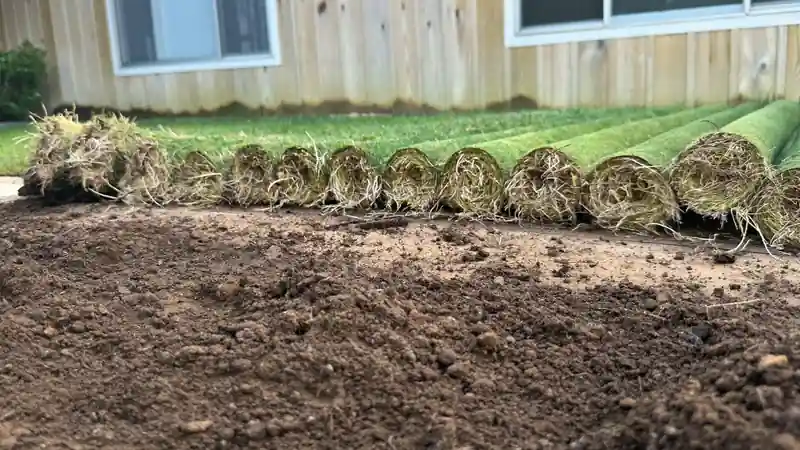
| Any size, need cover now, or a grass without good seed | Sod: cut back to a clean edge, lower the soil to fit | Instant cover; water often until rooted (USGA) | $1.00 to $1.60 per sq ft on ready soil; $1.65 to $2.25 if stripped and regraded | Sod cost |
| Same spot failed several times | Stop planting grass there | Groundcover, mulch or a bed (USGA) | Varies by material | Creeping thyme |
Timing decides whether any of this works. The USGA Green Section (August 2026) puts cool-season seeding in late summer through early fall and warm-season repairs in late spring through summer. A recent preemergence herbicide can stop new seed too, so check your last application before sowing. Soil and germination numbers are on our pages for soil temperature and germination time; more grass profiles sit under Turf and Trees.
How we compiled this
In November 2026 we read 18 extension publications, 3 research reports, a USGA article and a city water page, and transcribed Tables 6 and 7 of the 2006 Texas A&M report. The copy hosted by the San Antonio Water System opens with a promotional summary for one cultivar; we used only the report’s tables. We did not test any grass. “Decide after” and the gallon figures are our own reading and arithmetic. We could not open the 2008 final report directly, so browning days and recovery weeks come from LSU AgCenter’s summary of it.
Frequently asked questions
Can you just sprinkle grass seed over dead grass?
Only after opening the soil. Wisconsin says rake off enough dead blades to see soil, then sprinkle a mix of soil and seed; you need not remove it all. The USGA loosens the top inch and warns that more seed than the bag rate is not better.
Is it okay to leave dead grass on a lawn?
Over a spot you are not reseeding, yes, unless it builds thatch past the 1/2 inch Penn State sets for overseeding. Dead cover blocks seed from soil, so rake it before sowing. Dormant blades should stay: they are the same dead-looking leaves on a live plant.
Can fertilizer bring back dead grass?
No, and there is no best fertilizer for dead grass. LSU AgCenter says drought-dormant grass is short of water, not food, and should not be fertilized. Iowa State says it will not harm dormant cool-season grass but may not help. Use a starter fertilizer only when you reseed, and UMass suggests a low-nitrogen, high-potassium feed such as 15-0-30 in fall for recovering turf.
How long does it take dormant grass to come back?
At least 2 weeks after the soil is fully wet (Wisconsin). In the Texas trial reported by LSU, good recovery took 2.5 to 3 weeks for bermudagrass, 1 month for St. Augustinegrass and 5 to 6 weeks for zoysiagrass after 60 dry days.
Does it hurt to cut dormant grass?
It can. UMass says do not mow unless absolutely necessary, and the Texas A&M team stopped mowing at week 5 of its 60-day drought because growth had nearly ended. If weeds force a cut, mow high with a sharp blade; Iowa State suggests 3 to 3.5 inches in summer.
Sources
- Chalmers, Steinke, White, Thomas and Fipps, Texas A&M University System, Evaluation of Sixty-Day Drought Survival in San Antonio of Established Turfgrass Species and Cultivars: Year 1, December 2006. Accessed November 2026.
- LSU AgCenter, Drought-dormant Lawns, web page, adapted from the 2008 final report. Accessed November 2026.
- Hong, Bremer and Keeley, Kansas State University, Minimal Water Requirements of Cool-Season Turfgrasses for Survival and Recovery After Prolonged Drought, July 2019. Accessed November 2026.
- Domenghini, Bremer, Fry and Davis, HortScience 48(9), Prolonged Drought and Recovery Responses of Kentucky Bluegrass and Ornamental Groundcovers, 2013. Accessed November 2026.
- University of Nebraska-Lincoln Extension, G2191, Water Wise: Drought Effects on Turf in the Landscape, current edition. Accessed November 2026.
- Iowa State University Extension, Summer Dormancy in Cool-Season Lawns, web page. Accessed November 2026.
- University of Wisconsin-Madison Extension, Doug Soldat, Keeping your Grass Alive During Periods of Extended Drought, revised July 13, 2012. Accessed November 2026.
- University of Wisconsin-Madison Extension, Now is a great time to fixing dead spots in lawns, web page. Accessed November 2026.
- University of Illinois Extension, Managing Lawns During Drought, web page. Accessed November 2026.
- Utah State University Extension, Kelly Kopp, Is Your Lawn Dead or Dormant?, web page. Accessed November 2026.
- Utah State University Extension, Renovate your Lawn After a Long, Hot Summer, web page. Accessed November 2026.
- UMass Extension Turf Program, Management Tips to Improve Turfgrass Drought Survival, web page. Accessed November 2026.
- Texas A&M AgriLife Extension, B-6126, Keep Your Lawn Alive During Drought, PDF. Accessed November 2026.
- Texas A&M AgriLife Extension, Chinch Bug Management in Lawns, web page. Accessed November 2026.
- LSU AgCenter, A Triple Threat to Southern Lawns, web page. Accessed November 2026.
- UF/IFAS Extension St. Lucie County, Is My Lawn Dead, and Should I Be Fertilizing Right Now?, Dec. 22, 2025. Accessed November 2026.
- Penn State Extension, Renovation of Lawns, web page. Accessed November 2026.
- USGA Green Section Record, Vol. 64 Issue 15, John Petrovsky, Bringing Bare Spots in Your Lawn Back to Life, Aug. 21, 2026. Accessed November 2026.
- University of Maryland Extension, Lawn Problems Not Caused by Pests or Diseases, web page. Accessed November 2026.
- Colorado State University Extension, Dog Urine Damage on Lawns: Causes, Cures, and Prevention, web page. Accessed November 2026.
- Kansas State University Turfgrass, Lawn Problem Solver: Maintenance Selection, web page. Accessed November 2026.
- University of New Hampshire Extension, How do I keep my lawn alive in a drought?, July 2020. Accessed November 2026.
- City of Golden, Colorado, Grass Dormancy, web page. Accessed November 2026.