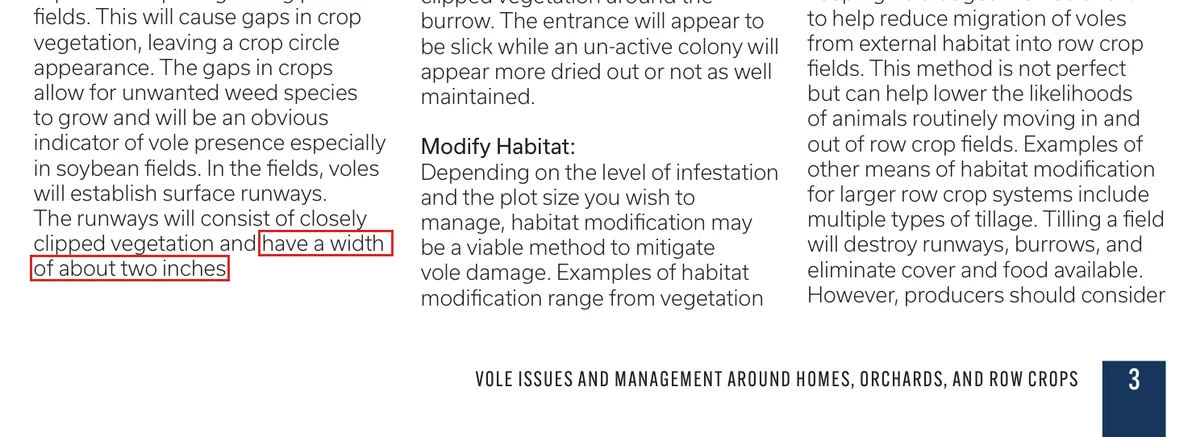
Lawn vole vs mole damage: voles cut grass-level trails 1.5 to 2 inches wide with golf-ball holes and no loose soil; moles push up soft ridges and round soil mounds. Mouse snap traps stop voles; trapping is what removes moles.
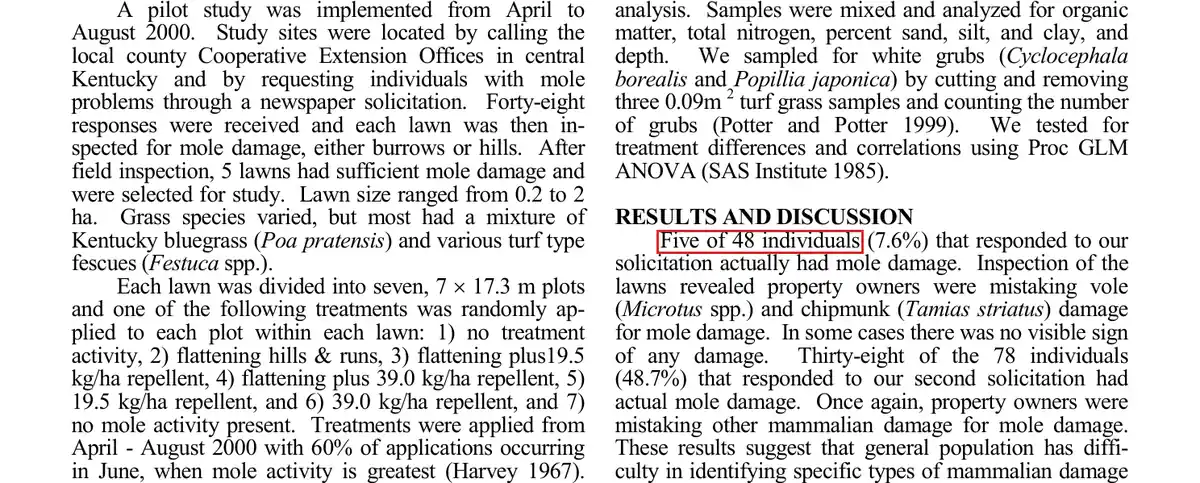
Lawn vole vs mole damage gets misread more often than either animal gets caught. When University of Kentucky researchers asked homeowners with “mole problems” to volunteer their lawns for a repellent trial, only 5 of the 48 lawns they inspected had mole damage; the rest were mostly vole or chipmunk work, and some showed no animal sign at all. A second call drew 78 responses and 38 real mole lawns (Courtney and Barnes, Proc. 20th Vertebrate Pest Conference, 2002). Treating the wrong animal is the most common reason a fix fails.
So the table below starts with what you can measure with a tape: trail width, tunnel depth, mound shape and size, and hole diameter, for the 7 animals that dig or graze lawns. Every cell comes from an extension service or a state wildlife agency, and a 24-hour stomp test then tells you whether the sign is still active. Control rules follow by animal, including the Washington trap ban and the field data on grub control and castor oil.
Vole vs mole damage, sign by sign
| Animal | Trail or tunnel | Mound | Open holes | What it eats in a lawn |
|---|---|---|---|---|
| Mole (eastern, Townsend’s) | Raised ridge about 3 in. wide over a tunnel 1 to 4 in. down; it sinks when stepped on (WDFW) | Round “volcano” 6 to 24 in. across, 2 to 8 in. high, hole plugged near the center (WDFW) | None left open | Earthworms, grubs, insects: 70 to 100% of body weight a day (Penn State) |
| Meadow vole | Path cut into the grass at soil level, about 1.5 in. wide (Penn State) to about 2 in. (UK FOR-172); clipped grass and rice-sized brown or green droppings | No large mounds (UMD) | Clusters of golf-ball-size or smaller holes (UK FOR-172); about 1 in. near bulbs (UMN) | Grass blades, roots, bulbs, bark |
| Pine (woodland) vole | No surface runways; tunnels underground (Penn State) | Small conical piles of soil | Small openings under shrubs and trees | Roots and bark at the base of trees |
| Pocket gopher | Tunnels 1.75 to 3.5 in. wide, 4 to 12 in. down; no ridges. Winter soil casts show at snowmelt (WDFW) | Fan- or heart-shaped mound; plug is a 1 to 3 in. circle of soil off to one side (WDFW) | Plugged within 24 hours | Roots, plants pulled down into the tunnel |
| Chipmunk | None at the surface | None | Single entrance about 2 in. across, no soil around it (Penn State) | Seeds, bulbs |
| Shrew | Makes no surface tunnels; hunts in vole and mole runways (Penn State) | None | Uses other animals’ holes | Insects; body only 3 to 4 in. long |
| Skunk or raccoon | None | None | Cone-shaped holes about 3 in. wide and deep, or sod rolled back in chunks (UMD) | Grubs, earthworms |
The width is the fastest tell. A vole trail is a groove you could lay a garden hose in, at grass level, with the blades clipped and droppings in it; Penn State calls these 1.5-inch travel lanes “reliable indicators of meadow vole activity” (Penn State, Voles). A mole ridge is about twice as wide, raised above the lawn, and springy underfoot because the soil under it is hollow.
Moles and voles can share a lawn. Voles, house mice and white-footed mice travel through mole tunnels and eat the bulbs and roots along them, which is why moles take the blame for plant loss (Penn State, Moles). If plants are dying from below and you see ridges, set a mouse trap at an opening as well as a mole trap in the ridge.
Which animal is it? The 24-hour stomp test
Most mole ridges are dug once and abandoned, so the sign alone does not tell you what is living there now. Penn State and the University of Maryland use the same check before setting any trap (UMD, Moles):
- Step a 1 ft section of each ridge flat with your heel, or pull a 1 in. section of tunnel roof off. Mark each spot with a flag.
- Rake each mound flat and note where it was.
- Check 24 hours later. A ridge pushed back up, or a roof repaired, is an active mole runway: that is where traps go.
- A fan-shaped mound rebuilt with its plug to one side is a pocket gopher; WDFW notes gophers plug any opening within 24 hours (WDFW).
- For voles, look at the trails instead: fresh clipped grass and green droppings mean the runway is in use; roots or mold in the path mean it is old (Penn State).
1Is there a raised ridge that sinks when you step on it?
YesMole surface tunnel. Step it flat; if it rises again within 24 hours, set a mole trap there (where state law allows).
NoGo to the next question
2Is there a fan- or heart-shaped mound with a soil plug off to one side?
YesPocket gopher. Gopher traps, not mole or mouse traps.
NoGo to the next question
3Is there a round mound, 6 to 24 in. across, with no open hole?
YesMole. Find the feeding ridges nearby and run the stomp test.
NoGo to the next question
4Are there grass-level trails 1.5 to 2 in. wide with clipped grass or rice-size droppings?
YesMeadow vole. Snap traps across the runway if trails are fresh; rake and reseed if they appeared at snowmelt.
NoGo to the next question
5Are there clusters of golf-ball-size holes with no soil around them?
YesVole colony. Mouse snap traps at 1/4 to 1/3 of the openings.
NoGo to the next question
6Is there one 2 in. hole with no soil, near a wall, step or woodpile?
YesChipmunk.
NoGo to the next question
7Are there cone-shaped holes about 3 in. wide, or sod rolled back?
YesSkunk or raccoon after grubs. Dig a square foot and count grubs.
NoNo animal sign: check for grubs, disease or drought before treating.
Source: Penn State Extension, University of Kentucky FOR-172, UMD Extension and WDFW
What vole damage after snowmelt means for the lawn
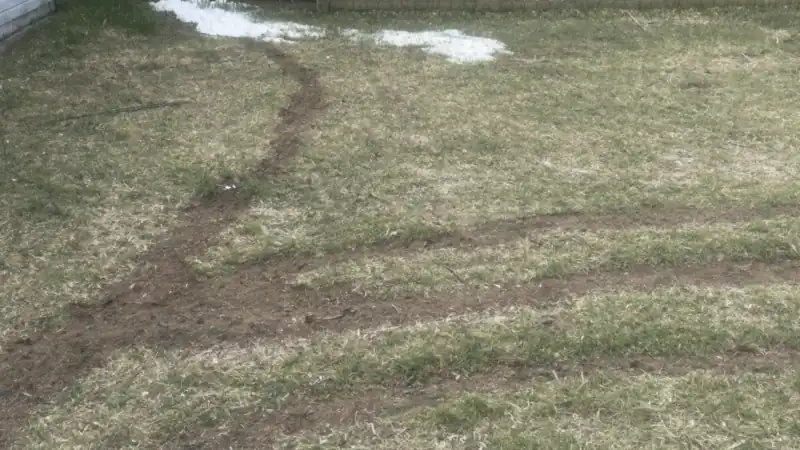
The winding brown trails that appear when snow melts are meadow vole runways. Under snow, voles graze open lawn they would avoid in summer, and they usually leave as the snow goes (Penn State). University of Minnesota Extension says the damage “is rarely permanent”: rake out the dead grass, reseed bare spots, and the surrounding grass covers the trails (UMN Extension, reviewed 2024).
Wait until the lawn is dry and growing before you rake. If more than about half the area is bare, our guide to overseeding a lawn gives seed rates by grass, and the crown test on our page about reviving dead grass shows whether a trail is dormant or dead. Pocket gophers can leave similar snowmelt lines, but theirs are ropes of soil (winter casts), not grazed grass (WDFW).
Vole numbers swing: Minnesota sees a population boom every 3 to 5 years, and one female can have 5 to 10 litters a year of 3 to 5 young (UMN). A lawn with trails one spring may have none the next. Trees and shrubs are the bigger risk, because voles girdle bark under snow; Penn State specifies 1/4-inch hardware cloth cylinders 18 to 24 inches high, buried 4 to 6 inches, and mulch pulled back 2 feet from trunks. Our page on mulching around trees covers the distances.
Control rules by animal
| Method | Voles | Moles | Evidence |
|---|---|---|---|
| Trap | Mouse-size snap traps across the runway, trigger in the path; peanut butter and oatmeal (UK FOR-172) | Harpoon, scissor-jaw or choker trap over a straight, active ridge (Penn State) | Strong for both: extension first choice |
| Washington State | Legal: common rat and mouse traps are not body-gripping traps under RCW 77.15.192 | Illegal: mole traps are body-gripping traps, banned by RCW 77.15.194 (gross misdemeanor), with no permit route (WDFW) | Statute |
| Habitat | Mow regularly, clear weeds and heavy mulch; voles avoid open ground (UMD) | Little effect; moles follow worms in moist soil | Extension guidance |
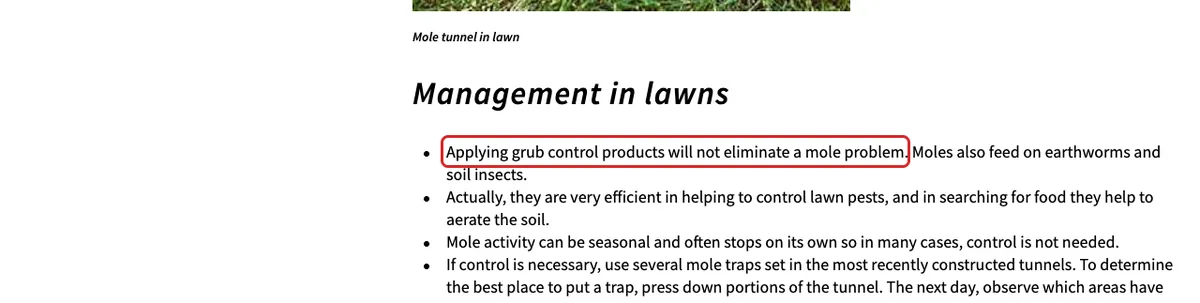
| Grub insecticide | No effect: voles eat plants | “Will not eliminate a mole problem” (UMD); see below | Field data against |
| Castor oil granules | Not studied for lawns | Kentucky trial: no better than stepping tunnels flat; see below | Weak |
| Repellents, registered | Thiram and capsaicin are registered for voles, “little data” on effect (Penn State) | None registered; Mole-Med registration canceled in 2005 (Penn State) | Weak |
| Vibrating, sonic, solar stakes | Not effective (Penn State) | “None, however, have been proven effective” (Henderson, 1994) | None |
| Poison baits | Zinc phosphide and anticoagulants are restricted use in Penn State’s guidance | Moles rarely take grain baits; WDFW says baits have proven ineffective | Risk to pets and predators |
| Exclusion | 1/4 in. hardware cloth around trunks and beds | 24 in. sheet metal or hardware cloth bent into an L, buried 12 in. (Penn State) | Works on small areas only |
Voles: how many snap traps
Kentucky’s 2023 guidance sets the trap count from the holes: place mouse snap traps at one quarter to one third of the burrow openings in a colony, cover each with cardboard to keep birds off, check daily, and keep trapping until nothing is caught for 3 days in a row (UK FOR-172). Move any trap that catches nothing in 48 hours. For a lawn colony, Kentucky expects the job to take 1 to 2 weeks.
- Traps, low (1/4 of openings)
- 3
- Traps, high (1/3 of openings)
- 4
Default: 12 openings gives 3 to 4 traps. Check daily; stop after 3 days with no catch; move a trap that catches nothing in 48 hours (University of Kentucky FOR-172, 2023).
| Active openings you counted | Traps at 1/4 | Traps at 1/3 |
|---|---|---|
| 6 | 2 | 2 |
| 12 | 3 | 4 |
| 20 | 5 | 7 |
| 40 | 10 | 13 |
Moles: where and when to trap
Set traps only on ridges that came back after the stomp test, on a straight run, never on a mound (Henderson, Prevention and Control of Wildlife Damage, 1994). Move a trap that has not fired in 2 days, Penn State says, because the mole has changed course or detected it. WDFW recommends concentrating the effort in late winter and early spring, before the 3 to 5 young are born (WDFW).
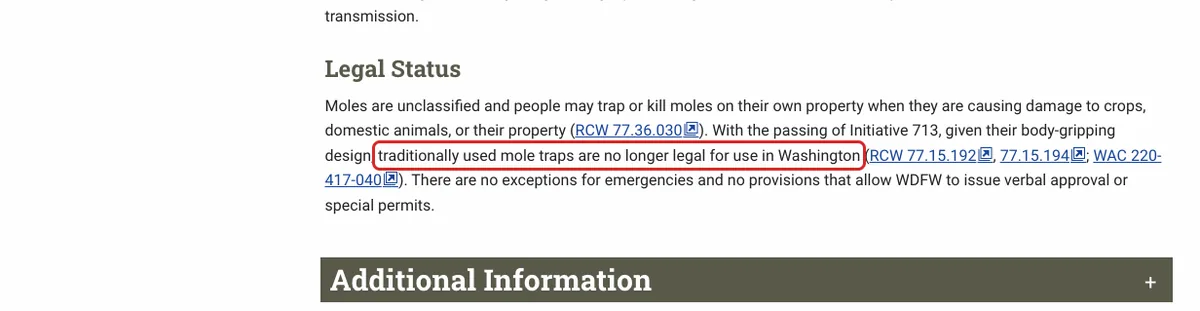
Before you buy one, check your state. Washington voters passed Initiative 713 in 2000, and RCW 77.15.194 now bars any body-gripping trap for any animal outside narrow permits; WDFW states that “traditionally used mole traps are no longer legal for use in Washington” and that there are no emergency exceptions. Henderson’s 1994 handbook notes moles are unprotected in most states, but trap rules are set state by state.
Flattening alone buys time but does not remove the animal: in the Kentucky trial, activity was still recorded in 9 of the 12 lawns that were only stepped flat (Courtney and Barnes, 2002). For bumps left behind, our page on rolling a lawn gives the water-roller fill for mole runs, and leveling a lawn covers topdressing.
Why grub control does not stop moles
Grubs are on the menu but not the whole menu. In stomach contents of 100 eastern moles, 64 held white grubs, 49 earthworms and 67 adult beetles, with spiders, centipedes, ants and seed husks in dozens more (Henderson 1994, Table 1). In Oregon, 70 to 90 percent of the Townsend mole’s diet was earthworms (WDFW). Killing grubs leaves the worms.
The field numbers agree. The Kentucky lawns with active moles averaged 0.26 grubs per lawn in their sod samples, too few to analyze, and the authors pointed to earthworms as the primary food (Courtney and Barnes, 2002). WDFW notes moles “often are present even in grub-free yards,” and Penn State warns that moles may dig more, not less, while hunting for what is left, with a delay of several weeks before any effect.
Treat grubs when the grubs justify it: dig a square foot and compare the count with the species thresholds in our guide to grubs in lawns. Skunk and raccoon holes are the sign that points to grubs, not mole ridges.
Does castor oil repel moles?
Castor oil granules are sold under the federal minimum-risk exemption: castor oil is on the list of active ingredients in 40 CFR 152.25(f), so these products carry no EPA registration number and EPA has not reviewed whether they work. The one registered castor oil mole repellent, Mole-Med, lost its registration in 2005 (Penn State).
The best lawn trial is Kentucky’s 2001 test of Molexit on 38 lawns. Lawns treated at 19.5 kg per hectare (about 0.4 lb per 1,000 sq ft) lost an average 34.0 m of active tunnel over 6 weeks and showed no activity for those 6 weeks, but lawns that were only stepped flat lost 28.0 m, and the difference between treatments was not significant (P = 0.83) (Courtney and Barnes, 2002). At two farm sites, activity returned after a heavy rain.
| Treatment, 2001 | Lawns | Lawns with less tunneling | Mean drop in active tunnel, 6 weeks |
|---|---|---|---|
| Molexit at label rate, 19.5 kg/ha | 15 | 14 | 34.0 m (112 ft) |
| Molexit at 2x label rate | 11 | 7 | 32.8 m (108 ft) |
| Tunnels stepped flat only | 12 | 3 | 28.0 m (92 ft) |
| Untreated areas next to treated lawns | 38 | 9 | 1.6 m (5 ft) |
Read that as a weak “maybe for 6 weeks.” The likely mechanism is WDFW’s point: a mole works one part of a tunnel system that may run several hundred feet, then shifts, so any product applied before a shift looks like it worked. If you use castor oil, apply it where the stomp test shows activity and expect to repeat it after rain.
This page is general information, not legal or pesticide advice. Trap and bait rules differ by state (Washington bans mole traps under RCW 77.15.194); the label is the law for any pesticide, and restricted-use products require a certified applicator.
How we compiled this
We read 15 primary documents in November 2026: Penn State, University of Kentucky, University of Minnesota and University of Maryland extension publications, Washington Department of Fish and Wildlife pages, Washington statutes RCW 77.15.192 and 77.15.194, 40 CFR 152.25, the 1994 Prevention and Control of Wildlife Damage chapter on moles and the 2002 Kentucky castor oil trial. Measurements in the sign table are copied from those sources, not measured by us. We ran no field tests. Trap counts in the worked example are our arithmetic on Kentucky’s published rule.
Frequently asked questions
How can I tell the difference between mole and vole damage?
Step on it. A mole ridge is raised, about 3 inches wide and hollow underfoot, often with round soil mounds nearby (WDFW). A vole trail is a groove at grass level, 1.5 to 2 inches wide, with clipped grass, droppings and open golf-ball-size holes but no soil piles (Penn State; UK FOR-172).
Do voles take over mole tunnels?
Yes. Penn State and the 1994 wildlife damage handbook both say voles, house mice and white-footed mice travel through mole tunnels and eat bulbs and roots along them, which is why moles get blamed for plant damage they do not cause.
Will grass grow back after voles?
Usually. University of Minnesota Extension (reviewed 2024) calls snowmelt vole damage rarely permanent: rake out dead grass, reseed bare spots, and the surrounding turf fills the trails. Penn State says the lawn quickly recovers once voles leave with the snow.
Should you flatten mole tunnels?
Yes, to find active runs and protect the mower: step them flat and see which rise again in 24 hours (UMD). Flattening alone rarely ends it; 9 of 12 lawns only flattened in the Kentucky trial still had moles.
Are moles or voles worse for a lawn?
For turf, moles: ridges and mounds up to 24 inches across disrupt roots and scalp under the mower, while vole trails usually regrow (UMD; UMN). For trees, shrubs and bulbs, voles are worse, because they eat roots and girdle bark; moles eat insects and worms.
Sources
- Courtney, A. and Barnes, T.G., University of Kentucky, The Efficacy of Molexit for Reducing Damage from Eastern Moles, Proc. 20th Vertebrate Pest Conference, 2002. Accessed November 2026.
- Penn State Extension, Voles, web page. Accessed November 2026.
- Penn State Extension, Moles, web page. Accessed November 2026.
- Penn State Extension, Identifying Moles, Voles, and Shrews, updated Dec. 15, 2025. Accessed November 2026.
- Penn State Extension, Chipmunks, web page. Accessed November 2026.
- University of Kentucky Cooperative Extension, FOR-172: Vole Issues and Management around Homes, Orchards, and Row Crops, May 2023. Accessed November 2026.
- University of Minnesota Extension, How to manage vole damage on lawns, trees and shrubs, reviewed 2024. Accessed November 2026.
- University of Maryland Extension, Animals digging in lawns, web page. Accessed November 2026.
- University of Maryland Extension, Moles, updated March 3, 2023. Accessed November 2026.
- Washington Department of Fish and Wildlife, Living with wildlife: Moles, web page. Accessed November 2026.
- Washington Department of Fish and Wildlife, Living with wildlife: Pocket gophers, web page. Accessed November 2026.
- Washington State Legislature, RCW 77.15.194, Unlawful traps, penalty, current. Accessed November 2026.
- Washington State Legislature, RCW 77.15.192, Definitions, current. Accessed November 2026.
- Henderson, F.R., Prevention and Control of Wildlife Damage (University of Nebraska-Lincoln, USDA APHIS), Moles, pp. D51 to D58 (Maine DACF copy), 1994. Accessed November 2026.
- U.S. EPA, eCFR, 40 CFR 152.25(f), minimum risk pesticides, Table 1, current. Accessed November 2026.