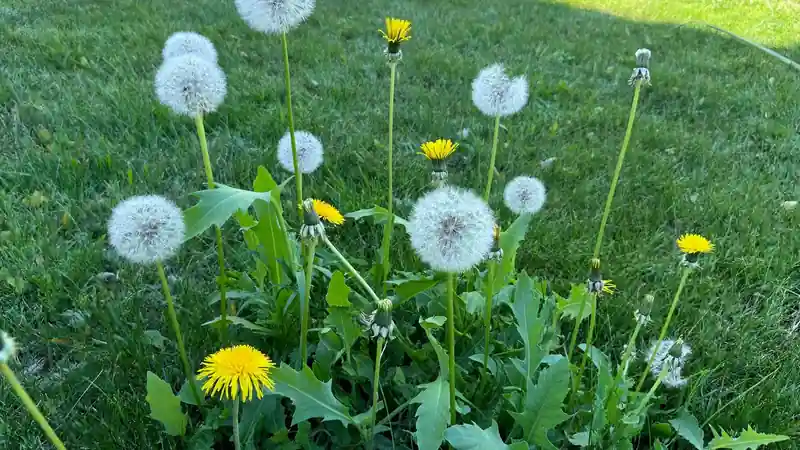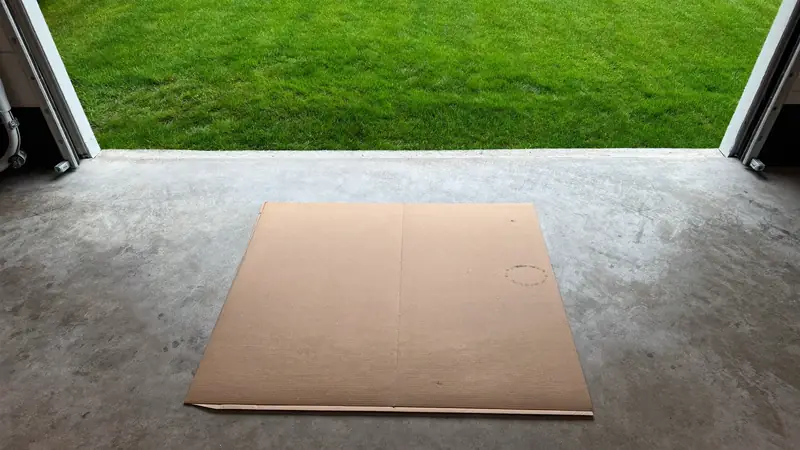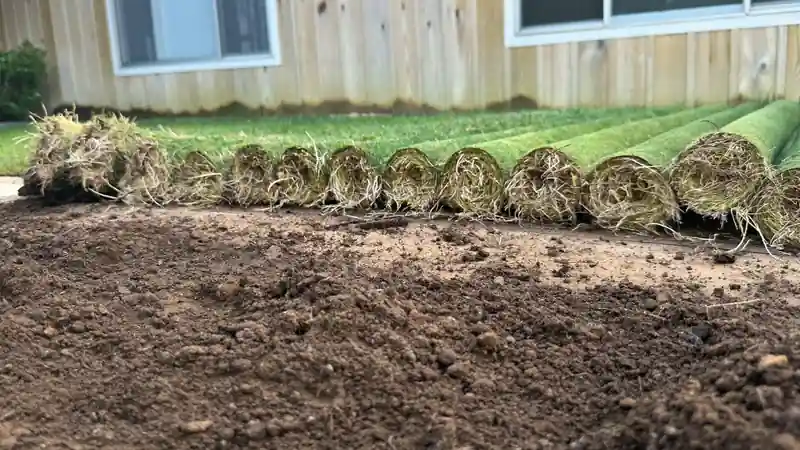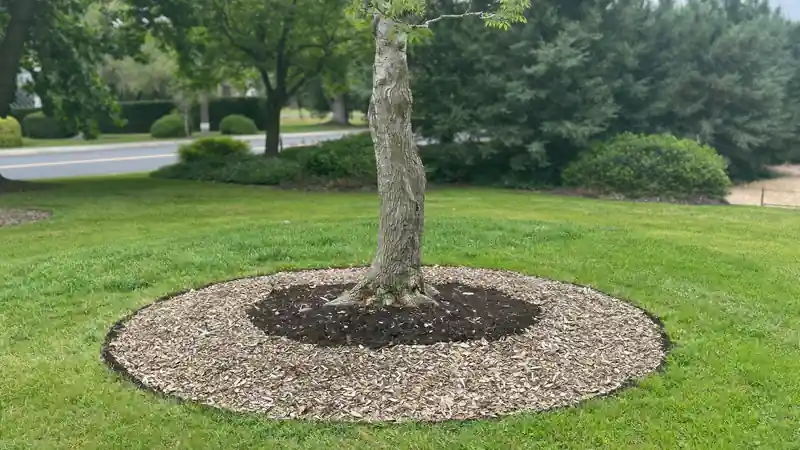
How to mulch around trees: clear the grass, spread 2 to 4 inches of wood chips in a ring at least 3 feet in radius, wider toward the drip line, and keep mulch 3 to 12 inches off the trunk so the root flare shows.
Most guides on how to mulch around trees stop at the rules. We set 15 published rule sets side by side and pulled the trials that measured each mistake. Grass to the trunk was the costliest: sugar maples with an 8-foot mulch circle grew about 2.6 times as much trunk diameter in 5 seasons as maples in lawn (Green and Watson 1989). A cone of mulch on the trunk did less than its reputation, but still more than doubled internal wood staining after a wound (Watson, TREE Fund 2010).
The rules, and what happens when you miss each one
Arborists’ working standard is the International Society of Arboriculture (ISA) brochure: 2 to 4 inches of mulch on well-drained sites, coarse arborist chips at 3 to 4 inches and fine composted material at 2 to 3, spread near but not touching the trunk and out to the drip line where practical, with a 3-foot radius as the minimum. The right-hand column below is the reason each number exists, taken from trials that measured it.
| Rule | Number to hit | What missing it did in trials | Source |
|---|---|---|---|
| Remove turf from the ring | No grass inside the mulched circle | Lawn to the trunk: 0.96 cm of trunk growth in 5 years vs 2.54 cm with mulch; 15 times fewer fine roots in the top 2 in of soil | Green and Watson 1989 |
| Depth | 2 to 4 in; 1 to 2 in of double-shredded; 2 in or less on wet soil | Peach trees: 0 to 5 percent died under 2 in of pecan-shell mulch, 15 percent under 4 in, 35 percent under 6 in in a wet year | Stafne 2009, via Martin 2025 |
| Not too deep for water | Stay near 3 in | Soil water potential: minus 9.1 kPa bare, minus 5.8 kPa under 3 in of pine bark, minus 16.2 kPa under 9 in (drier, rain blocked) | Arnold 2005 |
| Trunk gap | Root flare visible; 3 to 5 in on young trees, 8 to 10 in on mature | Wounded trunks under a volcano: 59 percent showed wood discoloration vs 25 percent under proper mulch | Watson 2010 |
| Ring radius | 3 ft minimum; drip line is better | Watson’s mulch root gains were measured in plots about 6.5 ft (2 m) from the trunk, well outside a 3 ft ring | ISA; Watson 1988 |
| New tree: water under the mulch | Irrigate the root ball itself, not the mulch surface | A 0.25 in watering over mulch on the root ball left live oaks more stressed, with lower survival, than bare root balls | Gilman and Grabosky 2004 |
| Plant at grade before mulching | Root flare at or slightly above grade | Green ash set 3 in deep and mulched: up to 60 percent greater losses after 3 seasons | Arnold 2005 |
Step by step
- Find the root flare, where the trunk widens into roots, and uncover it by hand if it is buried (Penn State Extension).
- Mark a circle at least 3 feet from the trunk; UF/IFAS asks for 8 feet across around new trees (UF/IFAS).
- Slice out the sod no more than 2 inches deep. Dig rather than spray, per the Arbor Day Foundation; skip tilling, which did nothing for maples in Green and Watson’s trial.
- Measure any old mulch down to soil; if 2 inches or more remain, fluff it and add 1 inch at most.
- Spread coarse chips 3 to 4 inches deep or shredded bark 2 to 3, level, not mounded.
- Pull mulch back 3 to 5 inches from a young trunk, 8 to 10 from a mature one (Penn State).
- Water a new tree on the root ball itself, 2 to 3 gallons per inch of trunk diameter (UF/IFAS).
What 15 published rule sets say, side by side
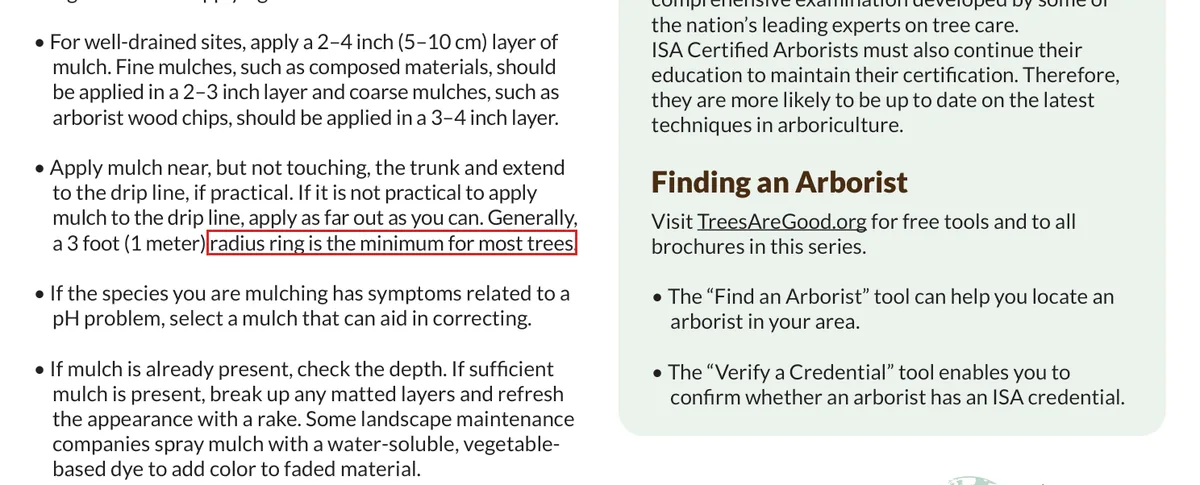
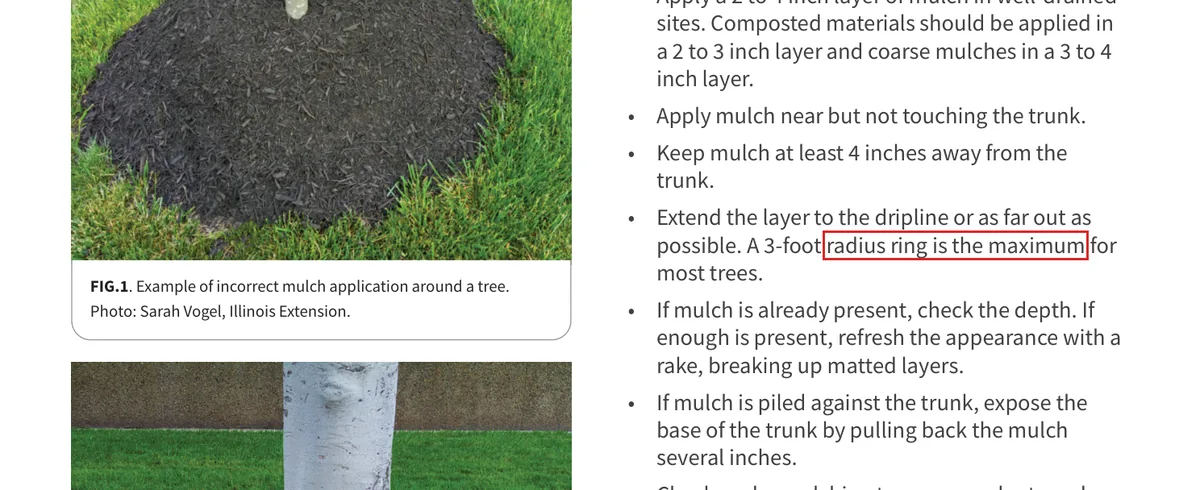
The guides agree on 2 to 4 inches and on keeping the trunk clear. They split on the two numbers a homeowner actually measures: the trunk gap runs from 1 to 2 inches (North Carolina Urban Forest Council) to 12 inches (UF/IFAS), a 6 to 12-fold spread, and the ring runs from 3 feet across to the drip line. One sheet inverts the standard: the Illinois Extension info sheet (March 2024) calls a 3-foot radius “the maximum for most trees,” where the ISA brochure it otherwise follows says minimum.
Swipe the table sideways to see every column.
| Publisher | Document | Depth | Trunk gap | Ring size |
|---|---|---|---|---|
| International Society of Arboriculture (ISA) | Proper Mulching Techniques, 2021 | 2 to 4 in (fine 2 to 3, coarse chips 3 to 4) | Near, but not touching | To the drip line if practical; 3 ft radius minimum |
| Penn State Extension | Mulching Landscape Trees | 2 to 4 in; 1 to 2 in of fine or double-shredded | 3 to 5 in (young), 8 to 10 in (mature) | To the drip line |
| University of Florida IFAS | Planting and Establishing Trees | 3 in | 12 in | 8 ft circle minimum (4 ft radius) |
| Iowa State University Extension | Care of Newly Planted Trees | 2 to 4 in | At least 6 in | Not stated |
| University of Illinois Extension | Proper Mulching Techniques info sheet, March 2024 | 2 to 4 in | At least 4 in | “3-foot radius ring is the maximum” |
| University of Illinois Extension | News release, Aug. 26, 2020 | 2 to 3 in | Not stated | Not stated |
| University of Maryland Extension | Mulching Trees and Shrubs, Dec. 2023 | 1 to 3 in | About 3 in | To the branch spread if possible |
| The Morton Arboretum | How to Mulch Trees and Shrubs | 3 to 4 in (medium to coarse) | Donut hole, no number | Drip line (young); 4 to 5 ft across minimum (older) |
| North Dakota State University Extension | Dakota Gardener column | 3 in | 3 in | At least 3 ft in diameter |
| City of Maple Grove, Minn. | How to Properly Apply Mulch (PDF) | 3 in maximum | 3 in | “3-foot radius” in text; “diameter of at least 3 feet” in graphic |
| K-State Research and Extension, Johnson County | How to Mulch Trees | 2 to 4 in | 3 to 6 in | At least 3 ft out; 6 ft better |
| North Carolina Urban Forest Council | Mulch the Right Way | 2 to 4 in (also 2 to 3 in) | 1 to 2 in | 3, 8, 12 ft radius for small, medium, large trees |
| Arbor Day Foundation | Arborist Advice: Mulching 101, 2018 | 2 to 3 in | Root flare kept completely clear | 3 to 10 ft around the base |
| Penn State Extension | Mulch Volcanoes Are Erupting Everywhere, 2018 | 2 to 3 in | Not touching | To the drip line |
| Martin, Klein, Koeser and Hauer, Arboriculture and Urban Forestry | Systematic review, Dec. 2025 (industry BMP) | 2 to 4 in; 2 to 3 in after settling | Kept away from the trunk | Not stated |
The 3-3-3 rule hides a factor of 4. North Dakota State Extension states it as a ring “at least 3 feet in diameter,” 3 inches deep, 3 inches from the trunk (NDSU). The City of Maple Grove, Minn. says “3-foot radius” in its text and “diameter of at least 3 feet” in its own graphic (Maple Grove PDF). A 3-foot radius covers about 28 square feet; a 3-foot diameter covers about 7. Use the radius: it is the ISA’s floor.
On the trunk gap, Penn State’s 3 to 5 inches for young trees and 8 to 10 for mature ones brackets most of the table. Read any single number as a minimum.
How much mulch one tree ring takes
A ring is the area of the outer circle minus a bare circle at the trunk. We left a 1-foot circle bare (6-inch radius), the same assumption our mulch quantity guide uses for beds and rings. Volume in cubic feet is ring area times depth in inches divided by 12; a 2-cubic-foot bag covers 8 square feet at 3 inches.
- Mulch (cubic feet)
- 6.9
- Bulk mulch (cubic yards)
- 0.25
- 2 cu ft bags
- 4
- 3 cu ft bags
- 3
Ring area = 3.1416 x (radius squared minus 0.25 sq ft); volume = area x depth / 12. Default: 1 tree, 3 ft radius, 3 in deep = 6.9 cu ft, 4 bags of 2 cu ft.
| Ring radius | Ring area, sq ft | Cu ft at 2 in | Cu ft at 3 in | Cu ft at 4 in | Cu yd at 3 in | 2 cu ft bags at 3 in |
|---|---|---|---|---|---|---|
| 3 ft (6 ft across) | 27 | 4.6 | 6.9 | 9.2 | 0.25 | 4 |
| 5 ft (10 ft across) | 78 | 13.0 | 19.4 | 25.9 | 0.72 | 10 |
| 8 ft (16 ft across) | 200 | 33.4 | 50.1 | 66.8 | 1.85 | 26 |
| 10 ft (20 ft across) | 313 | 52.2 | 78.3 | 104.5 | 2.90 | 40 |
The arithmetic also explains why volcanoes are wasteful. A cone 12 inches tall at the trunk, tapering to nothing at 3 feet, holds about 9.4 cubic feet, enough to cover a 4-foot-radius ring about 2.3 inches deep. Penn State makes the same point from the field: the mulch in a volcano it photographed “was sufficient to properly mulch the tree” once spread out.
What each mistake measurably does
Grass up to the trunk
This is the mistake with the biggest measured effect. In Green and Watson (1989), 40 bare-root ‘Green Mountain’ sugar maples, 2 to 2.5 inches in diameter, went into a parkway of 2 to 3 inches of topsoil over compacted clay in fall 1981. After the 1986 season, trees in an 8-foot circle of 4 inches of leaves and wood chips had grown 2.54 cm in trunk diameter against 0.96 cm for trees in lawn, with crowns about 1.6 times as large.
| Measure (5 seasons after planting) | Lawn to trunk | 8 ft mulch circle | Mulch as multiple of lawn |
|---|---|---|---|
| Trunk diameter increase | 0.96 cm | 2.54 cm | 2.6x |
| Crown silhouette area (relative) | 0.920 | 1.504 | 1.6x |
| Fine roots, top 0 to 5 cm (mm2 per 150 cm2 soil) | 41.8 | 634.6 | 15.2x |
| Fine roots, 0 to 15 cm total | 407.1 | 1,588.4 | 3.9x |
Two follow-ups sharpen what the result means. Gilman and Grabosky found live oaks in bare, weeded soil did as well as mulched ones, so the gain comes from removing turf; mulch is the practical way to keep it gone (Gilman and Grabosky 2004). Watson (1988) saw the same split on 20-year-old trees of 7 species: against grass, bare soil raised total root surface area by up to 113 percent and mulch by up to 195 percent.
Too deep
The 2-to-4-inch limit has thinner evidence than most guides imply. A December 2025 systematic review in Arboriculture and Urban Forestry found only 11 studies that varied mulch depth, 9 published before 2010, and concluded there are “few negative effects reported” between 2 and 4 inches but “often negative side effects” beyond 4.
The negatives are specific. Stafne and others (2009) lost 15 percent of young peach trees under 4 inches of pecan-shell mulch and 35 percent under 6 inches in a wet year, against 0 to 5 percent at 2 inches or less. Arnold and others (2005) measured soil under 9 inches of pine bark as drier than bare soil, minus 16.2 kPa against minus 9.1, because the layer intercepted rain. In Greenly and Rakow (1995), shoot growth peaked at 3 inches and fell at 6 and 10. Established roots are more forgiving: 18 inches of chips over existing roots did no measurable harm in 2 years (Watson and Kupkowski 1991). The risk sits with young trees, fine mulch and wet soil, where the ISA says 2 inches or less.
Mulch piled against the trunk
The best-measured test of volcano mulching is a Morton Arboretum project funded by the TREE Fund (Watson, 2010 grant report). Of 837 public trees surveyed in 38 western Chicago suburbs, 83 had at least 8 inches of material mounded on the trunk, and about 80 percent of those showed no disease under it.
In the controlled half of the study, trunks were wounded and then mulched properly or buried. After about a year, wood discoloration showed up in 59 percent of volcano-mulched trees against 25 percent of properly mulched ones, and in 70 against 43 percent when a fungus was added to the wound. No tree died. About one-third of the surveyed street trees had girdling or encircling roots, the long-term risk extension services tie to mulch on the trunk.
Ohio State’s Joe Boggs photographed maples volcano-mulched in 2016 with roots growing up into the pile by 2022, and calls the damage “irreversible if not recognized and corrected early” (Ohio State BYGL).
Mulch over a new tree’s root ball, or a tree planted deep
Two planting-time errors interact with mulch. In Florida sand, a 0.25-inch watering applied over mulch on the root ball left 3-inch live oaks more stressed, with lower survival, than oaks with a bare root ball; 2 inches of water erased the difference (Gilman and Grabosky 2004). In a College Station, Texas sandy loam over a clay pan, green ash planted 3 inches below grade and then mulched had up to 60 percent greater losses after 3 seasons (Arnold 2005). Set the flare at grade and water the ball directly for the first season.
Should you mulch around mature trees?
Yes. Watson’s 1988 root gains were measured on trees about 20 years old, and Morton Arboretum asks for at least a 4 to 5-foot circle around older specimens, wider where possible (Morton Arboretum). The North Carolina Urban Forest Council scales the minimum radius to size: 3 feet for small trees, 8 for medium, 12 for large.
Remove turf by hand and shallow, with no tilling and no added topsoil, which acts like planting deep. Leave 8 to 10 inches at the trunk, cover exposed roots with 2 to 3 inches of mulch, and skip the deep edging trench; Boggs warns it severs roots.
How to fix a mulch volcano
The question is what sits under the pile: in the TREE Fund survey of 83 mounded trees, many “volcanoes” were soil under a thin mulch skin, which takes more care than mulch. Work through these checks in order.
1Does the trunk go straight into the mulch with no visible flare, or is mulch touching the bark?
YesPull mulch back by hand until the root flare shows: 3 to 5 in of clearance on a young tree, 8 to 10 in on a mature one. Then answer the next questions.
NoGo to the next question
2Did you reach soil before finding the flare?
YesStop digging. The tree is planted or buried deep; ask an ISA Certified Arborist about a root collar excavation.
NoGo to the next question
3Are roots circling the trunk or pressed against it?
YesClip small roots growing into the mulch on a young tree; have an arborist judge any thick girdling root on a mature tree.
NoGo to the next question
4Is the mulch deeper than 4 in anywhere in the ring?
YesRake the excess out toward the drip line until no spot tops 4 in; the pile usually covers the wider ring.
NoGo to the next question
5Is grass growing within 3 ft of the trunk?
YesSlice out the sod no more than 2 in deep and widen the ring to at least a 3 ft radius.
NoThe ring is fine. Each spring, add mulch only where it has thinned below 2 in.
Work by hand, not with a metal rake, so the bark is not scraped. Penn State’s worked example on a young red maple moved the whole volcano onto a wider ring and removed nothing (Penn State). If you hit soil before the flare, a root collar excavation by an ISA Certified Arborist is safer than a shovel.
Penn State’s Sandy Feather traces volcanoes to crews topping up “without regard to the depth of the existing mulch” (Penn State Extension, 2018), so write “2 to 3 inches total, kept off trunks” into any maintenance contract.
What mulch to put around trees
The ISA calls fresh arborist wood chips, with bark and leaves mixed in, “an excellent material” around trees, at 3 to 4 inches. Shredded bark works at 2 to 3; double-shredded or dyed fines at 1 to 2 per Penn State, because fine particles mat and shed water. Maryland Extension says chips are fine on the surface but tie up nitrogen if mixed into soil, and warns hardwood bark can carry manganese toxic below pH 5.0 (UMD Extension).
Skip landscape fabric under the ring; Maryland says to cut it away near trunks because it can cause girdling roots. Compare materials in wood chips vs mulch, the mulch color guide and pine straw vs mulch; for prices, mulch cost per yard.
How we compiled this
We read 15 mulching rule sets from extension services, the ISA, the Arbor Day Foundation, an urban forestry council and a city, plus 8 peer-reviewed trials, a 2025 systematic review and a TREE Fund research summary, all accessed November 2026. Figures come from the primary documents; the Stafne mortality figures are taken from its abstract as quoted in the 2025 review. We did no field work. Ring volumes are our arithmetic and are shown in full.
Frequently asked questions
What is the 3-3-3 rule for mulch?
A ring 3 feet across or in radius, 3 inches deep, 3 inches from the trunk. Sources split on radius vs diameter, a 4-fold difference in area; use the 3-foot radius, the ISA minimum.
Should I mulch around mature trees?
Yes. Mulch raised root surface area up to 195 percent on 20-year-old trees in Watson’s 1988 study. Remove turf by hand, do not till, and run the ring 8 to 12 feet out on medium and large trees.
What is a common mistake when applying mulch?
Topping up yearly without checking the old layer, which pushes a ring past 4 inches. In Stafne 2009, 15 percent of peach trees died under 4 inches and 35 percent under 6.
What mulch should I put around trees?
Arborist wood chips at 3 to 4 inches, which the ISA calls an excellent material, or shredded bark at 2 to 3. Keep double-shredded mulch to 1 to 2 inches and skip landscape fabric.
Can I put new mulch over old mulch?
Yes, if the total stays at or under 4 inches. Rake the old layer to break up mats, measure to soil, and add only the difference, usually about 1 inch.
How do you mulch around a tree with exposed roots?
Spread 2 to 3 inches of coarse mulch over them and leave them in place. Do not add soil or till; soil over roots acts like planting the tree too deep.
Sources
- International Society of Arboriculture, Proper Mulching Techniques (TreesAreGood brochure), 2021. Accessed November 2026.
- Martin, Klein, Koeser and Hauer, Arboriculture and Urban Forestry, Does Excess Mulch Depth Lead to Poor Tree Growth and Condition, Root Girdling, and Decay? A Systematic Literature Review, Dec. 2025. Accessed November 2026.
- Green and Watson, Journal of Arboriculture 15(11), Effects of Turfgrass and Mulch on the Establishment and Growth of Bare Root Sugar Maples, 1989. Accessed November 2026.
- Watson, Journal of Arboriculture 14(8), Organic Mulch and Grass Competition Influence Tree Root Development, 1988. Accessed November 2026.
- Watson and Kupkowski, Journal of Arboriculture 17(9), Effects of a Deep Layer of Mulch on the Soil Environment and Tree Root Growth, 1991. Accessed November 2026.
- Gilman and Grabosky, Journal of Arboriculture 30(5), Mulch and Planting Depth Affect Live Oak Establishment, 2004. Accessed November 2026.
- Arnold, McDonald and Bryan, Journal of Arboriculture 31(4), Planting Depth and Mulch Thickness Affect Establishment of Green Ash and Bougainvillea Goldenraintree, 2005. Accessed November 2026.
- Greenly and Rakow, Journal of Arboriculture 21(5), The Effect of Wood Mulch Type and Depth on Weed and Tree Growth and Certain Soil Parameters, 1995. Accessed November 2026.
- Stafne and others, HortTechnology 19(4), Pecan Shell Mulch Impact on ‘Loring’ Peach Tree Establishment and First Harvest, 2009. Accessed November 2026.
- TREE Fund (Gary Watson, Morton Arboretum), Evaluating damage resulting from volcano mulching, 2010 grant, summary updated Oct. 2026. Accessed November 2026.
- Ohio State University, Buckeye Yard and Garden onLine, Shining a Spotlight on Mulch Volcanoes, May 2, 2024. Accessed November 2026.
- Penn State Extension, Mulching Landscape Trees, undated. Accessed November 2026.
- Penn State Extension (Sandy Feather), Mulch Volcanoes Are Erupting Everywhere!, July 19, 2018. Accessed November 2026.
- University of Illinois Extension, Proper Mulching Techniques information sheet, March 2024. Accessed November 2026.
- University of Illinois Extension, Too much of a good thing, mulch volcanoes slowly kill trees, Aug. 26, 2020. Accessed November 2026.
- University of Maryland Extension, Mulching Trees and Shrubs, Dec. 6, 2023. Accessed November 2026.
- The Morton Arboretum, How to Mulch Trees and Shrubs, undated. Accessed November 2026.
- Arbor Day Foundation, Arborist Advice: Mulching 101, March 28, 2018. Accessed November 2026.
- Iowa State University Extension and Outreach, Care of Newly Planted Trees, undated. Accessed November 2026.
- University of Florida IFAS Extension, Planting and Establishing Trees, undated. Accessed November 2026.
- North Dakota State University Extension, Dakota Gardener: Your lawn mower scares trees, undated. Accessed November 2026.
- City of Maple Grove, Minn., How to Properly Apply Mulch (PDF), undated. Accessed November 2026.
- K-State Research and Extension, Johnson County, How to Mulch Trees, undated. Accessed November 2026.
- North Carolina Urban Forest Council, Mulch the Right Way, undated. Accessed November 2026.