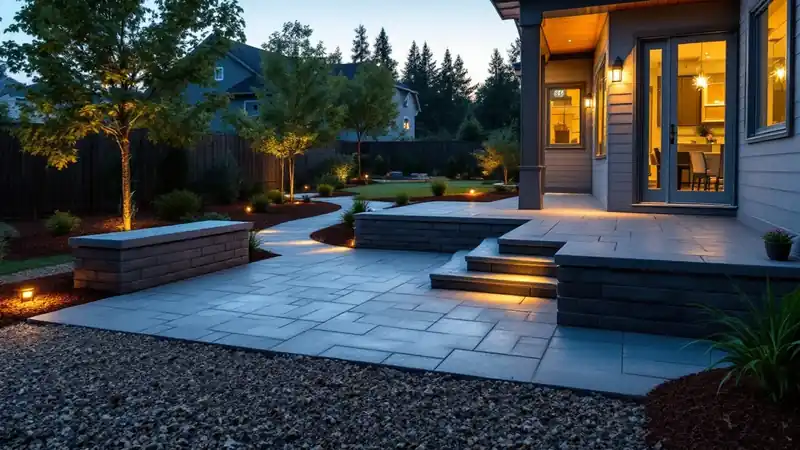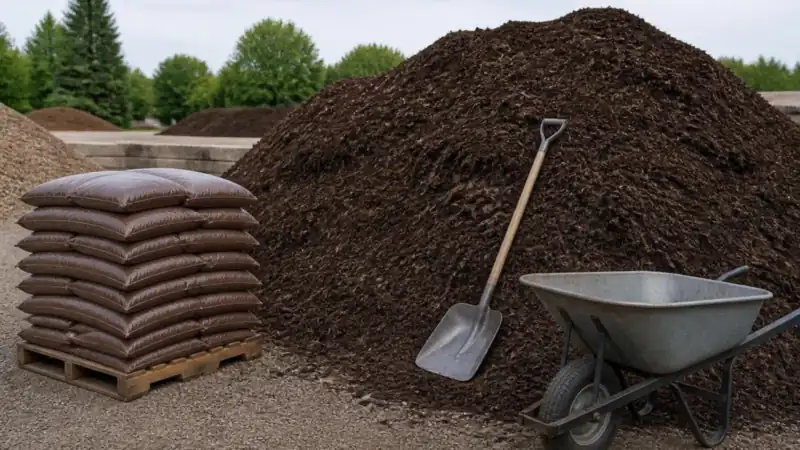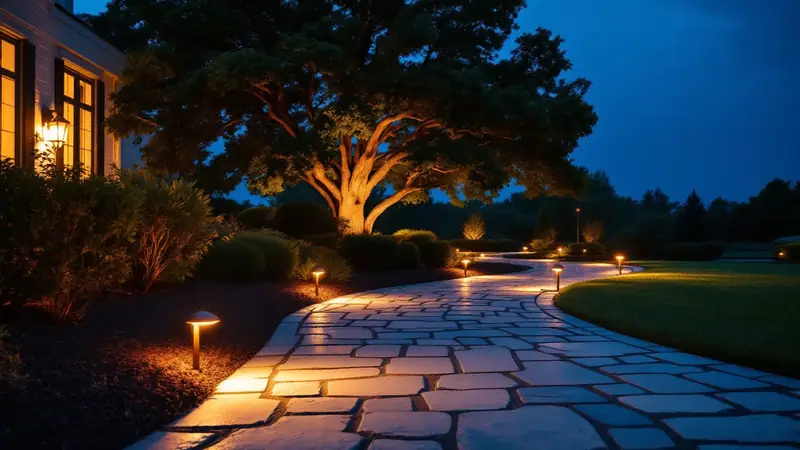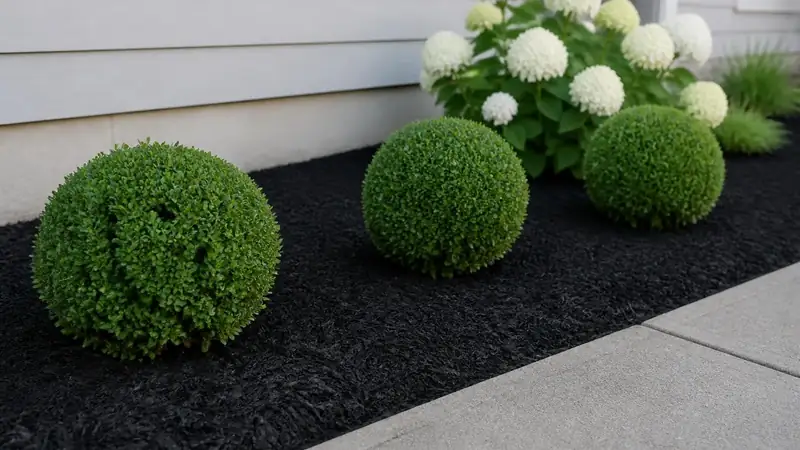
Mulch colors come down to three dyes: black (carbon black), red (iron oxide) and brown (blended shades). Bulk prices run about $43 a yard for black or brown and $44 for red; the wood under the dye matters most.
Key takeaways
- Price: across 19 supply yards checked Oct. 30, 2026, dyed black mulch had a median posted price of $43.47 a cubic yard, brown $42.95, red $44 and undyed mulch $40; at the 16 yards selling both, dye added a median $7 a yard. 8 of 11 yards that sell black and red charge the same for both (GIR price list, CSV).
- Dye chemistry: the Mulch and Soil Council’s colorant review covered iron oxide (red) and carbon black and found “no significant areas of concern” with either at label rates (MSC colorant review, 2006 to 2007).
- Wood source is the real risk: in Florida tests, 18 of 22 recycled construction-wood samples leached arsenic above the 50 µg/L groundwater limit, and under 0.1 percent CCA-treated wood can push mulch past Florida’s residential soil guideline (Townsend et al., 2003).
- Heat: an LSU AgCenter trial of shredded mulch dyed black, brown and red found soil temperatures 8 cm down “effectively equivalent” across colors; color changed peak temperatures only in the mulch surface (Abdi, Hickman and Fields, ASHS 2024).
- Fade: no independent trial has timed dyed mulch fading by color. The dated numbers are maker terms, such as Scotts’ 1-year ColorGuard guarantee, and a University of Florida trial where undyed mulches had weathered to gray between June and October (Scotts; Stinson et al., 1990).
$43.47 vs $44 median posted price per cubic yard for black and red dyed mulch at 19 supply yards (GIR list, Oct. 30, 2026)
60.3 million cubic yards of colored mulch produced in 2023, up from 711,000 in 1995 (Amerimulch at MSC, Oct. 2025)
0.1% CCA-treated wood that can put mulch over Florida’s residential arsenic soil guideline (Townsend et al., 2003)
1 year color guarantee on Scotts Nature Scapes Color Enhanced Mulch with ColorGuard (Scotts product page)
What mulch colors can you buy?
Dyed wood mulch is sold in three colors that make up nearly the whole market: black, brown and red. A colorant supplier’s October 2025 talk to the Mulch and Soil Council says “the colored mulch industry is dominated by red, brown, and black” (MSC 2025 annual meeting deck). Undyed hardwood, cedar, cypress and pine bark supply the natural browns.
The order of popularity has shifted. The same deck dates colored mulch to landscaping trade shows in the late 1980s, says red rose first in the 1990s and is now used mostly on commercial properties, and says brown became “the top choice by 2017”. Black is the newest of the three: KDCO in Minnesota still describes its black as “one of the newest colors to the mulch family” (KDCO price list, Oct. 30, 2026).
| Color | Colorant | Common product names | What the base wood usually is | Source |
|---|---|---|---|---|
| Black | Carbon black (elemental carbon) | Black Colorized, Forest Black, Midnight Black, Scotts Nature Scapes Black | Shredded hardwood, pine and spruce, or reprocessed pallet wood | MSC; T.W. Nickerson |
| Brown | Blended shades; T.W. Nickerson lists a carbon dye in its dyed brown | Chocolate, Dark Walnut, Triple Ground Brown | Same feedstock as black | KDCO; T.W. Nickerson |
| Red | Iron oxide (rust-colored pigment) | Bright Red, Ruby Red, Standard Red | Same feedstock; a Colorbiotics slide shows one red reading differently on pallet, pine, cedar and hardwood | MSC; Colorbiotics slide |
| Undyed brown | None | Natural, Double Ground, Triple Grind hardwood | Bark and wood, grays as it weathers | UF, 1990 |
| Natural red-brown | None | Cedar, cypress, redwood bark | Single species | cedar; cypress |
Volume grew 85-fold in 28 years. Amerimulch’s estimate, presented at the same meeting, puts U.S. colored mulch production at 711,000 cubic yards in 1995, 31.2 million in 2009 and 60.3 million in 2023, with 60 percent sold in bulk and 40 percent in bags. Growth flattened after 2015 at about 54 to 60 million yards a year.
Source: Amerimulch, Colored Mulch Insights, Mulch and Soil Council annual meeting, Oct. 2, 2025 Industry estimate; survey method not published.
Show the numbers
| Colored mulch produced | |
|---|---|
| 1995 | 0.71 |
| 2000 | 4.70 |
| 2003 | 8.44 |
| 2005 | 16.67 |
| 2009 | 31.21 |
| 2012 | 42.92 |
| 2015 | 55.52 |
| 2017 | 53.88 |
| 2020 | 55.90 |
| 2023 | 60.30 |
| Year | Colored mulch produced (cubic yards) |
|---|---|
| 1995 | 711,000 |
| 2000 | 4,704,000 |
| 2003 | 8,439,000 |
| 2005 | 16,665,000 |
| 2009 | 31,205,000 |
| 2012 | 42,918,000 |
| 2015 | 55,519,000 |
| 2017 | 53,877,000 |
| 2020 | 55,897,000 |
| 2023 | 60,300,000 |
What are mulch dyes made of?
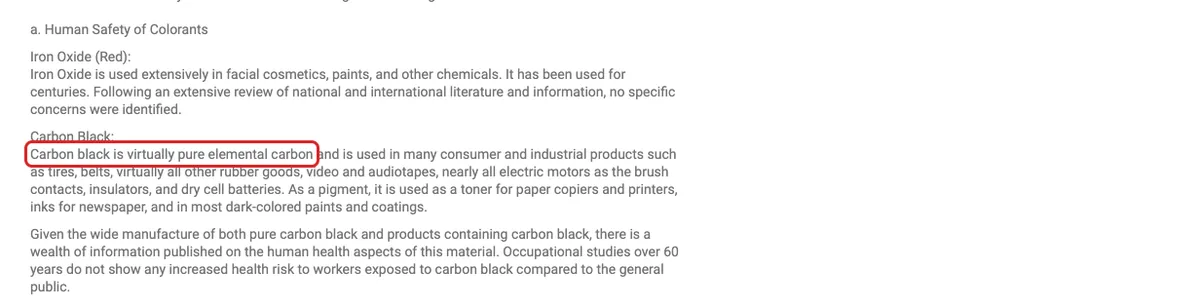
Mulch dyes are water-based pigment coatings, not stains that soak in. Red is iron oxide, the pigment used in cosmetics and paint; black is carbon black, which the Mulch and Soil Council calls “virtually pure elemental carbon” (MSC FAQ); T.W. Nickerson describes its Forest Black as wood “mixed with a carbon dye” (T.W. Nickerson). Browns are blended shades.
Producers spray the colorant with water onto ground wood in a drum or auger colorizer, at roughly 1.5 to 3.25 pounds per cubic yard. The application rate rises with the share of fines, particles 1/4 inch and smaller, because fine material has more surface to cover. Colorbiotics, a Sika brand, calculated 2,029 square feet of surface in a yard of 2-inch chips and 11,664 square feet in a yard of 1/2-inch fines, and its table below ties fines content to colorant, water and wet weight (MSC 2025 deck, Colorbiotics slides).
| Fines in the wood (1/4 in and smaller) | Colorant per cubic yard | Water per cubic yard | Wet weight per cubic yard | Yards per 42,000 lb truckload |
|---|---|---|---|---|
| 10% | 1.5 lb | 14 gal | 398 lb | 105 |
| 30% | 1.75 lb | 15 gal | 405 lb | 104 |
| 50% | 2 lb | 17 gal | 426 lb | 99 |
| 70% | 2.5 lb | 20 gal | 451 lb | 93 |
| 90% | 3.25 lb | 23 gal | 476 lb | 88 |
Iron oxide is an imported input. The deck states that 100 percent of synthetic iron oxide supplied to the United States is imported and walks through the duties on Chinese pigment as of October 2025: a 3.7 percent statutory rate, a 25 percent Section 301 tariff and a 20 percent IEEPA tariff, taking $1.00 a pound to $1.487 before freight. Tariff rates on Chinese goods have been revised since, so treat that as a dated example.
| Input | Value | Source |
|---|---|---|
| Colorant at 10% fines | 1.5 lb per cubic yard | Colorbiotics, MSC 2025 |
| Colorant at 90% fines | 3.25 lb per cubic yard | Colorbiotics, MSC 2025 |
| Imported Chinese iron oxide after duties, Oct. 2025 example | $1.487 per lb before freight | MSC 2025 tariff slide |
| Upper bound if all colorant were pure pigment | 1.5 × $1.487 = $2.23 to 3.25 × $1.487 = $4.83 per yard | GIR arithmetic |
| Median red premium over black at yards that charge one | $3 (Remington, Cummin); $6 (Got Mulch) | GIR price list |
Carbon black has one caveat buyers find online. The International Agency for Research on Cancer lists carbon black in Group 2B, possibly carcinogenic to humans, based mainly on rats that inhaled it as dust (IARC Monograph 93). That evaluation rests on inhaled dust, the exposure route in carbon black plants; MSC’s review says occupational studies over 60 years show no increased risk to exposed workers and calls carbon black non-toxic.
Is dyed mulch safe, or is the wood the problem?
The documented hazard in colored mulch is arsenic from chromated copper arsenate (CCA) treated lumber, not the dye. CCA was the standard deck and fence preservative until manufacturers stopped making it for homeowner uses in December 2003, and EPA says wood treated with it “should not be reused in products such as mulch” (EPA, chromated arsenicals).
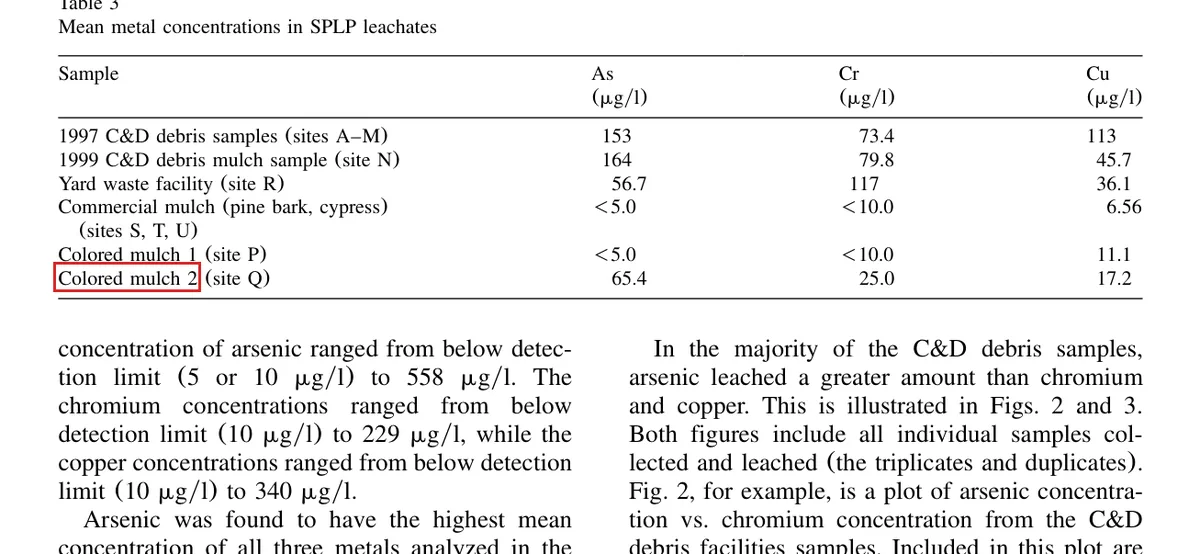
Dye matters because, as Florida researchers put it, coloring agents opened the mulch market to discarded wood that was unwanted for its color. University of Florida and University of Miami engineers tested mulch made from construction and demolition (C&D) debris in 2003. Eighteen of 22 facility samples leached arsenic above Florida’s 50 µg/L groundwater cleanup level, averaging 153 µg/L with a maximum of 558, and one of two red-colored retail mulches leached 65.4 µg/L (Townsend et al., Sci. Total Environ. 309, 2003).
| Sample (Florida, 1997 to 2001) | Mean leachable arsenic (µg/L) | Above 50 µg/L? | Source |
|---|---|---|---|
| Red-colored C&D wood mulch from a recycling yard (site N, 1999) | 164 | Yes | Townsend 2003, Table 3 |
| C&D debris wood from recycling facilities (1997) | 153 | Yes (18 of 22 samples) | Townsend 2003 |
| Red-colored retail mulch 2 (wood source not labeled) | 65.4 | Yes | Townsend 2003, Table 3 |
| Red-colored retail mulch 1 | Under 5 (not detected) | No | Townsend 2003, Table 3 |
| Pine bark and cypress retail mulch (virgin wood) | Under 5 (not detected) | No | Townsend 2003, Table 3 |
| Florida groundwater cleanup target level | 50 | Threshold | Townsend 2003 |
A 2007 follow-up sampled consumer mulch across Florida. Most colored mulch made from recycled C&D wood contained 1 to 5 percent CCA-treated wood, up to 15 percent, and the highest arsenic reading was 230 mg/kg against a 2.1 mg/kg residential guideline; undyed mulch with no sign of C&D wood never leached above 50 µg/L (Jacobi et al., Waste Management, 2007).
Iron oxide red pigment binds some arsenic. In a 1-year field test, colorant cut arsenic leaching by more than 20 percent on average, and by 50 percent in the lab test, but the authors warn the effect may not last (Shibata et al., Environ. Sci. Technol., 2006). The fix is clean feedstock, not a particular color.
How can you tell what wood is in a bag of colored mulch?
Read the ingredient statement and look for the Mulch and Soil Council (MSC) certification logo. MSC’s guidelines require any product with recycled wood to say so, for example “Contains Reprocessed Wood and Colorant”, while virgin wood reads “Natural Forest Products and Colorant” (MSC ingredient statement guidelines). Certified mulches must also pass lab testing for CCA.
Recycled wood is legal and common. Amerimulch’s 2025 estimate splits colored mulch fiber into 60 percent land-clearing, green-waste and tree-company chips, 25 percent sawmill residuals and bark, and 15 percent pallet fiber. MSC’s draft 2026 guidelines allow pallet and C&D wood only if it was never treated, stained or painted, and they bar CCA outright (MSC UVPG 2026 draft, definitions and item 11).
- Find the ingredient line on the bag. “Natural Forest Products” means virgin wood; “Reprocessed Wood” or “and/or Reprocessed Wood” means pallets or other recycled wood may be in it (MSC guideline SUIP #3, 2018).
- Check for the MSC Certified logo, then confirm the product on the council’s current certified mulch list (MSC certification page). Since 2025 a separate “Certified All-Natural” logo marks products meeting the stricter CANM guideline.
- For bulk mulch, ask the yard two questions: what the colored product is ground from, and whether incoming wood is screened for treated lumber. Write down the answer with the date.
- Look at a handful before you spread it. Florida researchers found colorant and visible plywood chips were effective first screens for C&D wood (Jacobi et al., 2007).
- For vegetable beds or play areas, pick a product labeled Natural Forest Products, or skip dye. Scotts, for example, states that Nature Scapes Color Enhanced Mulch “never uses recycled waste wood” and is free of construction debris and pallet wood (Scotts product page).
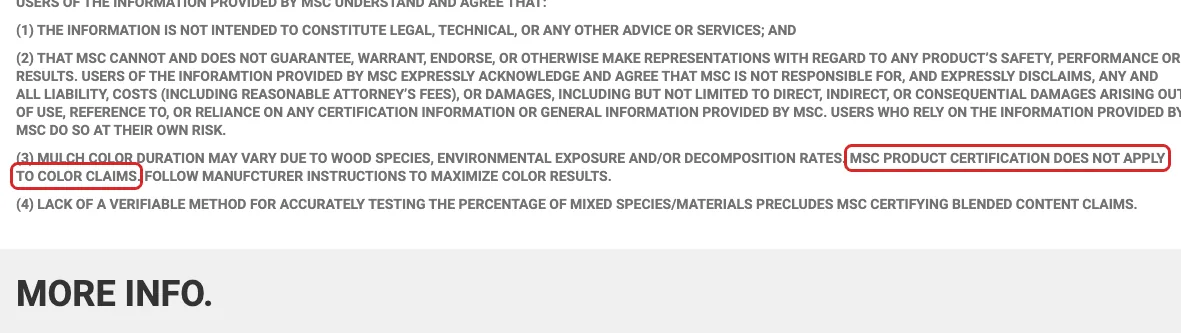
One limit is printed on MSC’s own page: “MSC product certification does not apply to color claims.” The logo speaks to what is in the bag and to CCA testing, not to how long the color lasts. Binders that stop mulch from washing off slopes are a separate product with their own labels; our mulch glue guide covers them.
Does black mulch heat the soil more than brown or red mulch?
At the surface, yes; a few inches down, the one trial of dyed wood mulch found almost no difference. LSU AgCenter researchers built 21 plots at the Hammond Research Station, 18 of them mulched, with shredded mulch dyed black, brown or red at 5 cm and 10 cm, logging temperature every 30 minutes through spring and summer (ASHS 2024 abstract).
They report that “subsurface temperatures were effectively equivalent between all mulched plots” at the base of the bed mix, 8 cm (about 3 inches) down. Surface temperatures did differ: thinner layers swung more, and color “influenced peak temperatures”. Light reaching the soil was cut equally by every color and depth. The abstract does not publish the degree values.
| Study | What was tested | Finding | Applies to dyed wood mulch? | Source |
|---|---|---|---|---|
| LSU AgCenter, 2024 | Shredded mulch dyed black, brown, red at 5 and 10 cm | Soil 8 cm down effectively equal across colors; surface peaks differ by color and depth | Yes | Abdi et al., ASHS 2024 |
| Fortnum et al., 1997, cited in J. Nematology 2000 | Black vs white polyethylene film over tomato beds | Soil under black film 8 °C (14 °F) warmer at 5 cm at solar noon | No: plastic film transmits heat directly | J. Nematology 32(1) |
| Hartin, UC Cooperative Extension, 2021 to 2022 | Surface readings in Coachella Valley, May to August | Black dyed mulch, synthetic lawn and asphalt surfaces up to 65 °F hotter than plant surfaces | Surface only | UC ANR, 2022; Hartin, 2021 |
| Scotts label directions | Depth for Nature Scapes | Spread 3 inches deep; keep it several inches from trunks and foundations | Yes | Scotts |
In practice, depth decides root-zone temperature more than color does. Hot surface mulch matters for the stems and crowns that touch it and for bare feet and paws, which is why UC’s Janet Hartin advises against black dyed chips in desert yards. For the soil temperatures that trigger germination and planting, see our soil temperature for planting guide.
How fast does each mulch color fade?
No independent trial has timed dyed mulch fading by color, so month-by-month fade charts online are estimates. The dated figures that exist are maker guarantees, about 12 months for color-enhanced bags, and field records of undyed mulch graying. Scotts guarantees Nature Scapes color “for a year with ColorGuard” and says to keep it dry for 24 hours after spreading (Scotts).
| Claim you will see | What a primary source shows | Verdict | Source |
|---|---|---|---|
| Black fades in 6 to 12 months, red in 8 to 14, brown lasts 1 to 2 years | No published trial measures these intervals; Scotts guarantees its Nature Scapes colors for the same 1 year | Unsupported | Scotts guarantee |
| Brown holds color longest because its colorant resists sun | MSC lists color duration as varying with wood species, exposure and decomposition, and certifies no color claim | Unsupported | MSC certification page |
| Undyed mulch grays within a season | 15 mulch materials laid in Florida in June had mostly weathered gray by October | Supported | Stinson et al., Proc. Fla. State Hort. Soc. 103, 1990 |
| Dyed mulch lasts longer than natural mulch | Red-dyed maple and poplar mulch lost about 23 percent of its dry weight in 2 years, in the fastest-decomposing group of 7 mulches | False for the wood | Maggard et al., HortTechnology 22(3), 2012 |
| Black mulch warms the soil | Subsurface temperatures equal across black, brown and red dyed mulch | Surface only | LSU AgCenter, 2024 |
| Red mulch is cheapest | Red was equal to or $3 to $6 a yard above black at 11 yards selling both | False | GIR price list |
The table below is a timeline of what is documented, from spreading day to year 2. Fade speed beyond these points depends on sun hours and the wood under the dye, which the bag rarely names.
| When | What is documented | Source |
|---|---|---|
| Day 0 to 1 | Keep color-enhanced mulch dry for 24 hours for longest color | Scotts |
| Months 0 to 5 | Undyed mulches spread in June had mostly weathered to gray by October in Gainesville, Fla. | Stinson et al., 1990 |
| 0 to 2,000 hours of weathering | Undyed screened mixed hardwood goes from brown to pale gray in Colorbiotics test photos | MSC 2025 deck |
| Month 12 | End of the color guarantee on Scotts Nature Scapes | Scotts |
| Year 2 | Red-dyed maple and poplar mulch down about 23 percent in dry weight | Maggard et al., 2012 |
| 12 years | Color guarantee typical of painted rubber mulch, which does not decompose | our rubber mulch page |
Faded beds rarely need a full new layer. Our mulch quantity guide explains why a bed that still measures 2 to 3 inches can be raked to bring up darker mulch, and why topping up for color alone builds depth that smothers roots.
Does dyed mulch stain concrete or hurt pets?
Makers publish no staining data; the instruction they do give is to keep fresh color-enhanced mulch dry, and Scotts says to keep Nature Scapes dry for 24 hours after spreading. Until then, rain or sprinklers can carry loose colorant onto pavement, so sweep spilled mulch off walks and driveways before you water and hose the pavement after the 24-hour window.
For pets, the dyes are not the documented hazard. MSC’s 2006 to 2007 committee found no acute toxicity for carbon black or iron oxide (MSC FAQ). The mulch with a documented dog-poisoning record is cocoa shell mulch, which is naturally dark brown and contains theobromine and caffeine.
The ASPCA Animal Poison Control Center reviewed cocoa mulch cases from January 2002 to April 2003: in 6 well-documented dogs, 50 percent vomited and 33 percent developed tremors (National Capital Poison Center summary). For dogs that chew wood, the hazards that apply to every color are swallowed splinters and, in full sun, dark surfaces that UC ANR measured up to 65 °F hotter than nearby plants.
How much more does colored mulch cost by color?
Very little, and usually nothing between colors: at 19 supply yards checked Oct. 30, 2026, the median pickup price was $40 a cubic yard for undyed mulch, $43.47 for black, $42.95 for brown and $44 for red. At the 16 yards selling both, dye added a median $7 a yard, from $0 at Plaisted in Minnesota to $16.05 at Sequoia in California; BioGrass in Utah charged $12 more for undyed (Plaisted; Sequoia; BioGrass).
Swipe the table sideways to see every column.
| Supply yard | Location | Undyed | Black | Brown | Red |
|---|---|---|---|---|---|
| Got Mulch | Long Island, NY | $20 | $29 | $29 | $35 |
| Kirk Allen Landscape Supply | Stanhope, NJ | $25.50 | $37.50 | $37.50 | $37.50 |
| Conestoga Stone | southeastern Pa., PA | $28.95 | $37 | $37 | Not listed |
| T.W. Nickerson | Cape Cod, MA | $40 | $41 | $45 | Not listed |
| Remington Mulch | northern Virginia, VA | $30 | $42 | $40 | $45 |
| Piedmont Landscape Materials | Concord, NC | $35 | $44 | $44 | $44 |
| Cummin Landscape Supply | Atlanta area, GA | Not listed | $42 | $42 | $45 |
| Mulch Center | Deerfield, IL | $45 | $51 | $51 | $51 |
| Mr. Mulch | Columbus, OH | $52 | $54 | Not listed | Not listed |
| McCarty Mulch & Stone | Indianapolis, IN | $32.50 | $42 | $42 | $42 |
| Plaisted Companies | Elk River, MN | $42.95 | $42.95 | $42.95 | $42.95 |
| KDCO | Medina, MN | $35.99 | $43.99 | $43.99 | $43.99 |
| Farr’s Landscape Supply | Nolanville, TX | $45 | $50 | Not listed | $50 |
| Bedrock Landscaping Material | Denver area, CO | $44 | $49 | $49 | $49 |
| Cheaper Than Dirt Landscape Supply | Belton, TX | $50 | $55 | Not listed | Not listed |
| BioGrass | Salt Lake City area, UT | $58 | $46 | $46 | Not listed |
| Sequoia Landscape Materials | Santa Rosa, CA | $44.95 | $61 | Not listed | Not listed |
| Gaston Mulch | Gainesville area, FL | $22 | Not listed | Not listed | $28 |
| Southridge Farm & Nursery | Walpole, MA | Not listed | $39 | Not listed | Not listed |
| Median | $40.00 | $43.47 | $42.95 | $44.00 | |
| Middle half | $30 to $45 | $41 to $49.75 | $40 to $45 | $40.88 to $46 | |
| Yards listing | 17 | 18 | 13 | 12 |
Red carried a premium at only 3 of the 11 yards that sell black and red: $6 at Got Mulch on Long Island, $3 at Remington Mulch in Virginia and $3 at Cummin Landscape Supply near Atlanta. Brown and black matched everywhere except Remington, where brown was $2 cheaper, and T.W. Nickerson, whose $45 brown is a finer triple grind than its $41 black.
| Seller | Bag size | Undyed bag | Dyed bag | Difference per bag | Difference per cubic yard |
|---|---|---|---|---|---|
| Remington Mulch (VA) | 3 cu ft | $7.50 (Bagged Wood Mulch (undyed)) | $8.50 (Bagged Black, Brown or Red Colorized Mulch) | $1 | $9 |
| Mr. Mulch (OH) | 2 cu ft | $5 (Natural Brown Double Shredded Bark Hardwood) | $5.40 (Dyed Black Double Shredded Wood Hardwood) | $0.40 | $5.40 |
| Mr. Mulch (OH) | 1.5 cu ft | $4.95 (Natural Brown Triple Shredded Hardwood) | $5.40 (Dyed Black Triple Shredded Hardwood) | $0.45 | $8.10 |
Use the calculator to compare colors for your own bed. It multiplies area by depth and by the middle-half price range for each color; the default is 200 square feet at 3 inches.
Cubic yards = area × depth in inches ÷ 324. Bulk ranges are the middle half of posted prices at 19 supply yards, Oct. 30, 2026; bag prices from Remington Mulch and Mr. Mulch.
| Worked example: 200 sq ft at 3 in | Volume | Price used | Material cost |
|---|---|---|---|
| Undyed bulk | 1.85 cu yd (200 × 3 ÷ 324) | $40 median | $74.07 |
| Brown bulk | 1.85 cu yd | $42.95 median | $79.54 |
| Black bulk | 1.85 cu yd | $43.47 median | $80.50 |
| Red bulk | 1.85 cu yd | $44 median | $81.48 |
| Dyed bags, 3 cu ft | 17 bags (50 cu ft ÷ 3, rounded up) | $8.50 a bag (Remington) | $144.50 |
| Undyed bags, 3 cu ft | 17 bags | $7.50 a bag (Remington) | $127.50 |
On a typical 200-square-foot bed, choosing red over black costs about $1 in bulk and choosing any dye over undyed about $5 to $7. Delivery, bag size and spreading labor move the bill far more; our mulch cost guide covers those by type and region.
Which mulch color goes best with your house?
Pick for contrast with the wall behind the bed and the leaves in it. No study ranks mulch colors against house colors, so the table is editorial: it applies the simple rule that a bed reads clearly from the street when mulch and siding differ in lightness, and red-on-red brick does not.
| House exterior | Editorial pick | Why | Trade-off |
|---|---|---|---|
| White, light gray, pale stone | Black | Highest light-dark contrast; green foliage and white flowers stand out | Hottest surface; shows dust and faded patches |
| Red or orange brick | Black or dark brown | Red mulch is close in hue to the brick and blurs the bed line | Dark brown hides fading best |
| Tan, beige, cream, buff brick | Dark brown or red | Brown reads natural; red adds contrast | Red shows wear first on walk edges |
| Navy, charcoal, dark green siding | Medium brown or undyed | Black disappears against dark siding | Undyed grays within a season |
| Natural wood, log or cedar siding | Undyed hardwood, cedar or cypress | Matches the wood’s own color as both weather | No color guarantee |
| Vegetable beds, play areas | Undyed, labeled Natural Forest Products | Avoids recycled-wood uncertainty | Color is not the point here |
Which mulch color should you choose?
Start with the wood, then the color. Decide what the bag must be made of for where it goes, then pick black, brown or red for contrast, then check whether red carries a premium at your yard. The table and flowchart below hold the same rules.
| If your situation is | Do this | Why (source) |
|---|---|---|
| Vegetable bed, fruit trees or a play area | Buy undyed mulch or a dyed product labeled Natural Forest Products | Colored C&D mulch held 1 to 5 percent CCA wood in Florida tests (Jacobi 2007) |
| Bag says “Reprocessed Wood and Colorant” and has no MSC logo | Ask the seller for CCA test results or choose another product | MSC certified mulch must pass CCA testing (MSC) |
| Bulk dyed mulch of unknown origin | Ask what it is ground from and whether treated lumber is screened out | Under 0.1 percent CCA wood exceeds Florida’s residential soil guideline (Townsend 2003) |
| Light gray or white house | Black | Highest contrast (editorial) |
| Red brick house | Black or dark brown, not red | Low contrast with red (editorial) |
| Desert or full-sun bed with heat-sensitive groundcovers | Brown or undyed, at least 3 inches deep | Dark mulch surfaces up to 65 °F hotter than plant surfaces (UC ANR) |
| You want color to last a full year | Buy a guaranteed bagged product and keep it dry for 24 hours | Scotts 1-year ColorGuard guarantee (Scotts) |
| Your yard charges more for red | Expect $3 to $6 a cubic yard extra | 3 of 11 yards did on Oct. 30, 2026 (GIR list) |
| Beds are faded but still 2 to 3 inches deep | Rake to turn the layer, or top up only 1 inch | Excess depth builds up when mulch is added to refresh color (GIR depth guide) |
1Is it for a vegetable bed, fruit trees or a play area?
YesUse undyed mulch or a product labeled Natural Forest Products.
NoGo to the next question
2Does the bag say Reprocessed Wood and lack an MSC Certified logo?
YesAsk for CCA test results or pick another product.
NoGo to the next question
3Is the house white, light gray or pale stone?
YesBlack gives the most contrast.
NoGo to the next question
4Is the house red or orange brick?
YesBlack or dark brown; skip red.
NoGo to the next question
5Is it a full-sun desert bed with heat-sensitive plants?
YesBrown or undyed, 3 inches deep.
NoDark brown or red; check whether your yard charges $3 to $6 more for red.
Source: MSC guidelines; Jacobi et al. 2007; UC ANR 2022; GIR price list Oct. 30, 2026
How we compiled this
We compiled this page in October 2026 from 20 primary documents: Mulch and Soil Council standards, FAQ and 2025 meeting deck, three Florida arsenic studies, EPA and IARC pages, university trials and extension articles, and maker product pages. Prices come from 19 supply-yard price pages and 2 bag price lists read Oct. 30, 2026. Nothing was tested, dyed or spread by us; the house-color table is editorial.
| Question | Short answer | Source |
|---|---|---|
| Black dye | Carbon black | MSC |
| Red dye | Iron oxide | MSC |
| Price by color (median per cu yd) | Black $43.47, brown $42.95, red $44, undyed $40 | GIR list, Oct. 30, 2026 |
| Main safety risk | CCA-treated recycled wood, not dye | Townsend 2003 |
| Black vs brown soil heat 3 in down | Effectively equal | LSU AgCenter 2024 |
| Color guarantee | 12 months (Scotts Nature Scapes) | Scotts |
Frequently asked questions
Is red mulch outdated?
Red is the oldest dyed color and the least chosen for homes now. The MSC 2025 deck says red rose in the 1990s, is used mostly on commercial properties today, and that brown became the top choice by 2017. It still costs the same as black at 8 of 11 yards we checked, so price is not the reason to skip it.
What color mulch fades the least?
No independent trial answers this. Scotts guarantees its black, brown and red Nature Scapes for the same 12 months, and MSC certification covers no color claims. Our reading: faded dye drifts toward the gray of weathered wood, so the change shows most on bright red and least on dark brown.
Is black mulch bad for plants?
MSC’s colorant review found no environmental concern with carbon black at label rates, and an LSU trial found soil 3 inches down was the same temperature under black, brown and red mulch. Risks come from recycled treated wood in some dyed products and from hot mulch touching stems in desert sun.
Can you mix black and brown mulch?
Yes. Both use the same feedstock and pigments, and several yards price them identically, so mixing changes only the look. A thin 1-inch top layer of one color over an older faded bed gives the same result for less material than a full new layer.
Is colored mulch safe for vegetable gardens?
It can be if the wood is clean. MSC says natural and properly reprocessed wood mulch is suitable for vegetable gardens, but Florida studies found CCA wood in colored mulch made from construction debris. Choose a bag labeled Natural Forest Products or MSC Certified, or use undyed mulch.
Can you re-dye faded mulch?
Yes. Spray-on colorants are mixed with water and sprayed over the old layer; Bare Ground’s concentrate, for example, calls for 10 parts water to 1 part colorant. The new color coats only the top of the layer, and the wood underneath keeps decomposing: red-dyed mulch lost about 23 percent of its dry weight in 2 years in Oklahoma.
Sources
- Mulch and Soil Council, Mulch and Soil FAQs (arsenic, vegetable gardens, colorant committee findings), Committee 2006 to 2007; page current 2026. Accessed October 2026.
- Mulch and Soil Council, Are mulch colorants safe?, Current 2026. Accessed October 2026.
- Mulch and Soil Council, Product certification program, Program since 2003; CANM 2025. Accessed October 2026.
- Mulch and Soil Council, Uniform Voluntary Product Guidelines, 2026 draft revisions v5, 2026 draft. Accessed October 2026.
- Mulch and Soil Council, Mulch ingredient statement guidelines, SUIP #3, 2018. Accessed October 2026.
- Mulch and Soil Council (AgriCoatings, Colorbiotics, Amerimulch presenters), Colored Mulch Insights, annual meeting presentations, Oct. 2, 2025. Accessed October 2026.
- Townsend, Solo-Gabriele, Tolaymat, Stook, Impact of chromated copper arsenate (CCA) in wood mulch, Sci. Total Environ. 309:173 to 185, 2003. Accessed October 2026.
- Jacobi, Solo-Gabriele, Dubey, Townsend, Shibata, Evaluation of commercial landscaping mulch for possible contamination from CCA, Waste Management 27(12):1765 to 1773, 2007. Accessed October 2026.
- Shibata, Solo-Gabriele, Dubey, Townsend, Jacobi, Arsenic leaching from mulch made from recycled C&D wood and impacts of iron-oxide colorants, Environ. Sci. Technol. 40(16):5102 to 5107, 2006. Accessed October 2026.
- U.S. Environmental Protection Agency, Chromated Arsenicals (CCA), Current 2026. Accessed October 2026.
- International Agency for Research on Cancer, Monograph Volume 93: Carbon Black, Titanium Dioxide, and Talc, 2010. Accessed October 2026.
- LSU AgCenter (Abdi, Hickman, Fields), The Effects of Mulch Color and Depth on Soil Temperature and Light Transmission, ASHS 2024 Conference abstract, Sept. 25, 2024. Accessed October 2026.
- Fortnum, Kasperbauer, Decoteau, Effect of Mulch Surface Color on Root-knot of Tomato Grown in Simulated Planting Beds, Journal of Nematology 32(1):101 to 109, 2000. Accessed October 2026.
- UC Agriculture and Natural Resources, Working with Mulch, Garden News and Views, Aug. 19, 2022. Accessed October 2026.
- Janet S. Hartin, UC Cooperative Extension, Synthetic turf, dark mulch and asphalt surfaces are superheating our inland cities, July 30, 2021. Accessed October 2026.
- Stinson, Brinen, McConnell, Black, University of Florida IFAS, Evaluation of Landscape Mulches, Proc. Fla. State Hort. Soc. 103:372 to 377, 1990. Accessed October 2026.
- Maggard, Will, Hennessey, McKinley, Cole, Oklahoma State University, Tree-based Mulches Influence Soil Properties and Plant Growth, HortTechnology 22(3):353 to 360, 2012. Accessed October 2026.
- Scotts Miracle-Gro, Scotts Nature Scapes Color Enhanced Mulch product page, Read Oct. 30, 2026. Accessed October 2026.
- National Capital Poison Center, Cocoa bean mulch can poison dogs, Current 2026. Accessed October 2026.
- Bare Ground Solutions, Mulch Colorant Concentrate product sheet, Read Oct. 30, 2026. Accessed October 2026.
- Got Mulch (NY), Bulk mulch price list, Read Oct. 30, 2026. Accessed October 2026.
- Kirk Allen Landscape Supply (NJ), Bulk mulch price list, Read Oct. 30, 2026. Accessed October 2026.
- Conestoga Stone (PA), Bulk mulch price list, Read Oct. 30, 2026. Accessed October 2026.
- T.W. Nickerson (MA), Bulk mulch price list, Read Oct. 30, 2026. Accessed October 2026.
- Remington Mulch (VA), Bulk mulch price list, Read Oct. 30, 2026. Accessed October 2026.
- Piedmont Landscape Materials (NC), Bulk mulch price list, Read Oct. 30, 2026. Accessed October 2026.
- Cummin Landscape Supply (GA), Bulk mulch price list, Read Oct. 30, 2026. Accessed October 2026.
- Mulch Center (IL), Bulk mulch price list, Read Oct. 30, 2026. Accessed October 2026.
- Mr. Mulch (OH), Bulk mulch price list, Read Oct. 30, 2026. Accessed October 2026.
- McCarty Mulch & Stone (IN), Bulk mulch price list, Read Oct. 30, 2026. Accessed October 2026.
- Plaisted Companies (MN), Bulk mulch price list, Read Oct. 30, 2026. Accessed October 2026.
- KDCO (MN), Bulk mulch price list, Read Oct. 30, 2026. Accessed October 2026.
- Farr’s Landscape Supply (TX), Bulk mulch price list, Read Oct. 30, 2026. Accessed October 2026.
- Bedrock Landscaping Material (CO), Bulk mulch price list, Read Oct. 30, 2026. Accessed October 2026.
- Cheaper Than Dirt Landscape Supply (TX), Bulk mulch price list, Read Oct. 30, 2026. Accessed October 2026.
- BioGrass (UT), Bulk mulch price list, Read Oct. 30, 2026. Accessed October 2026.
- Sequoia Landscape Materials (CA), Bulk mulch price list, Read Oct. 30, 2026. Accessed October 2026.
- Gaston Mulch (FL), Bulk mulch price list, Read Oct. 30, 2026. Accessed October 2026.
- Southridge Farm & Nursery (MA), Bulk mulch price list, Read Oct. 30, 2026. Accessed October 2026.
- Mr. Mulch (OH), Bagged mulch price list, Read Oct. 30, 2026. Accessed October 2026.