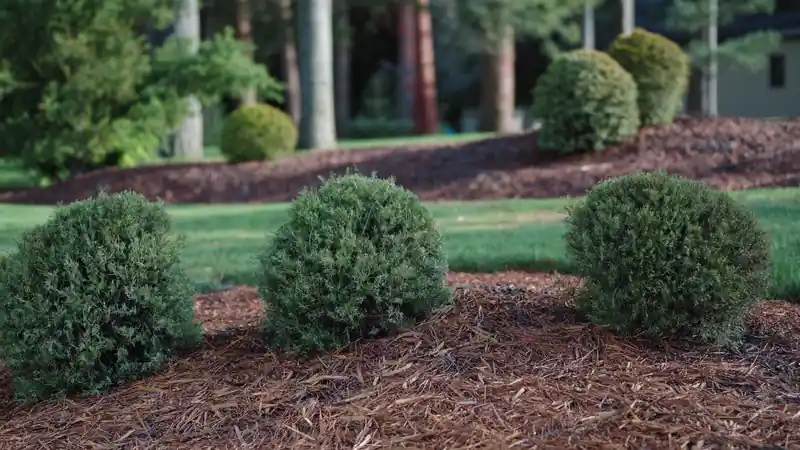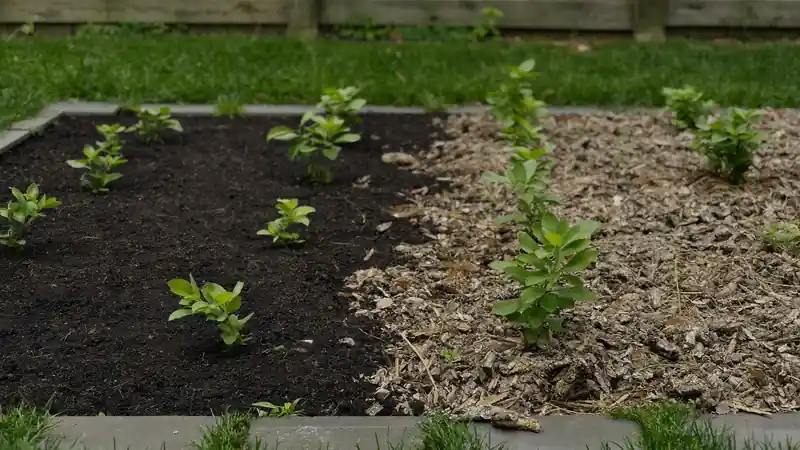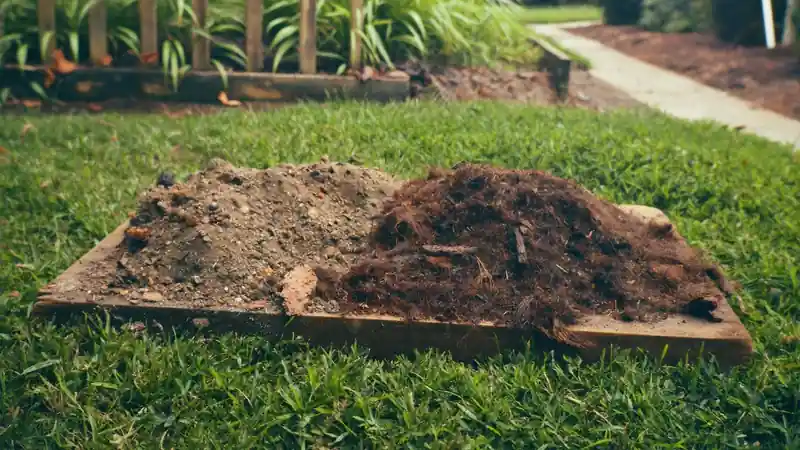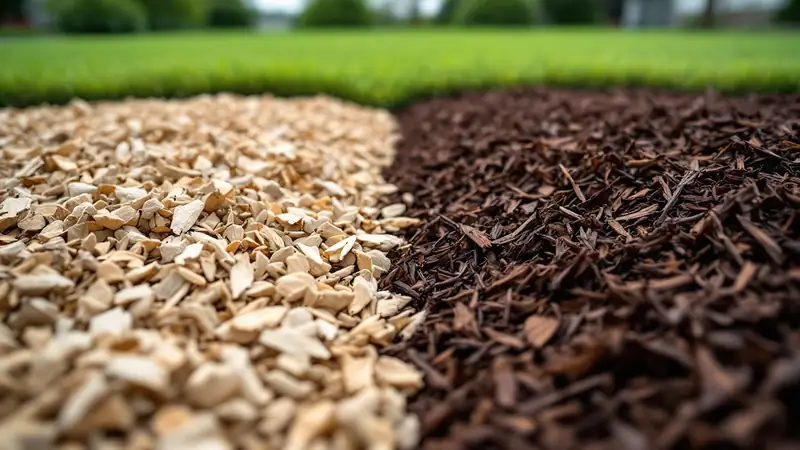
Wood chips vs mulch: chips are one kind of mulch, and in field trials they matched shredded bark on soil moisture, heat and tree growth. Raw chips cost about half as much, $20 vs $40 a yard, or free, but decay faster and look rougher.
The wood chips vs mulch question is mostly argued from opinion: none of the supplier and arborist pages ranking in the top 10 as of November 2026 cites a trial. We logged 14 published ones below. Six put chips directly against bark or shredded mulch, and the gap they found is far smaller than the gap between either one and bare soil. In an Iowa trial, soil 4 inches down ran 73.9°F under pine chips, 74.5°F under shredded bark and 84.7°F with no mulch at all.
Are wood chips and mulch the same thing?
Partly. Oregon State University Extension defines mulch as any material spread over the soil that influences soil or plant growth, so every chip layer is mulch. But OSU then lists wood chips, arborist mulch and bark as 3 separate products, and says most people hear “mulch” and think of bark. On a supply yard price list, the name is the first clue to what is in the pile:
| Name on the pile | What it is | Texture and look | Source |
|---|---|---|---|
| Arborist chips, arbor mulch | Chipped limbs and trunks: wood, bark and leaves from one or more species | Very coarse, with sticks; not uniform, resists packing | Oregon State EC 1629 |
| Wood chips (manufactured) | Chips of heartwood, or of chipped lumber and pallets | Pale, grays with age. Iowa State calls the lumber and pallet version inferior: it breaks down quickly and may be dyed to hide its origin | Oregon State; Iowa State |
| Shredded or double-shredded mulch | Shredded bark, or blends of bark and wood | Dark, thin strands; blows and washes away less than chips, per Iowa State | Penn State; Iowa State |
| Bark dust and nuggets | Mostly bark: Douglas-fir, hemlock, pine. pH near 4, high lignin | Uniform. Grades have no standard definition; fine grades seal over | Oregon State |
| Dyed mulch | Ground wood plus colorant. Amerimulch estimates 60 percent of the fiber is land-clearing, green-waste and tree-company chips | Even color; can begin as the same chips | Our mulch color guide |
| Playground chips, engineered wood fiber | Wood product built as a fall surface: ASTM F2075 spec, tested to ASTM F1292 | May look like landscape mulch, but sold with critical-height test data | CPSC Pub. 325 |
What 14 trials measured, chips against mulch
Swipe the table sideways to see every column.
| Trial | What was compared | Result | Direct chips vs mulch test? |
|---|---|---|---|
| Greenly and Rakow, 1995 (Cornell authors, silt loam) | Chipped pine vs shredded hardwood at 3, 6 and 10 in.; white pine and pin oak; 2 seasons | No differences between mulch types. Depth drove moisture, temperature and weeds; shoot growth peaked at 3 in. | Yes |
| Iles and Dosmann, 1999 (Gilbert, Iowa) | Pine chips vs shredded hardwood bark vs screened pine bark, plus 5 rocks; red maple; 2 years | Soil at 4 in.: 73.9, 74.5 and 73.8°F (bare 84.7°F). Moisture: 32, 31 and 32 percent (bare 19). Caliper: 4.1, 3.9 and 4.0 cm. | Yes |
| Duryea et al., 1999 (Gainesville, Fla.) | Utility-pruning chips vs pine bark, cypress, eucalyptus, melaleuca, pine straw at 3.5 in. (9 cm); 1 to 2 years | Mass lost in year 1: utility chips 32 percent, eucalyptus 21, the other four 3 to 7. Depth left at 2 years (UF/IFAS): utility chips about 5 cm, pine bark 6. Utility chips highest in N, P, K, Ca and Mg. Weed counts did not differ. | Yes |
| Bartley et al., 2017 (Auburn, Ala., nursery containers) | Chipped red cedar, pine, privet, sweetgum vs pine bark mini-nuggets at 1, 2 and 4 in.; 168 days | Depth was the only factor still significant: spotted spurge down 90, 99.5 and 100 percent. | Yes |
| Quarles and Smith, 2011 (Carson City, Nev.) | 8 mulches burned in plots, including composted chips, fuel-reduction chips, bark nuggets, shredded cedar | All combusted. Composted chips and a single layer of chips were least hazardous; shredded rubber, pine needles and shredded cedar most. | Yes |
| Duryea, Huffman and Osbrink, 1999 (Lab, forced feeding) | 6 mulches as the only food; 2 three-week experiments | Termites ate utility chips most in experiment 1; intake tracked N and P (r = 0.91, 0.96). Melaleuca was eaten least. | Yes |
| Cregg and Schutzki, 2009 (East Lansing, Mich.) | Pine bark, hardwood fines, cypress, color-enhanced ground pallets at 8 cm; 8 shrub taxa | All four raised soil moisture; all but cypress raised growth of most taxa. No foliar nitrogen difference. | Partly: pallet fiber, no raw chips |
| Steward et al., 2003 (outdoor plots) | 13 mulches, discarded cigarettes, 8 tries each | Ground recycled pallets ignited 4 of 8, shredded pine bark 3, shredded hardwood bark 0. | Partly: pallet fiber, no raw chips |
| Fraedrich and Ham, 1982 (South Carolina) | Fresh pruning chips at 10 cm vs none; maples; 1 year | Silver maple on sandy loam grew 0.66 m vs 0.16 m. On clay loam only current-year shoots gained. | No: chips vs nothing |
| Green and Watson, 1989 (Illinois) | 2 in. compost plus 2 in. chips vs lawn; bare-root sugar maple; 4 seasons | Diameter growth about 3 times lawn, crowns almost twice as large. 5 of 40 trees failed, not tied to treatment. | No: mulch vs lawn |
| Watson and Kupkowski, 1991 (10 Chicago playgrounds) | 18 in. of chips vs adjacent soil; 2 years | Oxygen diffusion 0.38 vs 0.46, above the 0.20 root limit. Nitrate 2.8 vs 4.2 ppm. Root density no different. | No: chips vs nothing |
| Tahboub et al., 2007 (Las Cruces, N.M.) | Pecan chips mixed into silty clay, up to 17,936 kg/ha (about 8 tons/acre); 3 years | No significant drop in inorganic nitrogen at any rate or number of applications. | No: mixed in, not on top |
| Long et al., 2001 (Maryland, plus lab) | Eucalyptus, hardwood, pine bark vs pea gravel vs bare; cardboard monitors | Groundcover did not change monitors found. Feeding ran higher under gravel. Mulch-fed termites survived less. | No: no raw chips |
| Koski and Jacobi, 2004 (Fort Collins, Colo.) | Cankered honeylocust pieces in 4 in. of cottonwood chips; up to 143 weeks | Canker fungus survived 143 weeks; isolates recovered at week 98 made new cankers. | No: disease survival only |
The cleanest test is the Cornell one: chipped pine against shredded hardwood, the same 3 depths around the same 2 tree species for 2 seasons. Greenly and Rakow found no difference by mulch type in soil oxygen, moisture, temperature, weeds or growth.
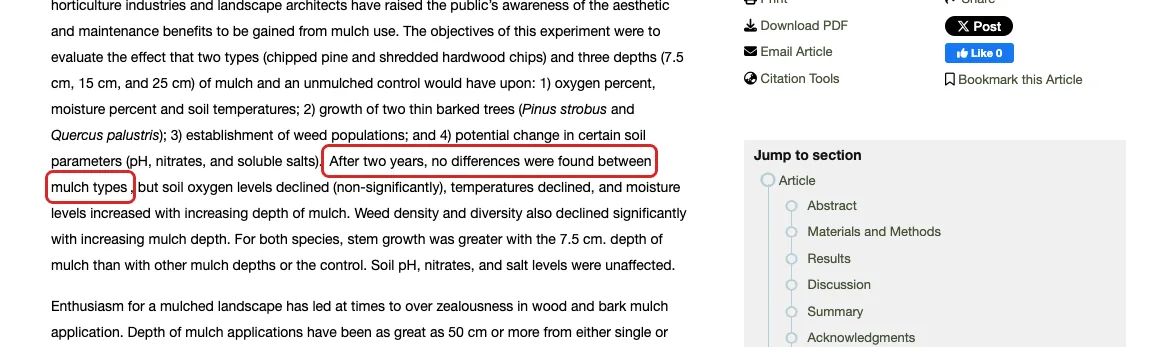
Iowa says the same with numbers. Pine chips and shredded hardwood bark sat 0.6°F and 1 moisture point apart; bare soil ran 10 to 11°F hotter and 12 to 13 points drier. Trees in chips calipered 4.1 cm against 3.9 cm in shredded bark, a gap Iles and Dosmann did not separate statistically. Bare-soil trees also reached 4.1 cm there, on fertile, well-drained ground, so soil gains do not always become growth.
Two limits. Greenly and Iles used pine chips, not the mixed leaves-and-wood load a tree crew drops; only the Florida trials used true utility prunings. And we found no published trial of arborist chips against dyed bagged mulch on tree growth or survival, so a claim that chips grow better trees than bark is unproven. The stronger evidence is mulch against lawn or nothing: silver maples in fresh pruning chips grew 0.66 m against 0.16 m in South Carolina, and sugar maples in a compost-and-chip circle added about 3 times the diameter growth of lawn trees, though survival did not change.
Depth moved the numbers more than material did
Going from bare soil to 3 inches raised soil moisture 58 percent in the Cornell plots, measured after a rain-free week. Going from 3 inches to 10 added under 2 more points, and pine and oak shoots grew best at 3 inches. In Auburn nursery containers, mulch depth outlasted the herbicide and every wood species: 1 inch cut spotted spurge 90 percent by day 168, 2 inches 99.5 percent.
Deep layers did not smother roots in these trials. Soil oxygen fell from 19.8 percent bare to 18.9 percent under 10 inches, and 18 inches of playground chips left oxygen diffusion well above the root-growth limit after 2 years. Wet sites are the exception: OSU says to leave poorly drained spots bare or lightly mulched, and CSU warns chips can float away where water stands.
Published depth advice splits by goal. OSU says 3 to 4 inches of chips and no more than 3 of bark; Iowa State says 2 to 4; WSU says 4 to 6 for weed control. Use 3 to 4 inches, and our mulch calculator converts that to yards. A thick layer will not fix runner weeds: yellow nutsedge pushed through 3 inches in the Cornell plots, and OSU lists bindweed and horsetail as uncontrolled by mulch.
The claim that shredded mulch mats and sheds water has real support but no head-to-head number. OSU says the more fine particles, the more surface sealing, and caps fine bark at 2 to 3 inches. We found no trial measuring infiltration through arborist chips against triple-shred, so treat that advantage as likely, not measured.
Chips rot faster, and that cuts both ways
Utility chips lost 32 percent of their mass in a year in Gainesville, against 3 to 7 percent for pine bark, cypress, melaleuca and pine straw (Duryea et al.). Green leaves are the likely reason: the utility mix carried the most nitrogen, phosphorus, potassium, calcium and magnesium and a low lignin-to-nitrogen ratio, the best predictor of decay (r = -0.88). So the same load feeds soil faster and thins faster. OSU ties bark’s staying power to high lignin but also calls coarse arborist mulch slow to decompose, so Florida’s rate may not hold for coarser loads or cooler yards.
The same Gainesville plots measured the lowest soil pH under pine straw, set beside burn and termite data in our pine straw vs mulch comparison.
Depth tells a milder story than mass. After 2 years in full Florida sun, 3.5 inches of utility chips had settled to about 5 cm and pine bark to 6 cm, roughly 0.8 inch against 0.6 inch a year. That is the only 2-year chip figure we found.
Do wood chips tie up nitrogen, and how shallow is it?
On top of the soil, no trial here found a nitrogen problem in established woody plants, though soil tests can dip. How shallow the effect runs is less settled than either side claims, because sources name different depths:
| Source | Finding | Depth named |
|---|---|---|
| Chalker-Scott, WSU, 2007 | A nitrogen-poor zone that inhibits weed seeds but not established roots; she labels it “my hypothesis” | The mulch and soil boundary |
| Oregon State EC 1629 | Most nitrogen is drawn from the top layer; small plants and recent transplants suffer, established ones generally do not | Top 3 to 6 in. |
| Greenly and Rakow, 1995 | Nitrate 9.8 to 10.3 ppm with no trend from 0 to 10 in. of mulch | Samples from the top 6 cm (2.4 in.) |
| Watson and Kupkowski, 1991 | 2.8 ppm under 18 in. of chips vs 4.2 ppm beside it: significant, but both far under the 30 to 39 ppm range, and no deficiency symptoms | Top 30 cm (12 in.) |
| Cregg and Schutzki, 2009 | No foliar nitrogen difference among treatments on shrubs | Leaf tissue |
| Broschat, 2007, citing Sonsteby et al., 2004 | Spruce bark lowered soil nitrate and ammonium after 3 years on unfertilized loam; Broschat saw no ammonium change at 6 weeks | Not stated |
| CSU GardenNotes 245 | Surface chips do not tie up nitrogen; chips mixed in can, and so can fine chips or sawdust on top | Not stated |
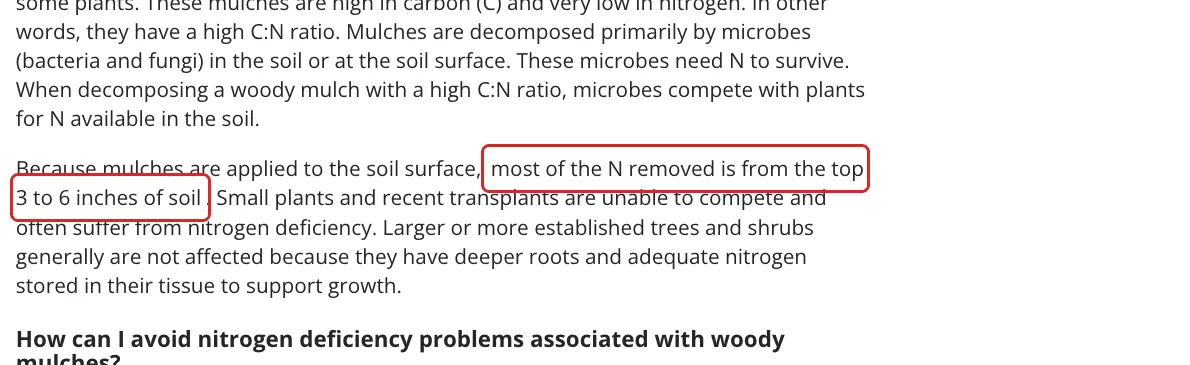
Even mixing chips in is not automatically a problem: New Mexico pecan chips tilled in at up to about 8 tons an acre did not significantly lower soil nitrogen over 3 years. For an established shrub bed, the trials give no reason to add nitrogen because of the mulch. For a new planting, OSU suggests 2 to 3 inches of low-salt compost mixed in before planting; if you suspect a shortage, fertilize a few plants and compare. Feeding a lawn is a separate job, and stump grindings where grass will go are the case where Iowa State does want wood removed.
For when compost belongs in the soil and wood belongs on top, with rates by job, see our compost vs mulch comparison.
Disease, termites and fire: the “no” answers that need conditions
An archived WSU fact sheet answers “No” to all 3 fears. The trials support something narrower.
Can chips from a sick tree infect yours?
Sometimes. A honeylocust canker fungus survived 143 weeks in chips and still caused cankers at week 98, so Koski and Jacobi say not to spread chips from infected honeylocust around honeylocust. That paper also cites Verticillium infecting about 90 percent of young eggplants through chips mixed into their potting mix. OSU says most pathogens fare poorly once chipped and spread from arborist mulch is little documented, but names Port-Orford-cedar root rot and sudden oak death as carried by uncomposted material. Ask the crew what they cut, and turn down chips from a diseased tree of a species in your yard.
Do wood chips attract termites?
Termites will eat chips, but Iowa State finds no evidence that chips attract termites not already present. Given no other food for 3 weeks, termites ate utility chips more than any other mulch in one of two experiments. In the Maryland field test, though, hardwood, pine bark and eucalyptus mulch did not change how many monitors termites found, and feeding ran higher under pea gravel; raw chips were not in that test. UF/IFAS gives the usable rule: under 2 inches of mulch within 12 inches of a foundation, with a 6-inch inspection gap below the siding.
Are chips a fire risk?
Yes, like every wood mulch tested, but texture matters. All 8 mulches burned in the Nevada plots; a single layer of chips and composted chips burned least, shredded cedar among the worst. WSU rates coarse chips least flammable of the organics, while Steward found 6 months outdoors made shredded pine bark and ground pallets easier to light with a cigarette. For wildfire zones, our mulch vs rock report covers California’s proposed 5-foot rule.
One cosmetic risk is shared: artillery fungus, which fires black specks onto siding and cars, seems to grow on either wood chips or double-shredded mulch. Penn State found that blending in 40 percent used mushroom compost greatly suppresses it.
Wood chips vs mulch cost
Raw chips run about half the price of shredded mulch at the yard. At Conestoga Stone in Pennsylvania they were $15 a yard, at Kirk Allen in New Jersey $18 and as Arbor Mulch at Sequoia in California $25 when we rechecked on Nov. 5, 2026.
| Option | Price per cubic yard, middle half (median) | Sellers | 500 sq ft at 3.5 in. (5.4 yd), at median |
|---|---|---|---|
| ChipDrop arborist load | $0 | n/a | $0 (offering $20 is optional), but you take the whole truck |
| Raw wood chips | $18 to $25 ($20) | 9 | $108 |
| Natural shredded mulch | $31 to $45 ($40) | 23 | $216 |
| Dyed mulch | $40 to $49 ($42.50) | 24 | $230 |
| Pine bark mulch or nuggets | $43 to $55 ($47.50) | 6 | $257 |
| Bagged mulch, 2 cu ft at about $5 | $53 to $77 ($67.50) | 3 | $365 (73 bags) |
Faster decay does not erase the saving. Using the Florida settling rates above, a 500 sq ft bed needs about 1.2 yards of chips or 0.9 yard of pine bark a year. Five seasons, starting bed plus 4 top-ups, comes to about $206 for chips and $429 for pine bark at median prices. That is our arithmetic on one trial, before any delivery fee.
Free has its own costs. ChipDrop says a load is 4 to 20 cubic yards, usually 7 to 12, with no partial drops and 1 to 5 weeks of waiting. At 3.5 inches, 7 to 12 yards covers 650 to 1,110 sq ft. Crews may include under 5 percent unchipped brush and as much trash as you could hold in 2 hands. Spreading labor runs $25 to $57 a yard if you hire it, the same for chips or mulch, and a local arborist may also give away loads.
Where chips are the wrong answer
- Seedbeds, annuals and vegetable rows. CSU does not recommend chips where soil is routinely cultivated, and Chalker-Scott calls high-carbon mulch inadvisable where roots are shallow. OSU rates yard-waste compost as the better summer mulch there.
- Slopes, standing water and open wind. CSU says chips float and do not work in open windy areas; Iowa State says shredded mulch stays put better. See erosion control methods for grades.
- Formal beds. OSU notes arborist mulch is less uniform and harder to spread. If that matters, pay for shredded, or read our cedar and cypress trade-offs.
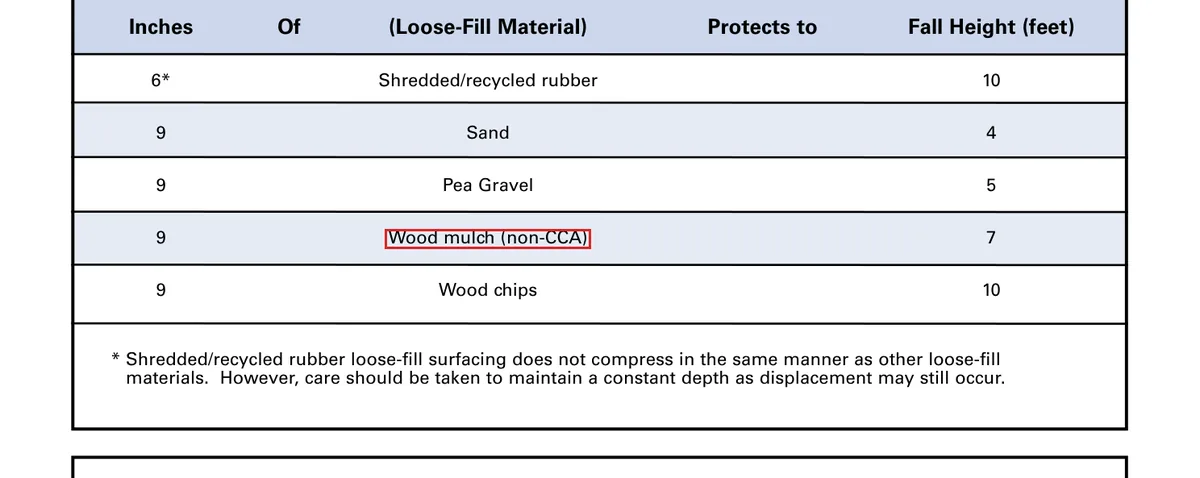
Playgrounds are where the label flips. CPSC Publication 325 rates 9 inches of compressed wood chips as protecting to a 10-foot fall, against 7 feet for non-CCA wood mulch, and says to fill 12 inches to hold 9. That is 18.5 yards on 500 sq ft, or about $889 at the $48 median for certified playground chips. CPSC also says to avoid mulch of unknown CCA content, which argues against a mixed truckload whose source you cannot confirm.
This page is general information, not safety certification. For a public play area, have surfacing checked against ASTM F1292 and the CPSC handbook.
1Is it under play equipment?
YesWood chips or certified wood fiber, 12 in. filled to hold 9. CPSC rates 9 in. of chips to a 10-ft fall, wood mulch to 7 ft. Confirm the source is free of CCA.
NoGo to the next question
2Are you seeding, or growing annuals or vegetables here?
YesNeither on the seedbed. OSU points to yard-waste compost as the summer mulch there; keep chips on the paths.
NoGo to the next question
3Is it a slope, a spot with standing water, or an open windy site?
YesShredded mulch, or a different erosion method. CSU says chips float and blow; Iowa State says shredded stays put better.
NoGo to the next question
4Is it within 12 in. of the foundation?
YesEither one, under 2 in., with a 6-in. inspection gap (UF/IFAS).
NoGo to the next question
5Could the load come from a tree species you are mulching, with a known canker or root rot?
YesTurn the load down, or use composted material from a known source (OSU).
NoGo to the next question
6Do you need a uniform look, or are you unable to take 4 to 20 yards at once?
YesBulk shredded mulch, $31 to $45 a yard at 3 in.
NoRaw or arborist wood chips, 3 to 4 in. deep, tapered to nearly nothing at the trunk.
Source: CPSC Pub. 325; OSU EC 1629; CSU GardenNotes 245; UF/IFAS ENY-832; Koski and Jacobi 2004
How we compiled this
We ran no field tests and have no job data. We read 14 published trials and 10 extension or agency documents, opening the journal text and tables rather than summaries, and left out vendor claims and forum reports. Prices come from our October 18, 2026 yard dataset, with 3 chip prices rechecked November 5, 2026. Cost arithmetic is ours and is labeled. Greenly and Rakow print 21.1°C in their text and 20.1°C in Table 2 for the 3-inch seasonal mean, so we left that figure out. The WSU sheet is marked archived; we cite it because it is still posted, and we note where trials disagree with it.
Frequently asked questions
What are the disadvantages of wood chips?
Rough looks, faster settling (about 0.8 inch a year against 0.6 for pine bark in Florida), a load size you cannot choose, possible disease from a matching host tree, and poor fit for seedbeds and slopes.
How long does it take wood chips to turn into soil?
No trial followed chips to the end. Utility chips lost 32 percent of their mass in year 1 in Florida, and about 44 percent of their depth over 2 years. CSU says chips mixed into typical soil take 10 or more years to decompose, so plan on topping up rather than waiting for a finish date.
Can I use normal wood chips as mulch?
Yes, if they came from trees. Iowa State warns that chips made from lumber or pallets break down quickly and may contain chemicals, and CPSC says to avoid mulch with unknown CCA content. Keep 3 to 4 inches, tapered to nearly nothing at the trunk.
How much is 20 yards of wood chips?
About $360 to $500 at the middle-half yard price of $18 to $25, and $300 to $840 across all posted prices of $15 to $42, before delivery, based on our October 2026 listings. The same volume can arrive free through ChipDrop, though you cannot choose the size.
What is the healthiest mulch to use?
No trial names one winner. A Michigan State shrub trial found pine bark, hardwood fines and ground pallets equally effective, with cypress trailing, and all 4 raised soil moisture over no mulch. Our cypress mulch page covers that material’s other trade-offs.
Sources
- Greenly and Rakow, The Effect of Wood Mulch Type and Depth on Weed and Tree Growth and Certain Soil Parameters, Journal of Arboriculture 21(5), 1995. Accessed November 2026.
- Iles and Dosmann, Effect of Organic and Mineral Mulches on Soil Properties and Growth of Fairview Flame Red Maple Trees, Journal of Arboriculture 25(3), 1999. Accessed November 2026.
- Duryea, English and Hermansen, A Comparison of Landscape Mulches: Chemical, Allelopathic, and Decomposition Properties, Journal of Arboriculture 25(2), 1999. Accessed November 2026.
- Duryea, Huffman and Osbrink, Will Subterranean Termites Consume Landscape Mulches? Journal of Arboriculture 25(3), 1999. Accessed November 2026.
- Duryea and Minogue, UF/IFAS, Landscape Mulches: How Quickly Do They Settle? (FR052), reviewed June 2020. Accessed November 2026.
- Broschat, Effects of Mulch Type and Fertilizer Placement on Weed Growth and Soil pH and Nutrient Content, HortTechnology 17(2), 2007. Accessed November 2026.
- Oi and Wheeler, UF/IFAS, The Facts About Termites and Mulch (ENY-832), revised June 2023. Accessed November 2026.
- Bartley, Wehtje, Murphy, Foshee and Gilliam, Mulch Type and Depth Influences Control of Three Major Weed Species in Nursery Container Production, HortTechnology 27(4), 2017. Accessed November 2026.
- Cregg and Schutzki, Weed Control and Organic Mulches Affect Physiology and Growth of Landscape Shrubs, HortScience 44(5), 2009. Accessed November 2026.
- Fraedrich and Ham, Wood Chip Mulching Around Maples: Effect on Tree Growth and Soil Characteristics, Journal of Arboriculture 8(4), 1982. Accessed November 2026.
- Green and Watson, Effects of Turfgrass and Mulch on the Establishment of Transplanted Trees, Journal of Arboriculture 15(11), 1989. Accessed November 2026.
- Watson and Kupkowski, Effects of a Deep Layer of Mulch on the Soil Environment and Tree Root Growth, Journal of Arboriculture 17(9), 1991. Accessed November 2026.
- Tahboub, Lindemann and Murray, Nutrient Availability in Soil Amended with Pecan Wood Chips, HortScience 42(2), 2007. Accessed November 2026.
- Long, Thorne, Breisch and Douglass, Effect of Organic and Inorganic Landscape Mulches on Subterranean Termite Foraging Activity, Environmental Entomology 30(5), 2001. Accessed November 2026.
- Koski and Jacobi, Tree Pathogen Survival in Chipped Wood Mulch, Journal of Arboriculture 30(3), 2004. Accessed November 2026.
- Quarles and Smith, The Combustibility of Landscape Mulches (SP-11-04), University of Nevada Cooperative Extension, 2011. Accessed November 2026.
- Steward, Sydnor and Bishop, The Ease of Ignition of 13 Landscape Mulches, Journal of Arboriculture 29(6), 2003. Accessed November 2026.
- Bell, Sullivan and Cook, Oregon State University Extension, Mulching Woody Ornamentals with Organic Materials (EC 1629), 2009. Accessed November 2026.
- Chalker-Scott, WSU Extension, Using Arborist Wood Chips as a Landscape Mulch (FS160E), archived, undated page, archived. Accessed November 2026.
- Chalker-Scott, WSU, Wood Chip Mulch: Landscape Boon or Bane? MasterGardener, Summer 2007. Accessed November 2026.
- Colorado State University Extension, CMG GardenNotes 245, Mulching with Wood/Bark Chips, Grass Clippings, and Rock, copy hosted by UC ANR. Accessed November 2026.
- Iowa State University Extension, Using Mulch in the Garden, page read November 2026. Accessed November 2026.
- Penn State, Artillery Fungus Threatens Homeowners, Mulch Industry, news release. Accessed November 2026.
- Brantley, Davis and Kuhns, Penn State Extension, What Is Growing in My Landscape Mulch?, page read November 2026. Accessed November 2026.
- U.S. Consumer Product Safety Commission, Public Playground Safety Handbook, Publication 325, Table 2, current edition read November 2026. Accessed November 2026.
- ChipDrop, Help articles on delivery size, wait, payment and allowed materials, read November 5, 2026. Accessed November 2026.
- Conestoga Stone, Kirk Allen Landscape Supply, Sequoia Landscape Materials, Posted bulk prices, rechecked November 5, 2026. Accessed November 2026.