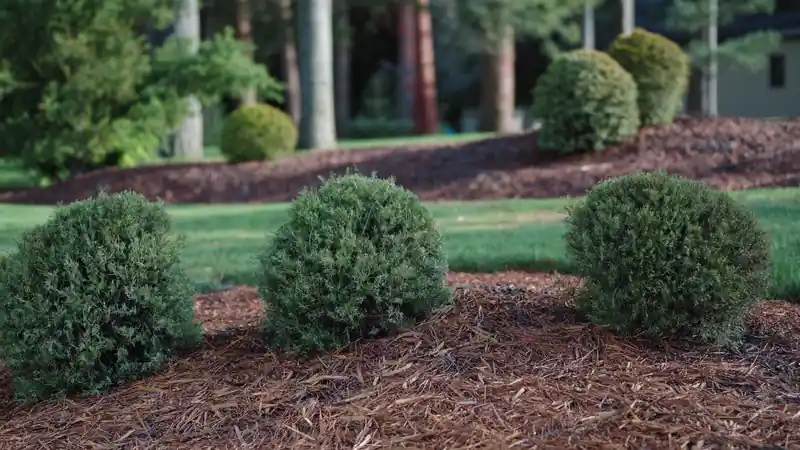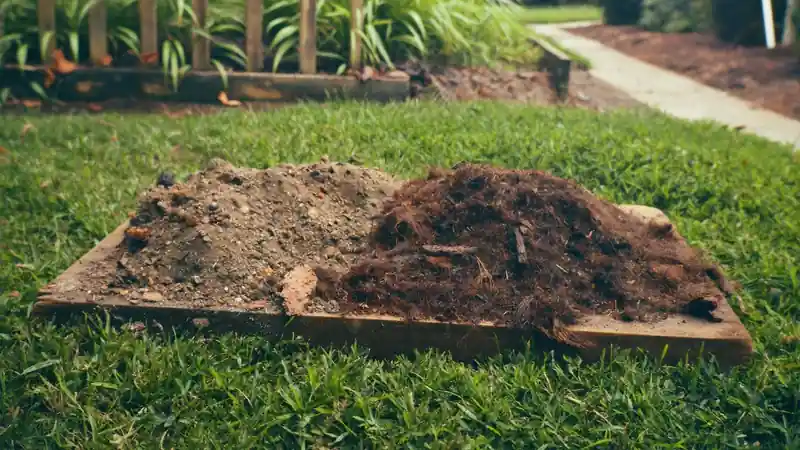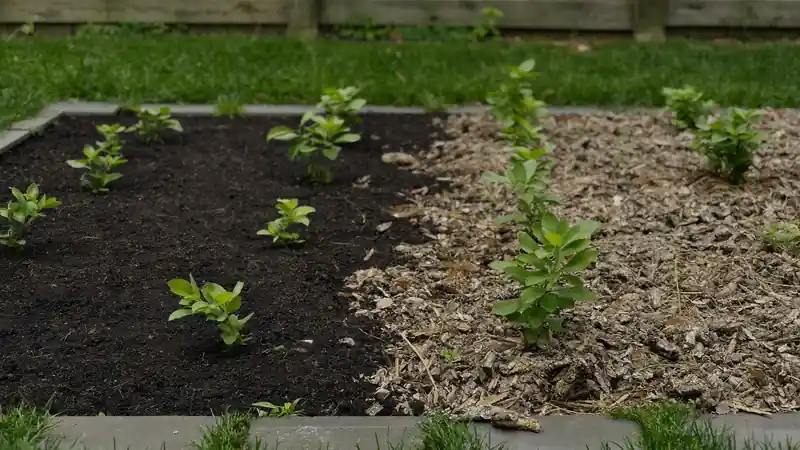
Compost vs mulch: compost is a soil amendment you mix in, 1 to 4 inches into the top 6 to 12 inches; mulch is a coarse layer left on top, 2 to 4 inches deep. Most beds need both: compost under, mulch over.
The compost vs mulch question comes down to particle size and carbon. Finished compost runs about 10 to 15 parts carbon per part nitrogen (Cornell Composting); wood chips run 100 to 500. Below, the two are set side by side using two US Composting Council lab sheets, same-yard prices from 4 supply yards checked Nov. 8, 2026, and the federal heat rule that most compost pages quote only half of.
| Property | Compost | Organic mulch (wood chips, bark, shredded wood) | Source |
|---|---|---|---|
| Job | Feeds and restructures soil: water and nutrient holding, aeration | Covers soil: cuts evaporation and runoff, blocks weeds, buffers temperature | Colorado State 7.235 |
| Where it goes | Mixed into the top 6 to 12 in., or a thin topdressing | Left on the surface | Colorado State 7.235 |
| Depth | 1 to 2 in. (lawn), 3 to 4 in. (new bed), 0.25 in. a year (dug beds) | 2 to 4 in.; fine composted material 2 to 3 in., coarse chips 3 to 4 in. | CSU Table 1; ISA |
| Particle size | Curb It and WLSSD sheets: largest aggregate 0.64 in. | Best weed mulches: about 2/3 in. to 3 in. | STA sheet; City of Bellingham |
| Carbon to nitrogen (C:N) | 10 to 15:1 finished; WLSSD Garden Green measured 11:1 | Bark 100 to 130:1; wood chips or sawdust 100 to 500:1 | Cornell; WLSSD 2025 |
| Total nitrogen | 2.3% (Curb It) and 2.8% (WLSSD), dry weight | Ties up soil nitrogen if mixed in fresh | Curb It; WLSSD; CSU |
| pH and salts | pH 8.54 and 8.18; soluble salts 3.2 and 6.0 dS/m | Not reported on mulch; manure and biosolids composts often run high in salts | Curb It; WLSSD; CSU |
| How long it lasts on top | Finely ground compost may not last a growing season | Hardwood chips may last a full year | Morton Arboretum |
| Weed control as a top layer | Poor; fine compost often supports seedling growth | Good at 3 to 4 in.; weed germination rises once it thins below 2 in. | City of Bellingham; Iowa State |
| Testing program | Voluntary USCC Seal of Testing Assurance: 10 parameters | No equivalent lab program | USCC STA description |
| Bulk price, same 4 yards, Nov. 2026 | $39.50 to $64 per cu yd (lowest listed at each yard) | $25 to $45 per cu yd (lowest undyed wood mulch) | Yard price lists, table below |
The carbon gap explains most of the rules. Colorado State Extension fact sheet 7.235 says fresh wood products tie up soil nitrogen when they are mixed in, because the microbes breaking down the wood use it, and that the hazard is greatest with sawdust. Compost has already finished that work, which is why it goes into the soil and wood stays on top.
Where each one goes, and how deep
The rates below come from Colorado State for compost and the International Society of Arboriculture for mulch. CSU writes its compost rates for plant-based compost or compost known to be low in salts, and notes that 3 cubic yards covers 1,000 sq ft about 1 inch deep.
| Job | Compost | Mulch | Source |
|---|---|---|---|
| New vegetable or flower bed | 3 to 4 in., mixed 8 to 12 in. deep | 2 to 4 in. on top after planting | CSU Table 1; ISA |
| Existing vegetable or annual bed dug each year | 0.25 in. a year, mixed 8 to 12 in. deep | Straw or shredded leaves in season | CSU Table 1; Iowa State |
| New lawn, before seed or sod | 1 to 2 in., mixed 6 in. deep | None | CSU Table 1 |
| Established lawn | 1/4 in. of fine compost with core aeration | None | Iowa State |
| Trees and shrubs, well-drained soil | Optional thin layer under the mulch | Coarse chips 3 to 4 in., at least a 3 ft radius ring, off the trunk | ISA |
| Wet or poorly drained soil | Fix drainage first | No more than 2 in. of organic mulch | ISA |
| Perennial bed, weedy | Thin layer to build soil | Coarse mulch topped back up to 4 in. when it thins below 2 in. | City of Bellingham |
For both in one bed, the City of Bellingham mulching fact sheet gives the order: fine compost in a thin layer to build soil, then coarse mulch over it for weeds. In practice:
- Pull weeds first. Mulch can smother tiny seedlings, but perennial and grassy weeds grow up through it (City of Bellingham).
- Spread compost at the CSU rate for the job, usually 3 to 4 inches for a new bed, and work it in 8 to 12 inches deep. On an existing bed with plants in place, spread 1/4 inch and leave it on the surface.
- Plant, then cover with 2 to 4 inches of coarse wood chips or bark, kept at least 1 inch off stems (City of Bellingham) and pulled several inches back from tree trunks (ISA).
- Each spring, check depth with a trowel. Below 2 inches of coarse mulch, top it back up to 4 inches; rake any matted fine layer loose first (ISA).
Our mulch calculator and coverage chart turns those depths into cubic yards, and our clay soil guide covers compost rates where clay is the problem.
Can you use compost as mulch?
You can, but it does the weed job badly. Iowa State Extension says compost improves structure and fertility but does not suppress weeds as well as other mulches. The City of Bellingham fact sheet goes further: fine-textured compost often supports seedling growth, and it lists screened compost and composted manures under materials to avoid for weed suppression.
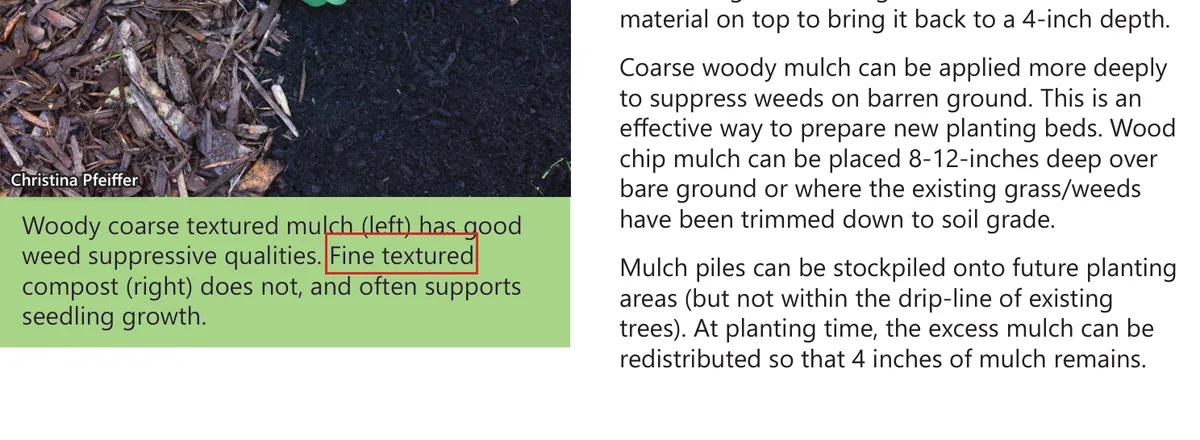
The reason is nutrients and water at the surface. A UF/IFAS 2024 publication, ENH1380 says nutrient-dense materials like compost can increase weed germination and benefit weed growth, and the Morton Arboretum adds that already-decomposed compost may not last a full season on top, where hardwood chips may last a year. The ISA still lists compost mixes as an organic mulch and caps fine composted material at 2 to 3 inches.
There is one exception, and it is not for home beds. In a University of Florida trial, 4-week-old municipal waste and biosolids compost laid 7.5 cm (about 3 inches) or deeper in vegetable row alleys stopped weeds for 240 days in fall 1995 but only 65 days in spring 1996, when yellow nutsedge pressure was higher. The authors credit part of the effect to acetic acid at 1,221 to 4,128 mg per kg, which is phytotoxic, and they found glass and plastic in the compost. Immature compost that kills weeds can hurt plant roots too.
Can mulch go into the soil, and will it turn into compost?
Fresh wood should stay on top. CSU 7.235 says fresh wood products are typically not used as amendments because they can cause nitrogen deficiency for several months to years, and that composting them first avoids it. On the surface the effect is small: Linda Chalker-Scott of Washington State University describes a zone of low nitrogen at the mulch and soil interface that inhibits weed seeds without affecting established roots below.
Yes, mulch does turn into compost over time. Iowa State notes that high C:N mulches such as hardwood bark, ground pallets, straw and sawdust lower available nitrogen most for herbaceous plants and new transplants, and that the effect fades as they decompose. CSU says organic mulches can be worked in as amendments once they have broken down too far to work as mulch. The wood chips vs mulch trials cover which wood products last longest.
What a compost lab sheet tells you before you buy
Bagged and bulk compost carry no required quality label. Colorado State says there are no regulations on the salt content or other qualities of bagged soil amendments and points buyers to the US Composting Council’s Seal of Testing Assurance (STA). Under the STA program description, certified products are tested for 10 properties, including pH, soluble salts, nutrients, particle size, stability, a seedling bioassay, pathogens and trace metals, and the producer publishes a Compost Technical Data Sheet.
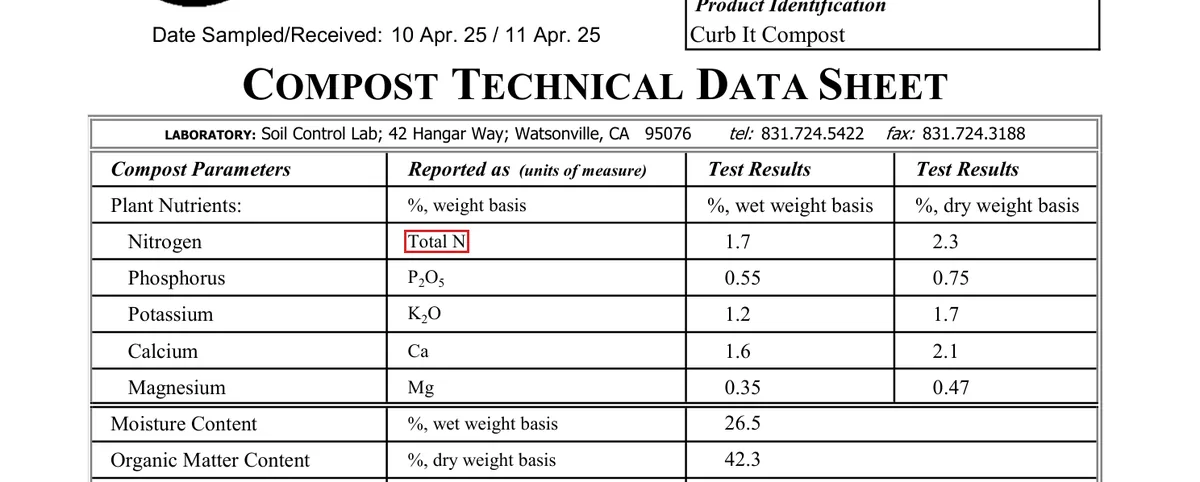
| Line on the sheet | Curb It Compost (Republic Services, Kuna, Idaho) | WLSSD Garden Green (Duluth, Minn.) | What to do with it |
|---|---|---|---|
| Date sampled | Apr. 10, 2025 | Feb. 11, 2025 | Ask for a sheet under 12 months old |
| Total nitrogen, dry weight | 2.3% | 2.8% | Useful, but USCC says compost is typically not characterized as a fertilizer |
| C:N ratio | Not on the STA sheet | 11:1 (Minnesota Class I limit: under 20:1) | Under 20:1: low risk of tying up soil nitrogen |
| pH | 8.54 | 8.18 | Above 7: a poor match for acid-loving plants; check your soil test |
| Soluble salts (EC) | 3.2 dS/m | 6.0 dS/m | Higher salts: use the low end of the rate and water in |
| Organic matter, dry weight | 42.3% | 63.7% | Higher means more soil building per yard |
| Moisture | 26.5% | 49.1% | You pay for water in a wet load |
| Largest particle | 0.64 in. | 0.64 in. | Fine enough to mix in; too fine to mulch for weeds |
| Seedling emergence and vigor, % of control | 100.0 and 100.0 | 93.3 and 75.3 | Vigor under 100 is a reason to mix in rather than plant straight into it |
| Fecal coliform or Salmonella; metals | Pass; pass | Pass; pass | Fail on either: do not use on food beds |
The two sheets show why a seal is not a grade. Both passed pathogens and metals, but WLSSD’s salt reading is nearly twice Curb It’s, and CSU warns that salt burn from salty amendments is a common cause of plant death. Ask the yard for its current sheet and compare those two lines before you order 3 or more yards.
The 131°F rule has two versions
Most compost pages say compost is safe once it holds 131°F for 3 days. That is the EPA Process to Further Reduce Pathogens (PFRP), 40 CFR Part 503, Appendix B, but only for in-vessel and aerated static piles. For windrows, open rows turned by machine, the same rule requires 55°C (131°F) or higher for 15 days or longer, with at least 5 turnings in that period.
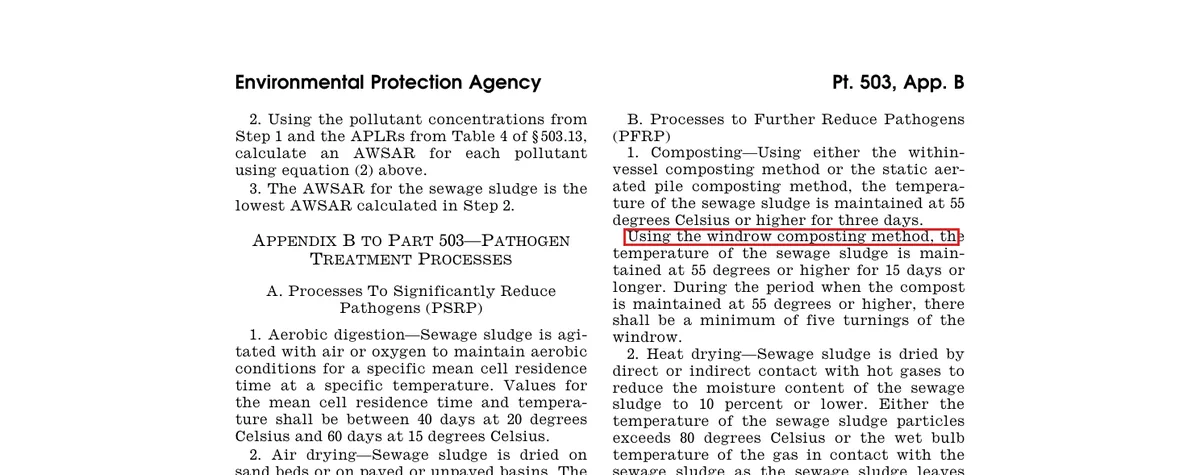
The rule binds sewage sludge compost by law; the USCC definition of compost borrows the same PFRP standard for all compost. CSU adds that composted manure heated above 145°F kills most pathogens and weed seeds, while aged manure piled 6 months without turning still carries viable weed seeds. When you buy, ask which method the site uses and whether it logs 15 days and 5 turns for windrows.
Herbicide carryover: run a pea test first
Some broadleaf herbicides survive composting. Oregon State University Extension EM 9307 names clopyralid and aminopyralid, and says chemical lab tests may miss them. NC State Extension lists products that carry them, including Milestone (aminopyralid), Transline and Lontrel (clopyralid) and Grazon P+D (picloram), and says deactivation can take 30 days to several years. NC State traces the risk to treated hay, straw, grass clippings and manure, and to compost made from them. Our grass clippings guide has the label lines that bar treated clippings from compost.
OSU’s bioassay takes 3 to 4 weeks and costs a few pots and a packet of peas:
- Fill 3 pots with a purchased peat-based potting mix that lists no compost (the control). Fill 3 more with 2 parts test compost to 1 part potting mix.
- Plant 3 garden pea seeds 1 inch deep in each pot and record the planting date.
- Grow all 6 pots in the same light, temperature and water until 3 sets of leaves appear, 14 to 21 days after germination.
- Compare: cupped, twisted or stunted leaves in the test pots and not the controls mean herbicide is present. Keep it away from beans, peas, tomatoes, peppers, potatoes, roses and grapes, which OSU lists as prone to damage.
If contaminated compost is already in a bed, OSU says the herbicide can take 2 to 5 years to break down; plant grasses or corn, which do not show damage, and repeat the bioassay once or twice a year until peas grow normally.
Which costs more at the same yard?
Compost usually does. At 3 of 4 supply yards we checked on Nov. 8, 2026, the lowest-priced compost cost $13 to $20 a cubic yard more than the lowest-priced undyed wood mulch; at Cheaper Than Dirt in Belton, Texas, cottonseed compost was $5 below cedar mulch.
| Supply yard | Compost, per cu yd | Undyed wood mulch, per cu yd | Price list |
|---|---|---|---|
| Sequoia Landscape Materials, Santa Rosa, Calif. | Sonny’s Organic Compost $39.50; Cold Creek Compost $54.00 | Arbor Mulch $25.00; Wood Chips $44.95; Redwood double grind bark $47.95 | Sequoia |
| Cheaper Than Dirt Landscape Supply, Belton, Texas | Cottonseed compost $40; organic compost / garden mix $50; cow manure compost $70 | Cedar mulch $45; hardwood mulch $50 | Cheaper Than Dirt |
| Mr. Mulch Landscape Supply, Columbus, Ohio | Zoo Brew bulk compost $52 | Natural brown double shredded hardwood $39; triple shredded $52 | Mr. Mulch |
| Cummin Landscape Supply, Atlanta area | Compost $64 | Mini pine nuggets $44; oak mulch $48.50 | Cummin |
Coverage changes the bill more than the yard price. A 200 sq ft new bed takes about 1.85 cu yd of compost at 3 inches (200 x 3 / 324) and the same 1.85 cu yd of mulch at 3 inches; at Mr. Mulch that is roughly $96 of compost and $72 of double-shredded mulch before delivery. Our mulch cost survey and topsoil cost data cover delivery fees and blends.
Compost, mulch or both: pick by the spot
1Is it a lawn?
YesCompost only: 1/4 inch after core aeration (Iowa State), or 1 to 2 inches mixed 6 inches deep before seeding (CSU). No wood mulch.
NoGo to the next question
2Is the soil wet or slow to drain?
YesFix drainage first; then no more than 2 inches of organic mulch (ISA).
NoGo to the next question
3Are you building a new bed in bare, worked soil?
YesBoth: 3 to 4 inches of compost mixed 8 to 12 inches deep (CSU), then 2 to 4 inches of coarse mulch on top after planting.
NoGo to the next question
4Is it a vegetable or annual bed you dig every year?
YesCompost: 0.25 inch a year worked in (CSU); straw or shredded leaves on top in season.
NoGo to the next question
5Is it a tree ring or an established shrub or perennial bed?
YesMulch: coarse chips 3 to 4 inches, off the trunk (ISA); optional 1/4 inch of compost under it.
NoTest the soil first: if pH or salts are the limit, neither compost nor mulch fixes it.
Source: Colorado State 7.235; ISA Proper Mulching Techniques; Iowa State Extension
If the spot is a lawn, compost is the only one of the two that belongs there. If it is a tree ring, mulch does nearly all the work, and our guide to mulching around trees sets the ring size and trunk gap. If you are weighing compost against bagged soil, topsoil vs garden soil reads the bag labels, and a soil test tells you whether pH or salts, not organic matter, are the real limit.
How we compiled this
We read 14 primary documents in November 2026: extension publications from Colorado State, Iowa State, Oregon State, NC State, UF/IFAS and Washington State; the ISA mulching brochure; the Morton Arboretum and City of Bellingham guidance; Cornell’s C:N tables; 40 CFR Part 503 Appendix B; a USCC STA program description; and two STA Compost Technical Data Sheets. Prices are posted list prices from 4 yards that sell both products, read Nov. 8, 2026. We ran no tests; the two lab sheets describe two products, not compost in general.
Frequently asked questions
Is it better to use mulch or compost?
Neither replaces the other. Use compost to change the soil, 3 to 4 inches mixed into a new bed (CSU), and mulch to cover it, 2 to 4 inches on top (ISA). For a lawn, use compost only, 1/4 inch after core aeration.
Can I just add compost on top of mulch?
It works as a feed but wastes the weed control: fine compost on the surface gives weed seeds a seedbed (City of Bellingham). Rake the mulch aside, spread about 1/4 inch of compost, and pull the mulch back over it.
Will mulch turn into compost?
Organic mulch does, slowly. Hardwood chips may last about a year and finely ground compost less than a season (Morton Arboretum). CSU says you can work broken-down mulch into the soil once it no longer does the mulch job.
What are the disadvantages of using compost?
Salts, high pH, weeds and herbicide carryover. The two STA sheets here read pH 8.18 to 8.54 and salts of 3.2 to 6.0 dS/m; manure composts often run higher (CSU). Clopyralid and aminopyralid can survive composting, so run a pea bioassay (OSU).
What is the 3-3-3 rule for mulch?
A tree-ring rule of thumb: a ring 3 feet across or in radius, 3 inches deep, 3 inches from the trunk. The ISA brochure gives a 3 foot radius as the minimum ring and 2 to 4 inches of depth.
What is the difference between compost, mulch and topsoil?
Topsoil is mineral soil for filling and grading, compost is decomposed organic matter mixed into soil, and mulch is a coarse cover laid on top. Topsoil is often cheaper per yard; compost costs more at 3 of the 4 yards in our price table.
Sources
- Colorado State University Extension, Choosing a Soil Amendment, fact sheet 7.235, current edition. Accessed November 2026.
- International Society of Arboriculture, Proper Mulching Techniques, 2021. Accessed November 2026.
- Cornell Composting (Cornell Waste Management Institute), Compost Chemistry: C/N ratio table, 1996. Accessed November 2026.
- City of Bellingham, Wash., Manage Weeds Naturally: Mulching Fact Sheet, undated. Accessed November 2026.
- Iowa State University Extension, Using Mulch in the Garden, current. Accessed November 2026.
- Iowa State University Extension, Core Aeration of Lawns, current. Accessed November 2026.
- UF/IFAS Extension (Khamare and Marble), Using Mulch for Weed Control in Container Plant Production, ENH1380, November 2024. Accessed November 2026.
- Morton Arboretum, How to Mulch Trees and Shrubs, current. Accessed November 2026.
- Ozores-Hampton, Obreza and Stoffella (record in FAO AGRIS), Mulching with composted MSW for biological control of weeds in vegetable crops, 2001; trials 1995 to 1996. Accessed November 2026.
- L. Chalker-Scott, Washington State University, Wood Chip Mulch: Landscape Boon or Bane? (MasterGardener magazine), undated. Accessed November 2026.
- Soil Control Lab for Republic Services Idaho (City of Boise), Compost Technical Data Sheet, Curb It Compost, sampled Apr. 10, 2025. Accessed November 2026.
- Western Lake Superior Sanitary District, 2025 STA Test Results, WLSSD Garden Green, sampled Feb. 11, 2025. Accessed November 2026.
- US Composting Council (copy hosted by TxDOT), Seal of Testing Assurance program description, undated. Accessed November 2026.
- U.S. EPA, eCFR, 40 CFR Part 503, Appendix B: Pathogen Treatment Processes, current. Accessed November 2026.
- U.S. Government Publishing Office, 40 CFR Part 503, 2024 annual edition (PDF), July 1, 2024. Accessed November 2026.
- Oregon State University Extension, Herbicide-contaminated compost and soil mix, EM 9307, current. Accessed November 2026.
- NC State Extension, Herbicide Carryover in Hay, Manure, Compost, and Grass Clippings, AG-727, current. Accessed November 2026.
- Sequoia Landscape Materials, Price list, checked Nov. 8, 2026. Accessed November 2026.
- Cheaper Than Dirt Landscape Supply, Pricing, checked Nov. 8, 2026. Accessed November 2026.
- Mr. Mulch Landscape Supply, Bulk mulch and compost, checked Nov. 8, 2026. Accessed November 2026.
- Cummin Landscape Supply, Mulch and soil, checked Nov. 8, 2026. Accessed November 2026.