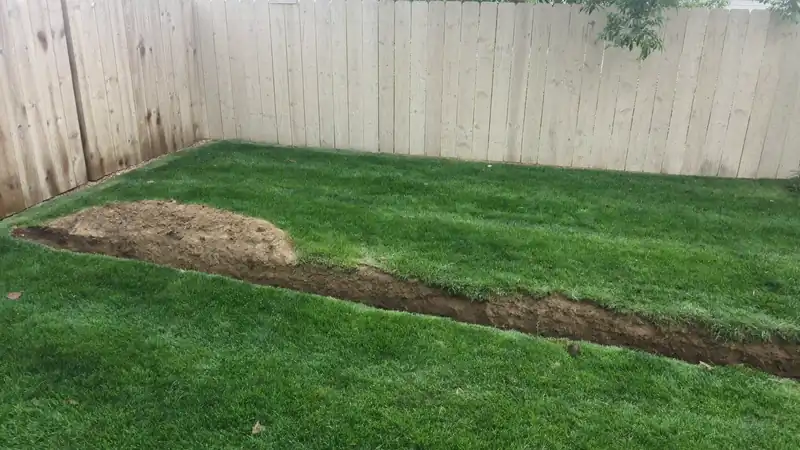
How to make a French drain: call 811, dig a trench 12 inches wide, 18 to 24 inches deep, falling 1 percent (12 inches per 100 feet) to a lower outlet, line it with fabric, and lay 4-inch perforated pipe holes down in washed stone.
Knowing how to make a French drain is mostly knowing where its numbers come from. The familiar 18 to 24 inch depth and 12 inch width are not folklore: they fall out of two public specs, the 2 inches of stone under the pipe and 6 inches over it in International Residential Code Section R405.1, and the 1 foot of cover and 8 inches of extra width in Wisconsin DOT Standard Specification 612. This page stacks those figures into a trench you can dig, shows how much deeper a flat-yard trench gets at its outlet, and turns your length into tons of stone.
The build specs, and which document says so
Every row below comes from an extension service, a building code, a state transportation spec or a manufacturer, read in November 2026. Where they disagree, the table says so. Highway and foundation specs are written for bigger drains than a backyard needs, so treat them as the upper end, not the minimum, for a lawn.
| Item | Published figure | Source |
|---|---|---|
| Fall (slope) | At least 1 percent | Clemson HGIC, 2020; NDS installation guide |
| Fall (slope) | 0.5 to 1 percent | WSU Extension, Clark County |
| Fall (slope) | At least 1 to 3 percent | Colorado State GardenNotes #219 |
| Depth | About 8 inches to 2 feet for yard work | NDS |
| Width | 5 to 6 inches for small problems | NDS |
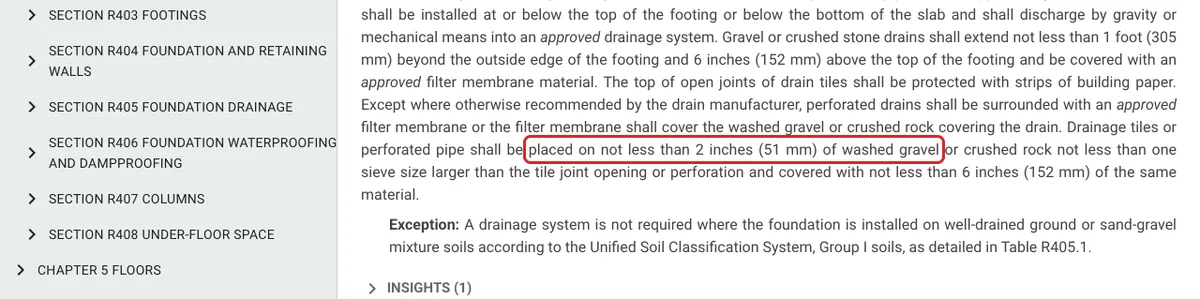
| Stone under pipe | At least 2 inches of washed gravel or crushed rock | IRC R405.1 (foundation drains) |
| Stone over pipe | At least 6 inches | IRC R405.1 |
| Stone over pipe | To 1 foot above the top of the pipe | WisDOT 612.3.5(1) |
| Stone width | At least 8 inches wider than the pipe’s outside diameter | WisDOT 612.3.5(1) |
| Stone size | No. 57 (100 percent passes 1.5 in, 0 to 10 percent passes No. 4); listed for shoulder drains | NCDOT Table 1005-1 |
| Stone size | At least one sieve size larger than the pipe’s holes | IRC R405.1 |
| Pipe | 4-inch smooth or 5-inch corrugated (highway underdrain) | FDOT Index 440-001, note 1 |
| Holes | Perforations on the underside | WisDOT 612.3.3(3) |
| Fabric | Filter membrane around the pipe or over the stone | IRC R405.1 |
| Fabric laps | 18 inches at joints (WisDOT); 1 foot (FDOT) | WisDOT 612.3.2; FDOT note 8 |
| Outlet pipe | Solid (nonperforated); bends made with 45 degree elbows | FDOT note 9 |
| Ends | Cap the upper end; screen the discharge end | WisDOT 612.3.3(4) and (5) |
| Dig order | Start at the outlet and work uphill | WisDOT 612.3.1(2) |
Why 18 to 24 inches deep and 12 inches wide?
Stack the code minimums and the depth appears. Allow about 4.5 inches for the outside of a 4-inch pipe, put 2 inches of stone under it and 6 inches over it per IRC R405.1, and add a 4-inch soil cap so grass can grow. That is 16.5 inches, which rounds to 18. Swap in WisDOT’s 1 foot of cover and the same stack reaches 22.5 inches, which rounds to 24.
| Layer, top to bottom | Code-minimum stack | Highway-cover stack | Basis |
|---|---|---|---|
| Soil or sod cap | 4 in | 4 in | Our assumption; WSU says the fabric is covered with soil |
| Stone over pipe | 6 in | 12 in | IRC R405.1 / WisDOT 612.3.5 |
| Pipe (4-in, outside) | 4.5 in | 4.5 in | Allowance for corrugated tubing |
| Stone under pipe | 2 in | 2 in | IRC R405.1 |
| Total depth | 16.5 in, dig 18 | 22.5 in, dig 24 | |
| Width: pipe plus envelope | 12.5 in | 12.5 in | WisDOT: 8 in wider than the pipe |
The deeper option buys more storage and more filtering stone between the surface and the pipe. The shallow option is 25 percent less digging and about a third less stone per foot (1.06 vs 1.56 cubic feet). For a lawn that is soggy only after storms, 18 inches is the usual call; for groundwater seeping from a slope, the 24-inch stack intercepts more of it.
How much fall does a French drain need?
Clemson Extension says to keep a 1 percent slope along the trench, WSU Extension gives 0.5 to 1 percent, and Colorado State says at least 1 to 3 percent. One percent is 1/8 inch per foot, 1.2 inches per 10 feet, or 1 foot per 100 feet. The popular “1 inch per 8 feet” works out to 1.04 percent; “1 inch per 10 feet” is 0.83 percent, inside WSU’s range but under Clemson’s.
| Run length | 0.5 percent | 1 percent | 2 percent | Outlet depth on flat ground, 18-in start at 1 percent |
|---|---|---|---|---|
| 10 ft | 0.6 in | 1.2 in | 2.4 in | 19 in |
| 25 ft | 1.5 in | 3.0 in | 6.0 in | 21 in |
| 50 ft | 3.0 in | 6.0 in | 12.0 in | 24 in |
| 100 ft | 6.0 in | 12.0 in | 24.0 in | 30 in |
| 150 ft | 9.0 in | 18.0 in | 36.0 in | 36 in |
- 0.5 percent (WSU low end)
- 1 percent (Clemson)
- 2 percent
Source: Slopes from Clemson, WSU and Colorado State Extension; fall = length x slope, our arithmetic Colorado State's minimum runs from 1 to 3 percent; 2 percent shown as a mid value.
Show the numbers
| 0.5 percent (WSU low end) | 1 percent (Clemson) | 2 percent | |
|---|---|---|---|
| 10 ft | 0.60 | 1.20 | 2.40 |
| 25 ft | 1.50 | 3 | 6 |
| 50 ft | 3 | 6 | 12 |
| 100 ft | 6 | 12 | 24 |
| 150 ft | 9 | 18 | 36 |
The last column is the problem most guides skip. On a level lawn, a 100-foot drain that starts 18 inches deep must end 30 inches deep, and a 150-foot run ends at 36 inches. Your outlet has to sit at least that low. If the lowest ground you control is not 12 inches below the trench bottom per 100 feet of run, you need a pop-up emitter in a lower spot, a dry well, or a shorter run, and our French drain cost guide prices each outlet.
To set grade, drive a stake at each end, run a mason’s line, level it with a line level, then lower the line at the outlet stake by the fall in the table: 6 inches for 50 feet at 1 percent. Measure from the line to the trench floor every 10 feet; each reading should grow by 1.2 inches. Check it again after the bedding stone goes in, since that is the surface the pipe actually follows.
Step by step: building the drain
- Find the water and the outlet. Watch where water stands after rain and pick a discharge point lower than the trench bottom by the fall in the table. Keep yard water out of the sanitary sewer and off neighbors: Lake Zurich, Ill. sets drains at least 3 feet from property lines and, where no storm structure exists, ends discharge at least 10 feet from them.
- Call 811. The national 811 service is free and wants notice a few business days ahead. Florida’s law, for example, requires at least 2 full business days and has utilities mark within 24 inches of each side of a line; dig by hand inside that zone.
- Mark and dig from the outlet uphill. WisDOT 612.3.1(2) starts at the outlet so water drains away while you work. Dig 12 inches wide, 18 to 24 inches deep at the top end, deepening 1.2 inches every 10 feet. Pile sod and topsoil apart from subsoil.
- Line the trench with nonwoven fabric. Leave enough on each side to fold over the top with a 12-inch lap: about 5.3 feet of fabric width per foot of an 18-inch trench, 6.3 feet for 24 inches.
- Lay 2 inches of washed stone and re-check grade with the string line before any pipe goes in.
- Lay 4-inch perforated pipe, holes down. WisDOT 612.3.3(3) specifies perforations on the underside. Cap the upstream end so stone cannot enter, per 612.3.3(4).
- Switch to solid pipe where the drain leaves the wet area. FDOT Index 440-001, note 9 uses nonperforated pipe for outlets and turns corners with 45 degree elbows; a 90 degree turn is two 45s at least 1 foot apart.
- Cover with stone to 6 inches over the pipe (12 inches for the deeper stack), keeping 3 to 4 inches below grade for soil.
- Fold the fabric over the stone with its 12-inch lap, then backfill with topsoil and reset the sod.
- Finish the outlet. Screen or grate the discharge end per WisDOT 612.3.3(5), or fit a pop-up emitter set below the trench bottom. Run a hose into the top end and confirm water reaches the outlet.

Do the pipe holes go up or down?
Down. Wisconsin DOT Standard Specification 612.3.3(3) says to lay perforated drainage pipe with the perforations on the underside unless the engineer directs otherwise. Water in a French drain does not drip in from above: rain soaks through the cap and stone, collects at the trench floor and rises. Holes set low on a 4-inch pipe, at 4 and 8 o’clock, take that water in once it is about 1 inch deep, and the pipe then carries it away at 1 percent.
With holes up, the trench has to fill to near the top of the pipe, about 4 inches, before any water gets in, and the pipe holds that water in the trench instead of draining it. The question matters most for rigid PVC drain pipe with 2 or 3 rows of holes. Single-wall corrugated tubing is usually slotted all the way around; check the slot pattern on the 10 feet you buy before deciding it has no top.
Fabric: does it clog, and where does it go?
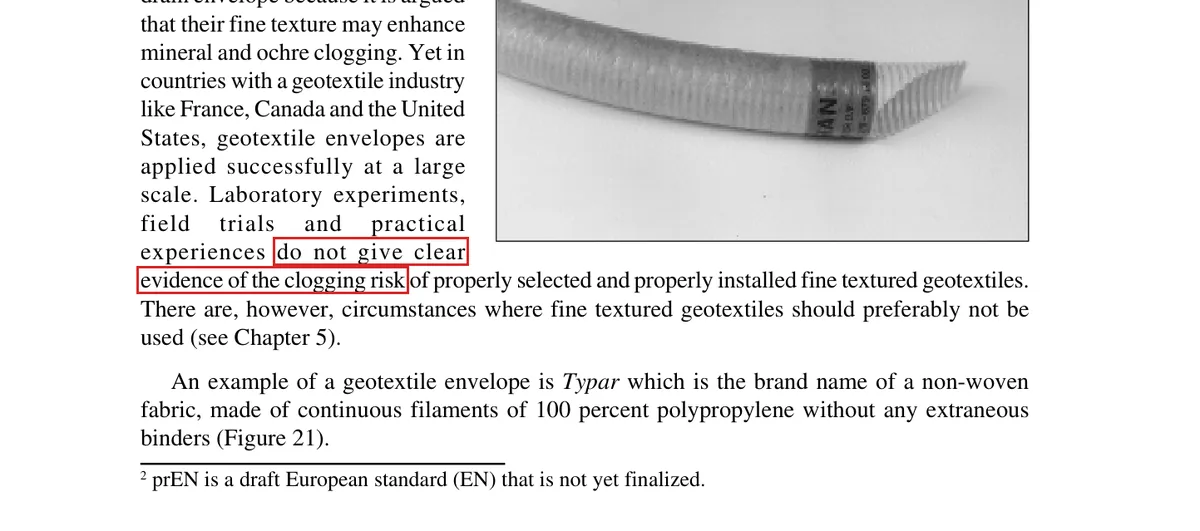
The worry is real but the evidence is thin. FAO Irrigation and Drainage Paper 60 reviewed drain envelopes worldwide and says laboratory experiments, field trials and practical experience do not give clear evidence of a clogging risk from properly selected, properly installed fine geotextiles. The same paper says sandy, cohesionless soils need an envelope in all circumstances, and soils with at least 20 to 30 percent clay usually do not.
| Your soil | FAO guidance | What to do in a yard drain | Source |
|---|---|---|---|
| Sand or loamy sand (falls apart when squeezed) | Envelope required | Wrap the whole trench in nonwoven fabric; a socked pipe adds a second filter | FAO Paper 60, ch. 6 summary |
| Silt, silt loam or very fine sand | Clogging-prone textures; envelope advised | Wrap the trench; a sock is optional once the trench is wrapped | FAO Paper 60 |
| Clay of 20 to 30 percent or more | Usually not needed for the pipe | Still line the trench so topsoil cannot wash into the stone | FAO Paper 60; WSU Extension |
| Rust-colored iron deposits in wet spots | Iron ochre risk | FAO notes fine-textured envelopes are argued to raise ochre clogging; plan a cleanout at the upper end | FAO Paper 60 |
Line the trench, not just the pipe. WSU Extension says the fabric wrapped over the gravel keeps soil from filling the spaces between stones and so keeps water moving through them. A sock alone keeps sand out of the pipe but lets the stone silt up. Lake Zurich’s permit rules make the same choice: pipe surrounded by washed stone and the trench wrapped in geotextile.
How much gravel for a French drain?
A 12-inch trench dug 18 inches deep with a 4-inch soil cap holds 1.17 cubic feet of stone per foot, about 1.06 after the pipe. At 100 pounds per cubic foot, which is what Bedrock Landscaping Materials’ 2026 coverage chart implies for 3/4-inch rock (1 ton covers 120 sq ft at 2 inches), that is about 106 pounds of stone per foot of drain.
- Stone (cubic feet)
- 58.3
- Stone (cubic yards)
- 2.16
- Stone (tons at 100 lb per cu ft)
- 2.92
- Bags of 0.5 cu ft
- 117
Default: 50 ft x 12 in x 14 in of stone = 58.3 cu ft, 2.16 cu yd, 2.92 tons, 117 bags. Length x width x stone depth; the pipe is not subtracted, which leaves about 9 percent for waste. Pipe length equals trench length plus solid pipe to the outlet.
| 100 ft yard drain, 12 x 18 in | Quantity | How we got it |
|---|---|---|
| Soil dug out | 150 cu ft (5.6 cu yd) in the ground | 12 x 18 in x 100 ft; it fluffs up once dug |
| Soil to haul or spread | 117 cu ft (4.3 cu yd) | All but the 4-inch cap |
| Washed 3/4-inch or No. 57 stone | 106 cu ft, 3.9 cu yd, 5.3 tons | Net of the pipe, at 100 lb per cu ft |
| Same stone in 0.5 cu ft bags | 211 bags | Why bulk delivery wins past about 20 ft |
| Perforated 4-inch pipe | 100 ft plus a cap | Plus solid pipe from the wet area to the outlet |
| Nonwoven fabric | 533 sq ft (5.3 ft wide x 100 ft) | Bottom, sides, top and a 12-inch lap |
| Fall to build in | 12 in | 1 percent of 100 ft; outlet trench 30 in deep on a level yard |
The calculator’s default, 50 feet at 12 by 18 inches, returns 58.3 cubic feet, 2.16 cubic yards or 2.92 tons, and 117 half-cubic-foot bags. For material and labor prices per foot, see the French drain cost breakdown; for stone by the yard, the river rock cost guide lists bulk prices.
When is a French drain the wrong fix?
When the water is on the surface, the grade is the problem. IRC R401.3 wants the ground to fall at least 6 inches in the first 10 feet away from a foundation, and our lawn leveling guide shows how to build that fall. Runoff cutting a channel is an erosion job, covered in erosion control methods. A drain dug down to a basement footing is a foundation drain under R405.1, and any trench 5 feet or deeper needs sloping, shoring or a trench box under OSHA 29 CFR 1926.652.
1Is the water mostly running or ponding on the surface near the house, where the ground falls less than 6 inches in the first 10 feet?
YesRegrade first to the IRC R401.3 fall; a drain will not fix a back-sloped yard.
NoGo to the next question
2Do you need to dig 5 feet or deeper, or down to a basement footing?
YesThat is a foundation drain under IRC R405.1 and an OSHA 1926.652 excavation. Hire it out.
NoGo to the next question
3Is there ground you control at least 12 inches below the trench bottom per 100 feet of run?
Yes
NoShorten the run, use a pop-up emitter in a lower spot or a dry well, and price the outlet before digging.
4Would the trench sit within 3 feet of a property line or discharge within 10 feet of one?
YesMove it or check local rules; Lake Zurich, Ill., bars both.
NoGo to the next question
5Is your soil sandy enough to fall apart when squeezed?
YesWrap the whole trench in nonwoven fabric and consider a socked pipe too (FAO Paper 60).
NoCall 811, then dig 12 inches wide and 18 to 24 inches deep at 1 percent fall, with pipe holes down on 2 inches of washed stone.
Source: IRC 2021 R401.3 and R405.1, OSHA 29 CFR 1926.652, Lake Zurich drainage handout, FAO Paper 60
How we compiled this
We read 14 primary documents in November 2026: 3 extension publications (Clemson, WSU, Colorado State), the 2021 IRC Chapter 4, Wisconsin DOT’s 2025 Standard Specification 612, NCDOT Table 1005-1, FDOT Standard Plans Index 440-001, FAO Irrigation and Drainage Paper 60, the NDS installation guide, Florida Statutes 556.105, the Lake Zurich drainage handout, OSHA 1926.652, 811beforeyoudig.com and a 2026 Bedrock stone price list. The depth stack, fall table and quantities are our arithmetic from those figures, with a 4.5-inch pipe allowance and a 4-inch soil cap as stated assumptions. We built no drains and ran no tests. Highway and foundation specs are stricter than a yard requires; we say where we borrowed them. Every figure is in the dataset.
Frequently asked questions
Can I make my own French drain?
Yes, for a yard drain 18 to 24 inches deep on your own lot. Call 811 a few business days first, and leave footing drains along a basement wall and any trench 5 feet or deeper, which OSHA 1926.652 requires shoring or sloping for, to a contractor.
How deep does a French drain need to be dug?
18 inches at the upper end covers 2 inches of stone, a 4-inch pipe, 6 inches of cover and a 4-inch soil cap per IRC R405.1 minimums; 24 inches allows WisDOT’s 1 foot of cover. Depth then grows 1.2 inches every 10 feet on level ground.
Do you need to put gravel under a French drain pipe?
Yes. IRC R405.1 puts perforated pipe on at least 2 inches of washed gravel or crushed rock and covers it with at least 6 inches. The bedding lets water reach the holes from below and gives the pipe a true grade.
What are the downsides of a French drain?
It needs an outlet 12 inches lower per 100 feet of run, silts up if the trench is not wrapped in fabric, and does little for water running over the surface. Heavy machinery over it can crush the pipe, WSU Extension warns.
Should French drain pipe holes face up or down?
Down, at about 4 and 8 o’clock. Wisconsin DOT Standard Specification 612.3.3(3) lays perforated pipe with holes on the underside, because water collects at the trench floor and rises into the pipe.
What is the alternative to a French drain?
Regrading so the ground falls 6 inches in the first 10 feet from the house (IRC R401.3), a surface swale or catch basin for ponding, or a dry well where no lower outlet exists.
This page is general information. Local codes, HOA rules and drainage law decide where water may go; confirm with your building department before you discharge near a property line or street, and call 811 before any digging.
Sources
- Clemson Cooperative Extension, Home & Garden Information Center, Dealing With Spring Drainage, February 24, 2020. Accessed November 2026.
- Washington State University Extension, Clark County, Improving Drainage, Checked November 2026. Accessed November 2026.
- Colorado State University Extension, Soil Drainage, GardenNotes #219, October 2015, reviewed September 2022. Accessed November 2026.
- International Code Council, 2021 International Residential Code, Chapter 4, Sections R401.3 and R405.1, 2021 edition. Accessed November 2026.
- Wisconsin Department of Transportation, 2025 Standard Specifications, Section 612 Underdrains, Effective with the November 2024 letting. Accessed November 2026.
- North Carolina Department of Transportation, Table 1005-1, Aggregate Gradation: Coarse Aggregate, 2012 Standard Specifications. Accessed November 2026.
- Florida Department of Transportation, Standard Plans Index 440-001, Underdrain, FY 2021-22. Accessed November 2026.
- Food and Agriculture Organization of the United Nations, Materials for Subsurface Land Drainage Systems, Irrigation and Drainage Paper 60 Rev. 1, Part II, 2005. Accessed November 2026.
- NDS (ADS), French Drain Installation Guide, Checked November 2026. Accessed November 2026.
- 811 Before You Dig, 811beforeyoudig.com, Checked November 2026. Accessed November 2026.
- Florida Legislature, Florida Statutes, Section 556.105, Procedures, 2025 Florida Statutes. Accessed November 2026.
- Village of Lake Zurich, Ill., Drainage: Sump Pumps, Downspouts, Drain Tiles (permit handout), Checked November 2026. Accessed November 2026.
- U.S. Occupational Safety and Health Administration, 29 CFR 1926.652, Requirements for protective systems, Current regulation. Accessed November 2026.
- Bedrock Landscaping Materials, Denver, Wholesale price list 2026, coverage chart, Valid March 10, 2026. Accessed November 2026.