Pine straw vs mulch: at the same Southeast yards, pine straw costs 30 to 60 percent as much per square foot and grips slopes, but it settles twice as fast and burns hotter. Bark or hardwood mulch lasts longer and suits beds beside the house.
Pine straw vs mulch is mostly a Southeast choice. The straw is the fallen needles of longleaf pine (Pinus palustris) or slash pine (Pinus elliottii), raked and baled in the coastal plain; NC State estimated North Carolina retail sales of longleaf straw alone at more than $34.8 million in 2016 (NC State Extension). Below, both covers are priced at the same three supply yards on Nov. 8, 2026, and run through the settling rates the University of Florida measured in side-by-side plots, so the cost per square foot covers five years, not just the first bale.
Three measured results do most of the work. Pine straw laid 3.5 inches deep was down to 1.6 inches after one year and 0.4 inch after two, against 2.4 inches of pine bark at two years (UF/IFAS FR052). Soil under it dropped from pH 5.0 to 4.4 in a year, 0.2 unit lower than under pine bark (Duryea, English and Hermansen, 1999). And it burned with 55 cm flames and over 300 kW of peak heat, against 28.5 cm and 80 kW for large pine bark (USDA Forest Service, 2007).
Pine straw vs mulch, side by side
| Measure | Pine straw | Bark or hardwood mulch | Source |
|---|---|---|---|
| What you buy | Longleaf or slash pine needles in bales (24 to 30 in. long, 8 to 25 lb dry) or rolls | Shredded hardwood, dyed wood or pine bark by the cubic yard or bag | NC State Extension |
| Posted price, same 3 yards, Nov. 8, 2026 | $5 to $5.50 a bale; $13 a roll | $26 to $48.50 a cubic yard | Cummin; American Landscape Supply; Miner’s |
| Material cost to cover 1 sq ft, first install | $0.11 to $0.25 | $0.24 to $0.45 at 3 in. | Our arithmetic, table below |
| Coverage | Bale: 20 to 50 sq ft by seller; 25 lb, 3 cu ft bale covers 50 sq ft at 3 in.; roll: 90 to 110 sq ft | 1 cu yd covers 108 sq ft at 3 in. (324 sq ft at 1 in.) | LSU AgCenter; Clemson HGIC |
| Depth to lay | 2 to 3 in. | 2 to 3 in. for fine mulch; up to 4 in. for coarse pine bark nuggets | Clemson HGIC |
| Depth left from 3.5 in. after 1 year / 2 years | 1.6 in. / 0.4 in. | Pine bark about 2.8 in. / 2.4 in. | Duryea 1999; FR052 |
| Mass decayed in year 1 | 3 to 7 percent | Pine bark 3 to 7 percent; utility-pruning chips 32 percent | Duryea 1999 |
| Soil pH after 1 year (start 5.0) | 4.4 | Pine bark 4.6; eucalyptus 4.8 | Duryea 1999 |
| Slopes | Needles interlock and stay in place, especially on slopes | Large pine bark nuggets float and may move in heavy rain | Clemson HGIC |
| Fire, field burns | 2.3 m (7.5 ft) a minute spread; 55 cm flames; 100 percent consumed | Large pine bark 28.5 cm flames; shredded cypress 0.35 m a minute | USDA Forest Service |
| Termites, 3-week lab feeding | Eaten | Wood mulches eaten too; utility chips most in one test, melaleuca least | Duryea, Huffman and Osbrink 1999 |
| Weeds after 1 year | No difference in weed counts among the 6 mulches | Same | Duryea 1999 |
What does each cost at the same yard?
Most price comparisons set a bale price from one seller against a yard price from another. The three yards below post both on the same page or product family, checked Nov. 8, 2026. Each pine straw price is divided by the seller’s own coverage claim; American Landscape Supply posts none, so its bale uses 40 to 50 sq ft, the range in Pine Straw King’s bale listing and LSU AgCenter’s 50 sq ft example. Mulch is the yard’s cheapest shredded product at 3 inches, 108 sq ft per cubic yard.
| Yard | Pine straw, posted | Coverage used | Straw per sq ft | Mulch, posted per cu yd | Mulch per sq ft at 3 in. | Straw as share of mulch |
|---|---|---|---|---|---|---|
| Cummin Landscape Supply, metro Atlanta, Ga. | $13 a long-needle roll | 90 to 110 sq ft (seller) | $0.12 to $0.14 | $42 dyed brown or black; $48.50 natural oak | $0.39; $0.45 | 30 to 37% |
| American Landscape Supply Co., Cary, N.C. | $5.50 a bale (N.C. Sandhills straw) | 40 to 50 sq ft (not posted) | $0.11 to $0.14 | $26 triple shred hardwood; $30 dyed; $38 mini nuggets | $0.24 | 46 to 57% |
| Miner’s Landscape Supply, Columbia, S.C. | $5 a bale | 20 to 30 sq ft at 2 to 3 in. (seller) | $0.17 to $0.25 | $45 brown or black | $0.42 | 40 to 60% |
Year one is not the whole bill, because straw needs more top-ups. The five-year figures below assume a 3-inch first layer, then 1 to 2 inches of straw a year, which matches LSU’s 1-inch top-up once or twice a year and the 2 inches the Florida plots lost in year one (LSU AgCenter; Duryea 1999). Mulch gets 0.6 to 1 inch a year; the Florida pine bark lost about 0.6 inch a year over two years (FR052). A 1-inch top-up of straw uses one-third of a full bale’s coverage, as LSU puts it, “one bale of pine straw should go three times as far.”
Per-sq-ft ranges from posted pickup prices at Cummin (Atlanta), American Landscape Supply (Cary, N.C.) and Miner's (Columbia, S.C.), Nov. 8, 2026. Material only: no delivery, tax or labor. Default: 500 sq ft of pine straw, first install = $55 to $125.
| 500 sq ft bed | Units for 3 in. | First install | Each later year | 5-year material total |
|---|---|---|---|---|
| Cummin pine straw rolls | 4.5 to 5.6 rolls | $59 to $72 | $20 to $48 | $138 to $265 |
| Cummin dyed mulch | 4.6 cu yd | $194 | $39 to $65 | $350 to $454 |
| American Landscape pine straw bales | 10 to 12.5 bales | $55 to $69 | $18 to $46 | $128 to $252 |
| American Landscape triple shred hardwood | 4.6 cu yd | $120 | $24 to $40 | $217 to $281 |
| Miner’s pine straw bales | 17 to 25 bales | $83 to $125 | $28 to $83 | $194 to $458 |
| Miner’s brown or black mulch | 4.6 cu yd | $208 | $42 to $69 | $375 to $486 |
Straw stays cheaper over five years at Cummin and American Landscape. At Miner’s, where the seller claims only 20 to 30 sq ft a bale, the ranges overlap: $194 to $458 for straw against $375 to $486 for mulch. Two costs sit outside these numbers. Bulk mulch usually means a truck or a delivery fee, while North Carolina producers now press light consumer bales that fit in a car (NC State Extension). If a crew spreads it, a twice-a-year straw schedule adds a labor visit that a bulk-mulch bed topped up once a year skips. Our mulch cost survey covers 133 listings in 22 states, including delivery fees.
How long does pine straw last compared with mulch?
Pine straw lasts about one season at full depth. In plots laid 9 cm (3.5 inches) deep near Gainesville in July 1997, pine straw settled the most of six mulches: to 4 cm after one year and an average 1 cm after two, “almost completely gone.” Pine bark and cypress still had 6 cm at two years, eucalyptus and utility mulch about 5, and melaleuca almost 7 (UF/IFAS FR052).
- Pine straw
- Pine bark
- Cypress
Source: Duryea, English and Hermansen 1999; UF/IFAS FR052 Year-1 values for pine bark and cypress are approximate: the paper reports they subsided about 2 cm in the first year. Pine straw and 2-year values as published.
Show the numbers
| Pine straw | Pine bark | Cypress | |
|---|---|---|---|
| Start (July 1997) | 9 | 9 | 9 |
| 1 year | 4 | 7 | 7 |
| 2 years | 1 | 6 | 6 |
The straw did not rot away. Only 3 to 7 percent of its mass decayed in the first year, the same band as pine bark, cypress and melaleuca, against 21 percent for eucalyptus and 32 percent for utility chips (Duryea 1999). The needles packed down. A refresh mostly restores loft and color, which is why LSU’s top-up is only 1 inch and why a seller such as Pine Straw King tells customers to leave the old straw in place.
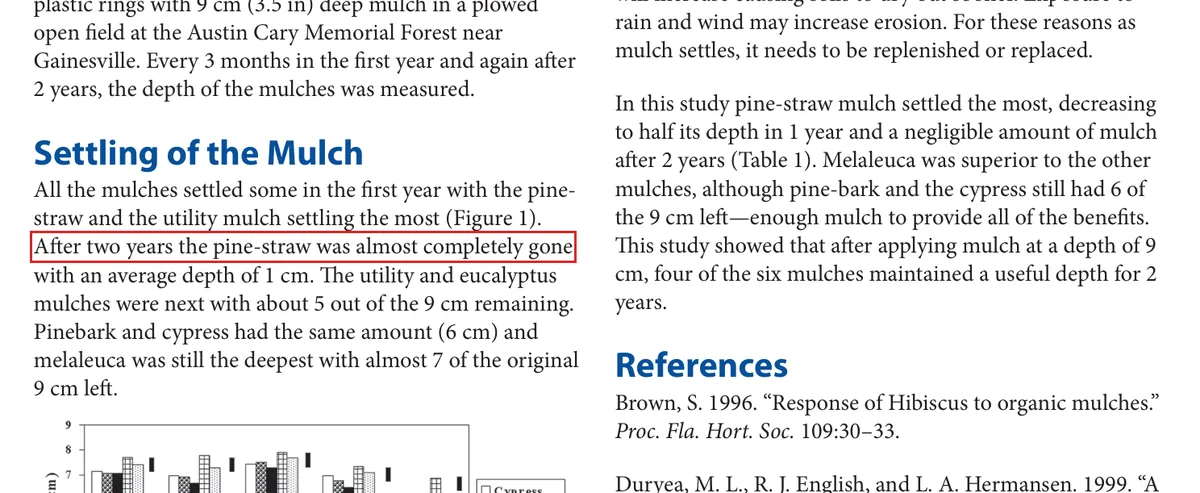
Extension advice spans a wide band. Clemson HGIC says pine needles and bark mulches “typically last for around 2 to 4 years before the need to add more”; the Florida numbers say straw falls below 2 inches inside year one in a hot, wet climate. Measure rather than follow a calendar: push a ruler into the bed each spring and top up either cover when it reads under 2 inches, the low end of Clemson’s 2 to 3 inch range. Our mulch quantity guide converts the gap into bales or yards.
Does pine straw make soil acidic?
A little, and less than its reputation. Freshly dropped needles read pH 3.2 to 3.8, and an Oregon State specialist quoted by NC State Extension in Lee County says turning them straight into soil may give “a slight drop in the soil pH” that would not damage plants. University of New Hampshire Extension goes further: “Even a 2 to 3 inch layer of pine mulch will not change the soil pH enough to measure.”
One field trial did measure it. On a Florida soil that started at pH 5.0, a year under 9 cm of each mulch gave the readings below; the pine straw result was significant at P = 0.0001 (Duryea, English and Hermansen, 1999). The same paper notes two other trials, one with 15 mulches over 6 months, that found no pH differences.
| Mulch (9 cm deep, 1 year) | Soil pH after 1 year | Change from 5.0 |
|---|---|---|
| Pine straw (slash pine needles) | 4.4 | minus 0.6 |
| Pine bark | 4.6 | minus 0.4 |
| Cypress | 4.6 | minus 0.4 |
| Melaleuca | 4.7 | minus 0.3 |
| Utility-pruning mulch | 4.7 | minus 0.3 |
| Eucalyptus | 4.8 | minus 0.2 |
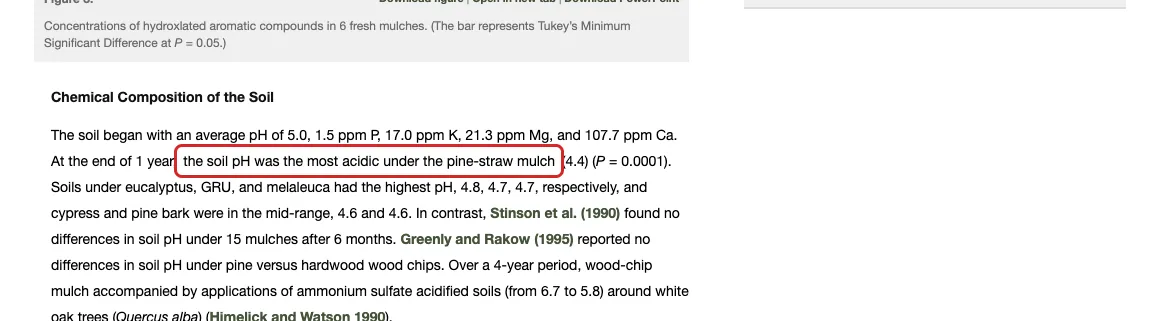
Every mulch in that trial lowered pH, and straw went 0.2 unit further than pine bark. That is a measurable effect on a sandy Florida soil, not a substitute for an amendment. If pH matters for the plants, get a soil test and use elemental sulfur at the rate our sulfur guide gives; straw is a mulch, not an amendment.
Which is the bigger fire risk near the house?
Pine straw. In USDA Forest Service field burns at the Ordway-Swisher Biological Station in Florida, 10 to 12 cm beds of four mulches were dried up to 30 days and lit upwind. Pine straw had the fastest spread, about 2.3 m (7.5 ft) a minute, and burned through the whole layer; in the lab it lost all its mass within 10 minutes (Zipperer, Long, Hinton, Maranghides and Mell, 2007).
| Measure | Pine straw | Large pine bark | Small pine bark | Shredded cypress |
|---|---|---|---|---|
| Rate of spread, field | 2.3 m a minute | not reported | not reported | 0.35 m a minute |
| Flame length, field | 55 cm | 28.5 cm | not reported | not reported |
| Temperature 25 cm above bed | over 350°C | over 350°C | not reported | 175°C |
| Fuel consumed | 100 percent, all plots | burned to the ground at stakes | not reported | under 25 percent in most plots |
| Peak heat release, lab | over 300 kW | 80 kW | 50 kW | 10 kW |
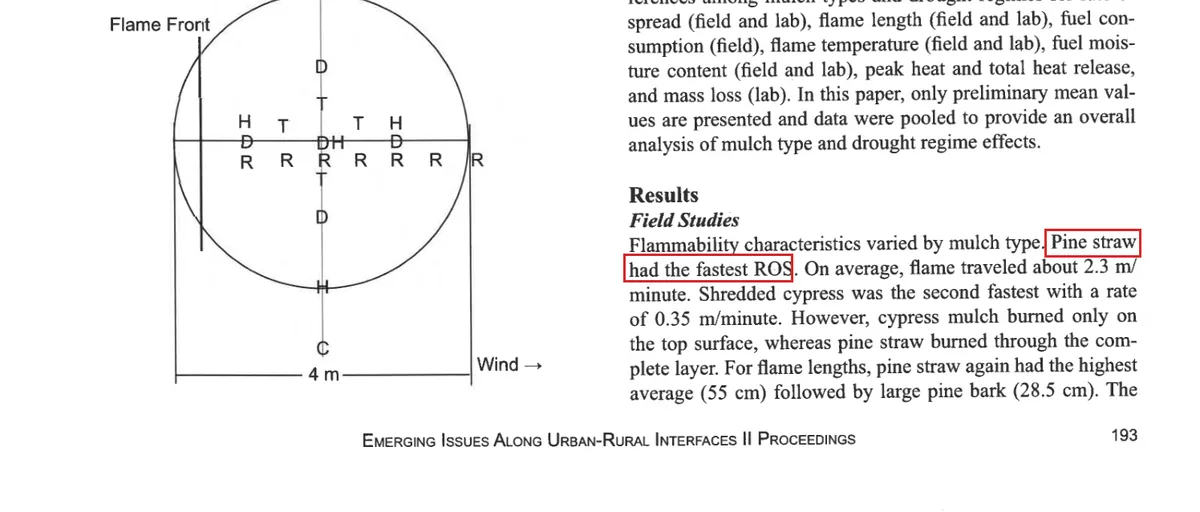
A separate set of Nevada burns ranked pine needles second only to shredded rubber among eight mulches. Its authors advise no combustible mulch within 5 feet of a house, bark nuggets or composted chips broken up by gravel or lawn from 5 to 30 feet, and pine needles only beyond 30 feet (Quarles and Smith, SP-11-04). A Florida county extension office gives homeowners the same 30-foot line for pine straw (UF/IFAS Suwannee County). In a wildfire-prone neighborhood, put rock in the first 5 feet; our mulch vs rock comparison prices it.
Mulch vs pine straw: which is worse for termites?
Neither keeps termites out, and UF/IFAS rates termites already on the property as a bigger risk than anything carried in with mulch (ENY-832). In two 3-week lab tests where mulch was the only food, subterranean termites ate pine straw along with the wood mulches and ate melaleuca least of the six; feeding tracked the mulch’s nitrogen and phosphorus (r = 0.91 and 0.96) (Duryea, Huffman and Osbrink, 1999). Pine straw had the second-highest nitrogen and phosphorus of the six (Duryea 1999).
Field evidence points the other way for ground covers in general: in a Maryland study cited by UF/IFAS, termites ate more cardboard in stations under pea gravel than under hardwood, pine bark or eucalyptus mulch, and mulch-fed termites survived less (UF/IFAS ENY-832). What matters is the strip next to the slab. UF/IFAS advises under 2 inches of any mulch within 12 inches of the foundation, a 6-inch inspection gap below the siding, and no irrigation wetting the walls; Clemson says to keep mulch 6 to 12 inches off building walls.
Slopes, weeds and where the straw comes from
On a bank, straw wins. Longleaf needles run 8 to 18 inches long (NC State Extension), and Clemson HGIC notes they “interlock and stay in place better than most mulches, especially on a slope,” while large pine bark nuggets float and can shift in heavy rain. For grades steep enough to gully, see our erosion control methods; for straw lifted by wind or blowers, mulch glue products list pine straw on their labels, at 1.3 to 2.7 gallons of ready-to-use glue per 100 sq ft for two coats.
On weeds the two tie when the depth is right. After a year in the Florida plots there was no difference in weed numbers among the six mulches; every fresh mulch slowed lettuce seed germination in the lab, and straw and utility mulch still did at 9 months (Duryea 1999). The practical gap is depth: straw drops to about 1.6 inches by month 12, so it needs its top-up to keep blocking light.
Straw supply follows the longleaf belt. A three-person crew with a box baler turns out 250 to 300 bales a day, a mechanical baler about 1,000, and an average stand yields 70 bales an acre a year (50 low, 100 high); owners rake each fall or every second year and fertilize every 6 to 8 years if they rake yearly (NC State Extension). Freight sets the price: our October survey found $5.50 a bale near the Sandhills and $17.50 in Ohio.
One mixed use comes from Clemson: artillery fungus, which shoots black spore specks onto siding and cars, grows in wood-based mulch, and Clemson HGIC suggests covering hardwood mulch with pine needles or switching to pure pine bark where it appears. For wood mulches themselves, our wood chips vs mulch and cypress mulch pages carry the same Florida trial data.
Which one for this bed?
Run the bed through the questions in order; the first yes decides. The fire and termite rules come first because they set distances from the house, and cost only decides once those are met.
1Is the spot within 5 ft of the house or deck in a wildfire-prone area?
YesNeither: rock, gravel or pavers in the first 5 ft (Univ. of Nevada SP-11-04).
NoGo to the next question
2Is it within 30 ft of the house in a wildfire-prone area?
YesBark nuggets broken up by lawn or gravel; keep pine straw beyond 30 ft (SP-11-04; UF/IFAS Suwannee County).
NoGo to the next question
3Is it the strip within 12 in. of the foundation?
YesEither, under 2 in. deep with a 6 in. inspection gap below the siding (UF/IFAS ENY-832).
NoGo to the next question
4Is it a slope where mulch washes out?
YesPine straw: the needles interlock and stay put (Clemson HGIC).
NoGo to the next question
5Do you want to top up only every 2 years?
YesBark or hardwood: pine bark kept 6 of 9 cm after 2 years; straw kept 1 (UF/IFAS FR052).
NoPine straw: 30 to 60 percent of the mulch price per sq ft at the same yard; add 1 in. once or twice a year (LSU AgCenter).
Source: UNR SP-11-04; UF/IFAS ENY-832 and FR052; Clemson HGIC; LSU AgCenter
How we compiled this
We read 13 primary documents in November 2026: four UF/IFAS and journal papers from the Gainesville mulch trials, the USDA Forest Service and University of Nevada burn studies, UF/IFAS ENY-832, and extension pages from Clemson, LSU, NC State (2) and UNH. Prices are posted pickup prices from 3 Southeast yards that sell both products, read Nov. 8, 2026; costs per square foot and the five-year totals are our arithmetic with the top-up assumptions stated above. We bought, laid and burned nothing.
Frequently asked questions
What are the disadvantages of pine straw?
Three measured ones. It settles fastest, from 3.5 to 1.6 inches in a year in Florida plots (FR052); it burns hottest of four mulches tested, over 300 kW peak heat (USDA Forest Service); and it lowered soil pH to 4.4 against 4.6 under pine bark (Duryea 1999).
Can you put mulch directly over pine straw?
Yes. The old straw counts toward depth, so rake off loose needles until the old layer is about 1 inch, then add bark or hardwood so the total stays at 2 to 3 inches, or up to 4 for coarse nuggets (Clemson HGIC). Keep it under 2 inches within 12 inches of the foundation (UF/IFAS).
How long does pine straw last as mulch?
About 6 to 12 months at useful depth. Florida plots lost half the depth in year one and kept an average 1 cm (0.4 inch) after two years (UF/IFAS FR052). LSU advises a 1-inch top-up once or twice a year (LSU AgCenter).
Is mulch or pine straw better for termites?
Neither is safer. Termites ate pine straw and the wood mulches in a no-choice lab test (Duryea 1999), and fed more under pea gravel than under mulch in Maryland. Follow the UF/IFAS rule: under 2 inches of any mulch within 12 inches of the foundation, 6-inch inspection gap (ENY-832).
Is it better to use mulch or pine straw around my house?
For the first 5 feet in a wildfire-prone area, use neither: rock or gravel. Nevada fire researchers put pine needles beyond 30 feet and bark nuggets from 5 to 30 feet (SP-11-04). Elsewhere, bark or hardwood mulch, thin near the slab, is the lower-risk choice by the house.
Sources
- UF/IFAS Extension (Duryea and Minogue), Landscape Mulches: How quickly do they settle? (FOR 69/FR052), 1999, reviewed June 2020. Accessed November 2026.
- Duryea, English and Hermansen, A Comparison of Landscape Mulches: Chemical, Allelopathic, and Decomposition Properties, Journal of Arboriculture 25(2), 1999. Accessed November 2026.
- Duryea, Huffman and Osbrink, Will Subterranean Termites Consume Landscape Mulches? Journal of Arboriculture 25(3), 1999. Accessed November 2026.
- USDA Forest Service and NIST (Zipperer, Long, Hinton, Maranghides, Mell), Mulch Flammability, Emerging Issues Along Urban-Rural Interfaces II, 2007. Accessed November 2026.
- Quarles and Smith, University of Nevada and UC Cooperative Extension, The Combustibility of Landscape Mulches (SP-11-04), 2011. Accessed November 2026.
- UF/IFAS Extension (Oi and Wheeler), The Facts About Termites and Mulch (ENY-832), revised June 2023. Accessed November 2026.
- Clemson Cooperative Extension, Home & Garden Information Center, Mulch (HGIC 1604), current page. Accessed November 2026.
- LSU AgCenter, Pine straw makes excellent mulch, March 30, 2009. Accessed November 2026.
- NC State Extension, Managing Longleaf Pine Straw, current edition. Accessed November 2026.
- NC State Extension, Lee County Center, Pine Needle Mulch: the Myths and Legends, June 8, 2023, updated July 31, 2025. Accessed November 2026.
- University of New Hampshire Extension, Do pine trees and pine needles make soil more acidic?, October 16, 2019. Accessed November 2026.
- UF/IFAS Extension Suwannee County, Is Your Home and Landscape Susceptible to Wildfires?, February 1, 2022. Accessed November 2026.
- Cummin Landscape Supply, Mulch & Soil (pine straw roll and bulk mulch prices), checked Nov. 8, 2026. Accessed November 2026.
- American Landscape Supply Co., Pine Straw (Bale), checked Nov. 8, 2026. Accessed November 2026.
- American Landscape Supply Co., Triple Shred Hardwood Mulch, checked Nov. 8, 2026. Accessed November 2026.
- Miner’s Landscape Supply, Pine Straw for Landscaping, checked Nov. 8, 2026. Accessed November 2026.
- Pine Straw King, Long Needle Pine Straw, Marietta, checked Nov. 8, 2026. Accessed November 2026.