How to make soil more acidic: lab-test first, then mix in elemental sulfur at about 20 lb per 1,000 sq ft per pH unit on loam, 12 on sand, 30 on clay, and retest in 3 months. If soil fizzes in vinegar, stop.
Knowing how to make soil more acidic comes down to three numbers: your pH, your organic matter and your free lime. Published rates for the same 1-point pH drop run from about 7 to 75 lb of sulfur per 1,000 sq ft, and most guides print one figure and skip the reason. Below, 12 published answers sit side by side in the same unit, next to the per-pass limits for lawns and beds and the arithmetic for when sulfur is a waste of money.
How much sulfur lowers soil pH? The rate table
These are the Oklahoma State University rates, PSS-2290, published March 2026, the most recent table we found and the one our calculator uses. They assume sulfur mixed into the top 6 inches. Divide by 10 for pounds per 100 sq ft, and by 100 for a 10 sq ft planting spot.
| Lower pH by | Sand (lb/1,000 sq ft) | Loam | Clay | 2 to 4% organic matter (Wisconsin) |
|---|---|---|---|---|
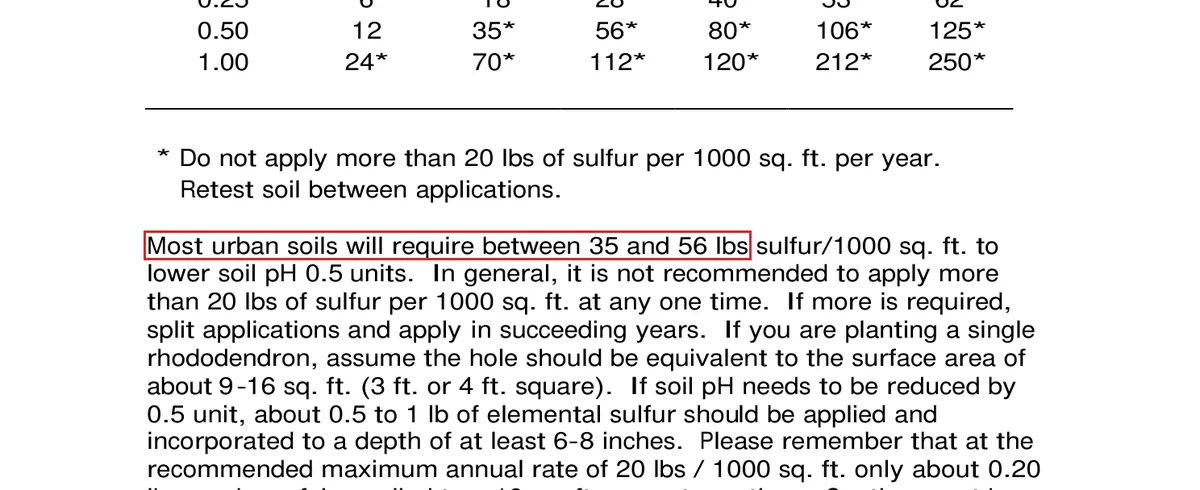
| 0.5 unit | 6 | 10 | 15 | 35 |
| 1.0 unit | 12 | 20 | 30 | 70 |
| 1.5 units | 18 | 30 | 45 | Not published |
| 2.0 units | 24 | 40 | 60 | Not published |
Two checks before you trust a row. Sulfur rates assume a soil without free lime, and they cover mineral soil: Wisconsin says most urban soils need 35 to 56 lb per 1,000 sq ft for only a 0.5-unit drop. If your lab reports 2 percent organic matter or more, use the last column.
- Pounds of product
- 22.2
- 50 lb bags
- 1
- Cups (about 2 per lb)
- 44
Pounds = area × rate ÷ sulfur percent. Rates: Oklahoma State PSS-2290 and University of Wisconsin. Split totals by the limits in this guide: 20 lb of sulfur per 1,000 sq ft a year on beds, 5 lb a pass on lawns. Skip this if your soil fizzes in vinegar. Prices checked Nov. 5, 2026.
| Worked example, 1-unit drop | Sulfur needed | 90% sulfur product | Mixed in at 20 lb a year | Lawn surface rate at 10 lb a year |
|---|---|---|---|---|
| Sand | 12 lb | 13 lb | 1 year | 6 lb: 1 year, 2 passes |
| Loam (calculator default) | 20 lb | 22 lb | 1 year | 10 lb: 1 year, 2 passes |
| Clay | 30 lb | 33 lb | 2 years | 15 lb: 2 years, 3 passes |
| 2 to 4% organic matter | 70 lb | 78 lb | 4 years | 35 lb: 4 years, 7 passes |
Why do published sulfur rates disagree by 10 times?
Texture explains part of the gap and organic matter explains most of the rest. On loam, nine of the 12 sources cluster at 15 to 24 lb per point. The only field measurement in our set sits at 75: in Oregon State EC 1560, one 45 lb application to a loam at pH 5.7 with 3.5 percent organic matter stabilized at pH 5.1 after two years. That works out to 75 lb per full unit from one site, and it nearly matches the 70 lb Wisconsin prints for 2 to 4 percent organic matter.
| Source | Sand | Loam | Clay | What the figure covers |
|---|---|---|---|---|
| Oklahoma State PSS-2290 | 12 | 20 | 30 | Any 1-unit drop, 6 inches |
| Clemson HGIC 1650 | 13 | 20 | 30 | pH 7.0 to 6.0; loam table, minus one-third for sand, plus one-half for clay |
| University of Georgia SB 62 | 8 | 20 | 32 | pH 6.5 to 5.5 |
| University of Tennessee blueberry guide | 13 | 20 | 27 | 2 lb per 0.1 unit above pH 5.5, top 3 inches |
| North Dakota State H1824 | 11 | 18 | 23 | pH 7.5 to 6.5 |
| K-State Riley County | 10 to 15 | 15 to 20 | 20 to 25 | pH 7.5 to 6.5, 6 inches, 95% sulfur |
| Colorado State Extension | Not split | 15 | Higher | 650 lb per acre per unit; more on clay and above pH 7.3 |
| Ontario OMAFA | 7 | 22.5 | Not listed | 350 and 1,100 kg per ha; sandy loam 15 |
| Royal Horticultural Society | 28 | Not listed | 55 | 135 to 270 g per sq m, pH 7.0 to 7.5 down to 6.0 to 6.5 |
| Espoma Soil Acidifier label rate | Not split | 36 | 45 | 12 lb and 15 lb of 30% sulfur product per 100 sq ft, as listed by the seller |
| University of Wisconsin soil lab | Not split | 24 to 70 | Not split | 24 at 0.5 to 2% organic matter, 70 at 2 to 4%, 250 above 10% |
| Oregon State field result | Not tested | 75 | Not tested | Measured: 45 lb, pH 5.7 to 5.1 after 2 years, 3.5% organic matter |
Use the low numbers as a starting dose, not a promise. Retesting tells you which row your soil belongs to: if 20 lb moved a loam only 0.3 unit after a season, your soil behaves like the 70 lb group. Oregon State’s method allows for this, with 10 to 20 lb on soil under 20 percent clay, 20 to 40 lb at 20 to 40 percent clay and 40 to 50 lb above 40 percent, then a spring test before repeating. Its ribbon test estimates clay: a moist ribbon of about 1 inch means under 20 percent, about 3 inches means over 40.
Can you make every soil acidic? The vinegar fizz test
No. Free lime absorbs sulfur before pH moves. Put 2 tablespoons of household vinegar in a cup, add about 1 tablespoon of soil and listen. North Dakota State says fizzing means calcium carbonate is present in high quantities and sulfur is not advised; run the test when your report reads pH 7.5 or higher. Colorado State gives the math: 2 percent lime in the top 6 inches is 20 tons per acre and needs about 6.5 tons of sulfur, for that layer alone.
| Free lime in top 6 in. | Lime, lb/1,000 sq ft | Sulfur to neutralize it | Years at 20 lb a year (beds) | Years at 10 lb a year (lawns) | Product cost, 90% sulfur |
|---|---|---|---|---|---|
| 0.5% | 230 | 75 lb | 4 | 8 | $43 to $80 |
| 1% | 459 | 149 lb | 8 | 15 | $86 to $159 |
| 2% | 918 | 298 lb | 15 | 30 | $172 to $318 |
| 5% | 2,296 | 746 lb | 38 | 75 | $431 to $796 |
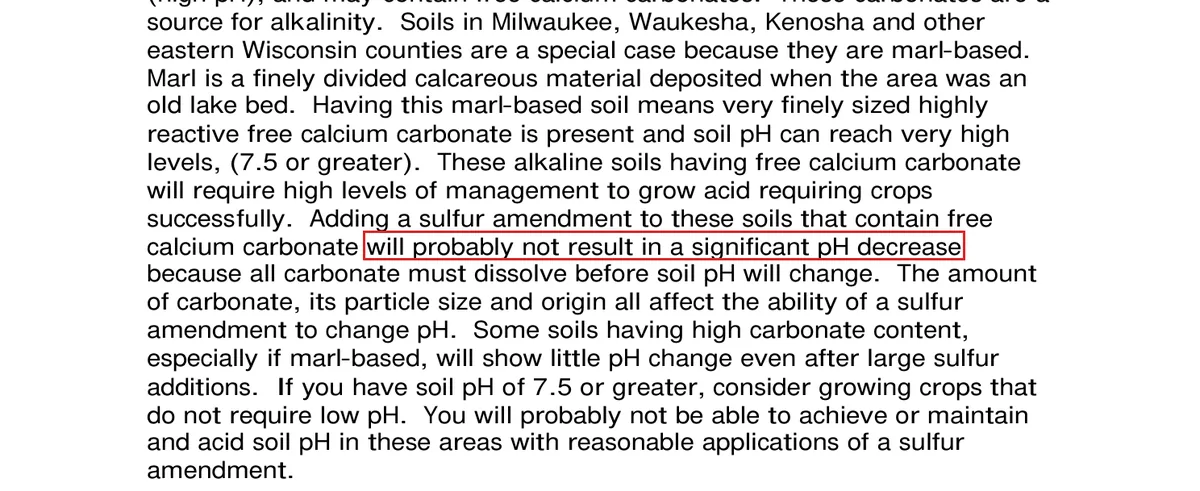
A long-term site shows how this ends. University of Minnesota Extension reports an Agvise Laboratories trial on soil above pH 8.0 with a 1.5 percent calcium carbonate equivalent: 10,000 lb of sulfur per acre, or 230 lb per 1,000 sq ft. pH fell 0.5 at first and was back at its starting level within 5 years. UF/IFAS SL 256 says there is no way to permanently lower soils formed from marl or limestone, and Wisconsin advises choosing other plants at pH 7.5 or above.
Irrigation can undo the work even without free lime. Oklahoma State names bicarbonate in municipal and well water as a primary driver of rising pH in irrigated landscapes, and K-State Research and Extension in Riley County reports Manhattan, Kansas, tap water at pH 8.51. Plan a retest every 2 to 3 years on any treated ground. Testing methods and lab costs are in our soil test guide.
1Is your lab pH within 0.5 of the plant's target range?
YesStop. UF/IFAS says a change that small will probably not improve performance.
NoGo to the next question
2Is pH 7.5 or higher, and does the soil fizz in vinegar?
YesDo not add sulfur. Free lime will absorb it. Choose plants suited to the pH or grow acid lovers in pots.
NoGo to the next question
3Is this an established lawn?
YesApply at most 5 lb of sulfur per 1,000 sq ft per pass and 10 lb a year, in cool weather, watered in. For yellowing, use iron instead.
NoGo to the next question
4Are the plants already in the ground?
YesTreat part of the root zone: 4 to 12 holes at the drip line with 1/4 cup of sulfur per hole.
NoGo to the next question
5Can planting wait a season?
YesTill elemental sulfur 6 inches deep from the rate table, at most 20 lb per 1,000 sq ft a year, and retest at 3 months.
NoUse aluminum sulfate at about 6 times the sulfur rate, at most 50 lb per 1,000 sq ft per pass, and accept the aluminum risk.
Source: UF/IFAS, NDSU, Purdue, Oregon State and University of Wisconsin publications
How to lower soil pH with sulfur, step by step
- Lab-test a 6-inch sample for pH and organic matter. Oregon State says color kits are often not accurate enough to guide acidifying.
- Run the fizz test if pH reads 7.5 or higher. Fizz means stop.
- Set your target. Clemson lists pH 5.0 to 5.5 for azaleas, rhododendrons and blueberries and 5.8 to 6.5 for vegetables, grasses and most ornamentals. UF/IFAS says a pH within 0.5 of the ideal range will probably not improve performance, and warns against going below 5.0 because of aluminum toxicity.
- Read your total from the rate table, then buy by the percent sulfur on the bag: total sulfur divided by 0.90 for a 90 percent product.
- Split the total. Wisconsin caps sulfur at 20 lb per 1,000 sq ft per year; UF/IFAS uses 14 lb per application on bare sandy soil.
- Spread on a still day with gloves, goggles and a dust mask, as the Royal Horticultural Society advises. Finer grinds react faster.
- Till it 6 inches deep. Oklahoma State assumes a surface application reaches only about 3 inches, and the RHS says acidity can take years to reach root depth from the surface.
- Keep the soil moist, not saturated. Bacteria do the work, so Oregon State warns too much water slows the reaction.
- Retest at about 3 months (Wisconsin), then at the same time each year because pH shifts seasonally (Oregon State).
- Plant the following season. Wisconsin ties poor growth and temporary acid toxicity to planting before the sulfur has reacted.
Timing guidance splits by climate. Oregon State prefers fall application with a spring test, west of the Cascades. The RHS prefers spring to autumn because cold soil slows sulfur to months instead of weeks. Wisconsin expects 2 to 3 months, or 6 or more where the bacteria are scarce; Ontario says 3 to 12; Colorado State says several months to a year. Budget for a full season.
Shrubs already in the ground
Treat part of the root zone. Oregon State says to dig at least 4 holes per tree (8 to 12 is better) near the drip line, each 1 foot deep and 4 to 8 inches wide, and mix 1/4 cup of sulfur into the soil from each. Its newer advice for rhododendrons and azaleas top-dresses 1/3 lb per plant monthly up to 1.5 lb total, and warns the response may not show until the following spring or summer. For a new planting, Wisconsin figures a 9 to 16 sq ft hole, 0.5 to 1 lb of sulfur for a 0.5-unit drop mixed 6 to 8 inches deep, and a later planting date when you exceed 0.2 lb per 10 sq ft at once.
Pots and containers
Start with an acid mix rather than correcting garden soil: UF/IFAS suggests pots for plants unsuited to your ground. To shift a peat-based mix one unit, the University of Georgia handbook (page 55) gives 1 to 1.5 oz of sulfur per bushel, which we calculate as about 0.5 to 0.8 oz for a 5-gallon pot. It sets 4.0 to 5.2 as the blueberry range in media. The RHS says sulfur is not suited to potting media, so treat this as a small, tested correction.
Can you lower pH under an established lawn?
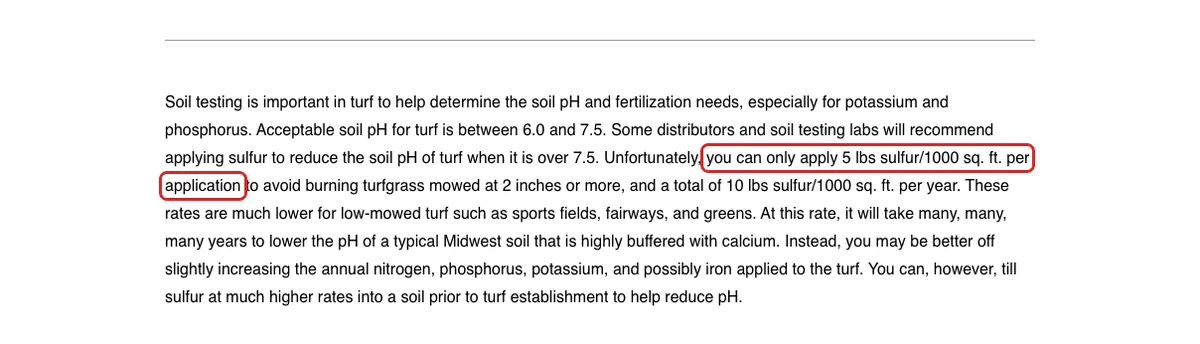
Only slowly, and often it is not worth trying. Purdue calls pH 6.0 to 7.5 acceptable for turf and limits grass mowed at 2 inches or higher to 5 lb of sulfur per 1,000 sq ft per application and 10 lb a year, which it says means many years on calcium-buffered Midwest soil. University of Georgia C 1058-1 reserves elemental sulfur for pH above 7.8 and prefers ammonium fertilizers below that.
| Situation | Most sulfur at once, lb/1,000 sq ft | Other limits | Source |
|---|---|---|---|
| Mature lawn, cut at 2 in. or higher | 5 | 10 lb a year | Purdue |
| Mature lawn, Georgia | 5; 2 is safer | Every 8 to 10 weeks; water in 0.3 to 0.5 in. at once | UGA C 1058-1 |
| Mature lawn, North Dakota | 5 | Half the table rate, spring or fall, with core aeration | NDSU H1824 |
| Mature lawn, Kansas | 5 | Spring and fall with aeration; not at 80 F or higher | K-State Riley County |
| Lawn, South Carolina | 5 to 10 | Every 2 to 3 months, below 75 F, watered in | Clemson calculator |
| Bentgrass and annual bluegrass greens | 2 and 0.8 | Very low cut turf | NDSU H1824 |
| Planted beds, sandy Florida soil | 7 | Avoids burn | UF/IFAS SL 256 |
| Bare sandy soil, Florida | 14 | Before planting | UF/IFAS SL 256 |
| Mixed-in or new beds, Wisconsin | 20 | Per year; top-dress up to 6 lb at the 3-month check | Wisconsin soil lab |
| Before planting, Georgia | 30 | Above that, half now, retest in 2 to 3 months | UGA SB 62 |
If the problem you are chasing is yellow grass, iron answers it faster. North Dakota State gives iron sulfate granules at 0.25 lb of actual iron per 1,000 sq ft, with green-up in 24 to 48 hours lasting about 2 weeks, and warns of staining on concrete. UF/IFAS sets a lower ceiling, 5 lb of iron per acre (about 0.11 lb per 1,000 sq ft), and reports more burn risk past it. Other causes are sorted in our guide to why grass turns yellow. Starting a new lawn is the one good window, since Purdue allows much higher rates tilled in before establishment. Grasses also differ: our centipede grass guide covers a species that wants pH 5.0 to 6.0.
What is the fastest way to acidify soil?
Aluminum sulfate, by days to weeks according to Oklahoma State, and Wisconsin calls the effect nearly immediate. You pay in weight, cost and risk. Oregon State does not recommend it because of root toxicity, and Wisconsin Horticulture says to avoid it. The sulfur rates for the same job look like this.
| Material | Pounds vs sulfur | For a 20 lb sulfur job | Speed | Limit or risk | Product cost, same job |
|---|---|---|---|---|---|
| Elemental sulfur, 90%, 50 lb bag | 1.1 times | 22 lb | 2 to 12 months | Burn above the per-pass limits | $12 to $21 of a $26 to $48 bag |
| Elemental sulfur, 90%, 4 lb bag | 1.1 times | 22 lb | 2 to 12 months | Same | $78 (6 bags at $12.99) |
| Soil acidifier, 30% sulfur, 6 lb bag | 3.3 times | 67 lb | Not stated; label prefers gradual change | Follow the label | $168 to $281 (12 bags at $13.99 to $23.41) |
| Aluminum sulfate, 4 lb bag | 5 to 7 times | 120 lb at 6 times | Days to weeks | 50 lb per 1,000 sq ft per pass, so 3 passes; aluminum toxicity | $330 (30 bags at $10.99) |
| Iron sulfate | 5 to 8 times | 100 to 160 lb | Quick when washed in (RHS) | K-State: 50 lb per 1,000 sq ft per pass; large doses interfere with phosphorus | No verified price |
| Ammonium sulfate, 21-0-0 | Not comparable | 3.5 lb N a year (about 17 lb product) | 0.1 to 0.2 unit a year | Not for more than a 0.4-unit drop; do not exceed your nitrogen rate | Not priced here |
Bag size is the biggest cost lever: 90 percent sulfur ran $0.52 to $0.96 a lb in 50 lb bags and $3.25 a lb in a 4 lb bag on Nov. 5, 2026. Per pound of actual sulfur, a 30 percent acidifier cost $7.77 to $13.00. Its appeal is a small, pre-measured dose for a hydrangea, not a whole bed. The Hi-Yield aluminum sulfate directions also print 5 lb per 100 sq ft, the same 50 lb ceiling Wisconsin sets. Follow the label on any product you buy.
How to make soil acidic naturally: what the evidence says
Elemental sulfur is the closest thing to a natural answer: soil bacteria do the converting, and 7 CFR 205.601(j)(2) lists it among crop and soil amendments allowed in USDA organic production. Check with your certifier if you hold one. The kitchen and yard remedies fall short.
| Remedy | What the evidence shows | Verdict | Source |
|---|---|---|---|
| Coffee grounds | Measured pH of composting grounds ranged 4.6 to 8.4; one study saw treated soil pH rise over 14 to 21 days | Do not count on it | WSU, Chalker-Scott, 2009 |
| Pine needles | Fresh needles read pH 3.2 to 3.8, but a 2 to 3 in. mulch layer will not change soil pH enough to measure | Good mulch, not an acidifier | UNH; NC State |
| Vinegar | 1 lb of sulfur yields about the acid of 9 gallons of 5% vinegar (our chemistry), and microbes mineralize acetic acid to CO2 and water in days to weeks | Fleeting, and it burns plants | EPA, 2008 |
| Epsom salt, gypsum, potassium sulfate | Sulfates without ammonium, iron or aluminum do not acidify | No effect on pH | UF/IFAS; Ontario |
| Peat moss | Acidic, but decomposes, so applications repeat once or twice a year; the RHS no longer recommends peat | Small beds only | UF/IFAS; RHS |
| Ammonium fertilizer | 3.5 lb N a year in ammonium sulfate lowered Willamette Valley lawns 0.1 to 0.2 unit a year | Slow but real | Oregon State |
Lemon juice is also an organic acid, and none of the documents we read recommends it. The 20 lb sulfur job would take about 180 gallons of 5 percent vinegar, and vinegar works as a contact burn on whatever it wets, as our vinegar weed killer guide details. Pine needles remain fine mulch by the numbers in our mulch calculator.
Overshot your target? Raising pH is the easier direction, and our lime rates by grass and soil cover it. Heavy soil has its own problems, covered in our clay soil guide, and more plant and lawn references sit in our turf and trees hub.
How we compiled this
We read 23 extension, agency, lab and regulatory documents in November 2026 and converted each rate to lb per 1,000 sq ft (1 acre = 43,560 sq ft; 1 kg per ha = 0.0205 lb per 1,000 sq ft; 1 g per sq m = 0.205 lb per 1,000 sq ft). Bag prices are public listings checked Nov. 5, 2026. Years, costs and the vinegar comparison are our arithmetic from those inputs. We ran no soil trials. Wisconsin’s table prints 120 lb for 1.0 unit at 6 to 8 percent organic matter, which breaks its own doubling pattern (80 lb at 0.5 unit), so we did not rely on that cell. Michigan State’s sulfur PDF blocked our browser and is not included. All cells are in the dataset.
Frequently asked questions
What is the fastest way to acidify soil?
Aluminum sulfate works in days to weeks, per Oklahoma State, at about 6 times the sulfur rate and no more than 50 lb per 1,000 sq ft per pass. Elemental sulfur is safer but takes 2 to 12 months.
How much sulfur to lower soil pH per square foot?
About 0.02 lb (0.3 oz) per sq ft per pH unit on loam, 0.012 lb on sand and 0.03 lb on clay, from Oklahoma State’s table. Soil with 2 to 4 percent organic matter may need 0.07 lb.
How fast does elemental sulfur lower soil pH?
Allow a season. Wisconsin says 2 to 3 months, or 6 or more where sulfur bacteria are scarce; Ontario says 3 to 12 months; Oregon State’s 45 lb field application took 2 years to stabilize.
Do coffee grounds really acidify soil?
Not reliably. Washington State University reports measured pH from 4.6 to 8.4 in composting grounds and says not to assume they will be acidic.
Does Epsom salt make soil more acidic?
No. UF/IFAS lists magnesium sulfate, gypsum and potassium sulfate among sulfates that will not acidify soil, and Ontario says they have no effect on pH.
Does adding vinegar to soil make it acidic?
Briefly. EPA says acetic acid breaks down to carbon dioxide and water in days to weeks. Replacing a 20 lb sulfur job would take about 180 gallons of 5 percent vinegar by our calculation.
This page is general information. Rates are published estimates and results depend on your soil; the product label controls how any product may be used, and a lab recommendation for your own sample takes priority over these tables.
Sources
- Oklahoma State University Extension, Acidifying Lawns and Garden Soils in Oklahoma, PSS-2290, March 2026. Accessed November 2026.
- Clemson Cooperative Extension, Changing the pH of Your Soil, HGIC 1650, Reviewed May 13, 2026. Accessed November 2026.
- Clemson University CU-CAT, Clemson Soil Acidification Calculator, 2019 to 2026. Accessed November 2026.
- University of Georgia, Soil Test Handbook for Georgia, Special Bulletin 62, pages 29, 30 and 55, Handbook edition online. Accessed November 2026.
- University of Georgia Extension, Turfgrass Fertility: Soil Texture, Organic Matter, Aeration, and pH, C 1058-1, May 10, 2021. Accessed November 2026.
- UF/IFAS Extension, Soil pH and the Home Landscape or Garden, SL 256, Reviewed August 2025. Accessed November 2026.
- University of Tennessee Institute of Agriculture, Home garden blueberries soil recommendations, Page dated 2026. Accessed November 2026.
- North Dakota State University Extension, Interpreting the NDSU Soil Test Analysis for Managing Turfgrass, H1824, Current online edition. Accessed November 2026.
- K-State Research and Extension, Riley County, Acidifying Your Soil, Undated fact sheet. Accessed November 2026.
- Colorado State University Extension, Changing Soil pH, December 2021, reviewed August 2025. Accessed November 2026.
- Ontario Ministry of Agriculture, Food and Agribusiness, Soil pH in blueberry plants, Current online edition. Accessed November 2026.
- Royal Horticultural Society, Acidifying soil, Current online edition. Accessed November 2026.
- University of Wisconsin Soil and Forage Lab, Lowering soil pH, 2010. Accessed November 2026.
- University of Wisconsin-Madison Extension, Do Garden Soils Need Limestone or Sulfur?, Current online edition. Accessed November 2026.
- Oregon State University Extension, Acidifying soil for blueberries and ornamental plants in the yard and garden, EC 1560, Current online edition. Accessed November 2026.
- Oregon State University Extension, How to acidify soil for rhododendrons, azaleas and other acid-loving plants, Current online edition. Accessed November 2026.
- Purdue University Turfgrass Science, Sulfur is not Effective for Lowering pH of Turfed Soils, April 25, 2004. Accessed November 2026.
- University of Minnesota Extension, Is It Feasible to Lower My Soil pH?, October 2018. Accessed November 2026.
- Washington State University, Coffee grounds: will they perk up plants?, Linda Chalker-Scott, MasterGardener, Winter 2009. Accessed November 2026.
- University of New Hampshire Extension, Do pine trees and pine needles make soil more acidic?, October 2019. Accessed November 2026.
- NC State Extension, Lee County, Pine Needle Mulch: the Myths and Legends, June 2023. Accessed November 2026.
- U.S. EPA, Acetic Acid and Salts Summary Document, EPA-HQ-OPP-2008-0016-0003, page 21, 2008. Accessed November 2026.
- Cornell Legal Information Institute, 7 CFR 205.601(j)(2), Current text. Accessed November 2026.
- Retail listings, Bag prices and label rates on the seller pages linked in the amendment table, Nov. 5, 2026. Accessed November 2026.