Mulch vs rock: use wood mulch around plants, small rock where nothing needs feeding or fire is a risk. Soil under rock ran 4.5°F warmer in Iowa, 23 to 40°F in Phoenix. DIY river rock takes 7 to 14 years to repay.
Most rock-or-mulch pages repeat two claims without a number: rock runs hot, and rock saves money. Both are narrower than they sound. At midday the bark surface is the hotter one; it is the soil under rock that heats up (Singer and Martin, 2008). And payback flips on stone size: 2 inches of pea gravel beats yearly mulch by year 1, while 3 inches of river rock takes until year 7.
Mulch vs rock cost: the year rock pays for itself
River rock costs 3.3 times as much as wood mulch on day one, then nothing to renew. Our inputs are the medians from our own price pages: $89.42 a ton for river rock, $64 a ton for pea gravel and $40 a yard for natural shredded mulch, all 2026 supply-yard listings. Top-ups run 1 inch a year per Virginia Cooperative Extension, which says permanent organic mulch “may need to be replenished annually.”
| 500 sq ft bed | Year 0 | Each mulch top-up | 10-season total | Rock pays back in |
|---|---|---|---|---|
| Wood mulch, 1 in. a year, you haul | $204 | $68 | $815 ($631 to $917) | Baseline |
| Wood mulch, 1 in. every 2 years, you haul | $204 | $68 | $475 ($368 to $535) | Baseline |
| Pea gravel, 2 in., you haul | $250 | $0 | $250 ($156 to $262) | Year 1 |
| River rock, 3 in., you haul | $671 | $0 | $671 ($480 to $862) | Year 7 (yearly mulch); year 14 (every 2 years) |
| River rock, 3 in., woven fabric, you haul | $748 | $0 | $748 | Year 9 (yearly mulch) |
| Wood mulch, 1 in. a year, contractor, delivered | $518 | $242 | $2,700 | Baseline |
| Wood mulch, 1 in. every 2 years, contractor, delivered | $518 | $242 | $1,488 | Baseline |
| Pea gravel, 2 in., contractor, delivered | $590 | $0 | $590 | Year 1 |
| River rock, 3 in., contractor, delivered | $1,226 | $0 | $1,226 | Year 3 (yearly); year 6 (every 2 years) |
| River rock, 3 in., woven fabric, contractor, delivered | $1,538 | $0 | $1,538 | Year 5 (yearly mulch) |
- Wood mulch, contractor, yearly
- River rock, contractor
- Wood mulch, you haul, yearly
- River rock, you haul
- Pea gravel, you haul
Source: Green Industry Report estimate at median 2026 yard prices Same inputs as the table above. No inflation, no rock refresh. Contractor lines include delivery.
Show the numbers
| Wood mulch, contractor, yearly | River rock, contractor | Wood mulch, you haul, yearly | River rock, you haul | Pea gravel, you haul | |
|---|---|---|---|---|---|
| Year 0 | 518 | 1,226 | 204 | 671 | 250 |
| 1 | 760 | 1,226 | 272 | 671 | 250 |
| 2 | 1,002 | 1,226 | 340 | 671 | 250 |
| 3 | 1,245 | 1,226 | 407 | 671 | 250 |
| 4 | 1,488 | 1,226 | 475 | 671 | 250 |
| 5 | 1,730 | 1,226 | 543 | 671 | 250 |
| 6 | 1,972 | 1,226 | 611 | 671 | 250 |
| 7 | 2,215 | 1,226 | 679 | 671 | 250 |
| 8 | 2,458 | 1,226 | 747 | 671 | 250 |
| 9 | 2,700 | 1,226 | 815 | 671 | 250 |
Trucks change the answer. A flat delivery fee ($60 to $150 for mulch, $75 to $200 for rock) hits mulch every year and rock once, so rock pays back fastest on small delivered beds.
| Bed size | Rock / mulch at 3 in. | You haul both | Delivered, you spread | Contractor, 1 in. a year | Contractor, 1 in. every 2 years | Contractor, rock on fabric |
|---|---|---|---|---|---|---|
| 100 sq ft | 1.5 tons / 1.0 yd | Year 7 | Year 2 | Year 2 | Year 4 | Year 2 |
| 200 sq ft | 3.0 tons / 2.0 yd | Year 7 | Year 2 | Year 2 | Year 4 | Year 3 |
| 500 sq ft | 7.5 tons / 5.1 yd | Year 7 | Year 3 | Year 3 | Year 6 | Year 5 |
| 1,000 sq ft | 15.0 tons / 10.2 yd | Year 7 | Year 5 | Year 4 | Year 8 | Year 6 |
| 2,000 sq ft | 30.0 tons / 20.4 yd | Year 7 | Year 6 | Year 5 | Year 10 | Year 7 |
- River rock at 3 in. (tons)
- 7.5
- Pea gravel at 2 in. (tons)
- 3.9
- Mulch at 3 in. (cu yd)
- 5.1
Default: 500 sq ft of wood mulch at 1 in. a year, you haul: $630 to $915, matching the table. Switch the material to compare, and tick only the add-ons for that material. Ranges use the middle half of 2026 yard prices; no inflation, weeding, removal or sales tax. Small jobs may hit a contractor minimum.
Local prices move those years. AZ Rock Express listed 1-inch river rock at $45 a ton on Nov. 5, 2026, which pays back in year 2 against median mulch. Raw wood chips at $20 a yard push DIY payback to year 17. Bagged on a 100 sq ft bed, at $270 to $377 a yard for rock and $67.50 for mulch, payback takes about 10 years. A two-person half-day minimum, about $483 at our labor rate, can swamp a 1.7-yard contractor top-up.
Rock has later costs too. One 1-inch refresh on 500 sq ft adds $224 and about 4 years to DIY payback, and UC IPM warns stone sinks into soil without fabric. Removal is worse: Portland Rock charges $75 a ton to accept clean rock, or $563 for this bed before labor. The model leaves out weeding and leaf-blowing time, because we found no published hours.
Is rock hotter than mulch? Only below the surface
The hottest surface in the bed is usually the bark. Montague and Kjelgren (2004) measured six surfaces over three summers, including gravel and lava rock, and pine bark had the highest surface temperature. CSU Extension says gravel beds stay cooler at the surface than wood chips. Bark traps heat at the top because it conducts poorly; rock passes it down.
| Measurement, Phoenix, 2004 to 2005 | Organic mulch (pine residue, tree trimmings) | Decomposed granite | What it means |
|---|---|---|---|
| Surface at 2 p.m. | 143°F and 154°F (Aug. 2004, July 2005) | Cooler than the organic mulches | Bark surface is the hot one at midday |
| Surface at 10 p.m. | 7°F and 14°F cooler than rock | Warmer | Rock holds heat into the night |
| Soil, 2 in. deep, afternoon | Never reached 104°F | Over 104°F for about 9 to 10 hours a day; organic ran 23 to 40°F cooler | The root-zone gap is largest here |
| Soil, 12 in. deep | About 82 to 90°F | 14 to 18°F warmer | Deep roots feel it too |
| Heat conduction (W/m°C at 100°F) | 0.05 | 0.18 | Rock passes about 3.6 times as much |
| Depth lost over 2 seasons | 27% and 48% | 19% | Rock settles too, more slowly |
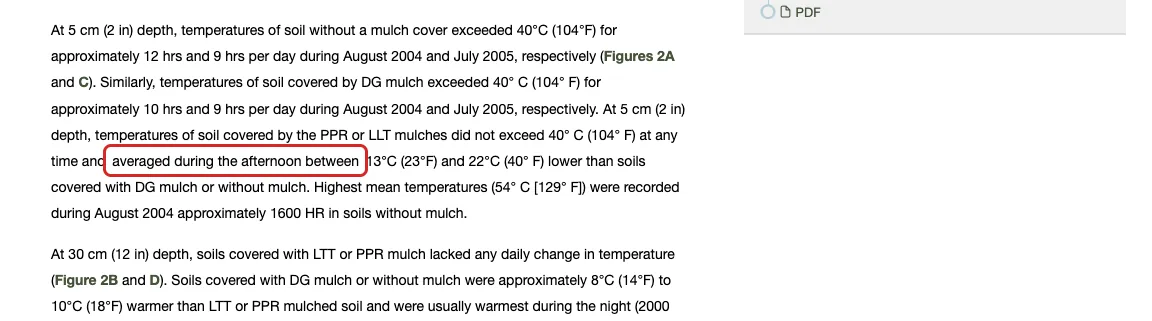
Iowa shows the mild-climate version, and it names the rocks. Iles and Dosmann (1999) mulched red maples at Gilbert, Iowa (USDA zone 5a), and read soil 4 inches down: the 3 organic mulches averaged 74.1°F, the 5 mineral mulches 78.6°F.
| Treatment (mineral mulches over woven fabric) | Stone or piece size | Soil temp, 1997 | Soil moisture | Stem caliper | Tree height |
|---|---|---|---|---|---|
| Bare soil, no mulch | none | 84.7°F | 19% | 4.1 cm | 219 cm |
| Pea gravel, 2 in. | 0.4 in. | 81.7°F | 31% | 4.2 cm | 220 cm |
| Crushed brick, 2 in. | 0.75 in. | 79.2°F | 30% | 4.2 cm | 219 cm |
| Carmel rock, 2 in. | 1 in. | 79.2°F | 29% | 4.2 cm | 218 cm |
| River rock, 3 in. | 1.5 in. | 77.4°F | 29% | 4.2 cm | 214 cm |
| Lava rock, 2 in. | 0.5 in. | 76.1°F | 30% | 4.1 cm | 222 cm |
| Shredded hardwood bark, 4 in. | 1.6 to 2.2 in. long | 74.5°F | 31% | 3.9 cm | 210 cm |
| Pine wood chips, 4 in. | 0.8 to 1.2 in. | 73.9°F | 32% | 4.1 cm | 222 cm |
| Screened pine bark, 4 in. | 1.6 to 2.4 in. long | 73.8°F | 32% | 4.0 cm | 214 cm |
Those trees did fine: maples in river rock and pea gravel reached a 4.2 cm caliper against 3.9 cm in shredded bark, which the authors link to warmer spring soil. They call blanket statements about rock “unwise,” and note the site was fertile and the seasons cool. CSU Extension adds that gravel may help plants in cold-winter climates but can pass heat to buildings. Hot desert sites are the opposite case.
Extension pages seem to disagree. University of Illinois Extension says rock does not raise summer soil temperature; K-State Extension says it does and hurts plants. Against bare soil, Illinois is right: rock ran 6.1°F cooler in Iowa and 5 to 16°F cooler in Phoenix. Against organic mulch, K-State is right. UC IPM adds that white rock can reflect enough light to damage sensitive plants and dark rock retains heat.
Does rock dry out the soil?
Coarse rock does, slightly. Soil moisture under pea gravel (31 percent) matched shredded bark in Iowa, river rock trailed wood chips at 29 against 32 percent, and bare soil sat at 19 percent. CSU Extension sets the line at about 1/2 inch: smaller gravel cuts evaporation and weeds about as well as wood chips, while larger stone increases runoff and “can actually inhibit plant growth.”
Weed fabric and weeds: where each one fails
Fabric belongs under rock, if anywhere. UC IPM suggests it to keep stone from sinking and soil from rising, at $0.44 to $0.81 per sq ft installed by our river rock model, about 2 years of added payback. Under wood mulch it defeats the point: Iowa State Extension notes organic mulch over fabric cannot mix with soil, so fertility and structure do not improve.
- Weeds arrive from above. University of Arizona Extension says blown-in seeds establish in gravel “even if you use landscape fabric underneath.”
- Leaves speed it up. Virginia Cooperative Extension says stone may need regular blowing off; K-State says leaves left on gravel break down into silt that adds weed pressure.
- Control means hand pulling or multiple herbicide applications a season, K-State says; a hoe is useless in rock.
- Rock slides down even slight inclines and exposes fabric, K-State reports, and removal means hand picking or a front-end loader. Slopes belong in our erosion control guide.
Against the house: fire rules and foundation drainage
Rock wins the first 5 feet where wildfire is a risk. In a 2008 Carson City burn test of 8 mulch treatments, all 8 were combustible: shredded rubber exceeded 630°F at 4 inches above the bed, and shredded cedar spread at 47.9 feet a minute. The authors recommend noncombustible rock, gravel, concrete or pavers within 5 feet of the house.
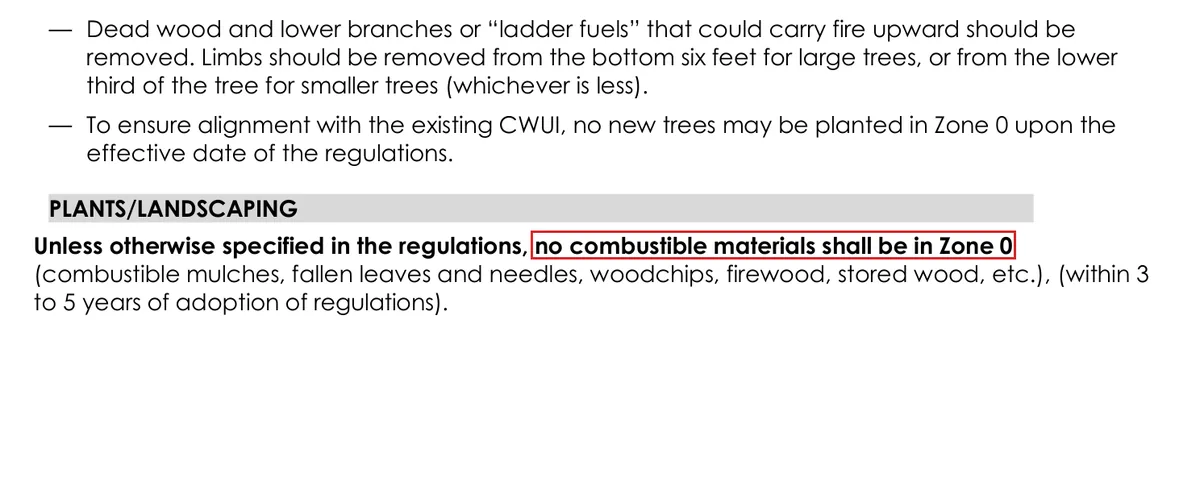
California is writing that into rule. Draft Zone 0 text (14 CCR 1298.04 and 1299.03) bars mulches such as bark and wood chips within 5 feet of structures in State Responsibility Areas and locally designated Very High Fire Hazard Severity Zones, with existing homes phased in over 3 to 5 years. As of Nov. 5, 2026, it is not in effect: the Board approved it Aug. 19, withdrew it from state review for edits, and brought it back Nov. 5 for re-adoption. The September guidance allows weed cloth under rock mulch, though it calls cloth flammable.
Neither material fixes drainage. IRC R401.3 requires the grade to fall at least 6 inches in the first 10 feet from the foundation, and rock laid on a flat or back-sloped grade still drains toward the wall. Regrade first, or price a French drain if water collects there. University of Arizona Extension advises keeping organic mulch off structures to cut termite activity, and says rock raises cooling costs, but gives no figure and we found none.
Where water still collects after regrading, our guide to how to make a French drain sets out the trench, stone and pipe specs.
Which one fits this bed?
Run the questions in order; the first yes decides it.
1Is the bed within 5 feet of a building in a wildfire-prone area?
YesRock or gravel. All 8 organic mulches burned in the Carson City test, and California draft Zone 0 text bars them there.
NoGo to the next question
2Do you expect to dig or replant here within about 7 years?
YesWood mulch. DIY river rock has not paid back by then, and removal means hand picking or a loader.
NoGo to the next question
3Are there trees or shrubs in a hot, dry climate like Phoenix?
YesOrganic mulch. It kept 2-inch soil 23 to 40°F cooler than decomposed granite.
NoGo to the next question
4Do leaf-dropping trees hang over the bed, or does it sit on a slope?
YesWood mulch. Leaves in gravel turn to silt and weeds, and rock slides on inclines.
NoGo to the next question
5Is it a planted bed where you want the soil to improve?
YesWood mulch, 3 inches, then 1 inch every 1 to 2 years. Rock adds no organic matter.
NoRock. Use gravel 1/2 inch or smaller at 2 inches for mulch-like benefits; river rock at 3 inches is the look, at about 2.7 times the material cost.
Source: K-State Extension; Singer and Martin 2008; Quarles and Smith 2011; CSU Extension
How we compiled this
We ran no field tests and have no job data. Heat and moisture figures come from 3 peer-reviewed studies and 8 extension publications; fire rules from the California Board of Forestry binder for Nov. 5, 2026. Costs use 2026 yard prices on our river rock, gravel and mulch pages (checked Oct. 13 to 18), at 0.005 tons per sq ft per inch for river rock, 1/128 ton per sq ft for 2 inches of pea gravel, and sq ft times inches divided by 324, plus 10 percent settling, for mulch. Contractor rock adds 10 to 20 percent handling and 1 to 2.5 tons per person-hour; contractor mulch adds $25 to $57 a yard. The yearly 1-inch top-up is an assumption; Phoenix measured losses of 0.27 to 0.48 inches a year, so we also show every 2 years.
This page is general information, not legal advice. Zone 0 text was still in rulemaking when we checked; confirm the adopted rule and your parcel with your local fire agency or CAL FIRE.
Frequently asked questions
Is it cheaper to do mulch or rocks?
Mulch upfront, rock later. On 500 sq ft hauled yourself, wood mulch starts at $204 and river rock at $671, which pays back in year 7 with yearly top-ups. Pea gravel at 2 inches costs $250 and pays back in year 1.
Is it okay to use rocks instead of mulch?
Yes on unplanted ground, in cooler climates and within 5 feet of a house in fire-prone areas. Iowa maples grew as well in rock as in wood chips. In desert heat, favor organic mulch around trees and shrubs.
What is the best rock to replace mulch with?
Gravel about 1/2 inch or smaller, per CSU Extension. Pea gravel matched bark on soil moisture in Iowa, though it ran warmest of the rocks at 81.7°F. Lava rock ran coolest, at 76.1°F.
Is it a good idea to put rocks over mulch?
No. Organic matter between stones becomes a seedbed: K-State says broken-down leaves in gravel speed silting and weed pressure. Rake old mulch out first, then lay stone 2 to 3 inches deep.
Do rocks keep weeds away better than mulch?
For a while. Seeds blow in and establish even over fabric, and UC IPM calls hand weeding rock very difficult. Gravel under 1/2 inch matches wood chips on suppression, per CSU Extension.
Bleach is not the fix for weeds in rock, since one cup on a square foot can leave up to 31 g of salt, per our bleach and weeds label review.
Boiling water leaves nothing behind in rock but only kills what it wets, so plan on repeat pours about 3 weeks apart, as our hot-water weed trial review explains.
What is the 3-3-3 rule for mulch?
A memory aid for tree rings, not rock: a ring at least 3 feet across, 3 inches deep, kept 3 inches from the trunk. Our mulch quantity guide covers it, including the wider ISA minimum.
Sources
- Singer and Martin, Effect of Landscape Mulches on Desert Landscape Microclimates, Arboriculture and Urban Forestry 34(4), 2008. Accessed November 2026.
- Iles and Dosmann, Effect of Organic and Mineral Mulches on Soil Properties and Growth of Fairview Flame Red Maple Trees, Journal of Arboriculture 25(3), 1999. Accessed November 2026.
- Montague and Kjelgren, Energy balance of six common landscape surfaces, Scientia Horticulturae 100 (abstract), 2004. Accessed November 2026.
- Colorado State University Extension, Mulching, checked Nov. 5, 2026. Accessed November 2026.
- UC IPM, Weed Management in Landscapes, checked Nov. 5, 2026. Accessed November 2026.
- University of Arizona Cooperative Extension, Backyard Gardener 30, Mulches, checked Nov. 5, 2026. Accessed November 2026.
- K-State Extension, Johnson County, Rock Mulch, a Solution, or a Problem?, checked Nov. 5, 2026. Accessed November 2026.
- University of Illinois Extension, Make the most of mulch, checked Nov. 5, 2026. Accessed November 2026.
- Iowa State University Extension, Using Mulch in the Garden, checked Nov. 5, 2026. Accessed November 2026.
- Virginia Cooperative Extension, SPES-661, Mulch, checked Nov. 5, 2026. Accessed November 2026.
- Quarles and Smith, The Combustibility of Landscape Mulches, SP-11-04, 2011. Accessed November 2026.
- California Board of Forestry and Fire Protection, Board memo, Zone 0 Rule Text Clarity Updates and Re-adoption, Nov. 5, 2026. Accessed November 2026.
- California Board of Forestry and Fire Protection, Summary of Draft Zone 0 Regulation Language and rule text, November 2026. Accessed November 2026.
- California Board of Forestry and Fire Protection, 2026 Guidance for Creating and Maintaining Defensible Space, September 2026. Accessed November 2026.
- International Code Council, 2021 IRC R401.3 Drainage, 2021 edition. Accessed November 2026.
- Rock Hard Landscape Supply, 2026 price list, 2026. Accessed November 2026.
- Portland Rock, 2026 retail price list, 2026. Accessed November 2026.
- AZ Rock Express, Landscape Rock Prices, checked Nov. 5, 2026. Accessed November 2026.
- U.S. Bureau of Labor Statistics, Occupational Employment and Wage Statistics, May 2025. Accessed November 2026.