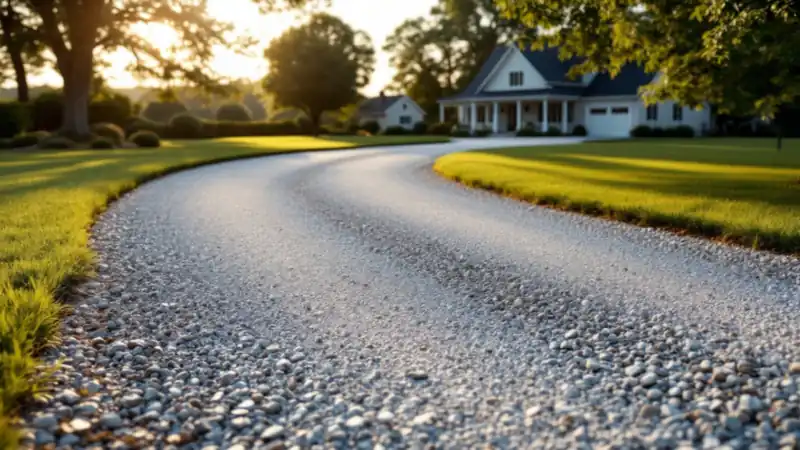
Short answer: A new gravel driveway costs about $1.35 to $3.81 per square foot installed by our estimate, for 6 inches of compacted stone on firm soil: about $1,380 to $2,460 for a 12×50 and $2,070 to $4,570 for a 12×100. A 2-inch top-up over a sound base runs $0.38 to $1.28 per sq ft. Soft ground nearly doubles the price.
$1.35–$3.81 per sq ft, new 6-in. gravel driveway installed (estimate; see method)
$25–$50 a ton for crusher run at the yard, middle half of 15 published price lists (supplier pages, 2026)
$18.50 per metric ton, average value of U.S. crushed stone at the quarry in 2025 (USGS, estimate)
+60.7% producer prices for sand, gravel and crushed stone, Aug. 2019 to Aug. 2026 (BLS PPI)
Most gravel driveway cost pages quote one per-square-foot range with no depth, no stone type and no tonnage behind it. This one builds the price from the bottom: published 2026 per-ton prices from 15 quarries and stone yards in 11 states, layer depths from the Federal Highway Administration and Penn State’s Center for Dirt and Gravel Roads, what state transportation departments actually paid per ton of placed stone in 2025, and BLS wages for the people who run the skid steer. The arithmetic is in the method note near the end, and the calculator below uses the same numbers.
Gravel driveway cost by size: 12×50, 12×100, 20×100 and a quarter-mile lane
These are the sizes people actually search for. The new-build columns assume the standard driveway section in this guide: topsoil stripped 6 inches, then 6 inches of compacted stone (crusher run throughout, or 4 inches of crusher run under 2 inches of clean #57). The top-up column is 2 inches of crusher run over an existing, still-firm base, with the surface regraded first. Small jobs carry a half-day crew minimum and a flat delivery fee, which is why the per-square-foot price climbs on short driveways.
| Driveway (ft) | Sq ft | Stone for a 6-in. new build | New build: crusher run, 6 in. | New build: crusher run + #57 top | Top-up: 2 in. crusher run |
|---|---|---|---|---|---|
| 12 x 20 (one car, short) | 240 | 9.6 t (1 load) | $960–$1,460 | $940–$1,400 | $780–$1,090 |
| 12 x 50 | 600 | 24.1 t (2 loads) | $1,380–$2,460 | $1,330–$2,270 | $910–$1,370 |
| 20 x 50 (two cars wide) | 1,000 | 40.2 t (2 loads) | $1,840–$3,810 | $1,770–$3,370 | $1,070–$1,680 |
| 10 x 100 | 1,000 | 40.2 t (2 loads) | $1,840–$3,810 | $1,770–$3,370 | $1,070–$1,680 |
| 12 x 100 | 1,200 | 48.2 t (3 loads) | $2,070–$4,570 | $1,980–$4,050 | $1,140–$1,880 |
| 20 x 100 | 2,000 | 80.4 t (4 loads) | $3,200–$7,610 | $2,940–$6,750 | $1,450–$2,670 |
| 12 x 200 | 2,400 | 96.5 t (5 loads) | $3,820–$9,130 | $3,500–$8,100 | $1,600–$3,070 |
| 12 x 500 | 6,000 | 241 t (11 loads) | $9,400–$22,830 | $8,610–$20,240 | $3,180–$7,670 |
| 12 x 1,000 | 12,000 | 482 t (22 loads) | $18,700–$45,660 | $17,120–$40,490 | $6,270–$15,350 |
| 12 x 1,320 (1/4 mile) | 15,840 | 637 t (29 loads) | $24,650–$60,280 | $22,560–$53,440 | $8,240–$20,260 |
Two patterns stand out. First, the stone is most of the bill: on a 12×100 new build, material is $1,210 to $2,410 of the $2,070 to $4,570 total. Second, length is nearly linear once a job passes about 30 tons, because every extra foot needs the same tonnage and crew time. A quarter-mile lane is not a bulk discount: it is 29 truckloads.
Uses the per-square-foot ranges in this guide. Jobs under about 25 tons also carry a half-day crew minimum of about $580 to $700. Local prices vary; see How we built these numbers.
The calculator multiplies your area by the per-square-foot range for the stone you pick, then applies the base-condition and fabric factors from this guide. Culvert and permit costs are flat adders because they don’t scale with length.
Gravel driveway cost per square foot, by stone type
Stone type matters less than most guides suggest, because a well-built driveway uses crusher run for the structural layers no matter what goes on top. What changes is the top 2 inches, plus how much each stone weighs per cubic yard (clean stone weighs less than dense-graded stone, so a ton covers more ground).
| Stone | What it is | Yard price, middle half of published lists | Top-up, 2 in. | New build, 6 in. on firm soil | Soft soil, 12 in. with fabric |
|---|---|---|---|---|---|
| Crusher run (ABC, 2A, #304, road base, 3/4 minus) | Crushed stone with fines; packs hard | $25–$50 a ton | $0.51–$1.28 | $1.55–$3.81 | $2.65–$6.71 |
| #57 clean stone (PennDOT 2B) | Crushed 1 in. to No. 4, no fines; drains, does not bind | $33–$57 a ton | $0.38–$0.85 | $1.42–$3.37 | $2.51–$6.28 |
| Pea gravel (3/8 in.) | Rounded or crushed small stone; rolls underfoot | $40–$67 a ton | $0.44–$0.93 | $1.47–$3.45 | $2.57–$6.36 |
| Recycled concrete aggregate | Crushed concrete, graded like crusher run | $20–$43 a ton | $0.45–$1.19 | $1.35–$3.52 | $2.44–$6.43 |
The size definitions are not marketing terms. North Carolina DOT’s aggregate table, for example, defines #57 as 100 percent passing 1-1/2 inches, 95 to 100 percent passing 1 inch and 0 to 10 percent passing a No. 4 sieve, while aggregate base course (ABC, the Carolinas’ name for crusher run) keeps 4 to 12 percent of fines passing the No. 200 sieve (NCDOT Table 1005-1). Those fines are what let crusher run lock into a hard surface, and what #57 deliberately lacks.
What stone yards charge in 2026
These are list prices on the suppliers’ own pages, checked October 13, 2026, before tax and, unless noted, before delivery. Where a yard prices by the cubic yard we converted at 1.3 tons per loose yard for dense-graded stone (the midpoint implied by WisDOT’s measured 1.79 to 1.98 tons per compacted yard and its 34 to 52 percent compacted-to-loose expansion, WisDOT research report 0092-22-05, 2023) and 1.25 tons for clean stone and pea gravel (Yard Works: a cubic yard of #57 weighs about 2,500 lb).
Swipe the table sideways to see every column.
| Supplier | Location | Crusher run / dense grade | #57 or 3/4 in. clean | Pea gravel | Recycled concrete |
|---|---|---|---|---|---|
| Oconee County Rock Quarry | Walhalla, S.C. | $15.50/t (non-DOT) | $23.50/t | $21.75/t | n/a |
| Palmetto Sand & Gravel | Upstate S.C. | $55/t | $68/t | $68/t | $50/t |
| Yard Works | Fort Mill, S.C. | $74.75/yd | $84.75/yd | n/a | n/a |
| Gill Quarries | East Norriton, Pa. | $22/t (2A) | $26/t | n/a | $12/t; millings $6/t |
| Conestoga Stone | Pottstown, Pa. | $40.90/t (2A) | $54/t (2B) | n/a | n/a |
| Route 202 Landscape Supply | Flemington, N.J. | $52/yd (DGA) | $69/yd | n/a | $41/yd |
| Blackstone Landscape Supply | Sutton, Mass. | $46.50/yd | $44.50/yd | $110/yd | n/a |
| Boyas Recycling | Cleveland, Ohio | $53/t (#304) | $58/t | n/a | $21/t (#304 recycled) |
| Lammon Bros | Delta, Ohio | $22/t (#304) | $32/t (#6) | $64/t | n/a |
| Farr’s Landscape Supply | Nolanville, Texas | $25/yd | n/a | $45/yd | n/a |
| Texas Garden Materials | Houston | $99.99/yd (1.5 in. minus) | n/a | $94.99/yd | $75.99/yd |
| Ainsworth Rock Sales | Denver | $39.95/t (Class 6) | n/a | $65.95/t | n/a |
| Rock N Yard | Copperton, Utah | $27.08/t | n/a | $24/t | $19.23/t |
| Portland Rock | Clackamas, Ore. | $59/yd | $68/yd | $66/yd | $46/yd |
| US Rock | Inglewood, Calif. | $60/yd (recycled Class II) | n/a | $80/yd | n/a |
The spread inside a single region is as wide as the spread across the country. Upstate South Carolina has a county-owned quarry selling crusher run at $15.50 a ton and a private yard in the same region at $55. Pickup at a quarry is cheapest; a landscape yard that stocks small quantities charges more per ton but delivers 2 or 3 yards at a time. For a driveway-sized order, call a quarry first.
What a gravel driveway quote should include, line by line
Here is our 12×100 new build (1,200 sq ft, 6 inches of crusher run on firm soil) broken into the lines a contractor’s quote should show. If a quote shows only one number, ask for this split.
| Line item | Basis | Low | High |
|---|---|---|---|
| Stone | 48.2 tons at $25 to $50 a ton | $1,206 | $2,412 |
| Delivery | 3 tri-axle loads; free over 15 tons at some yards, up to $15 a ton | $100 | $724 |
| Spread, grade, crown and compact | Crew of operator and laborer, skid steer and compactor; 8 to 15 tons an hour | $583 | $1,050 |
| Strip topsoil 6 in. and shape subgrade | 22 cubic yards at $8.33 to $17.12 per cubic yard | $185 | $380 |
| Total | $2,074 | $4,566 |
What is usually not in the number: hauling excess topsoil off site, clearing trees, a culvert where the driveway crosses a roadside ditch, the access permit, and any drainage work beyond a crowned surface. Each is priced further down.
How deep should a gravel driveway be?
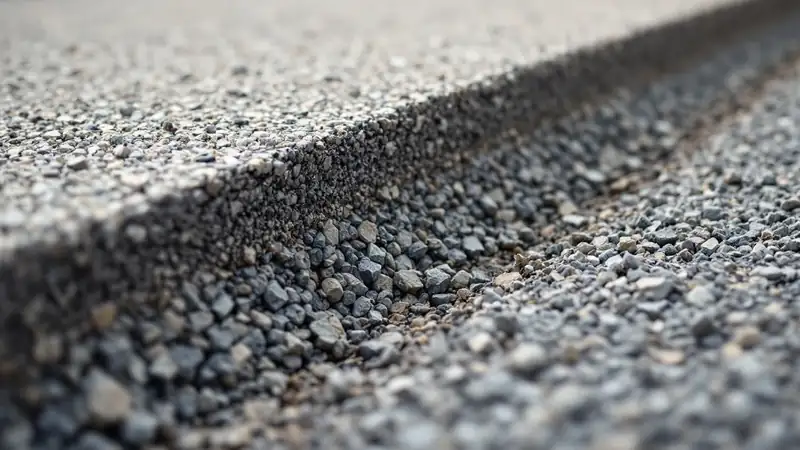
For a driveway on reasonably firm soil, plan on 6 inches of compacted stone; on soft or wet ground, 10 to 12 inches with fabric underneath. Those figures come from published road specifications, not from a rule of thumb:
- Penn State’s Center for Dirt and Gravel Roads places its driving surface aggregate 8 inches loose and compacts it to 6, or 6 inches loose compacted to 4-1/2, with a minimum 10-ton vibratory roller (DSA Tech Bulletin, March 2025).
- The FHWA’s gravel roads guide recommends a minimum 6-inch first layer when stone goes over fabric, and says each layer should be at least twice the size of the largest stone: 2 inches for 1-inch stone (Gravel Roads Construction & Maintenance Guide, 2015, pp. 39 and 73).
- USDA NRCS’s access road standard for Ohio lays out a vehicle section of 6 inches of AASHTO #1 or #2 stone, then 2 inches of #57 or #67, then a 3-inch surface of fine #9 or #10 stone, plus a geotextile layer (NRCS Conservation Practice Standard 560, Ohio, 2022).
| Section | When it fits | Layers (compacted) | Stone per 100 sq ft |
|---|---|---|---|
| Top-up | Existing base is firm, no ruts that hold water | 2 in. crusher run or #57 over the old surface | 0.8–1.3 t |
| Standard new build | Firm, well-drained soil; cars and light trucks | 4 in. crusher run + 2 in. top stone, or 6 in. crusher run | 3.5–4.0 t |
| Soft-soil build | Clay, wet spots, frost heave, delivery trucks | Woven fabric, 6 in. #3 or #2 stone, 4 in. crusher run, 2 in. top | 5.8–6.4 t |
Shape matters as much as depth. The FHWA guide calls for a crown of about 1/2 inch per foot, roughly 4 percent, so water leaves the surface before it softens the base; Penn State specifies 1/2 to 3/4 inch per foot for its aggregate. On a 12-foot driveway, a 4 percent crown puts the centerline about 3 inches above the edges. A flat gravel driveway is a pothole driveway.
How much gravel do you need for a driveway?
Tons = length x width (in feet) x depth in inches x a tonnage factor. For dense-graded crusher run use about 0.0067 tons per square foot per compacted inch; that is Penn State’s published ordering factor (0.04 tons per square foot for 8 inches loose, compacted to 6). For clean #57 or pea gravel, which weighs about 2,500 lb per cubic yard and compacts little, use about 0.0039.
| Stone and compacted depth | Sq ft covered by 1 ton | Tons for 12 x 50 | Tons for 12 x 100 | Tons for 20 x 100 |
|---|---|---|---|---|
| Crusher run, 2 in. | 75 | 8.0 | 16.1 | 26.8 |
| Crusher run, 4 in. | 37 | 16.1 | 32.2 | 53.6 |
| Crusher run, 6 in. | 25 | 24.1 | 48.2 | 80.4 |
| #57 or pea gravel, 2 in. | 128 | 4.7 | 9.4 | 15.6 |
| #57 or pea gravel, 4 in. | 64 | 9.4 | 18.7 | 31.2 |
Watch the coverage claims on supplier calculators. One South Carolina yard’s crusher run page says a ton covers about 70 square feet at 4 inches compacted, based on 22 cubic feet per ton (Palmetto Sand & Gravel). Penn State’s factor gives 37 square feet. The difference is compaction: the FHWA guide notes that compacting gravel reduces its volume by 30 percent or more (p. 71). Order from the loose number and you will run short by a truckload or two.
For a 20-foot driveway, the answer depends on the other dimension. A 12×20 parking pad at 6 inches takes about 9.6 tons of crusher run; a 20×20 pad takes about 16.1 tons, which fits on one tri-axle.
How much is a dump truck load of gravel?
A full tri-axle load of 20 to 22 tons of crusher run costs roughly $550 to $1,300 delivered at the middle-half yard prices above; #57 runs about $730 to $1,450 and pea gravel $880 to $1,670. The range is mostly the yard’s price per ton, then delivery distance.
| Truck | Typical capacity (supplier’s statement) | Delivery terms published |
|---|---|---|
| Tri-axle dump | 20–22 tons per load (Palmetto S&G) | $200 for 1–4 tons, $130 for 5–14 tons, free for 15+ tons |
| 10-wheel dump | 18–20 cubic yards of aggregate (Blackstone) | Priced by town on request |
| Quarry tandem | 8 tons of stone and sand (Conestoga) | $6.75 per mile one way, per trip |
| Small landscape truck | Up to 6.5 tons or 5 yards (Portland Rock) | $40 under 1 mile to $170 at 23–25 miles; large dump +$90 |
| Local flat rate | By zone (Boyas) | $95 (Cleveland south) to $145 (Akron); $50 minimum product charge |
The cheapest way to buy is in full tri-axle loads from a quarry that waives delivery above a threshold. The most expensive is a series of 5-yard trips from a landscape yard. For anything over about 15 tons, get the quarry price and the trucking price separately.
What stone costs at the quarry vs. what you pay
The U.S. Geological Survey puts the average value of crushed stone at the quarry at $18.50 per metric ton in 2025 (about $16.78 per short ton), up from $13.26 in 2021 (USGS Mineral Commodity Summaries 2026, Stone (Crushed)). That average covers 1.5 billion tons of every grade, most of it sold in bulk to road builders and cement plants. A homeowner buying 50 tons pays a yard price of $25 to $50, and a placed price well above that.
State transportation departments show what placed stone costs at scale. These are weighted averages of winning bids on public road contracts, so they include placement but reflect huge quantities and full-time crews:
| Item (agency, period) | Unit | Average price |
|---|---|---|
| Base aggregate dense 1-1/4 in. (WisDOT, FY 2025) | ton | $12.07 |
| Base aggregate dense 3/4 in. (WisDOT, FY 2025) | ton | $22.56 |
| Traffic bound surface course, Type E (Oklahoma DOT, Jul. 2024–Dec. 2025) | ton | $35.33 |
| Aggregate surface course, Class D-8 (Arkansas DOT, Jan.–Nov. 2025) | ton | $40.54 |
| Aggregate base course, Class 7 (ARDOT, 2025) | ton | $41.04 |
| Common/unclassified excavation (OK DOT; WisDOT; ARDOT) | cubic yard | $8.33; $11.74; $17.12 |
| Separator or geotextile fabric (OK DOT; WisDOT Type C; ARDOT) | sq yd | $1.73; $4.50; $6.10–$6.38 |
| 18 in. corrugated steel culvert pipe (OK DOT; WisDOT) | linear ft | $61.91; $82.22 |
| Removal of gravel driveway (OK DOT) | sq yd | $10.25 |
Subtract the USGS quarry value from the Oklahoma and Arkansas placed prices and haul plus placement works out to roughly $18 to $24 a ton for state contractors. Our residential estimate charges $9.72 to $21.77 a ton for spreading and compaction plus separate delivery, which lands in the same neighborhood once delivery is added.
Gravel prices have risen twice as fast as inflation
The BLS producer price index for construction sand, gravel and crushed stone rose 60.7 percent from August 2019 to August 2026 (preliminary), against 30.6 percent for consumer prices overall. It also outpaced ready-mixed concrete (40.0 percent) and asphalt paving mixtures (33.1 percent) over the same months. Gravel is still the cheapest surface by a wide margin, but the gap is narrower than it was in 2019, and a 6-year-old quote is not a guide to today’s price.
- Sand, gravel and crushed stone (WPU1321)
- Ready-mixed concrete (WPU1333)
- Asphalt paving mixtures (WPU13940113C)
- Consumer prices, all items (CPI-U)
Source: BLS Producer Price Index and CPI-U annual averages, rebased by The Green Industry Report Annual averages. CPI from cu.data.1.AllItems.
Show the numbers
| Sand, gravel and crushed stone (WPU1321) | Ready-mixed concrete (WPU1333) | Asphalt paving mixtures (WPU13940113C) | Consumer prices, all items (CPI-U) | |
|---|---|---|---|---|
| 2019 | 100 | 100 | 100 | 100 |
| 2020 | 104.50 | 102.60 | 99.80 | 101.20 |
| 2021 | 108.60 | 106.40 | 99.60 | 106 |
| 2022 | 119.60 | 117.40 | 112.90 | 114.50 |
| 2023 | 131.40 | 130.40 | 118.50 | 119.20 |
| 2024 | 141.20 | 138 | 120.70 | 122.70 |
| 2025 | 151.10 | 139.10 | 128.20 | 125.90 |
In the 12 months to August 2026 the stone index rose 6.2 percent, against 2.3 percent for ready-mix and 10.1 percent for asphalt mixtures (BLS PPI series WPU1321, WPU1333, WPU13940113C; CPI-U all items). USGS expected price pressure to continue in 2026, especially in and near metro areas, where local zoning limits supply.
Labor and equipment: what the crew costs
Gravel driveways are built by excavation and site-prep contractors and by landscapers who run a skid steer. In other specialty trade contractors (NAICS 2389, which includes site preparation), BLS puts the median wage at $28.92 an hour for operating engineers and equipment operators and $22.79 for construction laborers (BLS OEWS, May 2025). Benefits and payroll costs add about 44 percent: wages are 69.5 percent of total compensation in construction (BLS Employer Costs for Employee Compensation, June 2026). Our two-person crew therefore costs about $74 an hour before equipment.
Equipment rents by the day. Published rates from two Midwest rental yards: a skid steer at $250 to $290 a day, a plate compactor at $88 to $110 a day and a mini excavator at $225 to $350 a day (A USA Rentals, West Chicago, Ill.; Bloomfield Rent-All, Bloomfield, Iowa). That makes a crew-hour about $117 to $124 at cost and $146 to $174 billed with overhead and profit, which is the basis for the $583 to $697 half-day minimum in our size table.
Labor is where geography shows up. Median operator wages in Illinois, California and Washington are roughly double those in Arkansas or Georgia, so the labor share of a quote swings more by state than the stone does.
For a broader view of what landscape and site crews earn and what that means for quotes, see our landscaper pay data and the line-by-line landscaping cost guide.
Gravel vs. asphalt vs. concrete: upfront cost and the long run
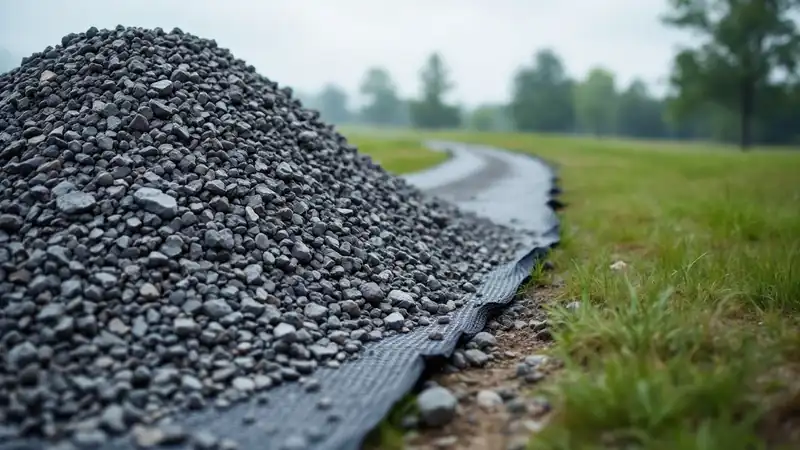
Gravel is cheaper than concrete or asphalt to build, by roughly two to four times. The fairest primary-source comparison we could build uses state DOT driveway bid prices against our gravel estimate for the same 12×100 driveway:
| Surface, 12 x 100 ft (1,200 sq ft) | Per sq ft | Total | Basis |
|---|---|---|---|
| Gravel, 6 in. crusher run (our estimate) | $1.73–$3.81 | $2,070–$4,570 | Method note |
| Asphalt, 3 in. over the same gravel base | $4.79–$6.99 | $5,750–$8,380 | Asphalt driveway bid prices $173.33 (WisDOT) and $180.03 (OK DOT) per ton at 106 lb per sq yd per inch (TDOT) |
| Concrete, 6 in. | $7.28–$14.63 | $8,740–$17,560 | Concrete driveway bid prices: WisDOT $65.55, OK DOT $94.94, ARDOT $131.70 per sq yd |
The long-run case for paving is maintenance. Gravel loses stone: the FHWA guide cites studies finding that a gravel road loses as much as one ton of aggregate per mile each year for every vehicle that passes daily (p. 79). For a 100-foot driveway with eight passes a day that is only about 0.15 tons a year, but ruts, washouts at the apron and plow damage take more than traffic does. In practice gravel owners pay for periodic top-ups and regrading.
Here is a way to compare without guessing at lifespans. On the 12×100 example, concrete costs $6,670 to $12,990 more than gravel up front, and asphalt $3,670 to $3,820 more. A 2-inch professional top-up of that driveway costs $1,140 to $1,880. So the concrete premium buys roughly 3.5 to 11 top-ups, and the asphalt premium roughly 2 to 3. If your driveway needs a top-up every few years, gravel stays cheaper over a long horizon; if it needs one every year because of slope, shade or heavy trucks, paving the steep or wet stretch starts to pay.
We looked for a primary source on how many years residential asphalt and concrete driveways last and did not find one we could verify, so we don’t put a lifespan on either. What the trade-off looks like in practice:
- Gravel’s downsides: loose stone tracks into the house and garage, snowplows and blowers throw it, it needs regrading, it is hard to shovel, and ruts and potholes form where water sits. Pea gravel rolls underfoot and shifts on slopes.
- Gravel’s upsides: lowest upfront cost, easy to repair in sections, and lets rain drain through instead of sheeting off.
- Middle options: pave only the apron at the road (some road authorities set apron surfacing rules, see below) and keep the rest gravel, or pave the steep section where washouts concentrate.
If you are weighing hard surfaces for a patio rather than a driveway, our pavers vs. concrete comparison and paver patio cost guide use the same base-stone arithmetic.
Maintenance costs: regrading and top-ups
| Job | What it involves | Estimated cost, 12 x 100 |
|---|---|---|
| Regrade and re-crown | Skid steer or box blade pulls stone back from edges and restores the 4 percent crown | $583–$697 (half-day crew minimum) |
| 2-in. top-up | 16 tons of crusher run, spread, graded and compacted | $1,140–$1,880 |
| Pothole patching, DIY | Dig out to firm material, fill with crusher run in 2-in. lifts, tamp | Stone and delivery: about $300–$600 for one 8-ton load |
| Rebuild a failed section | Excavate soft spot, add fabric and large base stone | Use the soft-soil row: $2.44–$6.71 per sq ft |
Two maintenance rules from the FHWA guide save money. Keep the crown, because a flat surface holds water and softens the base. And keep each new layer at least twice as thick as its largest stone, because a thin skim of 1-inch stone just rolls off. Penn State’s spec also says to verify that moisture is optimum before compacting; dry stone does not lock up.
Permits, culverts and the apron at the street
The part of a driveway that crosses the public right-of-way is regulated by whoever owns the road: the state DOT for state routes, the county road department or highway commission for county roads, and sometimes a township. Expect a permit, a culvert if there is a roadside ditch, and rules on width, sight distance and surfacing. Fees are usually small; the culvert is not.
| Jurisdiction | Permit fee | Culvert rule | Other rules |
|---|---|---|---|
| Pennsylvania DOT (67 Pa. Code 441.4) | $15 issuance + $10 inspection (minimum-use driveway) | Set in permit | State routes only |
| Virginia DOT (24VAC30-151-710) | $100 application; no added fee for a private entrance | Set in permit | Commercial entrance $150 |
| North Carolina DOT | No fee | Minimum 15 in. pipe, 20 ft long; NCDOT installs it for a single-family lot if the owner buys and delivers the pipe | Larger than 48 in.: owner installs |
| Hall County, Ga. | Not stated | Minimum 15 in.; aluminized steel, reinforced concrete or dual-wall HDPE | GDOT-approved pipe |
| Milam County, Texas | $25 (private); $500 penalty without permit | Minimum 30 ft corrugated galvanized pipe; county sets it for $15 per ft, owner supplies | Gates at least 60 ft back |
| Oconto County, Wis. | $200 new access; $800 if built first | Minimum 18 in. equivalent; length = cover depth x 8 + driveway width | Width 20–24 ft; sight distance 766 ft at 55 mph |
| Hillsdale County Road Commission, Mich. | $30 residential | 12 in. x 24 ft, owner installs | Gravel or better within the right-of-way |
| Washington County, Minn. | $150 + $500 deposit | Generally required unless curbed; owner provides pipe | Swing-away mailbox |
| Alamosa County, Colo. | $100; $50 each extra | At least 18 in., 6–12 in. of cover; owner maintains | Minimum 10 ft wide |
| Marion County, Ore. | $50 (2019 Q&A) | 12 in. standard, concrete pipe unless 12 in.+ cover | Rural residential: gravel or asphalt |
| Pend Oreille County, Wash. | $125 residential approach | Set in permit |
Culvert pipe is the expensive line. State contracts paid $61.91 (Oklahoma) to $82.22 (Wisconsin) per foot for 18-inch corrugated steel pipe installed, so a 20- to 30-foot culvert runs about $1,240 to $2,470 at those prices. In counties that set the pipe for you, like Milam County at $15 a foot, the owner still buys the pipe.
Long rural driveways and fire access
A long driveway may count as a fire apparatus access road. The International Fire Code requires access within 150 feet of all exterior walls of the first story, an unobstructed width of at least 20 feet, an all-weather surface, a design load of 75,000 pounds, a grade no steeper than 10 percent, and turnarounds on dead ends over 150 feet (Sections 503.1.1, 503.2.1, 503.2.3 and Appendix D, as printed in the 2021 Seattle Fire Code, Chapter 5 and Appendix D). Many rural fire districts adopt lighter rules for single-family driveways:
- Columbia County Fire Services, Ore.: at least 12 feet of firm all-weather surface for 75,000 pounds, 20×40-foot turnouts on driveways over 400 feet, grades up to 12 percent (15 percent on short pitches).
- Santa Clara County Fire Department, Calif. (Spec D-1, March 2025): 12-foot drivable surface for a 75,000-pound apparatus, turnouts every 500 feet, maximum 15 percent grade.
- Sedona Fire District, Ariz. (July 2025): 12 feet unobstructed; turnarounds beyond 150 feet.
That 75,000-pound load is why the 6-inch minimum matters on a long lane and why soft spots need the fabric-and-large-stone section. Ask the fire district before you build a driveway longer than 150 feet; widening a finished lane later costs more than building it right.
This page is general information, not legal advice. Permit, culvert and fire-access rules vary by road authority and change; confirm with the agency that owns the road and your local fire district before you build.
When geotextile fabric is worth it
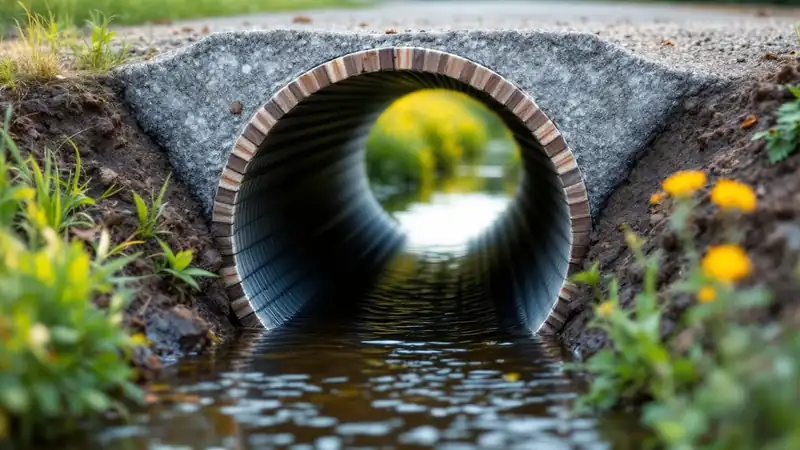
Woven stabilization fabric separates stone from the soil below, so the base does not punch into mud. On firm, sandy or gravelly soil it adds little. On clay, wet spots or anywhere the old driveway keeps rutting, it is the cheapest insurance in the job. The FHWA guide recommends at least 6 inches of stone over fabric in the first layer, and University of Kentucky Extension advises overlapping 12-foot-wide rolls by at least 2 feet (AEN-115).
Retail prices for 12.5-foot-wide woven rolls run about $0.25 to $0.36 per square foot shipped: $1,329.81 for 12.5 x 432 feet and $384.94 for 12.5 x 108 feet at Pro Fabric Supply, and $488.50 to $1,383.12 for the same sizes at Eastgate Supply. State contracts paid $1.73 to $6.38 per square yard installed ($0.19 to $0.71 per square foot). A 12-foot driveway fits one 12.5-foot roll with no side seam, which keeps waste low. We use $0.25 to $0.71 per sq ft installed, roughly 17 percent on top of a standard build. Thin landscape weed fabric is not a substitute.
DIY or hire a contractor?
A top-up is a realistic DIY job: order a tri-axle of crusher run, spread it with a rented skid steer ($250 to $290 a day) and run a plate compactor ($88 to $110 a day) over it in 2-inch lifts. For a 12×100 top-up that is about $400 to $800 of stone plus $340 to $400 of rentals, against $1,140 to $1,880 hired. A new build is different: stripping topsoil, cutting a crown and ditch, setting a culvert and compacting 6 inches in lifts are where amateur driveways fail, and a 10-ton roller is the tool Penn State’s spec calls for, not a plate compactor.
If you hire, check what your state requires before you sign. Some states license excavation or landscape contractors and many require registration for home-improvement work; our state licensing table and guide to checking a license show where to look.
Red flags in a gravel driveway quote
- No depth or stone type. “Gravel driveway, $X” with no inches and no stone name lets the contractor deliver 2 inches of whatever is cheapest.
- Tonnage that doesn’t match the area. Check it with the factors above: 6 inches of crusher run is about 4 tons per 100 square feet. A quote with half that is a thin driveway.
- No compaction step. Stone dumped and spread but not rolled loses 30 percent or more of its volume later, in ruts.
- No crown or ditch. A flat section with nowhere for water to go will pothole within a season.
- No mention of the permit or culvert when the driveway meets a public road with a ditch. Oconto County, Wis., charges $800 instead of $200 when the access is built before the permit.
- Pea gravel quoted for a slope or the whole driveway. Rounded stone doesn’t lock; it is a top dressing at most.
How we built these numbers
We have no job data of our own. The estimates combine published prices with published quantities and a stated production-rate assumption. All supplier prices were checked October 13, 2026.
Stone. We took per-ton and per-yard prices from 15 suppliers’ own pages in S.C., Pa., N.J., Mass., Ohio, Texas, Colo., Utah, Ore. and Calif. (table above), converted per-yard prices at 1.3 tons per loose yard for dense-graded stone and 1.25 for clean stone and pea gravel, and used the interquartile range of each list: crusher run $25 to $50 a ton (15 prices, median $40), #57 $33 to $57 (10 prices, median $54), pea gravel $40 to $67 (10 prices, median $64), recycled concrete $20 to $43 (7 prices, median $32). Large #3/#2-type base stone: $22 to $48 a ton (Oconee County, Lammon Bros, Conestoga).
Tonnage. Dense-graded stone (crusher run, recycled concrete): 0.0067 tons per square foot per compacted inch, from Penn State’s ordering factor of 0.04 tons per square foot for 6 inches compacted. Clean stone and pea gravel: 0.0039, from 2,500 lb per cubic yard (1 cubic yard covers 324 square feet at 1 inch). Penn State’s factor is 10 to 20 percent above WisDOT’s measured compacted density, which leaves room for waste and edge losses.
Delivery. $0 to $15 a ton for full loads (free over 15 tons at Palmetto; $6.75 a mile per 8-ton trip at Conestoga), with a $100 to $200 floor per job.
Spreading, grading and compaction. Crew of one equipment operator ($28.92 median) and one laborer ($22.79), NAICS 2389, BLS OEWS May 2025, grossed up by 1 / 0.695 for benefits (BLS ECEC, construction, June 2026) = $74.40 an hour. Equipment: skid steer $250 to $290 a day plus plate compactor $88 to $110 a day, over 8 hours = $42.25 to $50.00 an hour. Overhead and profit: 25 to 40 percent (our assumption). Production: 15 tons an hour (low) to 8 tons an hour (high), our assumption. Result: $9.72 to $21.77 a ton, with a half-day minimum of $583 to $697. Regrading an existing surface: 3,000 to 1,500 sq ft per crew-hour, or $0.05 to $0.12 per sq ft (assumption).
Excavation. $8.33 to $17.12 per cubic yard (Oklahoma DOT and ARDOT weighted averages), on 6 inches for a standard build and 10 inches for the soft-soil section. Hauling soil off site is excluded.
Sections. Top-up: 2 in. of the chosen stone plus regrading. New build: 6 in. of crusher run or recycled concrete, or 4 in. crusher run plus 2 in. of #57 or pea gravel, plus excavation. Soft soil: new build plus 6 in. of large base stone and fabric at $0.25 to $0.71 per sq ft. Low ends combine all low inputs and high ends all high inputs, so most real quotes should fall inside the range, not at its edges.
Calculator. Area x the new-build range for the chosen stone, times 0.30 for a top-up or 1.8 for soft soil (the average ratios across the four stones in our model) and 1.17 for fabric on a standard build, plus flat adders for a culvert ($1,240 to $2,470: 20 to 30 ft at the OK DOT and WisDOT 18-inch steel pipe prices), the permit fee ($15 to $200, the range of the fees in our table excluding deposits) and small-order delivery ($100 to $200). Factor-based results are approximate.
Limits. No production-rate data for residential driveway crews is published that we could find, so the hourly output is our assumption and the largest single source of uncertainty. Prices exclude sales tax. Remote rural sites, long hauls, steep grades, rock, tree clearing and wet-season work push quotes up. See our methodology page for how we source cost estimates.
Gravel driveway questions, answered
How much does a 1000 ft gravel driveway cost?
About $18,700 to $45,700 for a 12-foot-wide, 1,000-foot driveway built new with 6 inches of crusher run, by our estimate: roughly 480 tons of stone, or 22 tri-axle loads. If a sound base is already there, a 2-inch top-up runs about $6,300 to $15,300. A culvert and permit at the road are extra.
How much does a 200 ft gravel driveway cost?
About $3,800 to $9,100 for a new 12×200 driveway with 6 inches of compacted crusher run (about 97 tons, five truckloads), or $3,500 to $8,100 with a 2-inch #57 top layer. A 2-inch top-up of an existing 12×200 runs about $1,600 to $3,100.
Is a gravel driveway cheaper than concrete?
Yes, by roughly two to four times upfront. For a 12×100 driveway we estimate $2,070 to $4,570 in gravel against $8,740 to $17,560 for 6-inch concrete at 2025 state DOT driveway bid prices. Gravel needs periodic top-ups ($1,140 to $1,880 each at that size), which narrows but rarely closes the gap.
How much does 1 ton of driveway gravel cover?
A ton of crusher run covers about 75 square feet at 2 inches compacted, 37 at 4 inches and 25 at 6 inches. A ton of #57 or pea gravel, which is lighter per cubic yard, covers about 128 square feet at 2 inches and 64 at 4 inches.
What are the downsides of having a gravel driveway?
Stone tracks indoors, plows and snowblowers throw it, ruts and potholes form where water sits, and it needs regrading and periodic top-ups. Pea gravel shifts on slopes. Where the driveway meets a public road, the road authority may require a permit, a culvert and a minimum apron surface.
More project pricing lives on our costs hub, including retaining wall costs for driveways cut into a slope.
Sources
- U.S. Geological Survey, Mineral Commodity Summaries 2026: Stone (Crushed), 2021–2025 data; published Jan. 2026. Accessed October 2026.
- U.S. Bureau of Labor Statistics, Producer Price Index, nonmetallic mineral products (WPU1321, WPU1333, WPU13940113C), through Aug. 2026 (preliminary). Accessed October 2026.
- U.S. Bureau of Labor Statistics, Consumer Price Index, all items (CUUR0000SA0), through Aug. 2026. Accessed October 2026.
- U.S. Bureau of Labor Statistics, Occupational Employment and Wage Statistics, SOC 47-2073 and 47-2061, national, NAICS 2389 and state, May 2025. Accessed October 2026.
- U.S. Bureau of Labor Statistics, Employer Costs for Employee Compensation, Table 4, June 2026. Accessed October 2026.
- Wisconsin Department of Transportation, Average Unit Price List, FY 2023–2025; dated Oct. 21, 2025. Accessed October 2026.
- Oklahoma Department of Transportation, Weighted Average Item Price Report, Jul. 2024–Dec. 2025; dated Jan. 22, 2026. Accessed October 2026.
- Arkansas Department of Transportation, 2025 Weighted Average Unit Prices, Jan. 15–Nov. 5, 2025. Accessed October 2026.
- Tennessee Department of Transportation, Design guidelines 4-307 and 4-411: asphalt mixture quantities (IB 16-16), current. Accessed October 2026.
- Federal Highway Administration and South Dakota LTAP, Gravel Roads Construction & Maintenance Guide, August 2015. Accessed October 2026.
- Penn State Center for Dirt and Gravel Roads, Driving Surface Aggregate Tech Bulletin, March 2025. Accessed October 2026.
- USDA Natural Resources Conservation Service, Ohio, Conservation Practice Standard 560: Access Road, 2022. Accessed October 2026.
- North Carolina Department of Transportation, Table 1005-1, aggregate gradation, current. Accessed October 2026.
- Wisconsin Department of Transportation, Research report 0092-22-05 (aggregate unit weights and expansion), December 2023. Accessed October 2026.
- University of Kentucky Cooperative Extension, AEN-115, rev. April 2024. Accessed October 2026.
- Pennsylvania Code, 67 Pa. Code 441.4, highway occupancy permit fees, current. Accessed October 2026.
- Virginia Administrative Code, 24VAC30-151-710, land use permit fees, amended Nov. 19, 2025. Accessed October 2026.
- North Carolina Department of Transportation, Driveway Permit FAQ, current. Accessed October 2026.
- North Carolina Department of Transportation, Policy on Street and Driveway Access to North Carolina Highways, July 2003. Accessed October 2026.
- Hall County, Ga., Public Works, Notice to Residents: Driveways and Culverts, updated Jan. 29, 2025. Accessed October 2026.
- Milam County, Texas, Driveway Permit Application, standards eff. Feb. 17, 2023; file updated Jul. 1, 2026. Accessed October 2026.
- Oconto County, Wis., Highway Department, County Driveway Permit, undated; accessed Oct. 2026. Accessed October 2026.
- Hillsdale County Road Commission, Mich., Rules and fees, rev. Jan. 12, 2012. Accessed October 2026.
- Washington County, Minn., Highway Permits, accessed Oct. 2026. Accessed October 2026.
- Alamosa County, Colo., Road and Bridge, Driveway Application Packet, March 2025. Accessed October 2026.
- Marion County, Ore., Public Works, Access Permit Q&A, rev. Aug. 23, 2019. Accessed October 2026.
- Marion County, Ore., Public Works, Access Permits and Reviews, updated Feb. 6, 2024. Accessed October 2026.
- Pend Oreille County, Wash., Public Works, Road permit applications, accessed Oct. 2026. Accessed October 2026.
- City of Seattle, 2021 Seattle Fire Code, Chapter 5 (IFC 2021 with amendments), 2021 edition. Accessed October 2026.
- City of Seattle, 2021 Seattle Fire Code, Appendix D, 2021 edition. Accessed October 2026.
- Columbia County Fire Services, Ore., Access Roads and Driveways Standard, undated; accessed Oct. 2026. Accessed October 2026.
- Santa Clara County Fire Department, Spec D-1, Driveways, Turnarounds and Turnouts, March 11, 2025. Accessed October 2026.
- Sedona Fire District, Residential Access Guide, rev. July 22, 2025. Accessed October 2026.
- Oconee County, S.C., Rock Quarry, Price list, effective Aug. 3, 2026. Accessed October 2026.
- Palmetto Sand & Gravel, Crusher Run, checked Oct. 13, 2026. Accessed October 2026.
- Palmetto Sand & Gravel, #57 Stone, checked Oct. 13, 2026. Accessed October 2026.
- Palmetto Sand & Gravel, #789 Pea Gravel, checked Oct. 13, 2026. Accessed October 2026.
- Palmetto Sand & Gravel, Recycled Crusher Run, checked Oct. 13, 2026. Accessed October 2026.
- Palmetto Sand & Gravel, Pricing and delivery, checked Oct. 13, 2026. Accessed October 2026.
- Yard Works Landscape Supply, Crusher Run, checked Oct. 13, 2026. Accessed October 2026.
- Yard Works Landscape Supply, #57 Gravel, checked Oct. 13, 2026. Accessed October 2026.
- Conestoga Stone, 2026 price sheet, 2026. Accessed October 2026.
- Conestoga Stone, Delivery, checked Oct. 13, 2026. Accessed October 2026.
- Gill Quarries, 2026 Product Price List, 2026. Accessed October 2026.
- Route 202 Landscape Supply, Dense Grade Aggregate, checked Oct. 13, 2026. Accessed October 2026.
- Route 202 Landscape Supply, 3/4 in. Clean Stone, checked Oct. 13, 2026. Accessed October 2026.
- Route 202 Landscape Supply, Recycled Concrete Aggregate, checked Oct. 13, 2026. Accessed October 2026.
- Blackstone Landscape Supply, Dense Grade Gravel, checked Oct. 13, 2026. Accessed October 2026.
- Blackstone Landscape Supply, Crushed 3/4 in. Drainage Stone, checked Oct. 13, 2026. Accessed October 2026.
- Blackstone Landscape Supply, Peastone 3/8 in., checked Oct. 13, 2026. Accessed October 2026.
- Blackstone Landscape Supply, Delivery, checked Oct. 13, 2026. Accessed October 2026.
- Boyas Recycling, Limestone and gravel, checked Oct. 13, 2026. Accessed October 2026.
- Boyas Recycling, Recycled concrete, checked Oct. 13, 2026. Accessed October 2026.
- Boyas Recycling, Delivery fees, checked Oct. 13, 2026. Accessed October 2026.
- Lammon Bros, Stone, checked Oct. 13, 2026. Accessed October 2026.
- Farr’s Landscape Supply, Rocks and gravel, checked Oct. 13, 2026. Accessed October 2026.
- Texas Garden Materials, Crushed Limestone 1.5 in. minus, checked Oct. 13, 2026. Accessed October 2026.
- Texas Garden Materials, Pea Gravel 3/8 in., checked Oct. 13, 2026. Accessed October 2026.
- Texas Garden Materials, Crushed Concrete Washout 1.5 in. minus, checked Oct. 13, 2026. Accessed October 2026.
- Ainsworth Rock Sales, Landscape rock prices, checked Oct. 13, 2026. Accessed October 2026.
- Rock N Yard, Construction materials, checked Oct. 13, 2026. Accessed October 2026.
- Rock N Yard, Gravel, checked Oct. 13, 2026. Accessed October 2026.
- Rock N Yard, Recycled Road Base, checked Oct. 13, 2026. Accessed October 2026.
- Portland Rock, 2026 Retail Price List, 2026. Accessed October 2026.
- Portland Rock, Delivery Rates, 2025. Accessed October 2026.
- US Rock, Class II Base, checked Oct. 13, 2026. Accessed October 2026.
- US Rock, Pea Gravel, checked Oct. 13, 2026. Accessed October 2026.
- Pro Fabric Supply, Woven Stabilization Fabric 12.5 x 432 ft, checked Oct. 13, 2026. Accessed October 2026.
- Pro Fabric Supply, Woven Stabilization Fabric 12.5 x 108 ft, checked Oct. 13, 2026. Accessed October 2026.
- Eastgate Supply, Geotextile Fabric for Driveway Stabilization, checked Oct. 13, 2026. Accessed October 2026.
- A USA Rentals, Earthmoving equipment rates, checked Oct. 13, 2026. Accessed October 2026.
- Bloomfield Rent-All, Dirt moving and excavation rates, checked Oct. 13, 2026. Accessed October 2026.