Does boiling water kill weeds? It kills the leaves it touches within 1 to 3 days, and 2-leaf seedlings often die outright. Established perennials such as dandelion and dock usually regrow from roots, so trials repeated treatments every 3 to 4 weeks.
The part no top result gives is the dose. Swedish and Belgian hot-water trials report energy per square meter, which we converted to kitchen units: about 3 fl oz of just-boiled water per sq ft cut seedling weight by 90 percent, and a 6-leaf weed took about 9 fl oz. A 1.7-liter kettle therefore covers about 19 sq ft of young seedlings or about 6 sq ft of older ones. Roots are a different job: a broad-leaved dock needed 1.6 liters at 194°F driven into the soil per plant (Latsch and Sauter 2014). Use the calculator below for your own area.
What boiling water does to a weed, and how fast
Heat kills plant cells by denaturing proteins and rupturing membranes. A USDA-ARS paper (Boyette and others, 2018) puts the start of protein damage at about 113°F (45°C) and lethal leaf and stem temperatures at 131 to 203°F (55 to 95°C), with faster heating doing more damage than slow heating. Water off the boil is far above that line, so any leaf it wets dies. What it does not wet, including the growing point under a rosette or a root an inch down, may survive.
The timeline is short. Iowa State Extension says treated plants wilt almost at once but do not brown until 1 to 2 days later, and plants with established roots resprout after several days. UC IPM WeedCUT puts maximum injury at about 3 days, after which most plants start to recover at least partly. So judge a kettle treatment at 2 to 3 weeks, not the next morning: brown leaves on day 2 are expected even for a weed that will be green again by week 3.
| Temperature | What happens at it | Source |
|---|---|---|
| 113°F (45°C) | Protein damage in plant tissue can begin; plant parts held this hot for long periods can die | USDA-ARS 2018; UC WeedCUT |
| 120°F (49°C) | Third-degree burn to adult skin possible in 5 minutes; CPSC’s suggested water heater setting | CPSC 5098 |
| 130°F (54°C) | Adult third-degree burn in 30 seconds | CPSC 5098 |
| 131 to 203°F (55 to 95°C) | Lethal range for leaf and stem tissue | USDA-ARS 2018 |
| 135°F (about 57°C) | Water temperature used by hot-foam machines, which rely on foam to hold the heat in | UC WeedCUT |
| 140°F (60°C) | Adult third-degree burn in 6 seconds | CPSC 5098 |
| 150°F (66°C) | Adult third-degree burn in 2 seconds | CPSC 5098 |
| 172 and 190°F (78 and 88°C) | Most of 7 pavement weeds were 2 to 6 times less sensitive than at 208°F | De Cauwer 2015 |
| 194°F (90°C) | Enough to kill broad-leaved dock roots when 1.6 liters were driven into the root zone | Latsch and Sauter 2014 |
| 208°F (98°C) | Recommended operating temperature for hot-water weeders on pavement | De Cauwer 2015 |
| 212°F (100°C) | Boiling at sea level; cooler at altitude and cooler still once poured | Physical constant |
Read the two columns together. The gap between a lethal leaf temperature and a lethal skin temperature is small: water hot enough to kill a weed in a second is hot enough to give you a third-degree burn in 2 seconds. That is the one real hazard of the method, and it gets its own section below.
How much boiling water it takes per square foot
Hot-water research measures dose as heat energy per square meter. Hansson and Ascard (2002) found that a 90 percent cut in weight of white mustard at the 2-leaf stage took 340 kJ per square meter, one third of the energy needed at the 6-leaf stage. De Cauwer and others (2016) found four treatments in 12 weeks at 589 kJ per square meter highly efficient on dandelion, broadleaf plantain and two pavement grasses. Those are machine doses: even coverage, little runoff, water at about 208°F.
To turn them into kitchen units we divided by the heat 1 liter of just-boiled water carries above 61°F tap water, about 352 kJ (4.186 kJ per kg per degree C times 84 degrees). Treat the results as a floor: a kettle pours unevenly and loses heat to the air and the pavement, so real use will run higher.
| Goal in the trial | Published dose | Our conversion, per sq ft | One 1.7 L kettle covers | Source |
|---|---|---|---|---|
| White mustard, 2-leaf stage, 90% weight cut | 340 kJ/m² | 0.090 L (3.0 fl oz) | 19 sq ft | Hansson and Ascard 2002 |
| Dandelion, plantain, 2 grasses, each of 4 passes in 12 weeks | 589 kJ/m² | 0.156 L (5.3 fl oz) | 11 sq ft | De Cauwer 2016 |
| White mustard, 6-leaf stage, 90% weight cut | About 1,020 kJ/m² (3 times the 2-leaf dose) | 0.269 L (9.1 fl oz) | 6 sq ft | Hansson and Ascard 2002 |
| Hard-surface weed cover cut 90%, lasting 15 days instead of 7 | 50% more energy | 1.5 times the 7-day dose | Two thirds the area | Hansson and Ascard 2002 |
| Broad-leaved dock, 80% plants dead at 12 weeks, rotary nozzle | 1.6 L per plant at 194°F | Per plant, not per sq ft | About 1 plant | Latsch and Sauter 2014 |
| Broad-leaved dock, spiked injection heads A and B | 3.7 and 2.6 L per plant | Per plant | Under 1 plant | Latsch and Sauter 2014 |
| Soil under plastic film heated to 163°F at 2.4 in deep | 120 L/m² at about 194°F | 11.1 L (2.9 gal) | 0.15 sq ft | Ushiki and others 2007 |
The jump down the table is the whole story. Seedlings need about 3 fl oz per sq ft, a splash. A single dock plant needed roughly a full kettle forced into the root crown by a pressure washer nozzle, and the Japanese soil trial used 120 liters per square meter under plastic film to push 163°F down 2.4 inches. A 1.7 liter kettle cannot reach that zone by pouring from the surface.
- Boiling water (liters)
- 4.5
- Boiling water (US gallons)
- 1.2
- Full 1.7 liter kettles
- 2.6
- Electricity to heat it, theoretical minimum (kWh)
- 0.45
- That electricity at 18.16 cents per kWh (cents)
- 8.2
Floor doses converted from machine trials (Hansson 2002; De Cauwer 2016); a kettle pours less evenly, so expect to use more. Does not reach roots.
Why the roots survive a kettle
Soil soaks up heat. Using the van Wijk and de Vries heat capacities tabulated by Kodešová and others (2013) (soil minerals 1.9 MJ per cubic meter per degree C, water 4.18), we worked out what it takes to bring the top of a moist loam to 131°F, the bottom of the lethal range. Assumptions: 50 percent solids, starting at 68°F, and every joule staying put, which never happens.
| Soil layer under 1 sq ft | Heat to warm it 1°C | Heat to reach 131°F from 68°F | Boiling water needed, zero losses | Room for added water in that layer |
|---|---|---|---|---|
| Top 1 in, moist (25% water by volume) | 4.7 kJ | 165 kJ | 0.88 L (30 fl oz) | 0.59 L |
| Top 1 in, dry (10% water) | 3.2 kJ | 113 kJ | 0.60 L (20 fl oz) | 0.94 L |
| Top 2 in, moist (25% water) | 9.4 kJ | 330 kJ | 1.75 L (59 fl oz) | 1.18 L |
Two things fall out. Heating just the top inch of moist soil takes about 0.88 liters per sq ft, about 10 times the seedling dose, before any loss. And that inch has room for only about 0.59 liters of extra water, so most of a heavy pour drains deeper or runs off, carrying its heat with it. Wet soil makes it worse: the dry case needs about a third less, which matches the dock trial, where drier soil needed less hot water.
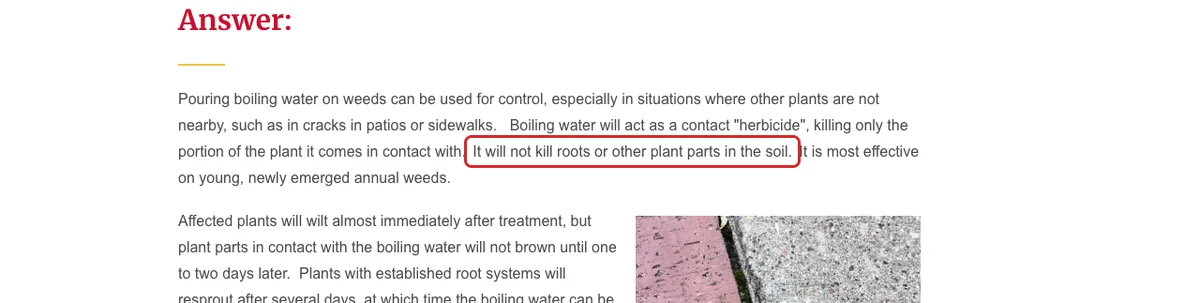
The trials agree. Iowa State says boiling water will not kill roots or other plant parts in the soil. Latsch and Sauter note the regrowth tissue of dock sits in a hypocotyl about 4 inches long; a 10-second dip in 190°F water killed every root in the lab, but in the field it took pressure heads injecting water 3.5 inches deep, or a high-pressure rotary nozzle, to get there. For creeping grasses, our bermuda grass control guide covers why rhizomes 6 inches down regrow after any contact treatment.
Which weeds boiling water kills, and which come back
Leaf shape decides a lot. De Cauwer and others (2015) found sensitivity highest in species with large, flat-lying leaves and lowest in grasses with small upright leaves, and UC WeedCUT adds that grasses regrow from stolons, rhizomes and protected growing points. Treat by type:
| Weed type | Likely result of one pour | What the evidence says | Source |
|---|---|---|---|
| Broadleaf seedlings, cotyledon to 2 true leaves | Often killed | 2-leaf white mustard needed one third of the 6-leaf energy; UC calls this the best window | Hansson 2002; UC |
| Annual broadleaf at 6 leaves or taller | Top killed, some regrow | 3 times the energy; UC says plants past 2 leaves often regrow, cut tall growth first | Hansson 2002; UC |
| Young grasses with upright leaves (perennial ryegrass, red fescue) | Burned, often regrow | Least sensitive group; red fescue more sensitive than perennial ryegrass | De Cauwer 2015; 2016 |
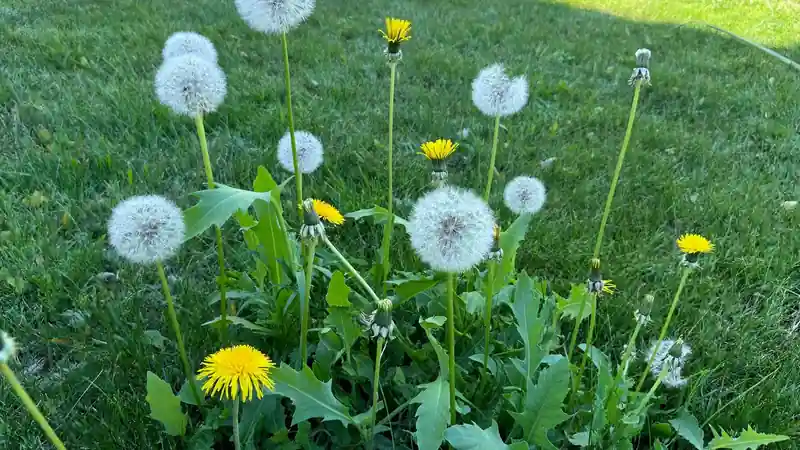
| Dandelion (Taraxacum officinale) | Leaves die, taproot regrows | More sensitive than grasses; good control took 4 passes in 12 weeks | De Cauwer 2016 |
| Broad-leaved dock (Rumex obtusifolius) | Leaves die, root crown regrows | 1.6 to 3.7 L per plant at 194°F, driven into the soil, for 80% kill | Latsch 2014 |
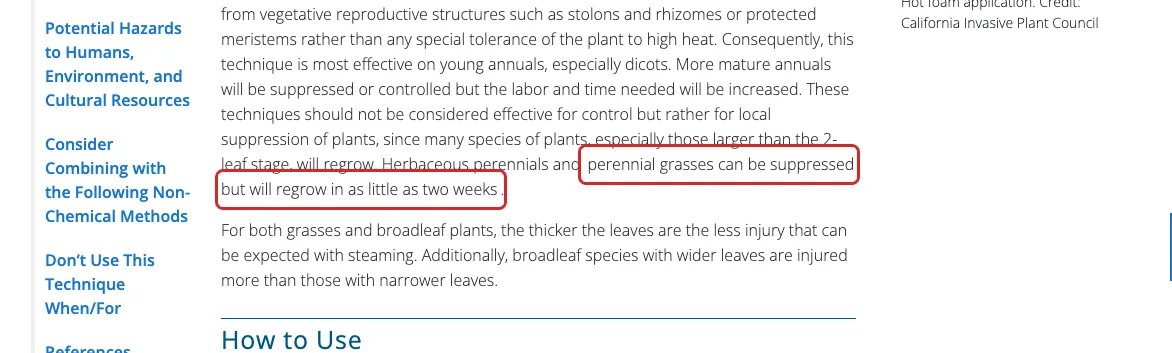
| Herbaceous perennials and perennial grasses | Suppressed only | Regrow in as little as 2 weeks | UC WeedCUT |
| Weed seeds already in the soil | Not killed | No evidence hot water kills buried seed; water and heat may trigger germination | UC WeedCUT |
1Is the weed in a lawn or a bed with plants you want to keep within splash range?
YesDo not pour. Dig it, or use a selective product on its label terms; boiling water kills turf and roots near the surface.
NoGo to the next question
2Is it a seedling with 2 true leaves or fewer, in a crack, joint or gravel?
YesOne pour of about 3 fl oz per sq ft, straight off the boil, late afternoon. Check at 2 to 3 weeks.
NoGo to the next question
3Is it a taprooted or creeping perennial, such as dandelion, dock or bermuda grass?
YesExpect regrowth. Plan 3 to 6 pours about 3 weeks apart, or dig out the crown; a kettle does not reach the roots.
NoOlder annual: cut it low, pour about 9 fl oz per sq ft, and repeat in 3 weeks if it greens up.
Source: Hansson and Ascard 2002; De Cauwer 2015; UC IPM WeedCUT; Iowa State Extension
If the weed is in turf, boiling water is the wrong tool: it kills the grass blades it touches just as fast. Dandelions in a lawn are covered on our page on killing dandelions without killing grass, and selective products on our lawn weed killer guide. Not sure what you have? Start with common lawn weeds.
How often you have to repeat it
On traffic islands, Rask and others (2013) counted how many treatments kept weed cover under 2 percent. Hot water needed 3 a year on average, glyphosate 2.5, flaming 5 and steam 5.5. That is a well-equipped crew with a dedicated machine. On gravel embankments with an established weed flora, Hansson’s SLU dissertation found 6 hot-water treatments per season were needed for good control.
Spacing matters as much as count. Hansson and Ascard found the required interval averaged 25 days, and that after 3 to 4 weeks almost no reduction remained because perennials had regrown. De Cauwer and others (2015) found 3-week intervals up to twice as effective and energy efficient as 6-week intervals. UC WeedCUT gives the same 3-week figure during active growth. For a resprouting crown, Iowa State suggests a second pour 7 to 10 days after the first.
How to pour boiling water on weeds
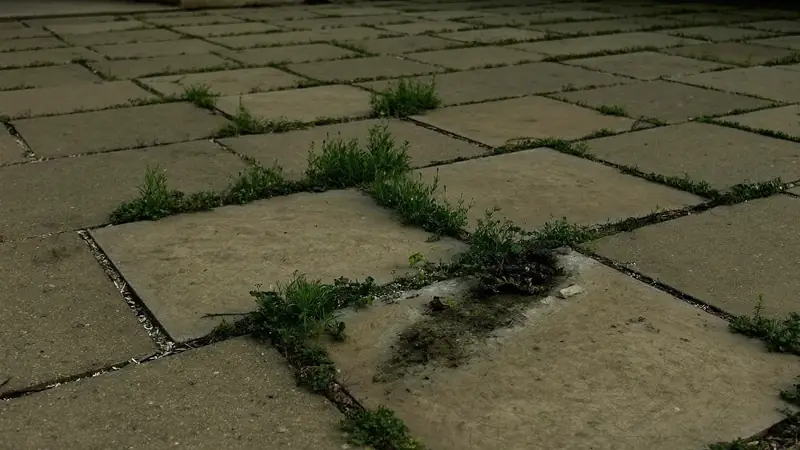
- Pick the spot: cracks, paver joints, gravel and bare edging, with no lawn or bed plant you want within splash range.
- Treat young. Pour when weeds are between the seed-leaf and 2 true-leaf stage; the 2-leaf dose is a third of the 6-leaf dose.
- Cut tall weeds down first, as UC WeedCUT advises for hard surfaces, so the water reaches the crown instead of running off leaves.
- Go in the late afternoon, on dry leaves. Plants were about twice as sensitive then as in the morning in De Cauwer 2015, and wet plants raised the required dose in Hansson 2002.
- Pour straight off the boil. At 172 to 190°F most species were 2 to 6 times less sensitive than at 208°F, so do not let the kettle sit.
- Use a kettle, held low, at about 3 fl oz per sq ft for seedlings and 9 fl oz for older weeds; wet every leaf and the center of the rosette.
- Wear closed shoes and long pants, keep children and pets indoors, and never carry an open pot.
- Check at 3 days for injury and at 2 to 3 weeks for regrowth. Pour again at 3 weeks, or 7 to 10 days for a resprouting crown, until the root gives out or you dig it.
Do not add salt. It turns a residue-free method into one that leaves sodium and chloride in the joint; our salt dose and soil math shows what each spoonful leaves behind. Vinegar has its own evidence on our vinegar weed killer page, and bleach on our bleach label review.
Burn risk: the number that matters
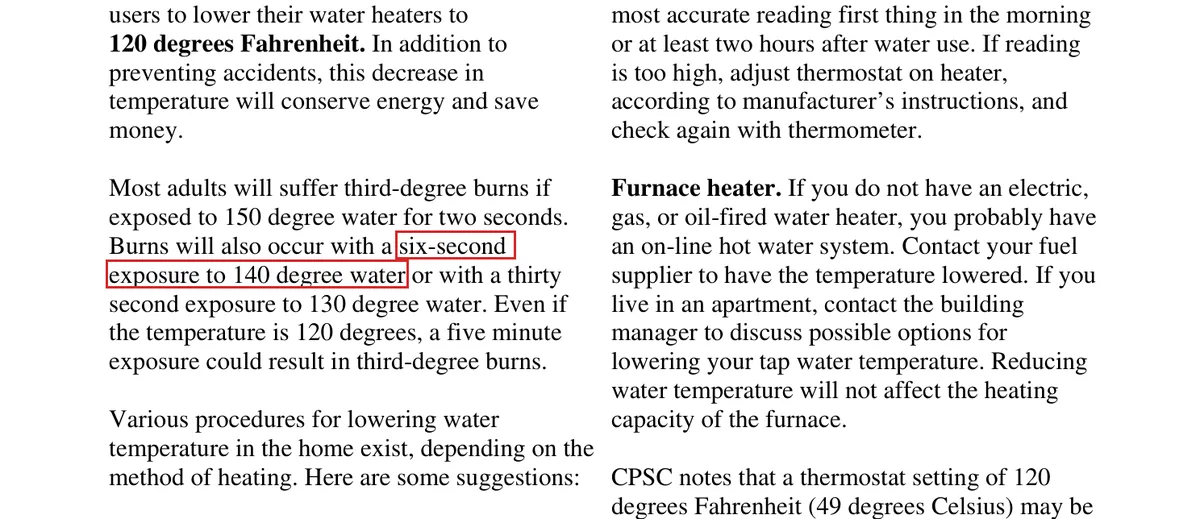
The U.S. Consumer Product Safety Commission says most adults suffer third-degree burns from 150°F water in 2 seconds and from 140°F water in 6 seconds. Water just off the boil is about 60 to 70 degrees hotter than either. CPSC also notes that most tap-water scald injuries and deaths are among older adults and children under 5, the two groups most likely to be nearby or to do the pouring on a patio.
Splash is the usual route to a burn: water hitting hard pavement bounces onto feet and shins. Pour from 2 to 3 inches up rather than from waist height, and refill indoors on a stable counter. Electricity is not a reason to skip it: heating 1 liter from 57°F takes about 0.1 kWh, under 2 cents at the August 2026 U.S. residential average of 18.16 cents per kWh.
This page is general information, not medical or safety advice. If a scald blisters or covers more than a small area, get medical care.
Where boiling water makes sense
The extension sources agree on the niche. Iowa State points to places where other plants are not nearby, such as patio and sidewalk cracks. USDA-ARS lists spot treatments around poles and fences, cracks in concrete and asphalt, and gravel. Our pavers versus concrete patio comparison and mulch versus rock page cover the surfaces where it fits.
One magazine result warns against pouring within 2 feet of shallow-rooted shrubs, while UC WeedCUT says commercial steam and foam can be used right up to the base of woody shrubs, with mature woody roots unaffected. Both can be right: the machines put down a thin film, while a pot emptied onto one spot sends liters into the root zone. UC also says household methods such as boiling water in a pot are not recommended. Above about 100 sq ft, a rented or contracted steam or foam unit is the practical step up; UC lists machines from about $13,000 to over $40,000 that treat 0.5 to 1 acre a day.
How we compiled this
In November 2026 we read 6 peer-reviewed hot-water and soil studies (Hansson 2002, De Cauwer 2015 and 2016, Rask 2013 from their published abstracts; Latsch 2014 and the 2013 soil heat-capacity paper in full), a USDA-ARS paper, 2 extension pages, CPSC Publication 5098 and EIA Table 5.6.A. We applied no hot water to anything: every per-square-foot dose and soil figure is our arithmetic, with the assumptions stated under each table. The machine and field trials were run in Europe and Japan, not in U.S. yards.
Frequently asked questions
How long does it take for boiling water to kill weeds?
Leaves wilt within minutes and brown in 1 to 2 days, per Iowa State Extension. Injury peaks at about 3 days, then many plants recover. Judge the result at 2 to 3 weeks: a seedling still brown then is dead, and a green crown means a second pour.
Will boiling water permanently kill weeds?
Seedlings, yes. Established perennials, rarely in one go: UC WeedCUT says herbaceous perennials and perennial grasses regrow in as little as 2 weeks, and a Swedish dissertation needed 6 treatments a season on established weeds. Buried weed seed is not killed, so new seedlings keep arriving.
What can I put in boiling water to kill weeds?
Nothing is needed. Adding salt leaves sodium and chloride in the soil; our salt page has the dose math. Wetting agents did not improve hot-water kill in De Cauwer 2016. Heat is the active ingredient.
Does boiling water kill weeds on a lawn?
It kills the turf it touches as fast as the weed, leaving a dead patch the size of the splash. Grass crowns and rhizomes may regrow, but a broad pour can leave bare soil that fills with new weeds. Use a selective product or dig the weed instead.
How hot does water have to be to kill weeds?
Leaf tissue dies at about 131 to 203°F, per USDA-ARS. In practice hotter is much better: De Cauwer 2015 found most weeds 2 to 6 times more sensitive to 208°F water than to 172 or 190°F. Hot tap water, which CPSC suggests setting near 120°F, sits close to the 113°F level that UC says kills plant parts only with extended exposure.
Sources
- Iowa State University Extension, Yard and Garden, Can I manage weeds with boiling water?, Aug. 4, 2025. Accessed November 2026.
- UC IPM / Cal-IPC, WeedCUT (C. Wilen), Steaming, undated, accessed Nov. 2026. Accessed November 2026.
- Boyette, Hoagland and Stetina, USDA-ARS, American Journal of Plant Sciences 9, Hot Water Treatment Enhances the Bioherbicidal Efficacy of a Fungus, 2018. Accessed November 2026.
- Hansson and Ascard, Weed Research 42, Influence of developmental stage and time of assessment on hot water weed control, 2002. Accessed November 2026.
- De Cauwer and others, Weed Research 55, Efficacy and reduced fuel use for hot water weed control on pavements, 2015. Accessed November 2026.
- De Cauwer and others, Weed Research 56, Impact of wetting agents, time of day and periodic energy dosing strategy on the efficacy of hot water for weed control, 2016. Accessed November 2026.
- Rask and others, Weed Research 53, Determining treatment frequency for controlling weeds on traffic islands using chemical and non-chemical weed control, 2013. Accessed November 2026.
- Hansson, Swedish University of Agricultural Sciences, Hot water weed control on hard surface areas (dissertation record), 2002. Accessed November 2026.
- Latsch and Sauter, Journal of Agricultural Engineering 45, Optimisation of hot-water application technology for the control of broad-leaved dock, 2014. Accessed November 2026.
- Ushiki, Kawana and Morita, Journal of Weed Science and Technology 53, Germination and survival of paddy weed seeds after soil sterilization with hot water, 2007. Accessed November 2026.
- Kodešová and others, Soil and Water Research 8, Thermal Properties of Representative Soils of the Czech Republic, 2013. Accessed November 2026.
- U.S. Consumer Product Safety Commission, Publication 5098: Avoiding Tap Water Scalds, 2012. Accessed November 2026.
- U.S. Energy Information Administration, Electric Power Monthly, Table 5.6.A, average price of electricity by state, August 2026 data. Accessed November 2026.