Does salt kill weeds? Yes, by dose: 1/2 tablespoon of table salt per sq ft controlled tillering crabgrass in a Georgia trial, 1/4 tablespoon injured bermudagrass, and bindweed took about 23. It kills grass too and lingers until about 1 foot of water passes.
The tablespoons are our conversions, not kitchen experiments. We turned the kg per hectare in published trials into grams and spoons at USDA’s 18 g per tablespoon, then ran the same grams through USDA Agriculture Handbook 60, the soil salinity manual. Result: 1 tablespoon per sq ft mixed through 6 inches of loam adds about 3.6 dS/m, just under the 4 dS/m line that defines a saline soil. Enter your own dose in the calculator below.
How much salt kills which weed
The range runs about 46 to 1 from a young annual grass to a deep perennial, which is why “salt works” and “salt did nothing” are both reported. Rates are as published; the spoon and soil columns are our arithmetic (download the data).
| Published rate | Grams per sq ft | Table salt equivalent | ECe added, top 6 in of loam (dS/m) | What happened | Source |
|---|---|---|---|---|---|
| 488 kg/ha, repeated, fine salt | 4.5 | 1/4 tbsp per pass | 0.9 | Sourgrass: 92 and 96% control at 6 weeks, 2007 and 2008 | Brosnan 2009 |
| 488 kg/ha, 3 weekly passes | 4.5 | 1/4 tbsp per pass | 0.9 | Goosegrass: under the 70% bar, slightly over 50% at 8 weeks, and injury faded by 6 weeks | Brosnan 2009; co-author note |
| 488 kg/ha, common bermudagrass | 4.5 | 1/4 tbsp | 0.9 | The lawn grass itself: over 20% injury | McCullough 2011 |
| 976 kg/ha, one pass | 9.1 | 1/2 tbsp | 1.8 | Smooth crabgrass at the tillering stage: 90 to 100% control, 7 to 28 days. Seashore paspalum injury 0 to 6%; bermudagrass over 20% | McCullough 2011 |
| 1,464 kg/ha, one pass, fine salt | 13.6 | 3/4 tbsp | 2.7 | Sourgrass: 84% one year, 23% the next | Brosnan 2009 |
| 1,952 kg/ha, one pass | 18.1 | 1 tbsp | 3.6 | Rate required for excellent control of younger, multileaf crabgrass | McCullough 2011 |
| 8 tons per acre | 167 | 9 tbsp | 33 | Stopped sprouts from green stumps; killed poison ivy and shrubs (Rudolfs 1921) | Harper 1940 |
| 1/2 to 2 lb per sq ft | 227 to 907 | 13 to 50 tbsp | Over 45 | The usual rate for eradicating vegetation, as of 1940 | Harper 1940 |
| 20 tons per acre | 417 | 23 tbsp (1.4 cups) | Over 50 | Needed for bindweed at Hays, Kansas; 1918 plots grew nothing but Russian thistle for 10 years | Harper 1940 |
| About 1 lb per plant | 454 per plant | 1.6 cups per plant | Not applicable | Spurge nettle: 2 of 28 marked plants reappeared by October 1940 | Harper 1940 |
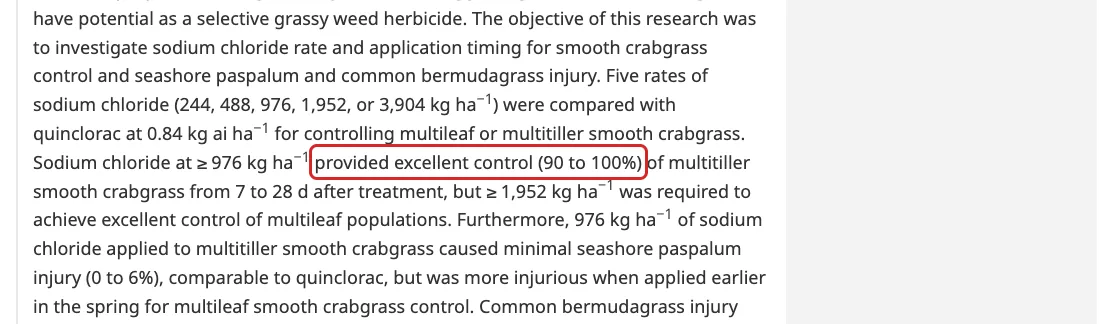
The trials explain the split. Dry salt on leaves burns tissue, so small grasses die at spoon doses, and WSU Extension warns that weeds and grasses with good root systems recover from contact burn. Killing the roots is a different job: Harper describes salting enough to reach perennial roots 4 feet down, and photographs a spurge nettle root 72 inches long. If your weed is dandelion, we found no published salt rate at all: it sits somewhere on this ladder and we could not find anyone who has measured where. Our common lawn weeds guide helps you place yours by type.
Boiling water burns leaves the same way without leaving salt behind, and our review of whether boiling water kills weeds converts hot-water trial doses to ounces per square foot.
What one tablespoon does to the top 6 inches of soil
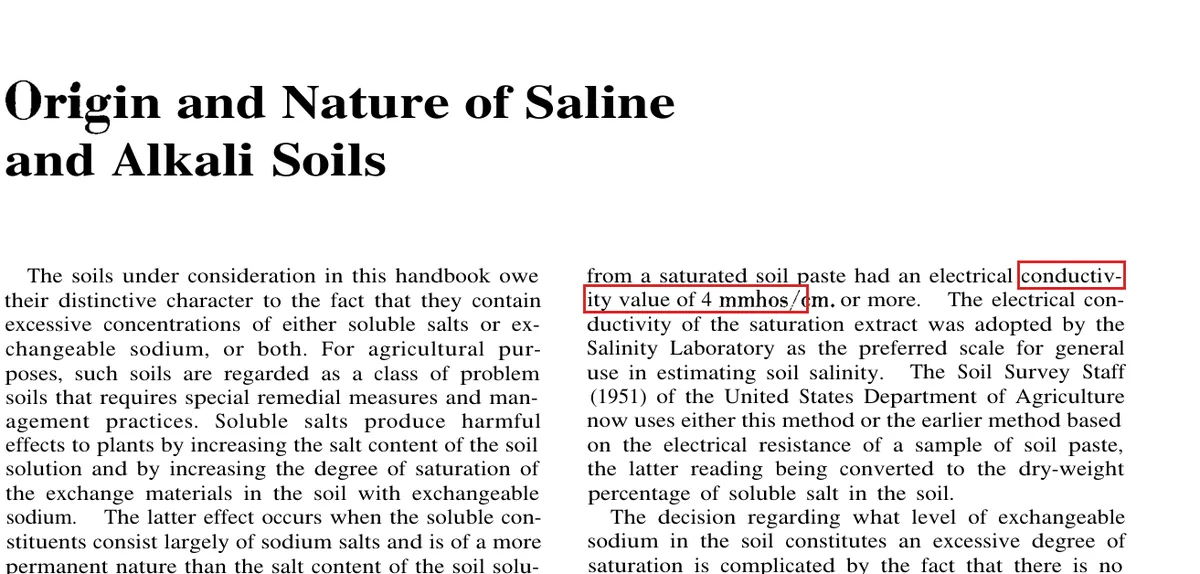
Salinity is measured as ECe, the electrical conductivity of water pulled from a saturated soil paste. Handbook 60 (p. 1) calls soil saline at 4 dS/m (its mmhos/cm) and sets the sodium line at an exchangeable sodium percentage (ESP) of 15. Its conversion, 640 mg of salt per liter per dS/m (p. 16), turns grams into ECe. Here is 18 g worked through three soils.
| Step, for 1 tablespoon (18 g) per sq ft | Sandy | Loam | Clayey | Input |
|---|---|---|---|---|
| Soil in 1 sq ft, 6 in deep (kg) | 21.2 | 18.4 | 17.0 | 0.5 cu ft at an assumed 1.5, 1.3 and 1.2 g per cm³ |
| Water at saturation (liters) | 6.8 | 7.8 | 10.1 | Average saturation percentage 31.8, 42.5, 59.5 (Handbook 60, Table 1) |
| Salt in that water (mg per liter) | 2,665 | 2,301 | 1,781 | 18,000 mg divided by liters |
| ECe added, mixed through 6 in (dS/m) | 4.2 | 3.6 | 2.8 | Divide by 640 |
| ECe added if it stays in the top 2 in (dS/m) | 12.5 | 10.8 | 8.3 | One third of the soil, so 3 times the strength |
| Chloride (mg per kg of soil) | 514 | 593 | 643 | NaCl is 60.66% chloride by weight |
| Starting SAR | 29 | 25 | 19 | Assumes 5 meq per liter of calcium plus magnesium, before exchange |
| ESP added, at most (points) | 29 | 11 | 6 | 308 meq of sodium, all held by the soil; assumed exchange capacity 5, 15 and 30 meq per 100 g |
Three readings matter. Plant roots see more than the ECe figure, because the soil solution at the wet end of the field range is about twice the paste concentration (Handbook 60, p. 8). A loose tablespoon that rain carries only 2 inches down reaches about 11 dS/m in loam, close to the 12 dS/m where FAO puts tall fescue and perennial ryegrass at half yield. And on sand the sodium math can cross ESP 15 at about 1/2 tablespoon, though sand also drains salt fastest.
- ECe added, sandy soil, top 6 in (dS/m)
- 4.2
- ECe added, loam, top 6 in (dS/m)
- 3.6
- ECe added, clayey soil, top 6 in (dS/m)
- 2.8
- ECe added, loam, if held in top 2 in (dS/m)
- 10.8
- ESP points added, loam, at most
- 11.2
- Water to dilute its chloride to 250 mg per liter (gallons per sq ft)
- 11.5
Compare with the 4 dS/m saline line and the grass table on this page. Arithmetic with stated assumptions, not a soil test; values above about 50 dS/m are rough.
Worked example at the default: 18 g per sq ft gives 4.2, 3.6 and 2.8 dS/m in sandy, loam and clayey soil. A 50 lb bag at that dose covers about 1,260 sq ft. Results above about 50 dS/m are rough, since the 640 factor was not built for near-brine soil water.
Does salt kill grass?
Yes, and leaf burn can come before soil salinity matters. McCullough and Raymer measured over 20 percent injury on common bermudagrass at 4.5 g per sq ft, about 1/4 tablespoon, even though bermudagrass ranks among the most salt-tolerant lawn grasses. Of the two turf grasses in that trial, only seashore paspalum took a weed-killing dose with little damage. UF/IFAS LH005 rates it excellent for salt and bahiagrass very poor, the last of seven Florida lawn grasses.
| Grass | CSU: growth problems start (dS/m) | FAO: ECe at 100% / 50% / 0% yield | Tablespoons per sq ft to reach CSU low end, 6 in of loam | Same, top 2 in only |
|---|---|---|---|---|
| Kentucky bluegrass | 3 to 6 | Not listed | 0.8 | 0.3 |
| Buffalograss | 3 to 6 | Not listed | 0.8 | 0.3 |
| Blue grama | 5 to 6 | Not listed | 1.4 | 0.5 |
| Perennial ryegrass | 8 to 10 | 5.6 / 12 / 19 | 2.2 | 0.7 |
| Turf-type tall fescue | 8 to 10 | 3.9 / 12 / 20 | 2.2 | 0.7 |
| Fine fescue | 8 to 12 | Not listed | 2.2 | 0.7 |
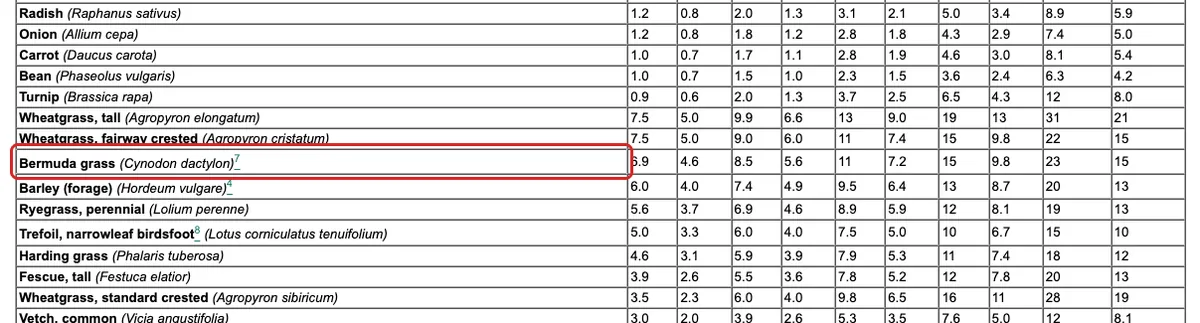
| Bermudagrass | 16 to 18 | 6.9 / 15 / 23 | 4.5 | 1.5 |
| Alkaligrass (Fults, Seasalt) | 20 to 30 | Not listed | 5.6 | 1.9 |
The two tables disagree: CSU puts bermudagrass at 16 to 18 dS/m, while FAO starts its yield loss at 6.9 and notes common types run about 20 percent less tolerant. CSU is rating lawn use and FAO forage yield, so plan on the lower number if the grass is staying.
How long does salt stay in soil?
Until water carries it out, since salt does not break down. CSU Extension’s table gives the rule: 6 inches of clean water removes 50 percent of soluble salts, 1 foot removes 80 percent and 2 feet removes 90 percent, in soil that drains. One foot over 1 sq ft is 7.5 gallons. So “permanent” is wrong, and so is “a few rains.”
Source: CSU Extension, Growing Turfgrass on Salt-Affected Sites, Table 2 Remaining percent is 100 minus CSU's stated reduction; 0 inches is the starting point. Applies only to soil with good internal drainage.
Show the numbers
| Salt remaining, percent | |
|---|---|
| 0 in | 100 |
| 6 in | 50 |
| 12 in | 20 |
| 24 in | 10 |
| City | Normal rain, inches per year | Months for 6 in to fall | Months for 1 ft to fall |
|---|---|---|---|
| Miami | 67.41 | 1.1 | 2.1 |
| Atlanta | 50.43 | 1.4 | 2.9 |
| Boston | 43.59 | 1.7 | 3.3 |
| Seattle | 39.34 | 1.8 | 3.7 |
| Dallas-Fort Worth | 37.01 | 1.9 | 3.9 |
| Minneapolis | 31.62 | 2.3 | 4.6 |
| Denver | 14.48 | 5.0 | 9.9 |
| Los Angeles | 14.25 | 5.1 | 10.1 |
| Phoenix | 7.22 | 10.0 | 19.9 |
Published cases bracket the range. On deep Oklahoma sand, Harper found only 1 of 6 spots still held an appreciable salt concentration 16 or 28 months after a 10 to 40 ton per acre dose. On the Kansas plots, a 20 ton per acre dose kept out everything but Russian thistle for 10 years. Virginia Tech says significant buildup is uncommon where rain tops 20 inches a year; CSU Pueblo says a pinch leaves soil uninhabitable for several months.
Clay holds a second problem after the salt is gone. Sodium replaces calcium on clay particles, and Harper notes sodium clay absorbs rain more slowly, which slows its own removal. In sodic soil, ESP 15 or more by Handbook 60, CSU warns that leaching can worsen drainage, so test before flushing. Our guide to improving clay soil covers that soil type.
The salt, vinegar and dish soap recipe, traced to evidence
The common mix is 1 gallon of vinegar, 1 cup of salt and a squirt of soap. That is 77 g of salt per liter, about 2.2 times ocean water’s 35,000 ppm. It sounds strong, yet the dose depends on how much reaches the ground.
| How the salt goes down | Salt delivered (g per sq ft) | Table salt equivalent | Compared with the 4.5 g trial rate |
|---|---|---|---|
| Recipe sprayed at a vinegar label volume, 44 to 88 fl oz per 1,000 sq ft | 0.10 to 0.20 | About 1/30 tsp at the high end | 20 to 45 times lower |
| Recipe soaked on, 1 gallon per 100 sq ft | 2.9 | 1/2 tsp | About 1/2 as much |
| A pinch (0.4 g) on a 3-inch circle | 8.2 on that circle | 1/2 tbsp rate, tiny area | About 2 times higher |
| 1 cup dry over 10 sq ft | 29 | 1.6 tbsp | About 6 times higher |
| Recipe poured, 1 quart per sq ft | 73 | 4 tbsp | About 16 times higher |
So a mist adds little salt per pass, and the buildup UConn Extension warns about comes from repeating it or from soaking. We found no trial of the three-part kitchen mix. Evidence for each part runs elsewhere: our vinegar weed killer page covers acid strength, Ask Extension says dish soap works but is not the best surfactant, and UF/IFAS EP580 says most of these mixes have not been tested. Bleach has its own page.
Rock salt, table salt, pool salt or Epsom salt?
| Salt | What it is | Evidence on weeds | Dated price (Nov. 5, 2026) |
|---|---|---|---|
| Table salt | 99% NaCl plus anticaking agent in the trial product; 83% of grains 0.25 to 0.5 mm in that product | Fine grains beat coarse in the 2008 sourgrass ratings | $11.04 for 12 boxes of 26 oz, about $0.57 per lb |
| Rock salt | Coarse crystals, like loose gravel; road grades run about 98.5% NaCl (Purdue ID-412) | Closest to the trial’s coarse salt, 75% of grains 1 to 2 mm: lower control on 3 of 4 rating dates | $10.67 to $13.06 for 50 lb, about $0.21 to $0.26 per lb |
| Pool salt | Sold as sodium chloride, same chemistry | No separate trial found | $9.78 to $10.99 for 40 lb, about $0.24 to $0.27 per lb |
| Softener crystals | Sold as sodium chloride, same chemistry | No separate trial found | $7.49 for 50 lb, about $0.15 per lb, one co-op |
| Epsom salt | Magnesium sulfate, no sodium; about half the dissolved charge per gram (8.1 vs. 17.1 meq per g) | UGA Extension agent: does not do anything to kill weeds. UConn: excess magnesium interferes with phosphorus uptake | Not priced |
Weight is what counts, and sodium chloride is sodium chloride. “Best rock salt for killing weeds” has no answer in the trials beyond grain size: if you use it at all, fine grains give more contact per gram.
Concrete, trees and wells
Concrete and pavers. Chloride migrates through concrete and can start corrosion once it reaches a critical level at the steel, and salt crystals growing in pores can cause damage without any cold weather, says the CP Road MAP Brief, August 2014. In freezing climates dilute brine is the worst case: the standard scaling test uses a 4 percent calcium chloride solution because damage accelerates at about that strength. The 1 cup per gallon recipe is 7.2 percent by weight and gets more dilute as it soaks in. Epsom salt is no clean swap, since magnesium ions can react with cement paste too. Our pavers vs. concrete comparison covers the de-icer ratings.
Trees and shrubs. Purdue ID-412 cites soil under 30 feet from a highway at 890 ppm chloride, ten times the level that inhibits germination and root growth in grasses and wildflowers. One tablespoon per sq ft in 6 inches of loam works out to 593 mg per kg, the same order. Virginia Tech finds road salt builds up within 30 to 50 feet and advises planting sensitive species 50 to 60 feet from salted paving. Injury shows as brown leaf edges and needle tips.
Water. One tablespoon carries 10.9 g of chloride. Leaving in 1 foot of drainage (28 liters), that is about 386 mg per liter, above EPA’s 250 mg per liter secondary drinking water standard and the 230 mg per liter chronic aquatic life criterion. Dose a few weeds and this stays small; salt a whole gravel drive above a shallow well and it does not.
Where salt is acceptable and where it isn’t
| Spot | Verdict | The number behind it | Source |
|---|---|---|---|
| Crack or paver joint, nothing wanted within 50 to 60 ft downslope | Acceptable as a spot dose | About 0.4 g per seedling, at most at the trials’ weekly interval | CSU Pueblo; Virginia Tech |
| Gravel path with bare soil beneath | Only if nothing should grow there | 1 cup over 10 sq ft adds about 5.8 dS/m in 6 in of loam | Our arithmetic |
| Lawn, any common grass | No | Over 20% bermudagrass injury at 4.5 g per sq ft | McCullough 2011 |
| Seashore paspalum turf | Researched, no consumer rate | 0 to 6% injury at 9.1 g per sq ft, when timed to tillering crabgrass | McCullough 2011 |
| Garden bed or vegetables | No | Salt is highly mobile and spreads to desired plants | Illinois Extension |
| Near trees | No | Roadside soil at 890 ppm chloride is ten times the level that inhibits root growth | Purdue ID-412 |
| Above a septic field or shallow well | No | About 386 mg per liter chloride per tablespoon, 1 ft of drainage | Our arithmetic; EPA |
| Reinforced slab or steel edging | Avoid | Chloride builds to a critical level at the steel | CP Road MAP Brief |
| Paid landscape job | No | UF/IFAS (Florida): illegal for commercial applicators to apply homemade herbicides; only EPA-registered products | UF/IFAS EP580 |
1Is anything you want alive within 50 to 60 ft downslope, or a septic field or shallow well nearby?
YesDo not salt. Pull the weed, or use a registered product and follow its label.
NoGo to the next question
2Is the weed in a lawn or garden bed?
YesDo not salt. About 4.5 g per sq ft injured bermudagrass over 20 percent, and salt moves through soil to nearby plants.
NoGo to the next question
3Is it a deep perennial such as bindweed, thistle or spurge nettle?
YesSkip salt. Bindweed took about 417 g per sq ft in the Kansas work, and tops regrow from roots below a light dose.
NoGo to the next question
4Is it a small seedling in a crack or joint, over no reinforcing steel?
YesA pinch of about 0.4 g at the base is a low-risk try. Wait at least 7 days before repeating, and hand-pull what survives.
NoHand-pull it, or see our selective herbicide guide for a registered option.
Source: McCullough 2011; Harper 1940; Virginia Tech SPES-342
For lawns, selective herbicides exist because salt cannot tell weed from turf. To clear a whole area for replanting, see how to kill grass before replanting: salt delays the very seed you plan to sow. Other lawn and weed pages are in our Turf and Trees hub.
If you already used too much
- Sweep up undissolved grains first. Every tablespoon removed is 18 g that never reaches the soil.
- Flush with clean water: Virginia Tech says 2 inches over 2 to 3 hours, stopping at runoff, and again 2 days later if levels stay high. Two inches is about 1.25 gallons per sq ft.
- On clay or slow-draining ground, get a lab test before repeated flushing. Ask for ECe and SAR or ESP, the two numbers on this page.
- Add gypsum only if the test shows sodium. Handbook 60 (p. 49) lists 5.2 tons per acre-foot to replace 3 meq per 100 g. For 1 tablespoon per sq ft in loam that scales to about 30 g of gypsum per sq ft, or 66 lb per 1,000 sq ft, at most. CSU advises against gypsum for ordinary white alkali.
- Retest before you reseed. Aim below 3 dS/m for Kentucky bluegrass, 8 for tall fescue and 16 for bermudagrass, per CSU’s table, and lower if you can, because germination may be more sensitive.
How we compiled this
We read three Weed Technology abstracts, a 1940 Oklahoma Academy of Science paper, USDA Handbook 60, FAO Paper 29 and 20 extension, agency and label documents in November 2026, then converted their rates. We applied no salt to anything: every spoon, ECe and SAR figure is arithmetic, with assumptions stated. The Weed Technology figures are from abstracts, not full text, and trial sites were turf plots.
This page is general information, not legal or pesticide-use advice. Salt carries no herbicide label; any registered product you use instead has one, and the label is the law.
Frequently asked questions
Can I just pour salt on weeds to kill them?
On a crack or joint, yes, and a pinch of about 0.4 g at the base is enough to try on a seedling. A poured 1 cup per gallon brine at 1 quart per sq ft delivers about 73 g per sq ft, which is 16 times the 4.5 g trial rate. Soil left that way will not grow much until about 1 foot of water has passed through.
How long will salt take to kill weeds?
Published ratings run from 7 to 28 days for tillering smooth crabgrass at 9.1 g per sq ft, and 6 weeks for sourgrass after repeated passes (McCullough 2011; Brosnan 2009). Goosegrass injury faded by 6 weeks, so a browned weed at 2 weeks is not proof of a kill. The 10-day figure on many blogs has no trial behind it that we could find.
Will grass grow back after salt?
Yes, once ECe drops below what that grass tolerates: under about 3 dS/m for Kentucky bluegrass or 16 for bermudagrass by CSU’s table. CSU reports 80 percent salt removal with 1 foot of clean water in draining soil. The 20 ton per acre Kansas plots stayed bare but for Russian thistle for 10 years.
Which is better for killing weeds, vinegar or salt?
Vinegar breaks down and salt does not, so vinegar leaves less behind. EPA-registered vinegar products carry label directions; salt does not. Salt keeps working in soil after the leaf burn, which is its only advantage and its main cost. A UGA Extension agent says vinegar, not Epsom salt, does the killing in those mixes.
What kind of salt is best for killing weeds?
Fine sodium chloride. In the 2008 sourgrass ratings, grains of 0.25 to 0.5 mm beat 1 to 2 mm grains at the same 488 and 1,464 kg/ha rates on 3 of 4 dates. Rock, pool and softener salt are the same chemical at about $0.15 to $0.27 per lb. Epsom salt is magnesium sulfate, and a UGA agent says it does nothing to kill weeds.
Does salt kill weeds permanently?
No. It leaves with water: about 50 percent per 6 inches through draining soil. Harper found salt mostly gone from Oklahoma sand 16 or 28 months after 10 to 40 tons per acre. Even at 20 tons per acre in Kansas, Russian thistle still grew.
Sources
- McCullough and Raymer, Weed Technology 25(4), Sodium Chloride Efficacy for Smooth Crabgrass Control and Safety to Common Bermudagrass and Seashore Paspalum, 2011. Accessed November 2026.
- Brosnan, DeFrank, Woods and Breeden, Weed Technology 23(2), Sodium Chloride Salt Applications Provide Effective Control of Sourgrass in Paspalum Turf, 2009. Accessed November 2026.
- Brosnan, DeFrank, Woods and Breeden, Weed Technology 23(1), Efficacy of Sodium Chloride Applications for Control of Goosegrass in Seashore Paspalum Turf, 2009. Accessed November 2026.
- Asian Turfgrass Center, Can sodium chloride control weeds in seashore paspalum turf?, current page. Accessed November 2026.
- H. J. Harper, Proceedings of the Oklahoma Academy of Science, Studies on the Eradication of Spurge Nettle, 1940. Accessed November 2026.
- USDA Salinity Laboratory, Agriculture Handbook 60, Diagnosis and Improvement of Saline and Alkali Soils, 1954. Accessed November 2026.
- FAO, Ayers and Westcot, Water Quality for Agriculture, Irrigation and Drainage Paper 29, Table 4, 1985 revision. Accessed November 2026.
- Colorado State University Extension, Growing Turfgrass on Salt-Affected Sites (Fact Sheet 7.227), published 1992, reviewed page. Accessed November 2026.
- CSU Extension, Pueblo County, Natural Ways to Eliminate Weeds, current page. Accessed November 2026.
- University of Florida IFAS, LH005, Selecting a Turfgrass for Florida Lawns, current page. Accessed November 2026.
- University of Florida IFAS, EP580, Use of Glyphosate and Herbicide Alternatives, 2020. Accessed November 2026.
- Washington State University Extension, Yakima County, Salt and Vinegar, June 21, 2025. Accessed November 2026.
- University of Illinois Extension, Home horticultural remedies, May 22, 2020. Accessed November 2026.
- UGA Today, Extension agent weighs in on whether Epsom salt kills weeds, Feb. 2026. Accessed November 2026.
- UConn Extension, Homemade weed killer recipes, current page. Accessed November 2026.
- Ask Extension, Vinegar, salt and dawn for killing weeds, Oct. 17, 2024. Accessed November 2026.
- Virginia Cooperative Extension, SPES-342, Trees and Shrubs that Tolerate Saline Soils, Salt Spray and De-icing Salts, current edition. Accessed November 2026.
- Purdue Extension, ID-412-W, Salt Damage in Landscape Plants, current edition. Accessed November 2026.
- University of Maryland Extension, Salt or Fertilizer Damage on Trees, current page. Accessed November 2026.
- National CP Tech Center, CP Road MAP Brief, deicers and concrete pavement, August 2014. Accessed November 2026.
- U.S. EPA, Secondary Drinking Water Standards, current page. Accessed November 2026.
- U.S. EPA, National Recommended Water Quality Criteria: Aquatic Life (chloride, 1988), current page. Accessed November 2026.
- eCFR, 40 CFR 152.25, minimum risk pesticide exemptions, current as of Nov. 2026. Accessed November 2026.
- U.S. EPA PPLS, Harris Vinegar Grass & Weed Killer II label, EPA Reg. No. 3-24, Sept. 14, 2022. Accessed November 2026.
- USDA FoodData Central, Salt, table (FDC 173468), portion weights, SR Legacy. Accessed November 2026.
- U.S. Geological Survey, Saline Water and Salinity, current page. Accessed November 2026.
- NOAA NCEI, U.S. Climate Normals, annual precipitation, 1991 to 2020, 2021 release. Accessed November 2026.
- Valley Wide Cooperative, Sure Soft water softener salt, 50 lb, listing, price checked Nov. 5, 2026. Accessed November 2026.