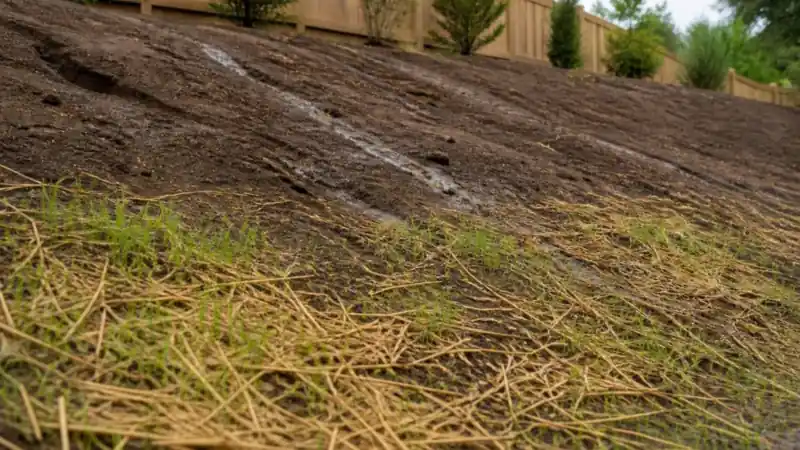
Erosion control means covering bare soil and slowing runoff to match the slope: anchored straw and seed on gentle grades, an erosion control blanket on slopes up to 1:1, and turf reinforcement mat or riprap where water concentrates.
Key takeaways
- Current ECTC-based classes rate erosion control blankets by slope: 3:1 for single-net Types 1.C and 2.C, 2:1 for double-net 1.D and 2.D, 1.5:1 for Type 3.B and 1:1 for Type 4.B, lasting about 3, 12, 24 and 36 months (Iowa SUDAS Design Manual 7E-5, 2025 edition).
- Tennessee DOT contracts awarded in 2025 averaged $1.04 to $2.53 per square yard installed for erosion control blanket Types I to III, $4.24 to $7.24 for turf reinforcement mat and $4.51 per linear foot for backed silt fence (TDOT Average Unit Prices, 2025).
- In the USDA soil loss equation, 2 tons per acre of anchored straw on a 6 to 10 percent slope has a cover factor of 0.06, a 94 percent cut in predicted soil loss against bare ground (USDA Agriculture Handbook 537, Table 9).
- A Clean Water Act stormwater permit applies once construction disturbs 1 acre or more, including smaller lots in a larger plan of development (EPA); on sites under EPA’s 2022 permit disturbing 5 acres or less at a time, stabilizing idle bare soil must finish within 14 calendar days.
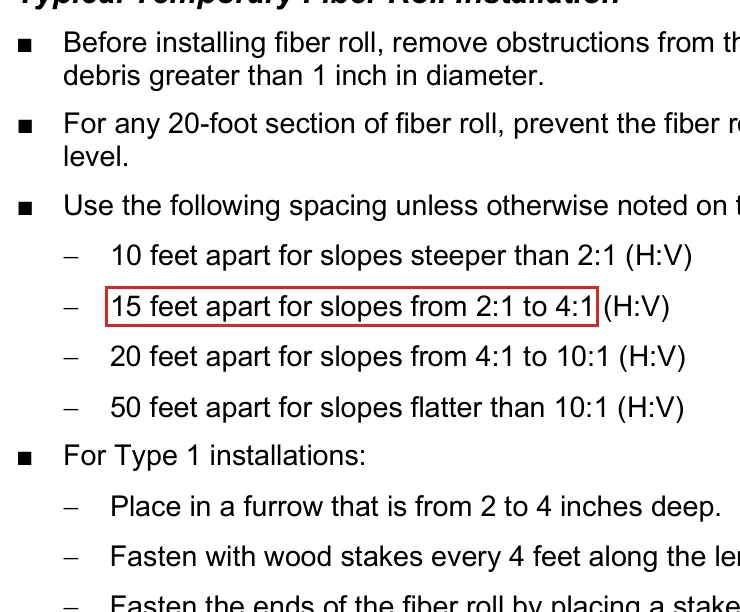
- Caltrans spaces fiber rolls (wattles) 10 feet apart on slopes steeper than 2:1, 15 feet apart from 2:1 to 4:1 and 20 feet apart from 4:1 to 10:1 (Caltrans Construction Site BMP Manual, SC-5, March 2024).
1 acre of disturbance triggers a federal construction stormwater permit (EPA)
$1.43 per sq yd, Type II blanket installed, Tennessee 2025 average (TDOT)
94 percent less predicted soil loss under 2 t/ac anchored straw (USDA AH 537)
10 to 50 ft fiber roll spacing, steepest to flattest slopes (Caltrans SC-5)
What is erosion control, and which methods work?
Erosion control is any practice that keeps soil in place where rain and runoff would move it: a cover that stops raindrop splash (mulch, blankets, sod, plants), a break that shortens a long slope (fiber rolls, terraces) or armor where water runs in a channel (turf reinforcement mat, riprap). Silt fence is different: it catches soil after it moves, so the EPA 2022 Construction General Permit lists it among perimeter sediment controls, not stabilization.
Each method has a slope or flow limit printed in a state manual or spec, and a 2025 unit price from state highway contracts. The table puts them side by side; prices are installed averages on Tennessee and Florida DOT jobs, which buy in volume, so a residential bid for a single slope starts above them.
Swipe the table sideways to see every column.
| Method | What it does | Slope or flow limit | Typical life | 2025 installed price | Source |
|---|---|---|---|---|---|
| Seed + straw mulch | Covers seed, stops raindrop splash | Straw is used on slopes under 2:1 | About 3 months for the straw | $57.10 per 1,000 sq ft (TDOT 801-01) | NC State AG-439-67; TDOT |
| Hydraulic mulch | Sprayed wood or paper fiber with tackifier | ECTC guide: up to 5:1 for 1-month products, 2:1 for 6 to 12-month products | 1 to 12 months | Priced per acre; see our hydroseeding cost guide | NC State, Table 2 |
| Sod, pegged | Instant vegetated cover | Peg both ends of each strip on steep slopes | Permanent once rooted | $4.51 (FDOT) to $5.61 (TDOT) per sq yd | Purdue AY-28-W; FDOT |
| Erosion control blanket, Types 1 to 4 | Fiber mat over seed, stapled | 5:1 to 1:1 by type | 3 to 36 months | $1.04 to $2.53 per sq yd (TDOT Types I to III) | Iowa SUDAS 7E-5; TDOT |
| Coir blanket, 700 g | Woven coconut fiber (coir) mat | Rated per product class | Per product class | $4.33 per sq yd | TDOT 805-12.08 |
| Turf reinforcement mat (TRM), 5.A to 5.C | Permanent synthetic matrix the roots grow through | Slopes to 0.5:1; 6, 8 or 10 lb per sq ft of shear once vegetated | Permanent | $4.24 to $7.24 (TDOT); $7.63 to $19.76 (FDOT) per sq yd | Mississippi DEQ, Table ECB-6; TDOT; FDOT |
| Fiber rolls (wattles) | Shorten slope length, spread runoff | 10 to 50 ft apart by slope | At least 1 year | $5.15 per ft straw wattle; $3.31 per ft 12-in sediment tube (TDOT) | Caltrans SC-5; TDOT |
| Compost filter sock | Filters sheet flow; perimeter or check dam | Kept within 5 percent of level over any 20 ft | At least 1 year | $3.95 (12 in) to $11.83 (24 in) per ft (TDOT) | Caltrans SC-11; TDOT |
| Silt fence | Traps sediment that already moved | 1/4 acre of drainage per 100 ft; never across concentrated flow | Fabric lasts 5 to 8 months | $2.16 to $4.51 per ft (TDOT); $3.16 sediment barrier (FDOT) | Caltrans SC-1; TDOT; FDOT |
| Rock check dam | Slows water in a swale | Spaced closer on steeper swales | Permanent if maintained | $716.23 each (TDOT) | Northern Virginia SWCD; TDOT |
| Riprap | Stone armor for channels and outlets | 6-in median stone holds 2.4 lb per sq ft; 12-in holds 4.8 | Permanent | $51.70 to $74.36 per ton (TDOT); $123.96 per ton ditch lining (FDOT) | FHWA HEC-15, Table 2.3; TDOT; FDOT |
| Terraces and walls | Break a steep slope into short, flat steps | Terraces over 2 ft may need a county permit | Permanent | See our retaining wall cost guide | Northern Virginia SWCD |
| Ground covers, grasses, shrubs | Permanent roots and canopy | Above 3:1, consider non-grass cover to avoid mowing | Permanent | Plant and labor cost | Northern Virginia SWCD |
The order of operations matters more than any single product. The Northern Virginia Soil and Water Conservation District splits every yard fix into two jobs: protect the eroded land, and redirect or capture the runoff causing it, and it calls capturing runoff near its source the least expensive fix (NVSWCD). If a downspout or a paved area is feeding the gully, a buried outlet line from our French drain cost guide may solve more than a blanket.
For the buried line itself, our French drain build specs cover slope, depth and pipe orientation.
Which erosion control method fits your slope?
Measure the slope as a ratio of horizontal run to vertical rise, then read across the decision table. A 3:1 slope drops 1 foot for every 3 feet across, a 33 percent grade. Every product limit below is written in that H:V form, and the published thresholds cluster at 4:1, 3:1, 2:1 and 1:1, so knowing your ratio narrows the choice to one or two methods before price enters.
| Slope (H:V) | Grade | Angle | What it means | Threshold that applies |
|---|---|---|---|---|
| 6.67:1 | 15% | 8.5° | 1 ft of rise per 6.67 ft across | EPA’s default steep slope: 15 percent grade (CGP Appendix A) |
| 5:1 | 20% | 11.3° | 1 ft of rise per 5 ft across | Type 1.A and 2.A mulch nets top out here |
| 4:1 | 25% | 14.0° | 1 ft of rise per 4 ft across | Purdue: mowing and erosion problems start beyond a 1-foot drop every 4 feet (AY-28-W) |
| 3:1 | 33% | 18.4° | 1 ft of rise per 3 ft across | Single-net blankets 1.C and 2.C; non-grass cover recommended above this (NVSWCD) |
| 2:1 | 50% | 26.6° | 1 ft of rise per 2 ft across | Double-net blankets 1.D and 2.D; NC State’s limit for straw mulch |
| 1.5:1 | 67% | 33.7° | 1 ft of rise per 1.5 ft across | Extended-term blanket Type 3.B |
| 1:1 | 100% | 45.0° | 1 ft of rise per 1 ft across | Long-term Types 4.A and 4.B, the steepest temporary classes |
| 0.5:1 | 200% | 63.4° | 1 ft of rise per 0.5 ft across | Turf reinforcement mats 5.A to 5.C, on geotechnically stable slopes only (Mississippi DEQ) |
| If your situation is | Do this | Why (source) |
|---|---|---|
| Bare soil, slope flatter than 4:1, no water running in a channel | Seed, then 1.5 to 2 tons of straw per acre (69 to 92 lb per 1,000 sq ft), crimped or tacked | Anchored straw cuts the USLE cover factor to 0.12 or 0.06 (AH 537, Table 9) |
| Slope from 4:1 to 3:1 | Seed plus a single-net blanket (Type 1.C for 3 months, 2.C for 12) or pegged sod | Both classes are rated to 3:1 (Iowa SUDAS); peg sod on steep slopes (Purdue AY-28-W) |
| Slope from 3:1 to 2:1 | Double-net blanket (Type 1.D or 2.D) and fiber rolls 15 ft apart; plan a non-grass cover | Double-net classes are rated to 2:1; Caltrans spacing for 2:1 to 4:1 (SC-5) |
| Slope from 2:1 to 1:1 | Extended or long-term blanket (Type 3.B to 1.5:1, Type 4.B to 1:1) with rolls 10 ft apart | Only these classes are rated past 2:1 (Iowa SUDAS) |
| Steeper than 1:1, or soil slumping or cracking | Stop: terraces or an engineered wall first, then cover | Blanket ratings assume a geotechnically stable slope (Mississippi DEQ); 3:1 or steeper tiered walls need engineering and a permit in Fairfax (NVSWCD) |
| Water runs in a swale or ditch | Compute shear: 62.4 × flow depth (ft) × slope; pick a lining rated above it | Blankets take 1.0 to 2.25 lb per sq ft, TRMs 6 to 10, bare soil under 0.15 (HEC-15) |
| Gully below a downspout or driveway | Redirect the water first: extension, splash pad or stone at the outlet | Redirecting stops new damage; it does not repair old damage (NVSWCD) |
| Construction disturbing 1 acre or more | Get permit coverage and a SWPPP; start stabilizing idle areas at once (14-day finish under EPA’s permit) | Clean Water Act construction stormwater rule (EPA) |
1Does runoff concentrate in a swale, ditch or downspout path?
YesTreat it as a channel: shear = 62.4 × depth × slope; pick a blanket (to 2.25), TRM (6 to 10) or riprap rated above it, and redirect downspouts first.
NoGo to the next question
2Is the slope steeper than 1:1, or is the soil slumping or cracking?
YesBlankets are rated for stable slopes only: build terraces or an engineered wall first.
NoGo to the next question
3Is the slope steeper than 2:1?
YesType 3.B blanket (to 1.5:1) or Type 4.B (to 1:1), with fiber rolls 10 ft apart.
NoGo to the next question
4Is the slope steeper than 3:1?
YesDouble-net blanket, Type 1.D or 2.D (rated to 2:1), with fiber rolls 15 ft apart; plan a non-grass cover.
NoGo to the next question
5Is the slope steeper than 4:1?
YesSingle-net blanket, Type 1.C or 2.C (rated to 3:1), or pegged sod.
NoSeed and anchored straw at 1.5 to 2 tons per acre (69 to 92 lb per 1,000 sq ft), or hydromulch.
Source: Iowa SUDAS 7E-5 (2025); Caltrans SC-5 (2024); USDA AH 537; FHWA HEC-15
Which erosion control blanket type do you need?
Pick the blanket class by slope and by how long the seed needs cover. The Erosion Control Technology Council (ECTC), a manufacturers’ group, sorts rolled erosion control products into Types 1 to 4 by functional longevity of 3, 12, 24 and 36 months, and letters within each type by construction. Iowa’s SUDAS design manual, revised for 2025, reprints the current limits (Iowa SUDAS 7E-5).
Swipe the table sideways to see every column.
| Type | Construction | Steepest slope (H:V) | Minimum shear, unvegetated (lb per sq ft) | Functional longevity | Source |
|---|---|---|---|---|---|
| 1.A | Mulch control net (over loose mulch) | 5:1 | 1.0 or more | 3 months | SUDAS Table 7E-5.01 |
| 1.B | Netless blanket | 3:1 | 1.0 or more | 3 months | SUDAS Table 7E-5.01 |
| 1.C | Single-net blanket or open weave | 3:1 | 1.5 | 3 months | SUDAS Table 7E-5.01 |
| 1.D | Double-net blanket | 2:1 | 1.75 or more | 3 months | SUDAS Table 7E-5.01 |
| 2.A | Mulch control net | 5:1 | 1.0 or more | 12 months | SUDAS Table 7E-5.01 |
| 2.B | Netless blanket | 3:1 | 1.0 or more | 12 months | SUDAS Table 7E-5.01 |
| 2.C | Single-net blanket | 3:1 | 1.5 or more | 12 months | SUDAS Table 7E-5.01 |
| 2.D | Double-net blanket | 2:1 | 1.75 or more | 12 months | SUDAS Table 7E-5.01 |
| 3.A | Open weave textile | 2:1 | 2.0 or more | 24 months | SUDAS Table 7E-5.01 |
| 3.B | Double-net blanket, slow-degrading | 1.5:1 | 2.0 or more | 24 months | SUDAS Table 7E-5.01 |
| 4.A | Open weave textile | 1:1 | 2.25 or more | 36 months | SUDAS Table 7E-5.01 |
| 4.B | Double-net blanket, slow-degrading | 1:1 | 2.25 or more | 36 months | SUDAS Table 7E-5.01 |
| 5.A | Turf reinforcement mat | 0.5:1 | 6.0 | Permanent | Mississippi DEQ, Table ECB-6 |
| 5.B | Turf reinforcement mat | 0.5:1 | 8.0 | Permanent | Mississippi DEQ, Table ECB-6 |
| 5.C | Turf reinforcement mat | 0.5:1 | 10.0 | Permanent | Mississippi DEQ, Table ECB-6 |
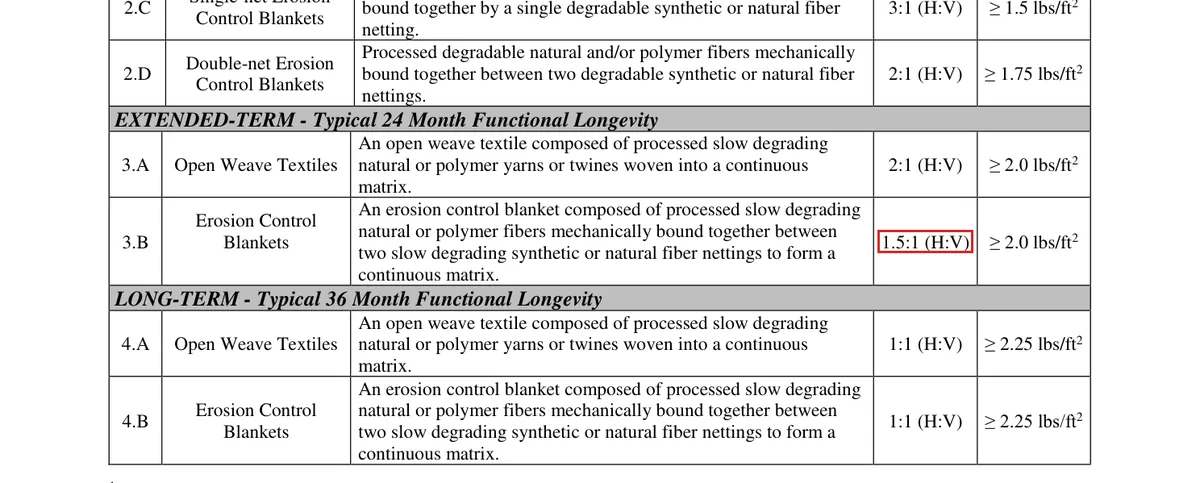
Older tables still circulate with different numbers. The Mississippi DEQ manual lists Type 1.A at 0.25 lb per sq ft and Type 1.B at 4:1 and 0.50 lb per sq ft, where the 2025 SUDAS table shows 1.0 lb per sq ft for both and 3:1 for 1.B (Mississippi DEQ; SUDAS). NC State’s mulch fact sheet, revised in March 2024, gives Type 3.A 3.0 lb per sq ft against SUDAS’s 2.0 (NC State). When a bid names a blanket, ask for the manufacturer’s ECTC class sheet and check that its rated slope covers yours.
How much running water can each lining take?
Running water is measured as shear stress in pounds per square foot: 62.4 × flow depth in feet × channel slope, the formula Iowa SUDAS uses in its design example (SUDAS 7E-5). Bare soil holds only 0.02 to 0.14 lb per sq ft (FHWA), temporary blankets 1.0 to 2.25, vegetated turf reinforcement mats 6 to 10, and riprap with a 12-inch median stone 4.8.
| Lining | Permissible shear (lb per sq ft) | Source |
|---|---|---|
| Bare silty sands, cohesive (PI over 20) | 0.072 | FHWA HEC-15, Table 2.3 |
| Bare inorganic clays, cohesive (PI over 20) | 0.14 | FHWA HEC-15, Table 2.3 |
| Single-net blanket, Type 1.C or 2.C | 1.5 | Iowa SUDAS |
| Double-net blanket, Type 1.D or 2.D | 1.75 | Iowa SUDAS |
| Extended-term blanket, Type 3.B | 2.0 | Iowa SUDAS |
| Long-term blanket, Type 4.B | 2.25 | Iowa SUDAS |
| Riprap, median stone (D50) 6 in | 2.4 | FHWA HEC-15, Table 2.3 |
| Riprap, median stone (D50) 12 in | 4.8 | FHWA HEC-15, Table 2.3 |
| Turf reinforcement mat 5.A / 5.B / 5.C, vegetated | 6.0 / 8.0 / 10.0 | Mississippi DEQ |
| Turf reinforcement mat 5.A or 5.B, before vegetation | 2.0 | NC State, Table 1 |
| Worked example | Swale A: backyard drainage swale | Swale B: steep roadside ditch |
|---|---|---|
| Flow depth in a design storm | 0.5 ft | 1.0 ft |
| Channel slope | 2% (0.02) | 5% (0.05) |
| Shear = 62.4 × depth × slope | 62.4 × 0.5 × 0.02 = 0.62 lb per sq ft | 62.4 × 1.0 × 0.05 = 3.12 lb per sq ft |
| Bare clay (0.14) holds? | No | No |
| Linings that hold | Every blanket class (1.0 lb and up) | Riprap with 12-in stone (4.8) on day one; TRM 5.A (6.0) once vegetated |
| Linings that fail | Bare soil (0.02 to 0.14) | Every temporary blanket (max 2.25), 6-in riprap (2.4) and an unvegetated TRM (2.0, per NC State) |
How do you install an erosion control blanket on a slope?
Seed first, trench the top edge, roll the blanket downhill, overlap and staple it to the pattern. The Mississippi DEQ manual, NC State Extension and Tennessee DOT’s specification give the measurements below; where a manufacturer’s instructions differ, the Mississippi manual tells contractors to follow the stricter of the two (Mississippi DEQ).
- Grade the slope smooth and remove rocks, clods and roots that would lift the blanket off the soil (NC State).
- Lime, fertilize and seed before the blanket goes down; Iowa SUDAS calls seeding first imperative for seed-to-soil contact (Iowa SUDAS). Tennessee DOT requires the blanket within 24 hours of seeding and before any rain or watering (TDOT spec 805.04).
- Dig an anchor trench 6 inches deep at the top of the slope, lay the blanket end in it, staple, backfill and tamp (Mississippi DEQ).
- Unroll downhill, flat and in full contact with the soil. Do not stretch it tight; a blanket that tents over the surface lets water run underneath.
- Overlap side edges at least 3 inches. Overlap roll ends at least 6 inches with the upslope piece on top; NC State suggests 18 inches down the slope (Mississippi DEQ; NC State).
- Staple with U-shaped 11-gauge wire, legs at least 6 inches and a 1-inch crown, in 3 rows (both edges and the center) no more than 3 feet apart; staple ends and check slots every 9 inches. NC State cites ECTC’s optimum density of 1.5 staples per square yard.
- On long slopes, bury a tight 6-inch fold of blanket (a check slot) so that an anchor, junction or check slot falls every 50 feet of slope.
- Inspect after storms until grass is established. Where soil washes out under the blanket, pull it back, fill and tamp soil, reseed and staple it again.
Will grass grow through an erosion control blanket?
Yes, as long as the seed went down first. Blankets are built to let seedlings grow up through the fiber while they hold soil and moisture; Iowa SUDAS calls seeding before placement imperative for seed-to-soil contact (SUDAS 7E-5). Temporary types then degrade in 3 to 36 months, leaving the grass to hold the slope. Turf reinforcement mats stay, with roots woven into them.
How much does erosion control cost?
On 2025 state highway contracts, slope covers cost $0.51 per square yard for seed with straw mulch, $1.04 to $2.53 for erosion control blankets, $4.33 for coir and $4.24 to $19.76 for turf reinforcement mat, installed. Silt fence ran $2.16 to $4.51 per linear foot and wattles $5.15 (TDOT; FDOT). These are bulk prices; a single residential slope costs more per unit.
Swipe the table sideways to see every column.
| Item | 2025 average, installed | 2025 quantity | State and item | Source |
|---|---|---|---|---|
| Seeding (with mulch) | $57.10 per unit of 1,000 sq ft ($0.51 per sq yd) | 4,280 units | Tennessee, item 801-01 | TDOT 2025 |
| Temporary seeding (with mulch) | $35.00 per unit of 1,000 sq ft ($0.32 per sq yd) | 19,891 units | Tennessee, item 801-01.07 | TDOT 2025 |
| Seeding (without mulch) | $35.03 per unit of 1,000 sq ft ($0.32 per sq yd) | 8,095 units | Tennessee, item 801-02 | TDOT 2025 |
| Temporary mulch | $25.92 per unit of 1,000 sq ft ($0.23 per sq yd) | 3,348 units | Tennessee, item 801-01.65 | TDOT 2025 |
| Erosion control blanket (Type I) | $1.04 per sq yd | 441,447 sq yd | Tennessee, item 805-12.01 | TDOT 2025 |
| Erosion control blanket (Type II) | $1.43 per sq yd | 380,125 sq yd | Tennessee, item 805-12.02 | TDOT 2025 |
| Erosion control blanket (Type III) | $2.53 per sq yd | 12,509 sq yd | Tennessee, item 805-12.03 | TDOT 2025 |
| 700 gram coir fiber erosion blanket | $4.33 per sq yd | 158,373 sq yd | Tennessee, item 805-12.08 | TDOT 2025 |
| Turf reinforcement mat (Class I) | $4.24 per sq yd | 38,702 sq yd | Tennessee, item 805-01.01 | TDOT 2025 |
| Turf reinforcement mat (Class II) | $5.00 per sq yd | 5,675 sq yd | Tennessee, item 805-01.02 | TDOT 2025 |
| Turf reinforcement mat (Class III) | $7.24 per sq yd | 1,614 sq yd | Tennessee, item 805-01.03 | TDOT 2025 |
| Sodding (new sod) | $5.61 per sq yd | 434,220 sq yd | Tennessee, item 803-01 | TDOT 2025 |
| Straw wattles | $5.15 per linear ft | 500 ft | Tennessee, item 801-06.11 | TDOT 2025 |
| Temporary sediment tube, 12 in | $3.31 per linear ft | 309,837 ft | Tennessee, item 740-11.02 | TDOT 2025 |
| Filter sock, 12 in | $3.95 per linear ft | 70,428 ft | Tennessee, item 209-03.21 | TDOT 2025 |
| Filter sock, 24 in | $11.83 per linear ft | 32,952 ft | Tennessee, item 209-03.23 | TDOT 2025 |
| Temporary silt fence (without backing) | $2.16 per linear ft | 360,511 ft | Tennessee, item 209-08.03 | TDOT 2025 |
| Temporary silt fence (with backing) | $4.51 per linear ft | 616,841 ft | Tennessee, item 209-08.02 | TDOT 2025 |
| Rock check dam | $716.23 each | 2,263 dams | Tennessee, item 209-08.07 | TDOT 2025 |
| Machined riprap (Class A-1) | $51.70 per ton | 58,310 tons | Tennessee, item 709-05.06 | TDOT 2025 |
| Machined riprap (Class C) | $74.36 per ton | 18,569 tons | Tennessee, item 709-05.09 | TDOT 2025 |
| Artificial coverings / rolled erosion control products | $5.60 per sq yd | 59,623 sq yd (15 contracts) | Florida, item 0104 1 | FDOT 2025 |
| Performance turf, sod | $4.51 per sq yd | 8,891,926 sq yd (259 contracts) | Florida, item 0570 1 2 | FDOT 2025 |
| Plastic erosion mat, turf reinforced mat, Type 1 | $9.04 per sq yd | 68,147 sq yd (12 contracts) | Florida, item 0571 1 11 | FDOT 2025 |
| Plastic erosion mat, TRM, Type 2 | $7.63 per sq yd | 52,938 sq yd (7 contracts) | Florida, item 0571 1 12 | FDOT 2025 |
| Plastic erosion mat, turf reinforced mat, Type 3 | $19.76 per sq yd | 10,073 sq yd (5 contracts) | Florida, item 0571 1 13 | FDOT 2025 |
| Sediment barrier | $3.16 per linear ft | 2,198,525 ft (235 contracts) | Florida, item 0104 10 3 | FDOT 2025 |
| Riprap, rubble, F&I, ditch lining | $123.96 per ton | 36,376 tons (50 contracts) | Florida, item 0530 3 4 | FDOT 2025 |
- Area in sq ft
- 1,197
- Blanket staples at ECTC's 1.5 per sq yd
- 200
Tennessee DOT 2025 average unit prices (temporary seeding with mulch $35.00 and seeding with mulch $57.10 per 1,000 sq ft; blanket Types I to III; coir; TRM Class I; sod) and Florida DOT 2025 weighted averages (TRM Type 1, sod). Highway contract prices; a residential quote usually runs higher per unit.
| Worked example | Arithmetic | Result at 2025 TDOT averages |
|---|---|---|
| Slope area | 40 ft wide × 30 ft long (measured on the slope), 3:1 | 1,200 sq ft = 133.3 sq yd = 1.2 seeding units |
| Seed + straw mulch | 1.2 units × $57.10 | $68.52 |
| Seed + Type II blanket | 133.3 sq yd × $1.43 + seeding 1.2 × $35.03 | $232.70 |
| Seed + 700 g coir blanket | 133.3 × $4.33 + $42.04 seeding | $619.37 |
| Seed + Class I TRM | 133.3 × $4.24 + $42.04 seeding | $607.37 |
| Sod | 133.3 × $5.61 | $748.00 |
| Add: fiber rolls at 15 ft spacing (2 rows × 40 ft) | 80 ft × $5.15 (TDOT straw wattles); spacing per Caltrans SC-5 for 2:1 to 4:1 | $412.00 |
| Add: backed silt fence along the 40-ft toe | 40 ft × $4.51 | $180.40 |
What moves the price of erosion control?
Product class moves the price most. In Tennessee’s 2025 averages, a Type III blanket cost $1.49 per square yard more than Type I, and a Class III turf reinforcement mat $3.00 more than Class I; Florida’s Type 3 mat, at $19.76, cost more than twice its Type 1 (TDOT; FDOT). Backed silt fence adds $2.35 a foot, Class C riprap $22.66 a ton.
Volume moves it next. Tennessee’s Type II blanket average covered 380,125 square yards across its 2025 contracts, and Florida’s sod average 8.9 million; a backyard job carries the same mobilization with none of that volume. Hydroseeding is priced by the acre and covered in our hydroseeding cost guide; sod by the pallet in our sod installation cost guide.
How do you stop erosion on a slope?
Stop the water first, then repair and cover the soil, then break up the slope’s length. The Northern Virginia Soil and Water Conservation District recommends replanting and mulch for light erosion and check dams or terraces where flow concentrates (NVSWCD). The sequence below adds the measurements from Caltrans, USDA and state manuals.
- Find where the water comes from. Extend downspouts or protect the outlet with a splash guard or stone; redirect runoff with swales or drains before repairing anything (NVSWCD).
- Measure the slope ratio (horizontal run ÷ vertical rise) and use the decision table above to pick the cover.
- Fill gullies with high-clay fill, then spread topsoil over the repair (NVSWCD). Our topsoil cost guide covers depths and delivered prices.
- Seed or plant. NVSWCD suggests covering grass seed with about 1/4 inch of topsoil and a thin straw layer; lay sod strips perpendicular to the flow and staple them. Seed prices and rates are in our grass seed cost guide.
- Cover the seed the day you sow it: straw at 1.5 to 2 tons per acre, anchored, on slopes flatter than 2:1, or the blanket class your slope needs (AH 537; NC State).
- Shorten the slope with fiber rolls on the contour: set them in a furrow 2 to 4 inches deep, stake every 4 feet, with a stake 6 inches from each end, and keep any 20-foot section within 5 percent of level (Caltrans SC-5).
- In a swale, build rock check dams a few inches high with the center lower than the ends, finer stone upstream and larger stone downstream, placed closer together as the swale steepens (NVSWCD).
- Water through the first year and walk the slope after every heavy rain until the cover is established.
How do you place rocks on a slope to stop erosion?
Size the rock to the water. In a swale, a check dam of stones a few inches high slows flow if its center sits lower than its ends, so water spills over the middle, not around the sides (NVSWCD). For armor, FHWA rates riprap with a 6-inch median stone at 2.4 lb per sq ft of shear and a 12-inch stone at 4.8 (HEC-15).
Rock on a whole hillside does not replace a cover. In the USDA’s construction-slope table, crushed stone mulch at 135 tons per acre still lets through 5 percent of bare-soil loss, and 240 tons per acre 2 percent, with slope-length limits of 75 to 300 feet (AH 537, Table 9). Bulk stone prices are in our river rock cost guide.
When does a slope need terraces or a retaining wall?
When the slope is too steep or too long for a cover to hold. NVSWCD advises that shorter terraces in series work better than tall ones, that 3:1 or steeper slopes may call for tiered walls needing engineering and a building permit, and that terraces over 2 feet may need a Fairfax County permit (NVSWCD). Model-code wall limits and prices are in our retaining wall cost guide.
What are the best plants for erosion control on slopes?
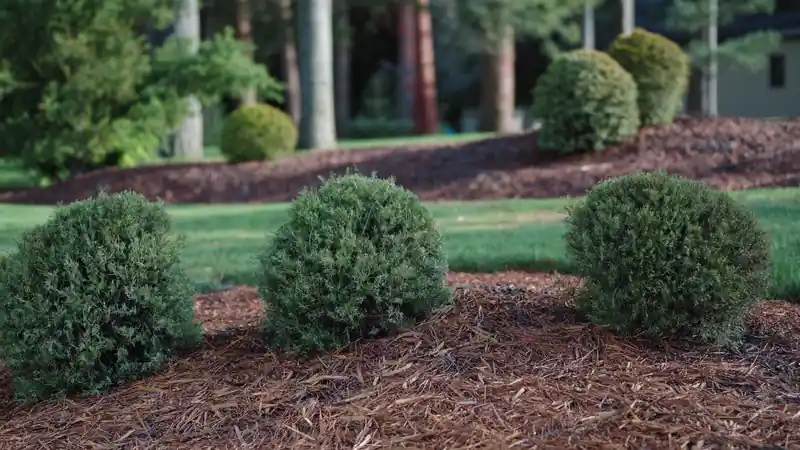
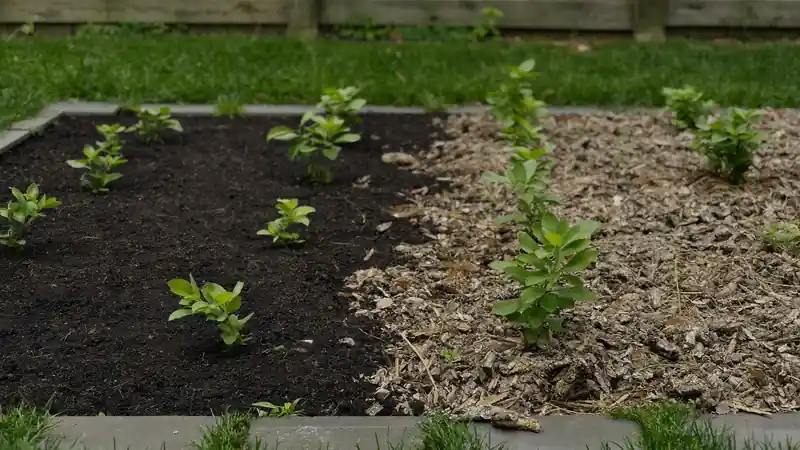
Deep-rooted native grasses, sedges, low woody ground covers and suckering shrubs, matched to sun and moisture. Purdue Extension calls a mix of native grasses, herbaceous and woody ground covers, shrubs and trees the best strategy for slope stabilization (Purdue), and NVSWCD suggests non-grass, low-maintenance cover on slopes steeper than 3:1 to avoid mowing (NVSWCD).
| Plant | Type | Height | Light | Note from the source | Source |
|---|---|---|---|---|---|
| Little bluestem (Schizachyrium scoparium) | Grass | 1 to 3 ft | Full sun | Listed by both extension services | NC State; Purdue |
| Switchgrass (Panicum virgatum) | Grass | 2 to 5 ft | Full sun | Drought and salt spray tolerant | NC State; Purdue |
| Muhlygrass (Muhlenbergia capillaris) | Grass | 2 to 3 ft | Full sun | Drought and salt tolerant | NC State |
| Sideoats grama, Virginia wild rye, fine fescue blends | Grasses | Not listed | Not marked for shade | Midwest slope list | Purdue |
| Pennsylvania sedge (Carex pennsylvanica) | Sedge | 6 to 12 in | Shade | Low ground cover | NC State |
| Creeping juniper (Juniperus horizontalis) | Woody ground cover | 6 in to 1.5 ft; spreads 4 to 10 ft | Full sun | Many cultivars | NC State |
| Green and gold (Chrysogonum virginianum) | Ground cover | 1 to 2 in | Part to full shade | Small yellow flowers | NC State |
| Christmas fern, wild ginger, Solomon’s seal | Ground covers | Not listed | Shade | Purdue’s shade picks | Purdue |
| Virginia sweetspire (Itea virginica) | Shrub | 3 to 5 ft | Sun to part shade | Suckering roots help hold soil | NC State |
| Silky dogwood (Cornus amomum) | Shrub | 6 to 12 ft | Sun to part shade | Streambanks and moist sites | NC State |
| Diervilla, snowberry, sumac, sweet fern | Low shrubs | Not listed | Varies | Woody ground covers for slopes | Purdue |
Leave out the vines sold for banks. NC State names English ivy, Asiatic jasmine and vinca as invasive ground covers to avoid, and pampas grass as a clump-former that makes erosion worse (NC State). Purdue suggests killing an existing lawn on a slope and leaving the dead turf in place to hold soil while replacement plants establish, with annual rye or wheat as a temporary living mulch (Purdue).
Grass is still the cheapest cover where it can be mowed safely. Purdue’s sod guide warns that mowing and erosion problems arise on slopes steeper than a 1-foot drop every 4 feet (AY-28-W); below that, a seeded or sodded lawn works, and the trade-offs are in our sod vs seed comparison. More grass and tree guides are in the turf and trees section.
How much soil does mulch or a blanket actually save?
A lot: on the same slope, the USDA soil loss equation predicts 94 tons per acre per year from bare graded soil and 5.6 tons under 2 tons per acre of anchored straw. The equation is A = R × K × LS × C × P, and the cover factor C does the work; USDA Agriculture Handbook 537 tabulates C for mulches on construction slopes (AH 537).
| Input | Value | Where it comes from |
|---|---|---|
| R, rainfall erosivity | 185 | Fountain County, Ind., from the handbook’s own worked example (isoerodent map) |
| K, soil erodibility | 0.37 | Russell silt loam, same example |
| LS, slope length and steepness | 1.37 | Table 3: 10 percent slope, 100 ft long |
| P, support practice | 1.0 | No contouring or terracing |
| R × K × LS × P | 93.8 tons per acre per year | Multiply by C for each cover below |
| Cover | C factor | Predicted loss (t/ac/yr) | lb per 1,000 sq ft per yr | Cut vs bare | Basis |
|---|---|---|---|---|---|
| Bare graded soil, no cover | 1 | 93.8 | 4,306 | 0% | C for bare soil = 1.0 (Table 9, line 1) |
| Straw 1.5 t/ac, not anchored | 0.24 | 22.5 | 1,033 | 76% | 0.12 doubled: AH 537 doubles straw C on soils with K above 0.30 when not anchored |
| Straw 1.5 t/ac, anchored | 0.12 | 11.3 | 517 | 88% | Table 9, 6 to 10 percent slope; length limit 150 ft |
| Straw 2 t/ac, anchored | 0.06 | 5.6 | 258 | 94% | Table 9, 6 to 10 percent slope; length limit 200 ft |
| Wood chips 12 t/ac | 0.05 | 4.7 | 215 | 95% | Table 9, under 16 percent slope; length limit 150 ft |
| Crushed stone 240 t/ac | 0.02 | 1.9 | 86 | 98% | Table 9, under 21 percent slope; length limit 300 ft |
Two lessons sit in that table. Anchoring matters: AH 537 tells users to double straw’s C value when it is not tied down on moderate or steep slopes with K above 0.30, which doubles predicted loss. Rate matters too: moving from 1.5 to 2 tons of straw per acre halves C from 0.12 to 0.06. The handbook puts soil loss tolerances for U.S. soils at 2 to 5 tons per acre per year; only the 2-ton straw, wood chip and stone covers land near that range here.
Blankets carry their own maximum C factors from ASTM D6459 slope tests: 0.10 at 5:1 for Types 1.A and 1.B, 0.15 at 3:1 for 1.C, 0.20 at 2:1 for 1.D and 0.25 at 1:1 for Type 4 (Mississippi DEQ, Table ECB-6). Those are measured on steeper test slopes than the 10 percent example, so they are not a like-for-like comparison with the straw rows.
When do you need an erosion control permit?
Federally, when construction disturbs 1 acre or more, or less than 1 acre within a larger plan that will disturb 1 acre. That triggers Clean Water Act permit coverage, a stormwater pollution prevention plan and the minimum controls in 40 CFR 450.21 (EPA). States and counties set lower triggers for erosion plans, and some reach individual lots.
| Rule | Threshold | What it requires | Source |
|---|---|---|---|
| Clean Water Act construction stormwater | 1 acre disturbed, or part of a common plan of 1 acre or more | Permit coverage; erosion and sediment controls | EPA |
| Federal C&D rule | Any permitted site | Stabilize disturbed areas immediately when work stops for more than 14 days | 40 CFR 450.21 |
| EPA 2022 CGP, Part 2.2.14 | 5 acres or less disturbed at one time | Start stabilizing idle soil by the next business day; finish within 14 calendar days | 2022 CGP, Table 2 |
| EPA 2022 CGP, Part 2.2.14 | More than 5 acres at one time | Finish stabilization within 7 calendar days of starting | 2022 CGP, Table 2 |
| EPA 2022 CGP, Part 4.2 | Every covered site | Inspect every 7 days, or every 14 days and within 24 hours of 0.25 in of rain | 2022 CGP |
| EPA 2022 CGP, Part 2.2.3 | Perimeter controls | Remove sediment before it reaches half the control’s above-ground height | 2022 CGP |
| EPA 2022 CGP, final stabilization | End of project | Vegetation covering 70 percent or more of the native background cover | 2022 CGP, Part 2.2.14c |
| Virginia Code § 62.1-44.15:55 | 10,000 sq ft (2,500 sq ft in Chesapeake Bay Preservation Areas) | Approved erosion and sediment control plan; home gardens and individual home landscaping exempt | Code of Virginia |
| Maryland COMAR 26.17.01.05 | 5,000 sq ft or 100 cubic yards of earth | Approved erosion and sediment control plan for grading | COMAR |
| Fairfax County, Va. (NVSWCD guidance) | Terraces taller than 2 ft | May need a county permit | NVSWCD |
As of October 2026, EPA has proposed a 2027 CGP to replace the 2022 permit, published in the Federal Register on Aug. 3, 2026, with comments closing Sept. 17, 2026 (EPA). The 2022 permit also defines steep slopes, which operators must minimize disturbing, as 15 percent grade or more unless a state or local manual sets its own definition (CGP Appendix A). Permit fees by state are in our land clearing cost guide.
This page is general information, not legal or engineering advice. Stormwater rules change and local ordinances can be stricter than state law; confirm the threshold with your county or state erosion and sediment control program before you grade.
Who installs erosion control, and what should the quote say?
Landscapers, hydroseeding firms and dedicated erosion control contractors all install these products; on a permitted site the inspector must also be qualified. EPA’s 2022 CGP requires inspectors on projects covered on or after Feb. 17, 2023 to have passed EPA’s construction inspection course or to hold an equivalent certification (CGP Part 6.3). A quote that names these items can be checked against the tables above:
- The product’s ECTC type (1.C, 2.D, 4.B, 5.A) and the slope it is rated for, against your measured ratio (Iowa SUDAS).
- Square yards covered, the staple pattern and staple count (ECTC’s optimum is 1.5 per square yard, per NC State), and anchor trench and check slot details.
- Whether seed, fertilizer and water are included; Tennessee DOT pays for them as separate items from the blanket (TDOT spec 805.07).
- Fiber roll or silt fence footage and spacing, against Caltrans’s 10, 15, 20 and 50-foot intervals.
- Who repairs washouts until the vegetation reaches the cover the plan requires, which is 70 percent of native background cover under EPA’s permit (CGP).
How we compiled this
We read 18 primary documents in October 2026: EPA’s 2022 Construction General Permit and its definitions appendix, 40 CFR 450.21, the Iowa SUDAS and Mississippi DEQ manuals, the Caltrans Construction Site BMP Manual (March 2024), FHWA HEC-15, USDA Agriculture Handbook 537, Tennessee and Florida DOT 2025 average unit price reports and Tennessee’s standard specifications, the Virginia and Maryland rules, and extension and conservation district guidance from NC State, Purdue and NVSWCD. Prices are DOT contract averages, not quotes; the soil loss and shear examples are our arithmetic from the published inputs. We did not install or test any product.
Frequently asked questions
What is the best method for erosion control?
Permanent vegetation is the end goal on almost every slope, and the best method is whatever protects the soil until it establishes. On grades flatter than 4:1, seed and 1.5 to 2 tons per acre of anchored straw usually suffice; from 3:1 to 1:1, use the blanket class rated for your slope; in channels, size a turf reinforcement mat or riprap to the water’s shear stress (Iowa SUDAS; USDA AH 537).
How do you stop erosion on a sloped yard?
Redirect the water feeding it first: downspouts, driveway runoff or a neighbor’s swale. Then fill rills, seed or plant, and cover the soil the same day with anchored straw or a stapled erosion control blanket. On slopes over 3:1, add fiber rolls on the contour 15 feet apart (10 feet past 2:1) and consider non-grass ground covers instead of lawn (Caltrans SC-5; NVSWCD).
How much does an erosion control blanket cost?
Tennessee DOT’s 2025 contracts averaged $1.04 per square yard installed for Type I, $1.43 for Type II and $2.53 for Type III, with seeding paid separately; a 700-gram coir blanket averaged $4.33. Florida DOT paid $5.60 per square yard for rolled erosion control products. Those are bulk highway prices; a small residential job usually costs more per square yard.
What is the best ground cover to stop erosion?
On sunny slopes, native bunch grasses such as little bluestem and switchgrass, or creeping juniper; in shade, Pennsylvania sedge, green and gold or ferns, per NC State and Purdue Extension lists. Avoid English ivy, vinca and Asiatic jasmine, which NC State lists as invasive. Pair new plantings with a jute or coir blanket until roots fill in.
How long does a straw wattle last?
Caltrans requires fiber rolls, its term for wattles, to have a minimum functional longevity of 1 year, and sets the same 1-year floor for compost socks. Its March 2024 manual says plastic netting should not be used except on short-duration rolls that will be removed, and to clear sediment once it reaches one-third of the roll’s height above ground.
What are some alternatives to straw wattles for erosion control?
Compost filter socks, wood excelsior or coir fiber rolls, and rock check dams in swales do the same job of shortening a slope or slowing a channel. Tennessee DOT’s 2025 averages put 12-inch compost socks at $3.95 a foot and 12-inch sediment tubes at $3.31, against $5.15 for straw wattles. Silt fence traps sediment but does not slow sheet flow on the slope itself.
Sources
- U.S. Environmental Protection Agency, Stormwater Discharges from Construction Activities, Page current Oct. 2026 (proposed 2027 CGP notice). Accessed October 2026.
- U.S. Environmental Protection Agency, 2022 Construction General Permit (CGP) documents page, As modified, 2025. Accessed October 2026.
- U.S. Environmental Protection Agency, 2022 Construction General Permit, Parts 1 to 9 (as modified), Modified April 2025. Accessed October 2026.
- U.S. Environmental Protection Agency, 2022 CGP Appendix A, Definitions (as modified), Modified April 2025. Accessed October 2026.
- U.S. Government (eCFR), 40 CFR 450.21, Effluent limitations reflecting the best practicable technology currently available, Current. Accessed October 2026.
- Iowa Statewide Urban Design and Specifications (SUDAS), Design Manual Section 7E-5, Temporary Rolled Erosion Control Products, 2025 edition. Accessed October 2026.
- Mississippi Department of Environmental Quality, Erosion and Stormwater Manual, 2nd ed., Vol. 1, Section 4.3, Erosion Control Blanket, 2nd edition. Accessed October 2026.
- California Department of Transportation, Construction Site Best Management Practices Manual (SC-1, SC-5, SC-11), March 2024. Accessed October 2026.
- Federal Highway Administration, Hydraulic Engineering Circular No. 15, Design of Roadside Channels with Flexible Linings, FHWA-NHI-05-114, September 2005. Accessed October 2026.
- USDA (Wischmeier and Smith), Agriculture Handbook 537, Predicting Rainfall Erosion Losses, 1978. Accessed October 2026.
- Tennessee Department of Transportation, Average Unit Prices, Jan. 1 to Dec. 31, 2025, Awarded Contracts, 2025. Accessed October 2026.
- Tennessee Department of Transportation, Standard Specifications for Road and Bridge Construction (Sections 801, 805, 920), January 1, 2021. Accessed October 2026.
- Florida Department of Transportation, Historical Item Average Costs, Statewide Annual 2025, 2025. Accessed October 2026.
- N.C. Cooperative Extension (D. Babcock, R. McLaughlin), Mulch Options for Erosion Control on Construction Sites, AG-439-67, May 2019, revised March 2024. Accessed October 2026.
- N.C. Cooperative Extension, Brunswick County Center, Erosion Control (plant lists), Undated page. Accessed October 2026.
- Purdue Extension (R. Lerner), Plants for Steep Slopes, Indiana Yard and Garden, October 2013. Accessed October 2026.
- Purdue Extension, AY-28-W, Establishing a Lawn from Sod, May 2013. Accessed October 2026.
- Northern Virginia Soil and Water Conservation District (Fairfax County), Stop Erosion: Protect Eroding Land, Current page. Accessed October 2026.
- Commonwealth of Virginia, Code of Virginia § 62.1-44.15:55, Regulated land-disturbing activities, As amended 2024. Accessed October 2026.
- State of Maryland, COMAR 26.17.01.05, Activities for Which Approved Erosion and Sediment Control Plans Are Required, Current. Accessed October 2026.